• 검색 결과가 없습니다.

Gender Differences in the Symptomatic Characteristics of Social Phobia Patients in One University Hospital

N/A
N/A
Protected

Academic year: 2021

Share "Gender Differences in the Symptomatic Characteristics of Social Phobia Patients in One University Hospital"

Copied!
6
0
0

로드 중.... (전체 텍스트 보기)

전체 글

(1)

일 대학병원 외래 내원 사회공포증 환자에서 증상적 특성의 남녀차이

성균관대학교 의과대학 강북삼성병원 정신과학교실

최홍민·김나현·임세원·오강섭

Gender Differences in the Symptomatic Characteristics of Social Phobia Patients in One University Hospital

Hong-Min Choi, MD, Na-Hyun Kim, MD, Se-Won Lim, MD and Kang-Seob Oh, MD, PhD

Department of Psychiatry, Kangbuk Samsung Hospital, Sungkyunkwan University, School of Medicine, Seoul, Korea

ABSTRACT

Objectives :Gender differences in demographic characteristics, symptom presentation, and severity may influence the selection of target behaviors as well as the course and outcome of therapeutic interventions for patients with social phobia. The purpose of this study was to explore the gender differences in the sympto- matic characteristics of Korean patients with social phobia.

Methods :A total of 256 outpatients with social phobia at Kangbuk Samsung Hospital were included in this study. All subjects were evaluated using the Korean version of the MINI International Neuropsychiatric Interview Plus. Potential differences in demographic characteristics, severity of anxiety, and situational fear and avoidance were examined. Self-report questionnaires and interviewer-administered instruments, inclu- ding the Social Phobia Scale (SPS), Social Phobia subscale of the Fear Questionnaire (FQ-social), Appraisal of Social Concerns (ASC), and Liebowitz Social Anxiety Scale (LSAS), were used to evaluate the severity of the patients’ symptoms.

Results :There were no gender differences in demographic characteristics, age, age at onset of social pho- bia, total SPS score, FQ-Social score, ASC score, and LSAS score. In addition, there was no gender difference in the severity of fear in specific social situations. However, women reported significantly higher total scores on the social helplessness category of the ASC than men (p=0.009).

Conclusion :Previous studies reported that the severity of social phobia symptoms is greater in women than in men, but our results suggest that there are no significant gender differences in the severity of social phobia symptoms. Thus, gender differences among patients with social phobia are discussed in the context of traditional sex-role expectations. (Anxiety and Mood 2008;4(1):62-67)

KEY WORDS:Social phobia·Gender difference·Symptom character.

서 론

사회공포증(social phobia) 또는 사회불안장애(social anxiety disorder)는 한 가지 또는 그 이상의 사회적 상황 이나 활동 상황에 대한 현저하고 지속적인 두려움을 특징

으로 하는 불안장애의 하나이며 임상적 영향도 심각하여 치료되지 않을 경우 만성화의 경과를 보여 결국 심각한 직 업적, 사회적 기능의 손상을 유발하게 되는 것으로 알려져 있다.

1-3

사회공포증의 이러한 임상적 중요성 때문에 과거로부터 다각적인 접근을 통해 이 질환의 특성을 밝히고자 하는 여 러 연구들이 있었다.

질환의 인구통계학적 특성, 심각도, 증상 표현 등에서 성 별 간 차이를 인지하는 것은 치료적 접근 시 목표증상의 선택, 질환의 경과, 예후에 영향을 미칠 것이다. 그렇기 때 문에 과거로부터 불안장애의 연구들에서 남녀 차이를 밝히

접수일자:2008년 2월 28일 / 심사완료:2008년 4월 3일 Address for correspondence

Kang-Seob Oh, M.D., Ph.D., Department of Psychiatry, Kangbuk Samsung Hos- pital, Sungkyunkwan University, School of Medicine, 108 Pyeong-dong, Jong- no-gu, Seoul 110-746, Korea

Tel:+82.2-2001-2481, Fax:+82.2-2001-2211

E-mail:[email protected]

(2)

고자 하는 여러 시도들이 있어왔으며 이는 사회공포증에서 도 마찬가지이다.

4-7

미국 National Comorbidity Survey

8

의 연구에 의하면 사회공포증의 평생 유병률이 여자에서는 15.5%, 남자에서 11.1%로 보고 되었고 유병기간의 기준에 있어 다소의 차 이가 있지만 여러 나라의 많은 다른 역학 연구들에서도 여 자에서 더 높은 유병률을 보였다.

9

한국의 경우에도 마찬 가지로 사회공포증의 평생 유병률이 남자보다 여자에서 더 높았다.

10-12

많은 역학연구들의 결과처럼 여자가 사회공포증의 진단 을 받을 가능성이 상당히 높음에도 불구하고 사회 공포증 의 치료를 위해 병원에 내원한 환자들의 남녀비율은 거의 차이를 보이지 않는다고 하였고 국내의 한 연구에서는 임 상에서 남자 환자의 비율이 여자환자에 비해 월등히 높게 보고 되었다.

14

이러한 결과들은 사회공포증에서 남녀 간에 질병행태의 차이가 있음을 지지하는 소견들이다.

한편, 사회공포증 환자에서 Flynn과 Markway 등

15

은 남 들이 미쳤다고 보는 것(being judged as crazy), 나쁜 부 모(a bad parent), 너무 뚱뚱하다(too fat), 이치에 맞지 않다(making no sense), 너무 크다(too tall)에서 여자가 남자에 비해 더 심한 정도의 불안을 느낀다고 하였고 Bri - dges와 Sanderman 등

16

은 여자에서 남자와 비교할 때 개인적 한계를 표현하고 다루는 것과 관련된 행위를 하는 것에 대해 남자에서 더 두려워하고 여자에서 부정적 감정 을 드러내는 것에 대해 더 두려워한다고 보고하였다.

과거의 연구들과 달리 Turk와 Heimberg 등

17

은 구조 화된 평가도구를 사용하여 사회공포증의 증상 양상에서 남 녀차이를 보고자 하였는데 LSAS(Liebowitz Social An - xiety Scale)척도의 문항으로 이용된 특정 상황에서 느끼 는 공포의 정도에서 남녀의 차이가 있음을 보여주었다. 여 자에서 윗사람과의 대화(talking authority), 청중 앞에서 의 연기/연주/연설(acting/performing/giving a talk in front of an audience), 남이 보는 곳에서 일하는 것(wor - king while being observed), 남들이 이미 앉아 있는 방 으로 들어가는 것(entering a room when others are al - ready seated), 주의 집중을 받는 상황(being the center of attention), 모임에서 연설하는 것(speaking up at a meeting), 잘 모르는 사람에게 반대의사 표시하는 것(ex - pressing disagreement or disapproval to people they do not very well), 사람들에게 보고하는 것(giving a re - port to a group), 파티를 개최하는 것(giving a party)에 서 더 높은 불안의 정도를 보고하였고 남자에서는 공중화 장실 이용(urinating in public bathrooms), 상점에서 물건

을 환불 받는 것(returning goods to a store)에서 더 높은 불안의 정도를 보고하였다. 여러 평가도구들의 총점을 이 용하여 남녀 간 사회공포증상의 심각도 차이를 비교하였 고 몇몇 평가도구들(Social Interaction Anxiety Scale, Social Phobia Scale, Fear Questionnaire-Social Phobia Subscale)에서 여자에서 남자보다 유의미하게 더 높은 총 점을 보고하였다.

이런 연구들에서 사회공포증의 심각성, 그리고 특정 상황 에서 느끼는 공포의 정도에 있어 남녀의 차이가 존재한다 는 것이 제시되었으나 국내환자들을 대상으로 사회공포증 의 남녀 차이를 비교한 연구는 거의 없는 실정이다.

이에 저자들은 한국인 사회공포증 환자를 대상으로 남 녀 간 증상의 심각도와 증상 특성의 차이를 비교하고, 아 울러 국내의 과거 연구와 비교하여 임상 환자들의 남녀 비 율의 변화 정도를 알아보고자 본 연구를 기획하였다.

대상 및 방법

연구대상

성균관대학교 의과대학 강북삼성병원 정신과 불안장애 클리닉에 2002년 1월부터 2007년 6월까지 내원한 환자 들 중, DSM-IV

18

진단기준에 따른 정신과 전문의의 임상 면담에 의해 사회공포증이 진단되고, 구조화된 면담도구인 Mini International Neuropsychiatric Interview-plus (M.I.N.I-plus)

19,20

를 시행하여 사회공포증이 확인되며 공 존질환 여부가 파악된 환자만을 대상으로 하였다. 주요 우 울증, 기분저하증, 범불안장애 등과 같은 공존질환은 그 질 환이 이차적인 경우에만 연구에 포함시켰고 정신병적 장 애가 있거나, 간질, 치매 및 기질성 뇌질환 등의 질환이 있 는 환자들은 연구에서 배제하였다. 연구에 포함된 모든 환 자에서 연구의 목적과 방법에 대한 동의서를 받았고, 강북 삼성병원 임상시험윤리위원회의 승인을 거쳤다. 최종적으 로 256명의 사회공포증 환자가 포함되었고 그 중 남자 168명, 여자 88명이었다.

연구방법

평가도구

남녀 간 사회공포증상의 심각도를 비교하기 위해 Social

Phobia Scale(SPS),

21

Social phobia subscale of Fear

Questionnaire(FQ-social),

22

Appraisal of Social Con -

cerns(ASC),

23

Liebowitz Social Anxiety Scale(LSAS)

24

를 모든 환자에게 시행하였다.

(3)

SPS는 일상적인 생활에서 타인에 의해 주시될 수 있는 상황에 대한 두려움의 정도를 파악하는 것으로 Mattick과 Clarke가 개발한 척도로서 모두 20문항으로 구성되어 있 으며 두려움의 정도에 따라 각 문항당 0점에서 4점(0점:

전혀 그렇지 않다, 1점:약간 그렇다, 2점:상당히 그렇다, 3점:심하다, 4점:매우 심하다)까지 분류되며 주관적인 두려움의 정도를 확인해보는 자기보고식 척도이며 김향숙

25

이 번안하여 타당화한 것을 사용하였다.

FQ-social은 임소공포증과 사회적 상황에서의 공포를 측정하는 15문항으로 구성되어있는 자기보고 설문지인 Fear-Questionnaire에서 social phobia 하위항목을 추 출하여 사용하였다.

ASC는 사회공포증 환자들이 전형적으로 인식하고 있는 사회적 상황을 얼마나 걱정하는지 그 정도를 측정하는 설 문지로 피검자가 특정 위협 사고를 인식하지 못하는 경우 에도 사회적으로 위협적인 지각을 평가할 수 있는 이점을 가진 척도이다.

LSAS는 Liebowitz가 사회공포증 환자들이 가장 불안 을 느끼는 상황들을 표집하여 사회공포증을 야기하는 상 황을 평가하기 위해 개발한 척도이며 사회적 상황에 대해 불안을 느끼는 정도(두려움 척도)와 회피하는 정도(회피 척도)를 0~3점으로 평가하는 설문지이며 유은승과 안창 일

26

이 번안하여 타당화한 한국판 LSAS를 사용하였다.

사회공포증상의 남녀간 특성 차이를 보기 위해 ASC는 부정적 평가에 대한 걱정(NE:멍청해 보이는 것, 사람들 이 웃는 것, 적절히 수행하지 못하는 것 등), 관찰 가능한 증상들(OS:떠는 것, 경련 일으키는 것, 머릿속이 하얗게 되며 아무 생각 안 나는 것 등), 사회적 무기력(SH:다른 사람으로부터 무시당하는 것, 통제감을 잃는 것, 약해 보이 는 것 등)의 3요인으로 이루어져 있어 ASC 각 요인별 남 녀차이를 보고자 하였다. 또한 LSAS 항목을 불안과 회피 항목으로 구분하여 남녀차이를 비교하였다.

또한 특정 상황에서 남녀별 불안의 정도의 차이를 비교 하기 위해 LSAS의 24개 항목을 이용하여 비교를 하였다.

통계분석

자료의 통계분석은 SPSS 12.0(window version, Chi - cago, U.S.A.)을 사용하였다. 남녀 간 진단 연령, 발병연 령, 교육수준 결혼상태 등의 인구통계학적 특징의 비교와 증상의 심각도 및 특정 상황에 대한 불안의 정도 비교를 위해 chi-square test 또는 independent t-test를 시행 하였다.

결 과

남녀 간 인구 통계학적 특성과 성별 분포 (Table 1) 대상 환자는 총 256명으로 남자 168명, 여자 88명이 었고 남녀 비율은 1.9:1 이었다. 평균 연령은 남자군이 34.57±12.16(Mean±SD)세, 여자군이 35.67±11.84 (Mean±SD)세였다. 발병연령은 남자군이 21.66±11.52 (Mean±SD)세, 여자군이 20.66±9.63(Mean±SD)세였 다. 성별간 연령, 발병연령, 결혼 상태, 학력의 유의한 차이 는 없었다.

남녀 간 사회 공포증상의 심각도 차이 (Table 2)

총 네 가지 평가도구로 남녀 두 그룹 간 사회공포증상 의 심각도를 비교하였고(Table 2) 유의확률은 <.05로 하 였을 때 SPS(51.6±18.0:51.0±16.4, t=0.192, df=

116, p=.848), FQ-Social(26.9±8.35 :26.2±8.42, t=0.485, df=144, p=.628), ASC(986.1±428:1131

±431, t=-1.536, df=87, p=.128), LSAS(59.97±

32.17:60.02±36.02, t=-0.008, df=110, p=.994) 네 가지 평가도구 모두에서 남녀 간 심각도 차이를 보이지 않았다.

Table 1. Demographic characteristics of female and male social phobia patients

Female (N=88)

Male (N=168) p Marital status (Married), N (%) 39.00 (44.30 ) 80.00 (47.60 ) .505 Education level (University),

N (%)

50.00 (56.80) 96.00 (57.10) .960

Age of onset, mean (SD) 20.66 ( 09.63) 21.66 (11.52) .715 Age of assessment, mean (SD) 35.67 (11.84) 34.57 (12.16) .456

Table 2. Mean Scores on Measures of Social Phobic Symptoma- tology

Female (N=88) Male (N=168)

Mean (SD) Mean (SD) p

SPS 0051.0 (016.40) 051.6 (018.00) .848 FQ-Social 0026.2 (008.42) 026.9 (008.35) .628 ASC total 1131.8 (431.80 ) 986.1 ( 428.10 ) .128 ASC-NE 0481.8 (203.90 ) 410.4 ( 231.00 ) .148 ASC-OS 0491.4 (176.90 ) 463.2 ( 163.60 ) .450 ASC-SH 0158.7 (081.10 ) 112.6 ( 076.70 ) .009*

LSAS total 0060.0 (036.00 ) 060.0 (032.20 ) .994 LSAS-Fear 0032.5 (018.10) 031.5 (017.10) .770 LSAS-Avoidance 0027.2 (017.90) 028.1 (015.70) .777

*:p<0.05. SPS:Social Phobia Scale, FQ-Social:Social phobia

subscale of Fear Questionnaire, ASC:Appraisal of Social Con-

cerns, NE:Negative Evaluation, OS:Observable Symptoms,

(4)

ASC, LSAS에서 각각의 하위척도로 구분하여 성별 차 이를 보고자 하였는데 ASC를 세 가지 하위항목으로 나 누어 비교를 했을 때 NE(410.37±231.04:481.78±

203.91, t=-1.458, df=87, p=.148), OS(463.18±

163.60:491.41±176.96, t=-0.759, df=87, p=.450)는 남녀 간에 차이를 보이지 않았으나 SH(112.58±76.70:

158.66±81.08, t=-2.664, df=87 p=.009)에서 남자군 에 비해 여자군에서 유의미하게 높은 값을 보여 사회적 무 기력감 측면에서 여자가 더 높은 수준의 두려움을 경험함 을 반영하였다. LSAS를 불안과 회피 두 가지 하위 항목 으로 나누어 비교를 했을 때 사회적 상황에 대한 불안정 도(31.47±17.06:32.45±18.10, t=-0.293, df=115, p=.770), 회피정도(28.12±15.74:27.20±17.94, t=

.284, df=111, p=.777) 모두에서 의미 있는 차이를 보 이지 않아서 사회적 상황에 대한 불안이나 회피의 정도에 있어 남녀간 차이가 없었다.

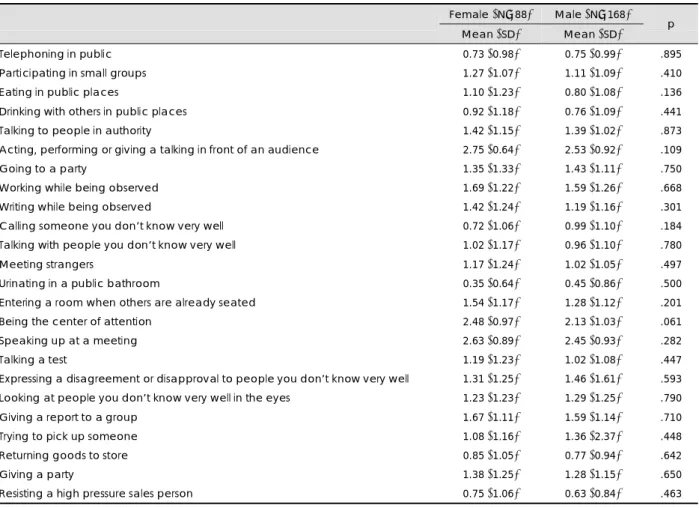
특정 상황에서 느끼는 불안정도의 남녀차이 (Table 3) LSAS의 24개 모든 항목에서 각각 성별차이를 비교하

였고 24개 항목 모두에서 유의미한 차이를 보이지 않았다.

즉, 한국 사회공포증 환자에서 특정한 상황에서 느끼는 불 안의 정도는 남녀에서 특별한 차이가 없었다.

고 찰

본 연구는 한국인에서 구조화된 면담을 통해 환자를 선 별하고 사용하고 사회공포증 평가에 주로 사용되는 구조 화된 평가척도들을 사용하여 남녀 환자들을 비교했다는 데 에서 그 의의를 찾을 수 있다.

일반적으로 사회공포증의 유병률은 여성에서 우세한 것 으로 알려져 있으나 치료를 위해 병원에 내원하는 환자들 의 남녀비율은 비슷하거나 남성에서 다소 많은 경향을 보 인다고 알려져 있다.

27-29

이는 사회공포증 환자에서 남녀 간 질병행태(Illness behaviour;증상이 있을 때 진단을 얻고 적절한 치료책을 찾기 위한 행위)에서 차이가 있음을 보여준다고 할 수 있다.

Bruch와 Cheek

30

는‘수줍음 많은 소년’ (shy boy)이 전 통적인 남성역할 기대(예, dominance, self-confidence)

Table 3. Gender Differences in Situational Fear Assessed by the Liebowitz Social Anxiety Scale

Female (N=88) Male (N=168)

Mean (SD) Mean (SD) p

Telephoning in public 0.73 (0.98) 0.75 (0.99) .895

Participating in small groups 1.27 (1.07) 1.11 (1.09) .410

Eating in public places 1.10 (1.23) 0.80 (1.08) .136

Drinking with others in public places 0.92 (1.18) 0.76 ( 1.09) .441

Talking to people in authority 1.42 (1.15) 1.39 ( 1.02) .873

Acting, performing or giving a talking in front of an audience 2.75 (0.64) 2.53 ( 0.92) .109

Going to a party 1.35 (1.33) 1.43 (1.11) .750

Working while being observed 1.69 (1.22) 1.59 (1.26) .668

Writing while being observed 1.42 (1.24) 1.19 (1.16) .301

Calling someone you don’t know very well 0.72 (1.06) 0.99 (1.10) .184

Talking with people you don’t know very well 1.02 (1.17) 0.96 (1.10) .780

Meeting strangers 1.17 (1.24) 1.02 ( 1.05) .497

Urinating in a public bathroom 0.35 (0.64) 0.45 ( 0.86) .500

Entering a room when others are already seated 1.54 (1.17) 1.28 ( 1.12) .201

Being the center of attention 2.48 (0.97) 2.13 (1.03) .061

Speaking up at a meeting 2.63 (0.89) 2.45 (0.93) .282

Talking a test 1.19 (1.23) 1.02 (1.08) .447

Expressing a disagreement or disapproval to people you don’t know very well 1.31 (1.25) 1.46 (1.61) .593 Looking at people you don’t know very well in the eyes 1.23 (1.23) 1.29 (1.25) .790

Giving a report to a group 1.67 (1.11) 1.59 ( 1.14) .710

Trying to pick up someone 1.08 (1.16) 1.36 ( 2.37) .448

Returning goods to store 0.85 (1.05) 0.77 ( 0.94) .642

Giving a party 1.38 (1.25) 1.28 (1.15) .650

Resisting a high pressure sales person 0.75 (1.06) 0.63 (0.84) .463

(5)

에 미치지 못하게 되고 그들의 사회화 과정에서 소녀에 비해 더 많은 갈등과 부정적 피드백을 받는다고 하였고 Bacon과 Ashmore

31

는 부모들이 딸보다 아들이 수줍음 타는 행동을 보일 때 더 큰 문제라고 생각하는 경향을 보 인다고 하였다. 이는 사회나 가정에서 남자의 사회공포증 상이 여자에 비해 더 큰 문제시 되고 있음을 보여주며 여 러 연구들이 보인 것처럼 남자가 여자에 비해 사회공포증 상의 심각도가 더 낮은데도 불구하고 치료의 필요성을 더 많이 느껴 병원을 더 많이 찾게 되는 결과를 이것으로 설 명할 수 있다.

본 연구의 결과에서 사회공포증 환자의 남녀비는 1.9:

1로 남자 환자의 비율이 상당히 높았고 이는 과거 본원에 서 시행된 연구의 결과(1.9:1)

14

와 거의 일치한 결과이다.

그러나 본원의 결과는 외국의 결과에 비해 남녀의 차이가 크게 나타났다. 이는 한국의 사회공포증 환자의 질병행태 에 있어 또 다른 요인이 관여한다고 생각된다.

환자가 치료를 위해 병원에 내원하는 데에는 사회문화 적 요인 또한 상당히 관여된다고 알려져 있다.

32

여자의 경우 남을 의식하고 조심스러워하며 다소 불편해 하는 것 이 당연하고 오히려 미덕 시 되어왔던 한국의 사회문화적 상황에서 여성 사회공포증 환자들이 상대적으로 치료의 필요성을 덜 느껴 병원에 적게 내원했을 가능성과 남자의 경우 일반적으로 사회적 활동이 더 많기 때문에 불안을 느 낄 상황에 더 자주 노출되어 상대적으로 치료의 필요성이 더 컸을 수 있다. 즉, 한국의 전통적인 성-역할 기대나 사 회참여도 같은 요인들이 사회공포증 환자의 남녀 비율이 나 임상양상에 영향을 미쳤을 가능성도 생각해 볼 수 있을 것이다.

이번 연구의 결과는 일본과 서양을 비교하여 사회가 서 구화되고, 여자들의 사회참여가 늘어날수록 병원에 내원하 는 사회공포증환자의 남녀 비율 차이가 줄어들어 갈 것이 라는 전망을 제시하였던 본원의 과거 연구

14

를 입증하지 는 못하였다. 향후에 더 많은 환자들을 대상으로 하는 지 속적인 연구가 필요할 것이다.

본 연구 결과 한국인의 사회공포증상의 심각성이나 특정 상황에서 보이는 불안의 남녀간의 차이가 나타나지 않았다.

이는 여자가 남자에 비해 심각도가 높고 몇몇 특정상황에 서 보이는 불안의 정도가 상황에 따라 다름을 보였던 과거 의 외국 연구들의 결과와 비교할 때 상이한 결과이다. 그 러나 다수의 평가도구를 사용하여 비교했음에도 불구하고 모두에서 남녀간 차이를 보이지 않아 어느 정도 일관된 경 향이라고 볼 수 있다. 이는 앞에서 논의된 사회, 문화적 차

만큼 심한 것으로 이해될 수도 있다. 그러나 본원의 환자 들은 외국 연구

17

의 환자들에 비해 평가도구들의 총점을 통한 증상의 심각도가 1.5~2배 정도 높은 수준이었다. 그 점을 감안할 때 전반적으로 높은 수준의 점수에서는 그룹 별로 차이가 드러나지 않는 것을 의미하는, 천정효과의 영 향일 가능성도 생각해 볼 수 있겠다. 추후 더 많은 환자들 을 대상으로 심각성의 수준에 따라 환자를 분류하여 남녀 차이를 비교해 보는 시도가 필요할 것이다.

한편 한국인 사회공포증 환자에서 남녀간 심각도 차이 는 없었지만 사회공포증 환자의 인지적 측면을 측정하는 ASC의 하위 항목인‘사회적 무기력’ 하위항목의 총합은 여자에서 더 높게 나타났다. 이는 여자에서 남들의 부정적 평가에 대한 두려움이나 드러나는 신체적 증상에 대한 불 안보다 자기 자신에 대한 통제감의 상실이나 사회적 열등 감에 대한 불안을 남자에 비해 더 많이 느낀다고 해석할 수도 있을 것이다. 이는 사회공포증 환자에서 인지적 측면 의 남녀 차이를 나타낼 가능성이 있으나 아직 이를 뒷받침 해주는 근거는 부족하며 추후 더 많은 연구가 있어야 할 것이다.

본 연구의 제한점으로는 외래에 내원한 환자만을 대상으 로 하였고 연구 집단을 증상의 경중이나 아형에 따른 분류 한 후 남녀차이를 비교하지 못했다는 점이다. 또한 다른 불안장애나 주요우울장애 등의 공존질환이 사회공포증의 증상에 미치는 영향을 고려하지 못하였고 실제로 사회공포 증의 증상의 심각도를 반영할 수 있는 직업상태를 고려하 지 않았다는 것이 이 연구의 제한점으로 지적될 수 있다.

결 론

저자들은 한국인 사회공포증 환자들에서 남녀간 증상 특 성의 차이를 알아보고자 하였다. SPS, FQ-Social, ASC, LSAS척도를 사용하여 성별간 비교를 하였고 그 결과 심 각도나 특정상황에서 느끼는 불안의 정도에서 성별 간 차 이를 보이지 않았다.

중심 단어 :사회공포증·성별 차이·증상 특성.

REFERENCES

1. Schneiner FR, Heckelman LR, Garfinkel R, Campeas R, Fallon B, Gitow A, et al. Functional impairment in social phobia. J Clin Psychi- atry 1994;55:322-331.

2. Stein MB, Kean YM. Disability and quality of life in social phobia:

epidemiologic findings. Am J Psychiatry 2000;157:1606-1613.

3. Oh KS, Oh MS, Lee SH. A study of functional impairment in social phobia. Korean J Psychosomatic Med 1999;7:72-78.

4. Bekker MH. Agoraphobia and gender: A review. Clinical Psychology

(6)

5. Pigott TA. Anxiety disorders in women. Psychiatr Clin North Am.

2003;26:621-672.

6. Tükel R, Polat A, Genç A, Bozkurt O, Atli H. Gender-related diffe- rences among Turkish patients with obsessive-compulsive disorder.

Compr Psychiatry 2004;45:362-366.

7. Bekker MH, van Mens-Verhulst J. Anxiety disorders: sex differences in prevalence, degree, and background, but gender-neutral treatment.

Gend Med 2007;4 Suppl B:S178-193 Review.

8. Kessler RC, McGonagle KA, Shanyang Z, Nelson CB, Hughes M, Eshleman S, et al. Lifetime and 12-month prevalence of DSM-III-R psychiatric disorder in the United States: result from the National Co- morbidity Survey. Arch Gen Psychiatry 1994;51:8-51.

9. Furmark T, Tillfors M, Everz P, Marteinsdottir I, Gefvert O, Fredrik- son M. Social phobia in the general population: prevalence and socio- demographic profile. Soc Psychiatry Psychiatr Epidemiol 1999;34:

416-424.

10. Lee CK, Kwak YS, Yamamoto J, Rhee H, Kim YS, Han JH, et al.

Psychiatric epidemiology in Korea. Part I: Gender and age differences in Seoul. J Nerv Ment Dis 1990;178:242-246.

11. Lee CK, Kwak YS, Yamamoto J, Rhee H, Kim YS, Han JH, et al.

Psychiatric epidemiology in Korea. Part II: Urban and rural differen- ces. J Nerv Ment Dis 1990;178:247-252 Review.

12. Lee CK, Lee KH. A nationwide epidemiological study of mental dis- orders in korea (XVIII). J Korean Neyropsychiatr Assoc 1997;36:

571-577.

13. Heimberg RG, Juster HR. Cognitive-behavioral treatment: Literature review. Social phobia: Diagnosis, assessment, and treatment. New Yock: Guilford Press;1995. p.261-309.

14. Lee SH, Chung KS. A Clinical Study of Social Phobia (1). J Korean Neuropsychiatr Assoc 1984;23:111-116.

15. Flynn TM, Markway BG, Pollard CA. Fear of negative evaluation and social phobia: Gender differences and relationship to depression, social sensitivity, and assertiveness. Paper presented at the annual meeting of the Association for Advancement of Behavior Therapy, Boston, MA;

1992.

16. Bridges KR, Sanderman R, Breuker P, Ranchor A, Arrindell WA. Sex difference in assertiveness on the U.S. version of the Scale for interper- sonal behavior. Personality and Indivisual Differences 1991;26:467- 486.

17. Turk CL, Heimberg RG, Orsillo SM, Holt CS, Gitow A, Street LL, et al. An investigation of gender differences in social phobia. J Anxiety Disord 1998;12:209-23.

18. American Psychiatric Association. Diagnostic and Statistical Manual of mental Disorders. 4

th

ed. Washington DC: Americal Psychiatric Press;1994.

19. Sheehan DV, Lecrubier Y, Sheehan KH, Amorim P, Janavs J, Weiller E, et al. The mini-international neuropsychiatric interview (M.I.N.I): the development and validation of structured diagnostic psychiatric inter- view for DSM-IV and ICD-10. J Clin Psychiatry 1998;59(suppl):2-33.

20. Woo SW. Recent update in anxiety disorders and introduction of M.I.

N.I GSK satellite symposium;2001, Lotte hotel, Cheju, Korea.

21. Mattick RP, Clarke JC. Development and Validation of measures of social phobia scrutiny fear and social interaction anxiety. Behav Res Ther 1998;36:455-470.

22. Marks LM, Matthews AM. Brief standard self-rating for phobic pati- ents. Behaviour Research and Therapy 1979;17:263-267.

23. Michael JT, Richard AL, Jasper AJS, Mark BP, Richard H, Trevor H.

Appraisal of Social Concerns: A Cognitive Assessment Instrument For Social Phobia;2004.

24. Fresco DM, Coles ME, Heimberg, Leibowitz MR, Hami S, Stein MB, et al. The Liebowitz social anxiety scale: a composition of the psy- chometric properties of self-report and clinician-administered formats.

Psychological Medicine 2001;31:1025-1035.

25. Kim HS. Memory bias in Subtypes of Social Phobia [Dissertation].

Seoul National Univ;2001.

26. Yu ES, Ahn CI, Park KH. Factor Structure and Diagnostic Efficacy of A Korean Version of the Liebowitz Social Anxiety Scale. J Korean Clin Psychol 2007;26:251-270.

27. Rapee RM, Sanderson WC, Barlow DH. Social phobia features across the DSM-III-R disorders. J Psychopathol Behav Assess 1988;10:287- 299.

28. Solyam L, Ledwidge B, Solyam CP. Delineating social phobia. Br J Psychiatry 1986;149:464-470.

29. Pollard CA, Henderson JG. Four types of social phobia in community sample. J Nerv Ment Dis 1988;176:440-445.

30. Bruch MA, Cheek JM. Developmental factors in childhood and adole- scent shyness. Social Phobia: Diagnosis, assessment, and treatment.

New York: Guilford Press;1995. p.163-182.

31. Bacon MK, Ashmore RD. How mothers and fathers catogorize des- criptions of social behavior attributed to daughters and sons. Social co- gnition 1985;3:193-217.

32. Weinstock LS. Gender differences in the presentation and manage-

ment of social anxiety disorder. J Clin Psychiatry 1999;60[suppl 9]:9-

13.

수치

Table 2. Mean Scores on Measures of Social Phobic Symptoma- Symptoma-tology  Female (N=88)  Male (N=168)  Mean (SD)  Mean (SD)  p  SPS  0051.0 (016.40)  051.6 (018.00) .848  FQ-Social  0026.2 (008.42)  026.9 (008.35) .628  ASC total  1131.8 (431.80 )  986.
Table 3. Gender Differences in Situational Fear Assessed by the Liebowitz Social Anxiety Scale

참조

관련 문서

This study aimed to speculate on the relations between self-resilience, euphoria and social support of early childhood teachers and mediating effects of

Fourth, reality therapy group counseling program was effective in improving prisoners' social relationships which is one of the sub factors of

Sarason, B. Perceived social support and working models of self and actual others. Conceptual methodological and theoretical problems in studying social supports

This suggests that p eer relationship programs can be used in schools to improve social behaviors and peer relationships of the students who lack

Children's experience of life sdtress: The role of family social support and social problem-solving skills as protective factors.. “Social competence: An

Thirdly, it appeared that social support had meaningful effect on self-efficacy and the quality of life, and in the case of the difference analysis by

3) When investigating effects of sports club activity on university life satisfaction and self-efficacy, social satisfaction of club activity affected influences positively

eds., Social Change and Social Issues in the Former USSR, Selected Papers from the Fourth World Congress for Soviet and East European Studies, Harrogate...