Original Articles Korean Circulation J 1999;;;;29((((12))))::::1350-1356
장기간에 걸친 Cholesterol 강하제 투여가 Lipoprotein (a) 농도에 미치는 영향
고려대학교 의과대학 순환기내과학교실
김진원·서홍석·신성희·오영재·안정천·이은미 송우혁·김영훈·심완주·오동주·노영무
The Effects of Long Term Use of HMG-CoA Reductase Inhibitor on the Level of Lp ((((a))))
Jin Won Kim, MD, Hong Seog Seo, MD, Sung Hee Sin, MD, Yung Jae Oh, MD, Jung Chun Ahn, MD, Eun Mi Lee, MD, Woo Hyuk Song, MD, Young Hoon Kim, MD, Wan Joo Shim, MD, Dong Joo Oh, MD and Young Moo Ro, MD
Cardiology Department of Korea University Hospital, Seoul, Korea
ABSTRACT
Background:Lipoprotein (a) concentration is mainly determined by apo (a) genotype, but elevated in the ath- erosclerotic vascular disease more than in normal group with the same apo (a) phenotype. It has been known that Lp (a) has independent metabolism in contrast with other lipoproteins and that the use of cholesterol low- ering agent such as HMG-CoA reductase inhibitor for 6 months does not change the level of Lp (a). The results of several studies suggests that Lp (a) may be related to inflammation of atherosclerotic plaque and there- fore, long term use of cholesterol lowering agents make plaque stable by reduction of inflammation at plaque.
We hypothesized that there is a relationship between long term use of HMG-CoA reductase inhibitor and change of Lp (a) level. We prospectively measured Lp (a), lipids and inflammatory markers before and after long term use of HMG-CoA reductase inhibitor to examine our hypothesis. Methods:Forty-nine subjects (M:
F=28:21, age=59.1±12.0) with hyperlipidemia were administered HMG-CoA reductase inhibitor for 15 months (minimum 6 months, maximun 44 months), and Lp (a), lipids and inflammatory markers were measur- ed before and after use of the HMG-CoA reductase inhibitor. In control group (ninty-nine subjects, M:F=
60:39, age=61.2±9.2), these parameters were measured more than 6 months. Results:In the hyperlipidemia group who were given HMG-CoA reductase inhibitor, baseline levels of total cholesterol, TG, LDL were signi- ficantly elevated more than those of the control group, but Lp (a) and inflammatory markers were not significa- ntly different. After use of HMG-CoA reductase inhibitor, the level of Lp (a) was reduced significantly (before 28.9±29.3 mg/dl, after 20.0±19.0 mg/dl, p=0.009), but not significantly in the control group. There was a minimal relation between baseline Lp (a) levels and percent changes of Lp (a) levels. Total cholesterol and LDL levels reduced significantly after use of the drug, but inflammatory markers did not. Conclusion:These data showed that Lp (a) level in the hyperlipidemia group after the long term use of HMG-CoA reductase inhibitor decreased significantly. We suggest that these changes of Lp (a) level may be one of reliable markers
논문접수일:1999년 7월 19일 심사완료일:1999년 11월 18일
교신저자:서홍식, 152-703 서울 구로구 구로동 80 고려대학교 의과대학 순환기내과학교실 전화:(02) 816-6634・전송:(02) 864-3062
E-mail:[email protected]
for plaque stability in atherosclerotic vascular disease. ((((Korean Circulation J 1999;29((((12)))):1350-1356)))) KEY WORDS:Lipoprotein(a)·HMG-CoA reductase inhibitor·Hyperlipidemia·Atherosclerosis·Plaque st-
ability.
서 론
Lipoprotein(a)(Lp(a))는 atherogenicity 및 thro- mbogenicity를 모두 가지고 있는 것으로 알려져 있으 며1) apo(a) 크기의 polymorphism에 의해 혈중농도가 결정되어 일부 호르몬 및 약물, 급성기양 반응을 제외 하고는 일생동안 거의 일정하게 유지되나2-4) 같은 유 전형인 경우에는 동맥경화 질환군에서 혈중치가 상승 되어 있어 동맥경화의 병태생리와 관련 있을 것으로 여 겨지고 있다.5)
대사도 지질과는 무관하여 nicotinic acid를 제외하고 는 24주까지의 단기간의 HMG-CoA reductase 억제 제 투여시에는 Lp(a) 농도에 영향을 미치지 않는 것으 로 보고되었다.6) 그러나 Lp(a)는 주로 동맥경화내 죽 상반의 plaque에 침착됨과 더불어 동맥경화와 무관한 여러 염증 조직에도 침착되는 것이 보고되어 염증과 Lp(a)와의 연관성이 제시되고 있다.7)8) 또한 죽상반 파 열과 염증의 관련성이 있음이 밝혀졌고, HMG-CoA reductase 억제제 투여가 심혈관 사망률을 떨어뜨리는 원인도 죽상반 파열 억제에 기인하는 것으로 알려져 있 어9)10) 장기간 HMG-CoA reductase 억제제 투여시 Lp(a) 농도에 영향을 미치리라 여겨지며9)10) 이러한 효 과는 HMG-CoA reductase 억제제에 의한 plaque의 안정화가 장기간의 시간을 필요로 한다는 점에서11) 6 개월 이상의 장기 투여에 따른 변화를 알아보는 것이 필요하리라 생각된다.
최근에는 Lp(a)가 plaque의 염증 반응과 관련 있는 것으로 보고되고 있어12) 만일 Lp(a)가 동맥경화의 염 증 표식자 역할을 한다면 장기간 HMG-CoA redu- ctase 억제제 투여에 따른 Lp(a)의 농도 변화를 죽상 반의 안정성과 관련된 장기 예후의 예측 지표로 사용할 수 있을 가능성이 제시되는 바이다.
따라서 저자들은 최소 6개월, 최대 3년 8개월(평균 16개월)에 걸친 장기간의 HMG-CoA reductase 억 제제 투여시 Lp(a)의 농도에 대한 변화를 추적 관찰하
고 다른 염증 지표들의 변화와 비교함으로써 서로 어떠 한 연관성이 있는지를 알아보고자 하였다.
대상 및 방법
대 상
1993년 2월부터 1995년 10월까지 고대구로병원에 내원한 148명중 고지혈증으로 진단 받고 HMG-CoA reductase 억제제를 투여 받은 49명(남:녀=28:21, 나이 59.1±12.0세)과 대조군 99명(남:여=60:39, 연령=61.0±9.2세)을 대상으로 하여 전향적으로 이루어 졌으며 급성기양 반응을 배제하기 위하여 2개월 내의 심 근 경색, 뇌혈관 질환, 수술이 있었던 경우는 대상에서 제 외하였다. HMG-CoA reductase 억제제는 동맥경화성 혈관 질환을 갖고 있으면서 LDL-cholesterol이 130 mg/dl 이상, 2개 이상의 위험인자를 갖고 있으면서 LDL- choleterol이 160 mg/dl 이상, 2개 이하의 위험 인자를 갖고 있고 LDL-choleterol 190 mg/dl 이상인 경우를 기준으로 하여 투여되었다. 고지혈증군으로 약물을 투여 받은 군과 대조군간 나이 및 위험 인자, 심혈관 질환자의 비율은 통계적인 차이가 없었다(Table 1).
Table 1. Baseline clinical characteristics
Hyperlipidemia Control Total Sex (M:F) 28:21 60:39 88:60 Age 59.1±12.0 61.2±9.2 60.9±10.0 Risk factor (%)
Hypertension 39.6 43.1 45.9
DM 16.3 11.1 12.8
Smoking 44.8 24.4 19.6
HDL<35 mg/dl 34.6 21.1 26.3 Atherosclerotoc vascular disease (%)
MI or AP 46.9 53.5 37.8
CVA 8.1 8.1 8.1
A.O.* 2.0 3.0 2.7
MI+CVA 2.0 2.1 2.0 Duration (months) 16.1±17.2 15.7±13.1 15.0±14.7
*A.O:Atherosclerosis Obliterans
투약 및 혈액 채취
혈액은 12시간 금식후 채취하였으며 오전 9시에서 10 시 사이에 절대 안정 상태에서 채혈하여 지질치 및 혈 중 Lp(a)와 염증 상태를 반영하는 지표인 erythro- cyte sedimentation rate, C-reactive protein, fibri- nogen, white blood cell을 측정하였다. 약물의 투여 기준에 따라 투약군에서는 HMG-CoA reductase 억 제제인 lovastatin을 저녁에 20 mg 하루 한 번, 최소 6개 월에서 최대 3년 8개월(평균 15.1개월)동안 투여하였 고 대조군은 최소 6개월이상, 평균 15.7개월의 간격을 두고 동일한 방법으로 혈액을 채취하여 동일한 인자를 측정하였다.
측정 방법
12시간 금식후 채혈 즉시 4,500 rpm에 20분간 혈장 원심 분리하여 EDTA, 0.02% sodium azide로 처리후 -70℃에 냉동 보관 2주내에 37℃로 녹여서 측정하였 으며 Lp(a)는 immunozyme Lp(a) Kit(Immuno Gm bH, Heidelberg, Swiss)를 이용한 효소 면역 방법(EL- ISA)으로, Fibrinogen, CRP는 latex 응집 kinetic 측 정법으로 측정하였다. 그외 혈청 총 콜레스테롤과 중성 지방은 효소법에 의해 Berkman Synchron CX4로 측 정하였고 HDL-콜레스테롤은 효소법에 의한 Spec- trophotometer UVi DEC-77을 이용하였으며 LDL콜 레스테롤은 Friedewald 공식으로 계산하였다.
통계 처리
SPSS 통계 처리 프로그램으로 통계처리 하였으며 모든 측정치는 평균값±표준편차로 표시하였고 Lp(a) 를 제외한 다른 변수는 paired t-test를, Lp(a)는 비모 수 통계 처리하여 Wilcoxon match pairs test를 시행 하여 비교 하였고 변수 상호간의 상관 관계는 Pearson 계수 및 Spearman 계수를 이용하였으며 p값이 0.05 이하인 경우를 유의한 차이로 정하였다.
결 과
고지혈증군과 대조군에서의 Lp(a) 및 염증인자, 지질치 의 비교
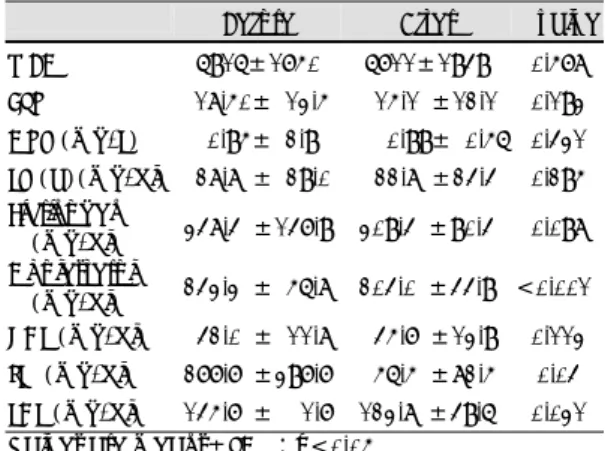
고지혈증군에서 총 콜레스테롤 및 중성지방, LDL
콜레스테롤이 의미있게 상승되어 있었으나 그 외 Lp(a) 및 염증 상태를 반영하는 ESR, CRP, Fibrinogen, WBC는 통계적인 유의한 차이는 없었다(Table 2).
Table 2. Baseline levels of Lp (a), inflammatory para- meters and lipids
Before After P value WBC 6916±1750 6711±1949 0.578 ESR 18.50± 13.5 15.1 ±12.1 0.193 CRP (mg/L) 0.95± 2.9 0.99± 0.56 0.431 LP (a)(mg/dl) 28.8 ± 29.0 22.8 ±24.4 0.295 Fibrinogen
(mg/dl) 348.4 ±147.9 309.4 ±90.4 0.098 Cholesterol
(mg/dl) 243.3 ± 56.8 204.0 ±44.9 <0.001*
HDL (mg/dl) 42.0 ± 11.8 45.7 ±13.9 0.113 TG (mg/dl) 277.7 ±397.7 56.5 ±82.5 0.04 LDL (mg/dl) 145.7 ± 1.7 123.8 ±49.6 0.031 Values are means±SD *:p<0.05
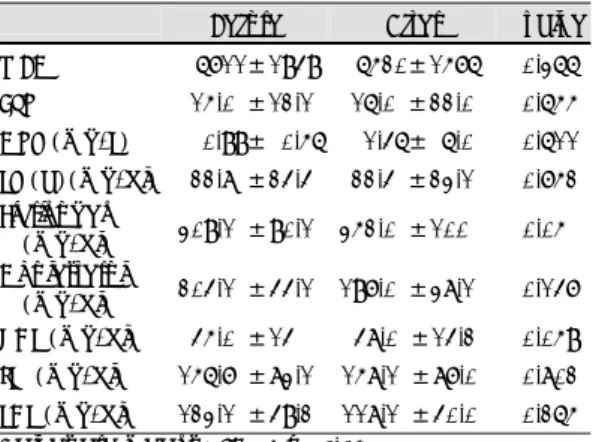
Table 3. Lp (a), inflammatory parameters and lipids in hyperlipidemia group before and after lipid lowering agent
Before After P value WBC 6916±1750 7115±1738 0.419 ESR 18.5 ± 13.5 16.0± 13.0 0.127 CRP (mg/L) 0.95± 2.9 3.2± 10.6 0.232 LP (a)(mg/dl) 28.8 ± 29.0 20.0± 19.0 0.009*
Fibrinogen
(mg/dl) 348.4 ±147.9 340.0± 87.0 0.744 Cholesterol
(mg/dl) 243.3 ± 56.8 228.0± 57.1 0.024*
HDL (mg/dl) 42.0 ± 11.8 70.0± 14.2 0.187 TG (mg/dl) 277.7 ±397.7 232.1±312.0 0.174 LDL (mg/dl) 145.7 ± 1.72 98.1± 16.9 0.06 Values are means±SD *:p<0.05
Fig. 1. Lp (a) before and after lipid lowering agent ad- ministration.
HMG-CoA reductase 억제제 투여 전후의 Lp(a) 및 염 증인자, 지질치의 비교
고지혈증군에서 6개월에서 3년 8개월간 약물 투여시 Lp(a)는 통계적으로 유의하게 감소하였다. 지질 중 총 콜레스테롤은 유의하게 감소하였고 LDL 콜레스테롤은 감소하는 양상을 보여주었다. 그 외 다른 염증지표는 유 의한 변화를 보이지 않았다(Table 3, Fig. 1).
그러나 약물을 투여하지 않은 대조군에서는 Lp(a) 및 지질, 염증인자에서 투여전 후 유의한 차이는 없었다 (Table 4).
HMG-CoA reductase 억제제 투여전후의 변화 값과 투여전 측정치간의 상관 관계
Lp(a)가 개개인에 따라 고유한 값을 갖는다는 점에서 초기 Lp(a)치에 대한 Lp(a)의 변화량을 비율로 나타 내어 고지혈증군에서 HMG-CoA reductase 억제제 투여전 후 기저 Lp(a)와의 관련성을 보았을 때는 미미 한 상관 관계를 보였다(Fig. 2).
그 외 초기 Lp(a)치와 다른 지질 변화량 및 염증지표 의 변화값, 그리고 약물을 투여한 기간과는 유의한 상 관관계가 없었다.
고 안
본 연구에서는 고지혈증 환자에서 최소 6개월 이상, 최대 3년 8개월까지의 장기간에 걸친 HMG CoA reductase 억제제 투여시 Lp(a) 농도를 알아본 결과 유의한 감소를 관찰 할 수 있었다.
Lipoprotein(a)(Lp(a))는 1970년대 초 Dahlen,13) Papadopoulus,14) Insull15)의 세 군에서 관상동맥 질환 과의 관련성이 보고된 후 심혈관 질환16) 뇌혈관 질환,17) 말초 혈관 질환18)에서 혈중 농도가 증가되어 있음이 알 려져 동맥경화의 새로운 예측 인자로 주목받고 있는 물 질로 이러한 Lp(a)와 동맥경화와의 관련성은 일차적으 로 Lp(a)가 atherogenicity와 관련이 있다고 알려진 LDL-cholesterol과 fibrin, fibronectin, ternacetin, proteoglycan등의 세포간 단백물질과 결합하는 특성을 지닌 apolipoprotein (a)19)20)가 disulfide bridge로 결 합됨으로써 병변이 되는 혈관 부위에 apo(a)가 결합하 여 LDL-cholesterol을 운반, 동맥경화를 야기시키는 것으로 여겨지고 있으며21) 특히 apo(a)와 plasmino- gen과 구조적 상동성(homology)에 의해 plasmino- gen과 경쟁적 억제인자로 작용하여22) 혈전용해를 방해 하는 점도23) Lp(a)와 동맥경화의 관련성을 추정하게 하는 근거가 되고 있다.
그러나 이와는 반대로 Bernard등은 2,156명을 대상 으로 한 전향적인 연구에서 Lp(a)와 동맥경화성 질환 사이에 아무런 관련성이 없음을 보고하였고24) Chang 등은 심장 이식후 동맥경화와 Lp(a)간에 관련성이 없 음을 보고하는등25) Lp(a)와 동맥경화성 질환과의 사이 에 상관 관계가 없다는 보고가 있으며 Lp(a)와 동맥경 Table 4. Lp (a), inflammatory parameters and lipids in
control group before and after lipid lowering agent Before After P value WBC 6711±1949 6520±1576 0.366 ESR 15.0 ±12.1 16.0 ±22.0 0.655 CRP (mg/L) 0.99± 0.56 1.46± 6.0 0.611 LP (a)(mg/dl) 22.8 ±24.4 22.4 ±23.1 0.752 Fibrinogen
(mg/dl) 309.1 ±90.1 352.0 ±100 0.05 Cholesterol
(mg/dl) 204.1 ±44.1 197.0 ±38.1 0.147 HDL (mg/dl) 45.0 ±14 48.0 ±14.2 0.059 TG (mg/dl) 156.7 ±83.1 158.1 ±87.0 0.802 LDL (mg/dl) 123.1 ±49.2 118.1 ±40.0 0.265 Values are means±SD *:p<0.05
Fig. 2. There was weak relationship between Lp (a)and change in Lp (a)/initial Lp (a) ratio.
화 질환과의 관련성에 대한 이론적 배경을 제공하였던 Lp(a)의 plasminogen에 대한 길항작용도 실험실에서 만 입증되었을 뿐이고 인체내에서는 증명되지 못한 상 태로 액체 상태에서는 plasminogen을 억제하지 못하 는 것으로 밝혀져 결과적으로 세포와의 결합부위에서 만 부분적으로 혈전용해 방해효과를 나타내게 되나23) Lp(a) 존재하에서도 pro-urokinase가 혈전용해에 충 분할 정도로 plasminogen을 활성화 시킬 수 있는 것 으로 밝혀져23) 이러한 부분적인 길항 작용조차도 t- PA와 D-dimer의 농도에 의해 제약 받음으로써 이들 의 농도가 낮은 상태여야 Lp(a)가 길항작용을 나타내 며 높은 농도에서는 이러한 길항작용이 없는 것으로 여 겨지고 있어26) 아직까지는 생체내에서 Lp(a)의 생리적 기능에 대하여 많은 논란의 여지가 있는 실정이다.
Lp(a)의 혈중 농도는 개체간 apo(a) 크기의 poly- morphism에 의해 영향 받아 apo(a)의 분자량에 정확 히 역상관 관계를 보이며27) polygenic control에 의해 주 유전자가 유전되는 것으로 알려져 있다.28) 따라서 그 혈중 농도는 90% 이상이 유전적 요인에 의해 결정되 고 나이, 성별, 식사, 약물등 환경적 요인에 의해 거의 영향을 받지 않으며 혈당의 조절이나 teststeron, 갑상 선 호르몬 등 일부 호르몬, 급성기양 반응2)3)29)등에 의 해서만 일부 영향을 받음이 알려져 있어 실제 한 개인 의 Lp(a) 수치는 위에서 언급한 특별한 경우 외에는 일 생동안 거의 일정하게 유지된다.
Kostner등이 HMG-CoA reductase 억제제가 LDL cholesterol은 감소시키나 Lp(a)의 농도에는 영향을 미치지 못함을 보고한 후30) 여러 작은 규모의 연구에서 Lp(a)를 오히려 상승시키거나 영향을 미치지 못하는 것으로 보고하였으며31) Haffnere등이 343명을 대상으 로 전향적으로 이루어진 대규모 무작위 대조군 연구에 서 24주간의 약물 투여시 LDL의 농도는 감소시키나 Lp(a)는 감소시키지 않는 것으로 보고하여6) HMG- CoA reductase 억제제는 Lp(a)의 대사에는 영향을 미치지 않은 것으로 결론내렸다. 그러나 본 연구에서는 HMG-CoA reductase 억제제의 투여기간이 최소 6개 월에서 최고 3년 8개월(평균 16개월)로 보다 장기간 에 걸친 투여시 Lp(a)에 미치는 영향을 알아본 결과 투여하지 않은 군에서는 Lp(a)의 의미있는 감소가 없 었던데 반해 고지혈증이 있어 약물을 투여한 군에서는 의미있는 감소를 관찰할 수 있었다. 이러한 차이는 MA-
AS가 혈관 촬영으로 확인되는 유의한 정도의 동맥경 화내 plaque의 변화는 4년 정도가 필요하여 HMG- CoA reductase 억제제에 의한 동맥경화의 죽상반 및 plaque의 변화는 매우 느리고 정도가 적다고 보고한 결과11)와 Lp(a)가 동맥경화의 죽상반 병변내 플라크에 주로 침착되며7)8) plaque의 염증반응과 관련되어 pla- que의 안정성과 관련 있다는12)점을 고려할때 동맥경 화 병변내 plaque에 영향을 미칠 정도의 장기간에 걸 친 HMG-CoA reductase 억제제의 투여시 Lp(a)에 미치는 영향은 단기간 투여시와는 다르게 나타나는 것 으로 생각된다.
본 연구에서는 HMG-CoA reductase 억제제를 투 여 받은 고지혈증군에서 ESR, CRP의 감소하는 경향을 관찰할 수 있었다. 그러나 통계적으로는 유의한 변화를 관찰할 수 없었는데 이는 fibrinogen 및 CRP가 HMG- CoA reductase 억제제에 의해 영향받지 않는다는 이 전의 보고와 동일한 결과이다32)33). 그러나 Kluft 등은 약물 투여전 CRP가 증가 되어 있는 경우에 한하여 HMG-CoA reductase 억제제가 CRP를 유의하게 감 소시킨다고 보고한 바 있다32). 본 연구에서는 대상군이 동맥경화가 있는 사람과 없는 사람이 혼재되어 있어 CRP의 개개인의 차이가 많았던 점에서 단순 비교만으 로는 단정 내리기는 힘들며 향후 동맥경화를 갖고 있는 자와 없는 자들로 구분하여 HMG-CoA reductase 억 제제 투여 여부에 따른 변화를 알아보는 것이 필요하리 라 여겨진다.
본 연구는 전향적으로 이루어진 것으로 6개월 이상의 장기간 HMG-CoA reductase 억제제 투여가 단기 투 여와 달리 lipoprotein(a)의 농도를 유의하게 감소시킨 다는 결과를 보여준 최초의 연구라는 점에서 의의가 크 다고 하겠으며 특히 다른 염증 인자와 달리 lipoprot- ein(a)의 농도만 뚜렷이 감소시킨다는 점에서 plaque의 안정성과 관련한34) 동맥경화 병변에 따른 장기 예후를 반영하는 지표로 사용할 수 있는가에 대한 연구 및 HMG-CoA reductase 억제제의 다른 약리 기전이 Lp(a) 변화에 작용하였을 가능성에 대해서도 추가적인 연구가 있어야 하리라 생각된다. 이러한 점에서 본 연구 에서 임상경과에 따른 Lp(a) 농도 변화를 추적 관찰 하 지는 못하였다는 점이 한계점이라고 하겠으며 따라서 앞으로 장기간에 걸쳐 임상 경과에 따른 Lp(a) 농도의 변화를 전향적으로 관찰하는 것이 필요하리라 사료된다.
요 약
연구배경:
Lipoprotein(a) 농도는 apolipoprotein(a)의 유전형 에 따라 결정되어 개인 차이가 많으나 같은 apolipo- protein(a)의 유전형에서는 동맥 경화 질환군에서 상 승되어 있다. 최근 lipoprotein(a)가 동맥경화의 죽상 반 파열과 유관한 염증성 지표로서 제안이 되고 있으며 심근 경색증 환자에 콜레스테롤 저하제 투여시 이차 예 방의 효과가 죽상반의 plaque 파열 억제에 기인하리라 는 점에서 이 두 가지가 서로 연관성이 있으리라 여겨지 며 HMG-CoA reductase 억제제의 plaque에 대한 영 향이 매우 장기간을 필요로 한다는 점에서 장기간에 걸 친 이 약물의 투여시 Lp(a) 및 지질, 염증 지표의 변화 를 비교하여 이들중 동맥경화 죽상반의 plaque의 안정 성과 가장 연관성이 높은 지표를 알아보고자 하였다.
방 법:
전향적 연구로 전체 148명 중 고지혈증으로 진단받 고 HMG-CoA reductase 억제제를 투여 받은 49명 과(남:여=28:21, 연령=59.1±12.0) 대조군 99명 (남:여=60:39, 연령=61.0±9.2)을 대상으로 하여 고지혈증군에서는 최소 6개월에서 최대 3년 8개월(평 균 16개월) 동안 HMG-CoA reductase 억제제를 투 여하였으며 투여 전후 Lp(a), Fibrinogen, CRP, ESR, WBC와 지질치를 측정하였다.
결 과:
지질치가 증가되어 HMG-CoA reductase를 투여한 군은 약물 투여전 Lipoprotein(a) 농도는 28.7±29.3 mg/dl 이었고 투여후 20.0±19.0 mg/dl으로 유의한 감소가 있었다(p=0.009). Lp(a)치에 대한 Lp(a)의 변화량의 비와 기저 Lp(a)간의 관련성간에는 통계적인 관련성이 감소하여 미미한 상관 관계를 보였다(r=0.2 53, p=0.05). 총 콜레스테롤 및 LDL 콜레스테롤 역시 유의한 감소가 있어 각각 241±57 mg/dl, 145±98 mg/
dl에서 218±57 mg/dl, 98±169 mg/dl으로 변하였으 나 WBC, ESR, CRP, fibrinogen 등의 유의한 변화는 약물투여 전후에 없었다.
결 론:
6개월 이상의 장기간 HMG-CoA reductase 억제제
이러한 변화는 plaque의 안정성과 관련하여 동맥경화 병변에 따른 장기 예후를 반영하는 지표로 사용할 수 있으리라 여겨지며 향후 임상경과에 따른 Lp(a) 농도 변화를 알아보는 연구가 추가적으로 있어야 하리라 사 료된다. 염증 인자간에는 유의한 변화가 없어 HMG- CoA reductase 억제제가 염증 반응의 억제와는 다른 기전으로 작용하였을 것으로 여겨지며 이 부분에 대해 서도 추가적인 연구가 필요하리라 생각되는 바이다.
중심 단어: lipoprotein(a)・HMG-CoA reductase in-hibitor・고지혈증・동맥경화・Plaque stability.
REFERENCES
1) Hervio L, Champam MJ, Thillet J, Loyau S, Angles-Cano E. Does apolipoprotein (a) hetero-genity influence lipo- protein (a) effects on fibrinolysis? Blood 1993;82: 392.
2) Boerwinkle E, Leffert CC, Lin J, Lackner C, Chiesa G, Hobbs HH. Apolipoprotein (a) gene accounts for gre- ater than 90% of the uariation in plasma lipoprotein (a) concentrations. J Clin Invest 1990;90:52.
3) Boerwinkle E. Genetics of plasma lipoprotein (a) con- centrations Current Opinion in Lipidology 1992;3:128.
4) Cynthia A DeMeester, Xiangdong Bu, Richard J. Gray, Aldons J, Lusis, Jerome I. Rotter. Genetic variation in Lipoprotein (a) levels in families enriched for coronary artery disease is determined almost entirely by the apoli- poprotein (a) gene locus. Am J Hum Genet. 1995;56:
287-92.
5) Seo HS, Oh DJ, Lee SC, Lim DS, Park CK, et al. Cha- racteristics of serum Lp (a) concentration and pheno- types of apolipoprotein (a) in Korean people. Korean J Med. 1996;50:695-708.
6) Haffner S, Orchard T, Stein E, Schmidt D, LaBelle P.
Effects of simvastatin on Lp (a) concentration. Clin Ca- rdiol May. 1995;18(5):261-7.
7) Axel Niendorf, Matthias Rath, Katrin Wolf, Susanne Peters, Hartmut Arps, Ulrike Beisiegel, Manfred Dietel.
Morphological detection and quantification of lipopro- tein (a) deposition in atheromatous lesions of human aorta and coronary arteries. Virchows Arch A Pathol Anat Histopathol 1990;417(2):105-11.
8) Rath M, Niendorf A, Reblin T, Dietel M, Krebber HJ, Beisiegel U. Detection and quantification of lipoprotein (a) in the arterial wall of 107 coronary bypass patients.
Atherosclerosis 1989;9:579-92.
9) O’Donnell MP, Kasiske BL, Kim Y, et al. Lovastatin inhibits proliferation of rat mesangial cells. J Clin Invest 1993;91:83-87.
10) Girona J, La Ville AE, Sola R, Plana N, Masana L.
Simvastatin decreases aldehyde production derived from lipoprotein oxidation. Am J Cardiol Mar 15 1999;83:
846-51.
11) MAAS investigators. Effects of simvastatin on coronary atheroma: The Multicentre Anti-Atheroma Study (MA- AS). Lancet 1994;344:633-8.
12) Dangas G, Mehran R, Harpel PC, Sharma SK, Marco- vina SM, Dube G, Ambrose JA, Fallon JT. Lipoprotein (a) and inflammation in human coronary atheroma: Ass- ociation with the severity of clinical presentation. J Am Coll Cardiol Dec 1998;32:2035-42.
13) Dahlen G, Reison C, Furgerg C. Angina of effect and on extra pre-beta lipoprotein fraction. Acta Med Scand 1972d;553(Suppl):6.
14) Papadopoulus MN, Bedynek JL. Serum lipoprotein pat- terns in patients with coronary atherosclerosis. Clin Chim Acta 1973;44:153.
15) Insull W, Najmi M, Bloedman DA. Plasma prebeta lipo- protein subfractions in diagnosis of coronary artery dis- ease. Circulation 1972;45(Suppl Ⅱ):170.
16) Rosengren A, Wilhelmsen L, Eriksson E, Risberg B, Wede H. Lipoprotein (a) and coronary heart disease: A prospective case-control study in a general population sample of middle-aged men. BMJ 1990;301:1248-51.
17) Murai A, Miyahara T, Fujimoto N, Matsuda M, Kam- cyma M. Lp (a) lipoprotein as a risk factor for coronary heart disease and cerebral infarction Atherosclerosis 1986;59:199-204.
18) S.W.K. Cheng, A.C.W. Ting and J. Wong. Lipoprotein (a) and its relationship to risk factors and severity of ath- erosclerotic peripheral vascular disesase. Eur J Vasc En- dovasc Surg 1997;14:17-23.
19) Harpel PC, Gordon BR, Pakker TS. Plasmin catayzes binding of lipoprotein (a) to immobilized fibrinogen and fibrin. Proc Natl Acad Sci USA 1989;86:3847.
20) Hadewijch LM, Pekelharing, Henne A. Kleinveks, Pieter F.C.C.M. Duif, Boono N. Bouma, Herman JM, van Rijn.
Effect of lipoprotein (a) and LDL on plasminogen binding to extracellular matrix and on matrix-dependent plasm- inogen activation by tissue plasminogen activator. Thro- mb haemost 1996;75:497-502.
21) Marcovina SM, Morrisett JD. Structure and metabolism of lipoprotein (a). Curr Opin Lipidol 1995;6:136-45.
22) Hajjar KA, Gavish D, Breslow J, Nachmann R. Lipoprotein (a) modulation of endothelial cell surface fibrinolysis potential role in atherosclerosis. Nature 1989;339: 303.
23) Katherine A. Hajjar, Dov Gavish, Jan L. Breslow, Ralph L. Nachman. Lipoprotein (a) modulation of endothelial cell surface fibrinolysis and its potential role in ath- erosclerosis. Nature 1989;339:303-5.
24) Bernard Cantin, France Gagnon, Sital moorjani, Jean- Pierre Despres. Benoit Lamarche, paul-Joseph Lupien etc. Is lipoprotein (a) an independent risk factor for ische- mic heart disease in Men? The Quebec Cardiovascular Study. J Am Coll Cardiol 1998;31:519-25.
25) Hong Soog Soe, Dong Joo Oh. Risk factors and Athero- sclerotic coronary artery disease in Korean people. Kor Cir J 1998;28:845-8.
26) Liu J, Harpel PC, Pannell R, Gurewich V. Lipoprotein (a): A kinetic study of its influence on fibrin-dependent plasminogen activation by prourokinase or tissue plas- minogen activator. Biochemistry 1993;32:9694-700.
27) Utermann G, Kraft HG, Menzel HJ, Hopferwieser T, Seitz C. Genetics of the quantitative Lp (a) glycoprotein phenotypes to Lp (a) lipoprotien concentrations in plas- ma. Hum Genet 1988;78:41.
28) Utermann G, Menzel HJ, Kraft HG, Duba HG, Kemmler HG, Seitz C. Lp (a) glycoprotein phenotypes-inheritance and relation to Lp (a)-lipoprotein concentration in plasma.
J Clin Invest 1987;80:458.
29) Santica M. Marcovina, Giuseppe Lippi, Carrie J. Bagatell, William J. Bremner. Testosterone-induced suppression of lipoprotein (a) in normal men; Relation to basal lipopro- tein (a) level. Atherosclerosis 1996;122:89-95.
30) Kostner GM, Gravish D, Leopold B, Bolzano K, Wein- traub MS, Breslow JL. HMG-CoA reductase inhibitors lower LDL cholesterol without reducing Lp (a) levels.
Circulation Nov 1989;80:1313-9.
31) Sampietro T, Galetta F, Bionda A. Behavior of Lp (a) and apoproteins (A1, B, C2, C3, E) during and after the- rapy with simvastatin. Cardiovasc Drugs Ther Dec 1995;
9:785-9.
32) Kluft C, DeMaat MPM, Leuven JA Gevers, van Loon BJ Potter, Mohrschadt MF. Statins and C-reactive protein.
Lancet April 10, 1999;353:1274.
33) Jose L. Zanbrana, Trancisco Velasco, Pedro Castra, Manuel Concha, Federico Valles, Pedro Montilla, et al.
Comparison of benzafibrate versus lovastatin for lowering plasma insulin, fibrinogen, and plasminogen activator inhibitor-1 concontration in hyperlipemic heart transplan- tation patients. Am J Cardiol Oct 1, 1997;80:836-40.
34) Davies MJ. A macro and micro view of coronary vascular insult in ischemic heart disease. Circulation 1990;82 (Suppl Ⅱ):II38-II46.