DOI 10.3349/ymj.2008.49.5.804
Purpose: Obesity is a major risk factor for asthma and it influences airway smooth muscle function and responsiveness.
Adiponectin is inversely associated with obesity and its action is mediated through at least 2 cell membrane receptors (AdipoR1 and AdipoR2). Leptin is positively associated with obesity. We investigated whether human airway smooth muscle (ASM) cells express adiponectin receptors and whether adiponectin and leptin regulate human ASM cell proliferation and vascular endothelial growth factor (VEGF) release.
Materials and Methods: Human ASM cells were growth- arrested in serum-deprived medium for 48 hours and then stimulated with PDGF, adiponectin and leptin. After 48 hours of stimulation, proliferation was determined using a cell proliferation ELISA kit. Human AdipoR1 and -R2 mRNA expressions were determined by RT-PCR using human- specific AdipoR1 and -R2 primers. Concentrations of VEGF, monocyte chemotactic protein (MCP)-1 and macrophage in- flammatory protein (MIP)-1 in cell culture supernatant wereɑ determined by ELISA. Results: Both AdipoR1 and AdipoR2 mRNA were expressed in the cultured human ASM cells.
However, adiponectin did not suppress PDGF-enhanced ASM cell proliferation, nor did leptin promote ASM cell prolifera- tion. Leptin promoted VEGF release by human ASM cells, while adiponectin did not influence VEGF release. Neither leptin nor adiponectin influenced MCP-1 secretion from human ASM cells. Adiponectin and MIP-1 were not secretedɑ by human ASM cells. Conclusion: Human ASM cells expressed adiponectin receptors. However, adiponectin did not regulate human ASM cell proliferation or VEGF release, while leptin
stimulated VEGF release by human ASM cells.
Key Words: Smooth muscle cells, cell proliferation, vascular endothelial growth factor, leptin, adiponectin, receptors
INTRODUCTION
Obesity has become a major health problem worldwide and its incidence has sharply increased.
Prevalence of asthma has also been steadily increasing during the past 30 years. Obesity is a major risk factor for asthma, and it increases the prevalence and severity of asthma and also influences lung function. Girls who become obese between the ages of 6 and 11 years have an almost fivefold increased risk of developing new asthma symptoms.
1Weight loss reduces airway obstruc- tion as well as peak expiratory flow variability in obese patients with asthma.
2Studies on mice have shown a causal relationship between obesity and asthma.
3Obesity influences airway smooth muscle function and airway hyper-responsiveness (AHR).
In epidemiological studies, the body mass index (BMI) has been shown to be associated with AHR,
4and innate AHR is manifested in obese mice.
5Hyperplasia and hypertrophy of airway smooth muscle (ASM) are characteristic features of airway remodeling in asthma. There is limited informa- tion on how obesity influences smooth muscle function. Obesity may reduce lung growth in childhood, which leads to reduced functional residual capacity, and may accelerate airway remodeling when asthma is exacerbated.
6Obesity induces systemic inflammation, which can affect the lung microenvironment by circulating cytokines
The Expression of Adiponectin Receptors and the Effects of Adiponectin and Leptin on Airway Smooth Muscle Cells
Joo Hwa Shin,
1Jung Ho Kim,
1Won Young Lee,
2and Jung Yeon Shim
1Departments of 1Pediatrics and2Internal Medicine, Kangbuk Samsung Hospital, Sungkyunkwan University School of Medicine, Seoul, Korea.
Received March 25, 2008 Accepted May 6, 2008
This research was supported by Kangbuk Samsung Hospital Medical Research Fund.
These results were presented at American Thoracic Society International Conference, San Francisco, USA, on May 2007.
Reprint address: requests to Dr. Jung Yeon Shim, Division of Pediatric Allergy & Pulmonology, Department of Pediatrics, Kangbuk Samsung Hospital, Sungkyunkwan University School of Medicine, 108 Pyeong-dong, Jongno-gu, Seoul 110-746, Korea. Tel:
82-2-2001-2200, Fax: 82-2-2001-2199, E-mail: jy7.shim@samsung.
com
and chemokines. Adiponectin, a fat tissue-derived hormone, is inversely associated with obesity. In children with obesity, serum adiponectin levels decrease,
7and adiponectin mRNA expression from adipose tissue is negatively associated with obesity.
8Adiponectin also demonstrates anti- inflammatory effects and down-regulation of vascular smooth muscle cell proliferation.
9The activity of adiponectin is mediated by at least 2 cell membrane receptors (AdipoR1 and AdipoR2).
However, there has been no report to date, on identification of adiponectin receptors in human ASM cells.
Leptin is a 16-kDa peptide released from fat cells and other tissues, and may exacerbate airway inflammation in asthma. It induces pulmonary inflammation after ozone exposure in mice,
5and augments AHR in ovalbumin-sensitized mice.
3Leptin induces cytokine production and cell proliferation in hematopoietic cells
10and human umbilical vein endothelial cells.
11However, it is unknown whether leptin influences ASM cell pro- liferation and cytokine production by ASM cells.
The goal of this study was to identify adipo- nectin receptors (AdipoR1 and AdipoR2) in human ASM cells and evaluate whether adiponectin and leptin regulate ASM cell proliferation. On the basis of the above, we hypothesized that leptin would enhance ASM cell proliferation, compared to no stimulation, and adiponectin would inhibit ASM cell proliferation enhanced by PDGF stimulation. In addition, we investigated whether adiponectin and leptin influence the release of vascular endothelial growth factor (VEGF), monocyte chemotactic protein (MCP)-1, macro- phage inflammatory protein (MIP)-1 , and ɑ adiponectin from ASM cells.
MATERIALS AND METHODS
Human airway smooth muscle cell culture Primary human ASM cells and cell growth supplements were purchased from Clonetics (San Diego, CA, USA). Penicillin, streptomycin, fetal bovine serum (FBS), 10% Dulbecco's modified Eagle's medium (DMEM), and DMEM/F-12 medi- um were obtained from Gibco BRL. Bovine serum
albumin (BSA) and insulin-transferrin-selenium (ITS) were obtained from Sigma. Adiponectin, leptin and PDGF were purchased from R & D (R
& D Systems, Minneapolis, MN, USA).
Human ASM cells were plated in 75 cm
2culture flasks with 10% FBS/DMEM containing 100 IU/
mL penicillin, 100 g/mL streptomycin, and 2 μ mM L-glutamine, and were incubated in a humidified incubator at 37°C with 5% CO
2. When the cells became confluent, they were passaged with the use of 0.025% trypsin in 0.01% EDTA. Cells at passages 3 to 6 were used for all experiments.
Analysis of human ASM cell proliferation Human ASM cells were seeded at a density of 1 × 10
4cells/cm
2in 96-well culture plates. When the cells reached 70% confluence, growth was arrested in serum-free DMEM/F-12 medium containing 0.1% BSA for 48 hours. Cells were then incubated with 20 ng/mL of platelet-derived growth factor (PDGF) for 48 hours as a positive control. ASM cell proliferations were compared after stimulation with 10, 50 and 100 ng/mL of leptin, and 10, 50, and 100 ng/mL of adiponectin with and without PDGF co-stimulation.
Cell proliferation was measured using a bromodeoxyuridine (BrdU) cell proliferation ELISA kit (Roche Applied Science, Mannheim, Germany). The cells were cultured in 96-well plates under the same conditions as described above and incubated with 10 M BrdU for 24 μ hours. The BrdU incorporation into DNA was detected using a commercial kit. Briefly, cells were fixed and DNA was denatured. Anti-BrdU- POD monoclonal antibody was used to bind to the BrdU incorporated into the newly synthesized cellular DNA. The absorbance of immune com- plex was measured at 450 nm.
Preparation of RNA and reverse transcriptase- polymerase chain reaction (RT-PCR) for adiponectin receptors
The total cellular RNA was prepared using a
Trizol reagent kit. After quantification by spectro-
photometry, the RNA was reverse transcribed and
cDNAs were produced. PCR was performed in a
Takara PCR thermal cycler at a 50 L reaction μ
volume containing 100 ng of genomic DNA, 10 mM Tris HCl, 50 mM KCl, 1.5 mM MgCl
2, 0.08%
Triton X-100, 200 M deoxyribonucleotides, 0.75 U μ Taq polymerase, and 1.0 M oligonucleotide μ primers of each gene. The following primers were used: for human AdipoR1, the forward primer was 5’-TTCTTCCTCATGGCTGTGATGT-3’, reverse:
5’-AAGAAGCGCTCAGGAATTCG-3’ (GenBank accession number: NM015999); for human Adipo R2, the forward primer was 5’-ATAGGGCAGAT AGGCTGGTTGA-3’, and the reverse primer was 5’-GGATCCGGGCAGCATACA-3’ (GenBank acces- sion number: nm024551); for -actin, the forward β primer was 5’-GATCTTGATCTTCATGGTGCTAG G-3’, and the reverse primer was 5’-TTGTAACCA ACTGGGACCATATGG-3’ (GenBank accession number: AL451010).
12,13After the initial denatura- tion at 95°C for 5 minutes, 40 cycles of denaturation for 1 minute at 95°C, annealing for 1 minute at 55°C and extension for 1 minute at 72°C were carried out, and the PCR was terminated by a final extension at 72°C for 10 minutes. Reaction products were then separated on a 1% agarose gel in Tris acetate EDTA buffer. Sequence of the PCR products was confirmed by the National Center for Biotechnology Information (NCBI) nucleotide- nucleotide BLAST program.
Cytokine assay
To evaluate the effects of adiponectin and leptin on the production of VEGF, MCP-1 and MIP-1 , ɑ by human ASM cells, the cells were cultured to confluence in 10% FCS/DMEM in humidified 5%
CO
2air at 37°C in 24-well culture plates and growth-arrested in serum-free DMEM/F-12 medium for 48 hours. Cells were stimulated with 20 ng/mL of PDGF, 10, 50, and 100 ng/mL of leptin and 10, 50, and 100 ng/mL of adiponectin.
After 24-hours of incubation, the cell culture supernatant was harvested and stored at - 80°C until ELISA for cytokines was performed.
Measurement of VEGF, MCP-1 and MIP-1 by ELISA ɑ VEGF, MCP-1 and MIP-1 in cell culture super ɑ - natants were analyzed by ELISA according to the manufacture's manuals (R & D Systems). The minimum detectable doses of cytokines were less
than 5 pg/mL for VEGF and MCP-1 and less than 10 pg/mL for MIP-1 . ɑ
Statistics
Each experiment was repeated on multiple occasions with triplicate dishes. Data were evaluated by one-way ANOVA followed by the Bonferroni's multiple comparison test.
RESULTS
Expression of AdipoR1 and AdipoR2 mRNA on the human ASM cells
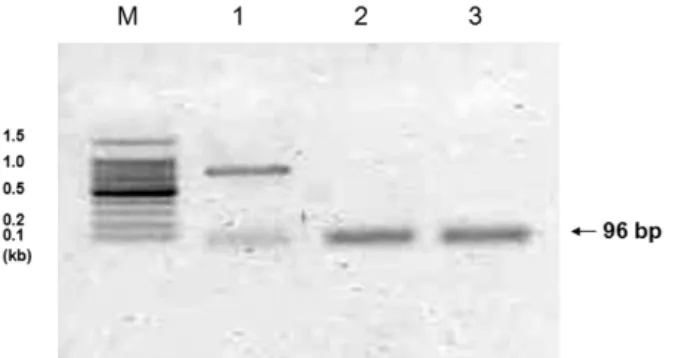
We found that the mRNAs of adiponectin receptors 1 and 2 were expressed in cultured human ASM cells. Sequencing of PCR products demonstrated that results were compatible with human adiponectin receptors 1 and 2 (according to the NCBI nucleotide-nucleotide BLAST pro- gram), thus confirming the presence of these genes in human ASM cells (Fig. 1).
Effect of adiponectin and leptin on the prolifera- tion of human ASM cells
To evaluate the effect of leptin on human ASM cell proliferation, ASM cells were stimulated with leptin (10, 50, and 100 ng/mL) and 20 ng/mL of
Fig. 1. Expression of adiponectin receptors AdipoR1 and AdipoR2 in the human airway smooth muscle cell.
Expression of β-actin (lane 1), AdipoR1 (lane 2) and AdipoR2 (lane 3) mRNA is observed. Sequencing of these PCR products demonstrated that the products were compatible with human AdipoR1 and AdipoR2 (according to NCBI nucleotide-nucleotide BLAST); these findings confirmed the presence of these genes in the human airway smooth muscle cells.
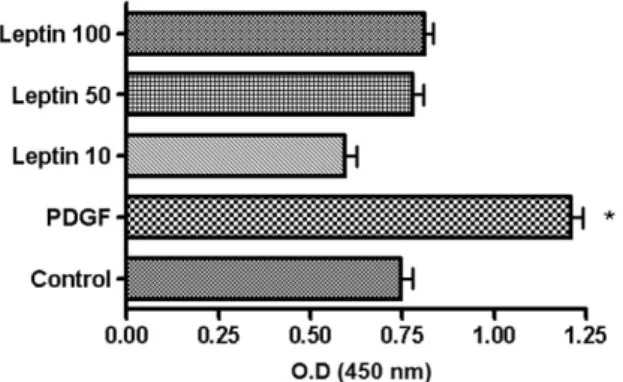
PDGF, and the proliferation was then compared with unstimulated ASM cells. The stimulation with PDGF significantly enhanced ASM cell proliferation compared to control cells. However, leptin did not enhance nor suppress ASM cell proliferation at all concentrations studied (Fig. 2).
Leptin also did not augment PDGF-enhanced ASM cell proliferation when co-stimulated with PDGF (data not shown).
Since the serum adiponectin level is inversely correlated with obesity, we investigated whether adiponectin had any effect on down-regulation of PDGF-enhanced ASM cell proliferation. Thus, human ASM cells were stimulated with 20 ng/mL of PDGF with and without adiponectin (10, 50, and 100 ng/mL), and the proliferation was compared to cells stimulated with PDGF only.
The PDGF-stimulated ASM cells showed enhanced proliferation. However, adiponectin did not suppress PDGF-enhanced ASM cell proliferation at all doses studied (Fig. 3). We also stimulated ASM cells with adiponectin only, however, no difference in proliferation was observed com- pared to no stimulation (data not shown).
Effect of PDGF, adiponectin and leptin on VEGF release by human ASM cells
Human ASM cells were treated with PDGF (20 ng/mL), adiponectin (50 ng/mL), and leptin (50 ng/mL). VEGF release was significantly enhanced
by both PDGF and leptin stimulation compared to controls. VEGF release by leptin stimulation was higher than PDGF stimulation. However, adiponectin did not show any additive effects on VEGF release when added to leptin. Adiponectin did not suppress PDGF-enhanced VEGF release nor did VEGF release by unstimulated ASM cells (Fig. 4).
Fig. 2.Effect of leptin on the proliferation of human ASM cells. Human ASM cells were stimulated with leptin (10, 50 and 100 ng/mL) and 20 ng/mL of PDGF, and com- pared to unstimulated cells. Leptin did not enhance or suppress ASM cell proliferation, while PDGF significantly augmented cell stimulation. ASM, airway smooth muscle;
PDGF, platelet-derived growth factor. *p < 0.01 vs. Control.
Fig. 4. Effect of PDGF, adiponectin and leptin on VEGF release by human ASM cells. Human ASM cells were treated with 20 ng/mL of PDGF, 50 ng/mL of adipo- nectin and 50 ng/mL of leptin. VEGF release was significantly enhanced by PDGF stimulation compared to no stimulation. Leptin significantly augmented VEGF release compared to no stimulation or stimulation by PDGF. Adiponectin showed no stimulatory or inhibitory effects on VEGF release, when it stimulated cells with and without PDGF or leptin. PDGF, platelet-derived growth factor; VEGF, vascular endothelial growth factor.
*p < 0.05 vs. Control, **p < 0.05 vs. Control and PDGF.
Fig. 3.Effect of adiponectin on the proliferation of human ASM cells. Human ASM cells were stimulated with 20 ng/mL of PDGF in the presence or absence of adipo- nectin (10, 50, and 100 ng/mL), and proliferation was compared with the control. PDGF-stimulated ASM cells showed enhanced proliferation, however, adiponectin did not enhance or suppress PDGF-enhanced ASM cell proliferation. ASM, airway smooth muscle; PDGF, platelet-derived growth factor. *p < 0.01 vs. Control.
Effect of PDGF, adiponectin and leptin on MCP-1, MIP-1 and adiponectin releases by human ASM ɑ cells
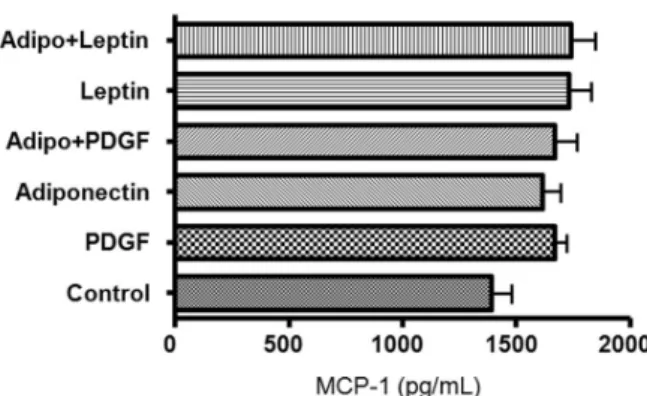
We evaluated the release of MCP-1 by human ASM cells treated with PDGF, adiponectin and leptin. MCP-1 was released by ASM cells, but was neither augmented, nor suppressed by PDGF, leptin or adiponectin stimulation. There were no differences in MCP-1 release when it was co- stimulated with adiponectin and leptin or with adiponectin and PDGF (Fig. 5). Human ASM cells did not secrete MIP-1 ɑ or adiponectin after stimulation with PDGF, leptin or adiponectin (data not shown).
DISCUSSION
Asthma and obesity are growing public health problems. Epidemiological data as well as data from animal models implicate obesity as an im- portant risk factor for asthma and atopic disease.
In this study, we studied the relationship between adiponectin, leptin, and airway smooth muscle cell proliferation. First, we demonstrated that adiponectin receptors (AdipoR1 and AdipoR2) were expressed in human ASM cells; to our knowledge, this is the first report on such finding.
To evaluate the role of adiponectin and leptin in
the ASM cells, we stimulated ASM cells with adi- ponectin and leptin, and found that adiponectin and leptin did not directly influence human ASM cell proliferation. However, since leptin increased the release of VEGF from ASM cells, it must play some role in asthma. Although ASM cells ex- pressed adiponectin receptors, they did not secrete adiponectin. It is, therefore, possible that adiponectin plays a role through its receptors.
Since serum adiponectin declines in obesity and adiponectin has an anti-inflammatory effect, these anti-inflammatory effects might inhibit ASM cell proliferation. Although adiponectin did not suppress the proliferation of ASM cells, it appeared to act on adiponectin receptors and cause anti-allergic reactions. Indeed, some studies have shown that adiponectin attenuated allergen- induced airway inflammation and hyperrespon- siveness in mice.
6,14Leptin acts on the hypothalamus to induce satiety and increase metabolism. In addition, leptin has proinflammatory effects.
10It has been shown to protect T lymphocytes from apoptosis, regulate T-cell proliferation and activation, recruit and activate monocytes and macrophages, and promote angiogenesis.
15Given the facts that serum leptin levels are increased in obesity and it has proinflammatory effects, it is reasonable to suggest that this hormone plays a role in asthma.
Leptin enhanced pulmonary inflammation induced by acute ozone exposure and increased AHR and serum IgE levels in mice.
3,5On the other hand, leptin has been shown to have no effect on IL-13, IL-4 and IL-5 mRNA expressions in lung tissue, and no direct effect on AHR in PBS- challenged mice, while it has AHR in OVA- challenged mice.
3Leptin may be involved in airway remodeling by inducing angiogenesis.
Leptin directly induces angiogenesis by activation of its functional receptor, Ob-Rb, which is expressed in endothelial cells.
16In addition to its angiogenic activity, leptin is also able to induce vascular fenestrations and permeability.
17Leptin could indirectly induce angiogenesis via upregulation of VEGF expression.
11,18This fact is consistent with our results that showed that leptin induced VEGF release by ASM cells. VEGF is a multifunctional angiogenic regulator that stimulates subepithelial neovascularization and vascular
Fig. 5. Effect of PDGF, adiponectin and leptin on MCP-1 release by human ASM cells. Human ASM cells were treated with PDGF (20 ng/mL), adiponectin (50 ng/mL), and leptin (50 ng/mL). MCP-1 was constitutively released from human ASM cells and was neither augmented by PDGF or leptin stimulation, nor suppressed by adipo- nectin. PDGF, platelet-derived growth factor; ASM, airway smooth muscle.
permeability, a key finding in asthma. It also pro- motes epithelial cell proliferation and endothelial cell survival.
19,20Recent data have shown that VEGF also induces an asthma-like phenotype characterized by mucus hyperplasia, subepithelial fibrosis, smooth muscle hyperplasia, and AHR.
21-24There has been no prior report on the expression of leptin in ASM cells. Leptin mRNA was detected in the lungs of mice.
3In addition, leptin expression has been found at sites of wound healing and in inflamed colonic epithelial cells.
25,26Although we did not investigate the ASM cell leptin receptor in this study, we can assume that there are leptin receptors in ASM cells because leptin augmented VEGF release by the cultured ASM cells.
MCP-1 plays an important role in allergic inflammation. MCP-1 expression is up-regulated in asthmatic airways. Interestingly, it is also asso- ciated with obesity. In obese mice, its expression is augmented, and the adipose tissue inflamma- tory gene expression is reduced in mice without MCP-1 or MCP-1 receptors.
27,28There is no prior report demonstrating that leptin or adiponectin affects MCP-1 release by ASM cells. In this study, the release of MCP-1 by human ASM cells was not influenced by adiponectin, leptin or PDGF. We also evaluated whether ASM cells released adiponectin and MIP-1 . However, neither was ɑ detected in the cultured ASM cell supernatants (data not shown). Since we stimulated ASM cells only with leptin, adiponectin and PDGF and did not investigate mRNA expression of adiponectin and MIP-1 by RT-PCR, we do not know whether ɑ adiponectin and MIP-1 are produced by ASM ɑ cells. We did not investigate the effects of adipo- nectin and leptin on the release of inflammatory cytokines other than VEGF, MCP-1 and MIP-1 . ɑ In conclusion, our results demonstrate for the first time that adiponectin receptors (AdipoR1 and R2) are expressed in human ASM cells. However, adiponectin did not influence human ASM cell proliferation or the release of VEGF and MCP-1.
Leptin promoted VEGF release by human ASM cells, while it did not influence ASM cell pro- liferation. Taken together, leptin and adiponectin are not likely to be a therapeutic target for the prevention of human ASM cell proliferation, nevertheless leptin may modulate angiogenesis
and airway remodeling by promoting the release of VEGF from ASM cells, and thus being a potential therapeutic target in obese asthmatic patients.
REFERENCES
1. Castro-Rodríguez JA, Holberg CJ, Morgan WJ, Wright AL, Martinez FD. Increased incidence of asthmalike symptoms in girls who become overweight or obese during the school years. Am J Respir Crit Care Med 2001;163:1344-9.
2. Hakala K, Stenius-Aarniala B, Sovijärvi A. Effects of weight loss on peak flow variability, airways obstruc- tion, and lung volumes in obese patients with asthma.
Chest 2000;118:1315-21.
3. Shore SA, Schwartzman IN, Mellema MS, Flynt L, Imrich A, Johnston RA. Effect of leptin on allergic airway responses in mice. J Allergy Clin Immunol 2005;
115:103-9.
4. Litonjua AA, Sparrow D, Celedon JC, DeMolles D, Weiss ST. Association of body mass index with the development of methacholine airway hyperrespon- siveness in men: the normative aging study. Thorax 2002;57:581-5.
5. Shore SA, Rivera-Sanchez YM, Schwartzman IN, Johnston RA. Responses to ozone are increased in obese mice. J Appl Physiol 2003;95:938-45.
6. Shore SA, Fredberg JJ. Obesity, smooth muscle, and airway hyperresponsiveness. J Allergy Clin Immunol 2005;115:925-7.
7. Nagel G, Rapp K, Wabitsch M, Büchele G, Kroke A, Zöllner I, et al. Prevalence and cluster of cardio- metabolic biomarkers in overweight and obese schoolchildren: results from a large survey in southwest Germany. Clin Chem 2008;54:317-25.
8. Kern PA, Di Gregorio GB, Lu T, Rassouli N, Ranganathan G. Adiponectin expression from human adipose tissue: relation to obesity, insulin resistance, and tumor necrosis factor-alpha expression. Diabetes 2003;52:1779-85.
9. Ouchi N, Kihara S, Funahashi T, Matsuzawa Y, Walsh K. Obesity, adiponectin and vascular inflammatory disease. Curr Opin Lipidol 2003;14:561-6.
10. Huang L, Li C. Leptin: a multifunctional hormone. Cell Res 2000;10:81-92.
11. Park HY, Kwon HM, Lim HJ, Hong BK, Lee JY, Park BE, et al. Potential role of leptin in angiogenesis: leptin induces endothelial cell proliferation and expression of matrix metalloproteinases in vivo and in vitro. Exp Mol Med 2001;33:95-102.
12. Yamauchi T, Kamon J, Ito Y, Tsuchida A, Yokomizo T, Kita S, et al. Cloning of adiponectin receptors that mediate antidiabetic metabolic effects. Nature 2003;
423:762-9.
13. Lee WY, Rhee EJ, Oh KW, Kim SY, Jung CH, Yun EJ, et al. Identification of adiponectin and its receptors in human osteoblast-like cells and association of T45G polymorphism in exon 2 of adiponectin gene with lumbar spine bone mineral density in Korean women.
Clin Endocrinol (Oxf) 2006;65:631-7.
14. Shore SA, Terry RD, Flynt L, Xu A, Hug C. Adiponectin attenuates allergen-induced airway inflammation and hyperresponsiveness in mice. J Allergy Clin Immunol 2006;118:389-95.
15. Hersoug LG, Linneberg A. The link between the epidemics of obesity and allergic diseases: does obesity induce decreased immune tolerance? Allergy 2007;62:
1205-13.
16. Jin X, Fukuda N, Su J, Takagi H, Lai Y, Lin Z, et al.
Effects of leptin on endothelial function with OB-Rb gene transfer in Zucker fatty rats. Atherosclerosis 2003;
169:225-33.
17. Cao R, Brakenhielm E, Wahlestedt C, Thyberg J, Cao Y. Leptin induces vascular permeability and synergistically stimulates angiogenesis with FGF-2 and VEGF. Proc Natl Acad Sci U S A 2001;98:6390-5.
18. Cao Y. Angiogenesis modulates adipogenesis and obesity. J Clin Invest 2007;117:2362-8.
19. Clauss M. Molecular biology of the VEGF and the VEGF receptor family. Semin Thromb Hemost 2000;26:
561-9.
20. Gerber HP, Dixit V, Ferrara N. Vascular endothelial growth factor induces expression of the antiapoptotic proteins Bcl-2 and A1 in vascular endothelial cells. J Biol Chem 1998;273:13313-6.
21. Nishigaki Y, Fujiuchi S, Yamazaki Y, Matsumoto H, Takeda A, Fujita Y, et al. Increased vascular endothelial
growth factor in acute eosinophilic pneumonia. Eur Respir J 2003;21:774-8.
22. Meyer KC, Cardoni A, Xiang ZZ. Vascular endothelial growth factor in bronchoalveolar lavage from normal subjects and patients with diffuse parenchymal lung disease. J Lab Clin Med 2000;135:332-8.
23. Asai K, Kanazawa H, Otani K, Shiraishi S, Hirata K, Yoshikawa J. Imbalance between vascular endothelial growth factor and endostatin levels in induced sputum from asthmatic subjects. J Allergy Clin Immunol 2002;
110:571-5.
24. Kanazawa H, Hirata K, Yoshikawa J. Involvement of vascular endothelial growth factor in exercise induced bronchoconstriction in asthmatic patients. Thorax 2002;
57:885-8.
25. Sitaraman S, Liu X, Charrier L, Gu LH, Ziegler TR, Gewirtz A, et al. Colonic leptin: source of a novel pro- inflammatory cytokine involved in IBD. FASEB J 2004;
18:696-8.
26. Murad A, Nath AK, Cha ST, Demir E, Flores-Riveros J, Sierra-Honigmann MR. Leptin is an autocrine/
paracrine regulator of wound healing. FASEB J 2003;17:
1895-7.
27. Kanda H, Tateya S, Tamori Y, Kotani K, Hiasa K, Kitazawa R, et al. MCP-1 contributes to macrophage infiltration into adipose tissue, insulin resistance, and hepatic steatosis in obesity. J Clin Invest 2006;116:1494- 505.
28. Weisberg SP, Hunter D, Huber R, Lemieux J, Slaymaker S, Vaddi K, et al. CCR2 modulates inflam- matory and metabolic effects of high-fat feeding. J Clin Invest 2006;116:115-24.