Noninfectious Complications of Peritoneal Dialysis in Korean Children: A 26-Year Single-Center Study
Ji Eun Kim
1,2*, Se Jin Park
3*, Ji Young Oh
1,2, Ji Hong Kim
1, Jae Seung Lee
1, Pyung Kil Kim
1, and Jae Il Shin
1,21Department of Pediatrics, Yonsei University College of Medicine, Seoul;
2Department of Pediatric Nephrology, Severance Children’s Hospital, Seoul;
3Department of Pediatrics, Ajou University School of Medicine, Daewoo General Hospital, Geoje, Korea.
Purpose: The aim of this study was to investigate noninfectious complications of peritoneal dialysis (PD), including mechanical and metabolic complications, at a single center in Korea.
Materials and Methods: We analyzed data from 60 PD patients aged ≤18 years (40 boys and 20 girls) during the period between 1986 and 2012. The collected data included gender, age, causes of PD, incidence of noninfectious complications, and treatment for the complications.
Results: The mean duration of PD therapy was 28.7±42.1 months (range 1–240 months). The most common cause of end-stage renal disease was glomerular disease (43.3%). There were no statistically significant differences between patients with and with- out mechanical complications regarding gender, age at the start of PD, and total duration of PD. Outflow failure was the most common catheter-related complication (14.3%), followed by leakage (10.0%) and hernia (8.6%). Metabolic complications, such as hyperglycemia and hypokalemia, were observed in three of 16 patients. The frequency of noninfectious complications of PD in our study was comparable with those in previous pediatric studies. PD was switched to hemodialysis (HD) in only three patients.
Conclusion: Our results indicate that noninfectious complications of PD are common, though they hardly lead to catheter re- moval or HD in pediatric patients on PD.
Key Words: Peritoneal dialysis, noninfectious complication, children Yonsei Med J 2015 Sep;56(5):1359-1364
http://dx.doi.org/10.3349/ymj.2015.56.5.1359 pISSN: 0513-5796 · eISSN: 1976-2437
Received: August 12, 2014 Revised: October 13, 2014 Accepted: October 23, 2014
Corresponding author: Dr. Jae Il Shin, Department of Pediatrics, Yonsei Univer- sity College of Medicine, 50-1 Yonsei-ro, Seodaemun-gu, Seoul 120-752, Korea.
Tel: 82-2-2228-2050, Fax: 82-2-393-9118, E-mail: [email protected]
*Se Jin Park and Ji Eun Kim contributed equally to this work.
•The authors have no financial conflicts of interest.
© Copyright: Yonsei University College of Medicine 2015
This is an Open Access article distributed under the terms of the Creative Com- mons Attribution Non-Commercial License (http://creativecommons.org/ licenses/
by-nc/3.0) which permits unrestricted non-commercial use, distribution, and repro- duction in any medium, provided the original work is properly cited.
INTRODUCTION
For pediatric patients with end stage renal disease (ESRD), the ultimate goal of treatment is successful kidney transplantation.
Until a donor kidney is provided, most patients require a period of dialysis before renal transplantation.1
Peritoneal dialysis (PD) has been performed without major complications in children who need renal replacement thera- py. However, several infectious or noninfectious complications may occur in continuous ambulatory peritoneal dialysis (CAPD).
Although infectious complications of PD have been frequently reported, the data for noninfectious complications of PD have not been sufficiently reported in children.2-10 The management of noninfectious complications of PD is highly dependent on the nephrologist’s experience, but it is important to establish proper treatment for noninfectious complications of PD. Early detection and intervention will play an important role in de- creasing the mechanical failure and patient morbidity associ- ated with PD.2 Globally, there have been few studies on the me- chanical complications of PD,6-9 and there was no report regar- ding comprehensive metabolic complications in Korea and other Asian countries. Therefore, we aimed to investigate non- infectious complications of PD, including both mechanical and metabolic complications, in Korean children at a single center.
MATERIALS AND METHODS
Data from all children who had received PD at Severance Hos-
pital between June 1, 1986 (when detailed medical data were available) and December 31, 2012 were reviewed retrospec- tively. Sixty patients (40 male and 20 female) who had initiated PD before or at the age of 18 years were selected for this study.
Fifty-seven patients who received PD before December 2011 were analyzed in our another study on peritonitis.5 The follow- up duration was defined as the period from the initiation of PD to the date of switching to hemodialysis (HD), renal transplan- tation, or death. The collected data included gender, age at the start of PD, underlying causes of PD, noninfectious complica- tions, duration of CAPD, treatments for complications, and change of modality.
Laboratory data before the year 2000 were not available for metabolic complications; thus, we obtained the serum glucose, sodium, potassium, and calcium levels of 21 patients (from 2000 to 2012). We excluded five patients who received HD and continuous renal replacement therapy. Hyperglycemia was de- fined as a fasting serum glucose level above 126 mg/dL. Hypo- natremia was defined as a serum sodium concentration <135 mmol/L, and hypernatremia was defined as >145 mmol/L. Hy- pokalemia was defined as a serum potassium level <3.5 mmol/
L, and hyperkalemia was defined as >5.5 mmol/L. Hypocalce- mia was defined as a serum calcium level <2.13 mmol/L, and hypercalcemia was defined as >2.63 mmol/L.
Among 60 patients treated by CAPD at our center during the period, a total of 70 catheters were used for treatment. Possible causes for switching to HD or catheter reinsertion were record- ed. Two-cuffed straight Tenckhoff catheters were placed in all patients by using the downward-facing tunnel method. CAPD was initiated two weeks postoperatively in elective situations.
Dialysate was composed of 1.5%, 2.5%, and 4.25% dextrose PD fluid and was selected according to the volume status of each patient.
Continuous variables were expressed as the mean±standard deviation or medians with ranges and were analyzed by the Mann-Whitney U test. Categorical variables were expressed as frequencies and percentages and were analyzed by chi-square test and Fisher’s exact test. SPSS software (version 22.0 for Windows, SPSS Inc., Chicago, IL, USA) was used for the statis- tical analysis. A p value less than 0.05 was considered statisti- cally significant.
This study was approved by the Institutional Review Board of Yonsei University Severance Hospital. The board exempted written informed consent from all study participants.
RESULTS
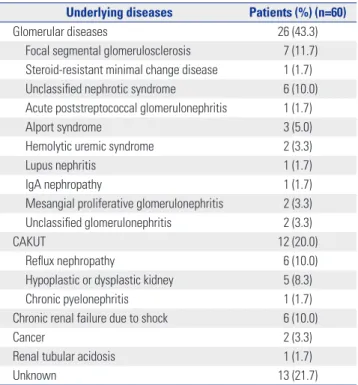
Incidence of noninfectious complications of PD The mean duration of PD therapy was 28.7±42.1 months (range 1–240 months). The common causes that led to ESRD were glo- merular diseases (43.3%), followed by congenital anomalies of kidney and urinary tract (CAKUT) (20%) (Table 1).
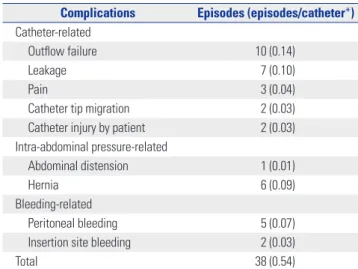
We divided the PD patients into those with and without me- chanical complications, and there were no statistically signifi- cant differences between the groups in gender, age at PD start, and total duration of PD (Table 2). Thirty-eight episodes of mechanical complications, not including metabolic complica- tions, occurred in 26 individuals (16 boys, 10 girls). The inci- dences of complications per catheter were as follows: outflow failure (14.3%), leakage (10.0%), hernia (8.6%), peritoneal bleed- ing (7.1%), inflow or outflow pain (4.3%), catheter tip migra- tion (2.9%), catheter injury by patient or care-giver (2.9%), and abdominal distension (1.4%) (Table 3).
We also divided the patients into 0–5-years and ≥6-years age groups (Table 4). Despite a relatively small number of patients, leakage was significantly more frequent in the 0–5-years age group than in the ≥6-years age group (Table 4).
Table 1. Causes of End-Stage Renal Disease in Patients on Peritoneal Dialysis
Underlying diseases Patients (%) (n=60)
Glomerular diseases 26 (43.3)
Focal segmental glomerulosclerosis 7 (11.7) Steroid-resistant minimal change disease 1 (1.7) Unclassified nephrotic syndrome 6 (10.0) Acute poststreptococcal glomerulonephritis 1 (1.7)
Alport syndrome 3 (5.0)
Hemolytic uremic syndrome 2 (3.3)
Lupus nephritis 1 (1.7)
IgA nephropathy 1 (1.7)
Mesangial proliferative glomerulonephritis 2 (3.3)
Unclassified glomerulonephritis 2 (3.3)
CAKUT 12 (20.0)
Reflux nephropathy 6 (10.0)
Hypoplastic or dysplastic kidney 5 (8.3)
Chronic pyelonephritis 1 (1.7)
Chronic renal failure due to shock 6 (10.0)
Cancer 2 (3.3)
Renal tubular acidosis 1 (1.7)
Unknown 13 (21.7)
CAKUT, congenital anomalies of kidney and urinary tract.
Table 2. Demographic Data of PD Patients with or without Mechanical Complications
With mechanical complications of PD (n=26) Without mechanical complications of PD (n=34) p value
Gender (M/F) 16/10 24/10 0.582
Age of PD commencement (months) 112.0±72.7 126.3±57.8 0.412
Total duration of PD (months) 29.9±38.7 27.8±45.1 0.928
PD, peritoneal dialysis.
After dividing the data into 5-year intervals, the incidence (episodes/catheter) of noninfectious complications of PD was highest during the years 2006–2012 (p=0.001) (Fig. 1). The high incidence of years 2006–2012 was thought to be attributable to the higher proportion of young patients, as young age was an important risk factor for noninfectious complications of PD.
The numbers of catheters used for 0–5-year-old patients were one (9.1%) in years 1986–1990, zero (0%) in years 1990–1995, five (55.6%) in years 1996–2000, seven (33.3%) in years 2001–
2006, and seven (64.6%) in years 2006–2012.
Metabolic complications, including hyperglycemia, hyper- natremia or hyponatremia, hyperkalemia or hypokalemia, and hypercalcemia or hypocalcemia within 1 month from starting PD, were observed in three (18.8%) of 16 patients: two patients (12.5%) had hyperglycemia, and one patient had hypokalemia (6.3%). However, the two patients with hyperglycemia at PD commencement showed no hyperglycemia after 1 month. Hy- pernatremia was not observed during the first month, although one patient showed mild hypernatremia (146 mmol/L) at the second month of PD. One patient had hyponatremia before
PD which persisted after PD, but no patient had newly devel- oped hyponatremia. Only one patient developed hypokale- mia, which is believed to be associated with potassium-free solution and high peritoneal permeability at the beginning of PD. The patients with such complications received conserva- tive care or were merely observed.
Patient outcomes
Three patients on PD were switched to HD. In the first patient, CAPD was started, but the PD catheter function was not ade- quate. Ultimately, he was treated with HD until kidney trans- plantation. In the second case, the patient’s cardiomegaly wors- ened, and the treatment was changed to HD. In the third case, the patient’s treatment was changed to HD due to catheter mal- function.
Another five patients required catheter reinsertion. Two pa- tients experienced catheter malfunction, one of whom also had catheter malposition. After reinsertion, the catheter func- tion was restored in these patients. Two cases of catheter injury were caused by the patient or care-giver. In the fifth patient, the catheter was reinserted due to oozing at catheter-insertion site.
Comparison of noninfectious complications of PD in different countries
The previous studies for noninfectious complications of PD in different countries are summarized in Table 5.4,6-10 Catheter-re- lated complications, such as catheter malfunction, leakage, and dislocation, were notable causes of technique failure. Although technique failure was not related to an increase in patient mor- tality, it resulted in an early switch to HD. A recent study in Iran showed a high rate (24.5%) of hernias in children with PD,6 while our study showed a relatively lower rate (8.7%), suggest- ing that hernias can also frequently occur in children with PD.
DISCUSSION
The main goal of this study was to investigate noninfectious Table 3. Frequency of Mechanical Complications of PD
Complications Episodes (episodes/catheter*) Catheter-related
Outflow failure 10 (0.14)
Leakage 7 (0.10)
Pain 3 (0.04)
Catheter tip migration 2 (0.03)
Catheter injury by patient 2 (0.03)
Intra-abdominal pressure-related
Abdominal distension 1 (0.01)
Hernia 6 (0.09)
Bleeding-related
Peritoneal bleeding 5 (0.07)
Insertion site bleeding 2 (0.03)
Total 38 (0.54)
PD, peritoneal dialysis.
*Total number of catheters: 70.
Table 4. Incidence of Mechanical Complications in 0–5 Years of Age Group and ≥6 Years of Age Group
0–5 yrs episodes (episodes/catheter*) ≥6 yrs episodes (episodes/catheter†) p value
Outflow failure 4 (0.20) 6 (0.12) 0.456
Leakage 5 (0.25) 2 (0.04) 0.018
Pain 0 (0.00) 3 (0.06) 0.552
Catheter tip migration 2 (0.10) 0 (0.00) 0.079
Catheter injury by patient 2 (0.10) 0 (0.00) 0.079
Abdominal distension 0 (0.00) 1 (0.02) 1.000
Hernia 2 (0.10) 4 (0.08) 1.000
Peritoneal bleeding 2 (0.10) 3 (0.06) 0.619
Insertion site bleeding 1 (0.05) 1 (0.02) 0.493
Total 18 (0.90) 20 (0.40) <0.0001
*Total number of catheters: 20, †Total number of catheters: 50.
complications of PD at Severance Hospital in Korea. Our study revealed that noninfectious complications were relatively common in children on PD. Noninfectious complications of PD can largely be divided into mechanical and metabolic complications. Mechanical complications include flow ob- struction, leakage, catheter disposition, and hernia. Common metabolic complications are hyperglycemia, hypertriglyceri- demia, and hyperinsulinemia. Recent studies have reported varying incidences of these complications.6-10 Although me- chanical complications are mainly caused by catheter-related problems and increased intra-abdominal pressure, appropriate catheter selection, adequate surgical technique, and proper postoperative care can prevent early catheter malfunction.2,11 Additionally, close collaboration between nephrologists, sur- geons, and radiologists will improve catheter function.
The most common mechanical complication in our center was outflow failure (14.3%). Some case series reported from different countries delineated the rate of outflow obstruction
between 4.8% and 24.5%.6,8 Outflow failure, the incomplete drainage of instilled dialysate, can be caused by constipation, catheter migration, intraluminal or extraluminal catheter oc- clusion, and catheter kinking.2,12,13 However, there are few data on the effect of catheter design and placement technique on long-term catheter survival and function.14,15 In our study, 10 patients had a variable degree of catheter malfunction; howev- er, only one patient required a change to HD, and two patients needed catheter reinsertion. Seven of these patients experi- enced restored catheter performance through conservative therapy, such as catheter irrigation, abdominal massage, and position change.
Pericatheter leaks are frequently observed within 30 days of catheter insertion. The spectrum of dialysate leaks includes any dialysate loss from the peritoneal cavity, ranging from pericatheter leakage to subcutaneous swelling and edema. A study by Hooman, et al.6 from Iran reported leakage rates as high as 17.6%, whereas the rate from an Italian group was 5.2%.8 Our study exhibited seven episodes (10.0%) of leakage, which was determined to be the second most common nonin- fectious complication of PD. One patient had a subcutaneous leak and required PD catheter reinsertion due to a hydrocele.
However, the remaining six patients with pericatheter leaks were treated with compression and by decreasing the dialysate volume.
Various study groups reported great variation in hernia rates (between 0% and 24.5%).6,7 Although there were one episode of ventral hernia and 5 episodes of inguinal hernia, two of whom developed twice. All of these patients underwent herni- orrhaphy.
Bloody PD effluent is called hemoperitoneum, and it has a good prognosis.2,11 We had five episodes of hemoperitoneum, and all of the patients recovered within several days. Heparin- mixed dialysate flushing was performed in all cases. Infusing Table 5. Comparison of This Study with Other Pediatric Studies for Noninfectious Complications of PD
Hooman, et al.6 Aksu, et al.7 Rinaldi, et al.8 Rahim, et al.9 Kim, et al.10 Park, et al.4 Ours Publication yr 2009 (Iran) 2007 (Turkey) 2004 (Italy) 2004 (USA) 2011 (Korea) 2003 (Korea) (Korea)
Study period 1993–2006 1995–2005 1986–2000 1990–2000 2001–2008 1991–2002 1986–2012
Number of patients 122
(102 catheters)
93 (108 catheters)
363 (503 catheters)
90 (127 catheters)
34 (34 catheters)
70 (93 catheters)
60 (70 catheters)
Age <14 yrs 3 months–16 yrs <15 yrs 0–21 yrs <18 yrs <18 yrs <18 yrs
Noninfectious complications of PD episode (episodes/catheter, %)
Catheter malfunction 25 (24.5) 14 (13.0)† 24 (4.8) 27 (21.3) 2 (5.9)‡ 9 (9.7) 10 (14.3)
Leakage 18 (17.6) 0 (0) 26 (5.2) 18 (14.2) 3 (8.8) 2 (2.2) 7 (10.0)
Abdominal pain - - - 3 (4.3)
Dislocation - 12 (11.1) 26 (5.2) - - 0 (0.00) 2 (2.9)
Hernia 25 (24.5) 0 (0) - - - - 6 (8.6)
Peritoneal bleeding - - 6 (1.2) - 0 (0.00) 3 (3.2) 5 (7.1)
Catheter insertion site bleeding 14 (13.7)* - - - 1 (2.9) - 2 (2.9)
PD, peritoneal dialysis.
*Bleeding after surgery, location was not described, †Including drainage problems and kinking, ‡Sum of obstruction and migration.
Fig. 1. Incidence of mechanical complications of peritoneal dialysis every 5 years.
Years 1986–1990
1991–1995
1996–2000
2001–2005
2006–2012
25
0 5
Episodes/catheter Total catheters Episodes
10 15 20
0.45
5 11
0.22
4 18
0.56
5 9
0.62
13 21
1.00 11
11
cool dialysate may also be helpful.
Migration of the catheter tip could be the cause of poor drain- age or inflow and pain during infusion or drainage. In our study, two patients had catheter tip migration, which lead to catheter malfunction. Kim, et al.10 suggested that laparoscopic PD cath- eter insertion would be better than classic open surgery, as laparoscopic surgery could fixate the catheter tip in the perito- neal cavity. Advanced laparoscopic technique facilitates rectus sheath tunneling and omentopexy and allows the catheter to be placed in the proper position under direct vision for lysis of adhesions.16-18 Thus, laparoscopic catheter insertion could be a good choice.
Disequilibrium syndrome is a well-known complication of HD, but it is rare in patients on PD. However, one patient in our study experienced disequilibrium syndrome. Decreasing the volume of dialysate and widening the interval of dialysate ex- change was beneficial in this case. Hyperglycemia and lipid metabolism abnormality are common complications of tradi- tional PD solutions and may persist or deteriorate during renal replacement therapy.19,20 The incidence of metabolic abnor- malities associated with PD was not high in our small number of patients, but long-term serial evaluation may be necessary in a large number of cohort. Glucose-sparing solutions such as icodextrin could be an option for avoiding the metabolic ef- fects of glucose and its byproducts.21
Although Rinaldi, et al.8 reported that there was no differ- ence in catheter survival between younger children (<2 years) and other age groups of PD patients, age may be an important factor for the outcome of PD. Hooman, et al.6 showed that young age (<24 months) was the only independent factor that predicted mortality of PD patients. In our study, young children (≤5 years) had more noninfectious complications than older children. Young children had a higher risk of injury than older children in catheter-related damage due to increased mucosal fragility and soft-tissue lesions. More important concerns are higher levels of physical activity and irritability after catheter insertion.
In conclusion, PD is the preferred dialysis modality for chil- dren requiring renal replacement therapy due to less interrup- tion of daily life and growth. Recently, treatment of peritonitis has been very successful, and noninfectious complications of PD have become relatively more important. The results of our study demonstrated that PD can be performed safely without severe complications, and noninfectious complications of PD rarely lead to catheter removal or HD in pediatric patients. The frequency of noninfectious complications of PD in our study was comparable with those of other pediatric studies.3,4,7-10,22 A reduction in noninfectious complications of PD can be achieved by optimal practices.23 Further randomized prospective stud- ies are necessary to determine a universal recommendation as to the insertion method of PD catheters and glucose-sparing strategies.
REFERENCES
1. Warady BA, Neu AM, Schaefer F. Optimal care of the infant, child, and adolescent on dialysis: 2014 update. Am J Kidney Dis 2014;
64:128-42.
2. McCormick BB, Bargman JM. Noninfectious complications of peritoneal dialysis: implications for patient and technique surviv- al. J Am Soc Nephrol 2007;18:3023-5.
3. Kim PK, Kim JH. Pediatric peritoneal dialysis in Korea: practical solutions to the problems of peritoneal dialysis for children. Perit Dial Int 1999;19 Suppl 2:S489-92.
4. Park SC, Jung SE, Lee SC, Park KW, Kim WK. Complications of Continuous Ambulatory Peritoneal Dialysis in Children. J Korean Assoc Pediatr Surg 2003;9:77-80.
5. Lee KO, Park SJ, Kim JH, Lee JS, Kim PK, Shin JI. Outcomes of peri- tonitis in children on peritoneal dialysis: a 25-year experience at Severance Hospital. Yonsei Med J 2013;54:983-9.
6. Hooman N, Esfahani ST, Mohkam M, Derakhshan A, Gheissari A, Vazirian S, et al. The outcome of Iranian children on continuous ambulatory peritoneal dialysis: the first report of Iranian National Registry. Arch Iran Med 2009;12:24-8.
7. Aksu N, Yavascan O, Anil M, Kara OD, Erdogan H, Bal A. A ten- year single-centre experience in children on chronic peritoneal dialysis--significance of percutaneous placement of peritoneal di- alysis catheters. Nephrol Dial Transplant 2007;22:2045-51.
8. Rinaldi S, Sera F, Verrina E, Edefonti A, Gianoglio B, Perfumo F, et al. Chronic peritoneal dialysis catheters in children: a fifteen-year experience of the Italian Registry of Pediatric Chronic Peritoneal Dialysis. Perit Dial Int 2004;24:481-6.
9. Rahim KA, Seidel K, McDonald RA. Risk factors for catheter-relat- ed complications in pediatric peritoneal dialysis. Pediatr Nephrol 2004;19:1021-8.
10. Kim HS, Jung SM, Lee SK, Seo JM. Comparison of the laparoscopic and open peritoneal dialysis catheter insertion in children. J Kore- an Assoc Pediatr Surg 2011;17:125-32.
11. Saha TC, Singh H. Noninfectious complications of peritoneal dial- ysis. South Med J 2007;100:54-8.
12. Ha IS. Peritoneal dialysis in children and adolescents. Korean J Pe- diatr 2009;52:1069-74.
13. Macchini F, Valadè A, Ardissino G, Testa S, Edefonti A, Torricelli M, et al. Chronic peritoneal dialysis in children: catheter related com- plications. A single centre experience. Pediatr Surg Int 2006;22:
524-8.
14. Negoi D, Prowant BF, Twardowski ZJ. Current trends in the use of peritoneal dialysis catheters. Adv Perit Dial 2006;22:147-52.
15. Flanigan M, Gokal R. Peritoneal catheters and exit-site practices toward optimum peritoneal access: a review of current develop- ments. Perit Dial Int 2005;25:132-9.
16. Jeong SI, Lee HY, Lee CG, Seo JM, Lee SK, Kim SJ, et al. Compari- son of early complications after peritoneal dialysis catheter im- plantation by laparoscopic surgery and conventional surgery in children. J Korean Soc Pediatr Nephrol 2007;11:51-8.
17. Hong SK, Kim SH, Ha IS, Jung SE, Park KW, Kim HY. Laparoscopic continuous ambulatory peritoneal dialysis (CAPD) catheter inser- tion in children: early experience comparison with open CAPD catheter insertion. J Korean Soc Endosc Laparosc Surg 2011;14:
106-10.
18. Stringel G, McBride W, Weiss R. Laparoscopic placement of peri- toneal dialysis catheters in children. J Pediatr Surg 2008;43:857-60.
19. Boyer J, Gill GN, Epstein FH. Hyperglycemia and hyperosmolality complicating peritoneal dialysis. Ann Intern Med 1967;67:568-72.
20. Bakkaloglu SA, Ekim M, Tümer N, Soylu K. The effect of CAPD on
the lipid profile of pediatric patients. Perit Dial Int 2000;20:568-71.
21. Holmes C, Mujais S. Glucose sparing in peritoneal dialysis: impli- cations and metrics. Kidney Int Suppl 2006:S104-9.
22. von Lilien T, Salusky IB, Boechat I, Ettenger RB, Fine RN. Five years’ experience with continuous ambulatory or continuous cy-
cling peritoneal dialysis in children. J Pediatr 1987;111:513-8.
23. Schaefer F, Klaus G, Müller-Wiefel DE, Mehls O. Current practice of peritoneal dialysis in children: results of a longitudinal survey.
Mid European Pediatric Peritoneal Dialysis Study Group (MEPPS).
Perit Dial Int 1999;19 Suppl 2:S445-9.