우엉뿌리추출물이 ICAM-1과 NO조절에 미치는 항염증효과
김예진, 강세찬1, 남궁승2, 정명근, 손은화*
강원대학교 생약자원개발학과, 1세명대학교 자연약재과학과, 2강원대학교 물리치료학과
Anti-inflammatory Effects by Arctium lappa L. Root Extracts through the Regulation of ICAM-1 and Nitric Oxide
Ye-Jin Kim, Se-Chan Kang1, Seung Namkoong2, Myoung-Gun Choung and Eun-Hwa Sohn*
Department of Herbal Medicine Resource, Kangwon National University, Samcheok 245-907, Korea
1Department of Natural Medicine Resources, Semyung University, Jecheon 309-711, Korea
2Department of Physical Therapy, Kangwon National University, Samcheok 245-907, Korea
Abstract - Atopic dermatitis is a chronic, allergic inflammatory skin disease that is accompanied by pruritic chronic eczema and markedly increased levels of inflammatory cells in endothelial cells. Arctium lappa L. is a popular edible vegetable cultivated in Asia. This study examined the effect of butanol extracts of A. lappa (ALBE) on the expression of adhesion molecule, ICAM-1 and the production of NO-iNOS induced by TNF-alpha in A549 endothelial cells. We also studied the effects of ALBE on the proliferation of keratinocyte. We observed significant inhibition of NO-iNOS production in dose-dependant manners and ALBE at 100 μg/mL suppressed the expression of ICAM-1 in TNF-α-induced A549 cells. In addition, the treatment of ALBE for 48 hrs increased the proliferation of HaCaT keratinocytes. These results support that ALBE has an anti-inflammatory effects for the treatment of atopic dermatitis.
Key words - Arctium lappa, ICAM-1, iNOS, NO, TNF-α
*
교신저자(E-mail) :[email protected]서 언
우엉(Arctium lappa L.)은 아시아 지역을 포함한 여러 국가에서 오랫동안 식이로 사용되어 왔던 식물이다. 특히, 우엉의 뿌리부위는 식품으로 사용되어 왔으며, 종자 부위는 이뇨제(diuretic), 해열제(antipyretic), 해독제(detoxifying agents)로 민간요법에서 사용되어 왔다(Fuchigami et al., 1990; Park et al., 2007). 실험적 증거들에 의하면 우엉 추출물에서 항염증작용(Lin et al., 1996; Kou et al., 2011), 자유라디칼의 소거작용(Chen et al., 2004), 항산 화작용(Maruta et al., 1995; Lee et al., 2009)이 보고되 었고, 항돌연변이작용(Morita et al., 1985) 및 간독성보 호작용(Lin et al., 2002)이 소수 보고되었다. 우엉의 주성 분에 대한 연구는 우엉 과실부위에서 분리된 리그난 성분의 arctigenin과 acrtiin의 효능이 보고되어 있다. Arctigenin
은 동물세포에서 열충격반응(heat shock response)의 억 제(Ishihara et al., 2006), 항암효과가 보고되었고(Jeong et al., 2011), arctiin은 쥐의 사구체염에 대한 회복효과 (Wu et al., 2009)와 cyclin D1을 억제하여 암세포 증식을 저해하는 항암효과가 보고되었다(Matsuzaki et al., 2008).
이와 같이 우엉추출물과 그 주요 성분들의 효능 연구가 점 차 진행되고 있지만, 항알러지 및 항아토피를 유발하는데 관련된 항염증 작용에 대한 기전 연구가 아직 충분히 보고 되지 않았다.
최근 염증반응에 대한 연구는 분자수준에서 활발히 이루 어졌다. 이러한 연구결과로 열(heat), 홍반(redness), 부 종(swelling) 등 3가지 증상으로 대표되었던 염증에 대한 정의가 염증을 일으키는 다양한 면역세포들과 이들이 분비 하는 염증매개인자들 그리고 염증매개인자들에 의한 세포 내 신호전달체계 등으로 더욱 구체화되었다. 염증반응은 손상된 조직으로 면역세포가 이동(migration)하면서 유발 되는데, 이러한 세포이동과정에 있어서 가장 중요한 역할
을 하는 것이 세포부착분자(cell adhesion molecule)의 발 현이다. 염증반응에는 세포부착분자의 발현 외에도 화학주 성을 유도하는 케모카인(chemokine)과 다양한 염증매개 요소들이 복합적으로 연관되어 있지만, 세포부착분자 발현 을 조절하는 항염증치료제 개발에 대한 연구는 면역세포들 의 이동을 억제함으로써 과도한 염증반응에 의한 조직손상 을 막을 수 있고, 염증반응의 초기단계를 차단할 수 있어 강력한 치료제 개발의 타겟점으로 이용되고 있다. 염증 반 응의 과정에서는 크게 ICAM-1(intracellular adheision molecule-1), VCAM-1(vascular CAM-1), E-selectin의 세포부착분자가 대표적으로 연구되고 있는데, 이 중 ICAM-1 은 염증 유발의 가장 강력한 단계로 인식되고 있다(Xu and Li, 2009; Kang et al., 2009).
염증반응과 매우 연관성이 있는 알러지 및 아토피 질환 은 최근 산업화, 도시화의 심화로 변화된 주거환경, 식생활 의 변화, 유전적인 영향, 환경오염에 의해 발생되는 화학 적, 생물학적 유해인자들에 대한 노출에 의해 유년기를 포 함한 다양한 연령층에서의 발생이 크게 증가하고 있다(Heo et al., 2008). 이는 인체가 무해한 외부환경에 대해서도 민감한 반응을 보이며, 지속적으로 천식이나 비염과 같은 호흡기계뿐만 아니라 만성 피부염증 즉 아토피 질환 등의 피부계 증상 등으로 일상생활은 물론 정서적인 면에도 악 영향을 미치는 것으로 알려져 있다(Lebovidge et al., 2009;
Fukamizu et al., 2009). 최근 2011년 본 연구팀에서는 우엉추출물이 알러지 유발에 대한 IL-4, IL-5 cytokine 의 생성을 억제하며 그 기전이 NF-kB 및 MAPKs 신호전 달기전을 경유한다는 결과를 발표한 바 있다(Sohn et al., 2011). 이에 본 연구에서는 우엉추출물이 만성염증으로 알 려진 아토피 질환에 적용할 수 있는 가능성을 확인하고자, 내인성 염증자극물질인 TNF-α에 의해 유도되는 염증반응 에서 면역세포와의 상호작용으로 알려진 상피세포의 ICAM-1 의 발현조절과 NO-iNOS의 유도 조절능력을 연구하고 피 부세포인 keratinocyte에 대한 세포증식조절을 연구함으 로써 우엉추출물이 만성 염증으로 알려진 아토피 질환의 사용에 필요한 기초 자료를 제공하고자 하였다.
재료 및 방법
세포주 및 재료
인간폐상피세포 A549(human lung adenocarcinoma
epithelial cell line) 세포는 American Type Culture Collection(ATCC, Manassas, VA)에서 구입하였고 10%
FBS, 2% penicillin-streptomycin(penicillin 10,000 unit/mL, streptomycin 10,000 μg/mL)을 첨가한 DMEM(Dulbecco’s modified Eagle’s medium) (GIBCO BRL, Grand Island, NY) 성장배지에서, HaCaT(human immortalized keratinocyte) 세포는 DMEM, 10% FBS, 2% penicillin-streptomycin에 2 mM L-glutamine를 첨가한 성장배지에 부착 배양하였 으며, 37℃, 5% CO2 조건을 유지하였다.
우엉추출물의 제조
대한민국 충청북도에서 재배한 우엉(Arctium lappa L.) 의 뿌리 부위를 수확, 수세 및 정선 후 생우엉 상태의 뿌리 1 kg을 30% 에탄올로 환류추출(10 L, 40℃, 24 h, 2회) 후, 추출액을 40℃에서 감압농축하여 건조분말 88.8 g을 수득 하였다. 건조분말 50 g을 1 L 물로 재용해시키고, 동량 부 피의 n-hexane, CH2Cl2, EtOAc 및 n-BuOH 용매로 분 획하여 n-hexane, CH2Cl2, EtOAc, n-BuOH, 및 H2O층 을 얻었다. 이와 같은 분획물 중에서 본 연구진의 선행연구 결과, n-BuOH층이 비만세포의 알러지 반응에 의한 β- hexosmainidase 분비를 가장 우수하게 억제시켰음으로 본 연구의 알러지 및 아토피에 대한 항염증 효과 또한 n-BuOH층을 이용하였다(Sohn et al., 2011). 본 연구에 사용된 n-BuOH층의 분획물은 22.0 g이 얻어졌으며, 실 험에 사용된 n-BuOH층을 A. lappa butanolic extract (ALBE)라고 명명하였다.
ICAM-1의 mRNA의 측정
TNF-α를 이용하여 A549 세포의 염증 환경을 만든 후, ALBE를 24시간 처리한 실험군과 ALBE를 처리하지 않은 대조군을 TRIzol reagent(Invitrogen Co., Carlsbad, CA) 를 이용하여 total RNA를 세포로부터 제조사의 방법에 따 라 분리하였다. 분리된 total RNA를 정량한 뒤, 다음과 같 은 ICAM-1(sense: 5′-CTGCTGGGAATTTTCTGGCCAC -3′, antisense: 5′-CTATGGCAACGACTCCTTCTCG-3′) 의 primer를 이용하여 RT-PCR를 실시하였다. 먼저 1 μg total RNA, 1 mM dNTP mix, 50 ng/ml Oligo(dT)12-18, DEPC-treated water를 10 μL가 되도록 혼합하였으며 65℃에서 5분간 반응한 후 4℃에서 2분간 방치하였다. 여 기에 2 μL의 10X RT buffer, 4 μL의 25 mM MgCl2, 1 μL
의 100 mM DTT와 1 μL의 RNaseOUT™ Recombinant RNase Inhibitor를 첨가하여 혼합한 후 42℃에서 2분간 반응시켰다. 그 다음 1 μL(50 units)의 SuperScript™ II RT 를 첨가한 후 42℃에서 50분간 추가 반응시킨 다음 70℃에 서 15분간 방치하여 반응을 종료하였다. 여기에 1 μL의 RNase H를 각 시료에 첨가하고 37℃에서 20분간 반응하여 template mRNA를 제거하였으며, 생성된 cDNA mixture 의 2 μL를 PCR 반응에 이용하였다. 이때 각각의 RT-PCR 에서 동량의 RNA가 사용되었음을 확인하기 위하여 house keeping gene인 β-actin에 대한 RT-PCR을 함께 진행하 였다.
Nitric oxide (NO) 생성능
A549 세포(1 × 10⁵ cell/mL)를 10% FBS, penicillin/
streptomycin을 함유한 RPMI 1640에 부유한 후 세포 부 유액을 96-well microplate에 100 μL씩 부착시킨 후 ALBE를 농도별로 처리하였다. 24 시간 후에 배양 상등액 100 μL를 취하여 96 microplate로 옮긴후 100 μL Griess Reagent(1% sulfanilamide, 0.1% napthyl-ethylenediamine dihydrochloride/2.5% H3PO4)를 넣고 10분간 실온에서 방치한 후 ELISA reader를 사용하여 흡광도 540 nm에서 측정하였다. Sodium nitrite 표준검량선으로부터 nitric oxide(NO)를 계산하였다.
iNOS 단백질 생성 측정
TNF-α를 이용하여 A549 세포의 염증 환경을 만든 후, ALBE를 24시간 처리한 실험군과 ALBE를 처리하 지 않은 대조군을 각각 lysis하여 총단백질을 얻었다. 정량 이 된 동일한 양의 단백질을 sodium dodecyl sulfate- polyacrylamide gel electrophoresis(SDS-PAGE) gel에 전기 영동한 후 PVDF membrane으로 Tank-type transfer unit을 이용하여 transfer 하였다. 단백질이 옮겨진 membrane 은 1시간 동안 상온에서 blocking buffer(5% skim milk 와 0.1% Tween20을 함유한 TBST용액)를 처리한 후 각 검 증 단백질에 대한 1차 항체(anti-iNOS)를 가하여 1~2시 간 동안 반응시켰다. 이어 TBST용액으로 10분간 3회 이상 세척 후 2차 항체(HRP-conjugated anti-IgG antibody)를 1시간 동안 상온에서 반응시켰다. 다시 3회 이상 세척 후에 detection reagent(Amersham™)를 가한 후 Fuji Mmedical X-ray film(Biomax Light)에 노출시켜 각 단백질의 발현
량을 확인하였다.
각질형성세포주의 세포증식효과
HaCaT 각질형성세포주를 96-well plate에 1 × 10⁵/well 이 되도록 분주하고 ALBE를 농도별로 처리한 후 각각 48 및 72시간 동안 배양한 후 MTT assay를 이용하여 세포 증 식능을 측정하였다. 원하는 처리한 후에 MTT solution 2 mg/mL을 25 μL씩 처리하고, 4시간 더 배양하여 formazan 을 형성하도록 하였다. 상등액을 제거하여 살아있는 세포 에서 생성된 formazan의 양을 DMSO로 녹여서 발색시킨 후 540 nm에서 흡광도를 측정하였다.
통계분석
실험 결과는 3회 반복하였으며, 가장 대표적인 실험결과 를 평균 ± 평균오차(mean ± S.E.M)로 나타내었고, 유의 수준은 #p<0.05, *p<0.05와 **p<0.01로 Student t′-test 를 실시한 결과를 표시하였다.
결과 및 고찰
ICAM-1의 발현에 미치는 영향
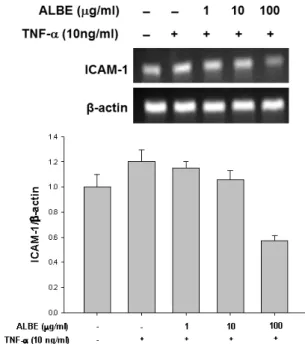
세포부착분자는 여러 염증성 질환의 발생에 중요한 역 할을 하는 세포 표면 당단백질(glycoprotein)로 구조적 차이에 따라 크게 selectins, integrins, immunoglobulin superfamily 등 세 가지로 나눠진다. 세포부착분자의 발현조 절에 의해 발생하는 염증세포의 내피 부착성은 염증 반응에서 초기에 일어나는 중요한 단계인데, 이 중 immunoglobulin superfamily에 속하는 ICAM-1의 발현은 각종 염증세포 의 이동 및 침윤을 유발 및 유지시키기 때문에 ICAM-1 발 현 억제는 염증 반응을 초기단계에 조절하는데 크게 작용 한다(Xu and Li, 2009). 본 연구에서는 ALBE가 TNF-α 내인성 염증성 사이토카인에 의해 유발된 A549 세포의 ICAM-1 mRAN의 전사과정에서의 발현 증가에 대하여 각 각 어떤 영향을 미치는지를 확인하였다. ALBE는 농도의존 적으로 TNF-α에 의해 증가된 ICAM-1의 발현을 감소시켰 으며, 특히, ALBE 100 μg/mL 에서 ICAM-1의 발현을 대 조군보다 더욱 감소시키는 양상을 나타내었다(Fig. 1). 이 러한 결과는 ALBE가 ICAM-1 발현 억제 조절을 통해 다른 염증세포의 이동 및 침윤을 억제하여 항염증효과를 나타낼 수 있다는 것을 보여준다.
Fig. 1. The effect of ALBE (A. lappa butanolic extract) on ICAM-1 expression in TNF-α-treated A549 epithelial cells.
Cells were treated with ALBE in the absence or presence of TNF-α (10 ng/mL) for 24 h. Total mRNA was extracted and subjected to RT-PCR analysis for ICAM-1 and β-actin.
The data represents the mean ± S.E.M. of triplicate experiments.
Densitometric analysis of the immunoreactive bands. The control value was set as 1 and presented as a bar graph.
Similar observations were obtained in two other experiments.
Fig. 2. The effect of ALBE on the production of NO by A549 cells in the presense of TNF-α. Cells were treated with various doses of ALBE in the presense of TNF-α (10 ng/mL) for 24 hrs. The 24 hrs-conditioned media were collected for NO2- assay. The results are mean ± S.E.M of quintuplicates from a representative experiment (#p<0.05;
significantly different from the control, **p<0.01; significantly different from the TNF-α-treated group).
Fig. 3. The effect of ALBE on iNOS expression in TNF-α -treated A549 epithelial cells. Cells were treated with ALBE in the absence or presence of TNF-α (10 ng/mL) for 24 h.
Total protein was extracted and subjected to Western blot anaysis for iNOS expression in protein level. Densitometric analysis of the immunoreactive bands. The control value was set as 1 and presented as a bar graph. Similar observations were obtained in two other experiments.
NO 분비 및 iNOS 발현에 미치는 영향
NO(nitric oxide)는 주로 LPS 또는 TNF-α 등의 염증 유발물질에 의해 자극된 세포가 염증을 유발할 때 분비하는 염증반응 매개물질로 알려져 있다(Strieter et al., 1993).
이와 같은 NO의 생성은 L-arginine의 guanidino nitrogen 이 산화에 의해 L-citrulline으로 변화하는 L-arginine- nitric oxide 경로를 통하여 생성되는데, 대식세포, 호중구 등의 면역세포와 섬유모세포, 혈관의 평활근, 및 기도 상피 세포에 있는 inducible nitric oxide synthase(iNOS) 효 소의 활성에 의해 NO가 다량 생성되며 염증 반응을 증가시 킨다고 알려져 있다(Kwon et al., 2001; Esposito and Cuzzocrea, 2007). 본 연구에서는 ALBE의 항염증효과를 확인하기 위하여 TNF-α를 이용하여 A549 상피세포에 인 위적으로 염증반응을 일으켜 NO를 과량 생성하는 조건을 만들고, ALBE를 처리하여 NO 생성이 억제 조절되는지 확 인하였다(Fig. 2). TNF-α 단독처리군에 비하여 TNF-α에 ALBE를 함께 처리한 군에서 NO의 생성이 농도의존적으
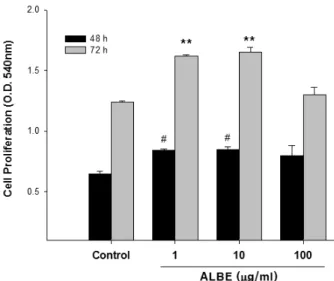
Fig. 4. The effects of ALBE on proliferation of keratinocyte.
HaCaT cells were treated with ALBE for 48 and 72 hrs.
The proliferation of keratinocytes (HaCaT) was assessed by MTT assay. Cell density was measured at 540 nm. The results are mean ± S.E.M of quintuplicates from a representative experiment (#p<0.05; significantly different from the control and **p<0.01; significantly different from the control groups in 48 hrs and 72 hrs respectively).
로 유의성 있게 감소하였다. TNF-α에 의한 NO의 생성이 iNOS의 효소 유도에 의한 것인가 확인하기 위하여 NO를 증가시켰던 동일한 실험환경에서 ALBE를 처리하여 iNOS 의 발현량을 측정하였다. Fig. 3에서 보여주는 바와 같이 ALBE는 TNF-α에 의한 iNOS의 발현을 농도 의존적으로 억제하고 있으며, 이는 NO의 생성 억제효과와 동일한 패 턴을 보여주었다.
Keratinocyte 세포 증식 효과
각질형성세포(keratinocyte)는 피부의 각질층 구성에 필수적인 세포로 피부에서 발생하는 면역반응의 1차적인 방어체로 작용한다. 인체와 외부환경 사이의 투과막인 피 부 각질장벽이 손상되면 경표피수분손실(transepidermal water loss)이 증가되고 수분결합력(water-bindng capacity) 이 감소되어 소양증이 심해지고 피부가 건조해진다(Schaefer et al., 1991). 그러므로 이러한 각질형성세포의 증식은 알 러지성 염증 질환을 완화시킬 수 있다. 실험 결과 ALBE 는 48시간부터 매우 유의성있는 세포증식능을 보여주었다 (Fig. 4). 기존의 보고들에 의하면 우엉추출물에서 분리한
artigenin과 arctiin에서는 다양한 암세포주에서 성장을 억제시켰다고 보고하였다(Matsuzaki et al., 2008; Jeong et al., 2011). 그러나 본 실험결과에서는 HaCaT 각질형성 세포의 증식을 오히려 증가시켰다. 본 실험에 사용된 우엉 은 정제된 성분이 아닌 다양한 성분이 들어있는 복합물이 라는 점과, HaCaT세포가 immortalized cell로 알려져 있 는 정상세포라는 점이 달라서 세포증식에 대한 이와 같은 상반된 결과를 나타낼 수 있을 것이라고 생각된다. 함께 포 함된 다른 유효성분에 의한 효과일 수 있으며, 암세포의 cell cycle은 정상세포와는 달라서 HaCaT에서의 영향은 전혀 다른 환경에서의 작용일 것이라고 생각된다. 그러나 우엉추출물 또는 그 주요성분이 세포주기 및 세포증식과정 에서 영향을 미치고 있음은 확실한 것으로 판단되며, 특히 정상세포와 암세포의 세포증식에서 차별적인 효과를 나타 낸다면 부작용이 없는 항암제 개발에 크게 기여할 것으로 생각된다.
적 요
본 연구는 우엉추출물의 항염증효과를 측정하였다. 인간 유래 폐상피세포 A549를 이용하여 염증반응을 유발하고 유지시키는데 중요한 역할을 나타낸다고 알려진 ICAM-1 의 억제적 조절 효과를 평가하였으며, 염증매개인자로 알 려진 NO와 이의 생성에 영향을 미치는 iNOS의 발현조절 에서도 억제효과가 있음을 확인하였다. 또한, 우엉추출물 이 인간각질형성세포주의 세포증식에 효과가 있음을 나타 내었다. 본 연구에서 사용되는 폐상피세포는 호흡기질환의 천식 등의 알러지 및 만성염증연구에 주로 활용되고 있으 며, 각질형성세포는 아토피 피부염의 만성 염증반응에서 주요하게 확인하는 요소이다. 따라서 본 연구결과에서 나 타난 우엉추출물의 항염증 효과는 다양한 염증반응에서도 특히, 알러지 및 아토피 피부염 질환을 더욱 악화시키는 만 성 염증에 있어서 우엉추출물이 유용한 소재로 사용될 수 있음을 시사한다고 할 수 있다.
사 사
본 연구는 농림수산식품부 농림기술개발사업의 지원에 의해 이루어진 결과물임을 밝힙니다.
인용문헌
Chen, F.A., A.B. Wu and C.Y. Chen. 2004. The influence of different treatment on the free radical scavenging activity of burdock and variations of its active components. Food Chem. 86:479-484.
Esposito, E. and S. Cuzzocrea. 2007. The role of nitric oxide synthases in lung inflammation. Curr. Opin. Investig. Drugs 8(11):899-909.
Fuchigami, M., Y. Kishigami and A. Sasaki. 1990. Pectic polysaccharides in edible burdock root. J. Home Economics Japan 41:947-962.
Fukamizu, R., M.H. Jang and M. Miyasaka. 2009. The role of eosinophils in allergic inflammation and intestinal immunity. Nippon Rinsho. 67(11):2088-2093.
Heo, Y. and H.A. Kim. 2008. Correlation between skin prick test and enzyme-linked immunoabsorbent assay using serum for identification of subjects positive to major respiratory allergens. J. Env. Hlth. Sci. 24(5):369-373.
Ishihara, K., N. Yamagishi, Y. Saito, M. Takasaki, T.
Konoshima and T. Hatayama. 2006. Arctigenin from Fructus arctii is a novel suppressor of heat shock response in mammalian cells. Cell Stress Chaperones 11(2):154-161.
Jeong, J.B., S.C. Hong, H.J. Jeong and J.S. Koo. 2011.
Arctigenin induces cell cycle arrest by blocking the phosphorylation of Rb via the modulation of cell cycle regulatory proteins in human gastric cancer cells. Int.
Immunopharmacol. 11(10):1573-1577.
Kang, N.S. S. Pyo and E.H. Sohn. 2009. Inhibitory effects of allicin on TNF-α-induced ICAM-1 expression is associated with catalase. J. Korean Plant Res. 22(6):552-557.
Kou, X., S. Qi, W. Dai, L. Luo and Z. Yin. 2011. Arctigenin inhibits lipopolysaccharide-induced iNOS expression in RAW264.7 cells through suppressing JAK-STAT signal pathway. Int. Immunopharmacol. 11(8):1095-102.
Kwon, S., R.L. Newcomb and S.C. George. 2001. Mechanisms of synergistic cytokine-induced nitric oxide production in human alveolar epithelial cells. Nitric Oxide 5(6):534-546.
Lebovidge, J.S., H. Strauch, L.A. Kalish and L.C. Schneider.
2009. Assessment of psychological distress among children and adolescents with food allergy. J. Allergy Clin. Immunol.
124(6):1282-1288.
Lee, M.Y., S.L. Shin, S.H. Park, N.R. Kim, Y.D. Chang and C.H. Lee. 2009. Development of optimal cultivation conditions and analysis of antioxidant activities of Arctium
lappa sprout vegetables. J. Korean Plant Res. 22(4):
281-363 (in Korean).
Lin, C.C., J.M. Lu, J.J. Yang, S.C. Chuang and T. Ujiie.
1996. Anti-inflammatory and radical scavenge effects of Arctium lappa. American J. Chin. Med. 24:127-137.
Lin, S.C., C.H. Lin, C.C. Lin, Y.H. Lin, C.F. Chen, J.C.
Chen and L.Y. Wang. 2002. Hepatoprotective effects of Arctium lappa L. on liver injuries induced by chronic ethanol consumption and potentiated by carbon tetrachloride tetrachloride. J. Biomed. Sci. 9:401-409.
Maruta, Y., J. Kawabata and R. Niki. 1995. Antioxidative caffeoylquinic acid derivatives in the roots of burdock (Arctium lappa L.). J. Agric. Food Chem. 43:2592-2595.
Matsuzaki, Y., M. Koyama, T. Hitomi, T. Yokota, M.
Kawanaka, A. Nishikawa, D. Germain and T. Sakai.
2008. Arctiin induces cell growth inhibition through the down-regulation of cyclin D1 expression. Oncol. Rep.
19(3):721-727.
Morita KY, Y. Nishijima and T. Kada. 1985. Chemical nature of a desmutagenic factor from burdock (Arctium lappa L.). Agric. Biol. Chem. 49:925-932.
Park, S.Y., S.S. Hong, X. Han, J.S. Hwang, D. Lee, J.S. Ro and B.Y. Hwang. 2007. Lignans from Arctium lappa and their inhibition of LPS-induced nitric oxide production.
Chem. Pharm. Bull. 55:150-152.
Schaefer, L. and K. Kragballe. 1991. Abnormalities in epidermal lipid metabolism in patients with atopic dermatitis. J. Invest. Dermatol. 96:10-15.
Sohn, E.H., S.A. Jang, H. Joo, S. Park, S.C. Kang, C.H. Lee and S.Y. Kim. 2011. Anti-allergic and anti-inflammatory effects of butanol extract from Arctium Lappa L. Clin.
Mol. Allergy 9(1):4.
Strieter, R., S. Kunkel and R. Bone. 1993. Role of Tumor Necrosis Factor-Alpha in Disease States and Inflammation.
Critical Care Medicine 21:S447-S463.
Wu, J.G., J.Z. Wu, L.N. Sun, T. Han, J. Du, Q. Ye, H. Zhang and Y.G. Zhang. 2009. Ameliorative effects of arctiin from Arctium lappa on experimental glomerulonephritis in rats. Phytomedicine 16(11):1033-1041.
Xu, Y. and S. Li. 2009. Blockade of ICAM-1: a novel way of vasculitis treatment. Biochem. Biophys. Res. Commun.
459-461.
(접수일 2011.8.29; 수정일 2011.10.7; 채택일 2011.11.16)