2015년 7월 http://dx.doi.org/10.5000/EESK.2015.19.4.161
지진격리 강재 케이블 교량의 다지점 진동대 실험
Multi-support excitation shaking table test of a base-isolated steel cable-stayed bridge
김성도1) ・ 안진희2) ・ 공영이3) ・ 최형석3) ・ 정진환3)*
Kim, Seong-Do1)* ・ Ahn, Jin-Hee2) ・ Kong, Young-Ee3) ・ Choi, Hyoung-Suk3) ・ Cheung, Jin-Hwan3)*
1)경성대학교 토목공학과, 2)경남과학기술대학교, 토목공학과, 3)부산대학교, 사회환경시스템공학과
1)School of Civil, Urban, and Environmental Engineering, Kyungsung University 2)Department of Civil Engineering, Gyeongnam National University
of Science and Technology 3)Department of Civil and Environmental Engineering, Pusan National University.
/ A B S T R A C T /
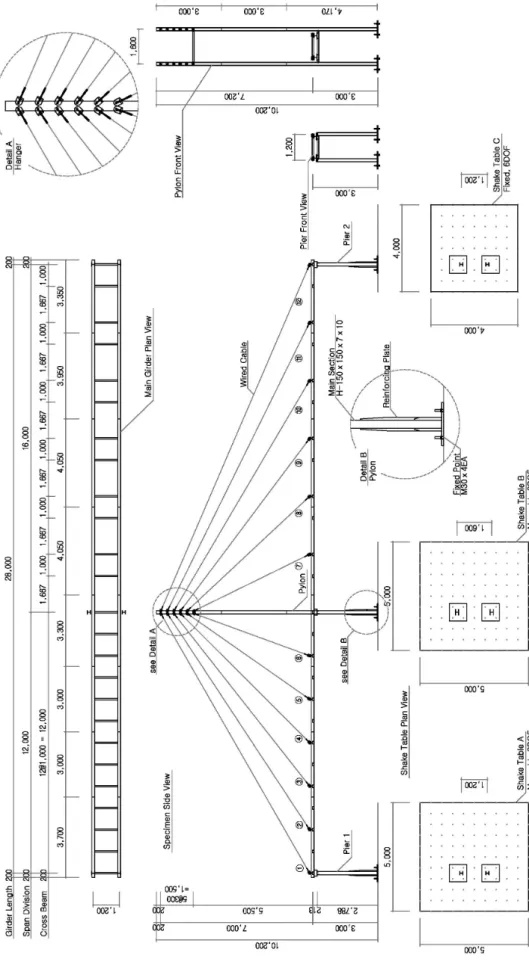
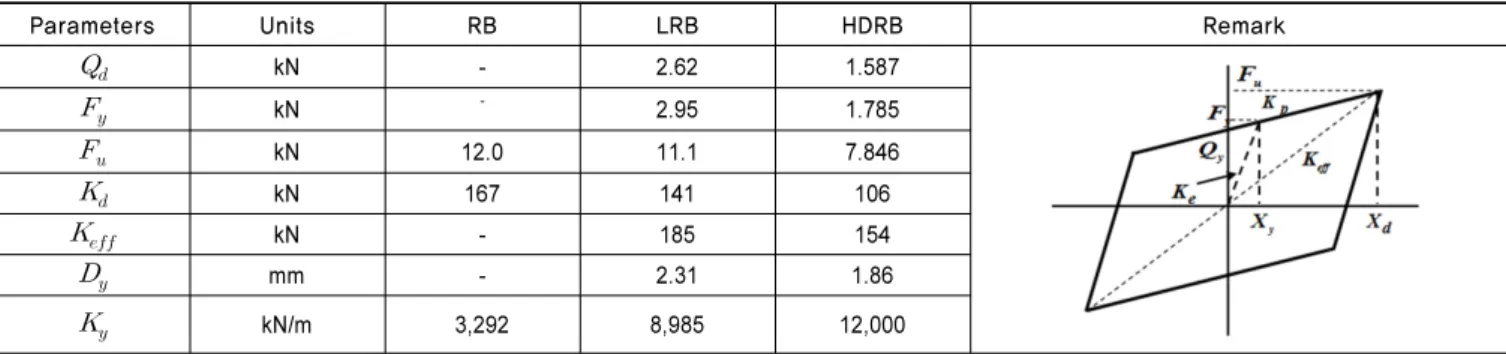
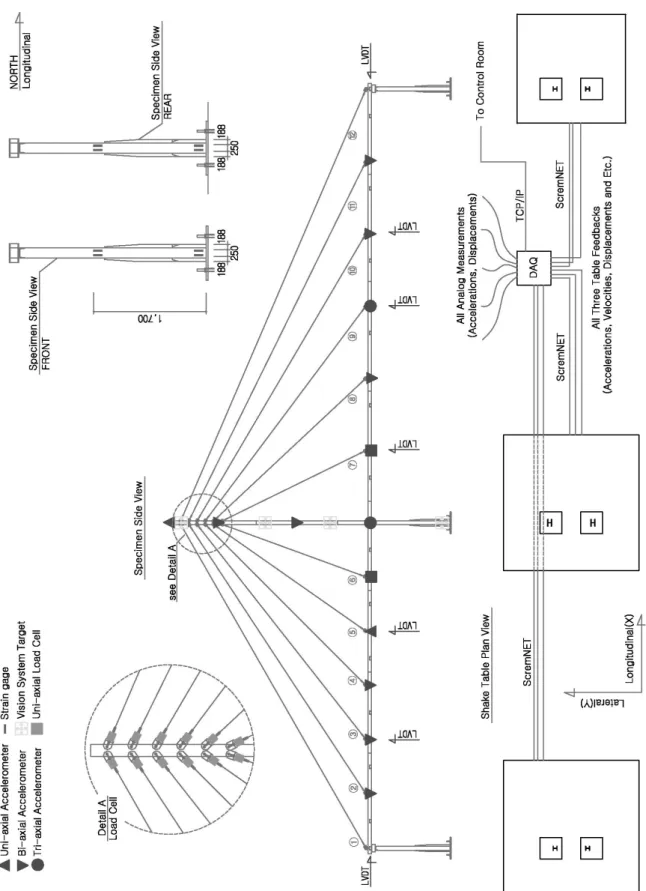
A series of tests was conducted for full-scale single-pylon asymmetric cable-stayed bridges using a system of multiple shaking tables. The 2-span bridge length was 28 m, and the pylon height was 10.2 m. 4 different base conditions were considered: the fixed condition, RB (rubber bearings), LRB (lead rubber bearings), and HDRB (high damping rubber bearings). Based on investigation of the seismic response, the accelerations and displacements in the axial direction of the isolated bridge were increased compared to non-isolated case.
However, the strain of the pylon was decreased, because the major mode of the structure was changed to translation for the axial direction due to the dynamic mass. The response of the cable bridge could differ from the desired response according to the locations and characteristics of the seismic isolator. Therefore, caution is required in the design and prediction in regard to the location and behavior of the seismic isolator.
Key words: Steel cable-stayed bridge, Multi-support excitation shaking table, Dynamic response, Base-isolation condition.
*Corresponding author: Cheung, Jin-Hwan E-mail: [email protected]
(Received March 9, 2015; Revised May 19, 2015; Accepted May 21, 2015)
1. Introduction
Cable-stayed bridges have become very popular for their long span, structural efficiency, economical construction, and aesthetic advantages.
However, they can be susceptible to large-amplitude vibration under seismic, wind, traffic, and rain loadings because of their structural flexibility, low mass, and low damping (less than 5% critical damping) [1]. Base-isolation techniques using isolation bearings are generally used in continuous girder bridges, and they have been considered for cable-stayed bridges to reduce the large deck displacement and base shear of the towers [2].
Various studies have numerically investigated the effectiveness of base isolation for bridges [3, 4]. However, there has been no experimental research for seismically isolated cable-stayed bridge system. The shaking table test is well known as the most useful and effective
method to examine the seismic and dynamic behaviors of structural model fabricated based on the similitude law. Only a few experimental studies have been carried out for the cable bridges, and they used small-scale models without isolation bearings[5-7]. The space and payload limitation of shake table test systems and severe similitude requirements for dynamic testing significantly increase the difficulty [8]. Therefore, numerical analysis methods have mainly been used to evaluate seismic behaviors.
Multiple-shake-table systems have become a great approach to
examine full-scale multi-span bridges dynamically with the advance of
hydraulic actuators. Shoji et al.[9] examined the seismic response of a
PC cable-stayed bridge using a 1:100 scale model with long-period
ground motion. Yang et al.[10] examined the effect of wave
propagation on the seismic response of cable-stayed bridges using a
1:120 scale model and multiple shake tables. Zong et al.[11] also
conducted shaking table tests for a multi-span cable-stayed bridge
under multi-support excitations using a 1:100 scale model of a
three-tower bridge under uniform and non-uniform excitation. In these