*정회원, 분당서울대학교병원 디지털헬스케어 연구사업부
**정회원, 분당서울대학교병원 가정의학과 (교신저자) 접수일자: 2019년 10월 22일, 수정완료: 2019년 11월 22일 게재확정일자: 2019년 12월 6일
Received: 22 October, 2019 / Revised: 22 November, 2019 / Accepted: 6 December, 2019
**Corresponding Author: [email protected]
Dept. of Family Medicine, Seoul National Univ. Bundang Hospital, Korea
https://doi.org/10.7236/JIIBC.2019.19.6.117
JIIBC 2019-6-17
의사들의 의료정보 시스템 수용도에 영향을 미치는 요인에 관한 연구
A Study on factors affecting physician's acceptance of Electronic Health Record(EHR) System
정세영*, 이기혁**
Se-Young Jung*, Kee-Hyuck Lee**
요 약 성공적 EHR 구현을 위해서는 의사들의 EHR에 대한 수용도(acceptance)와 태도(attitude)를 이해하는 것이 중요하다. 본 연구에서는 사우디 아라비아에 수출된 한국 EHR에 대한 사우디아라비아 의사들의 수용도(acceptance)를 조사하여 한국 EHR의 해외 확산을 위한 기초자료를 제공하고자 하였다. 의사가 EHR을 수용하는 주요 요인인 의사의 참여도, 적절한 훈련, 의사의 자율성, 의사와 환자와의 관계, 사용편리성, 유용성, 태도 중 자율성과 의사와 환자와의 관 계 요인을 제외하고는 모두 Likert 척도 3.5점으로 높게 조사되었다. 의사들의 한국 EHR을 실제 사용한 경험이 EHR 수용태도에 영향을 미쳤을 것이며, 긍정적인 연구결과로 비추어 볼 때 한국산 EHR이 해외 시장에서도 충분히 경쟁력이 있다고 판단할 수 있다.
Abstract For successful EHR implementation, it is important to understand physicians's acceptance and attitude for EHR. This study aims to provide basic information for the overseas expansion of Korean EHR by studying Saudi Arabia's physicians' acceptance for the Korean EHR exported to Saudi Arabia. Except for physician autonomy and physician-patient relationship, Likert scales of physician involvement, adequate training, ease of use, usefulness, and attitude about EHR usage were over 3.5 points, which are relatively high. The Physicians' experience of Korean EHR may have influenced the EHR acceptance score. Based on the positive research results of this study, we can say that Korean EHR can be competitive in the overseas EHR business.
Key Words : EHR acceptance, Saudi Arabia physician, Korean EHR, EHR export
Ⅰ. 서 론
의료와 IT 융합으로 인해 변화하고 있는 의료 시장에 서 의료인들에게 편의를 제공하는 의료정보시스템
(Electronic Health Record, EHR)의 중요성은 끊임없 이 강조되고 있다.
[1]-[4]국내 의료 시장의 경우 전체 의료기관의 90% 이상이
EHR을 사용하며 보급률이 전세계 최고 수준이고 관련된
IT 소프트웨어에서도 높은 기술력을 보유하고 있다.
[5]-[8]미국에서는 2009년 경기부양법(American Recovery and Reinvestment Act, ARRA) 의 하위 법인 건강정보 기술법(Health information Technology for Economic and Clinical Health, HITECH) Act에 따 라 오바마 정책으로 300억 달러의 예산이 투입되면서 상 호운용성을 보장하는 EHR 시스템을 도입하는 의원이나 병원에 다양한 인센티브를 제공하며 전체 의료기관의 EHR 보급률을 확대하였다.
[9]이런 의료 산업의 변화에 발맞춰 국내 일부 기업에서 는 국내병원에 EHR 시스템을 구축한 경험 및 기술력을 바탕으로 해외 의료 시장에 진출하려고 노력하고 있다.
하지만 해외와 국내 의료 환경 및 프로세스가 매우 상이 하고 실제 EHR 을 사용하는 의료진의 인식 및 태도가 다 양하기 때문에 이를 적절히 반영하여 EHR 시스템을 구 축하는 것이 쉽지 않은 실정이다.
성공적으로 EHR 시스템을 구현하기 위해서는 기본적 으로 그 병원 프로세스를 충분히 반영한 프로그램 개발 과 함께 그 프로그램을 사용하게 될 사용자의 인식 조사 가 필수적이다.
[10]특히, 의사(physician)는 환자 치료에 있어 주요 조력자 및 제공자로써 EHR 시스템의 주요 사 용자이기 때문에
[11]EHR 시스템에 대한 그들의 수용도 (acceptance)와 태도(attitude)를 이해하는 것이 매우 중요하다.
의사들의 EHR 수용도 및 인식, 태도에 영향을 미치는 요인 분석은 이미 이전부터 많은 연구에서 진행되어 왔
다.
[12]-[14]특히, TAM(Technology Acceptance Model)
기반의 이론적 모델을 적용하여 사용자의 의도된 행동들 을 통해 그들의 실제 시스템 사용을 예측하는 설계가 대 부분 이였다.
[15]본 연구에서도 앞서 진행되었던 연구 모 델 및 결과를 참고하였고 다른 연구와는 차별적으로 사 우디아라비아 병원에 구축된 한국산 EHR에 대한 사우디 아라비아 의사들의 수용도(acceptance)를 알아보고자 하였다.
본 연구 결과는 한국산 EHR 시스템이 해외 시장에 수 출되어 성공적으로 구현되기 위한 기초자료로 활용될 수 있을 것이다.
Ⅱ. 연구의 대상 및 방법
1. 연구의 대상본 연구는 한국산 EHR 시스템을 사용하고 있는 사우
디아라비아 Al Jubail 에 위치한 Royal Commission 병원에서 실시되었다. 이 병원은 2017년 10월부터 한국 산 EHR 시스템을 도입하여 사용하기 시작하였다.
설문조사는 자발적으로 동의한 25명의 의사를 대상으 로 하였고 기간은 시스템 도입이 후 한 달 이후인 2017 년 11월 11일부터 23일까지 총 2주간 진행되었다. 설문 방식은 면대면 자기기입식 응답 방식 이였다.
2. 연구의 도구
본 연구에서 사용한 설문지는 Aldosari(2003)
[16]와 Cork, Detmer, Friedman(1998)
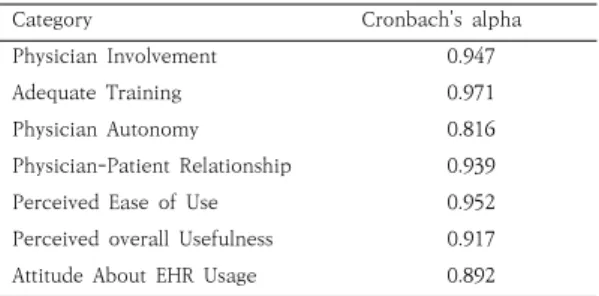
[17]에 의해 개발된 설 문 문항을 기반으로 구성되어 있으며 이 항목들은 이미 많은 연구에서 검증되었다. 설문 내용은 기본적인 인구 사회학적 정보와 함께 EHR 수용태도(Acceptance)에 영향을 줄 수 있는 7가지 요인으로 의사의 참여도 (Physician Involvement) 5문항, 적절한 훈련(Adequate Training) 4문항, 의사의 자율성(Physician Autonomy) 7문항, 의사와 환자와의 관계(Doctor-Patient Relationship) 4문항, 사용편리성(Perceived Ease of Use) 4문항, 유용성(Perceived Overall Usefulness) 7 문항, 태도(Attitude about EHR) 6문항이 구성되어 있 다. 이외 사용 경험에 대해 자유롭게 기입할 수 있도록 기타의견 항목을 추가하여 총 47개 문항으로 질의하였 다. 도구의 신뢰도 계수(Cronbach's alpha)는 모두 0.8 이상으로 높은 신뢰성을 갖는다고 볼 수 있다. [표 1]
Category Cronbach's alpha
Physician Involvement 0.947
Adequate Training 0.971
Physician Autonomy 0.816
Physician-Patient Relationship 0.939
Perceived Ease of Use 0.952
Perceived overall Usefulness 0.917
Attitude About EHR Usage 0.892
표 1. 설문의 문항
Table 1. Items on the survey
측정도구는 “매우 동의하지 않는다 (Strongly Disagree)" 1점부터 “매우 동의한다 (Strongly Agree)”
5점까지로 Likert 5점 척도를 사용하였다.
3. 데이터 분석 방법
본 연구에서 수집된 자료는 SPSS 22.0 통계 프로그램
을 이용하여 다음과 같이 분석을 진행하였다.
첫째, 대상자의 일반적 특성은 실수, 백분율로 산출하 였다.
둘째, 대상자의 EHR에 대한 의사의 참여도, 적절한 훈련, 의사의 자율성, 의사와 환자와의 관계, 사용편리성, 유용성, 태도 점수는 평균과 표준편차로 산출하였다.
셋째, 대상자의 일반적 특성에 따른 EHR에 대한 의사 의 참여도, 적절한 훈련, 의사의 자율성, 의사와 환자와의 관계, 사용편리성, 유용성, 태도와의 차이는 t-test 와 ANOVA를 이용하여 분석하였고 사후검정으로는 Scheffe를 이용하였다.
넷째, EHR에 대한 의사의 참여도, 적절한 훈련, 의사 의 자율성, 의사와 환자와의 관계, 사용편리성, 유용성, 태도와의 상관관계는 Pearson‘s correlation coefficiency 로 분석하였다.
Ⅲ. 결 과
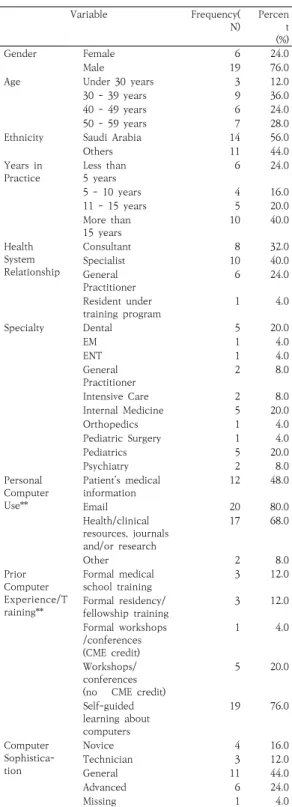
1. 설문 참여자의 일반적 특성대상자의 성별은 남자가 19명(76.0%)로 여자 6명 (24.0%)보다 많았고 연령에서는 30-39세가 9명(36.0%), 50-59세가 7명(28.0%), 40-49세가 6명(24.0%) 순으로 골고루 분포되었다. 인종은 사우디아라비아 국적이 14명 (56.0%)이고 그 외 11명(44%)은 중동, 이집트, 인도인 등으로 구성되었다. 병원에서 임상경력은 15년 이상의 경력자가 10명(40.0%)으로 가장 많았고 임상역할에서도 같은 비율로 Specialist 가 가장 많은 것으로 나타났다.
의사들의 전문분야는 치과(Dental), 내과(Internal Medicine), 소아과(Pediatrics)가 각각 5명(20.0%)으로 많은 비율을 차지했다.
컴퓨터 활용 측면에서 보면, 전체 대상자의 20명 (80.0%)이 E-mail을 확인하고 17명(68.0%)이 건강정보 및 저널을 확인하는데 컴퓨터를 사용한다고 응답하였다.
이전의 컴퓨터 경험에 대한 질문에서는 자가학습으로 습 득한 경우가 19명(76.0%)으로 가장 많았으며 컴퓨터 숙 련 측면에서는 11명(44.0%)이 보통 수준의 일반사용자 라고 응답하였다. [표 2]
Variable Frequency(
N) Percen (%)t
Gender Female 6 24.0
Male 19 76.0
Age Under 30 years 3 12.0
30 - 39 years 9 36.0
40 - 49 years 6 24.0
50 - 59 years 7 28.0
Ethnicity Saudi Arabia 14 56.0
Others 11 44.0
Years in
Practice Less than
5 years 6 24.0
5 - 10 years 4 16.0
11 - 15 years 5 20.0
More than
15 years 10 40.0
Health System Relationship
Consultant 8 32.0
Specialist 10 40.0
General
Practitioner 6 24.0
Resident under
training program 1 4.0
Specialty Dental 5 20.0
EM 1 4.0
ENT 1 4.0
General
Practitioner 2 8.0
Intensive Care 2 8.0
Internal Medicine 5 20.0
Orthopedics 1 4.0
Pediatric Surgery 1 4.0
Pediatrics 5 20.0
Psychiatry 2 8.0
Personal Computer Use**
Patient’s medical
information 12 48.0
Email 20 80.0
Health/clinical resources, journals and/or research
17 68.0
Other 2 8.0
Prior Computer Experience/T raining**
Formal medical
school training 3 12.0
Formal residency/
fellowship training 3 12.0
Formal workshops /conferences (CME credit)
1 4.0
Workshops/
conferences (no CME credit)
5 20.0
Self-guided learning about computers
19 76.0
Computer Sophistica- tion
Novice 4 16.0
Technician 3 12.0
General 11 44.0
Advanced 6 24.0
Missing 1 4.0
** multiple responses possible 표 2. 설문 참여자의 일반적 특성
Table 2. General characteristics of survey participants
Survey Item Mean SD
Physician Involvement 4.33 0.197
1) My involvement during EHR
implementation is a must 4.33 1.167
2) My involvement during EHR
implementation will be effective 4.12 1.191 3) My involvement during EHR
implementation will make EHR more useful to me
4.33 1.090
4) My involvement during
implementation will make EHR easier to be used
4.42 1.018
5) Overall, my involvement will positively
affect my attitude 4.46 0.779
Adequate Training 3.72 0.209
1) Training will be adequate 3.43 1.161 2) I will receive training I need to
understand/use EHR 3.70 0.974
3) Training will make EHR more useful
to me 3.87 1.014
4) Training will make EHR easier for me
to use 3.87 1.014
Physician Autonomy 3.27 0.163
1) *EHR will increase hospital 4.56 0.583 표 3. EHR 수용도에 미치는 7가지 요인에 대한 측정 점수 Table 3. Measurement Scores for Seven Factors on
EHR Acceptance
administration’s control
2) *EHR will increase RCH's ability to control/monitor physician’s clinical practices
4.48 0.653
3) *EHR may threaten physician’s
privacy 3.04 1.399
4) *EHR may result in legal/ethical
problems for physician 2.68 1.180
5) *EHR may limit physician’s
autonomy 2.60 1.323
6) *Overall, EHR may negatively affect physician’s attitude due to increased control/monitoring of clinical practices
2.96 1.513
7) *Overall, EHR may negatively affect physician’s attitude due to security, legal, ethical concerns
2.60 1.258
Doctor-Patient Relationship 2.99 0.243 1) *EHR may diminish patient’s
confidence in physician 2.88 1.269
2) *EHR may threaten physician’s credibility with patients
3) *EHR will likely decrease patient satisfaction
2.84 2.92 1.214
1.382
4) *Overall, EHR will likely interfere with
physician-patient interaction 3.32 1.406
Perceived Ease of Use 4.23 0.168
1) My interaction with EHR will be
user-friendly 4.20 0.816
2) Learning to use EHR will be easy for
me 4.12 0.833
3) I expect to become skilled using EHR 4.28 0.980 4) Overall, I expect EHR will be easy for
physicians to use 4.32 0.945
Perceived Usefulness 3.75 0.158
1) EHR will improve the quality of my
work 3.92 0.862
2) EHR will give me greater control over
my work schedule 3.84 1.068
3) EHR will allow me to accomplish tasks
more quickly 3.68 1.030
4) EHR will allow me to accomplish
more work 3.42 1.060
5) EHR will enhance my overall
effectiveness in my job 3.75 0.897
6) EHR will make my job easier to
perform 3.83 0.963
7) Overall, EHR should be a useful tool
for practicing 4.00 0.834
Attitude About EHR Usage 4.29 0.132 1) EHR will support physicians in
providing better care 4.36 0.638
2) I will encourage EHR among my
colleagues 4.40 0.645
3) I need the EHR to provide effective
patient care 4.24 0.879
4) I am not satisfied with using
paper-based patient records 3.84 1.248 5) All physicians should learn to use the
EHR effectively 4.44 0.651
6) Overall, my attitude about EHR usage
will be positive 4.48 0.653
* Items presented from negative perspective
2. 설문 대상자의 수용 태도에 영향을 미치는 요인
EHR 수용도(Acceptance)에 영향을 줄 수 있는 7가
지 요인으로 조사된 의사의 참여도 (Physician
Involvement)와 적절한 훈련(Adequate Training), 의
사의 자율성(Physician Autonomy), 의사와 환자와의
관계(Doctor-Patient Relationship), 사용 편리성
(Perceived Ease of Use), 유용성 (Perceived Overall
Usefulness), EHR에 대한 태도 (Attitude about EHR)
의 측정 점수는 표 3과 같다. 의사의 자율성과 의사와 환
자와의 관계 항목을 제외한 모든 항목에서 3.5점 이상으
로 동의하는 것으로 측정되었다. 의사의 자율성 항목에서
는 EHR 사용이 의사의 임상 진료 및 의사결정을 모니터
링 하며 통제하고 보안 및 법적 또는 윤리적 문제로 부정
적인 영향을 줄 수 있는지를 평가하였고 의사와 환자와
의 관계 항목에서는 EHR 사용이 의사와 환자와의 신뢰
관계를 저해하는지를 평가하였다. 이 두 가지 요인은 “동
의하지 않는다.”라고 점수가 낮게 체크 될수록 EHR 사용
에 대해 긍정적인 평가를 나타낸다. 본 연구에서는 의사
의 자율성이 3.27±0.163점이였고 의사와 환자와의 신
뢰관계가 2.99±0.243점으로 다른 항목에 비해 낮은 점
수로 평가되었다. [표 3]
Variable Physician
Involvement Adequate
Training Physician
Autonomy Physician-Patie
nt Relationship Perceived
Ease of Use Perceived overall Usefulness
Attitude About EHR Usage
M
(SD) t/F M
(SD) t/F M
(SD) t/F M
(SD) t/F M
(SD) t/F M
(SD) t/F M
(SD) t/F Gender
Female 4.00
(0.93) -0.86 3.37
(0.43) -0.74 3.26
(0.52) -0.04 2.91
(1.16) -0.16 4.45
(0.40) 0.75 3.61
(0.46) -0.63 4.55 (0.40) 1.12
Male 4.42
(0.97) 3.78
(1.07) 3.27
(0.89) 3.01
(1.25) 4.15
(0.93) 3.79
(0.87) 4.21
(0.70) Age
Under 30
years 4.60
(0.56) 0.38 2.00
(-) 1.19 3.33
(0.41) 1.09 3.41
(1.01) 0.33 4.41
(0.38) 1.11 3.66
(0.21) 1.33 4.44 (0.50) 0.10 30 - 39
years 4.26
(0.84) 3.91
(0.87) 3.20
(0.90) 3.00
(1.35) 4.36
(0.82) 3.74
(0.87) 4.25
(0.78) 40 - 49
years 4.63
(0.80) 3.58
(1.28) 3.73
(1.07) 3.16
(1.45) 4.50
(0.54) 4.23
(0.83) 4.36
(0.54) 50 - 59
years 4.08
(1.35) 3.82
(0.83) 2.93
(0.42) 2.64
(1.03) 3.75
(1.10) 3.38
(0.71) 4.21
(0.74) Ethnicity Saudi
Arabia 3.98
(1.16) -0.22 * 3.47
(1.12) -1.24 3.31
(0.94) 0.28 3.21
(1.28) 1.04 4.25
(0.65) 0.13 3.77
(0.79) 0.16 4.27 (0.68) -0.16
Others 4.74
(0.41) 3.97
(0.54) 3.22
(0.64) 2.70
(1.10) 4.20
(1.06) 3.72
(0.82) 4.31
(0.65) Years in
Practice
Less than 5 years 4.24
(0.75) 0.13 3.12
(0.82) 1.14 3.38
(0.49) 0.69 3.33
(0.86) 1.41 4.29
(0.33) 1.22 3.38
(0.36) 1.63 4.27 (0.38)b 5.91*
5 - 10 years 4.30
(0.80) 3.93
(0.12) 3.57
(0.98) 3.75
(1.25) 3.56
(1.26) 3.28
(1.16) 3.33
(0.79)a 11 - 15
years 4.16
(1.06) 3.35
(1.49) 2.82
(0.65) 2.25
(1.07) 4.60
(0.54) 4.08
(0.52) 4.63
(0.55)b More than
15 years 4.48
(1.16) 4.05
(0.58) 3.31
(0.97) 2.85
(1.34) 4.27
(0.93) 3.99
(0.84) 4.51
(0.44)b Computer
Sophistica tion
Novice 4.25
(0.75) 0.09 3.56
(0.82) 0.91 2.82
(0.56) 0.42 2.50
(1.73) 0.45 3.25
(0.86) 2.95 3.53
(1.18) 1.89 3.87 (1.20) 0.87 Technician 4.53
(0.80) 4.08
(0.87) 3.71
(1.13) 3.75
(1.14) 4.58
(0.38) 3.23
(0.54) 4.05
(0.78) General 4.38
(0.82) 3.62
(1.08) 3.14
(0.69) 2.79
(1.08) 4.25
(0.88) 3.63
(0.64) 4.40
(0.54)
Advanced 4.20
(1.50) 3.79
(1.20) 3.54
(1.03) 3.41
(1.19) 4.62
(0.49) 4.35
(0.74) 4.47
(0.34)
* p<.05
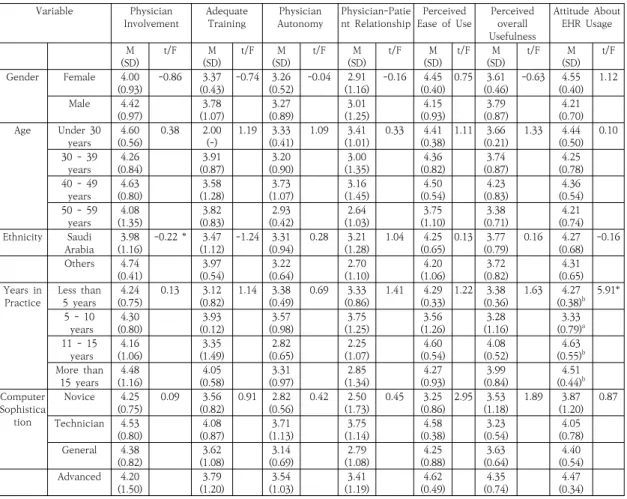
표 4. 의사의 일반적 특성에 따른 수용도에 미치는 요인의 차이 비교
Table 4. Comparison of factors affecting acceptance by general characteristics of physicians
3. 대상자의 일반적 특성에 따른 수용태도 요인 차이
대상자의 일반적 특성에 따른 7가지 요인(의사참여도, 적절한 훈련, 의사의 자율성, 의사와 환자와의 관계, 사용 편리성, 유용성, 태도)의 차이를 분석한 결과 의사의 참여 도 항목에서 인종이 사우디아라비아가 아닌 의사들이 4.74±0.41점으로 사우디아라비아 의사의 3.98±1.16점 보다 높게 나타났으며 통계적으로 유의하였다. EHR 사 용에 대한 태도 항목에서는 임상현장 근무경험이 5-10 년인 경우가 3.33±0.79점으로 5년 이하인 4.27±0.79 점, 11-15년 이상인 4.63±0.55점, 15년 이상인 4.51±0.44점보다 낮게 측정되었으며 통계적으로 유의 하게 나타났다.[표 4]
4. 대상자의 EHR 수용 태도 요인 간의 관계
대상자의 EHR에 대한 7가지 수용도 요인과의 관계를
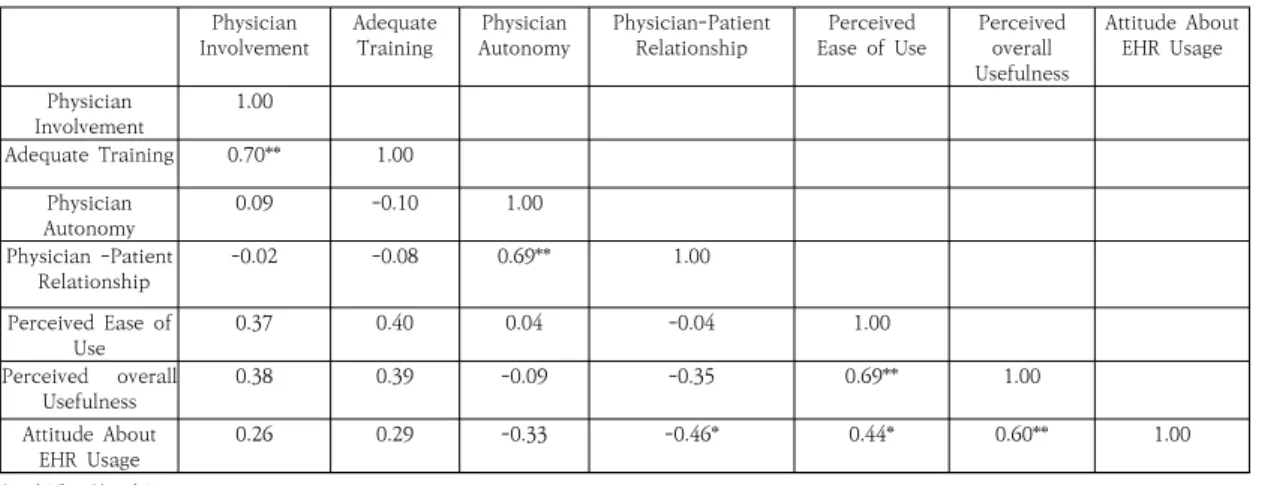
분석한 결과 의사의 참여도와 적절한 훈련과의 유의한 양의 상관관계를 나타내며 EHR 구현단계에서 적극적인 참여를 보일수록 훈련의 만족도가 높은 것으로 나타났다.
의사의 자율성과 의사와 환자의 관계 항목 간에도 유의 한 양의 상관관계가 나타났는데 EHR 사용이 의사의 자 율성에 부정적인 영향을 미친다고 생각할수록 의사와 환 자간의 상호관계에서도 의사에 대한 환자 신뢰가 감소될 수 있을 것이라고 측정되었다. EHR의 사용편리성과 유 용성도 유의한 양의 상관관계가 나타났다.
의사와 환자의 관계와 EHR 사용에 대한 태도 항목 간 에는 유의한 음의 상관관계를 보였는데 이는 EHR 사용 이 의사와 환자간의 신뢰를 감소시킨다고 생각할수록 EHR 사용에 부정적인 태도를 보일 것으로 파악되었다.
사용편리성 및 유용성과 EHR 사용에 대한 태도 항목 간
에는 유의한 양의 상관관계가 나타났다. [표 5]
Physician
Involvement Adequate
Training Physician
Autonomy Physician-Patient
Relationship Perceived
Ease of Use Perceived overall Usefulness
Attitude About EHR Usage Physician
Involvement 1.00
Adequate Training 0.70** 1.00
Physician
Autonomy 0.09 -0.10 1.00
Physician -Patient
Relationship -0.02 -0.08 0.69** 1.00
Perceived Ease of
Use 0.37 0.40 0.04 -0.04 1.00
Perceived overall
Usefulness 0.38 0.39 -0.09 -0.35 0.69** 1.00
Attitude About
EHR Usage 0.26 0.29 -0.33 -0.46* 0.44* 0.60** 1.00
* p<.05, ** p<.01
표 5. 대상자의 EHR 수용 태도 요인 간의 관계
Table 5. Relationships among factors of participants' EHR acceptance attitude
5. 기타 의견
EHR 수용 태도와 함께 한달 동안의 사용 경험을 바탕 으로 의사들의 기타 의견을 수렴한 결과, EHR 도입으로 인해 수기 문서 작업이 사라졌고 신속한 의사소통이 이 루어지며 업무 효율이 상승했다는 긍정적인 평가가 있었 다. 하지만 새로운 시스템 도입으로 인해 기존 프로세스 가 많이 변화되었기 때문에 이에 익숙하지 않은 상태에 서는 오히려 업무 지연이 초래될 수 있다는 부정적인 의 견도 있었다. 이 외 대부분은 EHR의 특정 화면 단위로 기능에 대한 장단점에 대한 의견을 제시하였다.
Ⅳ. 고 찰
임상 의료 현장에서 의료 오류를 감소시키며 환자 안 전에 기여하고 진료의 질과 효율성을 향상시키기 위한 목적으로 적극적으로 EHR을 사용하기 위하여 의사들의 EHR 수용 태도를 파악하는 것이 무엇보다 중요하다.
[10]본 연구에서는 의사가 EHR을 수용하는 주요 요인으로 기본적인 인구사회학적 정보와 함께 7가지 요인(의사의 참여도, 적절한 훈련, 의사의 자율성, 의사와 환자와의 관 계, 사용편리성, 유용성, 태도)을 평가하였다.
평가된 7가지 요인에서 의사의 자율성과 의사와 환자 와의 관계 요인을 제외하고는 모두 3.5점 이상으로 높게 측정되었다. 의사의 자율성과 의사와 환자와의 관계 요인 은 점수가 낮을수록 EHR사용에 긍정적인 평가를 나타내 는 항목이라는 것을 감안하면 모든 요인에서 긍정적으로 평가되었다고 할 수 있다.
대상자의 일반적 특성과 EHR 수용도 요인과의 관계 에서는 인종에 따른 의사의 참여도와 임상현장 근무경험 에 따른 EHR 사용 태도를 제외하고는 인구사회학적 변 수에서 대부분의 요인과 통계적으로 유의한 결과가 나타 나지 않았다. 이러한 결과는 이전 여러 연구에서 조사된 결과와 일치한다.
[18]-[25]특히 대다수(68%)가 자신의 컴 퓨터 사용 수준을 일반적인 수준이거나 그 이상으로 평 가하며 잘 다룬다고 생각하기 때문에 컴퓨터 사용 능력 이 EHR 수용태도에 큰 영향을 미치지 않는 걸로 조사되 었다.
앞서 소개한 바와 같이 EHR 사용은 많은 장점을 가지 고 있다. 그럼에도 불구하고 개인 정보의 보안 및 기밀을 해칠 수 있다는 우려는 EHR 사용에 있어 큰 장애 요인으 로 작용할 수 있다.
[26], [27]이런 요인은 EHR이 의료진과 환자의 관계 형성에 부정적인 영향을 미칠 수 있으며 직 접 치료 및 간호를 제공하는 의료진의 능력을 지원하는 도구로 활용되기 보다는 방해 요인으로 작용할 수 있다 고 보고되고 있다.
[28]-[30]본 연구 결과에서도 의사의 자 율성과 의사와 환자의 관계 항목 간에 유의한 양의 상관 관계를 보이며 EHR 사용이 보안적인 부분에서 부정적으 로 인식될수록 의사와 환자간의 신뢰도 측면에서도 위협 을 줄 수 있을 거라고 평가되었다.
EHR의 사용 편리성은 디자인과 기술적 이슈와 밀접 한 관련이 있다. 사용자 친화적으로 설계된 EHR 시스템 일수록 쉽고 빠르게 습득이 가능하며 업무 효율을 높이 는 효과적인 진료 보조 수단으로 인식될 가능성이 높
다.
[31]-[34]이는 곧 EHR 사용에 대한 수용태도에 긍정적
인 영향을 줄 수 있다. 특히 사용 편리성은 EHR 기능 단
위 별로 평가하는 것이 중요하다.
[10]예를 들면 의사들이 EHR 에서 가장 많이 사용하는 화면이 오더 입력 및 조 회, 기록 작성 및 조회, 검사결과 조회 화면 등인데 화면 별로 포함하고 있는 내용이나 사용 목적이 다르기 때문 에 디자인이나 기능이 서로 상이하기 때문이다. 실제 기 타 의견으로 조사된 결과에서도 화면 별로 의사들의 요 구사항이 다양하게 나왔다.
본 연구의 제한점은 설문 대상자 수가 25명의 소수 인 원으로 의사들의 EHR 수용 태도를 대표하기에는 한계가 있다는 점이다. 또한 특정 성향을 가진 집단에 의해 편향 된 결과가 나올 우려도 있다. 하지만 이런 제한점에도 불 구하고 본 연구는 한국산 EHR이 수출된 해외 병원의 의 사들을 대상으로 한국산 EHR의 수용 태도에 대한 설문 이 진행되었다는 점에서 다른 연구와 차별을 둘 수 있다.
특히 설문이 한국산 EHR 도입 이후 한 달 이내 진행되었 기 때문에 의사들의 실제 사용 경험이 EHR 수용태도에 영향을 미쳤을 것이며, 긍정적인 연구결과로 비추어 볼 때 한국산 EHR이 해외 시장에서도 충분히 경쟁력이 있 다고 판단할 수 있겠다.
추후 연구에서는 EHR을 사용하는 의사뿐만 아니라 간호사, 보건직 등 다양한 직군을 대상으로 수용 태도를 파악하고 한국산 EHR 수출 확대를 위해 실제 사용 경험 을 토대로 만족도 및 개선 점에 대한 조사가 병행해서 이 루어 질 필요가 있겠다.
Ⅴ. 결 론
한국산 EHR을 사용하는 외국 의사들은 EHR 수용도 에 영향을 미치는 대부분의 항목에서 긍적적인 답을 하 였다. 이는 한국산 EHR이 해외에서도 충분히 경잭력이 있음을 시사한다.
References
[1] Chaudhry B, Wang J, Wu S, Maglione M, Mojica W, Roth E, et al., “Systematic review: impact of health information technology on quality, efficiency, and costs of medical care”, Annals of internal medicine, 2006;144(10):742-52.
DOI:
https://doi.org/10.7326/0003-4819-144-10-20060516 0-00125
[2] Goldzweig CL, Towfigh A, Maglione M, Shekelle PG,
"Costs and benefits of health information technology:
new trends from the literature", Health affairs.
2009;28(2):w282-w93.
DOI: https://doi.org/10.1377/hlthaff.28.2.w282 [3] Keyhani S, Hebert PL, Ross JS, Federman A, Zhu CW,
Siu AL., "Electronic health record components and the quality of care. Medical care", 2008;46(12):1267-72.
DOI: https://doi.org/10.1097/MLR.0b013e31817e18ae [4] Buntin MB, Burke MF, Hoaglin MC, Blumenthal D., "The
benefits of health information technology: a review of the recent literature shows predominantly positive results", Health affairs. 2011;30(3):464-71.
DOI: https://doi.org/10.1377/hlthaff.2011.0178 [5] Do-Sun Song, Dong-Gyu Jeong, "Trend on Intelligent
Medical Devices and Service", The Journal of KIIT, Vol. 15, No. 2, pp. 41-48, 2017.
[6] JK Kim, SJ Lee, "Strategies and Implications of ICT Convergence Medical Industry in Major Countries", 2016.
http://www.bioin.or.kr/InnoDS/data/upload/industry/
f5de1128bb7843a68747e638186bd7f9.pdf
[7] Yong-Joon Lee, Taeyeol Jeon, “A Fingerprint Authentication Model of ERM System using Private Key Escrow Management Server”, Journal of the Korea Academia-Industrial cooperation Society(JKAIS), Vol.
20, No. 6 pp. 1-8, 2019
DOI: https://doi.org/10.5762/KAIS.2019.20.6.1 [8] Ho-Tae Lee, Byoung-Chul Kim, "Implementation of
Maritime Telemedicine System Using Android", The Journal of The Institute of Internet, Broadcasting and Communication (IIBC), Vol. 18, No. 6, pp.221-228, Dec. 31, 2018
DOI: https://doi.org/10.7236/JIIBC.2018.18.6.221 [9] Blumenthal D. "Stimulating the adoption of health
information technology", New England journal of medicine. 2009;360(15):1477-9.
DOI: https://doi.org/10.1056/NEJMp0901592 [10] Furukawa MF, King J, Patel V., "Physician attitudes on
ease of use of EHR functionalities related to Meaningful Use", The American journal of managed care. 2015;21(12):e684-92.
https://www.ncbi.nlm.nih.gov/pubmed/26760432 [11] Sittig DF, Kuperman GJ, Fiskio J, editors, "Evaluating
physician satisfaction regarding user interactions with an electronic medical record system", Proceedings of the AMIA Symposium; 1999: American Medical Informatics Association.
https://www.ncbi.nlm.nih.gov/pmc/articles/PMC22326 02/
[12] Morton ME, Wiedenbeck S., "EHR acceptance factors in ambulatory care: a survey of physician perceptions", Perspectives in Health Information Management/AHIMA, American Health Information Management Association. 2010;7(Winter).
https://www.ncbi.nlm.nih.gov/pmc/articles/PMC28055 55 [13] Nematollahi M, Moosavi A, Lazem M, Aslani N, Kafashi
M, Garavand A, "Factors Affecting in Adoption and Use of Electronic Medical Record Based on Unified Theory of Acceptance and Use of Technology in Iran", Shiraz E-Medical Journal. 2017;18(9).
DOI: https://dx.doi.org/10.5812/semj.57582
[14] Mehta N, Pandit A, "Perceptions of EMR System by Doctors in Pune (India)", Indian Journal of Public Health Research & Development. 2017;8(4).
DOI: http://dx.doi.org/10.5958/0976-5506.2017.00396.5 [16] Chang I-C, Hsu H-M, "Predicting medical staff intention to
use an online reporting system with modified unified theory of acceptance and use of technology", Telemedicine and e-Health. 2012;18(1):67-73.
DOI: http://dx.doi.org/10.1089/tmj.2011.0048 [16] Aldosari B, "Factors affecting physicians' attitudes
about the medical information system usage and acceptance through the mandated implementation of integrated medical information system at the Saudi Arabia National Guard Health System", A modified technology acceptance model. 2004.
[17] Cork RD, Detmer WM, Friedman CP, "Development and initial validation of an instrument to measure physicians' use of, knowledge about, and attitudes toward computers", Journal of the American medical informatics association. 1998;5(2):164-76.
DOI: https://doi.org/10.1136/jamia.1998.0050164 [18] Aaronson JW, Murphy-Cullen CL, Chop WM, Frey RD,
"Electronic medical records: the family practice resident perspective", Family medicine. 2001;33(2):128-32.
[19] Brown SH, Coney RD, "Changes in physicians' computer anxiety and attitudes related to clinical information system use", Journal of the American Medical Informatics Association. 1994;1(5):381-94.
DOI: https://doi.org/10.1136/jamia.1994.95153426 [20] Dansky KH, Gamm LD, Vasey JJ, Barsukiewicz CK,
"Electronic medical records: are physicians ready? ", Journal of Healthcare Management. 1999;44(6):440-54.
[21] Gadd CS, Penrod LE, editors, "Dichotomy between physicians' and patients' attitudes regarding EMR use during outpatient encounters", Proceedings of the AMIA Symposium; 2000: American Medical Informatics Association.
https://www.ncbi.nlm.nih.gov/pmc/articles/PMC22438 26/
[22] Gadd CS, Penrod LE, editors, "Assessing physician attitudes regarding use of an outpatient EMR: a longitudinal, multi-practice study", Proceedings of the AMIA Symposium; 2001: American Medical Informatics Association.
https://www.ncbi.nlm.nih.gov/pmc/articles/PMC2243374/
[23] Gardner RM, Lundsgaarde HP, "Evaluation of user acceptance of a clinical expert system", Journal of the American Medical Informatics Association.
1994;1(6):428-38.
DOI: https://doi.org/10.1136/jamia.1994.95153432
[24] Gaster B, Knight CL, Witt DE, Sheffield JV, Assefi NP, Buchwald D, "Physicians' use of and attitudes toward electronic mail for patient communication", Journal of General Internal Medicine. 2003;18(5):385-9.
DOI: https://doi.org/10.1046/j.1525-1497.2003.20627.x [25] Lærum H, Ellingsen G, Faxvaag A, "Doctors' use of
electronic medical records systems in hospitals: cross sectional survey", Bmj. 2001;323(7325):1344-8.
DOI: https://doi.org/10.1136/bmj.323.7325.1344 [26] Keselman A, Slaughter L, Arnott-Smith C, Kim H, Divita
G, Browne A, et al., editors, "Towards consumer- friendly PHRs: patients’ experience with reviewing their health records", AMIA Annual Symposium Proceedings; 2007: American Medical Informatics Association.
https://www.ncbi.nlm.nih.gov/pmc/articles/PMC26558 77/
[27] Greenhalgh T, Wood GW, Bratan T, Stramer K, Hinder S, "Patients’ attitudes to the summary care record and HealthSpace: qualitative study", Bmj.
2008;336(7656):1290-5.
DOI: https://doi.org/10.1136/bmj.a114
[28] Ludwick D, Doucette J, "Primary care physicians' experience with electronic medical records: barriers to implementation in a fee-for-service environment", International Journal of Telemedicine and Applications. 2009;2009:2.
DOI: https://dx.doi.org/10.1155%2F2009%2F853524 [29] Linder JA, Schnipper JL, Tsurikova R, Melnikas AJ, Volk
LA, Middleton B, editors, "Barriers to electronic health record use during patient visits", AMIA Annual Symposium Proceedings; 2006: American Medical Informatics Association.
https://www.ncbi.nlm.nih.gov/pmc/articles/PMC1839290/
[30] Kossman SP, "Perceptions of impact of electronic health records on nurses' work", Studies in health technology and informatics. 2006;122:337.
https://www.ncbi.nlm.nih.gov/pubmed/17102276 [31] Øvretveit J, Scott T, Rundall TG, Shortell SM, Brommels
M, "Improving quality through effective implementation of information technology in healthcare", International Journal for Quality in Health Care. 2007;19(5):259-66.
DOI: https://doi.org/10.1093/intqhc/mzm031 [32] Likourezos A, Chalfin DB, Murphy DG, Sommer B,
Darcy K, Davidson SJ, "Physician and nurse satisfaction with an electronic medical record system", Journal of Emergency Medicine. 2004;27(4):419-24.
DOI: https://doi.org/10.1016/j.jemermed.2004.03.019 [33] Hassol A, Walker JM, Kidder D, Rokita K, Young D,
Pierdon S, et al., "Patient experiences and attitudes about access to a patient electronic health care record and linked web messaging", Journal of the American Medical Informatics Association.
2004;11(6):505-13.
DOI: https://dx.doi.org/10.1197%2Fjamia.M1593 [34] Jisook Kang, Sunja Kim, Wonjeong Kim, “The
Autonomy, Nursing Performance based on the Awareness and satisfaction of EMR System for Nurses”, Journal of the Korea Academia-Industrial cooperation Society(JKAIS), Vol. 16, No. 9 pp.
6061-6070, 2015
DOI: http://dx.doi.org/10.5762/KAIS.2015.16.9.6061
저 자 소 개
정 세 영(정회원)
∙ 2007년 2월: 서울대학교 의과대학 의 학사
∙ 2017년 2월: 서울대학교 보건대학원 보건학 석사
∙ 2016년 3월~현재: 분당서울대학교병 원 가정의학과/디지털헬스케어 연구사 업부 조교수
이 기 혁(정회원)
∙ 1997년 2월 : 고려대학교 이과대학 computer science 학사
∙ 2006년 2월 서울대학교 의과대학 의 학사
∙ 2012년 8월 경희대학교 경영대학원 석사
∙ 2014년 3월~현재 : 분당서울대학교병 원 가정의학과/의료정보센터 조교수