INTRODUCTION
The typical symptoms of depressive disorder consist of de- pressed mood, loss of interest or pleasure, changes in appetite and weight, changes in sleep and activity, lack of energy, feel-
OPEN ACCESS http://dx.doi.org/10.4306/pi.2011.8.4.312
ings of guilt, problems thinking and making decisions, and recurrent thoughts of death or suicide.1 Of these symptoms, depressed mood, feelings of guilt and suicidal ideation are known as the depressive triad2 and can be easily recognized in depression, whereas other symptoms are sometimes mis- takenly considered as symptoms of medical illnesses other than depression. This makes depressive disorder difficult to diagnose by non-professional or non-psychiatry medical pro- fessional.3
In reality, depressive patients do not exhibit precisely typi- cal depressive symptoms such as depressive mood, feelings of guilt, and suicidal ideation.3 Rather, demographic charac- teristics, such as sociocultural background, sex, age, education
The Symptom Frequency Characteristics of the Hamilton Depression Rating Scale and Possible Symptom Clusters of Depressive Disorders in Korea: The CRESCEND Study
Sae-Heon Jang1 , Young-Nam Park2, Young-Myo Jae1, Tae-Youn Jun3, Min-Soo Lee4, Jae-Min Kim5, Seung-Hee Jeong6 and Jung-Bum Kim7
1Department of Neuropsychiatry, Bongseng Memorial Hospital, Busan, Korea
2Department of Psychiatry, SeoDaegu Daedong Hospital, Daegu, Korea
3Department of Psychiatry, School of Medicine, the Catholic University, Seoul, Korea
4Department of Psychiatry, School of Medicine, Korea University, Seoul, Korea
5Department of Psychiatry, School of Medicine, Chonnam National University, Gwangju, Korea
6Department of Preventive Medicine, School of Medicine, the Catholic University, Seoul, Korea
7Department of Psychiatry, Keimyung University School of Medicine, Daegu, Korea
ObjectiveaaThis study analyzed the symptom frequencies of 17-item Hamilton Depression Rating Scale (HDRS-17) to understand the characteristics of each item and to propose the possible symptoms clusters.
MethodsaaFrom psychiatric clinics of 18 Hospitals in Korea, 1,183 patients, diagnosed with major depressive disorder (psychotic or non-psychotic), dysthymia or depressive disorder not otherwise specified. according to DSM-IV criteria, participated in this study from January 2006 to August 2008. The frequencies of each item of HDRS-17 were analyzed according to sex and severity. In addition, we compared this study with a previous study performed in England by Hamilton and with two studies performed in Korea by Kim et al.
ResultsaaThe frequencies of HDRS-17 items varied widely in this study, ranging from 95.8% in work and activities to 37.4% in loss of weight. But, depressed mood, psychic anxiety and work and activities items exhibited constant and higher frequency or rank regardless of study, the severity of depression or sex. Insomnia early, somatic gastrointestinal, genital symptoms and insight showed relatively con- stant but lower frequency or rank in disregard of studies or the clinical variables. Other symptoms had variable frequencies or ranks ac- cording to the variable clinical situations (culture, time, sex, severity of depression).
ConclusionaaWe propose three clusters of symptoms in depressive disorders: core symptoms cluster, an associated symptoms, and a situation-specific symptoms. We can use these possible symptom clusters of depression in simplifying diagnosis of depression, increas- ing diagnostic specificity in special situation and indexing disease severity. Psychiatry Investig 2011;8:312-319 Key Wordsaa Symptom frequency, Variation, HDRS-17, Core symptoms cluster, Associate symptoms cluster,
Situation-specific symptoms cluster.
Received: February 10, 2011 Revised: April 25, 2011 Accepted: June 30, 2011 Available online: November 25, 2011
Correspondence: Sae-Heon Jang, MD
Department of Neurosychiatry, Bongseng Memorial Hospital, 40 Jungang- daero, Dong-gu, Busan 601-723, Korea
Tel: +82-51-664-4123, Fax: +82-51-631-8054, E-mail: [email protected]
cc This is an Open Access article distributed under the terms of the Creative Commons Attribution Non-Commercial License (http://creativecommons.org/licenses/by- nc/3.0) which permits unrestricted non-commercial use, distribution, and reproduc- tion in any medium, provided the original work is properly cited.
level, financial situation, and clinical variables (e.g., symptom severity) may influence the presentation of depressive emo- tion.4-21
Considering these characteristics of the psychopathology of the depression, the diagnostic criteria and instruments used for depression require adjustment to each patient’s clini- cal situation or variables. However, the diagnostic criteria and scales currently used appear to neglect these aspects as they only list the symptoms or items of the scale and consider th- em without adjustment or weighting according to signifi- cance in the whole context of a depressive disorder or accor- ding to specific situations.
General symptoms of depression that are not influenced by clinical or cultural variables, those symptoms can be used as universal criteria. Symptoms of depression that are sensi- tive to specific clinical variables and well-defined specific sit- uations can be used as specifying criteria. For example, Kiev divided depressive symptoms into primary symptoms, which are not influenced by cultural situations and include terminal insomnia, depressed mood, diurnal variation of mood, and loss of interests, and secondary symptoms, which are easily influenced by cultural situations and comprise retardation, feelings of guilt, and suicidal ideation.22
It is impossible to consider all the clinical situations and demographic characteristics of patients when diagnosing de- pression. However, several clinical and demographic vari- ables, such as culture or race, sex, and severity of depression, are frequently considered. In addition, they provide informa- tion that can be useful for evaluating the symptoms that are more influenced by such clinical or demographic variables.
This study analyzed the frequency of symptoms on the 17- item Hamilton Depression Rating Scale (HDRS-17),2 Korean version (K-HDRS),23 using multicenter Korean cohorts col- lected nationwide, and compared the findings with a previ- ous study from England3 and two studies from Korea,24,25 to understand the characteristic frequency variations in the fre- quency of each item according to cultural parameters, sex, severity of depression, and chronological aspects, and to identify the possible symptom clusters. We hypothesized that although the frequency of symptoms varies, there may be characteristic patterns in this variation. Furthermore, the 17 items of the HDRS can be divided into three groups accord- ing to patterns in the symptom frequency. The first group in- cludes core (general) symptoms with a constant and higher frequency; the second comprises associated symptoms with a constant but lower frequency; the third includes situation- specific symptoms with a variable frequency that is associat- ed with a well-defined specific clinical situation.
METHODS
This study used the cross-sectional baseline data from the Clinical Research Center for Depression Study (CRESCEND study; homepage: www.smileagain.or.kr), which was sup- ported by the Ministry of Health and Welfare of Korea. The CRESCEND study was a naturalistic, observational, multi- center, nationwide, and prospective cohort study. The partici- pants were in-and outpatients that visited the psychiatric de- partments of 16 university hospitals and two general hospitals, distributed throughout South Korea from January 2006 to August 2008.
The inclusion criteria used were:
1) Age over 7 years.
2) Diagnosis of Major Depressive Disorder (MDD), dysthy- mia or depressive disorder Not Otherwise Specified. using DSM- IV-based structured clinical interview26 and presence of first instance of the disease or relapsed disease.
3) Provision of signed informed consent by patients, based on an explanation of this study.
The exclusion criteria used were:
1) Diagnosis of schizophrenia, organic mental disorder, or seizure disorder.
2) Diagnosis of eating disorder, brief psychotic disorder, or schizoaffective disorder.
3) Presence of clinically significant nephrological, hepato- logical, cardiovascular, respiratory, cerebrovascular, or endo- crinological disease and difficulty in maintaining psychiatric evaluation and treatment. The consent form and research pro- tocol were approved by the individual university and/or hos- pital institutional review boards. All participants reviewed the consent form and gave written informed consent to participate the study, in the presence of research staff.
Demographic data were collected and neurological and laboratory tests were performed at baseline. Patients that had organic or physical problems were excluded from the study.
The HDRS-17, the Clinical Global Impression Scale-Severity (CGI-S),27 and the Social and Occupational Functioning As- sessment Scale (SOFAS)28 were administered to evaluate the state of depression. The 17-item version of the HDRS, which was used in this study, was recently translated into a K-HDRS,23 the reliability and validity of which have been confirmed. The DSM-IV-based structured clinical interview and the rater- administered assessment were conducted by the same rater.
The raters of each individual hospital were trained twice a year via formal consensus meeting for the use of rater-ad- ministered assessment instruments. The consensus meeting consisted of observing an experienced supervisory psychia- trist administer the evaluations and an actual administration via videotapes featuring standard MDD patients with or with-
out psychotic features.
Statistical analyses were performed using the SPSS soft- ware (version 12.0K). The χ2-test was used to examine the dif- ferences in HDRS-17 symptom frequency between groups.
All results were considered to be significant at the 5% level.
RESULTS
Demographic characteristics of subjects
Table 1 presents the demographic characteristics of sub- jects. The total number of patients enrolled was 1,183 (males, 303; females, 880). Forty-three patients (3.0%) were younger than 18 years of age. The age of the youngest patient was 11 ye- ars old. The mean age was 45.5 years for males and 48.8 years for females. The mean duration of education was 11.9 years for males and 9.9 years for females. The mean CGI-S score was 4.57 for males and 4.64 for females. The mean HDRS-17 to- tal score was 19.76 for males and 19.82 for females. The severi- ty of depression in both male and female patients met the di- agnostic requirements of MDD.
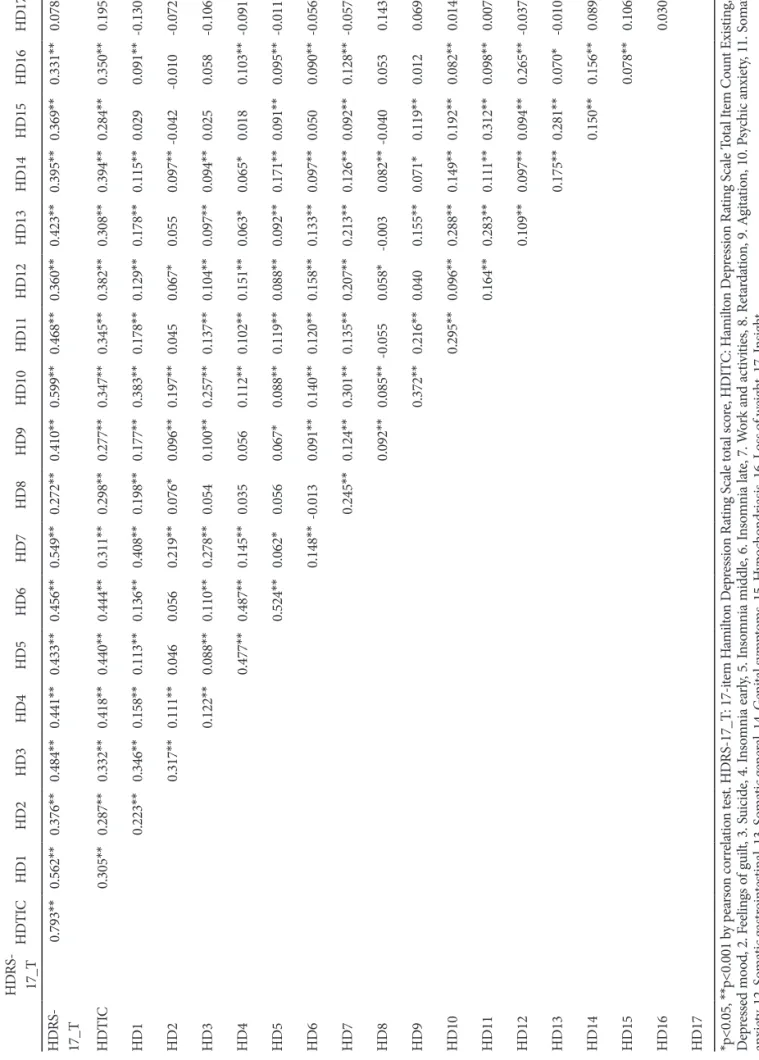
Correlation between HDRS-17 totals score and the presence/absence (yes/no) of each item
Table 2 shows the correlation between the HDRS-17 total sc-
ore and the dichotomous (yes/no) criterion of each item. The presence of each item and the total count of existing items were both significantly correlated with the HDRS-17 total sc- ore. Thus, the dichotomous (yes/no) criterion of each item, which had a score of 1 as the cutoff point can explain the clini- cal state of patients, to a certain degree and with some limita- tions. Almost all items were positively correlated with each other. However, item 17 (insight) was negatively correlated with item 1 (depressed mood), item 2 (feelings of guilt), item 3 (sui- cide) and item 4 (insomnia early). This suggests that these four items may provide patients with insight into the presence of depression.
Frequency and rank of HDRS-17 items according to sex
Table 3 presents the frequency and rank of HDRS-17 items.
The frequency of HDRS-17 items was more than 90% for three items (7, 1, and 10), 80-89% for three items (13, 11, and 9), in 70-79% for five items (5, 15, 12, 4, and 6), 60-69% for four items (2, 14, 3, and 8), and less than 50% for two items (16 and 17). The five most frequent symptoms, in descending order, were item 7 (work and activities), item 1 (depressed mood), item 10 (psychic anxiety), item 13 (somatic general), and item 9 (agitation) in males; and item 1 (depressed mood), item Table 1. Demographic characteristics of subjects
Males (N=303) Females (N=880) Significance, ‘t-test or χ2
Age (years) 45.45 (±17.83) 48.75 (±15.17) p<0.01
Education (years) 11.88 (±3.73) 9.91 (±4.65) p<0.01
CGI-S 04.57 (±1.09) 4.64 (±1.02) 00.298
HDRS-17 19.76 (±6.32) 19.82 (±5.96) 00.643
BDI 028.85 (±12.53) 29.04 (±11.64) 00.816
SOFAS 0057.6 (±12.04) 59.02 (±10.77) 00.075
Diagnosis Non-psychotic MDD 232 (82.39%) 725 (76.57%) 00.109
Psychotic MDD 6 (2.05%) 18 (1.98%)
Dysthymia 14 (2.73%) 24 (4.62%)
Depressive disorder NOS 51 (12.84%) 113 (16.83%)
Marriage Married 175 (57.8%) 605 (66.8%) p<0.01
Single 103 (34.0%) 120 (13.6%)
Broken marriage 25 (8.3%) 155 (17.6%)
Job Manager or Employed 129 (42.57%) 164 (18.64%) p<0.01
Unemployed 174 (57.43%) 716 (81.36%)
Religion Christian 65 (21.5%) 218 (24.8%) 00.002
Catholic 35 (11.6%) 136 (15.5%)
Buddhism 52 (17.2%) 198 (22.5%)
Others 151 (49.8%) 328 (37.3%)
CGI-S: Clinical Global Impression scale–Severity, HDRS-17: 17-item Hamilton Depression Rating Scale, BDI: Beck Depression Inventory, SOFAS: Social and Occupational Functioning Assessment Scale, MDD: major depressive disorder, NOS: Not Otherwise Specified. Broken marriage: include widowed, separated, divorced
Table 2. Correlation between the HDRS-17 total score and total count of present items and the presence/absence (yes/no) of each item HDRS- 17_THDTICHD1HD2HD3HD4HD5HD6HD7HD8HD9HD10HD11HD12HD13HD14HD15HD16HD17 HDRS- 17_T0.793**0.562**0.376**0.484**0.441**0.433**0.456**0.549**0.272**0.410**0.599**0.468**0.360**0.423**0.395**0.369**0.331**0.078** HDTIC0.305**0.287**0.332**0.418**0.440**0.444**0.311**0.298**0.277**0.347**0.345**0.382**0.308**0.394**0.284**0.350**0.195** HD10.223**0.346**0.158**0.113**0.136**0.408**0.198**0.177**0.383**0.178**0.129**0.178**0.115**0.0290.091**-0.130** HD20.317**0.111**0.0460.0560.219**0.076*0.096**0.197**0.0450.067*0.0550.097**-0.042-0.010-0.072* HD30.122**0.088**0.110**0.278**0.0540.100**0.257**0.137**0.104**0.097**0.094**0.0250.058-0.106** HD40.477**0.487**0.145**0.0350.0560.112**0.102**0.151**0.063*0.065*0.0180.103**-0.091** HD50.524**0.062*0.0560.067*0.088**0.119**0.088**0.092**0.171**0.091**0.095**-0.011 HD60.148**-0.0130.091**0.140**0.120**0.158**0.133**0.097**0.0500.090**-0.056 HD70.245**0.124**0.301**0.135**0.207**0.213**0.126**0.092**0.128**-0.057 HD80.092**0.085**-0.0550.058*-0.0030.082**-0.0400.0530.143** HD90.372**0.216**0.0400.155**0.071*0.119**0.0120.069* HD100.295**0.096**0.288**0.149**0.192**0.082**0.014 HD110.164**0.283**0.111**0.312**0.098**0.007 HD120.109**0.097**0.094**0.265**-0.037 HD130.175**0.281**0.070*-0.010 HD140.150**0.156**0.089** HD150.078**0.106** HD160.030 HD17 *p<0.05, **p<0.001 by pearson correlation test. HDRS-17_T: 17-item Hamilton Depression Rating Scale total score, HDITC: Hamilton Depression Rating Scale Total Item Count Existing, 1. Depressed mood, 2. Feelings of guilt, 3. Suicide, 4. Insomnia early, 5. Insomnia middle, 6. Insomnia late, 7. Work and activities, 8. Retardation, 9. Agitation, 10. Psychic anxiety, 11. Somatic anxiety, 12. Somatic gastrointestinal, 13. Somatic general, 14. Genital symptoms, 15. Hypochondriasis, 16. Loss of weight, 17. Insight
7 (work and activities), item 10 (psychic anxiety), and item 13 (somatic general) in females. The five least common symp- toms in ascending order were item 17 (insight), item 16 (loss of weight), item 8 (retardation), item 14 (genital symptoms), and item 15 (hypochondriasis) in males; and item 16 (loss of weight), item 17 (sight), item 8 (retardation), item 3 (suicide), and item 14 (genital symptoms) in females. There were signifi- cant differences in the frequency of three items (8, 11, and 15) between males and females. The frequency of psychomotor retardation was significantly higher in males than in females (66.3% vs. 58.1%), whereas somatic anxiety (86.4% vs. 80.2%) and hypochondriasis (75.9% vs. 68.0%) were significantly more frequent in females than in males. The comparison of rank of items between sexes revealed an absence of more than two rank differences for all but two items (4 and 15); the rank of insomnia early was three ranks higher in males and the rank of hypochondriasis was three ranks higher in females.
Comparison of symptom frequency according to symptom severity
To evaluate the relationship between the severity of depres- sive symptoms and the frequency of depressive symptoms, the
sample was divided into two groups: the below moderate de- pression group (7< HDRS-17 score <20) and the above mod- erate depression group (HDRS-17 score ≥20). There were sig- nificant differences in symptom frequency between the two groups regarding all items of the HDRS-17 (Table 4). Percent- age differences of symptom frequency were also observed be- tween the below moderate group and the above moderate group: these differences were <10% for four items (1, 7, 10, and 17), 10-20% for six items (8, 9, 11, 13, 14, and 15), and
>20% for seven items (2, 3, 4, 5, 6, 12, and 16). The rank of items was almost similar between the two groups with the ex- ception of item 6 (insomnia late: 12th vs. 8th) and item 15 (hy- pochondriasis: 8th vs. 11th). Although insomnia late and hy- pochondriasis were both more frequent in the above moderate group, insomnia late was ranked higher in the above moderate group whereas hypochondriasis was ranked higher in the be- low moderate group. Synthetically, only insomnia late showed a wide variance in terms of both frequency and rank.
DISCUSSION
The HDRS has been used as a standard for measuring de- Table 3. Comparison of symptom frequency (at least mild degree) between this study and the previous studies
Item I II III IV
Group
Male (N=303)
% (rank)
Female (N=880)
% (rank)
Both gender (N=1,183)
% (rank)
Male (N=239)
% (rank)
Female (N=260)
% (rank)
Both gender (N=173)
% (rank)
Both gender (N=100)
% (rank)
A B C D E F G
1 Depressed mood 94.7 (2) 96.0 (1) 95.7 (2) 96.5 (2) 94.5 (1) 94 (4) 99 (1)
2 Feelings of guilt 69.9 (10) 68.2 (12) 68.4 (12) 56.7* (12) 57.3* (11) 85** (6) 83* (9)
3 Suicide 68.7 (12) 62.7 (14) 64.2 (14) 73.0 (6) 70.4* (6) 85** (6) 99** (1)
4 Insomnia, early 73.3 (8) 71.0 (11) 71.6 (10) 76.2 (4) 69.6 (7) 72 (12) 75 (11)
5 Insomnia, middle 77.2 (7) 80.8 (7) 79.9 (7) 57.7** (11) 55.0** (12) 81 (9) 73 (12)
6 Insomnia, late 70.3 (9) 71.9 (10) 71.5 (11) 66.2 (7) 63.5* (8) 65 (15) 64 (13)
7 Work and activities 96.0 (1) 95.7 (2) 95.8 (1) 96.7 (1) 94.2 (2) 99 (1) 92 (6)
8 Retardation 66.3 (15) 58.1* (15) 60.2 (15) 37.5** (15) 36.2** (15) 65 (15) 40** (16)
9 Agitation 80.5 (5) 81.6 (6) 81.3 (6) 43.5** (14) 44.2** (13) 66** (14) 57** (15)
10 Psychic anxiety 91.1 (3) 93.8 (3) 93.1 (3) 87.5 (3) 91.9 (3) 97* (3) 99* (1)
11 Somatic anxiety 80.2 (6) 86.4* (5) 84.8 (5) 73.6 (5) 74.2** (5) 93* (5) 94* (5)
12 Somatic gastrointestinal 69.6 (11) 73.2 (9) 72.3 (9) 59.2* (10) 59.6** (10) 84* (8) 92** (6)
13 Somatic general 82.5 (4) 86.5 (4) 85.5 (4) 64.0** (8) 78.8* (4) 99** (1) 99** (1)
14 Genital symptoms 67.0 (14) 63.8 (13) 64.6 (13) 52.1* (13) 43.1** (14) 74* (11) 88** (8) 15 Hypochondriasis 68.0 (13) 75.9** (8) 73.9 (8) 24.3** (16) 21.5** (16) 78 (10) 81 (10) 16 Loss of weight 38.6 (16) 36.9 (17) 37.4 (17) 61.5** (9) 60.0** (9) 67** (13) 39 (17)
17 Insight 38.3 (17) 42.1 (16) 41.1 (16) 16.5** (17) 14.2** (17) 64** (17) 59* (14)
A vs B A vs D B vs E C vs F C vs G
I: this study, II: previous study by Hamilton,3 III: previous study Kim et al.,24 IV: previous study Kim et al.25 *p<0.05, **p<0.001 by χ2 test.
HDRS-17: 17-item Hamilton Depression Rating Scale
pression for almost 50 years. However it is not a diagnostic in- strument for depressive disorders. Current categorical classific- ation of depressive disorders is based on criteria set of defining symptoms. Therefore, it is important to identify the character- istic manifestations of these symptoms.
This study evaluated the current HDRS characteristics of depressive disorders in Korea. We compared this study with a previous study performed in England by Hamilton3 and with two studies performed in Korea by Kim et al.24,25 (Table 3). In comparison with the Hamilton’s study,3 we found that three items i.e., item 1 (depressed mood), item 7 (work and activities), and item 10 (psychic anxiety) were the most fre- quent symptoms in both studies. However, item 5 (insomnia middle), item 9 (agitation), item 15 (hypochondriasis), and item 16 (loss of weight) exhibited significant variance in the two studies, in terms of both frequency and rank. The com- parison of symptom frequency between this study and the two studies performed by Kim revealed that three items (1, 7, and 10) had a frequency of >90% in all three studies. In con- trast, item 2 (feelings of guilt), item 3 (suicide), item 9 (agita- tion) and item 13 (somatic general) showed significant vari- ance between this study and the previous studies in terms of frequency and rank.
The results of this study and their comparison with the re- sults of the Hamilton and Kim studies can be summarized as
follows: 1) the presence of wide variance in the frequency of symptoms was observed in this study as well as in the previ- ous studies; 2) a constant frequency or rank for some symp- toms was observed regardless of study, sex or the severity of depression; and 3) variance in the frequency or rank of some symptoms was observed regardless of study, sex or the sever- ity of depression.
The frequency of HDRS-17 items varied widely in this study, ranging from 95.8% for work and activities to 37.4%
for loss of weight. Variance in symptom frequency was no- ticed both in Hamilton’s study and Kim’s two studies.
However, despite such variance in symptom frequency within groups, some symptoms showed constant frequency or rank regardless of study, the severity of depression or sex.
Depressed mood, psychic anxiety and work and activities are among these symptoms, which also exhibited the highest frequency among the 17 items. Insomnia early, somatic gas- trointestinal, genital symptoms and insight can be included in the group with constant but low frequency or rank.
Some items had variable frequency according to culture, times, severity of depression, or sex. Regarding cultural as- pects, insomnia middle, agitation, hypochodriasis and loss of weight showed relatively wide variance. Regarding times, feel- ings of guilt, suicide, agitation, and somatic general showed wide variance. Regarding sex, retardation, somatic anxiety Table 4. Comparison of symptom frequency (at least mild) between the above moderate severity depression group (HDRS-17≥20) and the mild depression groups (7<HDRS-17<20)
Item
The mild (N=542)
% (rank)
The above moderate (N=614)
% (rank)
Differences
(%, rank) Pearson χ2 p-value
1 Depressed mood 94.5 (1) 99.2 (1) 04.7 (17) 21.851** <0.001
2 Feelings of guilt 58.1 (10) 79.8 (12) 21.7 (7) 64.033** <0.001
3 Suicide 50.6 (14) 78.8 (13) 28.2 (3) 101.940** <0.001
4 Insomnia, early 57.6 (11) 86.3 (9) 28.7 (2) 120.309** <0.001
5 Insomnia, middle 69.2 (7) 92.0 (6) 22.8 (6) 98.766** <0.001
6 Insomnia, late 56.8 (12) 87.1 (8) 30.3 (1) 133.918** <0.001
7 Work and activities 93.5 (2) 99.2 (1) 05.7 (16) 27.445** <0.001
8 Retardation 50.6 (14) 70.2 (14) 19.6 (8) 46.680** <0.001
9 Agitation 74.7 (6) 88.6 (7) 13.9 (13) 37.707** <0.001
10 Psychic anxiety 89.3 (3) 98.7 (3) 09.4 (14) 47.233** <0.001
11 Somatic anxiety 77.7 (5) 93.0 (5) 15.3 (12) 55.510** <0.001
12 Somatic gastrointestinal 59.0 (9) 86.0 (10) 27.0 (5) 107.001** <0.001
13 Somatic general 78.8 (4) 93.2 (4) 19.4 (9) 50.701** <0.001
14 Genital symptoms 51.1 (13) 70.2 (14) 19.1 (10) 93.325** <0.001
15 Hypochondriasis 66.2 (8) 82.2 (11) 16.0 (11) 39.092** <0.001
16 Loss of weight 23.2 (17) 51.0 (16) 27.8 (4) 93.981** <0.001
17 Insight 37.1 (16) 45.4 (17) 08.3 (15) 8.276** 0.004
*p<0.05, **p<0.001 by χ2 test. HDRS: Hamilton Depression Rating Scale
and hypochondriasis showed wide variance in this study. Re- garding severity of depression, insomnia late seemed to have a wide frequency variance.
Based on these observations, the authors propose three clu- sters of symptoms in depressive disorders: core symptoms cluster, an associated symptoms cluster and a situation-spe- cific symptoms cluster. The core symptoms cluster is present in most depressive disorders constantly and frequently and is not greatly affected by times, place, culture, sex or severity.
The associated symptoms cluster is present constantly but less frequently and is not affected by clinical variance. In con- trast, situation-specific symptoms cluster has variable fre- quency and is greatly affected by clinical situation. Depressed mood, work and activities, and psychic anxiety seem to be- long to the core symptoms cluster; insomnia early, somatic gastrointestinal, genital symptoms and insight seem to be part of the associated symptom cluster; and insomnia mid- dle, agitation, hypochodriasis and loss of weight can be clas- sified into culture-specific symptoms cluster. Hypochondria- sis, retardation and somatic anxiety can be grouped as sex- specific symptoms cluster. Feelings of guilt, suicide, agitation and somatic general can be classified as a time (or civiliza- tion)-specific symptoms cluster. Finally, insomnia late seems to be a severity-specific symptoms cluster.
We suggest that depressed mood, work and activities and psychic anxiety form a core symptoms cluster. This can be contrasted with two fundamental (or core) symptoms of the DSM-IV-TR diagnostic criteria for depressive episode. De- pressed mood is commonly defined as a core symptom both in DSM-IV-TR and in this study. Here, the work and activi- ties symptoms were regarded as corresponding to markedly diminished interest or pleasure in DSM-IV-TR. The only dif- ference between this study and DSM-I-TR was psychic anxi- ety. The item of agitation in DSM-IV-TR diagnostic criteria for depressive episode can be seen as equivalent to psychic anxiety in this study. However, this symptom is handled only as an associated symptom and is just a part of compound psychomotor disturbance criterion of DSM-IV-TR diagnos- tic criteria for depressive episode. Depression has variable characteristic features; The anxiety component may be am- ong these. In this respect, DSM-IV-TR categorical diagnostic criteria have been criticized for their apparent limitation in terms of reflecting the true clinical symptomatic nature of depression such as psychic anxiety component revealed in this study.29
The six most frequent symptoms in this study, work and activities, depressed mood, psychic anxiety, somatic general, somatic anxiety, and agitation are included in the core defin- ing symptoms of major depressive disorder as well as and anxiety disorders in DSM-IV-TR. This seems to reflect the
high prevalence of comorbidity between depressive disorders and anxiety disorders. The National Comorbidity Study in USA revealed that the lifetime prevalence of two or more psychiatric disorders was 21%, and that 61.8% of cases major depressive disorder had a previous history of other psychiat- ric diagnosis whereas 58% had a history of anxiety disorder.30 This study has some limitations. First, only cases with de- pression severity above the mild degree were considered in the calculation of the symptom frequency. This can distort the significance of symptoms in depression. Second, the Ha- milton study was not contemporary to this study. Therefore, it was difficult to compare cultural differences between the studies. Third, the influence of diverse demographic charac- teristics on the expression of the symptomatology of depres- sion was not addressed sufficiently.
Despite these limitations, this study is the first nationwide, multicenter, clinical population study of depression symp- tomatology in Korea. The results of this study led to the rec- ognition of the importance of symptom frequency in the di- agnosis of depression and the influence of sex, cultural para- meters, times and symptom severity on the diagnosis of de- pression. In clinical practice, we can simplify the diagnosis of depression using only the core symptoms cluster without us- ing all nine diagnostic categories of DSM-IV-TR. We can use symptoms classified as belonging to situation-specific symp- toms cluster to increase the diagnostic specificity according to sex, culture and times (or degree of civilization). In addi- tion, severity-specific symptoms, such as insomnia late can be used as an index of severe depression. Finally, future de- velopment or revision of depression rating scales should be channeled to give greater significance to symptoms that are more frequent such as depressed mood, work and activities, and psychic anxiety and to consider the situation-specific symptoms in specific settings.
Conclusions
This study evaluated the HDRS characteristics of depres- sive disorders in Korea. These results were then compared with those of previous studies performed by Hamilton in England3 and by Kim et al.24,25 in Korea. The frequency of HDRS-17 items varied widely in this study, ranging from 95.8% for work and activities. to 37.4% for loss of weight items. However, depressed mood, psychic anxiety and work and activities items exhibited constant and higher frequency or rank regardless of study, the severity of depression, or sex.
Insomnia early, somatic gastrointestinal, genital symptoms and insight items displayed constant but lower frequency or rank regardless of the clinical variables. Moreover, we found that some situation-specific symptoms exhibited variable fre- quency or rank according to the variable clinical situations.
We can use these possible symptom clusters of depression to simplify the diagnosis of depression, to increase diagnostic specificity in special situations and to index disease severity.
Acknowledgments
This research was supported by a grant of the Korea Health 21 R&D, Ministry of Health and Welfare, Republic of Korea (A050047). The Minis- try of Health and Welfare had no further role in study design; in the collec- tion, analysis and interpretation of data; in the writing of the report; or in the decision to submit the paper for publication.
REFERENCES
1. Sadock BJ, Kaplan HI, Sadock VA. Mood Disorder. In: Sadock BJ, Sa- dock VA, Editors. Kaplan & Sadock’s Synopsis of Psychiatry: Behav- ioral Sciences/Clinical Psychiatry, 10th Edition. Philadelphia: Wolter Kluwer/Lippincott Williams & Wilkins, 2007, p.527-528.
2. Hamilton M. A rating scale for depression. J Neurol Neurosurg Psy- chiatry 1960;23:56-62.
3. Hamilton M. Frequency of symptoms in melancholia (depressive ill- ness). Br J Psychiatry 1989;154:201-206.
4. Kraepelin E. Manic-Depressive Insanity and Paranoia. New York:
Arno Press; 1976.
5. Carothers JC. The African Mind in Health and Disease; A Study in Ethnopsychiatry. Geneva: World Health Organization; 1953.
6. Venkoba Rao A. Depression: a psychiatric analysis of thirty cases. In- dian J Psychiatry 1966;8:143-154.
7. Kim KI, Li DG, Kim DH. Transcultural study of depressive symptom:
a comparison among Chinese, Korean-Chinese in Yanbien and Kore- an in Seoul. J Korean Neuropsychiatr Assoc 1995;34:1039-1049.
8. Kim KI. Clinical study of primary depressive symptom. Part III: a cross cultural comparison. J Korean Neuropsychiatr Assoc 1977;16:53-60.
9. Gavin AR, Walton E, Chae DH, Alegria M, Jackson JS, Takeuchi D.
The associations between socio-economic status and major depressive disorder among Blacks, Latinos, Asians and non-Hispanic Whites:
findings from the Collaborative Psychiatric Epidemiology Studies.
Psychol Med 2010;40:51-61.
10. Chang SM, Hahm BJ, Lee JY, Shin MS, Jeon HJ, Hong JP, et al. Cross- national difference in the prevalence of depression caused by the diag- nostic threshold. J Affect Disord 2008;106:159-167.
11. Min SK, Suh SY, Song KJ. Symptoms to use for diagnostic criteria of hwa-byung, an anger syndrome. Psychiatry Investig 2009;6:7-12.
12. Kim JY, Choi SM, Seo GH, Cho SJ, Kim JG, Cho MJ. Cultural differ- ence in expressing depressive symptoms in Koreans. Korean J Psycho- pathol 2000;9:78-87.
13. Chang SM, Sohn JH, Lee JY, Choi JH, Cho SJ, Jeon HJ, et al. Charac- teristics of diagnostic criteria for depression in Korea. J Korean Neuro- psychiatr Assoc 2007;46:447-452.
14. Jang SN, Kawachi I, Chang J, Boo K, Shin HG, Lee H, et al. Marital status, gender and depression: analysis of the baseline survey of the Korean Longitudinal Study of Ageing (KLoSA). Soc Sci Med 2009;69:
1608-1615.
15. Sugihara Y, Sugisawa H, Shibata H, Harada K. Productive roles, gen- der, and depressive symptoms: evidence from a national longitudinal study of late-middle-aged Japanese. J Gerontol B Psychol Sci Soc Sci 2008;63:P227-P234.
16. Mitchell AJ, Subramaniam H. Prognosis of depression in old age com- pared to middle age: a systematic review of comparative studies. Am J Psychiatry 2005;162:1588-1601.
17. Hybels CF, Blazer DG, Pieper CF, Landerman LR, Steffens DC. Profiles of depressive symptoms in older adults diagnosed with major depres- sion: latent cluster analysis. Am J Geriatr Psychiatry 2009;17:387-396.
18. Hong SW, Lee DS, Jae YM, Jang SH, Choi JH, Jang YK, et al. Compari- son of depression symptoms of major depressive disorder between el- derly and non-elderly group in Busan city in South Korea. J Korean Soc Biol Ther Psychiatry 2008;14:58-64.
19. Kim BS, Jang HS, Lee JY, Suh GH, Hong JP, Hahm BJ, et al. Clinical man- ifestation of depression symptoms in Korean elderly. J Korean Geriatr Psychiatry 2003;7:163-177.
20. Jang SN, Cho SI, Chang J, Boo K, Shin HG, Lee H, et al. Employment status and depressive symptoms in Koreans: results from a baseline survey of the Korean Longitudinal Study of Aging. J Gerontol B Psy- chol Sci Soc Sci 2009;64:677-683.
21. Gaudiano BA, Young D, Chelminski I, Zimmerman M. Depressive symptom profiles and severity patterns in outpatients with psychotic vs nonpsychotic major depression. Compr Psychiatry 2008;49:421-429.
22. Kiev A. Transcultural Psychiatry. New York: Free Press; 1972.
23. Yi JS, Bae SO, Ahn YM, Park DB, Noh KS, Shin HK, et al. Validity and reliability of the Korean version of the Hamilton Depression Rating Scale (K-HDRS). J Korean Neuropsychiatr Assoc 2005;44:456-465.
24. Kim KI. Clinical study of primary depressive symptom. Part II: symp- tom pattern of the Korean depressive. J Korean Neuropsychiatr Assoc 1977;16:46-52.
25. Kim KI, Cho YG. Clinical study of primary depressive symptom. part VII: chronological comparison of depressive symptom between 1974- 1976 and 1992-1993. Ment Health Res 1993;12:110-117.
26. First MB, Spitzer RL, Gibbon M, Williams JB. User’s Guide for the Structured Clinical Interview for DSM-IV Axis I Disorders Research Version SCID-I. New York: New York State Psychiatric Institute, Bio- metrics Research; 1996.
27. Guy W. ECDEU Assessment Manual for Psychopharmacology, Re- vised. Rockville: National Institute of Mental Health; 1976.
28. American Psychiatric Association. Diagnostic and Statistical Manual of Mental Disorders, Fourth Edition. Washington, DC: American Psy- chiatric Press; 1994.
29. Lopez MF, Compton WM, Grant BF, Breiling JP. Dimensional ap- proaches in diagnostic classification: a critical appraisal. Int J Methods Psychiatr Res 2007;16(Suppl 1):S6-S7.
30. Kessler RC, Nelson CB, McGonagle KA, Liu J, Swartz M, Blazer DG.
Comorbidity of DSM-III-R major depressive disorder in the general population: results from the US National Comorbidity Survey. Br J Psychiatry Suppl 1996;30:17-30.