호흡기계 작용 약물의 치료군 중복처방 평가기준 개발
최경업·손현순*·김남효*·신현택*·이영숙**,#
건강보험심사평가원, *숙명여자대학교 약학대학, **원광대학교 약학대학 (Received January 17, 2012; Revised April 1, 2012; Accepted April 5, 2012)
Therapeutic Duplication Criteria Development of Respiratory System Drugs
Kyung Eob Choi, Hyun Soon Sohn*, Nam Hyo Kim*, Hyun Taek Shin* and Young Sook Lee**,#
Health Insurance Review & Assessment Service, Seoul 137-706, Korea
*College of Pharmacy, Sookmyung Women’s University, Seoul 140-742, Korea
**College of Pharmacy, Wonkwang University, Jeonbuk 570-749, Korea
Abstract — Purpose: To develop therapeutic duplication criteria for the drugs used for respiratory diseases. Method: Ther- apeutic duplication was defined as "more than 2 drug ingredient-usage in which each has the same therapeutic effect and combination therapy does not confer additional therapeutic benefit". Respiratory system drugs approved in Korea were examined for the study. The WHO’s Anatomical Therapeutic Chemical Classification System was used for grouping of the corresponding drug ingredients. The principles and recommendations on combination usage or multiple drug regimens were reviewed by using the clinical practice guidelines, textbooks, product labelings, and clinical articles. Clinical expert group consultation was performed and expert opinions were incorporated into the final criteria. Results: Nine hundred sixty two drug products with Korean Food and Drug Administration classification codes of 141, 149, 222, and 229 were evaluated, of which 87 active ingredients were composed. The drug ingredients were classified into 12 groups (antihistamines, oral nasal decongestants, leukotriene receptor antagonists, inhaled anticholinergics, inhaled corticosteroids, oral β2-agonists, long-act- ing β2-agonists, short-acting β2-agonists, xanthines, antiallergics, mucolytics and cough suppressants). The use of more than 2 drug ingredients including the same group was therapeutic duplication, and thus combination should be rec- ommended not to be used. Conclusion: Twelve drug groups were identified as therapeutic duplication criteria. Combination therapy within each group should not be used otherwise therapeutic benefits outweigh potential risks.
Keywords □ DUR, therapeutic duplication, respiratory drugs, cough suppressants, mucolytics, antihistamines
안전한 약물 사용에 대한 관심이 높아짐에 따라, 의약품사용 검토(Drug Utilization Review, DUR)는 부적절한 의약품 사용을 줄이고 적정한 의약품 사용을 도모하기 위한 제도로, 우리나라 에서도 주목받고 있다. 2010년 하반기에 전국에 확대 시행 예정 임을 발표한 DUR 제도는 현재까지 건강보험심사평가원에서 후 향적 방식으로 진행되던 심사 방식과는 달리, 처방이나 조제 단 계에서 부적절한 약물 처방을 심사하여 환자가 약을 복용하기 전 에 미리 위험을 줄인다는 점에서 많은 기대가 되고 있다. 또한, 현재 건강보험심사평가원에서는 보험급여 청구 건에 대하여 병 용 및 연령금기 의약품, 임부금기 의약품, 저함량 배수처방조제 의약품, 안전성관련급여중지 의약품, 동일성분 의약품중복 등에
대한1)평가를 수행하여 약제비 심사를 하고는 있지만 미국의 OBRA'90(Omnibus Budget Reconciliation Act 1990)2)에 따른 DUR과 비교할 때 치료군 중복, 약물-질환 금기, 부적절한 약물 용량, 약물-알레르기 상호작용, 부적절한 치료기간, 임상적 남용 과 오용 등과 같은 항목에 대한 평가는 이루어지지 않고 있었다 는 점에서도 그 필요성이 더욱 부각되었다.
DUR의 평가 항목 중 특히 치료군 중복의 경우 인구고령화로 노인의 약물사용이 증가하고 의료기관 이용도 증가함에 따라 여 러 의료기관을 통한 처방중복의 가능성이 높아지면서 이를 점검 할 수 있는 시스템의 필요성이 제기되었고, 실제로 처방명세서 를 가지고 약물사용 실태를 분석한 국내 선행 연구에서도 치료 군 중복의 발생률이 큰 것으로 조사되고 있어 많은 환자들이 이 에 노출되어 있음을 알 수 있다.3,4) 치료군 중복을 DUR 대상항 목에 추가시켜 이를 점검하기 위해서는 우선 치료군 중복으로 정 의할 수 있는 과학적 기준을 마련되어야 하며, 특히 치료군 중복
#본 논문에 관한 문의는 저자에게로 (전화) 063-850-6821 (팩스) 063-853-6821 (E-mail) [email protected]
종설
이 많이 일어나고 있는 효능군을 우선적으로 기준을 만드는 것 이 효과적일 것이다. 또한 약물이 처방된 목적에 따라 치료군중 복의 판별 여부가 달라지므로, 치료군 중복 기준안은 효능군별 로 만들어지는 것이 타당하다. 2009년에 청구된 약제심사 청구 명세서 약 140만 건을 분석한 연구결과에 따르면, 동일 분류번 호 내 의약품 처방 빈도가 가장 높은 약효군으로 식약청 분류 번호 222번 진해거담제, 141번 항히스타민제가 각각 1위와 3위 로 나타났다.5)이 결과에 따라 본 연구는 치료군 중복 가능성 이 높은 것으로 판단되는 진해거담제와 항히스타민제를 포함하 여 호흡기계 작용 약물의 치료군 중복 기준안을 확립하고자 하 였다.
연구방법
대상성분 선정
본 연구는 현재 국내에서 허가된 식품의약품안전청 의약품분 류번호 141번(항히스타민제)과 222번(진해거담제)을 주 대상으 로 하고, 항히스타민 성분이 포함된 149번(기타의 알레르기용약) 과 기타로 분류된 호흡기계통 작용약물인 229번(기타의 호흡기 관용약)의 의약품을 대상성분에 포함시켰다. 이들은 모두 호흡기 계통 질환의 치료를 목적으로 한 약제로서, 관련 적응증은 알레 르기성 비염, 천식, 만성 폐쇄성 폐질환, 기침 등이었다.6) 위 분 류번호에 해당되어 있기는 하지만 호흡기계통의 효능효과를 갖 지 않는 성분은 연구대상에서 제외하였다. 호흡기계통 약물은 전 문의약품으로써 전신작용 제형(경구제, 주사제)과 더불어 질환의 특성상 비강 내 분무 또는 흡입되는(intranasal 또는 inhalant) 제 형이 많이 사용됨을 고려하여 이들 외용 흡입제 또한 연구대상 에 포함하였다. 이들 호흡기계통 약물의 치료군 중복 기준을 확 립하기 위하여 본 연구에서 대상으로 한 식품의약품안전청 의약 품 분류번호 141번, 149번, 222번 및 229번 의약품의 전체 목록 은 식품의약품안전청으로부터 제공받았다.
치료군 중복의 정의
DUR 에 대한 국내 공식 문건과 연구문헌에 따르면 '치료군 중 복'은 같은 치료계열 약물군에 속하는 2가지 이상의 약물이 처방 또는 조제되는 사례로, 약리학적으로 부작용이나 독성을 증가시 키고, 치료적 이득 없이 의료자원의 낭비를 초래하는 경우로 정 의하고 있다.3,7)이를 반영하여 본 연구에서도 '치료군 중복'을 '동일한 적응증 또는 동일 치료목적을 갖는' 동일 약물계열에 속 한 약제가 2개 이상 처방된 경우로 정의하였다.
치료군 중복 기준 설정 근거
치료군 중복이라고 볼 수 있는 기준을 설정할 때 참고할 수 있 는 방법으로 1) 의약품분류체계, 2) 국내외 허가사항(의약품의 임
상적 용도로서 질환에 대한 정보를 활용하는 방법), 3) 의약품정 보집, 교과서, 임상약물치료지침, 임상문헌 등(실제 약물이 치료 학적으로 사용되는 것을 고려한 방법)을 들 수 있다. 본 연구에 서는 의약품 분류체계를 근거로 한 첫 번째 방법을 우선적으로 채택하여 활용하였고, 두 번째, 세 번째 방법을 함께 참고하여 치 료군 중복 기준을 정하였다. 외국에서 수행된 연구를 살펴보았 을 때 동일 약물계열(drug class)의 약제를 중복 처방한 '치료군 중복'을 정의하면서 "동일 약물계열"에 대한 참고의 근거로 국제 보건기구(WHO)의 분류체계(Anatomical Therapeutic Chemical Classification System, ATC), 미국병원약사회(American Hospital Formulary Service, AHFS)에서 사용하는 의약품 분류체계 (Pharmacologic-Therapeutic Classification System) 등을 참고한 경우가 있었다.8,9)
ATC는 5단계 7자리수로 이루어진 분류체계로서 신체기관별 및 약리기전이나 화학구조, 약물학적 및 치료학적 특성으로 세 분화되어 있다. 본 연구는 ATC 분류체계가 치료군 중복 기준을 개발하기 위한 의약품 분류체계로서 가장 적합하다고 판단하여 이 분류체계를 활용하였다. 우리나라의 식품의약품안전청 분류 체계는 3단 분류로 총 161개 번호로 구성된 반면,10) ATC 분류 체계는 4단계 의약품 분류가 총 854개 군으로 구성되어 있어서 좀더 상세한 분류체계라고 할 수 있다.11)
ATC 분류체계의 1단계 분류는 약물이 작용하는 신체기관으로 분류하므로 이 분류에 속한 약물의 병합사용은 중복으로 평가하 지 않았다. 2단계 분류는 치료목적에 의한 분류로 작용기전이 서 로 다르기 때문에 대개 병합사용이 가능하다. 따라서 이 역시 중 복으로 평가하지 않았다. 그러나 3단계 분류의 경우 같은 분류 에 속한 약물은 대개 작용기전이 유사하므로 2개 이상 사용하는 것은 중복으로 간주되는 경우가 많다. 그러나 경우에 따라서는 이 경우에도 병합을 하는 경우도 있으므로 여러 가지 임상문헌 자료를 참고로 하여 병합요법이 추천되는 경우에 치료군 중복으 로 하지 않았다. 마찬가지로 4단계 분류의 동일 화학구조를 가 진 계열 내 성분들의 처방은 원칙적으로 모두 치료군 중복으로 정의하였으며, 임상치료지침 등을 함께 참고하여 병용이 가능한 조합으로 규정되어 있는 경우는 치료군 중복으로 간주하지 않았다.
국내외 허가사항으로는 우리나라, 미국, 일본 및 영국 등을 참 고하였으며, 이들 주요외국 3개국에 수재되지 않은 의약품은
"Martindale: The Complete Drug Reference"을 조사하였다. 또 한 대상 성분들의 주요 적응증을 기준으로 국내외의 임상치료지 침(practice guideline)을 수집, 고찰하였다. 국외 가이드라인으로 약물치료학 교과서와 영국의 NICE, 영국 알레르기 및 임상면역 학회(BSACI), 알레르기비염 및 천식 워크샵그룹(ARIA) 세계천 식협회(GINA) 등의 가이드라인을, 국내 가이드라인으로 대한결 핵 및 호흡기학회 만성폐쇄성폐질환 진료지침위원회, 대한결핵 및 호흡기학회 천식진료지침위원회, 대한비과학회의 가이드라인
등을 고찰하였다.
본 연구의 평가대상 약제는 전신작용을 나타내는 경구제 및 주사제를 기본으로 하였으나, 국소제형이라 하더라도 전신효과 가 있는 외용흡입제도 치료군 중복 기준을 적용하였으며, 전신 효과가 있는 이들 서로 다른 제형도 동일 성분이라면 중복으로 간주하였다. 연구대상 성분들 각각을 해당되는 ATC 분류번호에 배정하였고 ATC 분류체계에는 포함되어 있지 않은 국내 성분의 경우, 효능효과 및 화학구조, 작용기전에 근거하여 가장 타당한 소분류번호에 배정하였다. 동일한 분류번호에 포함된 성분들은 치료군 중복 성분조합으로 간주하였으며, 만일 동일 질병을 치 료 시 2개 이상의 의약품을 사용해야 하는 상황은 국내외 임상 가이드라인에서 수집된 내용을 기준으로 평가하였다. 또한, 호흡 기계통 질환의 특성상 흡입제도 연구대상에 포함시켰기 때문에, 국내외 임상가이드라인에서 권고하고 있는 흡입제 병용 가이드 라인을 조사하였다.
치료군 중복 기준 개발 과정
본 연구에서 호흡기계 작용 약물의 치료군 중복 기준안을 개 발과정은 Fig. 1과 같다. 우선 식품의약품안전청으로부터 제공받 은 대상약효군(분류번호 141, 149, 222, 229번) 품목 중에서 연
구 대상으로 포함되어야 할 대상성분들을 확정한 후, 이들 각 성 분들을 ATC 분류번호에 맵핑하여 동일 치료군으로 통합이 가능 한 성분들끼리 그룹화하여 치료군 중복 기준을 1차적으로 규정 하였다.
그 뒤, 임상가이드라인에서 권고하고 있는 호흡기계 질환 약 물치료 권고사항들을 반영하였고, 국내외 허가사항과 의약품집 의 약물계열과 적응증 정보를 조사하여 치료군 중복 기준 설정 시 고려해야 할 사항이 있는지 조사하였다. 이를 통해 연구진 나 름의 치료군 중복 기준안을 개발한 후, 실제 임상에서 사용되는 약물치료를 반영하기 위해서 호흡기계 질환 전문가로 구성된 자 문위원단(호흡기계 임상전문의, 임상약사 및 약학전문위원 등)의 자문을 받아 최종적인 치료군 중복 기준을 제안하였다. 따라서 개발과정을 정리하면 첫째, 유사한 약물 즉, 병용을 대개 하지 않 는 약물들의 그룹화, 둘째, 동일한 질환에 사용하는 약제간의 추 천되는 혹은 명확한 근거를 지닌 병합요법의 발굴을 통한 치료 군중복으로 간주하지 않는 경우의 확인, 세번째, 임상전문가를 통한 검증의 절차를 거쳤다고 하겠다.
연구결과
대상성분 목록
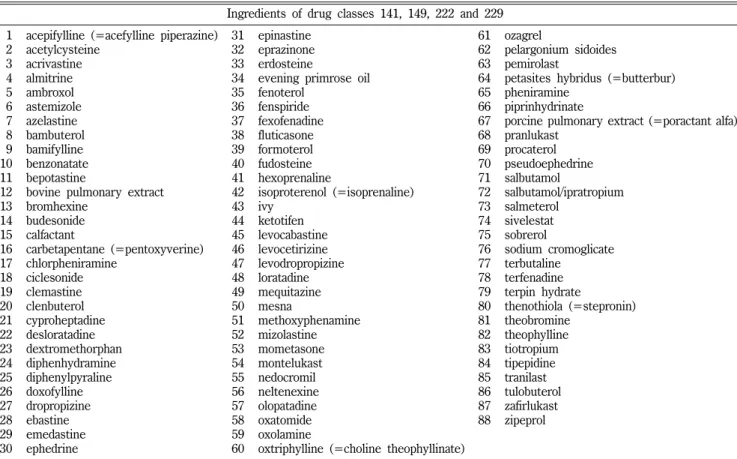
국내 허가된 항히스타민제(국내 분류번호 141)는 245품목, 기 타의 알레르기용약(국내 분류번호 149)은 152품목, 진해거담제 (국내 분류번호 222)는 504품목, 기타의 호흡기관용약(국내 분류 번호 229)은 61품목으로 총 962품목을 연구 대상으로 하였다. 이 들 품목의 고유한 성분은 총 88개(Table I)이었다. 국내 허가 성 분이지만 ATC 분류 번호가 배정되어 있지 않은 성분 14개는 화 학구조와 효능효과를 참고하여 적절한 ATC 소분류번호에 배정 하였다. 한편, 현재의 식품의약품안전청 분류번호 149번으로 되 어 있지만, 주 효능효과가 호흡기계 질환 치료가 아닌 아토피성 습진에 허가 받은 evening primrose oil 성분은 본 연구대상에 서 제외하였다. 그리하여 호흡기계 작용 약물의 치료군 중복 성 분 조합에 대한 기준안을 개발하기 위한 본 연구의 대상 성분은 총 87개로 최종 확정되었다.
ATC 분류체계에 따른 치료계열 분류
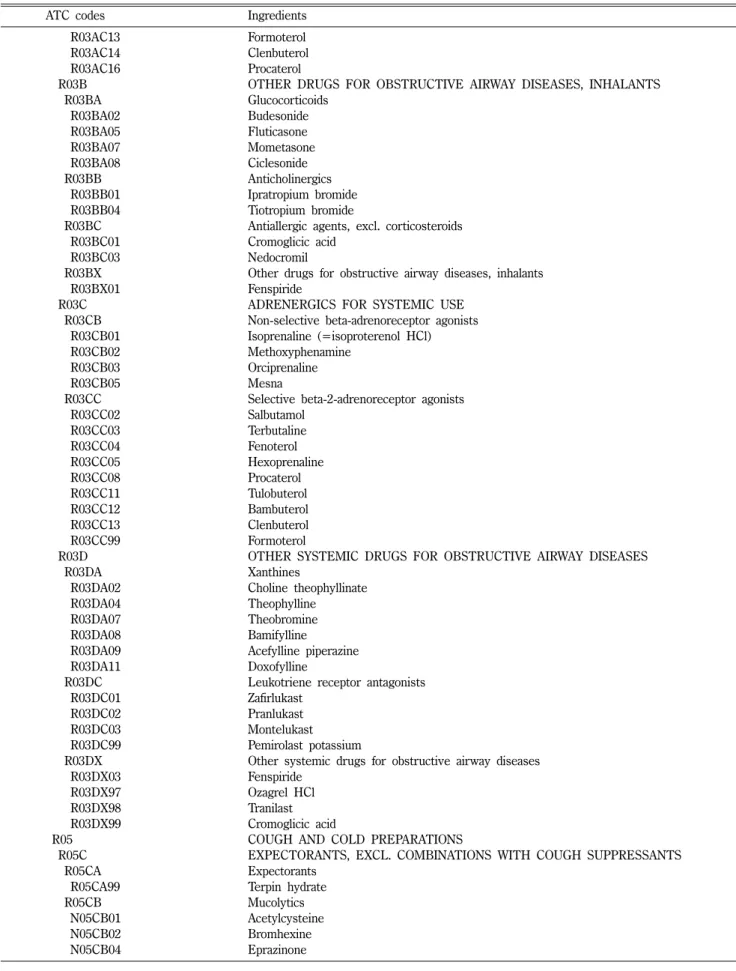
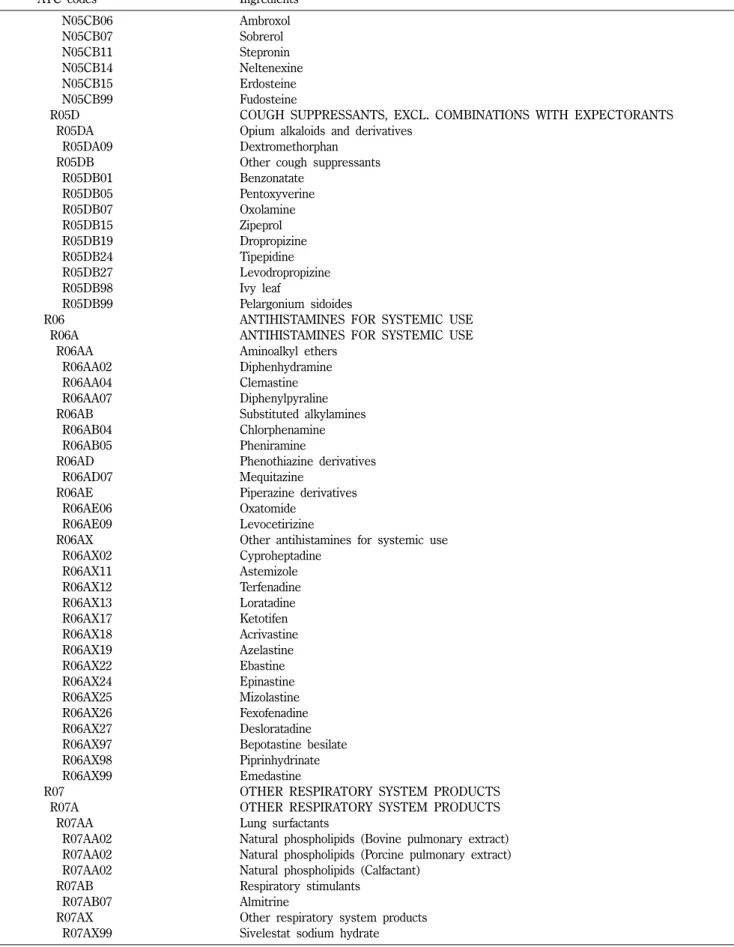
연구대상 성분을 각각 해당되는 ATC 분류번호에 맵핑하여 목 록을 열거하였다. 그 결과, 대부분의 성분들이 ATC 1단계 분류 중 R(Respiratory system)에 해당되었다. 2단계 분류로는 R01 (Nasal preparations), R03(Drugs for obstructive airway diseases), R05(Cough and cold preparations), R06(Antihistamines for systemic use), R07(Other respiratory system products) 에 배정되었다. 호흡기계 작용 약물의 경우, 같은 계열의 약물도 ATC 분류상으로 흡입제 분류제형과 전신작용 분류제형 두 가지 Fig. 1− Therapeutic duplication criteria development process.
가 존재하였다(R03A Adrenergics, inhalants; R03C Adrenergics, systemics). 그리하여 ATC 분류상에는 흡입제형만 있으나 국내
허가된 제형은 경구제인 formoterol과 cromoglicic acid의 경우 에는 ATC 전신작용 분류제형 쪽에 한 번 더 임의 배정하였다 Table I− Drug ingredient lists of KFDA drug class codes 141, 149, 222 and 229
Ingredients of drug classes 141, 149, 222 and 229
01
02 03 04 05 06 07 08 09
10 11 12 13 14 15 16 17 18 19 20 21 22 23 24 25 26 27 28 29 30acepifylline (=acefylline piperazine) acetylcysteine
acrivastine almitrine ambroxol astemizole azelastine bambuterol bamifylline benzonatate bepotastine
bovine pulmonary extract bromhexine
budesonide calfactant
carbetapentane (=pentoxyverine) chlorpheniramine
ciclesonide clemastine clenbuterol cyproheptadine desloratadine dextromethorphan diphenhydramine diphenylpyraline doxofylline dropropizine ebastine emedastine ephedrine
31 32 33 34 35 36 37 38 39 40 41 42 43 44 45 46 47 48 49 50 51 52 53 54 55 56 57 58 59 60
epinastine eprazinone erdosteine
evening primrose oil fenoterol
fenspiride fexofenadine fluticasone formoterol fudosteine hexoprenaline
isoproterenol (=isoprenaline) ivy
ketotifen levocabastine levocetirizine levodropropizine loratadine mequitazine mesna
methoxyphenamine mizolastine mometasone montelukast nedocromil neltenexine olopatadine oxatomide oxolamine
oxtriphylline (=choline theophyllinate) 61 62 63 64 65 66 67 68 69 70 71 72 73 74 75 76 77 78 79 80 81 82 83 84 85 86 87 88
ozagrel
pelargonium sidoides pemirolast
petasites hybridus (=butterbur) pheniramine
piprinhydrinate
porcine pulmonary extract (=poractant alfa) pranlukast
procaterol pseudoephedrine salbutamol
salbutamol/ipratropium salmeterol
sivelestat sobrerol
sodium cromoglicate terbutaline
terfenadine terpin hydrate
thenothiola (=stepronin) theobromine
theophylline tiotropium tipepidine tranilast tulobuterol zafirlukast zipeprol
Table II− Ingredients matched up with ATC classification codes system
ATC codes Ingredients
R RESPIRATORY SYSTEM
R01 NASAL PREPARATIONS
R01A DECONGESTANTS AND OTHER NASAL PREPARATIONS FOR TOPICAL USE
R01AA Sympathomimetics, plain
R01AA03 Ephedrine
R01AC Antiallergic agents, excl. corticosteroids
R01AC01 Cromoglicic acid
R01AC02 Levocabastine
R01AC03 Azelastine
R01AC08 Olopatadine
R01B NASAL DECONGESTANTS FOR SYSTEMIC USE
R01BX99 Petasites hybridus(Butterbur)
R01BA Sympathomimetics
R01BA02 Pseudoephedrine
R03 DRUGS FOR OBSTRUCTIVE AIRWAY DISEASES
R03A ADRENERGICS, INHALANTS
R03AC Selective beta-2-adrenoreceptor agonists
R03AC02 Salbutamol
R03AC03 Terbutaline
R03AC04 Fenoterol
R03AC06 Hexoprenaline
R03AC11 Tulobuterol
R03AC12 Salmeterol
Table II− Continued
ATC codes Ingredients
R03AC13 Formoterol
R03AC14 Clenbuterol
R03AC16 Procaterol
R03B OTHER DRUGS FOR OBSTRUCTIVE AIRWAY DISEASES, INHALANTS
R03BA Glucocorticoids
R03BA02 Budesonide
R03BA05 Fluticasone
R03BA07 Mometasone
R03BA08 Ciclesonide
R03BB Anticholinergics
R03BB01 Ipratropium bromide
R03BB04 Tiotropium bromide
R03BC Antiallergic agents, excl. corticosteroids
R03BC01 Cromoglicic acid
R03BC03 Nedocromil
R03BX Other drugs for obstructive airway diseases, inhalants
R03BX01 Fenspiride
R03C ADRENERGICS FOR SYSTEMIC USE
R03CB Non-selective beta-adrenoreceptor agonists R03CB01 Isoprenaline (=isoproterenol HCl)
R03CB02 Methoxyphenamine
R03CB03 Orciprenaline
R03CB05 Mesna
R03CC Selective beta-2-adrenoreceptor agonists
R03CC02 Salbutamol
R03CC03 Terbutaline
R03CC04 Fenoterol
R03CC05 Hexoprenaline
R03CC08 Procaterol
R03CC11 Tulobuterol
R03CC12 Bambuterol
R03CC13 Clenbuterol
R03CC99 Formoterol
R03D OTHER SYSTEMIC DRUGS FOR OBSTRUCTIVE AIRWAY DISEASES
R03DA Xanthines
R03DA02 Choline theophyllinate
R03DA04 Theophylline
R03DA07 Theobromine
R03DA08 Bamifylline
R03DA09 Acefylline piperazine
R03DA11 Doxofylline
R03DC Leukotriene receptor antagonists
R03DC01 Zafirlukast
R03DC02 Pranlukast
R03DC03 Montelukast
R03DC99 Pemirolast potassium
R03DX Other systemic drugs for obstructive airway diseases
R03DX03 Fenspiride
R03DX97 Ozagrel HCl
R03DX98 Tranilast
R03DX99 Cromoglicic acid
R05 COUGH AND COLD PREPARATIONS
R05C EXPECTORANTS, EXCL. COMBINATIONS WITH COUGH SUPPRESSANTS
R05CA Expectorants
R05CA99 Terpin hydrate
R05CB Mucolytics
N05CB01 Acetylcysteine
N05CB02 Bromhexine
N05CB04 Eprazinone
Table II− Continued
ATC codes Ingredients
N05CB06 Ambroxol
N05CB07 Sobrerol
N05CB11 Stepronin
N05CB14 Neltenexine
N05CB15 Erdosteine
N05CB99 Fudosteine
R05D COUGH SUPPRESSANTS, EXCL. COMBINATIONS WITH EXPECTORANTS
R05DA Opium alkaloids and derivatives
R05DA09 Dextromethorphan
R05DB Other cough suppressants
R05DB01 Benzonatate
R05DB05 Pentoxyverine
R05DB07 Oxolamine
R05DB15 Zipeprol
R05DB19 Dropropizine
R05DB24 Tipepidine
R05DB27 Levodropropizine
R05DB98 Ivy leaf
R05DB99 Pelargonium sidoides
R06 ANTIHISTAMINES FOR SYSTEMIC USE
R06A ANTIHISTAMINES FOR SYSTEMIC USE
R06AA Aminoalkyl ethers
R06AA02 Diphenhydramine
R06AA04 Clemastine
R06AA07 Diphenylpyraline
R06AB Substituted alkylamines
R06AB04 Chlorphenamine
R06AB05 Pheniramine
R06AD Phenothiazine derivatives
R06AD07 Mequitazine
R06AE Piperazine derivatives
R06AE06 Oxatomide
R06AE09 Levocetirizine
R06AX Other antihistamines for systemic use
R06AX02 Cyproheptadine
R06AX11 Astemizole
R06AX12 Terfenadine
R06AX13 Loratadine
R06AX17 Ketotifen
R06AX18 Acrivastine
R06AX19 Azelastine
R06AX22 Ebastine
R06AX24 Epinastine
R06AX25 Mizolastine
R06AX26 Fexofenadine
R06AX27 Desloratadine
R06AX97 Bepotastine besilate
R06AX98 Piprinhydrinate
R06AX99 Emedastine
R07 OTHER RESPIRATORY SYSTEM PRODUCTS
R07A OTHER RESPIRATORY SYSTEM PRODUCTS
R07AA Lung surfactants
R07AA02 Natural phospholipids (Bovine pulmonary extract) R07AA02 Natural phospholipids (Porcine pulmonary extract) R07AA02 Natural phospholipids (Calfactant)
R07AB Respiratory stimulants
R07AB07 Almitrine
R07AX Other respiratory system products
R07AX99 Sivelestat sodium hydrate
(R03CC99 Formoterol; R03DX99 Cromoglicic acid). 또 emedastine의 경우 R06AX(Other antihistamines for systemic use)에 해당되는 성분이나 ATC 1단계의 S 코드에만 존재하여, 임의로 R06AX 코드로 배정하였다(R06AX99). ATC 분류코드에 없는 14개 성분들은 다음과 같이 5단계 코드를 부여하였다:
Petasites hybridus(=butterbur)(R01BX99), pemirolast potassium (R03DC99), ozagrel HCl(R03DX97), tranilast(R03DX98), terpin hydrate(R05CA99), fudosteine(R05CB99), ivy leaf(R05DB98), pelargonium sidoides(R05DB99), bepotastine besilate(R06AX97), piprinhydrinate(R06AX98), sivelestat sodium hydrate(R07AX99), bovine pulmonary extract(R07AA02), porcine pulmonary
extract(=poractant alfa)(R07AA02), calfactant(R07AA02). 대상 성분들의 ATC 분류체계에 따른 치료계열 분류를 요약 정리하였 다(Table II).
임상치료지침에 따른 병용 가능 약물
국내외 임상치료지침을 조사 및 정리하여 알레르기성비염, 기 침, 만성폐쇄성폐질환, 천식의 적응증 별로 임상에서 병용투여가 가능하다고 언급된 약물들의 조합을 요약 정리하였다(Table III).
허가사항과 의약품집에서 수집된 정보 중에서는 직접적으로 어 떤 성분과 어떤 성분이 치료군중복임을 결정하는 절대적인 기준 을 제시해 주는 정보는 없었다.
Table III− Allowable drug combinations based on the clinical guidelines
Indication Combinations allowed Source guidelines
Rhinitis
○ systemic antihistamine+intranasal steroid
○ loratadine+pseudoephedrine
○ chlorpheniramine (1st generation)+pseudoephedrine/phenylephrine
○ antihistamines+decongestants (sympathomimetic agents)
○ H1 antihistamine+decongestant
○ antihistamines+montelukast
○ 2nd generation antihistamines+montelukast
○ ipratropium+intranasal beclomethasone
○ intranasal glucocorticoid+oral glucocorticosteroid+oral H1 antihistamine
○ decongestant+intranasal corticosteroid
○ LTRA+antihistamine
○ LTRA+H1 antihistamine
○ LTRA+decongestant
○ LTRA+ipratropium
○ LTRA+oral corticosteroid
○ LTRA+intranasal corticosteroid
[12-21]
Cough
○ antihistamine+decongestant
○ antihistamine (1st generation)+decongestant
○ antihistamine (1st generation)+pseudoephedrine SR
○ oral corticosteroid+inhaled corticosteroid
○ inhalation of salmeterol/fluticasone combination
○ sedating antihistamine/decongestant combination
[22-27]
COPD
○ SABA+SAAC
○ LABA+theophylline
○ ≥1 LABD (LABA or LAAC)
○ SABD+≥1 LABD+inhaled glucocorticosteroid
○ SABA+anticholinergic agents
○ LABA+inhaled corticosteroid
○ albuterol+ipratropium
○ β-agonist+anticholinergic+inhaled corticosteroid+oral steroid
○ LABA+glucocorticosteroid in one inhaler
○ β2-agonist+anticholinergic+theophylline
○ tiotropium+LABA+inhaled corticosteroid
○ LABD or SABA+SAAC
[26, 28-33]
Asthma
○ Age 0~4: high-dose inhaled corticosteroid+montelukast or LABA+oral corticosteroids
○ Age 5~11: high-dose inhaled corticosteroid+LABA or LTRA or theophylline+oral corticosteroid
○ Adults: high-dose inhaled corticosteroid+LABA+oral corticosteroid+omalizumab
○ Age ≥5: inhaled corticosteroid+LTRA+LABA+theophylline
○ inhaled SABA+inhaled steroid+inhaled LABA+LTRA+theophylline+β2-agonist tablet
○ steroid tablet+inhaled steroid+inhaled LABA+LTRA+theophylline
○ steroid tablet+inhaled steroid+LABA+LTRA+theophylline
○ nebulized β2-agonist (salbutamol)+ipratropium
[25, 26, 34-40]
COPD=chronic obstructive pulmonary disease; LTRA=leukotriene receptor antagonist; LABA=long-acting β2-receptor agonist;
SABA=short-acting β2-receptor agonist; LABD=long-acting bronchodilator; SABD=short-acting bronchodilator; SAAC=short-acting anticholinergic; LAAC=long-acting anticholinergic.
치료군 중복 기준안
위와 같은 과정을 통해 호흡기계 작용 약물의 치료군 중복 기 준안을 개발하였다(Table IV). 연구대상 약물을 작용기전에 근거 한 서로 다른 치료군으로 총 12개 그룹으로 나누었고, 이 12개 그룹에서 같은 그룹 내에 속하는 성분들을 2가지 이상 동시에 투 여하는 경우가 치료군 중복에 해당되는 것으로 하였다:
antihistamines, systemic nasal decongestants, leukotriene receptor antagonists, inhaled anticholinergics, inhaled corticosteroids, oral β2-agonists, inhaled long-acting β2- agonists, inhaled short-acting β2-agonists, xanthines for bronchodilation, antiallergic agents, mucolytic agents, cough suppressants. 서로 다른 그룹에 속한 성분을 동시에 투여하는 것은 치료군 중복이 아니기 때문에 병용투여가 허용되는 것이라 하겠다. 개발된 기준안은 해당 분야의 전문가로 구성된 자문위 원회로부터 의견을 받아 반영하였고, 최종 확인 및 수정 과정을 거쳤다.
결론 및 고찰
본 연구는 국내에서 허가된 호흡기계 작용 약물(식품의약품안 전청 분류번호 141, 149, 222 및 229번) 총 88개 성분을 대상으 로 하여 1개 성분을 제외한 87개 성분에 대한 치료군 중복 기준 안을 마련하였다. 미국에서 먼저 실시된 의약품사용검토(DUR) 제도는 부적절한 약물 사용을 예방하여 올바른 약물 치료를 유 도할 수 있는 제도로 알려져 있고, 국내에서도 이에 대한 관심이 점점 높아지며 현재 시행에 박차를 가하고 있다. 이러한 DUR의 항목 중 하나인 치료군 중복에 대한 기준안을 만들었다는 점에 서 본 연구는 향후 DUR의 국내 정착 시 유용한 자료로 활용될 수 있을 것으로 본다. 본 연구에서는 국내외의 확립된 가이드라 인을 수집, 고찰하여 기준안에 반영하였고, 현재 임상에서 활동 중인 호흡기계 분야 전문가의 자문을 받아 실제의 약물 사용 경 향 또한 반영하려 노력하였다. 본 연구는 호흡기계 작용 약물만 을 선택하여 치료군 중복 기준안을 만들었으나 향후 다른 신체 Table IV− Suggested criteria for determining therapeutic duplication
Group Major indication Ingredients
Antihistamines Allergic disease
bepotastine, chlorphenamine, clemastine, cyproheptadine, diphenhydramine, diphenylpyraline, mequitazine, oxatomide, piprinhydrinate, pheniramine, acrivastine, astemizole, azelastine, desloratadine, ebastine, emedastine, epinastine, fexofenadine, ketotifen, levocabastine, levocetirizine, loratadine, mizolastine, terfenadine Oral nasal
decongestants Nasal mucosa congestion ephedrine, pseudoephedrine Leukotriene receptor
antagonists Bronchial asthma montelukast, pranlukast, pemirolast, zafirlukast Inhaled
anticholinergics COPD tiotropium, ipratropium (including combination of salbutamol) Inhaled
corticosteroids Bronchial asthma budesonide, ciclesonide, fluticasone, mometasone
Oral β2-agonists Bronchial asthma
bambuterol, clenbuterol, fenoterol, formoterol, hexoprenaline, isoproterenol (=isoprenaline), methoxyphenamine, procaterol, salbutamol, terbutaline, tulobuterol
Inhaled LABAs Bronchial asthma formoterol, salmeterol Inhaled SABAs Bronchial asthma, Acute and
chronic bronchitis, Emphysema procaterol, salbutamol Xanthines for
bronchodilation Bronchial asthma
acebrophylline (=acebrofylline, ambroxol acefyllinate), acepifylline (=acefylline piperazine), bamifylline, doxofylline, oxtriphylline (=choline theophyllinate), theobromine, theophylline
Antiallergic agents
Bronchial asthma sodium cromoglicate (oral inhalant), nedocromil
Allergic rhinitis sodium cromoglicate (nasal inhalant), olopatadine, Petasites hybridus (=butterbur)
Mucolytic agents Sputum acetylcysteine, ambroxol, bromhexine, eprazinone, erdosteine, fudosteine, neltenexine, sobrerol, thenothiola (=stepronin) Cough suppressants Cough benzonatate, carbetapentane (=pentoxyverine), dextromethorphan,
dropropizine, ivy, levodropropizine, oxolamine, tipepidine, zipeprol Instructions for DUR conflict: More than 2 ingredients within each group should not be prescribed simultaneously. Risk may overweigh than benefit from therapeutic duplication.
COPD=chronic obstructive pulmonary disease; SABAs=short-acting β2-agonists; LABAs=long-acting β2-agonists.
계통에 대한 의약품들을 대상으로 한 연구가 추가적으로 필요할 것이다.
본 연구는 다음의 몇 가지 제한점을 가지고 수행되었다. 첫째, 본 연구는 호흡기계 작용 약물을 대상으로 하여 이들의 적응증 을 크게 알레르기성 비염, 천식, 만성 폐쇄성 폐질환, 기침의 4 가지로 분류한 후, 가이드라인 검색 및 전문가 자문을 수행하였 다. 따라서 본 연구대상인 식약청 분류코드 141, 149, 222, 229 번에 속하더라도 위의 4가지 적응증 이외의 목적으로 약물이 처 방되는 경우에도 포괄적으로 본 가이드라인을 적용하는 것이 적 절하지 않을 수 있다. 둘째, 본 연구는 현재 국내에서 사용하는 의약품 분류체계를 기준으로 품목을 선정하였으므로 만일 의약 품 분류체계가 달라져 다른 품목이 포함되거나 제외될 경우 치 료군 중복 기준을 업데이트할 필요가 있다. 이러한 업데이트는 새로운 품목이 생겨나거나 혹은 허가된 적응증이 수정될 때마다 필요하다. 셋째, 본 연구의 대상 품목은 전문의약품으로 제한되 었다. 따라서 일반의약품의 성분은 본 연구에 포함되어 있지 않 다. 향후 일반의약품의 성분도 포함한 치료군 중복 기준이 만들 어져야 할 것이다.
결론으로 본 연구는 호흡기계 질환에 사용하는 약물을 대상으 로 치료군중복의 기준을 개발하였다. 본 연구는 기존의 연구에 서 활용한 의약품분류체계뿐만 아니라 임상치료지침 및 다양한 임상문헌을 근거로 하여 기준을 개발하였다. 본 연구를 통해 개 발된 호흡기계 작용 약물의 치료군 중복 기준안은 약물 중복 사 용의 위험을 줄일 수 있는 하나의 근거 정보로서, 국내에서 DUR 프로그램 시행 시 안전한 의약품 사용을 위한 정책적 활용가치 가 있다 하겠다.
감사의 말씀
본 연구는 2009년도 식품의약품안전평가원 용역연구개발과제 (09142의약안236) 지원에 의하여 수행되었으며, 이에 감사드립 니다.
참고문헌
1) 건강보험심사평가원 : 약제정보 - 처방.조제안전정보(DUR).
Avaialbe at http://www.hira.or.kr/rfl_dur_freeboard_public.do?
method=listFreeBoard&bbrd_no=36&pgmid=HIRAB0304020 00000. Accessed on August 2 (2010).
2) Omnibus Budget Reconciliation Act 1990 (OBRA'90) : Available at http://faculty.ksu.edu.sa/hisham/Documents/Pharmacy_Docs/
omnibus.pdf. Accessed on August 2 (2010).
3) (주)퍼스트디스 : 의료급여 환자별 의약품 적정사용 실태조사 연 구보고서 (2006. 4. 21).
4) 전혜숙 : 노인 외래환자의 의약품 사용평가. 성균관대학교 임상약
학대학원 석사학위 논문 (2009).
5) 신현택 : 중복치료 의약품에 대한 적정사용정보 개발. 식품의약품 안전청 연구보고서 (2009. 11).
6) 식품의약품안전청 : 의약품 등 정보. Available at http://ezdrug.
kfda.go.kr/kfda2. Accessed on August 4 (2010).
7) 대한약사회 : 의약품사용평가(DUR) 학술정보자료집 (2004).
8) Meredith, S., Feldman, P. H., Frey, D., Hall, K., Arnold, K., Brown, N. J. and Ray, W. A. : Possible medication errors in home healthcare patients. J. Am. Geriatr. Soc. 49, 719 (2001).
9) Azoulay, L., Zargarzadeh, A., Salahshouri, Z., Oraichi, D. and Berard, A. : Inappropriate medication prescribing in community-dwelling elderly people living in Iran. Eur. J. Clin.
Pharmacol. 61, 913 (2005).
10) 식품의약품안전청 : 의약품등 분류번호에 관한 규정. 식품의약품 안전청 예규 제 196호 (2009. 8. 24).
11) WHO Collaborating Centre for Drug Statistics Methodology : About the ATC/DDD system. Available at http://www.whocc.no/
atcddd/. Accessed on August 3 (2010).
12) Joseph T. Dipiro, Robert L. Talbert, Gary C. Yee, Gary R.
matzke, Barbara G. Wells, L. and Michael Posey. : Pharmacotherapy A Pathophysiologic Approach 7th ed. Mc Graw Hill. pp. 1565-1575 (2008).
13) Joint Task Force on Practice Parameters : Attaining optimal asthma control: a practice parameter. J. Allergy Clin. Immunol.
116, S3-11 (2005).
14) Bousquet, J., Reid, J., van Weel, C., Baena Cagnani, C., Canonica, G. W., Demoly, P., Denburg, J., Fokkens, W. J., Grouse, L., Mullol, K., Ohta, K., Schermer, T., Valovirta, E., Zhong, N. and Zuberbier, T. : Allergic rhinitis management pocket reference 2008.
Allergy 63, 990 (2008).
15) Potter, P. C., Carte, G., Davis, G., Desmarais, P., Friedman, R., Gill, M., Gravet, C., Green, R., Groenewald, M., Hockman, M., Jeena, P., Jooma, O., Joyce, G., Manjra, A., Ossip, M., Seedat, R., Vidjak, D. and Wolff, L. : Allergy Society of South Africa Consensus. : Clinical management of allergic rhinitis - the Allergy Society of South Africa Consensus Update. South African Medical Journal 96, 1269 (2006).
16) Price, D., Bond, C., Bouchard, J., Costa, R., Keenan, J., Levy, M. L., Orru, M., Ryan, D., Walker, S. and Watson, M. : International Primary Care Respiratory Group (IPCRG) Guidelines: Management of allergic rhinitis. Primary Care Respiratory Journal 15, 58 (2006).
17) Institute for Clinical Systems Improvement (ICSI), Clinical Management of Allergic Rhinitis-the Allergy Society of South Africa Consensus Update, (2006). Available at http://
www.icsi.org/respiratory_illness_in_children_and_adults__
guideline_/respiratory_illness_in_children_and_adults__
guideline__13116.html. Accessed on September 2 (2009).
18) Allergic Rhinitis and its Impact on Asthma Workshop Group :
Allergic rhinitis and its impact on asthma (ARIA). Allergy 63, 8 (2008).
19) van Cauwenberge, P., Bachert, C., Passalacqua, G., Bousquet, J., Canonica, G. W., Durham, S. R., Fokkens, W. J., Howarth, P.
H., Lund, V., Malling, H. J., Mygind, N., Passali, D., Scadding, G. K. and Wang, D. Y. : Consensus statement on the treatment of allergic rhinitis. European Academy of Allergology and Clinical Immunology. Allergy 55, 116 (2000).
20) 대한비과학회, 알레르기비염 치료의 가이드라인 요약본 2003.
Available at http://www.guideline.or.kr/. Accessed on September 5 (2009).
21) 이종명 : 알레르기비염의 진단과 치료. 대한내과학회지 76, 268 (2009).
22) Pratter, M. R. : Chronic upper airway cough syndrome secondary to rhinosinus diseases (previously referred to as postnasal drip syndrome): ACCP evidence-based clinical practice guidelines. Chest. 129, 63S (2006).
23) Pratter, M. R.: Cough and the common cold: ACCP evidence- based clinical practice guidelines. Chest. 129, 72S (2006).
24) Brown, K. K. : Chronic cough due to nonbronchiectatic suppurative airway disease (bronchiolitis): ACCP evidence- based clinical practice guidelines. Chest. 129, 132S (2006).
25) Pratter, M. R., Brightling, C. E., Boulet, L. P. and Irwin, R. S. : An empiric integrative approach to the management of cough:
ACCP evidence-based clinical practice guidelines. Chest. 129, 222S (2006).
26) Joseph T. Dipiro, Robert L. Talbert, Gary C. Yee, Gary R.
Matzke, Barbara G. Wells, L. and Michael Posey : Pharmacotherapy A Pathophysiologic Approach 7th ed. Mc Graw Hill. pp. 463-518 (2008).
27) British Thoracic Society of Cough Guideline Group : Recommendations for the management of cough in adults.
Thorax. 61, i1 (2006).
28) NICE. Management of chronic obstructive pulmonary disease in adults in primary and secondary care 2004. Available at http://guidance.nice.org.uk/CG012. Accessed on September 5 (2009).
29) Braman, S. S. : Chronic cough due to chronic bronchitis: ACCP evidence-based clinical practice guidelines. Chest. 129, 104S (2006).
30) Institute for Clinical Systems Improvement (ICSI), Diagnosis and Management of Chronic Obstructive Pulmonary Disease (COPD). Available at http://www.icsi.org/chronic_obstructive_
pulmonary_disease/chronic_obstructive_pulmonary_disease_
2286.html. Accessed on September 6 (2009).
31) Global strategy for the diagnosis, management, and prevention of chronic obstructive pulmonary disease, Available at http://
www.goldcopd.com/Guidelineitem.asp?l1=2&l2=1&intId=
2003. Accessed on September 6 (2009).
32) Qaseem, A., Snow, V., Shekelle, P., Sherif, K., Wilt, T. J., Weinberger, S., Owens, D. K. : Clinical Efficacy Assessment Subcommittee of the American College of Physicians. : Diagnosis and management of stable chronic obstructive pulmonary disease: a clinical practice guideline from the American College of Physicians. Ann. Intern. Med. 147, 633 (2007).
33) 대한결핵 및 호흡기학회 만성폐쇄성폐질환 진료지침위원회 만성 기도폐쇄성질환 임상연구센터 : 만성폐쇄성폐질환의 진료지침 관련연구. Available at http://www.lungkorea.org/thesis/file/
COPD%c1%f8%b7%e1%c1%f6%c4%a7(05.11.7).pdf. Accessed on September 7 (2009).
34) Global Initative for Asthma (GINA) : Global strategy for Asthma Management and Prevention, Available at http://
www.ginasthma.com/Guidelineitem.asp??l1=2&l2=1&intId=
1561. Accessed on September 8 (2009).
35) National Asthma Education and Prevention Program (NAEPP) - National Heart Lung and Blood Institute, Expert Panel Report 3 (EPR3) : Guidelines for the Diagnosis and Management of Asthma, Available at http://www.nhlbi.nih.gov/guidelines/
asthma/asthgdln.htm. Accessed on September 8 (2009).
36) BTS (The British Thoracic Society) & SIGN (Scottish Intercollegiate Guidelnes Network) : British Guideline on the Management of Asthma. Available at http://www.sign.ac.uk/
pdf/sign101.pdf. Accessed on September 8 (2009).
37) Institute for Clinical Systems Improvement (ICSI) : Diagnosis and management of asthma. Available at http://www.icsi.org/
asthma__outpatient/asthma__diagnosis_management_of__
guideline_.html. Accessed on September 9 (2009).
38) Joint Task Force on Practice Parameters : Attaining optimal asthma control: a practice parameter. J. Allergy Clin. Immunol.
116, S3 (2005).
39) 대학 결핵 및 호흡기학회 천식 진료지침 위원회, 기관지 천식의 진료 지침. Available at http://www.lungkorea.org/thesis/file/
%c3%b5%bd%c4%c1%f8%b7%e1%c1%f6%c4%a7(05.11.7).pdf.
Accessed on September 9 (2009).
40) 대한의학회 및 보건복지가족부, 한국 성인 천식의 진료지침 2007. Available at http://ncrc.cdc.go.kr/guideline/files/guideline/
1256623696791.pdf. Accessed on September 9 (2009).