DOI 10.17480/psk.2018.62.2.63
Enzalutamide와 활성대사체의 동시분석법 개발 및 흰쥐에서의 활성대사체 동태 특성 규명
정종우 · 구태성* 충남대학교 신약전문대학원
(Received February 2, 2018; Revised March 29, 2018; Accepted April 1, 2018)
Simultaneous Quantification of Enzalutamide and Its active Metabolite and Characterization of the Kinetics of Active Metabolite in Rats
Jong-woo Jeong and Tae-Sung Koo*
Graduate School of New Drug Discovery and Development, Chungnam National University, Korea
Abstract — A liquid chromatography–tandem mass spectrometric method was developed for the determination of an anti- prostate cancer drug, enzalutamide (EZT), and its active metabolite, N-desmethyl enzalutamide (NDE), in rat plasma. EZT, NDE and bicalutamide (internal standard; BCT) were extracted with ethyl acetate and separated using a column packed with octadecylsilica (5μm, 2.1 × 50 mm) with 0.1% formic acid and methanol as the mobile phase. Detection was accomplished using MS/MS by multiple-reaction monitoring the transitions of m/z 465.1 to 209.2, 451.2 to 195.2 and 431.1 to 217.1 for EZT, NDE and BCT, respectively. The quantifiable range for the plasma samples was confirmed to be from 0.5 to 1,000 ng/
mL, and the all validation values, including the precision (coefficient of variance≤ 11.80%) and accuracy (relative error≤ 5.107%) of the measurements, were within the acceptable ranges given by FDA guidelines. The developed analytical method was successfully applied to characterize the kinetics of formation of the active metabolite. Considering EZT is pri- marily eliminated by hepatic metabolism in rats, the formation of NDE accounts for approximately 34% of the overall elim- ination of EZT in rats.
Keywords Enzalutamide, N-desmethyl enzalutamide, Pharmacokinetics, Metabolite, LC-MS/MS
Enzalutamide (EZT)는 전이성 거세 내성 전립선 암(metastatic castration-resistant prostate cancer, mCRPC)에 치료에 사용되 는 항암제이다. Medivation과 Astellas가 개발한 이 약품은 2012 년에 Xtandi™라는 상품명으로 미국 식품의약국(Food and Drug Adminstration, FDA)에 신약 승인되었다.1,2) EZT는 기존의 안드로 겐 수용체 길항제(androgen receptor antagonist)인 bicalutamide (BCT) 대비 5~8배 더 큰 안드로겐 수용체 친화성을 갖고 있으 며, BCT와 달리 핵으로의 전좌(translocation) 감소 및 DNA와의
상호 작용을 억제하는 추가 항암 기전을 가지고 있다. 결과적으 로, EZT는 암세포의 증식억제 뿐 아니라 세포 사멸을 유도하여 종양의 부피를 감소시킨다.3,4)
EZT는 주로 2C8과 3A4에 의해 간에서 대사를 받는다.5)사람 에서 EZT의 주요 대사체로 N-desmethyl 및 카르복시산 대사체 가 발견되었고, 이 중, N-desmethyl enzalutamide (NDE)는 활 성 대사체로 알려져 있다.5-7) ICH M3 (R2) 지침에 따르면, 주요 대사체(특히 활성대사체)는 약효 및 독성 연구를 위해 특징 지어 져야 한다. 따라서 NDE에 대한 약동학 특성 및 이를 위한 분석 방법 개발이 필요하다.8)
최근 LC-MS/MS를 이용하여 EZT와 NDE를 동시분석하는 몇 편의 논문이 보고되었다. Bennet 등이9) 발표한 논문에서는 tert- butyl methyl ether를 이용한 액체-액체 추출법을 사용하여 전처 리를 하였는데 대사체의 회수율(recovery)이 매우 낮았고, Ohtsu
#
Corresponding Author Tae-Sung Koo
Graduate School of Drug Discovery and Development, Chungnam National University, Daejeon 34134, Republic of Korea
Tel.: +82-42-821-8622 Fax.: +82-42-821-8927 E-mail: [email protected]
Short Report
종설등이10)이를 개선했다고 발표했으나 정확한 개선여부가 보고되 지 않았으며 정량감도 또한 10 ng/mL로 높았다. Kim 등은11) methanol을 이용한 단백질침전법을 통해 전처리 방법을 개선했 으나 정량감도가 100 ng/mL으로 높았다. 그 외 EZT의 약동학 특성은 여러 논문에서 보고되었으나 활성대사체인 NDE의 약동 학 결과는 매우 제한적으로 보고되어 있고 NDE 자체의 생성 및 소실에 대한 연구는 전무한 상태다.7,12,13)따라서 우리는 이 논 문에서 흰쥐의 혈장에서 EZT와 NDE을 동시분석 할 수 있는 쉽 고 민감한 LC-MS/MS 방법을 확립하고 약물동태학 연구에 적용 함으로써, 흰쥐에서 EZT와 NDE의 약물동태학 특성을 확인하고 자 한다.
실험방법 (Experimental Methods)
시약
실험에 사용된 내부표준물질인 BCT는 Sigma-Aldrich (St.
Louis, MO, USA)에서, EZT와 NDE은 한국화학연구원(대전, 한 국)에서 구하였다. Acetonitrile과 methanol은 HPLC 등급으로 Tedia (Fairfield, OH, USA)에서 구입하였고 formic acid는 Kanto Chemical (Tokyo, Japan)에서 구입하였다.
기기조건
분석기기로는 LC/MS/MS System을 이용하였으며, HPLC System은 Agilent 1200 (Agilent Technologies, Santa Clare, CA, USA), Column은 Agilent Eclipse Plus® C18 (3.5μm, 2.1× 50 mm, Agilent Technologies, Santa Clare, CA, USA)을 사용하였다. 이동상은 0.1% Formic acid in distilled water 와 methanol 을 각각 40:60 (v/v)으로, 유속 0.3 mL/min의 isocratic 조건을 이용하여 약물을 분리하였다. Column과 autosampler tray 는 각각 25oC와 4oC로 유지하였다. 검출은 tandem quadrupole mass spectrometer (API 4000 QTrap; Applied Biosystems/
MDS SCIEX, Foster City, CA, USA)를 이용하여 ESI Positive MRM (Multiple Reaction Monitoring) 모드에서 수행하였다. EZT 는 m/z 465.2 → 209.2에서, NDE은 m/z 451.2 → 195.2에서, 내부 표준물질인 BZT는 m/z 431.1 → 217.1에서 세 채널을 동시에 정 량하였다(Fig. 1). 세부조건은 curtain gas, 20 psi; nebulizer gas, 40 psi; turbo gas, 40 psi; ionspray voltage, 5500 V; temperature, 500oC 이었고, declustering potential, 106, 106, 81 V; entrance potential, 10 V; collision energy, 41, 33, 29 V; collision cell exit potential, 12 V로 EZT와 NDE, 내부표준물질에서 각각 설 정하였다.
표준액, 품질관리시료와 내부표준물질의 저장용액 준비 EZT, NDE와 BCT의 표준품은 methanol에 농도 0.2 mg/mL,
0.2 mg/mL와 0.1 mg/mL로 각각 용해시켰다. EZT와 NDE는 농 도 0.2 mg/mL을 methanol을 이용하여 표준액이 1, 4, 10, 40, 400, 1,000, 2,000 ng/mL이 되도록 희석하고 품질관리시료는 2(저 농도 품질관리시료), 200(중농도 품질관리시료), 1,800(고농도 품 질관리시료) ng/mL이 되도록 희석하였다. BCT는 농도 0.1 mg/
mL을 methanol을 이용하여 0.5 μg/mL로 희석하였다.
혈장시료의 전처리
혈장시료를 준비하기 위해 표준액 및 품질관리 시료 50 μL를 microtube에 분주한 후, 60oC로 설정한 IR Micro CENVAC (NB-503 CIR, N-Biotek, korea)에서 15분 간 건조하였다. 이 건
Fig. 1 − Product Ion Mass Spectra of (a) enzalutamide, (b) N-
desmethyl enzalutamide, and (c) bicalutamide (Internal
Standard).
조 시료에 공혈장 100 μL를 가한 후 vortex mixer로 30초 간 현 탁하여 혈장시료를 준비하였다. 혈장으로부터 약물을 추출하기 위해 혈장 100 μL에 1000 ng/mL 내부표준물질 50 μL를 가하고 vortex mixer로 10초간 현탁시킨 후 ethyl acetate 1000 μL를 가 하였다. 이 혼합물질을 vortex Mixer로 10분간 섞어준 후 10분 간 원심분리하고 유기층 1000 μL를 취하여 새로운 microtube에 옮긴 후 IR Micro CENVAC을 이용하여 증발건조 시킨 후, 이 동상 150 μL로 재현탁 시키고 분석용기에 옮겨 이 중 5 μL를 LC-MS/MS에 주입하였다.
분석법 밸리데이션(Analytical Method Validation) 분석법의 적합성을 확인하기 위한 밸리데이션은 특이성 (specificity), 직선성(linearity), 정밀성(precision), 정확성(accuracy), 안정성(stability), 회수율(recovery) 항목을 통해 평가하였다. 특이 성은 혈장 샘플을 가지고 추출 후 분석하였을 때 주위의 피크 (peak)와 명확하게 분리되고 일정한 용출시간을 갖는지 확인하 였다. 특이성 평가를 위해 흰쥐의 공혈장 시료를 이용하여 내부 표준물질만 있는 blank, 최저정량한계(0.5 ng/mL) 및 EZT가 투 여된 흰쥐의 혈장시료를 비교하였다. FDA 2013년 Guideline에 따라 최저정량한계는 상대표준편차가 20% 내로, 정확도는 80~120% 내로 정하였다.14)직선성은 표준액 50 μL(EZT와 NDE 의 농도는 1, 4, 10, 40, 400, 1000, 2000 ng/mL)를 건조 후, 공 혈장 100 μL을 가해 만든 0.5, 2, 5, 20, 200, 500, 1000 ng/mL 시료를 분석하여 최적 직선 방정식을 구하고 상관계수(correlation coefficient)인 R을 구하여 직선성을 나타내는지 확인하였다. 정 밀성은 4가지 농도(0.5, 1, 100, 900 ng/mL)의 품질관리시료를 상 기의 전처리 방법인 액체-액체 추출법(liquid-liquid extraction, LLE)을 이용하여 EZT와 NDE 대비 내부표준물질의 피크면적의 표준편차를 피크 면적 비의 평균값으로 나눈 비의 백분율(%)을 구함으로써 확인하였다. 하루에 6번 시행하여 batch 내 정밀성 (CV, %)을 구하였고 3회의 batch를 나누어 실험을 반복 시행할 때 batch 간 정밀성(CV, %)을 구하였다. 또한 정확성은 4가지 농 도(0.5, 1, 100, 900 ng/mL)의 EZT와 NDE을 가한 품질관리시 료를 LLE법을 이용하여 피크면적을 구하고 EZT와 NDE 대비 내부표준물질 피크면적 비의 평균값과 농도의 차를 기지의 농도 로 나눈 비인 정확성(%)을 구함으로써 확인하였다. 하루에 6번 시행하여 batch 내 정확성(RE, %)을 구하였고 3회의 batch를 나 누어 실험을 반복 시행할 때 batch 간 정확성(RE, %)을 구하였 다. 안정성은 약물이 혈장 중에서 단·장기간과 냉·해동시의 안 정한 지 알아보기 위하여 농도 1(저농도 품질관리시료), 900(고 농도 품질관리시료) ng/mL을 이용하여 상온 6시간 방치하였을 때와 한 달간 냉동(−20oC) 보관 시 그리고 냉·해동 3회 반복을 통하여 각 환경에 따른 EZT와 NDE의 안정성을 확인하였다. 생
체시료영향, 추출 효율과 회수율은 분석과정의 영향을 확인하기 위해 표준액 분석물질 100% 대비 사용한 시험법의 시료추출과 처리과정을 거친 후, 회수율(Recovery, %), 생체시료영향(Matrix effect, %), 전처리 효율(Process efficiency, %) 값을 통하여 평 가하였다. 평가를 위해, 첫 번째 배치는 이동상에 분석 시료와 내 부표준물질 만을 가하였고, 두 번째 배치는 분석 시료(EZT, NDE) 와 내부표준물질(BCT)을 제외하고 앞에 제시한 방법대로 전처 리 한 다음 분석 전 분석시료와 내부표준물질을 가하고, 세 번째 배치는 앞에 제시한 방법으로 전처리 하여 분석하였다. 첫 번째 배치와 두 번째 배치를 비교한 것이 생체시료영향이고 두 번째 배치와 세 번째 배치를 비교한 것이 회수율이며 첫 번째 배치와 세 번째 배치를 비교한 것이 전처리 효율이다.15-17)
흰쥐에서의 약동학 시험
EZT를 웅성 흰쥐에 정맥 또는 경구투여 하고, NDE을 정맥투 여 한 후 시간에 따른 혈장중 농도를 분석하였다. 195~215 g의 Sprague Dawley계 웅성 흰쥐(7 주령; Orient Bio, Seongnam, Korea)를 플라스틱 우리 안에 넣어두고 사료(5L79; Orient Bio, Seongnam, Korea)와 물을 공급해 주었다. 또한 12시간씩 명암 을 주었고 40~60% 습도를 맞추어 유지시켰다. 실험 14시간 전 에는 절식을 시켰고 경구투여 4시간 후 먹이를 공급하였다. 투 여는 생리식염수, PEG (Polyethylene glycol 400), DMSO (Dimethyl sulfoxide)의 혼합액(각각 45%, 45%와 10%)에 EZT 와 NDE를 각각 2 mg/mL이 되도록 녹인 약물을 흰쥐 4 마리에 2 mg/kg의 용량이 되도록 하여 정맥투여 또는 경구투여용 니들 을 이용하여 경구투여 하였다. 투여 후 5 (정맥 투여군만 채혈), 20분, 1, 3, 6, 10, 24, 48, 72시간에 흰쥐를 고정틀(NAIGAI- CFK-1S; As One, japan)에 고정한 후 경정맥에서 혈액 0.3 mL 를 Heparin으로 코팅 처리한 1회용 1 mL 주사기를 이용하여 채 혈하였다. 채혈된 혈액을 5분간 원심분리 한 후 혈장을 분리하 고 분석 전까지 −20oC에 냉동보관 하였다.
시간에 따른 혈장 중 EZT 및 NDE의 농도를 상기에 기재된 LC- MS/MS 분석법을 이용하여 구하고, WinNonlin® 4.2 (Pharsight Corp., Cary, NC, USA) 소프트웨어의 non-compartmental analysis로 약동학적 매개변수(PK parameters)를 계산하였다. 최 고농도(Cmax)와 최고농도 도달시간(Tmax)은 혈중약물농도 대비 시간에 따른 곡선에서 경시적으로 구하였고, 소실속도상수(Ke)는 log scale의 terminal phase에서 선형회귀분석을 통해 계산하였 다. 반감기(T1/2)는 LN2를 Ke로 나누어 구하였고, 혈중약물농도 대 시간 곡선 하 면적 (AUC0-∞) 및 혈중약물 모멘트 대 시간 곡 선하면적(AUMC0-∞)은 선형사다리꼴법(linear trapezoidal rule) 과 표준면적외삽법(standard area extrapolation method)으로 계 산하였다. 클리어런스(clearance, CL)와 분포용적(steady state
volume of distribution, Vss)는 아래의 식들로 계산하였다.
(1)
(2)
(3)
NDE에 대한 CLm(형성 클리어런스, formation clearance)은 이전 논문들에서 설명한 moment analysis를 사용하여 결정하
였다.18,19)간략하게, 모약물의 정맥 내 투여 후 대사체의 AUC
(AUCpm)는 식 (4)와 같다.
(4)
AUC의 비율은 식 (5)와 같으며, 이 때 fm, D 및 CL(m)은 각각 NDE으로 변환된 모약물의 비율, 모약물의 투여량 (EZT) 및 NDE 의 소실클리어런스를 나타낸다.
(5)
AUCpp는 정맥 내 투여 된 EZT로부터의 모약물의 농도에 대 한 AUC를 나타내고, AUCpm은 정맥 내 투여 된 EZT로부터의 NDE 농도에 대한 AUC를 시간에 따라 나타낸다. 정맥투여 후 NDE의 소실 클리어런스(CL(m))은 식 (3)의 moment analysis를 통하여 구하였다.
(6)
여기서 Dm, AUCmm는 NDE 정맥투여 시의 NDE 용량과 NDE 농도에 대한 AUC를 나타낸다. 데이터는 평균±표준편차 (mean±SD)로 표현하였다.
결과 및 고찰 (Result and Discussion)
분석법 밸리데이션
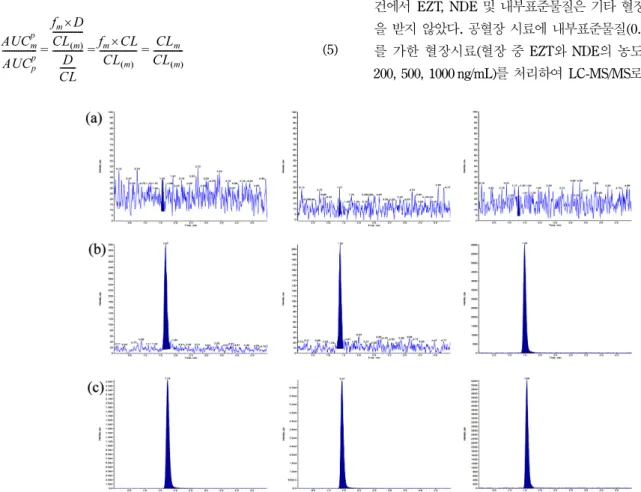
LC-MS/MS로 분석하였을 때 크로마토그램은 Fig. 2와 같았으 며, EZT 피크 유지시간은 약 1.6분, NDE 피크의 유지시간은 약 1.9분, 내부표준물질의 피크 유지시간은 약 1.8분이었다. 분석조 건에서 EZT, NDE 및 내부표준물질은 기타 혈장 성분들과 간섭 을 받지 않았다. 공혈장 시료에 내부표준물질(0.5 μg/mL) 50 μL 를 가한 혈장시료(혈장 중 EZT와 NDE의 농도는 0.5, 2, 5, 20, 200, 500, 1000 ng/mL)를 처리하여 LC-MS/MS로 분석하였을 때, CL Dose
AUC0 ∞– ---
=
MRT AUMC0 ∞– AUC0 ∞–
---
=
Vss=MRT CL×
AUCmp fm×D CL( )m ---
=
AUCmp
AUCpp ---
fm×D CL( )m
--- CLD ---
--- fm×CL CL( )m --- CLm
CL( )m ---
= = =
CL(m) Dm
AUCmm ---
=
Fig. 2 − HPLC/MS/MS chromatograms of samples from (A) double blank rat plasma, (B) rat plasma containing 0.5 ng/mL (LLOQ) of
enzalutamide and N-desmethyl enzalutamide, and 0.5 µg/mL of bicalutamide and (C) rat plasma sample obtained at 10 hours after
oral administration. Each chromatograms represents enzalutamide, N-desmethyl enzalutamide, and bicalutamide, respectively, from
left to right.
혈장시료로부터 구한 EZT와 NDE에 검량선의 계산식은 y=a + bx (EZT 1/x2, a=0.0000235, b=0.000517, r=0.9984; NDE 1/
x2, a=0.0008374, b=0.00284, r=0.9984)로 0.5~1,000 ng/mL 범위에서 양호한 직선성을 나타내었다. 본 분석방법의 EZT와 NDE의 품질관리시료에 대한 정밀성(CV, %)은 batch 내 정밀성 에서 각각 8.40%, 9.93% 이하, batch 간 정밀성에서 각각 8.00%, 9.01% 이하로 나타났다. 또한 품질관리 시료의 정확성(RE, %) 은 ±4.00, 4.03% 이내로 나타났다(Table 1). EZT와 NDE의 각 Condition에 따른 안정성(Stability, %)은 6시간 동안 상온에 방 치하였을 때 각각 88.8, 97.7%, 4주간 동안 −20oC에서 보관하였 을 때 100.8, 97.0%, 냉 해동 3회 반복 시 99.6, 93.5%로 나타 나 매우 안정한 약물임을 알 수 있었다. 생체시료 영향 (matrix effect), 회수율(recovery) 및 전처리 효율(process efficiency)은 표준액 분석 물질 100% 대비 사용한 시험법의 시료추출과 처리 과정을 거치는 세 가지 배치를 이용하여 평가하였다. 분석 결과 EZT의 생체시료 영향은 저, 중, 고 품질관리시료에서 각각 101, 94.7, 102%로 분석 외 물질에 영향을 많이 받지 않는 것으로 나 타났으며, 회수율은 저, 중, 고 품질관리시료에서 76.7, 87.0, 90.4%로 높은 회수율을 보였다. 전처리 효율은 저, 중, 고 품질 관리시료에서 각각 77.2, 82.5, 92.4% 이었다. NDE 또한 생체시 료 영향 95.3, 96.8, 108%, 회수율 85.5, 89.3, 92.8%, 전처리 효 율 78.6, 86.5, 100.1%로 사용한 전처리 방법이 두 물질 모두에 효율적임을 알 수 있었다.
흰쥐에서의 약동학 시험
2 mg/kg의 용량으로 미정맥을 통해 EZT를 투여했을 때, EZT 는 다중지수적(multi-exponential)으로 감소하였고, T1/2는 8.51 h, AUC는 38.2 μg·h/mL, CL는 53.2 mL/h/kg, Vss는 588 mL/
kg, MRT는 11.1 h 값을 나타내었다(Fig. 3). 이 때 모약물로부터 형성된 NDE는 Cmax는 0.06 μg/mL T1/2는 10.3 h, AUC는 1.56μg·h/mL를 나타내었고 투여 10시간 후에 최고농도를 보이
며 감소하는 전형적인 대사체 패턴을 나타내었다(Fig. 4). 모약물 대비 대사체의 AUC 비율은 4.07% 였다. 동일용량을 경구 투여
Table I − Precision and accuracy of quality control (QC) samples of enzalutamide (EZT) and N-desmethyl enzalutamide (NDE) (n = 3 days and
six replicates per day)
LLOQ (0.5 ng/mL) LQC (1 ng/mL) MQC (100 ng/mL) HQC (900 ng/mL)
EZT NDE EZT NDE EZT NDE EZT NDE
Intra-assay
Concentration (ng/mL) 0.51 0.51 0.96 0.99 101.08 104.03 870.00 881.00
Precision (%) 8.40 2.27 6.92 11.80 5.25 9.93 3.76 7.84
Accuracy (%) 1.83 1.27 4.00 1.23 1.08 4.03 3.33 2.11
Inter-assay
Concentration (ng/mL) 0.51 0.50 0.95 0.97 103.47 101.18 890.67 870.17
Precision (%) 3.17 4.59 6.53 9.01 8.00 5.82 3.83 3.90
Accuracy (%) 1.87 0.93 5.10 2.57 3.83 1.18 1.04 3.31
CV, coefficient of variation; RE, relative error
Fig. 3 − Plasma concentration time curves of enzalutamide after 2 mg/kg intravenous (●) and oral (□) administration to rats (n = 3).
Fig. 4 − Plasma concentration time curves of N-desmethyl enzalutamide
after 2 mg/kg enzalutamide intravenous ( ●) and oral (□)
administration to rats (n = 3).
했을 때 Cmax는 2.13 μg/mL T1/2는 9.78 h, AUC는 32.5 μg·h/
mL를 나타내어 생체이용률(BA)은 84.6%로 계산되었다. 이 때 형성된 NDE의 패턴은 정맥투여시의 NDE 패턴과 매우 유사하였 고 이 때 Cmax는 0.06 μg/mL T1/2는 10.3 h, AUC는 1.56 μg·h/mL 를 나타내었다(Fig. 4). 모약물 EZT와 NDE의 약동학 파라메타 (pharmacokinetic parameter)는 Table 2~4에 요약 되어있다.
2 mg/kg의 용량으로 NDE의 정맥 내 투여 후 NDE에 대한 CL(m), Vss, m및 MRTm값은 473 mL/h/kg, 1703 mL/kg 및 3.68 h 이었다. NDE에 대해 2 mg/kg의 정맥 투여에서, 모든 샘플의 EZT 수준은 검출한계 이하였기 때문에, EZT의 가역적 대사는 발생하
지 않은 것으로 판단된다. 식 (5)와 Table 3에 제시된 자료에 따 르면, 2 mg/kg의 EZT 투여에서 NDE의 추정된 형성 클리어런스 (CLm)는 19.3 mL/h/kg 이었다(Table 4). EZT가 주로 간의 2C8과 3A4에 의해 대사를 받는다는 것과 2 mg/kg EZT 투여 후의 NDE 의 CLm값 19.3 mL/h/kg을 고려하면 총 EZT 투여 량의 36.3%
가 NDE의 형성을 통해 제거되는 것으로 계산된다.
결 론 (Conclusion)
본 연구에서 혈장 중 EZT와 NDE의 생체시료 분석법을 개발 하였고 validation을 통하여 분석조건을 확립하였다. 확립한 분석 법은 빠르고 간편하며 충분한 감도를 나타내었으며, 약동학 시
Table II − Pharmacokinetic parameters of enzalutamide after 2 mg/
kg intravenous and oral administration to rats (n = 3)
PK parameters Dosing route
Intravenous Oral
T max (h) 0.08±0.00 2.33±1.34
C max (
μg/mL) 4.09±0.71 2.13±0.56
T 1/2 (h) 8.51±0.05 9.78±0.75
AUC last (
μg·h/mL) 38.1±6.01 32.3±5.78
AUC inf (
μg·h/mL) 38.2±6.01 32.5±5.76
MRT (h) 11.1±0.96 13.2±1.04
CL (mL/h/kg) 53.2±9.00
V ss (mL/kg) 588±50.6
F (%) 84.61
T max , time of maximum plasma concentration; C max , maximum plasma concentration; T 1/2 , terminal half-life AUC last , area under the plasma concentration–time curve from time zero to last (72h); AUC inf , area under the plasma concentration–time curve from time zero to infinity; V ss , volume of distribution at steady state; CL, elimination clearance
Table III − Pharmacokinetic parameters of N-desmethyl enzalutamide after 2 mg/kg enzalutamide intravenous and oral administration to rats (n = 3)
PK parameters Dosing route
Intravenous Oral
T max (h) 10.0±0.00 10.0±0.00
C max (
μg/mL) 0.06±0.01 0.06±0.02
T 1/2 (h) 10.3±0.41 11.7±2.17
AUC last (
μg·h/mL) 1.54±0.39 1.48±0.42
AUC inf (
μg·h/mL) 1.56±0.40 1.53±0.38
MRT (h) 19.3±2.22 21.3±2.07
AUC m /AUC p 0.04±0.01 0.05±0.02
T max , time of maximum plasma concentration; C max , maximum plasma concentration; T 1/2 , terminal half-life; AUC last , area under the plasma concentration–time curve from time zero to last (72h); AUC inf , area under the plasma concentration–time curve from time zero to infinity; AUC m, AUC inf of metabolite; AUC p, AUC inf of parent drug
Table VI − Pharmacokinetic parameters of N-desmethyl enzalutamide after 2 mg/kg intravenous injection to rats (n = 3)
PK parameters Dosing route
Intravenous
T max (h) 0.08±0.00
C max (
μg/mL) 1.30±0.07
T 1/2 (h) 2.81±0.70
AUC last (
μg·h/mL) 4.15±0.90
AUC inf (
μg·h/mL) 4.35±0.84
MRT (h) 3.68±0.73
CL (mL/h/kg) 473±91.1
V ss (mL/kg) 1,703±220
T max , time of maximum plasma concentration; C max , maximum plasma concentration; T 1/2 , terminal half-life; AUC last , area under the plasma concentration–time curve from time zero to last (24h); AUC inf , area under the plasma concentration–time curve from time zero to infinity; V ss , volume of distribution at steady state; CL, elimination clearance
Fig. 5 − Plasma concentration time curves of N-desmethyl enzalutamide
after 2 mg/kg N-desmethyl enzalutamide intravenous (●)
injection to rats (n = 3).
험에 이용할 수 있는 특이성, 정확성, 정밀성, 안정성, 생체시료 영향 및 전처리효율과 회수율을 갖고 있었다. 이 분석법을 통해 흰쥐에서 EZT와 NDE의 약동학 실험에 적용하였고, EZT 소실 에 있어 활성대사체인 NDE로 가는 비율은 36.3%임을 알 수 있 었다.
감사의 말씀 (Acknowledgment)
본 연구는 충남대학교의 학술연구비 지원을 받아 수행되었으 며 이에 감사드립니다.
References
1) Mullard A.: 2012 FDA drug approvals. Nature Reviews Drug Discovery. 12, 87-90 (2013).
2) Schrader A. J., Boegemann M., Ohlmann C. H., Schnoeller T.
J., Krabbe L. M., Hajili T., Jentzmik F., Stoeckle M., Schrader M., Herrmann E., and Cronauer M. V.: Enzalutamide in Castration-resistant Prostate Cancer Patients Progressing After Docetaxel and Abiraterone. European Urology. 65, 30-36 (2014).
3) Scher H. I., Beer T. M., Higano C. S., Anand A., Taplin M. E., Efstathiou E., Rathkopf D., Shelkey J., Yu E. Y., Alumkal J., Hung D., Hirmand M., Seely L., Morris M. J., Danila D. C., Humm J., Larson S., Fleisher M., Sawyers C. L., and Fdn P. C.:
Antitumour activity of MDV3100 in castration-resistant prostate cancer: a phase 1-2 study. Lancet. 375, 1437-1446 (2010).
4) Tran C., Ouk S., Clegg N. J., Chen Y., Watson P. A., Arora V., Wongvipat J., Smith-Jones P. M., Yoo D., Kwon A., Wasielewska T., Welsbie D., Chen C. D., Higano C. S., Beer T.
M., Hung D. T., Scher H. I., Jung M. E., and Sawyers C. L.:
Development of a second-generation antiandrogen for treatment of advanced prostate cancer. Science. 324, 787-790 (2009).
5) Mccutcheon S. B.: Enzalutamide: a new agent for the prostate cancer treatment armamentarium. J. Adv. Pract. Oncol. 4, 182 (2013).
6) Gibbons J. A., De Vries M., Krauwinkel W., Ohtsu Y., Noukens J., Van Der Walt J. S., Mol R., Mordenti J., and Ouatas T.:
Pharmacokinetic drug interaction studies with enzalutamide.
Clin. Pharmacokinet. 54, 1057-1069 (2015).
7) Gibbons J. A., Ouatas T., Krauwinkel W., Ohtsu Y., Van Der Walt J.-S., Beddo V., De Vries M., and Mordenti J.: Clinical pharmacokinetic studies of enzalutamide. Clin. Pharmacokinet.
54, 1043-1055 (2015).
8) ICH.: Guidance on nonclinical safety studies for the conduct of
human clinical trials and marketing authorization for pharmaceuticals M3 (R2). http://www.ich.org/fileadmin/
Public_Web_Site/ICH_Products/Guidelines/Multidisciplinary/
M3_R2/Step4/M3_R2__Guideline.pdf
9) Bennett D., Gibbons J. A., Mol R., Ohtsu Y., and Williard C.:
Validation of a method for quantifying enzalutamide and its major metabolites in human plasma by LC–MS/MS. Bioanalysis. 6, 737-744 (2014).
10) Ohtsu Y., Thakker D. R., Gibbons J. A., Tsubota K., Otsuka S., and Arai H.: Determination of the androgen receptor inhibitor enzalutamide and its metabolites in animal plasma and brain homogenates using LC-MS/MS and its application to pharmacokinetic studies. Chromatography. 36, 115-122 (2015).
11) Kim K. P., Parise R. A., Holleran J. L., Lewis L. D., Appleman L., Van Erp N., Morris M. J., and Beumer J. H.: Simultaneous quantitation of abiraterone, enzalutamide, N-desmethyl enzalutamide, and bicalutamide in human plasma by LC–MS/
MS. J. Pharm. Biomed. Anal. 138, 197-205 (2017).
12) Krauwinkel W., Noukens J., Dijk J., Popa S., Ouatas T., Vries M., Phung D., Gibbons J., Mordenti J., and Mateva L.: A comparison of the pharmacokinetics and safety of enzalutamide in subjects with hepatic impairment and matched healthy subjects. J. Clin. Pharm. Ther. 42, 268-275 (2017).
13) Weiss J., Kocher J., Mueller C., Rosenzweig S., and Theile D.:
Impact of enzalutamide and its main metabolite N-desmethyl enzalutamide on pharmacokinetically important drug metabolizing enzymes and drug transporters. Biopharm. Drug Dispos. 38, 517- 525 (2017).
14) US FDA: Analytical Procedures and Methods Validation for Drugs and Biologics. (2014). https://www.fda.gov/downloads/
drugs/guidances/ucm386366.pdf
15) Buhrman D. L., Price P. I., and Rudewiczcor P. J.: Quantitation of SR 27417 in human plasma using electrospray liquid chromatography-tandem mass spectrometry: A study of ion suppression. Journal of the American Society for Mass Spectrometry. 7, 1099-1105 (1996).
16) Matuszewski B. K., Constanzer M. L., and Chavez-Eng C. M.:
Strategies for the assessment of matrix effect in quantitative bioanalytical methods based on HPLC-MS/MS. Analytical chemistry. 75, 3019-3030 (2003).
17) Song J. H., Kim T. H., Jung J. W., Kim N., Ahn S. H., Hwang S. O., Kang N. S., Yoo S. E., and Koo T. S.: Quantitative determination of enzalutamide, an anti-prostate cancer drug, in rat plasma using liquid chromatography-tandem mass spectrometry, and its application to a pharmacokinetic study.
Biomedical chromatography : BMC. 28, 1112-1117 (2014).
18) Koo T. S., Kim D. H., Ahn S. H., Kim K. P., Kim I. W., Seo S.
Y., Suh Y. G., Kim D. D., Shim C. K., and Chung S. J.:
Comparison of pharmacokinetics of loxoprofen and its active
metabolites after an intravenous, intramuscular, and oral administration of loxoprofen in rats: evidence for extrahepatic metabolism. Journal of pharmaceutical sciences. 94, 2187-2197 (2005).
19) Lee J. H., Ahn S. H., Maeng H. J., Lee W., Kim D. D., and
Chung S. J.: The identification of lobeglitazone metabolites in rat liver microsomes and the kinetics of the in vivo formation of the major metabolite M1 in rats. J. Pharm. Biomed. Anal.
115, 375-382 (2015).