1
©The Korean Society of Food Science and Technology
시판 농산물의
dithiocarbamates
분석
김희연·최희주1·엄지윤·서은채·최승희·정소영·최선희·이화정1·최재천2*
서울지방식품의약품안전청, 1식품의약품안전청, 2경인지방식품의약품안전청
Determination of Dithiocarbamates in Agricultural Products
Circulated in Korea
Hee-Yun Kim, Hee-Ju Choi1, Ji-Yoon Eom, Eun-Chae Seo, Sung-Hee Choi, So-Young Cheong,
Sun-Hee Choi, Hwa-Jeong Lee1, and Jae-Chun Choi2*
Seoul Regional Korea Food and Drug Administration
1Korea Food and Drug Administration
2Gyeongin Regional Korea Food and Drug Administration
Abstract To revise the dithiocarbamates residue analysis method and survey the residues in agricultural products that
were treated with these fungicides in Korea, we purchased 20 types of foodstuffs (rice, potato, cabbage, apple etc.) from markets in five major cities. 236 samples of the purchased foodstuffs were then analyzed for the presence of dithiocarbamates by HPLC/UV and HPLC/APCI-MS. The R2, LOD and LOQ in the range of 0.5-107.3 mg/L were as
follows: DCC: y=174.34x+18.315, R2=0.9999, 0.01 mg/L, and 0.04 mg/L; EBDC: y=227.38x−14.715, R2=1.0000, 0.01
mg/L and 0.02 mg/L; PBDC: y=38.46x−21.412, R2=0.9999, 0.04 mg/L, and 0.1 mg/L; ETU: y=52.752x−4.4819, R2=0.9−
998, 0.02 mg/L and 0.03 mg/L; PTU: y=128.28x+4.4624, R2=0.9998, 0.02 mg/L, and 0.04 mg/L. The levels of DDC,
EBDC, PBDC, ETU and PTU in 20 agricultural products fortified to 10.0-107.3 mg/L ranged from 61.7-117.5%, 65.3-110.1%, 61.5-109.6%, 69.3-116.3% and 70.2-97.2%, respectively. Overall, dithiocarbamates were detected in 100 samples and the detection ratio was 42.4%. Among these, only 3 samples (1.3%) of Lycii fructus had residue levels that were
above the action limits, while the remaining samples (233 samples) contained levels of dithiocarbamates below the detection limit or below the Korea MRLs (Maximum Residue Limits).
Key words: Dithiocarbamates, DDC, EBDC, PBDC, ETU, PTU
서 론
Dithiocarbamate계농약(DTCs)은가장중요한유기유황
(organo-sulfur)계살균제로서농업분야에서뿐아니라고무산업에서도가 황촉진제 및항산화제로서도 널리 사용되는 화합물이다(1). 이 들 농약은 화학구조에 따라 thiram, ferbam 및 ziram과 같은
dialkyl-dithiocarbamate(DDC), maneb, mancozeb, metiram, zineb
및 nabam과 같은 ethylene-bis-dithiocarbamate(EBDC) 그리고 propineb과같은 propylene-bis-dithiocarbamate(PBDC) 등의 3가지 그룹으로 구분되며 분해 대사산물로서 ethylenethiourea(ETU)와 propylenethiourea(PTU)가 존재하는데, 그 중 EBDC계는 1943년 Gold-Worthy에의해 살균력이 발견된 이래가장 널리 사용되는 농약으로알려져있다. 이가운데우리나라에서 현재사용중인 농약으로는 thiram, mancozeb, metiram, propineb 4종이 있다.
Dithiocarbamate계농약은크게비파괴분석법과, 유도체화를포함 한 파괴분석법으로나눌 수있다(1). 전자는 전기영동이나 크로 마토그래피법에 주로의존되며, 후자는 dithiocarbamate계분자의 CS2를유리시켜, CS2를직접, 또는간접적으로다른 물질로유도 체를 만들어검출하는방식으로써크로마토그래피를택하든지또 는분광광도검출물질로변환하여흡광도를읽어분석하는방법 이다. 전자의분석법으로는 capillary electrophoresis(CE), gas
chro-matography(GC), high performance liquid chromatography(HPLC)
또는 liquid chromatography mass spectrometer(LC/MS)에의한디 치오카바메이트계 농약의분석법(2-7)이있고, 후자의 방법으로는 Keppel법의변경된 방법에 따라 100oC 이상에서 분해시켜정량 적으로발생하는 CS2가스를포집하여분광광도계또는 GC로정 성 및 정량하는 방법(8,9)이나 메칠화(methylation) 또는 부칠화 (butylation)에따른 GC, GC/MS 또는 HPLC 분석법(10,11)이있다. Dithiocarbamate계농약의국내연구로는 2003년식품의약품안전 청에서 실시한식물성원료식품의잔류농약조사연구(12)가있다. 2003년식품의약품안전청에서수행한연구는 dithiocarbamate계농 약 약 8종 가운데 국내에서 사용이 등록된 mancozeb, metiram, thiram 및 propineb를사용할수있는쌀, 감자, 대두, 사과, 배및 포도 등 20종농산물에대해 GC와 HPLC 시험법을이용하여 잔 류량을 분석한것이었다. 국외연구사례를 살펴보면 HPLC, GC 등을 사용하여과일퓨레와 토마토제품, 각종농산물중의 잔류 량에대한연구가이루어진바있다(13).
*Corresponding author: Jae-Chun Choi, Gyeongin Regional Korea Food and Drug Administration, Incheon 402-835, Korea
Tel: 82-32-450-3365 Fax: 82-32-442-4622 E-mail: [email protected]
Received March 2, 2009; revised September 14, 2009; accepted October 19, 2009
본연구에서는 DDC, EBDC 및 PBDC 그리고 ETU 및 PTU의
HPLC/atmospheric pressure chemical ionization mass spectrometer (APCI-MS) 분석법을확립하고 확립된잔류시험방법에의한잔류 실태를조사하고자국내에서재배된농작물중 dithiocarbamate계 농약의사용이허가된 사과, 배, 포도, 밀감, 감, 복숭아, 메론, 수 박, 오이, 고추, 양파, 배추, 인삼 및구기자등 20개 작물에대 하여서울, 대전, 광주, 대구및부산 5개지역의대단위시장에 서총 236점의시료를채취하여 dithiocarbamate계농약의잔류량 을조사하였다. 재료 및 방법 실험재료 농산물의소비자 구매시점에서 조사대상 20개농산물에 대하 여서울, 대전, 광주, 대구및 부산전국 5개대도시 지역의최 종유통단계인 대단위시장에서구입하여생체시료그대로를신 속히운반하여 바로전처리과정을 수행하였다. 조사대상 농산물 의채취된 시료총수는 236건이었다. 표준품 및 시약
L-Cysteine-HCl, EDTA, tetrabutylammonium hydrogen sulfate
및 methyl iodide는 Sigma사(St. Louis, MO, USA)의특급시약을 사용하였고, HCl, NaOH, NaCl 및 Sodium sulfate는 Wako Chem-icals사(Osaka, Japan)의농약잔류분석용을사용하였다. 또한 Ethanol 은 J.T.Baker Chemicals사(Phillipsburg, NJ, USA)의 HPLC용을사 용하였다. Dithiocarbamate계 농약 표준품은 ferbam(84.5%),
thiram(99.0%), metiram(70.0%), maneb(69.0%), mancozeb(72.5%), zineb(71.5%), ziram(97.0%), nabam(64.0%), propineb(70.0%), eth-ylenethiourea(99.5%) 및 propylenethiourea(98.5%)를 Dr.
Eheren-stofer GmbH사(Augsburg, Germany)로부터구입하여사용하였다. 표준용액의 제조 Dithiocarbamate계 농약 중 DDC, EBDC 및 PBDC는 각각의 표준품을 시료전처리및 회수율시험에 따른유도체화를 행한 후(ETU와 PTU는 유도체화 없이) 100-1073.1 mg/L 농도가 되게 메탄올에녹여표준원액으로사용하고이를다시 0.5-107.3 mg/L 가되게메탄올로희석하여 표준용액으로사용하였다. 이표준용 액은매 3일마다새로이조제하여사용하였다. DDC, EBDC 및 PBDC 용 시료의 전처리 잘게썰거나 절단한시료 20 g을삼각플라스크에 정밀히달아 0.5 g의 L-cysteine-HCl을첨가하고여기에다시 0.25 M EDTA가 함유된 0.45 M NaOH 수용액 80 mL을첨가하여마개를한후 20 분간 진탕 교반하였다. 진탕이 완료된 플라스크는 여과보조제
(Hyflo supercel)가깔려있는 glass fiber filter에서 여과하고 용기 및잔사를다시 10 mL의물로세척하여여과한후앞의여액과 합하였다. 여기에 5 mL의 0.41 M tetrabutylammonium hydrogen sulfate 수용액과 10 g의 NaCl을 첨가한 후 2 M 염산으로 pH를 6.5-8.5로조정하였다. 여기에디클로로메탄:헥산(1:1) 혼합용매에 0.05 M methyl iodide가용해되어있는용액 30 mL를첨가하여 5 분간진탕하고두개의층으로나뉘면 methyl iodide가함유된유 기용매층을분리하여취하고다시물층에위의 methyl iodide 용 액 10 mL를첨가하여 5분간진탕한 후유기용매층을 취하여앞 의것과합하였다. 여기에 무수황산나트륨을첨가하여 탈수시키 고 30분동안실온에서방치하였다. 여기에 20%의 1,2-propandiol 이함유된디클로로메탄용액 5 mL를가하고 35oC의감압농축기 에서 농축하였다. 농축잔류물은 methanol로희석하여 5.0 mL가 되게한후이를시험용액으로하여 HPLC/UVD 및 HPLC/APCI-MS에서분석하였다. 회수율시험을위해서는 쌀, 배추, 고추등 20개시료에 최종 농도가 10.28-107.3 mg/L가되도록 즉시조제 한표준용액을첨가한후위와 같이되풀이하여시험하고 HPLC/ UVD에서분석하여표준용액과 비교, 회수율을산출하였다. ETU 및 PTU의 전처리 잘게썰거나절단한시료 20 g을삼각플라스크에정밀히달아 ammonia 용액(약 pH 9.5) 80 mL을 첨가하고 여기에 다시 L-cysteine-HCl 0.5 g을첨가하여마개를한후 20분간진탕교반하 였다. 진탕이완료된플라스크는 여과보조제(Hyflo supercel)가깔 려있는 glass fiber filter에서 여과하고 용기 및 잔사를 다시 10
mL의물로세척하여 여과한후앞의여액과합하였다. 이용액 중 45 mL을 분액여두에 분취한 후 XTR 1포(14.5 g)와 Na2SO4 anhydrous 40 g을 가한다음 20분정치 후 acetonitrile:ethylacetate (3:1) 200 mL을가하여 10분간 shaking하고전체를 whatman 5A (110 mm) 여지로여과 한후여액을 35oC의감압농축기에서 농 축하였다. 농축잔류물은 methanol로희석하여 2.5 mL가되게 한 후 이를 시험용액으로 하여 HPLC/ultra-violet detector(HPLC/ Table 1. Conditions of HPLC/UVD
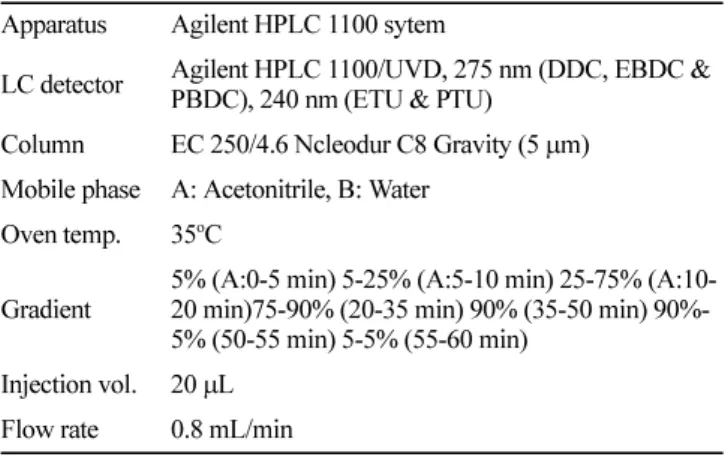
Apparatus Agilent HPLC 1100 sytem
LC detector Agilent HPLC 1100/UVD, 275 nm (DDC, EBDC & PBDC), 240 nm (ETU & PTU) Column EC 250/4.6 Ncleodur C8 Gravity (5µm)
Mobile phase A: Acetonitrile, B: Water Oven temp. 35oC
Gradient 5% (A:0-5 min) 5-25% (A:5-10 min) 25-75% (A:10-20 min)75-90% (20-35 min) 90% (35-50 min) 90%-5% (50-55 min) 5-90%-5% (55-60 min)
Injection vol. 20 µL
Flow rate 0.8 mL/min
Table 2. Conditions of HPLC/APCI-MS
Apparatus Thermo Surveyor Modular HPLC/MS System LC detector Thermo Surveyor HPLC/UVD, 275 nm (DDC, EBDC & PBDC), 240 nm (ETU & PTU) Column EC 250/2 Ncleodur 100-C8 Gravity (5 µm)
Mobile phase A: MeOH, B: Water Oven temp. 35oC
Gradient 5% (A: 0-5 min) 5-25% (A: 5-10 min) 25-75% (A: 10-20 min) 75-90% (A: 20-35 min) 90% (A: 35-50 min) 90-5% (A: 50-55 min) 5-5% (A: 55-60 min) Injection vol. 20 µL
Flow rate 0.2 mL/min Surveyor
MSQ detector
Ionization
mode APCI Probe temp. (oC) 350 Corona (kV) 17 Detector (V) 1247
RF Lens 0.3 Ion energy (V) 0.3 LM Res 12.7 HM Res. 12.5
UVD) 및 HPLC/APCI-MS에서분석하였다. 회수율 시험을위해 서는 쌀, 배추, 고추등 20개시료에 10.0 mg/L 농도로즉시조 제한표준용액을첨가한후위와같이되풀이하여시험하고 HPLC/ UVD에서분석하여표준용액과비교, 회수율을산출하였다. 분석조건 시료의 분석에 사용한 HPLC/UVD와 HPLC/APCI-MS의 분석 조건은 Table 1-3과같았다. 결과 및 고찰 직선성
,
검출한계 및 정량한계HPLC/UVD에서 얻은 DDC(thiram, ferbam, and ziram), EBDC
(maneb, mancozeb, metiram, zineb, and nabam), PBDC(propineb), ETU 및 PTU의 표준검정곡선, 직선성, 검출한계 및 정량한계는
Fig. 1, 2 그리고 Table 4와같았다. 0.5-107.3mg/L 범위에서의직 선성은 DCC: y=174.34x+18.315, R2=0.9999; EBDC: y=227.38x−
14.715, R2=1.0000; PBDC: y=38.46x−21.412, R2=0.9999; ETU: y=52.752x−4.4819, R2=0.9998; PTU: y=128.28x+4.4624, R2= 0.9998로고도의상관성이있으므로, 이범위내의농도에서정량 분석이가능한것으로평가되었으며, 검출한계와정량한계의경우 도 DDC: 0.01mg/L 및 0.04mg/L, EBDC: 0.01mg/L 및 0.02mg/
L, PBDC: 0.04mg/L 및 0.1 mg/L, ETU: 0.02mg/L 및 0.03mg/L,
PTU: 0.02mg/L 및 0.04mg/L로만족할만한수준이었다.
Limit of detection (LOD)=As−Ab=3×Sb
Limit of quntification (LOQ)=As−Ab=10×Sb
(As: the mean of area of sample signal, Ab: the mean of area of blank signal, Sb: standard deviation)
회수율
분석대상인쌀, 감자, 사과, 배추등 20개농산물에 대해회수 율시험을실시한결과 Table 5에서보는바와같이 DDC(thiram,
ferbam and ziram), EBDC(maneb, mancozeb, metiram, zineb and nabam), PBDC(propineb), ETU 및 PTU는각각 61.7-117.5%,
65.3-110.1%, 61.5-109.6%, 69.3-116.3% 및 70.2-97.2% 범위의 만 족할만한수준의 회수율을보여주었다.
Dithiocarbamate
분석결과DDC(thiram, ferbam, and ziram), EBDC(maneb, mancozeb, metiram, zineb, and nabam), PBDC(propineb), ETU 및 PTU의
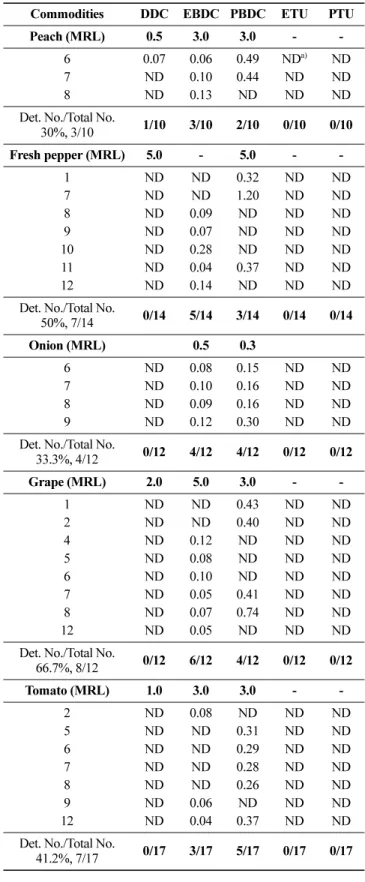
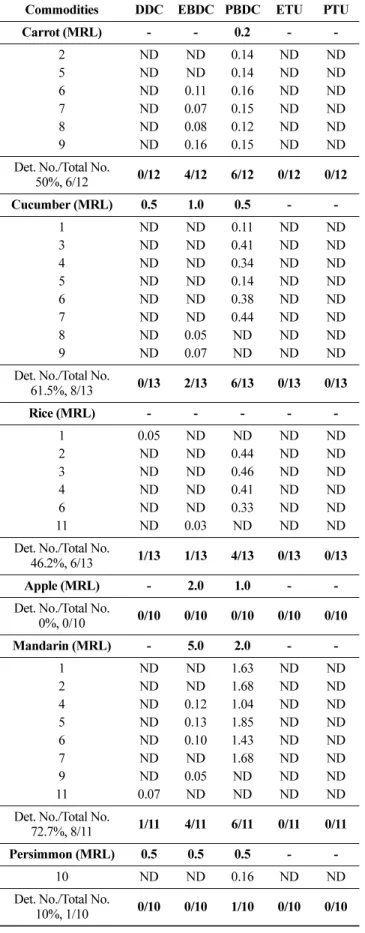
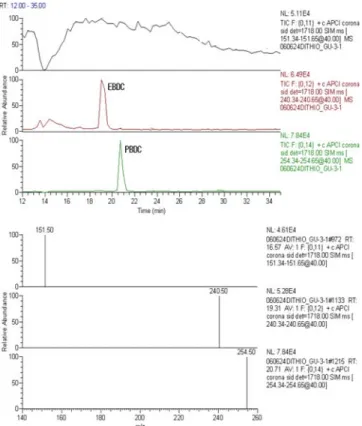
HPLC/UVD 및 HPLC/APCI-MS에 의한정성 및정량법을 확립 하였다. 총 236건중의 잔류량을조사하여 얻은결과를 Table 6 에나타내었고, 검출시료의 HPLC/UVD와 HPLC/APCI-MS 크로 마토그램과 mass fragments를 Fig. 3-7에나타내었다. 총 236건의 시료 가운데 100건의시료에서 dithiocarbamate계농약이검출되 어 총 42.4%의검출율을 보였다. 분석대상 시료 검출건수는 복 숭아가 10건중 3건(30%), 고추가 14건중 7건(50%), 양파가 12 건중 4건(33.3%), 포도가 12건중 8건(66.7%), 토마토가 17건중
Table 3. Parameters of HPLC/APCI-MS
Compound Name M.W [M+H] + (theory) m/z CV DDC 135 136 151.5 P40 EBDC 240 241 240.5 P40 PBDC 254 255 254.5 P40 ETU 102.16 103 103 P40 PTU 116.19 117 117 P40
Fig. 1. Calibration curves of DDC, EBDC, and PBDC.
Fig. 2. Calibration curves of ETU and PTU.
Table 4. Linearity, LOD, and LOQ of dithiocarbamates Compound
name C.C LOD (mg/L) LOQ (mg/L)
DDC 0.9999 0.01 0.04 EBDC 0.9999 0.01 0.02 PBDC 1.0000 0.04 0.10 ETU 0.9998 0.02 0.03 PTU 0.9998 0.02 0.04
Table 5. Recoveries (%) of dithiocarbamates
Commodities DDC EBDC PBDC ETU PTU
Peach 85.2 100.1 99.7 79.6 97.2 Fresh pepper 84.4 69.6 83.8 80.2 96.5 Onion 74.8 102.6 104.0 81.8 88.6 Grape 78.1 75.9 62.9 99.2 76.5 Tomato 101.8 65.3 86.0 92.2 83.8 Photato 86.7 77.8 63.0 88.0 77.0 Lycii Fructus 92.8 110.1 102.8 116.3 78.4 Water melon 98.1 82.5 61.5 69.3 81.5 Cabbage 80.4 76.2 88.0 99.8 90.1 Carrot 96.3 85.2 77.9 95.4 70.2 Cucumber 96.1 87.3 80.7 105.1 72.5 Chinese cabbage 88.2 80.1 109.6 94.5 90.3 Apple 98.0 75.2 98.8 83.2 74.9 Mandarin 87.2 84.0 63.7 86.7 87.6 Melon 83.7 82.7 86.5 112.1 87.8 Pear 99.7 81.4 77.7 105.1 88.7 Rice 117.5 96.0 76.6 104.2 96.1 Persimmon 62.2 74.3 79.1 107.0 90.1 Ginseng 67.4 68.8 83.4 98.5 71.7 Soybean 61.7 75.3 72.1 106.9 88.2
7건(41.2%), 감자가 14건 중 4건(28.6%), 구기자가 10건 중 9건 (90%), 수박이 10건 중 6건(60%), 양배추가 11건 중 8건(72.7%), 배추가 10건 중 7건(70%), 당근이 12건 중 6건(50%), 오이가 13
Table 6. Level of dithiocarbamate residues in foodstuffs (mg/kg) Commodities DDC EBDC PBDC ETU PTU Peach (MRL) 0.5 3.0 3.0 -
-6 0.07 0.06 0.49 NDa) ND
7 ND 0.10 0.44 ND ND 8 ND 0.13 ND ND ND Det. No./Total No.
30%, 3/10 1/10 3/10 2/10 0/10 0/10 Fresh pepper (MRL) 5.0 - 5.0 - -1 ND ND 0.32 ND ND 7 ND ND 1.20 ND ND 8 ND 0.09 ND ND ND 9 ND 0.07 ND ND ND 10 ND 0.28 ND ND ND 11 ND 0.04 0.37 ND ND 12 ND 0.14 ND ND ND Det. No./Total No.
50%, 7/14 0/14 5/14 3/14 0/14 0/14 Onion (MRL) 0.5 0.3 6 ND 0.08 0.15 ND ND 7 ND 0.10 0.16 ND ND 8 ND 0.09 0.16 ND ND 9 ND 0.12 0.30 ND ND Det. No./Total No.
33.3%, 4/12 0/12 4/12 4/12 0/12 0/12 Grape (MRL) 2.0 5.0 3.0 - -1 ND ND 0.43 ND ND 2 ND ND 0.40 ND ND 4 ND 0.12 ND ND ND 5 ND 0.08 ND ND ND 6 ND 0.10 ND ND ND 7 ND 0.05 0.41 ND ND 8 ND 0.07 0.74 ND ND 12 ND 0.05 ND ND ND Det. No./Total No.
66.7%, 8/12 0/12 6/12 4/12 0/12 0/12 Tomato (MRL) 1.0 3.0 3.0 - -2 ND 0.08 ND ND ND 5 ND ND 0.31 ND ND 6 ND ND 0.29 ND ND 7 ND ND 0.28 ND ND 8 ND ND 0.26 ND ND 9 ND 0.06 ND ND ND 12 ND 0.04 0.37 ND ND Det. No./Total No.
41.2%, 7/17 0/17 3/17 5/17 0/17 0/17
Table 6. Continued
Commodities DDC EBDC PBDC ETU PTU Photato (MRL) - 0.3 0.2 -
-7 ND 0.07 0.15 ND ND 8 ND 0.13 0.16 ND ND 9 ND 0.13 0.13 ND ND 10 ND 0.13 0.14 ND ND Det. No./Total No.
28.6%, 4/14 0/14 4/14 4/14 0/14 0/14 Lycii Fructus (MRL) - - 5.0 - -1 ND 1.49 3.40 ND ND 2 ND 3.31 1.73 ND ND 3 ND 2.68 42.82 ND ND 4 ND 8.52 43.31 ND ND 5 ND 0.07 1.02 ND ND 6 ND 1.65 34.05 ND ND 7 ND 0.08 1.21 ND ND 8 ND 0.73 4.66 ND ND 9 ND ND 0.43 ND ND Det. No./Total No.
90%, 9/10 0/10 8/10 9/10 0/10 0/10 Water melon (MRL) 0.5 0.5 0.3 - -1 ND 0.10 0.12 ND ND 2 ND 0.09 0.15 ND ND 7 ND 0.44 ND ND ND 8 ND 0.19 ND ND ND 9 ND 0.19 ND ND ND 10 ND 0.08 ND ND ND Det. No./Total No.
60%, 6/10 0/10 6/10 2/10 0/10 0/10 Cabbage (MRL) - - - - -1 ND ND 0.14 ND ND 2 ND ND 0.13 ND ND 3 ND ND 0.22 ND ND 4 ND ND 0.15 ND ND 5 ND ND 0.30 ND ND 6 ND ND 0.29 ND ND 7 ND 0.13 ND ND ND 8 ND 0.07 0.21 ND ND Det. No./Total No.
72.7%, 8/11 0/11 2/11 7/11 0/11 0/11 Chinese cabbage (MRL) - - - - -2 ND ND 0.18 ND ND 3 ND ND 0.11 ND ND 4 ND ND 0.19 ND ND 5 ND 0.12 ND ND ND 6 ND 0.06 ND ND ND 7 ND 0.06 ND ND ND 8 0.05 0.13 0.25 ND ND Det. No./Total No.
건중 8건(61.5%), 쌀이 13건중 6건(46.2%), 감귤이 11건중 8 건(72.7%), 메론이 16건중 5건(31.3%), 감이 10건중 1건(10%), 인삼이 11건중 1건(9.1%), 대두가 10건중 2건(20%)이었으나사 과와 배 각 10건에서는 불검출이었다. 검출된 dithiocarbamate계 농약이 잔류허용기준을 초과하여 검출된 경우는건 구기자에서 3건으로나타났다. 3건모두잔류허용기준(5.0 ppm)을초과한 점 을 감안하면 현행 생물 구기자를 대상으로한 dithiocarbamate계 농약성분의 잔류허용기준을 건물에 대하여 설정하여야 할필요 가있는 것으로 사료되었다. 기타 다른농산물의 경우는 dithio-carbamate계농약의잔류치가높은검출율에비해비교적 안전한 수준으로 인체에 크게위협이되지 않는수준인것으로 판단되 었다. Table 6. Continued
Commodities DDC EBDC PBDC ETU PTU Carrot (MRL) - - 0.2 - -2 ND ND 0.14 ND ND 5 ND ND 0.14 ND ND 6 ND 0.11 0.16 ND ND 7 ND 0.07 0.15 ND ND 8 ND 0.08 0.12 ND ND 9 ND 0.16 0.15 ND ND Det. No./Total No.
50%, 6/12 0/12 4/12 6/12 0/12 0/12 Cucumber (MRL) 0.5 1.0 0.5 - -1 ND ND 0.11 ND ND 3 ND ND 0.41 ND ND 4 ND ND 0.34 ND ND 5 ND ND 0.14 ND ND 6 ND ND 0.38 ND ND 7 ND ND 0.44 ND ND 8 ND 0.05 ND ND ND 9 ND 0.07 ND ND ND Det. No./Total No.
61.5%, 8/13 0/13 2/13 6/13 0/13 0/13 Rice (MRL) - - - - -1 0.05 ND ND ND ND 2 ND ND 0.44 ND ND 3 ND ND 0.46 ND ND 4 ND ND 0.41 ND ND 6 ND ND 0.33 ND ND 11 ND 0.03 ND ND ND Det. No./Total No.
46.2%, 6/13 1/13 1/13 4/13 0/13 0/13
Apple (MRL) - 2.0 1.0 -
-Det. No./Total No.
0%, 0/10 0/10 0/10 0/10 0/10 0/10 Mandarin (MRL) - 5.0 2.0 - -1 ND ND 1.63 ND ND 2 ND ND 1.68 ND ND 4 ND 0.12 1.04 ND ND 5 ND 0.13 1.85 ND ND 6 ND 0.10 1.43 ND ND 7 ND ND 1.68 ND ND 9 ND 0.05 ND ND ND 11 0.07 ND ND ND ND Det. No./Total No.
72.7%, 8/11 1/11 4/11 6/11 0/11 0/11
Persimmon (MRL) 0.5 0.5 0.5 -
-10 ND ND 0.16 ND ND Det. No./Total No.
10%, 1/10 0/10 0/10 1/10 0/10 0/10
Table 6. Continued
Commodities DDC EBDC PBDC ETU PTU Melon (MRL) 1.0 - 1.0 - -7 ND 0.06 0.18 ND ND 8 ND 0.14 0.18 ND ND 9 ND 0.13 0.14 ND ND 10 ND 0.13 0.15 ND ND 11 ND 0.15 0.27 ND ND Det. No./Total No.
31.3%, 5/16 0/16 5/16 5/16 0/16 0/16
Pear (MRL) 0.5 0.5 - -
-Det. No./Total No.
0%, 0/10 0/10 0/10 0/10 0/10 0/10
Ginseng (MRL) - 0.3 - -
-5 ND 0.16 ND ND ND Det. No./Total No.
9.1%, 1/11 0/11 1/11 0/11 0/11 0/11
Soybean (MRL) - - - -
-9 0.29 0.16 ND ND ND 10 ND 0.86 ND ND ND Det. No./Total No.
20%, 2/10 1/10 2/10 0/10 0/10 0/10
NDa): Not detected
Fig. 3. Standard chromatogram of ETU and PTU by HPLC/ UVD.
Fig. 4. Standard chromatogram of DDC, EBDC, and PBDC by HPLC/UVD.
요 약 HPLC/APCI-MS에 의한 dithiocarbamate계 분석법을 확립하고 아울러국내에서 dithiocarbamate계농약이사용되는쌀, 배추, 사 과등 20종농산물에대해잔류실태를조사한본연구의결과는 다음과같았다. Dithiocarbamate계농약검출건수는 복숭아가 10 건중 3건(30%), 고추가 14건중 7건(50%), 양파가 12건중 4건 (33.3%), 포도가 12건 중 8건(66.7%), 토마토가 17건 중 7건 (41.2%), 감자가 14건중 4건(28.6%), 구기자가 10건중 9건(90%), 수박이 10건중 6건(60%), 양배추가 11건중 8건(72.7%), 배추가 10건중 7건(70%), 당근이 12건중 6건(50%), 오이가 13건중 8 건(61.5%), 쌀이 13건중 6건(46.2%), 감귤이 11건중 8건(72.7%), 메론이 16건중 5건(31.3%), 감이 10건중 1건(10%), 인삼이 11 건중 1건(9.1%), 대두가 10건중 2건(20%)으로 100건의시료에 서 42.4%의검출율을보였으나 사과와배각 10건의시료에서는 검출되지 않았다. 이중기준치를초과한농산물은 건구기자 3 건이었으나 기준규격을설정하여관리되고 있다. 문 헌
1. Malik AK, Faubel W. Methods of analysis of dithiocarbamate pesticides: A review. Pestic. Sci. 55: 965-970 (1999)
2. Lo CC, Hsiao YM. Comparison of micellar electrokinetic capil-lary chromatographic method with high-performance liquid chro-matographic method for the determination of imidazolidine-2-thione (Ethylenethiourea) in formulated products. J. Agr. Food Chem. 45: 3118-3122 (1997)
3. Debbarh I, Mooret N. A simple method for the determination of ethylenethiourea in biological samples. J. Anal. Toxicol. 26: 216-221 (2002)
4. Sottani C, Bettinelli M, Fiorentino ML, Minoia C. Analytical method for the quantitative determination of urinary ethylenethio-urea by liquid chromatography/electrospray ionization tandem mass spectrometry. Rapid Commun. Mass Sp. 17: 2253-2259 (2003)
5. Kontou S, Tsipi D, Oreopoulou V, Tzia C. Determination of ETU in tomatoes and tomato products by HPLC-PDA. Evaluation of cleanup procedures. J. Agr. Food Chem. 49: 1090-1097 (2001) 6. Startin JR, Hird SJ, Sykes MD. Determination of ethylenethiourea
(ETU) and propylenethiourea (PTU) in foods by high perfor-mance liquid chromatography-atmospheric pressure chemical ioni-sation-medium-resolution mass spectrometry. Food Addit. Contam. 22: 245-250 (2005)
7. Blasco C, Font G, Pico Y. Determination of dithiocarbamates and metabolites in plants by liquid chromatography: Mass spectrome-try. J. Chromatogr. A 1028: 267-276 (2004)
8. Caldas ED, Conceição MH, Miranda MCC, Luiz César K.R. de Souza LC, Lima JF. Determination of dithiocarbamate fungicide residues in food by a spectrophotometric method using a vertical
Fig. 5. Standard mass chromatogram and mass fragment of ETU and PTU by HPLC/APCI-MS.
Fig. 6. Standard mass chromatogram and mass fragment of DDC, EBDC, and PBDC by HPLC/APCI-MS.
Fig. 7. Mass chromatogram and mass fragment of EBDC and PBDC detected in Lycii Fructus sample by HPLC/APCI-MS.
disulfide reaction system. J. Agr. Food Chem. 49: 4521-4525 (2001)
9. Royer A, Ménand M, Grimault A, Communal PY. Development of automated headspace gas chromatography determination of dithiocarbamate in plant matrixes. J. Agr. Food Chem. 49: 2152-2158 (2001)
10. Kawamoto T, Yano M, Makihata N. Development of a high-sen-sitivity quantitative analytical method for determining polycar-bamate by gas chromatography-mass spectrometry incorporating temperature-programmable inlet on-column injection. J. Chro-matogr. A 1074: 155-161 (2005)
11. Petsch M, Seipelt J, Mayer-Helm BX. A novel pre-column
derivatization reaction for the determination of dithiocarbamates in plasma by high-performance liquid chromatography. Anal. Chim. Acta 516: 119-124 (2004)
12. Hwang IG, Hong MK, Choi DM, Lee KB, Oh GS, Suh JH, Lee EJ, Choi KG, Seo CO, Lee KJ, Lee JS, Kim MC. Improvement of residue analysis method and monitoring for dithiocarbamates in foodstuffs. The Annual Report of KFDA, Korea 7: 394-402 (2003)
13. Bolzoni L, Sannino A, Bandini M. Determination of ethylenethio-urea and propylenethioethylenethio-urea in tomato products and in fruit purees. Food Chem. 47: 299-302 (1993)