담배연기 노출량 평가 생체지표
박철훈․신한재․이형석․유지혜․손형옥
*KT&G 중앙연구원 (2009년 6월 8일 접수)
Biomarkers of Exposure for Cigarette Smoke
Chul-Hoon Park Han-Jae Shin, Hyeong-Seok Lee, Ji-Hye Yoo and Hyung-Ok Sohn
*KT&G Central Research Institute, Daejeon 305-805, Korea (Received June 8, 2009)
ABSTRACT
: Biomarkers could be critical and useful tools for assessing the biological effects of smoking and detecting differences between potentially reduced exposure product (PREP) and conventional cigarettes. Smoking-related biomarkers can be classified into three categories as biomarkers of exposure, biomarkers of effects, and biomarkers of potential harm.When compared with the biomarkers of effects or harm, the biomarkers of exposure for chemical constituents of cigarette smoke are well established and characterized. In addition, they could offer the important information in understanding how cigarette smoke interacts with biological molecules and causes the disease to human. Therefore, we provide an overview of 6 biomarkers of exposure (Nicotine and nicotine metabolites, Carboxyhaemoglobin, NNAL (4-(methylnitrosoamino)-1-(3-pyridyl)-1-butanol) and NNAL - glucuronide, 3-Hydroxypropyl- mercapturic acid, and Monohydroxy-butenyl-mercapturic acids, and Urine mutagenicity) which were validated through extensive research and clinical experience. These reliable biomarkers could help identify the efficacy of PREP by predicting early toxicological effects and lead to improve it.
Key words : biomarker, potentially reduced exposure product, cigarette smoke
생체지표(biomarker)란 항상성(Homeostasis)을 유지하고 있는 생물시스템에 어떠한 원인에 의해 생리학적 변화가 생긴 경우, 그러한 변화를 지시 하는 지표물질을 말한다. 2009년 6월 위해성 감소 제품을 공식적으로 인정한 ‘가족 흡연 방지 및 담 배 규제법’이 미국 의회를 통과하면서 이러한
*연락저자 : 305-805 대전광역시 유성구 신성동 302 번지, KT&G 중앙연구원
*Corresponding author : KT&G Central Research Institute, 302 Shinseong-dong, Yuseong-gu, Daejeon 305-805, Korea (phone: 82-42-866-5599 ; fax: 82-42-866-5426; e-mail: [email protected])
생체지표 연구 필요성이 더욱 커졌다. 그 이유는 위해성 감소 제품 입증방법으로 장기간 임상 시 험이나 역학조사 방법이 가장 바람직할 수 있지 만, 기술의 발전 속도가 빠르고, 실질적 위험성 감 소 제품의 존재 시 그 사용을 늦춘다는 것은 법제 정의 취지에 맞지 않으며, 위해성 감소제품만을
장기간 사용하게 하는 것은 현실적으로 어렵기 때 문에 현재 위해성 감소 주장을 위한 실질적인 방 법으로 생체지표를 이용한 단기 임상시험이 주목 을 받고 있기 때문이다(Shields, 2002).
최근 미국의학연구소(Institute of Medicine;
IOM) 보고서에서는 잠재적 위해성 감소 제품을 평가하기 위한 방법으로, 외적 노출량(external exposure)의 측정을 비롯하여 3가지 생체지표의 측정을 권고하였다. 3가지 생체지표는 체내 노출 량 평가를 위한 노출생체지표(biomarkers of exposure) 측정, 생물학적 유효용량(biologically effective dose) 평가를 위한 생체지표 측정, 잠재 적 유해성 생체지표(biomarkers of potential harm) 측정이다. 그러나 외적 노출량 측정은 체내로 흡 수되는 용량 및 흡연으로 인한 영향을 확인할 수 없으며, 생물학적 유효용량 평가를 위한 생체지표 분야는 아직 개발 단계인 생체 지표가 많고, 많은 경우 체내에 미량이 존재하여 측정이 어렵다는 단 점이 있다. 잠재적 유해성 생체지표의 경우도 아 직 검증되지 않은 부분이 많고 비용이 많이 든다 는 단점이 있으며 더욱이 대개의 경우 흡연 노출 에 대한 특이성을 갖지 못한다는 단점이 있다 (Shields, 2002). 이에 비해 노출 생체지표는 저렴 하고 기존에 많은 연구가 축적되어 있다는 점, 그 리고 상대적으로 검체수집이 용이하다는 점에서 장점이 있다. 따라서 본 연구에서는 노출생체지표 를 중심으로 위해성 감소제품을 평가하기 위한 방 법에 대해 살펴보고자 한다.
노출량 평가에 이용되는 생체 시료(Biological Matrices for biomarker of exposure)
담배연기에 의한 노출 생체 지표 측정에 있어서 가장 보편적으로 사용되는 생체 시료는 날숨, 혈 액, 뇨 등이다. 날숨에 의한 생체지표는 시료수집 이 용이한 반면 매우 단기적 노출만을 반영한다는 단점이 있다. 흡연 시 호기 중 일산화 탄소, 벤젠, VOCs(volatile organic compounds)의 농도가 증가 하기 때문에 이러한 생체지표를 측정할 수 있지만 (IARC, 2004), 정확한 노출량 측정에는 어려움이 있어 독립적 방법으로 사용하기에는 적합하지 않 다.
혈액의 경우 몇몇 생체지표에 대해서 좋은 민감 성과 선택성을 보여준다(Degiampietro, et al., 1987). 그러나 니코틴 같이 혈액에서 빠르게 대사 되거나 다른 기관으로 분배 또는 배출 되는 생체 지표의 경우에 혈액에서 측정하는 것은 바람직하 지 않다. 또한 혈액에서 헤모글로빈 부가체 (Hemoglobin adducts)를 측정할 경우 실험 기간에 대한 고려가 필요하다. 즉 헤모글로빈 부가체는 시간가중 평균농도(time-weighted average)로 노 출 시 최근 120일 이상 노출되었음을 의미하는 생 체지표이기 때문에, 동일 흡연자를 대상으로 담배 종류를 바꿔야하는 담배 간 비교를 위한 단기 임 상 연구 에서는 적합하지 않다.
니코틴, 코티닌 등 몇몇 생체 지표는 일반적으로 혈액 또는 타액 시료에서보다 뇨 중에서 농도가 높은 것으로 알려져 있다. 특히 뇨는 측정이 용이 하고 생체 지표를 측정할 수 있는 시간이 상대적 으로 길기 때문에 현재 담배연기 노출 생체지표 연구에 가장 널리 이용되는 생물학적 시료이다.
그러나 뇨를 사용하는 경우 뇨 중 수분 함량에 따 라 생체지표 수준이 변할 수 있기 때문에, Creatinine 등을 이용하여 보정하기도 한다. 다만 이 경우에도 Creatinine이 개체 내 또는 개체 간 차이가 있을 수 있고, 근육량 같은 내인성 인자 및 육식, 육체적 운동 같은 외인성 인자에 의해서 도 영향을 받을 수 있다는 점에 유의하여야 한다 (Boeniger et al., 1993). 뇨 수집은 뇨량 및 뇨 물 질량의 편차를 줄이기 위해 24시간 수집하는 방법 이 바람직하다. 알려진 몇 가지 단점에도 불구하 고, 뇨는 피실험자들에게 주는 부담이 적고, 채취 가 용이하며, 기존 연구된 데이터가 많이 축적되 어 있다는 점에서 현재 노출 생체지표를 위한 생 물학적 시료로 가장 적합하다.
노출 생체지표(Biomarker of exposure)
노출생체지표란 체내 거대분자와의 상호작용 가 능성이 있으며, 체액 또는 조직에서 측정될 수 있 는 성분 또는 대사체를 의미한다(IOM, 2001). 이 러한 노출 생체 지표는 내부 용량 측정법으로 고 려될 수 있다. 다만, 비교적 최근의 노출된 양의 추정만이 가능한 경우가 대부분이라는 단점을 갖
고 있다.
최근 미국 생명과학 연구소(Life Science Research Office; LSRO)에서는 임상연구를 위한 노출 생체지표의 조건으로 담배에 대한 특이성, 낮은 개인 변이, 약동력학의 정립여부, 화학물질 선택성, 분석 민감도, 낮은 분석변이, 시료 채취의 용이성 등을 지적한 바 있다. 또한 이러한 조건에 따라 노출생체지표를 3단계로 나누고 그 중 상위 2단계를 노출생체지표로 권고하였다(LSRO, 2007).
기존에 충분히 연구되어 적절한 노출량 측정이 가 능하며, LSRO에서도 category 1로 권고하는 대표 적인 노출 생체지표를 Table 1에 나타내었다. 노 출생체지표의 경우 담배 구성성분과 밀접한 관련 이 있으므로 화학적 연구 결과, 일부 또는 특정 성분의 감소가 있었고, 노출생체지표 임상연구에 서도 일치된 결론을 얻었다면 궁극적으로 노출량 감소 결론에 신뢰성을 증가시킬 수 있다. 그러나 이러한 노출량 감소 결과가 반드시 위해성 감소로 이어 지는 것은 아니기 때문에 PREP의 입증을 위 한 노출생체 지표 측정은 한계를 가지고 있으며, 생물학적 영향 평가 등 다양하고 체계적인 데이터 수집이 필요하다.
Table 1. Representative biomarkers of tobacco smoke exposure
Biomarker Smoke
constituents
Biological matrix
Purpose of measurement Urine mutagenicity Mutagens
Carcinogens urine Mutagen uptake Nicotine and nicotine metabolites Nicotine urine
blood
Potential chemical toxins
Carbon monoxide CO exhaled breath
blood
Potential chemical toxins 4-(methylnitrosoamino)-1-(3-pyridyl)-1-bu
tanol(NNAL) 및 NNAL - glucuronide
Tobaco specific Nitrosamines
urine Carcinogen (NNK) uptake 3-Hydroxypropyl-mercapturic acid
(HPMA) Acrolein urine Oxidative stress;
Inflammation Monohydroxy-butenyl-mercapturic
acids (MHBMA) 1,3-butadiene urine Volatile organic
Carcinogen (LSRO, 2007; Hatsukami et al., 2006)
니코틴 노출 생체지표 - 니코틴 및 니코틴 대사체 (Nicotine and nicotine metabolites)
니코틴은 체내에 흡수되면 최소 13개의 대사체로 대사될 수 있다. Fig. 1에 주요 니코틴 대사체에 대해 요약하였다. 니코틴 농도 측정에는 가스 크로 마토그래피, LC-MS/MS, HPLC, Immunoassay를 포함한 다양한 측정방법이 존재한다(Byrd, 2005;
Jacob et al., 1999; SRNT Subcommittee on Biochemical Verification, 2002). 그러나 1-2 시간 인 짧은 반감기, 그리고 환경적 요인에 의한 시 료 또는 분석 장비의 니코틴 오염 때문에 노출 생 체지표로서 사용되기에는 많은 단점을 갖고 있다.
이에 비해 코티닌(Cotinine)은 반감기가 19-24 시 간으로 상대적으로 길며(Sepkovic et al., 1985), 비 교적 안정적인 농도를 보이고, 환경적 요인에 의 한 오염 역시 거의 없어 현재 니코틴 노출에 대한 가장 이상적인 생체지표로 인정받고 있다. 코티닌 의 측정 역시 다양한 방법이 존재하지만, 몇몇 면 역 측정법의 경우 다른 니코틴 대사체와 교차 반 응성(cross reactivity)이 있어 그 양이 과대평가될 수 있으므로 주의하여야 한다. 이외에 니코틴 대 사체인 trans-3-hydroxycotinine 및 cotinine-N-
glucuronide의 혈중 농도를 측정한 보고가 있었으 나 노출 생체 지표로서 사용되기에는 실험적 데이 터가 아직 부족한 것으로 생각된다.
역학연구에서는 뇨중 코티닌 양을 담배연기 노 출상태 확인과 니코틴 노출의 대략적 표지로 자주 사용한다. 그러나 뇨 중 코티닌은 전체 니코틴 흡 수량의 약 10%를 반영할 뿐이며, 더욱이 니코틴 대사 과정의 작은 변화가 코티닌 배설에서 큰 차 이로 나타날 수 있으므로 대부분의 연구기관에서 는 니코틴, Nicotine-N-β-glucuronide, Cotinine, Cotinine-N-1-β-glucuronide, Trans-3'-hydroxy cotinine, Trans-3'-hydroxycotinine-O-β-glucuronide 의 5개의 주요 니코틴 대사체를 측정하여 니코틴 노출 지표로 사용한다. 즉 24시간 동안 수거한 뇨 에서 니코틴 및 5개 주요 니코틴 대사체를 측정하 고, 이들의 몰수를 이용하여 이에 상당하는 니코 틴 양을 계산하는데, 보통 이 값이 뇨를 통해 배 출되는 전체 니코틴 노출량의 80%에 달하기 때문 에 1.25를 곱하여 그 노출된 양을 추정한다. 다만, 니코틴 노출량을 니코틴 이외의 담배 연기 구성성 분에 대한 노출량 예측을 위해 사용하는 것은 바 람직하지 않다. 그 이유는 개별 담배 연기 성분에 따라 각기 체내로 흡수되는 속도나 축적되는 조직 이 다르기 때문이다.
일산화탄소(Carbon monoxide) 생체 지표 - COHb (Carboxyhaemoglobin)
일산화탄소는 호기 중 일산화탄소의 양 혹은 혈 액 중 헤모글로빈에 결합한 일산화탄소를 측정함 으로써 비교적 간단하게 그 양을 측정할 수 있다.
표준참고치는 CO의 경우, 비흡연자는 3-7 ppm, 흡연자는 20-40 ppm이고, COHb는 비흡연자의 경 우 0.8-1.5 %, 흡연자의 경우는 4-8 %이다.
생체지표로서는 혈중 헤모글로빈에 결합한 일산 화탄소 양을 측정하는 것이 호기를 측정하는 것보 다 생물학적 유효용량의 개념에 근접해 있기는 하 지만, 호기 중 일산화탄소의 양과 헤모글로빈에 결합한 일산화탄소의 양 사이에 직접적 상관관계 가 존재하고 채혈에 따른 피실험자에게 주는 부담 때문에 간단하게 일산화탄소 분석기를 이용한 호 기 중 일산화탄소 측정이 자주 이용된다. 그러나 두 생체시료로부터 측정된 일산화탄소 양 모두 담 배연기의 노출에 특이적인 것이 아니며, 물리적인 활동량, 성별, 폐질환 유무 등 여러 요인에 영향을 받고, 대략 2-4 시간 이내의 짧은 반감기를 갖는 다는 단점을 갖고 있다(Shields, 2002). 그리고 일 산화탄소는 연소산물로서 측정되는 것이므로 무연 담배에 대한 노출 생체지표로는 사용할 수 없으 며, 흡연량이 적은 흡연자에서는 주위환경으로부 Fig. 1. Quantitative scheme of nicotine metabolism, based on average excretion of
major nicotine metabolites as percentage of total urinary nicotine (Tricker, 2006) Nicotine
Cot inine Trans-3- hydroxycot inine
터 노출되는 범위로 일산화탄소가 검출 될 가능성 이 많기 때문에 상습적인 흡연자에서의 측정이 바 람직하다.
NNK 생체지표 - NNAL (4-(methylnitrosoamino)- 1-(3-pyridyl)-1-butanol) 및 NNAL - glucuronide)
4-(methylnitrosoamino)-1-(3-pyridyl)-1-butanone (NNK)는 실험동물모델에서 강력한 발암성 때문에 N-nitrosonornicotine(NNN)과 더불어 가장 많이 연구되어 온 담배 특이적 니트로사민(tobacco specific nitrosamines) 중 하나로 최근 국제암연구 소(IARC, The International Agency for Research on Cancer)는 NNK의 발암 분류 기준 등급을 Group 2b(인체 발암 가능성 물질)에서 Group 1(인 체 발암 물질)으로 상향 조정한 바 있다(IARC, 2007). NNK는 체내에 흡수되면 많은 경로를 통해 대사되지만 주로 4-(methylnitrosoamino)-1-(3- pyridyl)-1-butanol(NNAL)을 경유한 대사과정을 거친다(Fig 2). 즉 간에서 NNAL로 환원되며 다시
UDP glucuronosyltransferase에 의해 NNAL-N- glucuronide 및 NNAL-O-glucuronide로 변환되기 도 한다(Carmella et al., 1993; Hecht et al., 1993;
Sturla et al., 2005; Muscat et al., 2005). 이러한 대사체들은 모두 뇨를 통해 배설되지만 NNK 자체 는 광범위한 대사과정을 거치기 때문에 뇨에서는 검출되지 않는다. NNAL 및 NNAL- glucuronide가 체내에서 제거되는 반감기는 40-45일로 매우 느리 다. 뇨에서 NNAL의 측정은 GC-TEA, GC-MS 및 LC-MS/MS를 포함한 다양한 방법이 사용되고 있 으나 GC방법은 LC방법에 비해 전처리 과정 등 많 은 시간이 소요된다는 단점이 있다(Byrd and Ogden, 2003). 수집한 뇨를 두 개 분획으로 나누어 한 개 분획에서는 직접 free NNAL을 측정하고 나 머지 분획에는 β-glucuronidase를 처리하여 total NNAL 함량을 측정한다. 그리고 total NNAL 함량 에서 free NNAL 함량을 빼면 NNAL-glucuronide 함량을 계산할 수 있다(Byrd and Ogden 2003;
Carmella et al. 1995).
Fig. 2. Overview of NNK metabolism and DNA adduct formation (Hecht, 1999)
Aclorein 생체지표 - HPMA (3-Hydroxypropyl- mercapturic acid)
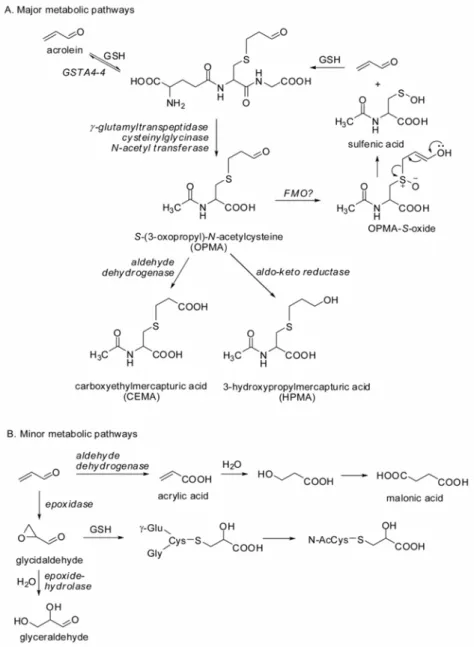
Acrolein은 가장 단순한 unsaturated aldehyde로 반응성이 높고, 강력한 세포독성 물질로 알려져 있으며 특히, 담배연기 가스상 물질이 유발하는 세포독성에 절반 이상 기여하는 것으로 보고된 바 있다. HPMA를 비롯한 Mercapturic acid는
acrolein과 같은 친전자성 물질의 주요 대사산물로 (Kaye 1973), 특히 LSRO의 보고에 의하면 HPMA 는 충분히 검토되고 측정법이 잘 정립되어 있는 acrolein의 노출 생체 지표이다(Fig. 3). 그러나 HPMA가 CEMA (2-carboxyl-ethyl mercapturic acid)와 더불어 acrolein의 대사 산물로 알려져 있 음에도 불구하고, 이들 모두 allyl alcohol, allyl
Fig. 3. Metabolism of acrolein (Stevens and Maier, 2008)
eformate, allyl sters, allyl chloride 및 allyl amines과 같은 물질의 대사를 통해서도 생성될 수 있기 때문에 직업적 노출, 살충제에 대한 노출, 음 식을 통한 노출 등은 교란 요인으로 작용할 수 있 다(Athersuch et al., 2006). HPMA는 LC-MS/MS, H-NMR, ELISA 등의 방법으로 측정할 수 있으나, 정량적으로 LC-MS/MS에 의한 측정법이 가장 민 감한 것으로 알려져 있으며, 이때 최소 검출 한계 값(LOD, limit of detection)은 6 ng/mL이다 (Scherer et al., 2007).
1,3-Butadiene 생체지표 - MHBMA (Monohydroxy-butenyl-mercapturic acids)
DHBMA(dihydroxy-butyl mercapturic acid)와 MHBMA(Monohydroxy-butenyl-mercapturic acids)는 사람 및 실험동물의 뇨에서 가장 많이 검 출되는 1,3-butadiene의 노출 생체 지표이다.
1,3-butadiene은 국제암연구소 발암 분류 기준 등 급 Group 1(인체 발암 물질)에 속하는 물질로 담 배 연기 이외에도 합성고무 생산과정이나 배기가 스, 불완전 연소과정에서 어느 정도 쉽게 노출될 수 있다. 따라서 실험 설계 시 이러한 교란요인을 고려할 필요가 있다. 체내로 흡수된 1,3-butadiene
은 먼저 cytochrome P450 효소에 의해 대사되면 서 3,4-epoxy-1-butene(EB) 및 1,2:3,4- diepoxybutane(DEB)과 같은 반응성이 높은 epoxides로 변환된다. EB는 glutathione과 결합하 여 MHBMA를 형성하거나 epoxide hydrolase 활성 에 의해 1,2-dihydroxy-3-butene(DHB)로 가수분 해 된 후 glutathione과 결합하여 DHBMA를 형성 한다(Fig. 4). 그러나 Urban 등의 보고에 의하면 뇨 중 MHBMA 수준이 비흡연자에 비해 흡연자에 서 유의적으로 증가한 반면 DHBMA의 경우에는 유의적인 차이가 없었다고 한다(Urban et al., 2003). 더구나 셀룰로오스 아세테이트 필터 담배 흡연자와 활성탄 필터 담배 흡연자의 뇨 중 MHBMA의 유의적인 수준 차이를 보여준 최근 연 구는 MHBMA가 흡연과 관련하여 1,3-butadiene이 매우 민감하고 유용성 있는 노출 생체지표임을 보 여주었다(Scherer et al., 2006).
MHBMA의 분석은 GC-MS/MS를 이용한 방법 이 민감도가 좋은 방법으로 알려져 있으며, 최근 전처리과정이 간편하며 민감도를 높인 LC- MS/MS를 이용한 방법도 사용되고 있다(Sapkota et al., 2006; McDonald et al., 2004).
Fig. 4. Overview of 1,3-Butadiene metabolism
돌연변이원성 물질에 대한 노출 생체지표 - 뇨 돌 연변이 유발성(Urine mutagenicity)
뇨 돌연변이 유발성은 담배연기 중 돌연변이원 성 물질이나 발암물질에 대한 노출 수준을 결정할 수 있는 노출 생체지표로 이용될 수 있다. 지금까
지 많은 연구들이 대사활성계 존재하에
Salmonella thyphimurium TA98 및 TA1538 균주 를 이용한 복귀돌연변이 시험에서 비흡연자의 뇨 에 비해 흡연자의 뇨에서 복귀돌연변이 집락수가 증가함을 보여준 바 있다. 더 나가, YG1021 및 YG1024를 이용한 최근 연구에서는 다른 담배 형 태를 사용하는 흡연자들 간 그리고 기존 담배 및 가열식 담배를 사용한 흡연자들 간의 차이까지 구 별가능하다는 것을 보여줌으로써 이들 균주가 흡 연자의 뇨에 더욱 민감하다는 것을 보여준 바 있 다(Bowman et al., 2002; Roethig et al. 2005). 그 러나 뇨 돌연변이 유발성 측정 시 유발물질에 대 한 정확한 추적이 어렵기 때문에 기타 돌연변이 유발성 물질 노출에 대한 관리가 필요하며 따라서 식단 등에 대한 통제된 실험 환경이 어느 정도 필 요할 것으로 생각된다.
결 론
‘위험 감소 제품(MRTP)’의 정의에 대해서 ‘가족 흡연 방지 및 담배 규제법’에서는 기존 시장에서 상업적으로 거래되는 담배제품과 비교하여 덜 해 롭다는 것 또는 담배관련 질환 유발 위험성을 낮 춘 것이 입증된 담배 제품이라고 규정하고 있다.
이러한 위해성 감소의 주장의 근거로 화학적 성분 감소, 세포독성이나 유전독성 시험 같은 in vitro 실험 및 흡입독성이나 발암성 시험 등 동물을 이 용한 in vivo 실험에 의한 독성 감소 자료가 제공 될 수 있으나, 위해성 감소가 '실질적'이어야 한다 고 명시한 것은 그 입증 수준이 집단 위해성 평가 등 임상 시험을 요구하고 있는 것으로 해석된다.
생체지표는 이러한 대규모 임상 시험이나 역학조 사의 시간적, 경제적 부담을 감소시킬 수 있는 방 법으로 주목받아 왔으며 분석 방법의 발전, 흡연 관련 질환 및 기전 연구와 더불어 상당한 성과가 있었다. 그러나 그럼에도 불구하고 현재까지 유해
성과 관련하여 기본적인 용량-반응 관계를 보이는 생체지표 조차도 여전히 제한적이고 소수로 존재 하며 더욱이 이런 소수의 생체지표에 대해서도 위 해성 감소 주장에 필요한 정량적인 변화의 범위가 어느 정도인지에 대한 정보나 연구가 미비한 실정 이다(Hatsukami et al., 2006). 더불어 연구된 생체 지표 중 많은 것들이 담배 연기에 특이적이지 않 다는 것은 흡연 생체 지표 관련 연구를 어렵게 만 드는 요인이었다.
지금까지 살펴본 노출 생체지표는 담배 특이적, 또는 담배연기 노출과 높은 상관관계를 갖고 있다 는 것이 인정된 생체지표로서(LSRO, 2007), 세포 수준 생체지표(Cellular biomarker)인 뇨 돌연변이 유발성(urine mutagenicity)를 제외하고 모두 화학 적 생체지표(Chemical biomarker)로 분류되며, 일 산화탄소 및 니코틴은 심혈관 질환 관련 생체지 표, 뇨 돌연변이 유발성, NNAL 및 NNAL- Glucuronide, HPMA, MHBMA는 암관련 생체 지 표로 활용 가능하다(Hatsukami et al., 2006). 그러 나 노출 생체지표는 단기간의 노출만을 반영하며, 질환과의 인과관계가 부족하고, 개인의 흡연 습관 및 생활 습관에 따른 편차가 크다는 여러 단점이 존재한다. 따라서 보다 체계적인 평가를 위해서는 이러한 노출 생체지표를 기반으로 하여 정립된 효 과 생체지표나 위해성 생체지표, 또는 질환 생체 지표를 연계한 시스템 구축이 필요 할 것으로 생 각된다.
참 고 문 헌
Athersuch, T. J., Keun, H., Tang, H. and Nicholson, J. K. (2006) Quantitative urinalysis of the mercapturic acid conjugates of allyl formate using high-resolution NMR spectroscopy. J Pharm Biomed Anal. 40(2):
410-416.
Bowman, D. L., Smith, C. J., Bombick, B. R.
and Avalos, J. T., Davis, R. A., Morgan, W.
T. and Doolittle, D. J. (2002) Relationship between FTC 'tar' and urine mutagenicity in smokers of tobacco-burning or Eclipse
cigarettes. Mutat Res. 521(1-2): 137-149.
Boeniger, M. F., Lowry, L. K, and Rosenberg, J.
(1993) Interpretation of urine results used to assess chemical exposure with emphasis on creatinine adjustments: a review. Am Ind Hyg Assoc J. 54(10): 615-627.
Byrd, G. D., Davis, R. A. and Ogden, M. W.
(2005) A rapid LC-MS-MS method for the determination of nicotine and cotinine in serum and saliva samples from smokers:
validation and comparison with a radioimmunoassay method. J Chromatogr Sci.
43(3): 133-140.
Byrd, G. D. and Ogden, M. W. (2003) Liquid chromatographic/tandem mass spectrometric method for the determination of the tobacco-specific nitrosamine metabolite NNAL in smokers' urine. J Mass Spectrom.
38(1): 98-107.
Carmella, S. G., Akerkar, S. and Hecht, S. S.
(1993) Metabolites of the tobacco-specific
n i t r o s a m i n e
4-(methylnitrosamino)-1-(3-pyridyl)-1-butan one in smokers' urine. Cancer Res. 53(4):
721-724.
Carmella, S. G., Akerkar, S. A., Richie, J. P. and Jr, Hecht, S. S. (1995) Intraindividual and interindividual differences in metabolites of the tobacco-specific lung carcinogen 4-(methylnitrosamino)-1-(3-pyridyl)-1- butanone (NNK) in smokers' urine. Cancer Epidemiol Biomarkers Prev. 4(6): 635-642.
Degiampietro, P., Peheim, E., Drew, D., Graf, H.
and Colombo, J. P. (1987) Determination of thiocyanate in plasma and saliva without deproteinisation and its validation as a smoking parameter. J Clin Chem Clin Biochem. 25(10): 711-717.
Hatsukami, D. K., Benowitz, N. L., Rennard, S.
I., Oncken, C. and Hecht, S. S. (2006) Biomarkers to assess the utility of potential
reduced exposure tobacco products. Nicotine Tob Res. 8(4): 600-622.
Hecht, S. S., Carmella, S. G., Murphy, S. E., Akerkar, S., Brunnemann, K. D. and Hoffmann, D. (1993) A tobacco-specific lung carcinogen in the urine of men exposed to cigarette smoke. N Engl J Med. 329(21):
1543-1546
Hecht, S. S. (1999) DNA adduct formation from tobacco-specific N-nitrosamines. Mutat Res.
424(1-2): 127-142.
Institute of Medicine, Committee on Quality of Health Care in America (2001). Crossing the quality chasm: A new health care system for the 21st century. National Academy Press, Washington, DC, USA
International Agency for Research on Cancer (2007) Smokeless tobacco and tobacco-specific nitrosamines. IARC Monographs on the Evaluation of Carcinogenic Risks to Humans, vol. 89. Lyon (France): IARC; 2007. p. 553.
International Agency for Research on Cancer.
(2004). Tobacco smoke and involuntary smoking. In, IARC Monographs on the Evaluation of Carcinogenic Risks to Humans.
(Vol. 83). Lyon, France.
Jacob, P. 3rd,, Yu, L., Shulgin, A. T. and Benowitz, N. L. (1999) Minor tobacco alkaloids as biomarkers for tobacco use:
comparison of users of cigarettes, smokeless tobacco, cigars, and pipes. Am J Public Health. 89(5): 731-736.
Kaye, C. M. (1973) Biosynthesis of mercapturic acids from allyl alcohol, allyl esters and acrolein. Biochem J. 134(4): 1093-1101.
Life Science Research Office (2007) Scientific methods to evaluate potential reduced-risk tobacco product, 1st ed. p.49-56, Catherine ed., Life Science Research Office, Maryland, USA.
McDonald, J. D., Bechtold, W. E., Krone, JR., Blackwell, W. B., Kracko, D. A. and Henderson, R. F. (2004) Analysis of butadiene urinary metabolites by liquid chromatography-triple quadrupole mass spectrometry. J Anal Toxicol. 28(3):
168-173.
Muscat, J. E., Djordjevic, M. V., Colosimo, S., Stellman, S. D., and Richie, J. P. Jr. (2005) Racial differences in exposure and glucuronidation of the tobacco-specific
c a r c i n o g e n
4-(methylnitrosamino)-1-(3-pyridyl)-1-butan one (NNK). Cancer. 103(7): 1420-1426.
Roethig, H. J., Kinser, R. D., Lau, R. W., Walk, R. A. and Wang, N. (2005) Short-term exposure evaluation of adult smokers switching from conventional to first-generation electrically heated cigarettes during controlled smoking. J Clin Pharmacol.
45(2): 133-145.
Sapkota, A., Halden, R. U., Dominici, F., Groopman, J. D. and Buckley, T. J. (2006) Urinary biomarkers of 1,3-butadiene in environmental settings using liquid chromatography isotope dilution tandem mass spectrometry. Chem Biol Interact. 160(1):
70-79.
Sepkovic, D. W. and Haley, N. J. (1985) Biomedical applications of cotinine quantitation in smoking related research. Am J Public Health. 75(6): 663-665.
Scherer, G., Engl, J., Urban, M., Gilch, G., Janket, D. and Riedel, K. (2007) Relationship between machine-derived smoke yields and biomarkers in cigarette smokers in Germany.
Regul. Toxicol. Pharmacol. 47(2); 171-183.
Scherer, G., Urban, M., Engl, J., Hagedorn, H.
W. and Riedel, K. (2006) Influence of smoking charcoal filter tipped cigarettes on various biomarkers of exposure. Inhal Toxicol. 18(10): 821-829.
Shields, P. G. (2002) Tobacco smoking, harm reduction, and biomarkers. J Natl Cancer Inst. 94(19): 1435-1444.
SRNT Subcommittee on Biochemical Verification.
(2002) Biochemical verification of tobacco use and cessation. Nicotine Tob Res. 4(2):
149-159.
Stevens, J. F. and Maier, C. S. (2008) Acrolein:
sources, metabolism, and biomolecular interactions relevant to human health and disease. Mol Nutr Food Res. 52(1): 7-25.
Sturla, S. J., Scott, J., Lao, Y., Hecht, S. S. and Villalta, P. W. (2005) Mass spectrometric analysis of relative levels of pyridyloxobutylation adducts formed in the reaction of DNA with a chemically activated form of the tobacco-specific carcinogen 4-(methylnitrosamino)-1-(3-pyridyl)-1-butan one. Chem Res Toxicol. 18(6): 1048-1055.
Tricker, A. R. (2006) Biomarkers derived from nicotine and its metabolites: a review, Beitr.
Tabakforsch. Int. 22: 147–175.
Urban, M., Gilch, G., Schepers, G., van Miert, E.
and Scherer, G. (2003) Determination of the major mercapturic acids of 1,3-butadiene in human and rat urine using liquid chromatography with tandem mass spectrometry. J Chromatogr B Analyt Technol Biomed Life Sci. 796(1): 131-140.