(Snow crab, Chionoecetes opilio)
, , , ,
,
50 600m, ,
0 5 (Miyake, 1983;
Lim, 2001).
J. Kor. Soc. Fish. Tech., 45(2), 122 127, 2009 DOI:10.3796/KSFT.2009.45.2.122
Size selectivity of gill net for female snow crab, Chionoecetes opilio
Chang-Doo PARK*, Heui-Chun AN1, Sam-Kwang CHO, Bong-Seong BAE2, Hae-Hoon PARK2, Jae-Hyun BAE1and Hyun-Young KIM
Fisheries Resources Division, West Sea Fisheries Institute, NFRDI, Incheon 400-420, Korea
1Fisheries Engineering Division, National Fisheries Research & Development Institute, Busan 619-902, Korea
2Fisheries Resources Division, East Sea Fisheries Institute, NFRDI, Gangwon-do 210-861, Korea
A series of fishing experiments was carried out in the eastern coastal waters of Korea from January, 2002 to March, 2003, using gill nets of different mesh sizes (m 180, 210, 240, 270 and 300 mm) to determine the size selectivity of gill net for female snow crab, Chionoecetes opilio. The catch of experimental gears was mostly snow crab (97%), Chionoecetes opilio. The maximum carapace length (RL) of each female snow crab caught in the fishing experiments was measured. The master selection curve was estimated by applying the extended Kitahara s method. The selection curve showed that the gill nets of larger mesh size allowed more female crabs of small carapace size to escape. The optimum values of RL/m for 1.0 of retention probability was 0.563 and RL/m was estimated to be 0.249, 0.290, 0.319, 0.344 and 0.367 when the retention probability were 0.1, 0.2, 0.3, 0.4 and 0.5, respectively.
Key words : Chionoecetes opilio, Snow crab, Gill net, Selectivity, Selection curve, Kitahara s method
*Corresponding author: [email protected], Tel. +82-32-745-0570, Fax. +82-32-745-0569
(
) ( )
(Yamasaki, 1994).
(TAC ), ,
,
(Yamasaki, 1994; Xu and Millar, 1993).
, ,
(9cm ) ,
( 240mm, 150mm
) .
,
87.3% ,
11.6% (2007 ).
(Yamasaki, 1994; Xu and Millar, 1993; Conan and Comeau, 1986).
. ,
.
.
,
150 400m .
, (monofilament) 200 (1 , 300m)
80m, 90 100m 1
,
. 1 15 30
1 ( ) 5 6
,
7 30 .
m(mm) 5 ( 180, 210, 240, 270, 300mm)
. d(mm)
4 (φ 0.331), 5 (φ 0.370), 6 (φ 0.405), 7 (φ
0.438), 8 (φ 0.468) . 1
4 20
.
3 (7.93 ) 99
(6.33 ) .
2002 1 2003 3 6
, 12 , 10 25
.
CW(mm), RL(mm), CL(mm), (chela) Ch(mm)
0.1mm (Park et al., 2003). , (Jadamec et al., 1999) ,
( )
CL,
RL (Park et al., 2003). ,
,
.
Ishida (Ishida, 1962), Holt (FAO, 1992), Kitahara
(Kitahara, 1968), SELECT
(Park et. al., 2004 ; Millar and Walsh, 1992) .
Master Curve
Kitahara (Fujimori et al., 1996; Cho et al., 2000; Park et al., 2003)
.
,
97% ,
.
2,351 (56.7%), 1,795 (43.3%) .
CW(mm), RL(mm), CL(mm), BH(mm)
.
CW 1.0771RL 2.99 (R2 0.9692) RL 0.8998CW 5.12 (R2 0.9692) CL 0.9345RL 5.61 (R2 0.9657) RL 1.0334CL 8.50 (R2 0.9657) CL 0.8517CW 1.71 (R2 0.9602) CW 1.1274CL 5.20 (R2 0.9602) BH 0.6209RL 14.38 (R2 0.8559)
,
. Park et
al.(2003) (BH 0.3959RL
0.62)
.
. , 80mm
. ,
15cm ,
(chela)
(Conan and Comeau, 1986; Yamasaki, 1994; Park et al., 2003). ,
. 8cm
(Lim,
2001). (CW)
Fig. 1. Relationship between the carapace size and the chela height in the natural logarithm for the female snow crab. CW : carapace width, RL : maximum carapace length (rostral horn), Ch : chela height
2.7 2.5 2.3 2.1 1.9 1.7 1.5 2.7 2.5 2.3 2.1 1.9 1.7 1.5
3.8 4.0 4.2 4.4 4.6 ln CW
3.8 4.0 4.2 4.4 4.6 ln RL
55 67 81 99 mm
y 1.1138 2.5166 R2 0.8077 y 1.0539 2.2952 R2 0.82112
N 561 N 561
In Ch(mm)
(RL) (Ch) Fig. 1
. ,
(Ch)
.
(RL)
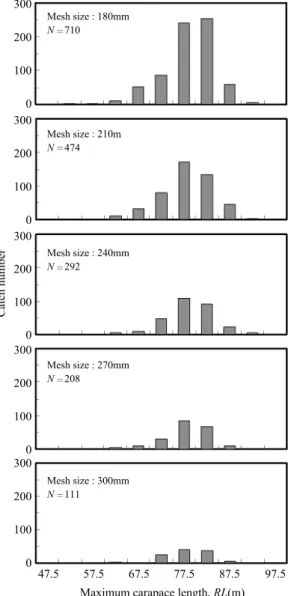
5mm Fig. 2
. 45
100mm 60 90mm
. , Fig. 2
.
(Park et al., 2003) (
45 155mm, 60 115mm
)
.
.
1 ( 420m)
11 1
c 180, 210, 240, 270,
300mm , 16.1, 10.8, 6.6, 4.7, 2.5
(Fig. 3).
Fig. 2. Maximum carapace length (RL) distributions of female snow crab caught in the experiment.
300
200
100
0 300
200
100
0 300
200
100
0 300
200
100
0 300
200
100
0 47.5 57.5 67.5 77.5 87.5 97.5
Catch number
Maximum carapace length, RL(m)
Fig. 3. Relationship between the mesh size (m) and the catch number per unit net of female snow crab (c) caught in the experiment.
c 253.88exp( 0.0151m) (R2 0.9922)
20
16
12
8
4
0
Catch number / net
150 180 210 240 270 300 330
Mesh size, m(mm) c 253.88exp 0.0151m R2 0.9922 Mesh size : 180mm
N 710
Mesh size : 210m N 474
Mesh size : 240mm N 292
Mesh size : 270mm N 208
Mesh size : 300mm N 111
Kitahara (Kitahara, 1968)
.
(3 )
. Master
Fig. 4 .
S(R) S(RL/m)
exp{(44.121R3 83.965R2 52.591R 5.000) 5.868}
(Fig. 4) RL/m
0 1
1 RL/m 0.563
. (Cho et al., 2000: Park et al.,
2004) , (Bell Type)
Sigmoid . ,
(Fujimori et al. 1996; Park et al., 2003). ,
.
(Fig. 4) 0.1, 0.2, 0.3, 0.4, 0.5
RL/m 0.249, 0.290, 0.319, 0.344, 0.367 .
Park et al.(2003)
. 240mm
0.5
85 88mm 1.0
132 135mm .
. ,
.
(Jeong et al., 2009).
,
.
.
180, 210, 240, 270
300mm 5 2002 1
2003 3
CW,
RL, BW .
97%
. Kitahara Fig. 4. Master selection curve of gill net for female snow
crab.
RL(mm) 57.5 62.5 67.5 72.5 77.5 82.5 87.5
RL/m 0.563
0 0.1 0.2 0.3 0.4 0.5 0.6 0.7 0.8 Maximum carapace length / Mesh size 1.4
1.2 1.0 0.8 0.6 0.4 0.2 0.0
Retention probability
. 1
RL/m 0.563 0.1,
0.2, 0.3, 0.4, 0.5 RL/m
0.249, 0.290, 0.319, 0.344, 0.367 . Park et al.(2003)
. ,
.
.
( ,
, RP 2008 FE 005) .
Cho, Y.B., C.D. Park and J.H. Lee, 2000. A study on the selectivity of the mesh size in trammel net for Cynoglossidae Spp. Bull. Korean Soc. Fish. Tech., 36(2), 89 95.
Conan, G.Y. and M. Comeau, 1986. Functional maturity and terminal molt of male snow crab, Chionoecetes opilio. Can. J. Fish. Aquat. Sci., 43, 1710 1719.
FAO, 1992. Introduction to tropical fish stock assesment.
FAO Fisheries Technical Paper, 306/1, 172 199.
Fujimori, Y., T. Tokai, S. Hiyama and K. Matuda, 1996.
Selectivity and gear efficiency of trammel nets for kuruma prawn (Penaeus japonicus). Fisheries Research, 26, 113 124.
Ishida, T., 1962. On the gill net mesh selectivity curve.
Bull. Hokkaido Reg. Fish. Res. Lab., 25, 20 25.
Jadamec, LS., WE. Donaldson and P. Cullenberg, 1999.
Biological field techniques for Chionoecetes Crabs.
University of Alaska Sea Grant College Program, pp
29 31.
Jeong, E.C, H.H. Park, B.S. Bae, D.S. Chang, C.S. Kim, S.H. Choi and H.K. Cha, 2009. Size selectivity of gill net for male Japanese sandfish (Arctoscopus japonicus) off Gangwon in winter. J. Kor. Fish.
Soc., 42(1), 78 82.
Kitahara, T., 1968. Mesh selectivity curve of sweeping trammel net for branquillos. Bulletin of the Japan.
Soc. of Scientific Fisheries, 34(9), 759 763.
Lim, Y.S., 2001. Sexual maturation and larval growth of the snow crab, Chionoecetes opilio. Pukyong National University, Doctoral Thesis, pp 1 114.
Millar, R.B and S.J. Walsh, 1992. Analysis of trawl selectivity studies with an application to trouser trawls. Fisheries Research, 13, 205 220.
Miyake, S., 1983. Japanese Crustacean Decapods and Stomatopods in Color. Vol. . Hoikusha, Tokyo. pp 31 32.
Park, C.D., H.C. An, S.K. Cho and C.I. Baik, 2003. Size selectivity of gill net for male snow crab, Chionoecetes opilio. Bull. Korean Soc. Fish. Tech., 39(2), 143 151.
Park, C.D., E.C. Jeong, J.K. Shin, H.C. An and Y.
Fujimori, 2004. Mesh selectivity of encircling gill net for gizzard shad Konosirus punctatus in the coastal sea of Korea. Fish. Sci., 70, 553 560.
Xu, X. and R.B. Millar, 1993. Estimation of trap selectivity for male snow crab (Chionoecetes opilio) using the SELECT modeling approach with unequal sampling effort. Can. J. Fish. Aquat. Sci. 50(11), 2458 2490.
Yamasaki, A., 1994. Studies on stock management of snow crab based on biology. Kyoto Institute of Oceanic and Fishery Science, Special Report, No.4, pp 1 53.
2008 10 10
2009 3 30 1
2009 5 19