한국컴퓨터정보학회 하계학술대회 논문집 제22권 제2호 (2014. 7)
389
센서재료용 고분자의 전기전도 특성 데이터 분석
황봉성*, 박건호○
○*청강문화산업대학교 모바일스쿨
e-mail: [email protected]*, [email protected]○
Data Analysis of Electrical Conduction Properties in Polymer for Sensor Material
Bong-Sung Hwang*, Geon-Ho Park○
○*School of Mobile Communication, Chungkang College of Cultural Industries
● ABSTRACT ●
The electrical conduction properties in oriented polypropylene(OPP) were studied over the electric field intensity between 10[㎹/m] and 300[㎹/m] at the range of temperature from 5[℃] to 55[℃] in this study. The range of electrical conduction properties observed at 15[℃] were divided into five regions with increasing electric field intensity.
Particularly, voltage-controlled negative resistance was shown in the region from 70[㎹/m] to 82[㎹/m].
키워드: Electrical Conduction Properties, Electric Field Intensity, Negative Resistance
I. INTRODUCTION
Many studies on electrical conduction properties of polypropylene have been performed. Generally, it is difficult to interpret conduction mechanism occurring in oriented polypropylene due to its high volume resistance and very low carrier density[1],[2]. In this study the influence of electric strength and temperature on electrical conduction in oriented polypropylene is examined.
II. EXPERIMENTAL
1. Specimens
Commercially available oriented polypropylene of 15[㎛]
thickness films were used in this study. The samples were cut into 100[㎜] diameter circles and cleaned in benzene. And then they were later covered with aluminium plate and inserted into the electrode that was located in pure paraffin oil.
2. Measuring Apparatus
A schematic diagram of the experimental apparatus is shown in Fig. 1. DC voltage was supplied with DC HV generator and the conduction current was measured by an
electrometer and then recorded by a recorder.
Fig. 1. Experimental Apparatus
III. RESULTS AND DISCUSSION
1. Conduction Current
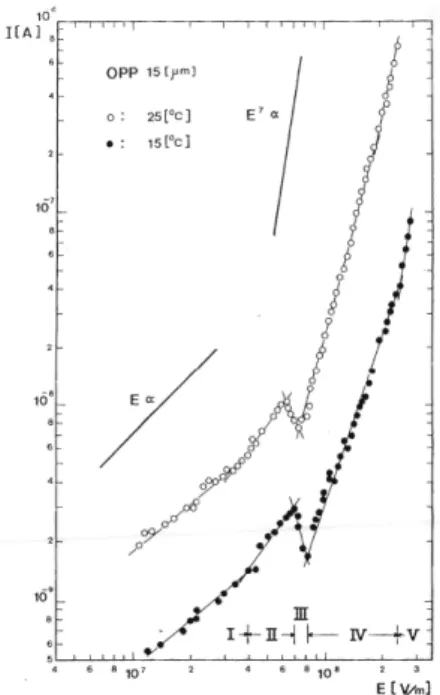
The conduction current depends on the temperature and the electric field. Measuring results are given in Fig. 2, which shows the conduction current of OPP at two constant temperature(15[℃] & 25[℃]). The relationship between the conduction current and the electric field is not linear. Five different regions- i.e., region Ⅰ, Ⅱ, Ⅲ, Ⅳ and Ⅴ- may be distinguished as Fig. 2[3],[4].
한국컴퓨터정보학회 하계학술대회 논문집 제22권 제2호 (2014. 7)
390
Fig. 2. I-E Plot of OPP
2. Negative Resistance of Region III
Region Ⅲ of Fig. 2 shows a voltage-controlled negative resistance. The negative conduction phenomena for OPP were observed between 70[㎹/m] and 82[㎹/m] at 15[℃]. Fig. 3 shows the negative resistance obtained as a function at the temperature range of 5~55[℃].
Fig. 3. Negative Resistance according to Temperature
It may be observed that as the temperature is increased above 25[℃], the entire current vs. electric field plot is shifted gradually toward low field intensity and so the magnitude of the current increases. Table 1 shows that excellent agreement was found between the experimental and theoretical values.
Table 1. Electric Field at Negative Resistance Point
Field T [℃]
Electric Field [㎹/m]
Experimental Theoretical
15 70 -
25 61 60.9
35 52 53.2
45 44 45.8
55 38 40.4
Ⅳ. CONCLUSION
The properties of conduction current on OPP studied over field intensity between 10[㎹/m] and 300[㎹/m] at the temperature range of 5~55[℃].
The relationship between the current and the electric field shows nonlinear characteristics, in which five regions can be distinguished.
Particularly, the negative resistance was observed at electric field between 70[㎹/m] and 82[㎹/m] and its characteristics of this region can be explained by Gibbson’s theory.
REFERENCES
[1] K. Ikejaki, T. Kaneko and T. Sakakibara, J. Appl. Rhys., 20, 609 (1981)
[2] T. Umemura, K. Akiyama and D. Couderc, IEEE Trans.
Elect. Insul., EI-21, No. 2, 137, April (1986)
[3] J. G. Simmons, DC Conduction in Thin Films, 52, Mills
& Boon Limited (1971)
[4] Chen C. Ku and R. Liepins, Electrical Properties of Polymers, 220, Hanser Publishers (1985)