충돌회피를 위한 드론택배 시스템의 통신망 토폴로지 및 성능평가
조준모*
Communication Network Topology and Performance Evaluation of the Drone Delivery System for Collision Avoidance
Jun-Mo Jo*
요 약
최근 기업에서는 드론을 이용하여 다양한 상업적인 서비스를 시도하고 있다. 특히, 드론을 이용한 택배서비스 가 그 좋은 예라고 할 수 있다. 그러나, 이러한 드론 택배시스템은 사람들이 활보하는 거리 위에서 무거운 물건들 을 배송하는 일이기 때문에 서로 충돌로 인한 소포가 떨어지는 등 다양한 사안을 고려해야만 한다. 이러한 문제 점을 해결하기 위해 본 논문에서는 드론간 통신을 활용하고자 하며 예상되는 드론의 통신망 토폴로지를 Opnet 시뮬레이터로 구현하고, 해당 통신망의 성능을 시뮬레이션하고 분석하였다. 추가적으로 자유 운동적(random mobility)인 이동경로의 토폴로지도 구현하여 제안한 드론망의 성능과 비교분석하였다.
ABSTRACT
Recently, many companies try to offer various services using drones. Especially, the drone delivery system is a good example.
However, the drone delivery service has some problems since the heavy parcels flies over the people walking down streets, so many things must be considered such as dropping mails by collision of drones. To resolve the problem, in this paper, a inter-drone network communication will be used to design the topology and to simulate in the Opnet simulator for the performance evaluation.
Additionally, the topology with random mobility of trajectory of drones is also designed and simulated for the result.
키워드
Drone Delivery Service, Wireless LAN, Network Simulation, Network Performance Analysis 드론 택배 서비스, 무선랜, 네트워크 시뮬레이션, 네트워크 성능 분석
* 교신저자 (corresponding author) : 동명대학교 전자공학과([email protected])
접수일자 : 2015. 07. 29 심사(수정)일자 : 2015. 08. 13 게재확정일자 : 2015. 08. 23
Ⅰ. Introduction
In recent days, many companies are willing to offer various types of services using UAV(Unmanned Aerial Vehicle) such as drones.
Not only the small companies but also the big companies like Google, Amazon, Alibaba and
Samsung are already started or ready to service.
Government authorities such as law enforcement
agencies, corporations and private individuals have
identified the advantages inherent in the use of
UAVs. Some corporations marketing and
manufacturing UAVs for civilian purposes, and the
industries that support these manufacturers, have
identified the enormous economic potential which may be derived from the sale and maintenance of UAVs. Hence, in the coming years, we will undoubtedly witness a rapid expansion of the civilian use of UAVs. Given the assumption that the entry of UAVs into the civilian market is a certainty[1].
And also monitoring vehicular or UAV related issues are studied these days. There is a study related on the scientometric analysis through paper analysis of each organization and author to decide research direction for autonomous driving vehicles.
They have confirmed research trend of autonomous driving vehicle by using number of papers[2-3].
Also there are many applications using drones such as analyzing road traffic congestion through with it. Due to the variability of the transportation demand, knowledge of the road network and the traffic conditions is essential to optimize urban mobility, to analyze and solve the environmental problems affecting urban areas. The fundamental variables for the analysis of traffic congestion are density, capacity and traffic flow. They are able to analyze and simulate the instantaneous movement of each vehicle present on the road[4].
However, there is a problem to deploy this service in real life. The security of the drone including collision of drones or dropping of parcels.
So not many governments give their permission to deploy this service yet.
Some recent studies related on the UAV show a variety aspects from military aircraft to civilian aircraft. In particular, for small unmanned aircraft research for the ease of turning and hovering and Vertical Off-Take and Landing(: VTOL), have been studied mainly quadrotor unmanned aircraft is a type suitable for this study of small unmanned aircraft. The studies of these unmanned aircraft is the kinetic analysis requires complex processes, because these support by the aerodynamic forces on the unmanned aircraft study. These study, the controller design, based on the dynamical analysis
and experimental model analysis. The main issue is related on the implementation of the basic attitude control with a general PID(: Proportional Integral Derivative) controller. They have proposed an concept design of the attitude control method on quadrotor by using the reinforcement learning algorithm of neural networks for non-linear elements not considered in the controller design[5].
Traditionally communication relay was considered a secondary mission on a platform deployed on another main mission. However, with the advent of light weight, robust and autonomous platforms as well as wireless networking technologies, UAVs can now perform this relay mission. UAV communication relay is intended to replace the legacy radios currently being used on tactical size UAVs such as Predator. Regarding the airborne communication relay payload. A developed a communication relay package to provide four communication software programmable channels, which can be configured to provide ground to ground, air to air, or ground to air relay[6].
Mostly the UAV uses GPS for the positioning function. And there are many sensors available for the specific operations. For the delivery service, the GPS is a necessary function and to avoid collision, other specific sensors such as infrared sensor is required.
Even though some studies require as a complete UAV, variety of sensors to be employed for their location, sensor data pre-processing and processing, sensor fusion, map building, motion planning, motion control, etc.[7]. However, the GPS and for the near field communication network function will do the work.
Therefore, in this paper, a communication
network topology of the drone delivery system for
collision avoidance is designed and simulated in the
Opnet simulator. In section II, an autonomous
communication drone system is elaborated. In
section III, the suggested drone delivery network
topology is shown and explained in detail. Then in
section IV, the simulation result of the topology is
analyzed with a network topology of random mobility. Finally, the conclusion is made in section V.
Ⅱ. Autonomous Communication Drone
Autonomous vehicles as drone is an important study subjects in these days. There are many possible applications to apply as a new trand.
Especially this new technology has the power to dramatically change the way in which transportation or delivery systems operate. While the UAV impacts for traffic safety and congestion have been predicted in some detail, potential behavioral shifts and resulting environmental impacts have received little attention[8].
For the remote control of the vehicle or monitoring, the Controller Area Network(: CAN) can be used for the application. The CAN is a contention-based serial communication bus with high performance, high speed, high reliability, and low cost for distributed real-time control applications. Increasing use of several CAN networks in modern industrial plants results in need for internetworking. It requires installation of new communication systems[9].
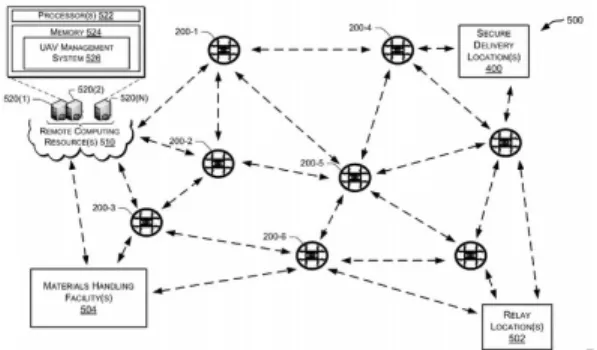
The Amazon company started to deliver with drones. An example of drone network topology is shown in Fig. 1. They try to serve in secure way to deliver, and control or monitor in the control center.
Fig. 1 A Secure delivery of the drone structure
To deliver parcels they use GPS, but there is a danger of crash each other in the air. The collision of drones causes a dangerous factor to the pedestrian on the street. To avoid the drone collision, the infrared sensors are needed, but the weight of the drone could affects the efficiency of the battery power. So, in order to avoid the collision, a near field communication function could be a good solution. In other words, if they can communicate, they might have chance to crash each other since the rage of the communication is narrow.
Ⅲ. Drone Delivery Network Topology
Mostly for the near field communication, they use specific network protocol such as wifi or Bluetooth. It is an innovative technology that incorporates the capabilities of new generation wireless technology into vehicles or UAV. They provide a continuous connectivity to mobile consumers while they are on the road but linked with others who are at their homes or offices and using different networks. The network protocol effectively integrated into heterogeneous wireless technologies such as 3G cellular systems, Long term evolution(LTE), LTE advance, IEEE 802.11, and IEEE 802.16e[10].
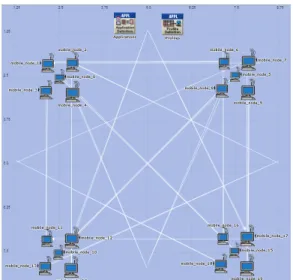
The Wireless LAN protocol as a communication
function is adopted to this topology with GPS as a
positioning function. And the topology suggested in
this paper is shown in Fig. 2.
Fig. 2 Topology of autonomous drone network
The scenario of the topology is as follows. There is a delivery company operates 4 sections in a city.
Each section uses 5 drones to deliver parcels. The destination of a drone could be everywhere in the city rage of 10km by 10km.
The trajectory of each drone has various rages and directions, and all the trajectories specified in this simulation were manually designed since the drones’ movements are unique and not specified in the Opnet. And the speed of a drone is 50km/h and the direction is just a round trip. The directions of each drone is the other side of its initial position.
For example, the mobile_node_1 drone is located in the upper left side. So the drone is heading straight to the right direction. Then the next drone, the mobile_node_2 is heading to the middle right direction about 45 degrees, and so on.
The most drones take for about 15 minutes as well as the simulation time. The encounter moments of drones are in a short period of time.
And the communication rage of each drone is not so wide. This is the factor to avoid collision between drones by communicating each other.
IV. Simulation Result and Analysis
For the simulation and analysis of this topology, the random mobility of drone network is also designed and simulated. The simulation parameters selected for the global network of the performance evaluation are delay, load, number of re- transmission attempts, and throughput of the wireless LAN.
Every drone delivers a parcel in a round trip manner for about 15 minutes. The durations of each flight of drone are not the same, but mostly they finish in about 15 minutes. So, as shown in Fig. 3, the simulation time started at 10:16am and finished at 10:33. As we can see, the communication started around at 10:20 since the loss of data started at that time.
Fig. 3 Delay of global drone network
The data loss of the random mobility topology
gradually increases as time goes by. The more the
complexity of the movements, the more the data
loss. As a result, the drone delivery topology
showed less performance than the random mobility
one. There are not much chance of the encounters
between drones since their movement is a simple
back and forth manner in a relatively wide area of
10km by 10km. We can see the same result in the
performance parameters such as the load, the
number of retransmission attempts, and the
throughput as shown in Fig. 4 to Fig. 6.
Fig. 4 Load of global drone network
Fig. 5 Retransmission attempts of global drone network
Fig. 6 Throughput of global drone network
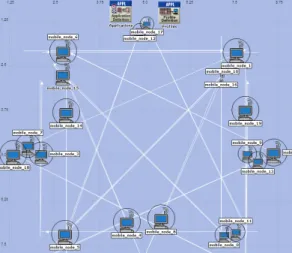
There are some points to encounter each other during they are flying. For example at 10:26 am
shown in Fig. 3, Fig. 5 and Fig. 6, the loss of data and the number of retransmission attempt are decreasing while throughput is increasing. It happens when they are close each other as shown in Fig. 7.
Fig. 7 Moment of drone encounter topology
The topology of delivery drone network and the common random mobility of drone network showed totally different performance and behavior in many aspects shown above. And also the wireless LAN can be a solution to avoid collision of drones in the real situation.
V. Conclusion
The drone delivery service have to solve some drawbacks such as collision between drones and dropping the parcels they deliver. To solve these problems, the near field communication system such as wireless LAN is adopted to the delivery drone.
To verify the possibility of the system, the
performance of drone delivery network system is
designed and simulated in Opnet simulator. The
performance is compared with the topology adopted
the random mobility drones. I conclude that the
delivery drone network adopted the wireless LAN
to avoid collision can be feasible in the real situation. For the further study, the suggested topology in this paper with various routing protocols will be designed and simulated for examining superior routing protocol.
Reference
[1] U. Volovelsky, “Civilian uses of unmanned aerial vehicles and the threat to the right to privacy – An Israeli case study”, Computer Law & Security Review, vol. 30, 2014, pp.
306-320.
[2] S. Yun, H. Son, and Y. Rhee, “A Study of Head Up Display System for Next Generation Vehicle”, J. of The Korea Institute of Electronic Communication Sciences, vol. 6, no. 3, 2011, pp.439–444.
[3] J. Park, J. Choi, and Y. Bae, “Scientometric Analysis of Autonomous Vehicle through Paper Analysis of each Nation”, J. of The Korea Institute of Electronic Communication Sciences, vol. 12, no. 7, 2013, pp.321-328.
[4] G. Salvo, “Urban traffic analysis through an UAV”, Procedia Social and Behavioral Sciences 111, Elsevier, 2014, pp.532–539.
[5] S. Kim, “A Study on the attitude control of the quadrotor using neural networks”, J. of The Korea Institute of Electronic Communication Sciences, vol. 9, no. 9, 2014, pp.1019–1025.
[6] S. Kim, H. Oh, J. Suk, and A. Tsourdos,
“Coordinated trajectory planning for efficient communication relay using multiple UAVs”, Control Engineering Practice 29, Elsevier, vol.
7, no. 2, 2014, pp. 42-29.
[7] S. Ge and F. Lewis, “Autonomous Mobile Robots, Sensing: Control, Decision Making and Applications”, 2006, CRC Press.
[8] D. Fagnant and K. Kockelman, “The travel and environmental implications of shared autonomous vehicles, using agent based model scenarios”, Transportation Research Part C, 2014, pp.1-13.
[9] G. Cena, A. Valenzano and S. Vitturi,
“Advances in automotive digital communications”, Computer Standards &
Interfaces, vol. 4, no. 2, 2005, pp.665–678.
[10] Z. Sharef, A. Alaradi, and B. Sharef,
“Performance Evaluation for WiMAX 802.16e OFDMA Physical layer”, In Computational Intelligence, Communication Systems and Networks(: CICSyN), Fourth International Conference on, 2012, pp. 351-355.
Author
조준모(Jun-Mo Jo)