드론 택배 통신망시스템을 위한 효율적인 MANET 라우팅 프로토콜
조준모*
An Efficient MANET Routing Protocol for the Drone Delivery Communication Network System
Jun-Mo Jo
*요 약
전 세계적으로 드론을 이용한 택배서비스가 새로운 주요사업으로 떠오르고 있다. 미국의 DHL 운송업체는 이 미 드론을 이용한 택배서비스를 시작하였으며 구글과 아마존, 그리고 중국의 알리바바, 바이두에서도 드론 택배 사업에 적극적으로 나서고 있다. 그러나, 이러한 사업이 아직 활성화 되지 못하는 이유는 운영하는데 있어서 몇 가지 문제점을 가지고 있기 때문이다. 사람들이 활보하는 거리 위에서 무거운 물건들을 배송하는 일이기 때문에 다양한 보안성과 안전성을 고려해야만 한다. 드론 간에 원활한 네트워크를 구성하여 서로 충돌을 회피할 수 있도 록 드론 간에 정보를 교환함으로써 이러한 문제점을 해결할 수 있다. 이를 위해, 효율적인 망성능이 필수적이며 본 논문에서는 옵넷 시뮬레이터를 통하여 드론 간의 원활한 통신을 위한 효율적인 라우팅 프로토콜을 비교함으 로써 이러한 문제점을 보완하고자 한다. 드론 간 통신을 위한 MANET을 구성하고 이를 시뮬레이션을 통하여 효 율적인 라우팅 프로토콜을 제안하고자 한다.
ABSTRACT
The drone delivery service as a new important business is emerging worldwide. American DHL parcel service is already running the delivery business using drones, and the Google, Amazon, and china’s Alibaba, Baidu are also preparing for the same business.
However, there are some problems in security and safety since the heavy parcels flies over the people walking down streets, so many things must be considered. The problems can be solved by communicating among drones to avoid collision. Therefore, the efficient network performance is essential, and to resolve the problem, in this paper, an efficient routing protocol is suggested by the Opnet simulator. The drone intercommunication network of MANET is designed and simulated for the efficient routing protocol.
키워드
Routing Protocol, Unmanned Aerial Vehicle, Drone Delivery Service, Network Simulation 라우팅 프로토콜, 무인 항공기, 드론 택배 서비스, 네트워크 시뮬레이션
* 교신저자 (corresponding author) : 동명대학교 전자공학과([email protected])
접수일자 : 2015. 08. 01 심사(수정)일자 : 2015. 09. 13 게재확정일자 : 2015. 09. 23
Ⅰ. Introduction
Recently, the drone related service is emerging as a new important business. American DHL parcel
service is already running the delivery business
using drones, and the Google, Amazon, and China’s
Alibaba, Baidu are also ready to jump into the
business. Drones are aircraft that have no onboard,
human pilot. Through the twentieth century, piloted aircraft made far greater progress than drones.
During the twenty-first century, on the other hand, changes in both drone technologies and drone economics have been much more rapid. Particularly in the case of small, inexpensive devices, the question arises as to whether existing regulatory frameworks can cope[1].
Some corporations marketing and manufacturing Unmanned Aerial Vehicles(: UAVs) for civilian purposes, and the industries that support these manufacturers, have identified the enormous economic potential which may be derived from the sale and maintenance of UAVs. Hence, in the coming years, we will undoubtedly witness a rapid expansion of the civilian use of UAVs. Given the assumption that the entry of UAVs into the civilian market is a certainty[2].
The routing protocol is also important to improve the UAV system. Especially transmitting multimedia using sensors in the network is a trend these days. Some research related on the routing technique based on traffic priority in order to improve the network efficiency by minimizing latency. And it proposes a congestion control mechanism that uses packet service time, packet inter-arrival time, buffer usage, etc[3].
In Mobile Ad-hoc Network, link failure and packet loss may occur frequently due to its nature of mobility and limited battery life. So there are some research on a robust routing protocol based on AODV by monitoring variation of receiving signal strength is proposed. New metric function that consists of node mobility and hops of path is used for routing decision. For preventing route failure by node movement during data transmission, a new route maintenance is presented[4].
Also there are many applications using drones such as analyzing road traffic congestion through with it. Due to the variability of the transportation demand, knowledge of the road network and the
traffic conditions is essential to optimize urban mobility, to analyze and solve the environmental problems affecting urban areas[5].
However, there is a problem to deploy this service in real life. The security of the drone including collision of drones or dropping of parcels.
So not many governments give their permission to deploy this service yet. Some recent studies related on the UAV show a variety aspects from military aircraft to civilian aircraft. The studies of these unmanned aircraft is the kinetic analysis requires complex processes, because these support by the aerodynamic forces on the unmanned aircraft study. These study, the controller design, based on the dynamical analysis and experimental model analysis. With the advent of light weight, robust and autonomous platforms as well as wireless networking technologies, UAVs can now perform this relay mission[6-7].
Mostly the UAV uses GPS for the positioning function. And there are many sensors available for the specific operations. For the delivery service, the GPS is a necessary function and to avoid collision, other specific sensors such as infrared sensor is required. Even though some studies require as a complete UAV, variety of sensors to be employed for their location, sensor data pre-processing and processing, sensor fusion, map building, motion planning, motion control, etc.[8]
Wireless sensor networks(: WSNs) are traditionally made up of a number of small nodes with the ability to communicate wirelessly. The aim of the system is to gather sensory data, which is usually accumulated at the sink. Mobile nodes maybe required for moveable objects in smart environments such as surveillance performed by drones[9].
To improve the performance of the network, the
type of routing protocol is important. Therefore, in
this paper, the most efficient routing protocol is
suggested by simulating and analyzing in Opnet
simulator. Some well-known routing protocols in MANET will be simulated, and analyzed.
In section II, some MANET routing protocols apply to the topology network will be introduced.
And in section III, the drone MANET operated by a routing protocol is elaborated. Then in section IV, the simulation result of the routing protocols are explained and analyzed for the best routing protocol.
Finally, the conclusion is made in section V.
Ⅱ. MANET Routing Protocols
Mobile Ad Hoc Networks(MANETs) use many different routing protocols to route data packets between nodes. Many researches studied and evaluated on the performance of these routing protocols. However, the studies evaluate the performance of routing protocols using traffic generators that do not correspond to specific applications such as drone delivery network. And the scenarios used in previous research are rather simple and do not correspond to real and complex situations, where various types of UAV traffic coexist in the network. There are some protocol types such as the proactive and reactive routing protocols to evaluate when specific application traffic exists in the network. Examination of the generic case where the data to be transferred is different for each destination node. By executing several simulations, some conclusion about the type of the traffic load in the network plays an important role on the performance. The operation of the most popular routing protocols used in MANETs, regardless of the mobility model employed by the relay nodes[10].
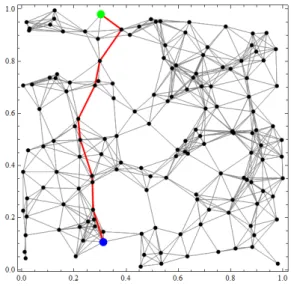
An example of connectivity in the MANET protocol is shown as Fig. 1. Any MANET routing protocol can be applied to the topology.
Fig. 1 Connectivity of Nodes in Routing Protocol Network
The most general distinction of MANET routing protocols is proactive and reactive. Some of the most popular protocols examined in previous studies are Dynamic Source Routing(DSR), Ad-hoc On-demand Distance Vector(AODV), which belong to the reactive or on-demand category and Optimized Link State Routing(OLSR), Destination Sequenced Distance Vector(DSDV), which belong to the proactive or table-driven category. Additionally, Geographic Routing Protocol(GRP) is classified as proactive routing protocol.
Ⅲ. Drone MANET Routing Protocol
MANETs require that data must be able to flow
both ways between any two nodes. This additional
functionality often adds overhead, which is
unnecessary in this network. Protocols designed for
MANETs are normally flat, they are intended to be
capable in mobile scenarios and are often split into
two categories; proactive and on-demand. The
rapidly changing topology of the network can cause
proactive protocols to flood the network with
topology information so frequently that the amount of data delivered is severely reduced. Alternatively, the topology information may not be distributed often enough and a large number of packets may be lost. However in low traffic scenarios this approach may still be feasible making MANET routing protocols such as DSR possible candidates.
Even though in highly dynamic scenarios it is unable to react fast enough to the frequent topology changes. It is an innovative technology that incorporates the capabilities of new generation wireless technology into UAV[9].
They provide a continuous connectivity to mobile consumers while they are on the road but linked with others who are at their homes or offices and using different networks. The Wireless LAN protocol as a communication function is adopted to this topology with GPS as a positioning function.
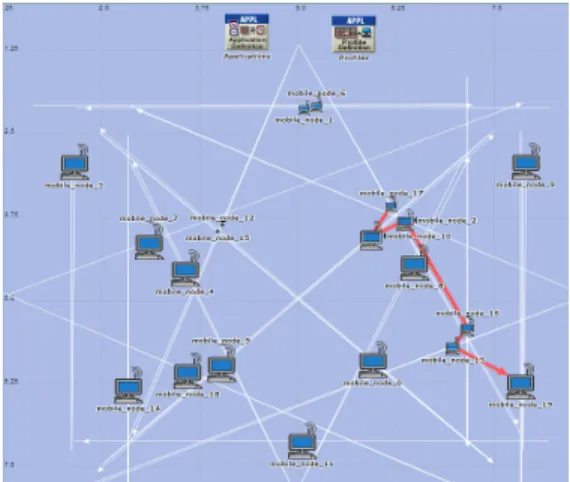
An example of routing path consists of some drones are shown in Fig. 2.
Fig. 2 A Routing Path of Drones
The scenario of the topology is as follows. There is a delivery company operates 4 sections in a city.
Each section uses 5 drones to deliver parcels. The destination of a drone could be everywhere in the city rage of 10km by 10km.
The trajectory of each drone has various rages
and directions, and all the trajectories specified in this simulation were manually designed since the drones’ movements are unique and not specified in the Opnet. And the speed of a drone is 50km/h and the direction is just a round trip. The directions of each drone is the other side of its initial position.
For example, the mobile_node_1 drone is located in the upper left side. So the drone is heading straight to the right direction. Then the next drone, the mobile_node_2 is heading to the middle right direction about 45 degrees, and so on.
The most drones take for about 15 minutes as well as the simulation time. The encounter moments of drones are in a short period of time.
And the communication rage of each drone is not so wide. This is the factor to avoid collision between drones by communicating each other.
IV. Simulation Result and Analysis
The performance comparison among 3 routing protocols, AODV, DSR, and GRP are simulated and analyzed. To obtain the best routing protocol in the drone delivery network, some netwrork performance parameters are calculated and compared.
The simulation parameters selected for the global network of the performance evaluation are routing traffic received, total traffic received, and wireless LAN delay, number of re-transmission attempts, and throughput.
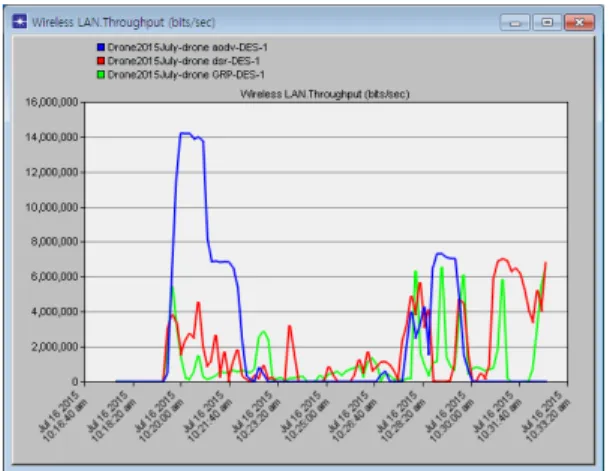
In Fig. 3, Fig. 4 and Fig. 5, the LAN throughput, retransmission attempts, and delay of AODV, DSR, and GRP are compared. The result show that the AODV is the best performance, then others.
In Fig. 3, the throughput of AODV is much
more than the others. Not any routing protocols
made a good performance since there are not much
drones interact to it near at 10:23 am. The DSR
showed the better at the end of the simulation, but
the AODV showed the best performance. The
AODV showed 14,000,000bits/sec as a throughput at the first part while the others showed around 4,000,000bits/sec.
Fig. 3 Throughput of Global Drone Network
Another performance parameter showed similar result. The AODV has just few of retransmission attempts during simulation. But, the GRP had many retransmission attempts during whole simulation time. The GRP showed the results during the whole simulation time compare to the DSR and AODV. The parameter doesn’t exceed 6 times but it is very sparsely distributed in the AODV.
Fig. 4 Retransmission Attempts of Packets
In the Fig. 5, the GRP also showed the worst result compare to the others. Mostly the delay doesn’t lasts more than 0.28sec except the GRP.
There was 0sec delay in the middle and end of the simulation in AODV, because of the drones’
encounter in the air.
Fig. 5 Delay of Global Drone Network
In the Fig. 6, we can see more clearly that the DSR is better than the GRP in the aspect of total traffic received parameter, even though, the GRP gets better in the end. The traffic received rate of the GRP does not exceed 100packet/sec, while the DSR exceeds it 4 times during simulation.
Fig. 6 Total Traffic Received[DSR/GRP]
The AODV showed that it is the most suitable for routing protocol in the drone delivery network.
Then DSR is the second and, then the GRP.
V. Conclusion
The performance of routing protocol affects a great deal to improve the drone delivery network.
In order to suggest the best routing algorithm, AODV, DSR, and GRP are designed and simulated in the Opnet simulator. As a result, the AODV showed the best performance in every aspects of the performance parameters in this simulation.
Therefore, there is no doubt that the AODV is recommended as a routing protocol for the drone delivery network environment. For the further study, a combined network consists of UAV in VANET will be studied.
Reference
[1] R. Clarke, “Understanding the Drone Epidemic,” Computer Law & Security Review, vol. 30, 2014, pp. 230-246
[2] U. Volovelsky, “Civilian uses of unmanned aerial vehicles and the threat to the right to privacy – An Israeli case study,” Computer Law & Security Review, vol. 30, 2014, pp.
306-320.
[3] J. Park, S. Lee, and W. Oh, “Priority routing based Congestion Control; Packet Service Time; Wireless sensor networks; Congestion Detection,” J. of the Korea Institute of Electronic Communication Sciences, vol. 10, no. 2, 2009, pp. 13-18.
[4] K. Kim, D. Kim, and S. Bae, “An Enhanced Robust Routing Protocol in AODV over MANETs,” J. of the Korea Institute of Electronic Communication Sciences, 2013, pp.321-328.
[5] G. Salvo, L. Caruso, and A. Scordo, “Urban traffic analysis through an UAV,” Procedia Social and Behavioral Sciences, vol. 111, 2014,
[6] S. Kim, “A Study on the attitude control of the quadrotor using neural networks”, J. of the Korea Institute of Electronic Communication Sciences, vol. 9, no. 9, 2014, pp.1019–1025.
[7] S. Kim, H. Oh, J. Suk, and A. Tsourdos,
“Coordinated trajectory planning for efficient communication relay using multiple UAVs,”
Control Engineering Practice, vol. 29, 2014, pp.
42-29.
[8] S. Ge and F. Lewis, “Autonomous Mobile Robots, Sensing: Control, Decision Making and Applications,” CRC Press, 2006.
[9] T. Hayes, and F. H. Ali, “Proactive Highly Ambulatory Sensor Routing(PHASeR) protocol for mobile wireless sensor networks,”
Pervasive and Mobile Computing, vol. 21, 2015, pp. 47-61.
[10] D. Kampitaki, A. A. Economides, “Simulation study of MANET routing protocols under FTP traffic,” Procedia Technology, vol. 17, 2014, pp. 231-238.
Author
조준모(Jun-Mo Jo)