고속도로 상의 교통위반 단속을 위한 드론 패트롤 네트워크의 MANET 라우팅 프로토콜 성능비교
조준모*
Performance Comparison among MANET Routing Protocols of Drone Patrol Network for Traffic Violation Enforcement on a Highway
Jun-Mo Jo*
요 약
근래에는 드론을 이용하여 실생활에 적용하는 사례가 늘고 있다. 드론을 이용하여 방송국에서 항공촬영을 하거나, 드론 경기등 다양한 영역에 적용하고 있다. 특히 몇 년 전부터는 드론을 활용하여 고속도로 상에서의 교통위반 차량을 단속하고 있다. 경찰당국에서는 30분 단위로 단속을 하는 ‘스팟 이동식’ 방식을 사용하고 있 으나, 적은 인력으로 넓은 지역을 단속하기에는 비효율적인 방식이다. 따라서, 다수의 드론을 무선망으로 연결 하여 체계적으로 관리할 수 있는 시스템이 필요하다. 본 논문에서는 고속도로에 적합한 MANET 드론 통신망 에서 다양한 라우팅 프로토콜을 적용하여 가장 효율적인 라우팅 프로토콜을 선택하고자 한다. 이를 위해 OPNET 시뮬레이터로 라우팅 프로토콜을 적용한 드론 패트롤망을 디자인하고 시뮬레이션을 하였다.
ABSTRACT
Recently, there are many real life applications that uses drones. There are various applications such as the aerial shot with the drones for the broadcasting service or drone racing competition and so on. Specifically, they patrol for the traffic enforcement on a highway. The police department use the ‘Spot Mobility’ method which float the drones for 30 minute period. However, this method is inefficient for the wide area with small numbers of enforcement. Therefore, a wireless network system consists of drones to patrol on the highway systematically is required. In this paper, the most efficient routing protocol will be selected for the MANET drone network by applying various routing protocols. To accomplish this, the drone patrol network system with routing protocols are designed and simulated in OPNET simulator.
키워드
Routing Protocol, Drone Patrol, Network Simulation, Performance Evaluation 라우팅 프로토콜, 드론 정찰, 네트워크 시뮬레이션, 성능평가
* 교신저자 : 동명대학교 전자공학과 ㆍ접 수 일 : 2017. 08. 12 ㆍ수정완료일 : 2017. 11. 13 ㆍ게재확정일 : 2018. 02. 15
ㆍReceived : Aug. 12, 2017, Revised : Nov. 13, 2017, Accepted : Feb. 15, 2018 ㆍCorresponding Author : Jun-Mo Jo
Dept. Electronic Engineering, TongMyong University, Email : [email protected]
Ⅰ. Introduction
In Korea, since year 2016, the police department started to use drones to patrol violated vehicles on
the highway area. They monitors vehicle drivers who use side ways on the highway during traffic congested hours of the season, drunken drivers, or violent drivers. However, this method is inefficient http://dx.doi.org/10.13067/JKIECS.2018.13.1.107
since it requires manually charging batteries, gathering data, and operate drones with many numbers of policeman. Drones equipped with one or more electrical motors and a fixed angle camera targeting on the ground. The drones are able to identify static or mobile ground targets, which are considered as points that have to be monitored.
Recent developments in wireless communication technologies, energy storage, computing power and Unmanned Aerial Vehicles(UAV) make a system composed of Wireless Sensor Networks(WSN) and multi-UAV the perfect candidate to play an important role in various area[1].
The routing protocol is also important to improve the UAV system. Some research related on the routing technique based on traffic priority in order to improve the network efficiency by minimizing latency. And it proposes a congestion control mechanism that uses packet service time, packet inter-arrival time, buffer usage, etc[2].
In Mobile Ad-hoc Network, link failure and packet loss may occur frequently due to its nature of mobility and limited battery life. So there are some research on a robust routing protocol based on AODV by monitoring variation of receiving signal strength is proposed. New metric function that consists of node mobility and hops of path is used for routing decision[3].
The drones need to have autonomous functions.
The policeman could control the drones, but many drones are required for the wide area of the highway. While the UAV impacts for traffic safety and congestion have been predicted in some detail, potential behavioral shifts and resulting environmental impacts have received little attention[4].
There is study on border patrol systems that have gained interest to address the concerns about national security in U.S. To monitor the border in real time with high accuracy and minimize the need for human support, a new border patrol system framework based on hybrid wireless sensor networks, which can
accurately detect and track the border intrusion with minimum human involvements[5].
Because of the variability of the transportation demand, knowledge of the road network and the traffic conditions is essential to optimize urban mobility. It requires to analyze the road traffic congestion through with it. The fundamental variables for the analysis of traffic congestion are density, capacity and traffic flow. That should be able to analyze and simulate the instantaneous movement of each vehicle present on the road[6].
A communication relay is also important factor to performance evaluation. But with the advent of light weight, robust and autonomous platforms can now perform this relay mission. A developed a communication relay package to provide four communication software programmable channels, which can be configured to provide ground to ground, air to air, or ground to air relay[7].
In this paper, drone patrol network in highway is designed and simulated with random mobility. The concept related to the common routing protocols are discussed in section II. Then, in the section III, the suggested drone patrol network topology is explained for applying various routing protocols. Next, in section IV, the simulation result of the various routing topology is analyzed. Finally, the conclusion is made in section V.
Ⅱ. MANET Routing Protocols
Mobile Ad Hoc Networks(MANETs) use many different routing protocols to route data packets between nodes. Many researches studied and evaluated on the performance of these routing protocols. However, the studies evaluate the performance of routing protocols using traffic generators that do not correspond to specific applications such as drone delivery network. And the scenarios used in previous research are rather simple and do not correspond to real and complex
situations, where various types of UAV traffic coexist in the network.
Autonomous vehicles as drone is an important study subjects in these days. Especially this new technology has the power to dramatically change the way in which transportation or delivery systems operate. While the UAV impacts for traffic safety and congestion have been predicted in some detail, potential behavioral shifts and resulting environmental impacts have received little attention[8].
There are some protocol types such as the proactive and reactive routing protocols to evaluate when specific application traffic exists in the network. Examination of the generic case where the data to be transferred is different for each destination node. By executing several simulations, some conclusion about the type of the traffic load in the network plays an important role on the performance. The operation of the most popular routing protocols used in MANETs, regardless of the mobility model employed by the relay nodes[9].
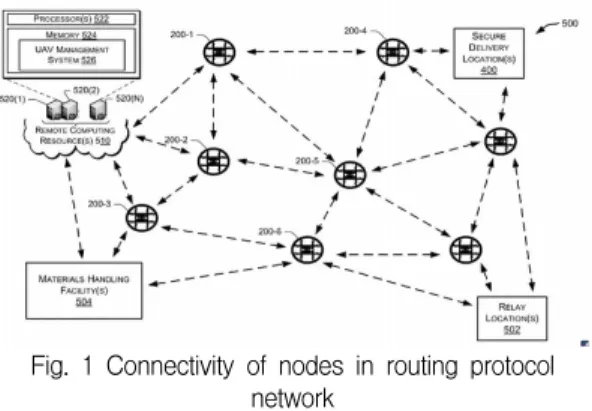
An example of connectivity in the MANET protocol is shown as Fig. 1. Any MANET routing protocol can be applied to the topology.
Fig. 1 Connectivity of nodes in routing protocol network
The most general distinction of MANET routing protocols is proactive and reactive. Some of the most popular protocols examined in previous studies are Ad-hoc On-demand Distance
Vector(AODV), which belong to the reactive or on-demand category and Optimized Link State Routing(OLSR), Destination Sequenced Distance Vector(DSDV), which belong to the proactive or table-driven category. Additionally, Geographic Routing Protocol(GRP) is classified as proactive routing protocol.
Ⅲ. Drone Patrol Network Topology
In this section analytical expressions are derived for packet delivery ratio. Packet delivery ratio (PDR) is one of the key metrics in any routing scheme as it is a good measure of the quality of a protocol. It is defined as the fraction of packets successfully received, Prx, out of the all of the packets created, Ptx , and is given as:
(1)
As such the primary cause of packet loss will be through link breakages on the path of a packet.
Taking an expression for the average link lifetime, tav:
m ax
(2)
where dlink is the link distance, v is the relative velocity between the transmitter and receiver, vmax
is the maximum speed that a node is capable of and r is the transmission radius of the nodes. So, during the time between a packet is created and received at the sink, the probability of a link breaking, Pbreak , is
m ax
(3)
where Dav is the average end-to-end delay of a packet. Then the expected number of broken links, Lbroken, is given by multiplying the expected number of links by the probability of a link breaking. The expected number of links in the network is derived
through the multiplication of the probability that two nodes are within communication range with all of the possible two node combinations[10].
Table 1. Wireless LAN parameters
Attributes Value
Data Rate 11 Mbps
Transmit Power 0.001 W
Packet Reception Power -95
Physical Characteristics Direct Sequence
So the mobile nodes in the network considered as patrol drones set as shown in the Table 1 and Table 2. The Table 1 shows the specification of the wireless LAN parameters.
Table 2. Random waypoint parameters
Attributes Value
Speed (meters/sec) uniform_int(0, 10) Pause Time (sec) constant(20) Start Time (sec) constant(10) Record Trajectory Enabled
The Table 2 is characteristic of drone mobility.
Their speed, start time, and pause time are set as probabilistic manner shown in the table. Five drones are set for each section to patrol. Each drone has random mobility in their dedicated section.
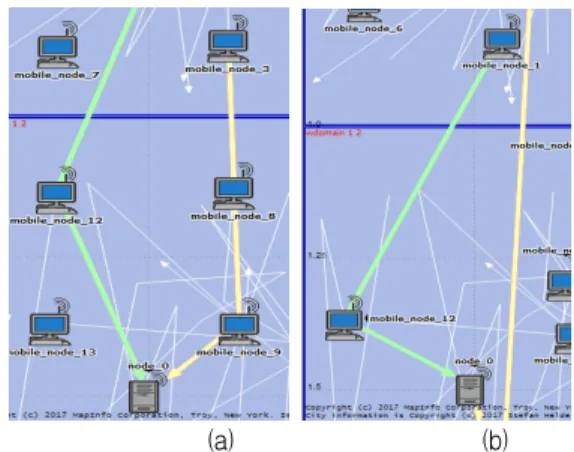
(a) (b)
Fig. 2 Highway drone patrol network topology
The topology in this paper is shown in Fig. 2 with an example of trajectories. The patrol drones cover 500m wide, 1km long roads. There is a total of 3km long road consists of 3-one kilometer sections. Only the center of the section has a server, the node_0, that gathers patrol data from 3 sections in real time.
Every node try to send their obtained data on the road in real time through adjacent drone at certain time. The picture (b) in Fig. 2 shows the connections between node and the server through other nodes.
IV. Simulation Result and Analysis
There are several routing protocols in OPNet such as AODV, GRP, and TORA. The routing protocols are applied to the topology explained in the prior chapter. For the comparison of the performance among those routing protocols, the tested parameters are delay, load, number of retransmission attempts, and throughput of the wireless LAN. However, for the conclusion, the throughput and the delay are shown.
(a) (b) Fig. 3 Connection between drone and server
Additionally, the routing path is also examined for an accurate result as shown in fig. 3. The picture (a) and (b) shows the nodes in different positions in different time line. And the simulation time is total of 10 minutes.
Fig. 4 Throughput performance in global network
The GRP showed better throughput in global aspect than the AODV. The TORA showed worst performance as shown in Fig. 4. The AODV had a little better section than the GRP, but overally, the GRP showed steady on the throughput. The TORA degraded the throughput more than 7 times.
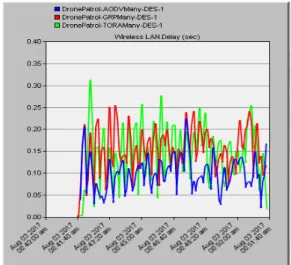
Fig. 5 Delay performance in global network
The AODV showed better than the GRP protocol since it is operated as requesting manner in shown in Fig. 5. However, the GRP gathers their adjacent node’s information for the future routing. Therefore, the AODV showed better than the GRP in delay aspect.
Fig. 6 Throughput performance of the server The result of the throughput performance is similar to the Global network’s. The GRP is better than the AODV and then the TORA. This means the GRP routing protocol was the most efficient protocol to gather data from the nodes to the server.
Fig. 7 Delay performance of the server
The delay performance to the server is also showed the AODV is slightly better than the GRP shown in Fig. 7.
However, the throughput of the GRP for both in global network and in server showed better than the other protocols. So I have concluded the GRP is the best routing protocol among others.
V. Conclusion
Various routing protocols such as GRP, AODV, TORA are applied to the drone patrol network topology to examine the performance. The AODV showed slightly better than the GRP in delay because of the characteristic of the storing the routing table method. However, the GRP showed better throughput performance both in globally and in the server. I have examined the performance of each connections with every node in this network for the accurate result. For the further study, to enhance the quality of the network’s performance, the proper numbers of the drones in the network will be simulated and tested.
Reference
[1] M. Erdelj, M. Krol, and E. Natalizio, “Wireless Sensor Networks and Multi-UAV systems for natural disaster management,” Computer Networks 124, Elsevier, vol. 124, 2017, pp.72-86.
[2] C. Lee and J. Lee, “Data transfer Rate of the Wireless Node Moving in the Static Wireless Network Space,” J. of the Korea Institute of Electronic Communication Sciences, vol. 11, no. 10, 2016, pp.941-948.
[3] C. Kim, “Design and Implementation of a Smart Home Cloud Control System Using Bridge based on IoT,” J. of the Korea Institute of Electronic Communication Sciences, vol. 12, no. 5, 2017, pp.865-872.
[4] D. Fagnant and K. Kockelman, “The travel and environmental implications of shared autonomous vehicles, using agent based model scenarios,” Transportation Research Part C, vol.
40, 2014, pp.1-13.
[5] Z. Sun, P. Wang, M. Vuran, M. Rodhaan, A.
Dhelaan and L. Akyildiz, “BorderSense: Border Patrol through advanced wireless senssor networks,” Ad Hoc Networks, vol. 9, No. 3,
Elseview, 2011, pp.468-477.
[6] G. Salvo, L. Caruso and A. Scordo, “Urban traffic analysis through an UAV,” Procedia Social and Behavioral Sciences 111, Elsevier, vol. 111, 2014, pp.532–539.
[7] S. Kim, H. Oh, J. Suk, and A. Tsourdos,
“Coordinated trajectory planning for efficient communication relay using multiple UAVs,”
Control Engineering Practice 29, Elsevier, vol. 29, 2014, pp. 42-29.
[8] G. Cena, A. Valenzano, and S. Vitturi, “Advances in automotive digital communications,” Computer Standards & Interfaces, vol. 27, 2005, pp.665–678.
[9] D. Kampitaki and A. A. Economides, “Simulation study of MANET routing protocols under FTP traffic,” Procedia Technology, vol. 17, 2014, pp.
231-238.
[10] T. Hayes and F. Ali, “Robust Ad-Hoc Sensor Routing protocol for mobile wireless sensors networks,” Ad Hoc Networks 50, Elsevier, vol. 50, 2016, pp.128-144.
Author
조준모(Jun-Mo Jo) 1991년 아이오아주립대학교 컴퓨 터과학과 졸업 (공학사)
1995년 경북대학교 대학원 컴퓨터 공학과 졸업(공학석사)
2004년 경북대학교 대학원 컴퓨터공학과 졸업(공학 박사)
1998년~현재 동명대학교 전자공학과 교수
※ 관심분야 : 이동통신, 뇌파통신, 인공지능