효율적인 보행자의 EEG 신호 전송을 위한 드론기반 센서네트워크 시나리오
조준모
*
Drone Based Sensor Network Scenario
for the Efficient Pedestrian’s EEG Signal Transmission
Jun-Mo Jo
*요 약
오늘날 사람들의 건강을 실시간으로 점검하고 응급상황에 대처하기 위해 다양한 기술들이 개발되어지고 있다.
지금까지는 대부분 맥박과 같은 생체신호를 측정하여 활용하고 있지만 최근에는 뇌파(EEG)를 활용하는 연구가 늘어나고 있다. 그러나 길에서 걸어 다니는 모든 사람들의 EEG 신호를 실시간으로 검출하여 해당 서버에 전송 하는 것은 여러 가지 문제점을 야기시킨다. 특히, 2차원 공간에서 실시간으로 EEG 신호를 수집 및 전송하는 제 약이 존재하기 때문에 본 논문에서는 이러한 제약을 피할 수 있는 3차원 공간의 드론을 활용하는 효율적인 네트 워크 모델을 제안하고자 한다. 이러한 모델을 Opnet 시뮬레이터를 활용하여 네트워크 구조를 설계하고 시뮬레이 션하고 평가하였다.
ABSTRACT
The various technologies related to the monitoring human health in real-time for the emergency situations are developing these days. Mostly the human pulse is used for measuring as the vital signs so far, but the EEG became a major research trend now. However, there are some problems measuring and sending EEG signals of all the people walking down the street to the dedicated server. Especially, there are some restrictions for collecting and sending EEG signals in 2-dimensional space in real-time. Therefore, I suggests an efficient network model using 3-dimensional space of drones to avoid the restrictions. The models are designed, simulated, and evaluated with the Opnet simulator.
키워드
EEG Signal, Drone, Sensor Network Scenario EEG 신호, 드론, 센서네트워크 시나리오
* 교신저자 : 동명대학교 전자공학과 ㆍ접 수 일 : 2016. 08. 11 ㆍ수정완료일 : 2016. 09. 13 ㆍ게재확정일 : 2016. 09. 24
ㆍReceived : Aug. 11, 2016, Revised : Sep. 13, 2016, Accepted : Sep. 24, 2016 ㆍCorresponding Author : Jun-Mo Jo
Dept. Electronics Engineering, Tongmyong University, Email : [email protected]
Ⅰ. Introduction
The drone industry is a major trend in our information technology society. Many companies are competing for the various applications using drones
such as the drone mailing services, geographical
photos and so on. Moreover, the government
authorities as law enforcement agencies,
corporations and private individuals have identified
the advantages inherent in the use of drones. Also
http://dx.doi.org/10.13067/JKIECS.2016.11.9.923
there are many applications using drones such as analyzing road traffic congestion through with it[1].
Some corporations marketing and manufacturing drones for civilian purposes, and the industries that support these manufacturers, have identified the enormous economic potential which may be derived from the sale and maintenance of drones[2].
They use head up display to compete with opponents in the drone competition with the head up display device. There is a research on the head up display to control future vehicular system[3].
And also monitoring vehicular or drones related issues are studied these days. There is a study related on the scientometric analysis through paper analysis of each organization and author to decide research direction for autonomous driving vehicles[4].
Some recent studies related on the drones show a variety aspects from military aircraft to civilian aircraft. The studies of these unmanned aircraft are the kinetic analysis required complex processes.
These techniques are supported by the aerodynamic forces on the unmanned aircraft. Some recent studies related on the drones show a variety aspects from military aircraft to civilian aircraft.
The studies of these unmanned aircraft is the kinetic analysis requires complex processes, because these support by the aerodynamic forces on the unmanned aircraft study[5, 6].
Mostly the drones use GPS for the positioning function. And there are many sensors available for the specific operations. Some studies require as a complete drones, variety of sensors to be employed for their location, sensor data pre-processing and processing, sensor fusion, map building, motion planning, motion control, etc.[7].
Therefore, in this paper, some EEG signal transmission network scenarios are designed and simulated for the network performance. Then analyze the result to suggest an efficient EEG transmission sensor network. In section II, the EEG signal transmission via drones will be suggested. In
section III, the specification of the various EEG network using drones scenarios will be presented and explained. Then, in section IV, the simulation result of the scenarios is compared and analyzed for the efficient scenario. Finally, the conclusion is made in section V.
Ⅱ. EEG Signal Transmission via Drones
2.1 Autonomous drones
The autonomous vehicles as a drone is the relative research of the area, and there are many possible applications to apply as a new trend.
Especially this new technology has the power to dramatically change the way to operate. While the drones impacts for traffic safety and congestion have been predicted in some detail, potential behavioral shifts and resulting environmental impacts have received attention[8].
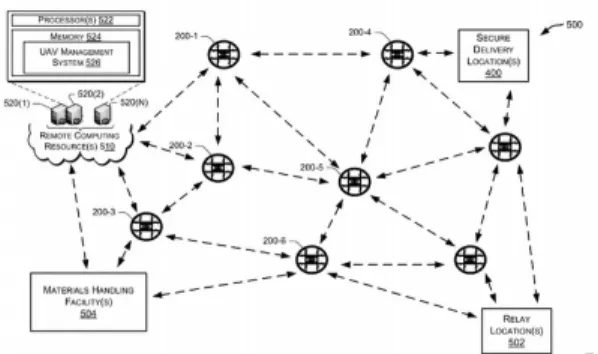
The Fig. 1 shows an example of data transactions of drone network. The drones can communicate each other or propagates their data stream through the network.
Fig. 1 Data transactions via the drones network
2.2 EEG Signal Propagation using Drones
To transfer the EEG signals to the server using
drones have to consider many things. For instance,
to avoid the collisions they need to have infrared
sensors. However, for the performance of the
network consists of many drones collect and propagates the EEG signals to the server has to be efficient. I believe this is the first paper to present transmitting EEG signals to the server via drones.
There are many people on the city street and it can be divided into many sections to manage effectively.
To obtain the better performance, the efficient network scenario is required. For instance, the numbers of the pedestrians in certain area and the numbers of the server to collect the data in a section will affect the performance.
Ⅲ. Various EEG Signal Drone Network Scenario
Mainly, the two types of network scenario are suggested and simulated for this paper:
One network scenario is no routers to propagate the end devices as pedestrians. Another words, the end device directly sends the EEG signals to the coordinators in the center of the network.
The other network scenario is some mobile routers propagates the EEG signals from the end devices.
This could not help the performance of the network much since the routers are few and they have the mobility. So that they don’t have much chance to encounters with the end devices as adjacent nodes.
This is the major purpose of the experiment to evaluate the potential of the mobile routers.
Additionally, the network with few fixed routers network is designed and compared with the two network scenarios at the end. Even though we can expect that this will performs the best of all, It is necessary to figure it out the effectiveness of the scenario. And how many mobile routers are needed to cope up with the fixed router network structure.
Basically, the EEG signal network using drones are designed with sensor nodes. The network consists of end zigbee devices, zigbee routers, and zigbee coordinators.
Fig. 2 The private many network scenario
The no routers network is named as a ‘Private many’ for the simulation shown in Fig. 2. There are 30 zigbee end devices which are considered as pedestrians.
Fig. 3 The mobile routers network scenario
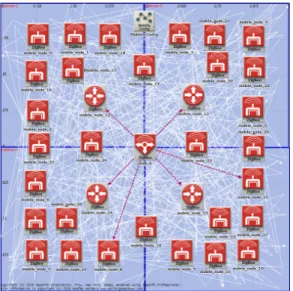
Then for the second network scenario, named the ‘Mobile Routers’, same numbers of the zigbee end devices with 4 mobile routers as shown in Fig.
3. The 4 zigbee routers are propagating the EEG
signals from the zigbee end users to the zigbee coordinator located in the center.
Fig. 4 The mobility of zigbee devices
The zigbee routers and end devices in the network and their mobility are shown in the Fig. 4.
For the routers the figure shows that there are 4 sections on the street, and each section has 4 zigbee routers with boundaries of their own. Other words, a router cannot cross their own boundaries. This will makes the better network performance since the routers have more chances to encounter with near end devices. The end devices also have their random mobilities.
Finally, the additional ‘FixRout many’ network scenario looks just like as the Fig. 3 except for the no boundaries of the routers. It will be compared and discussed with the first two scenarios at the end of the simulation.
The specification of the device is summarized in the Table 1. The ACK mechanism, the CSMA-CA parameters, and the parameters of physical layer is specified for the simulation.
The packet reception-power threshold is related to the network perimeters of the zigbee end devices to transmit the data.
Table 1. Specification of zigbee end device
Contents Value
1 ACK
Mechanis m
ACK Wait
Duration(sec) 0.05
No. of
Retransmission 5
2 CSMA -CA Parameters
Min. Backoff Exponent 3 Max. No. of Backoffs 4 Channel Sensing Duration 0.1
3
P h y s i c a l L a y e r Parameter
Packet Reception Power
Threshold -95
IV. Simulation Result and Analysis
Mainly, the first and the second scenario discussed in the previous chapter will be analyzed and discussed with various network parameters.
The additional fixed router scenario will be compared and analyzed at the end of this chapter.
The network performance parameters chosen for the simulation result are the global throughput and the data received rate in the zigbee coordinator.
Fig. 5 Throughput of global network scenario
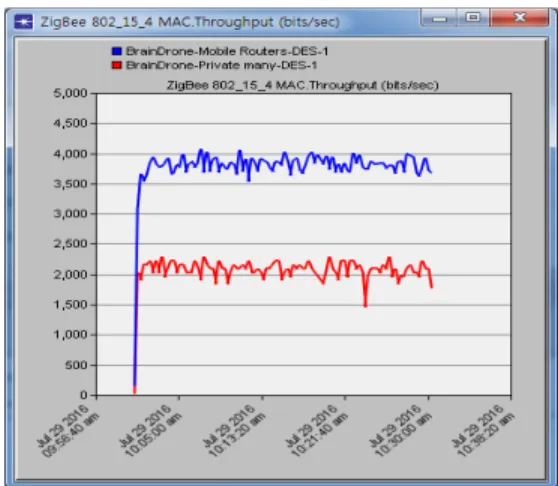
Fig. 5 shows the throughput comparison between
the ‘Mobile Routers’ and the ‘Private Many’. The
throughput of the mobile Routers showed better
performance.
Fig. 6 Throughput of the Zigbee Coordinator
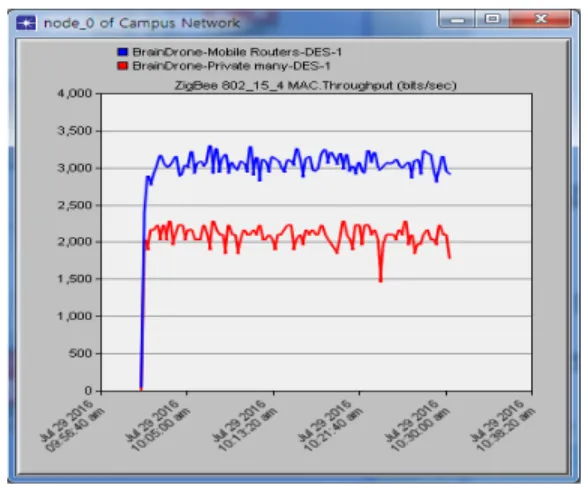
The throughput of the zigbee coordinator located in the center of the network also showed better performance of the ‘Mobile Routers’ as shown in Fig. 6. However, I am curious that how much the fixed routers scenario performs better than the suggested scenarios. To obtain this answer, the fixed router network is designed and simulated for the comparison with the two scenarios.
Fig. 7 Throughput Comparison with Fixed Router Scenario
The fixed router scenario is designed and simulated to evaluate. Then I have obtained the throughput comparison graph shown as Fig. 7. The result showed enormous gaps between fixed router
scenario and others than I have expected. So I have added 4 times of mobile routers in the network to compensate their gap.
Fig. 8 Throughput Comparison with Many Routers Scenario
The middle graph line of Fig. 8 shows the result of the expanded routers scenario. But the throughput doesn’t seemed have progressed.
Therefore, I have concluded that adding the numbers of mobile routers did not affects much to the performance of the network.
V. Conclusion
In the future, most people walking down the street might need to be monitored their EEG signals for their health or medical emergencies.
There are some problems measuring and sending
their EEG signals to the dedicated server in
real-time. Especially, there are some restrictions for
collecting and sending EEG signals in
2-dimensional space in real-time. Therefore, I have
suggested an efficient network model using
3-dimensional concept of drones which can
eliminate the restrictions. Three network scenarios,
the FixRoute, the Mobile Routers, and the Private
many, are suggested, designed, and simulated for
the evaluation. The Opnet simulation result showed that the fixed router scenario performed much better the others. The quad expanded numbers of the routers in the Mobile Routers couldn’t catchup the enough performance that I have expected.
However, the routers which have the mobility in their region performed better than the Private one.
For the further study, the suggested scenario in this paper will be applied to the patients in the hospital network.
Reference
[1] G. Salvo, L. Caruso, and A. Scordo, “Urban traffic analysis through an UAV,” Procedia Social and Behavioral Sciences, vol. 111, 2014, pp.532–539.
[2] U. Volovelsky, “Civilian uses of unmanned aerial vehicles and the threat to the right to privacy – An Israeli case study”, Computer Law & Security Review, vol. 30, 2014, pp.
306-320.
[3] S.-H. Yun, H.-B. Son, Y.-C. Rhee, “A Study of Head Up Display System for Next Generation Vehicle”, J. of The Korea Institute of Electronic Communication Sciences, vol. 6, No. 3, 2011, pp.439–444.
[4] J.-G. Park, J.-D. Choi, Y.-C. Bae,
“Scientometric Analysis of Autonomous Vehicle through Paper Analysis of each Nation”, J. of The Korea Institute of Electronic Communication Sciences, Vol. 8, No. 2, 2013, pp.321-328.
[5] S-D. Kim, “A Study on the attitude control of the quadrotor using neural networks”, J. of The Korea Institute of Electronic Communication Sciences, vol. 9, No. 9, 2014, pp.1019–1025.
[6] S. Kim, H. Oh, J. Suk, and A. Tsourdos,
“Coordinated trajectory planning for efficient communication relay using multiple UAVs,”
Control Engineering Practice, vol. 46, no. 19 2014, pp. 42-29.
[7] S-S. Ge, F-L. Lewis, Autonomous Mobile Robots, Sensing: Control, Decision Making and Applications, New York, USA, CRC Press, 2006.
[8] D-J. Fagnant, K.-M. Kockelman, “The travel and environmental implications of shared autonomous vehicles, using agent based model scenarios”, Transportation Research Part C, Elsevier, vol. 40, 2014, pp.1-13.
Author
조준모(Jun-Mo Jo)