1. INTRODUCTION
Chestnuts, a kind of nuts used as ingredients of food, are fruits of deciduous trees (Park et al., 2011) belonging to Fa- gacea Castanea, and they are divided into Catanea cretanea vadulis Nakai, Catanea mollisima Blume, Catanea cretanea 1ea Seib et Zucc and Catanea sativa Miller. Catanea cretanea va- dulis Nakai especially is high in quality (Ahn, 2017), so it has been used uncooked and used for various food items, such as boiled rice, porridge, thin rice gruel, rice cakes, chestnut candies, chestnut balls, chestnut danja, stuffing for rice cakes and dasik (Lee, Jang, & Kim, 2016; Son et al., 2012), in the
form of dried chestnuts, chestnut powder and chestnut inner skin. The inside skin and flesh of chestnuts, in particular, con- tain lots of antioxidants, including coumarin, gallic acid and catechin (Barreira et al., 2008; Lee et al., 2008), so it is said that they decrease neutral fat and total lipid in blood, improve anticoagulant activities (Kim et al., 2009), restrains cell prolife- ration in stomach cancer cell lines and promote apoptosis (Lee, Kim, & Kim, 2011). Leaves and roots of chestnut trees are effective for treating inflammation (Hong & Hwang, 2011;
Kim, Ahn, Lee, & Lee, 1999) and good for skin care, recovery from fatigue and prevention of colds (Hong & Hwang, 2011) because of their effects for blood circulation and bleeding Information available at the Culinary Society of Korea (http://www.culinary.re.kr/)
Culinary Science & Hospitality Research
Journal & Article Management System: https://cshr.jams.or.kr/
21-28
http://dx.doi.org/10.20878/cshr.2018.24.2.012
Quality Characteristics of the Sulggitteok made by Chestnut Powder
Ok Hwa Jhee
Dept. of Practical Arts Education, Gongju National University of Education
KEYWORDS ABSTRACT
Chestnut, Sulggi,
Quality properties, Sensory test, Texture,
Antioxidant activity.
The objective of this study was to assess the quality characteristics of Sulggitteok prepared with different ratios of chestnut powder: 0%, 5%, 10%, 15%, and 20%. The moisture content of the chestnut Sulggi without added chestnut powder was 38.24% than that of any other chestnut pow- der added groups and gradually decreased from 33.34~26.27% based on the addition of chestnut powder. In terms of color, the lightness (L) decreased significantly but redness (a) and yellowness (b) significantly (p<0.001) increased with increasing contents of chestnut powder. The total polyphenol content and DPPH free radical scavenging activity increased as the amount of chestnut powder increased and decreased. Total phenol contents of phenol contents was higher in the 10%
added group (347.50 mg GAE/100 g) and DPPH radical scavenging activity was significantly higher in the 5% added group (69.35±2.02%) and 10% added group (74.33±2.29%). Texture profile analysis showed that the hardness, adhesiveness, chewiness were higher than that of the control. The result of sensory evaluation test and the overall acceptability showed that the taste, color, flavor, chewiness, softness and overall acceptability were the highest in the 10% added group while the color and flavor showed no significant different group. Based on these results, it is suggested that chestnut Sulggi with up 10% added chestnut powder can be developed as products.
*This study was supported by research funds from Gongju National University of Education in 2016.
Corresponding author: Ok Hwa Jhee, Dept. of Practical Arts Education, Gong National University of Education, 27 Woongjinro, Gongju-si, Chung Nam, 32553, South Korea, Tel. +82-41-850-1692, Fax. +82-41-850-1690, E-mail. [email protected]
control. In addition, they have lots of essential amino acids, such as valine, leucine, isoleucine, threonine, histidine, phenyl- alanine, they are good as dietary supplements for children with poor nutritive conditions (Hong & Hwang, 2011). As people are growing more and more interested in promotion of health and recovery, their interests in functional foods also are getting keener. As the concept of wellbeing has recently been introduced in the nation, people have become to have more positive conceptions of tteok. Tteok has been considered as simple breakfasts and light meals for modern people (Kim, 2008). Tteok has been made and used since the ancient Bronze Age. Tteok has become a traditional dish of the nation with the passage of time and has been widely used for va- rious events, ceremonies and holiday food (Lim, 2011). Tteok which has become food with Korea's unique and deep folkway and traditionality represents the nation's unique food customs. To make tteok, not only nonglutinous rice and gluti- nous rice but also minor grains, including beans, fruits, nuts, vegetables, herbal medicines and spices are added, so tteok is very excellent in terms of nutrition. Sulggi which is steamed after sugar is added to finely grinded rice powder and air and water are mixed, in particular, is very scientific and rational food to improve nutritive values and physiological functio- nality (Choi, Cho & Jhee, 2008; Cho et al. 2006; Jhee & Choi, 2008). Various ingredients are added to unglutinous pow- dered rice. For this study, chestnuts with diverse nutritional contents and health functionality are grinded into powder to be added to baeksulggi and then the effect of sulggi on physical and organic quality characteristics and the antioxi- dant activity depending on the ratio of added powder was compared and analyzed. Efforts were made to figure out the possibility to enhance values of chestnut power products and to develop those products into functional items.
2. MATERIAL AND METHODS
2.1. Materials
For the study, chestnuts of Okgwang (Gongju, produced in 2015) cultivars were used. Chestnuts were peeled and sliced in 2 mm thick, and then dried in hot air of 40℃ and grinded in less than 120 mesh, in order to be used for making Sulggi- tteok. Unglutinous rice (Cheonggyeolmi produced in 2015 in Icheon, Gyeonggi Province), sugar (CJ, Cheil Jedang) and salt (Haepyo, purity higher than 88%) used to make Sulggitteok had been kept in the room temperature.
Table 1. Fomula for chestnut Sulggi prepared with chestnut
powder (g)
Ingredient Samples1)
CS0 CS5 CS10 CS15 CS20
Rice powder 200 190 180 170 160
Raw chestnut powder 0 10 20 30 40
Sugar 20 20 20 20 20
Salt 2 2 2 2 2
Water 10 10 10 10 10
1) CS0: Chestnut Sulggi containing raw chestnut powder (0%), CS5: Chestnut Sulggi containing raw chestnut powder (5%), CS10: Chestnut Sulggi containing raw chestnut powder (10%), CS15: Chestnut Sulggi containing raw chestnut powder (15%), CS20: Chestnut Sulggi containing raw chestnut powder (20%).
2.2. Material Mixing Ratio of Chestnut Sulggi
This study first conducted a preliminary experiment based on the advanced research of Ogapisulggi (Jhee & Choi, 2008) and then made change and supplementation. After that, as shown in Table 1, chestnut powder 0%, 5%, 10%, 15%, and 20% were added, respectively, to make Sulggitteok.
2.3. Preparation of Sulggi added with Chestnut Powder Unglutinous rice was washed five times and soaked in 18℃
water for five hours. After it, rice was put into a bamboo basket for to be dried for 30 minutes. Then rice was grinded twice using a roller mill and then was mesh-sifted in a 20-mesh wicker tray to be used as rice powder. Chestnut powder was added to rice powder in the ratio of 0%, 5%
10%, 15% and 20% and sugar was added. After it, they were mixed well and salty water was added into the mixture.
Mixed powder was rubbed with hands to get rid of lumps and was mesh-sifted in the 20-mesh wicker tray two times.
Wet cotton cloth was spread in a bamboo steamer of 18 cm across and 7 cm high and the sample was put into it. The upper side was flattened and water of 2 L was put into a pan.
When steam came out, the bamboo steamer was put on the pan, and was steamed for 20 minutes and was let to settle by its own heat for five minutes. Completed Sulggitteok was taken out and cooled for 30 minutes to be used for a test.
The control group used rice powder only.
2.4. Moisture
The moisture content of Sulggitteok made with chestnut
powder was measured using an infrared moisture meter (ML- 50, A & D Company, Korea). Such a process was repeated three times and then the average value was found.
2.5. Color Evaluation
The chromaticity of Sulggitteok made with powdered chest- nuts was measured using a color meter (Chroma meter CR- 410, Minilta, Japan) three times each and the average value was shown in brightness (L value), red color (a value) and yellow color (b value). Correction of the standard white board used at this time were L=98.46, a=-0.23 and b=+1.02.
2.6. Content of Total Phenol Compounds
10 g of chestnut Sulggi was extracted for 24 hours (20℃) after 95% ethanol 90 mL was added, and then centrifugation was made for 10 minutes in 3,000 rpm and the supernatant liquid was used as a sample. The content of total phenol compounds was measured following the Folin-Denis’s phenol method (Swain & Hillis, 1959). After 2N Folin-Ciocalteu rea- gent 0.2 mL was added in the sample liquid 0.2 mL, the mixture was left for three minutes. Then, 10% sodium car- bonate (Na2CO3) 3 mL was added and it was made to react in the dark place for an hour and the absorbance was mea- sured at 765 nm. A calibration curve was written using gallic acid (gallic acid, Sigma Chemical Co.) as a standard substance and then the polyphenol content was shown with mg gallic acid (mg GAE/100 g) in the sample 100 g. The experiment was repeated three times to show the average value and the standard deviation.
2.7. DPPH (1,1-diphenyl-2-picrylhydrazyl) Radical Scavenging Activity
The DPPH (1,1-diphenyl-2-picrylhydrazyl) radical scavenging ability of chestnut Sulggi was shown with relative comparison between the control group and the chestnut powder addi- tion group. The antioxidant activity was compared and ana- lyzed after measuring scavenging activities about DPPH radi- cals following the method of Lee et al. (2009). In other words, DPPH solution (1.5x10⁻⁴) 1 mL was added in the sample liquid 4 mL and they were stirred. The mixture was left in the dark place for 30 minutes and the absorbance was mea- sured at 517 nm. The absorbance of the control group for which etanol was added, instead of the sample liquid, was measured together and the DPPH radical scavenging activity
was shown using the percentage.
Free radical scavenging
activity(%)
= 1- Sample absorbance
Control absorbance ×100
2.8. Texture Analysis
Such a process was repeated three times to show the average value and the standard deviation. texture analysis of chestnut Sulggi was measured using a texture analyzer (TA XT Express, Stable Micro Systems, UK) repeatedly three times following conditions of Table 2 to find the average value. At this time, the measured items were hardness, cohesiveness, gumminess, springiness and chewiness.
2.9. Sensory Evaluation Test
Chestnut Sulggi was steamed and then cooled for 30 mi- nutes. Ten students of the Department of Practical Arts Edu- cation at Gongju National University of Education were given no food from 10:30 to 11:00 and a 7-point scoring method was executed about the color, smell, taste, softness, texture, wetness and general characteristics of chestnut sulggi three times. The degree of preference was evaluated using two conditions, 'dislike extremely' one point and 'like extremely' seven points. The suggested samples were shown with three- digit figures using a table of random numbers. The sample was cut in same size (2×2×2 cm), put on a white dish and provided with water. The students tasted one sample and then tasted another sample after rinsing their mouths cleanly.
To reduce errors which could be caused by the order of
Table 2. Operation condition for texture profile analysis
Measurement Condition
Pre-test speed 2.0 mm/sec
Test speed 2.0 mm/sec
Post-test speed 2.0 mm/sec
Test mode and option T.P.A
Probe P10(10 mm DIA cylinder)
Sample area 3.0 mm2
Contact force 5.0 g
Threshold 20.0 g
Distance 25 mm
Strain deformation 50.0%
sample testing, there was a suggestion to test samples at random.
2.10. Statistical Analysis
All experiments were executed repeatedly three times or more and results were compared through average values and standard deviations using SPSS 20.0 (Statistical Package for the Social Sciences, IBM). Significance among average values was verified at around p<0.05 with the Duncan’s multiple range test after conducting the ANOVA test.
3. RESULTS AND DISCUSSION
3.1. Moisture of Chestnut Sulggi
Results after measuring the water content in chestnut Sulggi were shown in Table 3. The moist content of Sulggi without chestnut powder was 38.24% and the figure decreased signifi- cantly gradualy to 33.34~26.27% depending on addition of chestnut powder (p<0.001). As the water content in chestnut powder was much smaller than rice powder, such a condi- tion apparently affected the water content in the entire Sulggi, showing a same tendency with a study telling that more addition of powdered chestnut damaged water on the sur- face of Sulggi more because chestnut powder contained little
Table 3. Value of moisture of chestnut Sulggi added with chestnut powder Samples1)
F-value
CS0 CS5 CS10 CS15 CS20
Moisture(%) 38.24±1.102)a 33.34±0.47b 32.10±0.36c 31.03±0.55d 26.27±0.50e 131.566***
1) Sample at the same as in Table 1.
2) Means±standard deviation, *** p<0.001.
a e Means with different superscript in the same column are significantly different (p<0.05) by the Duncan's multiple range test.
Table 4. Hunter's color value of chestnut Sulggi added with chestnut powder Samples1)
F-value
CS0 CS5 CS10 CS15 CS20
Color value
L value 89.63±0.892)a 81.46±0.84b 80.73±0.30b 79.48±0.15b 76.30±0.49c 46.407***
a value -0.79±0.03a 0.52±0.01b 1.01±0.02c 1.09±0.05c 1.32±0.12d 559.606***
b value 8.20±0.06a 9.39±0.54b 10.47±0.11c 10.83±0.06c 11.32±0.18d 67.861***
1) Sample at the same as in Table 1.
2) Means±standard deviation, *** p<0.001.
a d Means with different superscript in the same column are significantly different (p<0.05) by the Duncan's multiple range test.
water (Ahn & Lee, 2014; Ahn, 2017).
3.2. Color Evaluation
Results after measuring colors of chestnut Sulggi were show in Table 4. The L value showing brightness was highest, 89.63, in the control group which didn't add chestnut pow- der. The figure drew a significant downward curve as increa- singly more chestnut powder was added (p<0.001), showing similar results to Sulggitteok with those from steamed chest- nut powder (Ahn, 2017) and sulggtteoki with powdered gingko (Kim, Suh, Kim. & Kim, 2004). The a value showing the red color was -0.79 in the control group which didn't add chest- nut powder. The figure drew a significant upward curve, com- pared with the control group, as increasingly more chestnut powder was added (p<0.001). The b value showing the yellow color was lowest, 8.20, in the control group which didn't add chestnut powder and the figure significantly increased com- pared with the control group as increasingly more chestnut powder was added (p<0.001). Kim et al. (2002) measured the chromaticity of yanggaeng containing mesh-sifted powders from safflower seeds and found the L and a values slightly decreased as the number of meshes increased, while the b value slightly increased, showing that characteristics of the sample chromaticity of added samples were reflected in the chromaticity of Sulggitteok.
3.3. Content of Total Phenol Compounds and DPPH Radical Scavenging Activity
The total phenol compound content of chestnut Sulggi following the amount of added chestnut powder was studied from a standard curve prepared using the gallic acid as a standard solution and then the total phenol content of every 10 g of chestnut Sulggi was shown in Table 5. The total phe- nol content was 62.54 mg GAE/100 g in the control group and the figure significantly (p<0.01) increased and decreased as increasingly more chestnut powder was added. And it was significantly (p<0.01) as 347.50 mg GAE/100 g in 10% added group. As such a high polyphenol content, coumarin, gallic acid, catechin, etc. has positive effects on the antioxidant ac- tivity of chestnut Sulggi, the antioxidant activity is expected to expand through adding powdered chestnut in Sulggi.
The DPPH radical scavenging ability of Sulggi made with different amounts of chestnut powder was measured and the result is shown in Table 5. The figure was 52.01% in the control group which didn't add chestnut powder, but it significantly increased ans decreased as increasingly more chestnut powder was added (p<0.01) in the 5% added group
Table 5. Total polyphenol content and DPPH radical scavenging activity of chestnut Sulggi added with chestnut powder Samples1)
F-value
CS0 CS5 CS10 CS15 CS20
Total polyphenol (mg GAE/100 g) 62.54±4.322)a 277.50±2.50d 347.50±13.75e 157.27±0.40c 128.13±0.63b 935.16***
DPPH radical scavenging activity(%) 52.01±1.08a 69.35±2.02c 74.33±2.29c 54.97±5.91ab 60.35±2.15b 26.80***
1) Sample at the same as in Table 1.
2) Means±standard deviation, ** p<0.01.
a d Means with different superscript in the same column are significantly different (p<0.05) by the Duncan's multiple range test.
Table 6. Texture properties of chestnut Sulggi added with chestnut powder Samples1)
F-value
CS0 CS5 CS10 CS15 CS20
Hardness (kg f) 2,354.53±521.712)a 4,673.06±1458.83b 6,100.89±509.66c 8,300.38±564.21d 4,532.19±179.56b 23.969***
Adhesiveness (%) -213.58±114.74ab -272.72±25.35a -193.59±7.82ab -158.01±31.45b -51.19±16.82c 6.678**
Springiness (%) 0.87±0.11a 1.26±0.58a 1.11±0.32a 1.28±0.52a 0.92±0.05a 0.754
Cohesiveness (%) 0.49±0.01a 0.48±0.01a 0.48±0.01a 0.42±0.03a 0.34±0.08b 7.668**
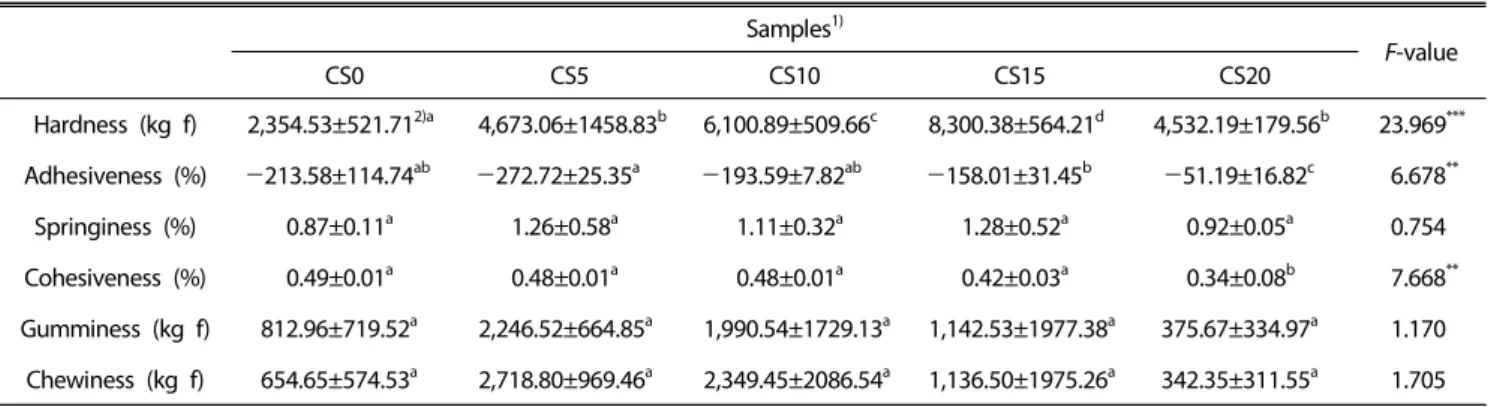
Gumminess (kg f) 812.96±719.52a 2,246.52±664.85a 1,990.54±1729.13a 1,142.53±1977.38a 375.67±334.97a 1.170 Chewiness (kg f) 654.65±574.53a 2,718.80±969.46a 2,349.45±2086.54a 1,136.50±1975.26a 342.35±311.55a 1.705
1) Sample at the same as in Table 1.
2) Means±standard deviation, ** p<0.01, *** p<0.001.
a d Means with different superscript in the same column are significantly different(p<0.05) by the Duncan's multiple range test.
(69.35) and the 10% added group (74.33). Such results were similar to Sulggitteok of Yoon and Lee (2016) containing balsam pear powder. It was found that chestnut powder was high in polyphenol content, which affected the free radical scavenging ability and reducing power. The antioxidant acti- vity of chestnut Sulggi is expected to be improved through adding chestnut powder.
3.4. Texture Analysis
The result after measuring mechanical properties of chest- nut Sulggi is shown in Table 6. Hardness increased as chest- nut powder was added and began to decrease in Sulggi con- taining 20% of chestnut powder (p<0.001). Adhesiveness sig- nificantly increased compared with the control group (-213.58%) as increasingly more chestnut powder was added. Springi- ness increased as chestnut powder was added but decreased in the group of Sulggi containing 20% of chestnut powder, but there were not significant differences. Cohesiveness was significantly highest in the 20% addition group (p<0.01). Gum- miness and chewiness decreased as chestnut powder was added but there were no significant differences.
Table 7. Sensory evaluation of chestnut Sulggi added with chestnut powder Samples1)
F-value
CS0 CS5 CS10 CS15 CS20
Taste 6.00±1.042)a 5.50±0.67ab 5.25±0.75ab 4.75±1.14bc 4.33±1.30c 4.937**
Color 4.08±1.00a 4.67±0.98ab 5.08±0.90ab 4.92±0.79b 5.08±1.16b 2.207
Flavor 4.92±1.08a 4.58±0.90a 5.08±0.90a 4.25±0.97a 4.58±1.16a 1.246
Chewiness 3.08±0.90a 4.25±0.75b 5.42±0.79bc 4.92±0.67c 5.50±1.24c 14.979***
Softness 5.17±0.94a 4.75±0.62a 5.00±0.74a 3.42±1.24b 3.50±1.68b 6.912***
Overall acceptability 5.33±1.15a 4.83±0.83ab 5.17±0.83a 4.00±1.21b 4.08±1.44b 3.605*
1) Sample at the same as in Table 1.
2) Means±standard deviation, * p<0.05, ** p<0.01, *** p<0.001.
a c Means with different superscript in the same column are significantly different(p<0.05) by the Duncan's multiple range test.
3.5. Sensory Evaluation Test
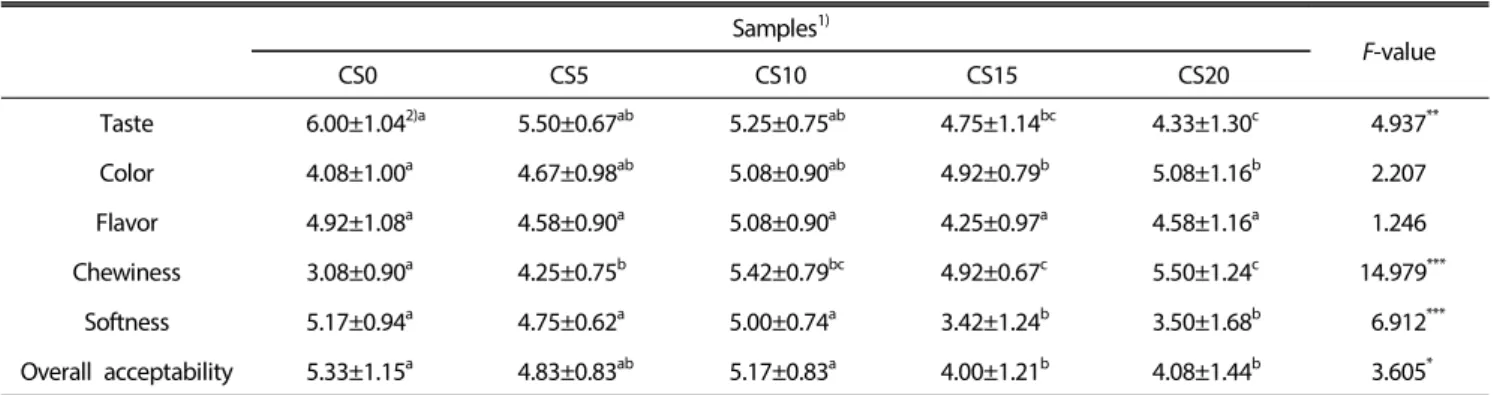
Regarding preference for chestnut Sulggi, a sensory test was executed about taste, color, flavor, chewiness, softness and the entire preference using a 7-point scale and results are shown in Table 7. According to the sensory test of taste, color, flavor, chewiness and softness of chestnut Sulggi and the entire preference for it, Sulggi containing no chestnut powder was significantly delicious (p<0.01) and color and flavor were high in the 10% addition group, but there were no significant differences. Chewiness was highest in the 20%
addition group (p<0.001) and softness was significantly high (p<0.001) in the group without containing chestnut powder, apparently due to water content. The general preference was significantly low in the 15% addition group, indicating that to add chestnut less than 15% would favorably affect pre- ference for chestnut Sulggi.
4. CONCLUSION
For this study, dried and powdered chestnuts produced in Gongju was added in the ratios of 0, 5, 10, 15 and 20% to make chestnut Sulggi and its water content, chromaticity, total phenol content, DPPH radical scavenging ability and mechanical texture were measured and a sensory test was executed. Results are as follows. Water content of Sulggi containing no chestnut powder was 38.24% and the figure gradually decreased to 33.34~26.27% as chestnut powder was added. Regarding the chromaticity, the L value was highest in the control group without chestnut powder and the a and b values were significantly high, compared with the control group, as chestnut powder was added. Regarding the total
phenol compounds and antioxidant activity, phenol content increased and decreased as more chestnut powder was added, it was significantly (p<0.01) high with 347.50 mg GAE/100 g in the group containing 10% chestnut powder. And the DPPH radical scavenging ability was significantly high with in the group containing 5% (69.35±2.02%) and 10% (74.33±2.29%) chestnut powder. Regarding mechanical texture, hardness, adhesiveness and chewiness increased as chestnut powder was added, but cohesiveness, springiness and gumminess de- creased. Taste, color, flavor, chewiness, softness and the en- tire preference were highest in the group containing 10%
chestnut powder. Considering the above-mentioned results, the addition of 10~15% chestnut powder to the rice flour at the preparation of Sulggitteok added with chestnut pow- der may be suitable for quality, antioxidant activity and sen- sory properties. Gongju mass-produces high-quality chestnuts but most of it is consumed unprocessed, and only a part of it is processed food items, such as chestnut jelly, makgeolli and tea. To develop more diverse and more value-added food items will effectively expand chestnut consumption.
Sulggi containing chestnut powder suggested by this study shows favorable results in mechanical tests and tests of antioxidant activity and preference tests, so the item will be good as functional food if it can be supplemented as an article of commerce.
REFERENCES
Ahn, G. J. (2017). Quality characteristics of Sulgidduk with di- fferent amount of dried steaming chestnut powder. Culi- nary Science & Hospitality Research, 23(7), 80-87.
Ahn, G. J., & Lee, Y. J. (2014). Quality characteristics of Sul- gidduk with different amount of dried tangerine peel powder. Journal of Korean Society of Food & Cookery Science, 30(3), 284-290.
Barreira, J. C. M., Ferreira, I. C. F. R., Oliveira, M. B. P. P., &
Pereira, J. A. (2008). Antioxidant activities of the extracts from chestnut flower, leaf, skins and fruit. Food Chemistry, 107, 1106-1113.
Cho, E. J., Yang, M. O., Hwang, C. H, Kim, W. J., Kim, M. J.,
& Lee, M. K. (2006) Quality characteristics of sulgidduk added with Rubus coreanum Miquel during storage. Jour- nal East Asian Society Dietary Life, 16, 458-467.
Choi, Y. S., Cho, S. H., & Jhee, O. H. (2008) Sensory and textural characteristics of OgapiSulggi by different ingre- dient ratios. Journal East Asian Society Dietary Life, 18(6), 1046-1055.
Hong, K. J., & Hwang, S. H. (2011). Quality characteristics of Sulgidduk with added chestnut. Journal of the East Asian Society & Dietary Life, 21(2), 194-199.
Jhee, O. H. (2016). Quality characteristics of the Yanggaeng made by chestnut powder. Culinary Science & Hospitality Research, 22(8), 182-191.
Jhee, O. H., & Choi, Y. S. (2008). Quality characteristics of Sulgidduk added with concentrations of Acanthopanax sessiliflorus aeemann var. goma powder. Korean Society of Food & Cookery Science, 24(5), 601-607.
Kim, C. S., Ahn, W. S., Lee, C. Y., & Lee, M. H. (1999). Chest- nut, persimmon, date, walnut. Naewyoi Press Soul, Seoul.
Kim, J. H., Park, J. H., Park, S. D., Kim, J. K., Kang, W. W., &
Moon, K. D. (2002). Effect of addition of various mesh sifted powders from safflower seed on quality characte- ristic of yanggeng. Korean Journal of Food Preservation, 9, 309-314.
Kim, J. M., Suh, D. S., Kim, Y. S., & Kim, K. O. (2004). Physical and sensory properties of rice gruels and cakes containing different levels of ginkgo nut powder. Korean Journal of Food Science & Technology, 3, 410-415.
Kim, S. J., Kim, M. H., Kim, J., Kim, H. J., Kim, S. H., Lee, S.
H., Park, Y. S., Park, B. K., Kim, B. S., Kim, S. K., Choi, C.
S., Ryu, G. H., & Jung, J. Y. (2009). Effect of chestnut on lipid metabolism and antithrombotic capacity in rats. Jour- nal of Food Hygiene & Safety, 24(1), 69-77.
Kim, Y. S. (2008). Addition ratio of buckwheat vegetable powder (Fagopyrum esculentum Moench) on the quality characteristics of Sulgidduk. The Korean Journal of Food &
Nutrition, 21(4), 436-442.
Lee, H. J., Chung, M. J., Cho, J. Y., Ham, S. S., & Choe, M.
(2008). Antioxidative and macrophage phagocytic activi- ties and functional component analysis of selected Ko- rean chestnut (Castanea crenata S. et Z.) cultivars. Journal of the Korean Society of Food Science & Nutrition, 37(9), 1095-1100.
Lee, H. S., Jang, Y. J., & Kim, S. H. (2016). The study on deve- lopment of processed foods with chestnut. Journal of the Korean Society of Dietary Culture, 31(2), 194-203.
Lee, H. S., Kim, E. J., & Kim, S. H. (2011). Chestnut extract in- duces apoptosis in AGS human gastric cancer cells. Nu- trition Research & Practice, 5(3), 185-191.
Lee, J. O., Kim, K. H., & Yook, H. S. (2009). Quality charac- teristics of cookies containing various levels of aged garlic.
Journal East Asian Society Dietary Life, 19,71-77.
Lim, J. H. (2011). Quality characteristics of Sulgidduk prepared with apple powder. Korea Journal of Korean Socirty of Food & Cookery Science, 27(2), 111-123.
Park, J. H., Yoon, J. H., Hwang, M. S., Cho, M. G., Choi, M. S., Kim, J. K., & Moon, H. S. (2011). Nut characteristics of chesnut varieties cultivated in southern Korea. Journal of Agriculture & Life Science, 45(2), 61-67.
Son, J. W., Shin, S. M., Oh, M. Y., Kim, Y. S., Kim, D. H., Park, K. M., Song, T. H., Ahn, C. K., Yom, Y. H., Lee, S. M., Jung, K. H., & Cho, K. O. (2012). Korean foods. Powerbook.
Seoul. Korea. 36-49.
Swain, T. & Hillis, W. E. (1959). The phenolic constituents of Prunus domestica. I.-The quantitative analysis of phenolic constituents. Journal of the Science of Food & Agriculture, 10, 63-68.
Yoon, S. J. & Lee, M. Y. (2004). Quality of characteristics of Sulgidduk added with concentrations of Hericium erina- ceus powder. Korea Journal of Food & Cookery Science, 20(1), 575-580.
Received:
Revised:
Accepted:
4 February, 2018 11 February, 2018 14 February, 2018