이종 셀룰러 네트워크 환경에서
트래픽 비율에 따른 동적 주파수 재사용 기법
정 성 문°
Dynamic Frequency Reuse Scheme Based on Traffic Load Ratio for Heterogeneous Cellular Networks
Sungmoon Chung°
요 약
이종 셀룰러 네트워크 환경에서 셀 간 간섭 문제와 부족한 주파수자원 환경을 극복하는 것은 통신 성능을 향상 시키기 위한 주요 방법 중 하나이다. 정적 주파수 재사용 방식은 한정된 주파수 자원 환경에서 셀 간 간섭 문제 를 효율적으로 해결하기 위해 제안된 방식이다. 이러한 방식은 미리 정해진 파워와 대역으로 주파수를 할당하기 때문에 네트워크의 통신 성능향상에 제한이 있다. 또한 기존의 동적 주파수 재사용 방식들은 대부분의 경우 셀 안 에 존재할 수 있는 스몰 셀 환경을 고려하지 않고 있고, 네트워크의 트래픽 부하기 심하고 불균일한 환경에 특화 되어 있지 않다. 제안한 동적 주파수 재사용 기법은 다중 이종 셀룰러 네트워크 환경에서 네트워크 환경에 적응하 여 각 셀의 트래픽 비율에 알맞게 동적으로 주파수를 할당한다. 제안한 기법은 먼저 각 셀 Edge의 PRB 사용량을 수집하고 이에 적응하여 스몰 셀을 제외한 전 셀 지역에 주파수를 재 할당한다. 그 후 이를 고려하여 스몰 셀을 위한 주파수를 할당하고 이를 반복하여 전체 셀의 주파수 자원을 할당한다. 해당 기법은 네트워크의 트래픽 부하 가 심하고 불균일할 때 스몰 셀 환경을 위해 각 셀의 트래픽 부하에 적합한 주파수 자원을 할당시킴으로써, 기존 의 방식에 비해 Spectral Efficiency 성능을 향상시켜 결과적으로 시스템의 Throughput 성능을 향상시킨다.
Key Words : Frequency Reuse, HetNet, FFR, SFR, Interference
ABSTRACT
Overcoming inter-cell interference and spectrum scarcity are major issues in heterogeneous cellular networks.
Static Frequency reuse schemes have been proposed as an effective way to manage the spectrum and reduce ICI(Inter cell Interference) in cellular networks. In a kind of static frequency reuse scheme, the allocations of transmission power and subcarriers in each cell are fixed prior to system deployment. This limits the potential performance of the static frequency reuse scheme. Also, most of dynamic frequency reuse schemes did not consider small cell and the network environment when the traffic load of each cell is heavy and non-uniform. In this paper, we propose an inter-cell resource allocation algorithm that dynamically optimizes subcarrier allocations for the multi-cell heterogeneous networks. The proposed dynamic frequency reuse scheme first finds the subcarrier usage in each cell-edge by using the exhaustive search and allocates subcarrier for all the cells except small cells. After that it allocates subcarrier for the small cell and then iteratively repeats the process. Proposed dynamic frequency reuse scheme performs better than previous frequency reuse schemes in terms of the throughput by improving the spectral efficiency due to it is able to adapt the network environment immediately when the traffic load of each cell is heavy and non-uniform.
http://dx.doi.org/10.7840/kics.2015.40.12.2539
° First and Corresponding Author : Defense Industry Technology Center, [email protected], 정회원
논문번호:KICS2015-09-295, Received September 6, 2015; Revised November 26, 2015; Accepted December 7, 2015
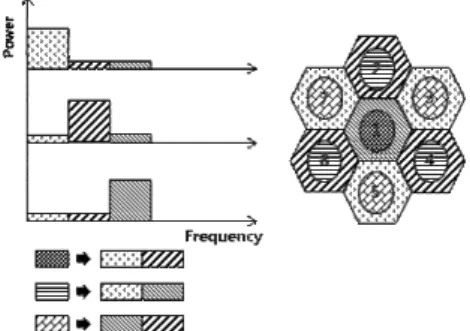
Fig. 1. Strict Fractional Frequency Reuse Scheme
Ⅰ. Introduction
Inter-cell interference is considered to be a major issue in cellular systems in that it results in severe performance degradation in the system due to frequency band overlapping in adjacent neighboring cells, particularly for users at the cell-edge[1-6]. The inter-cell interference problem can be solved by frequency reuse schemes, which usually have a high reuse factor to prevent adjacent neighbor cells from using the same frequency bands[7] in traditional 2G and 3G networks. However, these schemes do not work well in future cellular systems such as 4G, 5G in which the spectrum efficiency is critical because of the scarcity of radio resources[8].
The Long Term Evolution (LTE) system as defined by the 3rd Generation Partnership Project (3GPP)[9], rather than using a partial frequency reuse scheme, utilizes a frequency reuse scheme or nearly that by allowing each cell to access the entire frequency band that has been allocated to the system[10,11]. In addition, LTE is expected to provide greater flexibility in frequency reuse by relying on Orthogonal Frequency Division Multiple Access (OFMDA), which further increases the requirement for inter-cell interference avoidance[12].
Soft frequency reuse (SFR)[13] is known to be the most effective frequency planning scheme that reduces inter-cell interference in cellular systems. In the SFR scheme and a number of frequency reuse schemes based on SFR, the cell-edge bandwidth for a cell is fixed with the aim of ensuring that neighbor cells can allocate orthogonal frequency bands.
Therefore, cell-edge users cannot use more than one third of the entire available bandwidth at a cell that has a lot of traffic, and they cannot use an unoccupied frequency. Furthermore, spectrum wasting can be particularly severe when the traffic load of each cell is more non-uniform. Also, there is no clear policy related to frequency reuse for heterogeneous cellular networks when the traffic load of each cell is heavy and non-uniform.
Our dynamic frequency reuse scheme can perform better than previous frequency reuse schemes in terms of the throughput by improving
the spectral efficiency. In addition, the reliability of the PRB usage information is guaranteed with a TWAF (Time weighted Average Function). Also, the relay in the cell edge can allocate more frequency bands than the previous scheme.
Ⅱ. Related Works
Inter-cell interference can be reduced with the traditional frequency reuse schemes as demonstrated previously[14], but the improvement in the interference reduction can only be presented in terms of the cell throughput. Several frequency reuse schemes have been studied to reduce the interference of the cell edge region and to increase the capacity of the system[15,16].
All the static reuse schemes implement fixed resource partitioning which is predefined. There are two types of common static frequency reuse schemes for the LTE: the Strict Fractional Frequency Reuse (FFR) scheme[17] and the Soft Frequency Reuse (SFR) scheme[13]. Both strict FFR and SFR divide the available spectrum into two reserved parts: one subband for the inner region that supports the User Equipment (UE) of the cell-center, and one subband for the outer region that supports the UE of the cell edge. The subband for the inner region is common in each cell, and the subband for the outer region is different among adjacent neighbor cells using strict FFR. Therefore, the UEs of the cell edge do not suffer from Co Channel Interference (CCI) from neighbor cells, so the spectral efficiency of the outer region is improved.
However, strict FFR (Figure 1 is an example of strict FFR for cell edge users) cannot use the entire available frequency bandwidth, so the overall cell
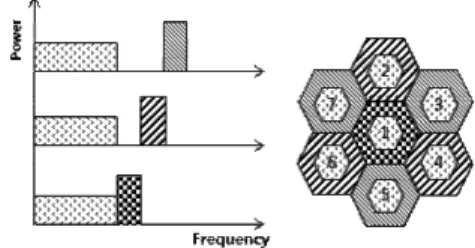
Fig. 2. Soft Frequency Reuse Scheme
throughput in a cell is lower than in the reuse case.
SFR[13] has been proposed to improve the overall cell throughput of FFR. SFR (Figure 2 is an example of SFR for cell edge users) assigns the subband with a high transmission power level to the cell edge UE and assigns the subband with a low transmission power level to the cell-center UE. SFR can use all of the available frequency bandwidth in a cell, so the overall cell capacity in a cell is higher than with strict FFR. The biggest disadvantage of SFR is the strict bandwidth allocation to the cell-edge UE in each cell. The flexibility in the frequency allocation can be greatly decreased, resulting in lower spectrum efficiency to the cell-edge UE by restricting the cell-edge UE to a maximum of one third of the entire available bandwidth.
In dynamic reuse schemes, a flexible resource partitioning is performed between the cell-center and cell-edge users, which can be based on the various factors which is predefined. Such schemes have the potential of achieving efficient resource utilization and improved throughput performance. A dynamic reuse scheme was proposed in [18], which the authors refer to as “softer” frequency reuse (SerFR).
In [18], the reuse factor for both cell-center and cell-edge users is 1, and a proportional fair scheduler is used, which gives preference to edge users over cell-center users and ensures fairness among them. Therefore it is essential for the resource management algorithms to adapt to the
networks dynamically while keeping the flexibility of using the entire spectrum resource. Also dynamic resource plans for interference mitigation are proposed in [19] and [20] which performs better than their static counterparts due to the algorithm that they provide the flexibility of using all the available resources. Self-organizing dynamic fractional frequency reuse is featured in [21] and [22], where resource allocation is performed by dynamically adapting to the traffic dynamics for a constant bit rate and best-effort traffic. However, they did not consider the heterogeneous networks which include small cells.
Relay Nodes (RNs) can enlarge the coverage and increase the cell throughput as compared to 3GPP LTE[23]. In the case of RN deployment for cell-edge, the UE of the cell-edge’s Signal to Interference and Noise Ratio (SINR) can be significantly improved when the UEs are directly linked by an RN because of the short distance between them. The cell-edge deployment for an RN also introduces less interference to the adjacent neighbor cells and local interior UEs, since the RN has a much lower transmit power level than eNodeB (eNB). Therefore, we can utilize the features of the RN to reduce the inter-cell interference in the frequency reuse plan for the relay enhanced cellular network [24] and [25].
However, most of the previously proposed relay-based frequency reuse schemes were based on the assumption that RNs are deployed at the cell boundary, and that all of the cell-edge UEs are in the coverage area of the RNs. There is a study[21]
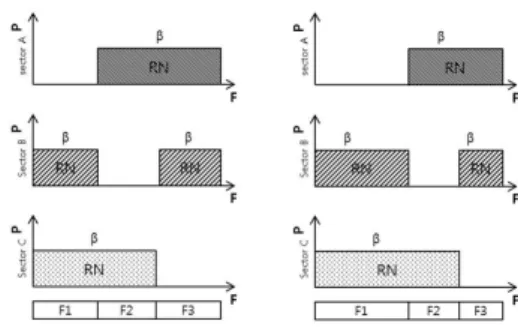
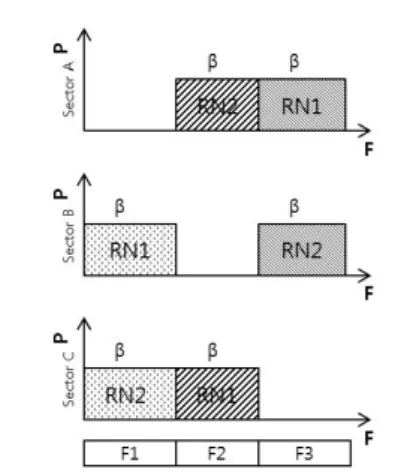
regarding the utilization of the SFR technology in the heterogeneous cellular networks where RNs cover just the part of cell-edge. Figure 3 shows the SFR-ICIC[26] Power-frequency management of the RN. In [21], they allocate the predefined orthogonal subband to their relays based on SFR. However, in the case of nonuniform traffic density, the resource allocation policy of [26] does not perform very well.
Because RNs cannot use an unoccupied frequency at the cell.
Thus, we observe that there are no particular reuse policy works for all possible scenarios.
Especially, the variation in user traffic density
Fig. 3. SFR-ICIC Power-frequency management of RN affects the performance of the reuse policy, which needs to be taken into account. In this paper, therefore, we focused the heterogeneous networks which RNs cover just the part of cell-edge and the traffic load of each cell is heavy and non-uniform.
Ⅲ. System Model
3.1 Basic Assumption
We consider LTE downlink transmissions of OFDMA in which the aforementioned frequency reuse schemes are applied. In each transmission time interval (TTI), eNB has to decide on the assignment of the radio resources to its served terminals. In LTE, the basic element of the radio resource is a physical resource block (PRB), consisting of twelve subcarriers in the frequency domain and one slot duration (0.5 msec) in the time domain. Therefore, the PRB is considered to be the bandwidth-unit of resource allocation in this paper. Also, we consider an eNB equipped with an omnidirectional antenna is at the center of each cell. In addition, assume the following throughout the paper.
1) UEs are categorized as cell-center and cell-edge UEs by the reported measurements of each UE’s received signal reference signal (RSRP)[27]. Although different methods[28] may show different performance evaluation results, that fall outside the scope of this paper. A cell-edge UE may be denied access when there is a shortage of available cell-edge PRBs within the cell. Also, a cell-center
PRB may be denied access when there are no more cell-center PRBs or cell-edge PRBs to be allocated.
Therefore, the PRB usage is always less than the number of all of the available PRBs of the cells.
2) We assume that orthogonality among the subcarriers is perfectly maintained, and that the intra-cell interference is reduced in each cell by allowing that the same PRB cannot be simultaneously assigned to more than one user within the cell.
3) For cell-edge UEs, the full transmission power density P0 is used in order to guarantee the required SINR threshold. However, for cell-center UEs, the transmit power density is set to α*P0, where α has a range of 0 ≤ α ≤ 1, in order to reduce the potential interference with other UEs.
4) All the relays are deployed at the cell-edge for utilizing the features of relay to coordinate the inter-cell interference in frequency planning for the relay enhanced cellular network.
3.2 Proposed Dynamic Frequency Reuse Scheme
Proposed dynamic frequency reuse scheme has two main points called reallocation and relay allocation. First, we refer to the entire process of the proposed reuse scheme, and explain in detail about both of the two points in the subsection. Proposed dynamic frequency reuse scheme has a criteria based on the PRB usage of each cell and operates reallocation when the traffic load is over the criteria considering the system performance and the network overhead. In addition, Time Weight Average Function is used for reallocation to improve the reliability of PRB usage information. The entire process of proposed dynamic frequency reuse scheme, for which the flow chart diagram is illustrated in Figure 4, comprises the following eight parts.
1. Each eNB collects its PRB usage information based on its UE’s PRB occupancy.
2. The eNBs share their PRB information with their adjacent neighbor eNBs via X2.
3. eNB operates the reallocation when more than an eNB has the PRB usage over the criteria. In
Fig. 4. Proposed Dynamic Frequency Reuse Algorithm detail, reallocation is operated when MAX[APRB, BPRB, CPRB]≥UPRB/3, while it utilizes SFR when eNBPRB< UPRB/3. According to the criteria, the system is able to decide to operate frequency reallocation or not. APRB, BPRB, CPRB denotes the set of each cell-edge’s(A, B, C) PRB usage, and UPRB denotes the number of the whole PRBs of the system.
4. Store the most recent each eNBPRB to the its own buffer[0]. eNBPRB denotes each eNB’s recent PRB usage information. And multiply the PRB information by the predefined N*1 Weight Matrix (W0=1,Wn-1>Wn, 1≥Wn≥0) to calculate the eNBPRB and store the result. The Predefined Weight Matrix is based on the Time Weight Average Function. The purpose of TWAF is to add more weight to the recent PRB usage and prevent the sensitive fluctuation of eNBPRB. 5. Increase N when N is smaller than δ. δ denotes
the maximum size of the buffer.
6. eNB divides UPRB based on the proportion of PRB usage by sharing eNBPRB with the neighbor eNB via X2. The concrete scheme to divide UPRB is explained in subsection 2.1)
7. Shift the buffer [N-1] to [N]. The purpose of this step is to update the PRB usage information of the system.
8. eNB utilizes Additional Relay PRB allocation algorithm when the relay(s) wants to additional bandwidth, while it skips the algorithm when relays don’t want to additional bandwidth or there are no remain PRB set which can be allocated to UE of Relay. The concrete scheme about Additional Relay PRB allocation algorithm is explained in subsection 2.2)
9. eNB allocates PRB to the edge UE with their subband.
3.2.1 Subband reallocation modeling In this paper, L denotes the number of cells in the system and N denotes the number of available PRBs that can be used for transmission in each TTI and in each cell. In addition, denotes the number of UEs, and denotes the set of indices that indicate the UEs belonging to cell l, respectively, where l = 1, ..., L.
(1) PRB allocation: , are the PRB allocation matrices of the UEs and eNBs with and denoted as:
(2) Throughput: The PRB scheduling is expressed as an optimization problem in order to maximize the total throughput, which is formulated as (1):
(1)
and
(2)
Fig. 5. Dynamic Frequency Reuse scheme
Fig. 6. Proposed Power-frequency management of RN formula (2) is the throughput of UE m and WPRB is
the PRB bandwidth, following the listed constraints:
The non-uniform traffic load of each cell ,which is formulated as (3):
∈
⊓ (3)
⊓ denotes the ceil operator.
The reserved cell-edge bandwidth in each cell is one third of the available bandwidth when MAX[APRB,BPRB,CPRB]<UPRB/3, which is formulated as (4):
⊔ ∈
⊔ ≤ (4)
The reserved cell-edge bandwidth in each cell is its portion of the PRB use when MAX[APRB,BPRB,CPRB]≥UPRB/3, which are formulated as (5), (6), (7):
Cell A:
⊔
∈
⊔ ≤
(5)
Cell B:
⊔ ∈
⊔ ≤ (6) Cell C:
⊔ ∈
⊔ ≤
(7)
⊔denotes the floor operator. From these formulas, the system reallocates frequency resource efficiently to the cell-edge. Therefore the system allocates more PRB to the cell-edges which have a lack of PRB by taking the PRB from the cell-edges which have enough PRB when the traffic load of each cell is heavy and non-uniform.
As Figure 5, we allocates subband to UEs by our dynamic frequency reuse algorithm based on
proportion of PRB usage when some cells experience relatively heavier and more non-uniform traffic loads on their cell-edge bandwidth.
3.2.2 Additional Relay PRB allocation Algorithm
Our proposed Power-frequency management scheme for the RN(Relay Node) use PRBs which are not allocated for the cell-edge UEs as Figure 6.
Therefore, all of the RNs that are in the cell-edge can utilize the same subband area. In addition, there is no interference among RNs because RNs have a much lower transmit power level than their eNB.
Relays are deployed in the cell-edge area in relay-enhanced cellular networks. The heavy traffic loads for cell-edge have a detrimental effect on relay since relay should use the extra bandwidth provided to the cell-edge area to avoid interference.
Therefore, it is essential to solve subband fairness problem between cell-edge area and its relay area.
Additional Relay PRB allocation scheme is shown as formulas (8), (9), (10).
Fig. 7. Normalized cell edge throughput
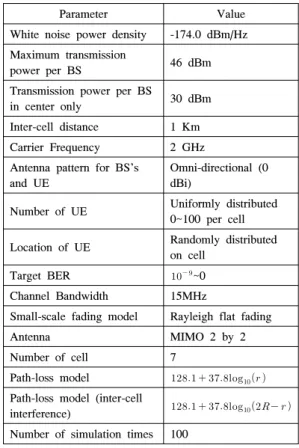
Parameter Value
White noise power density -174.0 dBm/Hz Maximum transmission
power per BS 46 dBm
Transmission power per BS
in center only 30 dBm
Inter-cell distance 1 Km Carrier Frequency 2 GHz Antenna pattern for BS’s
and UE
Omni-directional (0 dBi)
Number of UE Uniformly distributed 0~100 per cell Location of UE Randomly distributed
on cell
Target BER ~0
Channel Bandwidth 15MHz
Small-scale fading model Rayleigh flat fading
Antenna MIMO 2 by 2
Number of cell 7
Path-loss model Path-loss model (inter-cell
interference) Number of simulation times 100
Table 1. Performance evaluation parameter
∪∪ (8)
(9)
≤ ≤ (10)
APRBrelay denotes PRB sets that UEs of cellA edge can use, AavailablePRB denotes unused PRB sets of reserved cellA edge. APRB, BPRB, CPRB denotes reserved PRB sets for cell A edge, cell B edge, cell C edge. AoccupiedPRB denotes used PRB sets of reserved cell A edge, AadditionalPRBrelay denotes additional PRB sets that cell A edge hands to their relays. δ denotes a parameter which indicates the allocation size according to additional required PRB sets of relay. The cell-edge hands unused PRB sets to their relay by eNB when the traffic load of the cell-edge isn’t full by additional relay PRB allocation algorithm. Thus it achieves subband fairness between cell-edge area and its relay area.
Ⅳ. Performance Evaluation
Table 1 shows the our performance evaluation parameters. The LTE specifications define the parameters for system bandwidths from 1.25 to 20MHz. We do a performance evaluation at 15MHz.
There are 75 available PRBs per a cell at 15MHz.
For the purpose of comparison, the performances of proposed scheme and strict FFR and SFR are evaluated here.
Figures 7 shows the normalized cell edge throughput. It is shown that the normalized throughput performance of our proposed dynamic frequency reuse scheme is quite different than the other previous schemes. Since our dynamic frequency reuse scheme can reallocate frequency resources based on the PRB usage, while previous schemes allocate frequency resources with the fixed proportion of the entire available bandwidth for the cell-edge UE.
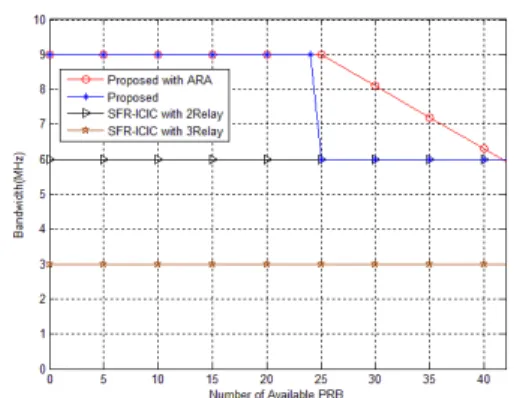
Figure 8 shows the occupied bandwidth by PRB per number of available PRBs with relays at the cell edge, and the proposed with additional relay PRB allocation algorithm has the greatest channel
capacity for the different frequency reuse schemes considered in this paper.
SFR-ICIC[26]-based SFR allocates frequency bands to their relays by dividing the frequency bands based on SFR. Thus, they always allocate only one third of the entire available bandwidth to their relay. On the other hands, the proposed scheme can allocate all of the frequency bands to the relays except for the frequency bands for the cell edge UE.
Fig. 8. Relay Bandwidth per Number of PRBs
Since we solve subband fairness problem between the cell-edge area and its relay area by additional relay PRB allocation algorithm.
Ⅴ. Conclusion
In this paper, we proposed dynamic frequency reuse scheme for the heterogeneous networks which RNs cover just the part of cell-edge and the traffic load of each cell is heavy and non-uniform. It is clear that the proposed scheme performs better when the traffic load of is to be heavier and more non-uniform. Our performance evaluation for the downlink scenario shows that the proposed dynamic frequency reuse scheme can dramatically improve the spectral efficiency based on traffic load ratio when some cells experience relatively heavier and more non-uniform traffic loads on their cell-edge bandwidth. In addition, TWAF improves the reliability of the PRB information. Also the dynamic frequency reuse scheme with our proposed additional relay PRB allocation algorithm, as proposed in the paper, we show that it can guarantee more frequency resources to the edge users including relay users. Therefore our dynamic frequency reuse scheme is efficient in the environment where the traffic load of each cell is often heavy and non-uniform.
References
[1] S. Deb, P. Monogioudis, J. Miernik, and J.
Seymour, “Algorithms for enhanced inter-cell interference coordination (eICIC) in LTE HetNets,” IEEE/ACM Trans. Networking (TON), vol. 22, no. 1, pp. 137-150, Feb. 2014.
[2] T. Tran, Y. Shin, and O. Shin, “Overview of enabling technologies for 3GPP LTE- Advanced,” EURASIP J. Wireless Commun.
Netw., vol. 2012, no. 1, pp. 1-12, Oct. 2012.
[3] O. Fratu, A. Vulpe, R. Craciunescu, and S.
Halunga, “Small cells in cellular networks:
Challenges of future HetNets, wireless personal communications,” Wirel. Pers. Commun., vol.
78, no. 3, pp. 1613-1627, Oct. 2014.
[4] M. H. Monhsini, S.-Y. Kim, and C.-H. Cho,
“Performance analysis of a cellular networks using power control based frequency reuse partitioning,” J. KICS, vol. 40, no.3, pp.
559-567, Mar. 2015.
[5] S. Y. Park, J. Y. Kim, and D. H. Kim,
“Decentralized frequency reuse scheme best-effort services in downlink small-cell network,” J. KICS, vol. 38, no. 4, pp. 360- 370, Apr. 2015.
[6] H. Kim, Y. Jo, J. Lim, and D. Hong,
“Interference mitigation by joint employment of power control and almost blank subframes in heterogeneous networks,” J. KICS, vol. 39, no. 1, pp. 62-64, Jan. 2014.
[7] M. Necker, “Interference coordination in cellular OFDMA networks,” IEEE Network, vol. 22, no. 6, pp. 12-19, Dec. 2008.
[8] G. Boudreau, J. Panicker, N. Guo, R. Chang, N. Wang, and S. Vrzic, “Interference coordination and cancellation for 4G networks,”
IEEE Commun. Mag., vol. 47, no. 4, pp. 74-81, Apr. 2009.
[9] D. Astely, E. Dahlman, A. Furuskar, Y.
Jading, M. Lindstrom, and S. Parkvall, “LTE:
the evolution of mobile broadband - [LTE part II: 3GPP release 8],” IEEE Commun. Mag., vol. 47, no. 4, pp. 44-51, Apr. 2009.
[10] H. Sari, S. Sezginer, and E. Vivier, “Full
frequency reuse in mobile WiMAX and LTE networks with sectored cells,” in IEEE Mob.
WiMAX Symp., pp. 42-45, Napa valley CA, USA, Jul. 2009.
[11] A. Racz, N. Reider, and G. Fodor, “On the impact of inter-cell interference in LTE,” in IEEE Global Telecommun. Conf., pp. 1-6, New orleans LO, USA, Nov. 2008, [12] 3GPP and Nokia, OFDMA downlink inter-cell
interference mitigation, in R1-060291, RAN WG1#44, Denver, Colorado, 2006.
[13] 3GPP; Huawei, Soft frequency reuse scheme for UTRAN LTE, R1-050507, May 2005.
[14] V. H. MacDonald, “The cellular concept,” Bell System Technical J., vol. 58, no. 1, pp. 15-41, Jan. 1979.
[15] Huaiwei, Soft Frequency Reuse Scheme for UTRAN LTE, R1-050507, 3GPP TSG-RAN WG1 Meeting #41, Greece, May. 2005.
[16] M. Rahman, H. Yanikomeroglu, and W.
Wong, “Interference Avoidance with Dynamic Inter-Cell Coordination for Downlink LTE System,” in Proc. IEEE Wirel. Commun. and Netw. Conf., pp. 1-6, Budapest, Hungary, Apr.
2009.
[17] T. D. Novlan, R. K. Ganti, A. Ghosh, and J.
G. Andrews, “Analytical evaluation of fractional frequency reuse for OFDMA cellular networks,” IEEE Trans. Wirel.
Commun., vol. 10, no. 12, pp. 4294-4305, Dec. 2011.
[18] Z. Xunyong, H. Che, J. Lingge, and X. Jing,
“Inter-cell interference coordination based on softer frequency reuse in OFDMA cellular systems,” in Proc. Int. Neur. Netw. Signal Process. Conf., pp. 270–275, Nanjing, China, Jun. 2008.
[19] M. M. Wang and T. Ji, “Dynamic resource allocation for interference management in orthogonal frequency division multiple access cellular communications,” IET Commun., vol.
4, no. 6, pp. 675-682, Apr. 2010.
[20] F. Bernardo, R. Agustí, J. Pérez-Romero, and O. Sallent, “A novel framework for dynamic spectrum management in multicell OFDMA
networks based on reinforcement learning,” in Proc. IEEE WCNC, pp. 1520-1525, Piscataway, NJ, USA, Apr. 2009.
[21] A. L. Stolyar and H. Viswanathan, “Self- organizing dynamic fractional frequency reuse in OFDMA systems,” in Proc. IEEE 27th INFOCOM, pp. 691-699, Phoenix AZ, USA, Apr. 2008.
[22] A. L. Stolyar and H. Viswanathan, “Self- organizing dynamic fractional frequency reuse for best-effort traffic through distributed inter- cell coordination,” in Proc. IEEE INFOCOM, pp. 1287-1295, Rio de Janeiro, Brazil, Apr.
2009.
[23] 3GPP TR 36.814, Further Advancements for E-UTRA Physical Layer Aspects, v1.5.2, Dec.
2009.
[24] Y. Zhao, X. Fang, X. Hu, Z. Zhao, and Y.
Long, “Fractional frequency reuse schemes and performance evaluation for OFDMA multi-hop cellular networks,” in Proc.
TridentCom, pp. 1-5, Washington DC, USA, Apr. 2009.
[25] W. Lee, M. Nguyen, and H. Lee, “A resource allocation algorithm and system architecture to extend the cell coverage and alleviate the intercell interference,” in Proc. IEEE Symp.
Comput. Commun., pp. 222-227, Marrakech, Moroco, Jul. 2008.
[26] J. Liu, D. Wang, J. Pang, J. Wang, and G.
Shen, “Inter-cell interference coordination based on soft frequency reuse for relay enhanced cellular network,” IEEE PIMRC 2010, pp. 2304-2308, Istanbul, Turkey, Sept.
2010.
[27] R1-080361, Additional RSRP reporting trigger for ICIC, Ericsson, 3GPP TSG RAN WG1 Meeting #51b, Sevilla, Spain, Jan. 2008.
[28] 3GPP, Description and simulations of interference management technique for OFDMA based E-UTRA downlink evaluation, in R1-050896, RAN WG1#42, London, UK, 2005.
정 성 문 (Sungmoon Chung)
2007년 8월:한양대학교 미디 어통신공학부 졸업
2009년 8월:한양대학교 전자 컴퓨터통신공학과 석사 2015년 2월 :한양대학교 전자
컴퓨터통신공학과 박사 2015년 7월~현재: 국방과학연구소 부설 방위산업기술지원센터 연구원
<관심분야> 군통신, 4G/5G 이동통신, 무선센서네트 워크, SDN, CPS, DDS
![Fig. 4. Proposed Dynamic Frequency Reuse Algorithm detail, reallocation is operated when MAX[A PRB , B PRB , C PRB ]≥U PRB /3, while it utilizes SFR when eNB PRB < U PRB /3](https://thumb-ap.123doks.com/thumbv2/123dokinfo/5276552.371391/5.808.100.358.91.561/proposed-dynamic-frequency-reuse-algorithm-reallocation-operated-utilizes.webp)