원예과학기술지 19(1):43-47. 2001
배나무잎검은점병 무독수의 선발 및 품종 저항성
오중환1․남기웅2*․水谷房雄3
1국립한경대학교 원예학과, 2농업과학기술원 작물보호부 식물병리과, 3愛媛大學 農學部 附屬農場
Selection of Pear Trees Free from Pear Black Leaf Spot Disease and Resistant Test for Pear Tree Cultivars
Jung Hwan Oh1, Ki Woong Nam2*, and Fusao Mizutani3
1Department of Horticulture, Hankyong National University, Ansung 456-749, Korea
2Plant Pathology Division, Department of Crop Protection, National Agricultural Science & Technology Institute, Suwon 441-707, Korea
3University Farm, College of Agriculture, Ehime University, Ehime 799-24, Japan
*corresponding author
ABSTRACT This study was conducted to investigate the integrated control strategy against pear black leaf spot
disease. Using indicator plant PS-95 we selected six virus-free trees (cv. Niitaka) from commercial orchards in the major pear production area. Disease symptom by pear black leaf spot in the shoot of pear (Niitaka) has been successfully inhibited by heat treatments for 3 weeks at temperature of 40℃ (day) and 32℃ (night) or 4 weeks at 37℃ and 30℃, respectively. However, survival rate of the shoot tips on stocks was low. Seven cultivars Niitaka, Imamura- aki, Waseaka, Nijisseiki, Wasenijisseiki, Shinsetsu and Whangkeumbae produced visible symptoms in the first year after inoculation with the virus. Other 11 selections remained symptomless. Two resistant cultivars Suwhangbae and Gamcheonbae were selected, which showed high fruit quality. It is recommended that these cultivars could be top-grafted onto the infected Niitaka trees to overcome the damage caused by the disease in the orchard.
Additional key words: heat treatment, top-graft, virus-free
※ Received for publication 2 January 2001. Accepted for publication 3 February 2001.
서 언
배나무잎검은점병은 배 재배농가에서 가장 큰 피해를 주고 있는 병해로 현재 시판되는 농약으로는 방제가 곤란하다(Hong 등, 1985; Nam과 Kim, 1994). 일반적으로 과수는 접목에 의해서 영 양번식하는 대표적인 영년생 작물이다. 이와 같이 영년생인 과수에 서 어떤 병이 접목에 의해서 전염되는 병해로 확인되면 일단 곰팡 이와 세균병보다는 바이러스병으로 진단할 수 있는데(Fridlund, 1967; Posnette, 1963; Nam과 Kim, 1996), 본 병도 접목에 의해 서 전염되는 것이 확인되었고(Nam과 Kim, 1995b), 본 병의 병원 에 대한 많은 연구를 통해 Capillrovirus에 의한 접목전염성 병해 로 밝혀졌다(Nam과 Kim, 1995b; Nam 등, 1996c).
과수 바이러스병은 주로 목본 지표식물에 의해서 검정하는데 (Posnette, 1963), 본 병에 대한 목본지표식물은 배나무 교배실생 중에서 본 병과 유사한 검은무늬병에는 저항성이고 본 병에는 병징 이 민감하게 발현하는 개체를 선발 ‘PS-95’로 명명하였고, 또한 배
나무잎검은점병을 신속 정확하게 검정할 수 있는 방법이 개발되어 본 병의 이병유무 판단이 가능하다(Nam 등, 1996a, b). 과수에서 일단 바이러스병에 감염되면 과실의 품질과 생산성을 크게 저하시 켜 피해가 크다. 사과의 경우 바이러스에 심하게 감염되면 30 90%의 수량 감소를 나타내며(Fridlund, 1967; Posnette, 1963), 배 나무에서는 vein yellow virus에 감염되면 40%의 수세 쇠약을 나 타낸다(Werthein과 Oosten, 1986). 본 배나무잎검은점병에 심하게 이병되면 49%의 수량 감소와 품질 저하를 나타낸다(Nam과 Kim, 1994). 이렇게 피해가 큰 과수 바이러스병의 방제는 초본식물과는 달리 바이러스 보독수로부터 바이러스 무독개체를 획득하여 무독 모수를 지정하고 이 모수에서 접수를 채취 무독묘목을 생산 보급하 는 것이 가장 좋은 방법이다(Campbell과 Best, 1964; Meer, 1975;
Murashige 등, 1972; Yanase 등, 1988). 그동안 과수 바이러스의 무독화는 열처리 기술에 의존하여 왔고, 최근에는 조직배양기술로 경정분열조직배양에 의한 virus-free화가 개발되었다(Campbell과 Best, 1964; Yanase 등, 1988). 이러한 기술을 이용하여 배나무
Area sampled Treatment stocks
Double graftingz Chip-buddingy
No. of setting No. of trees without
symptoms No. of setting No. of trees without symptoms
Anseong I 4 2 2 2 2
Anseong II 4 2 2 2 2
Cheonan 4 2 2 2 2
Control 10 5 0 5 0
zSeedling/Niitaka (sample)/PS-95.
yPS-95/Niitaka (sample).
Table 1. Inhibition effect of pear black leaf spot symptoms by grafting methods in the shoots of mature pear trees in commercial orchards.
Heat treatment No. of stocks
grafted with shoot tips
No. of stocks with surviving
shoot tips
No. of stocks virus
inactivated
Day/night Period
(Week)
40/32℃ 3 12 2 2
37/30℃ 4 21 5 1
35/30℃ 5 19 8 0
Table 2. Effect of heat treatments on pear black leaf spot disease inactivation of shoot tips grafted on PS-95.
apple stem grooving virus의 병원바이러스를 38/33℃의 열처리와 경정배양을 겸용하여 바이러스 무독개체를 획득할 수 있었다 (M origuchi 등, 1989). 일본에서 바이러스병으로 확인된 배괴저반 점병은 38 40℃/30℃의 변온조건에서 무독화가 가능하였다(Kishi 등, 1972, 1976). 열처리 이외의 다른 방법으로는 저항성 품종으로 고접갱신하는 방법 등이 제시되고 있다. 본 연구는 배나무잎검은점 병에 대한 무독개체를 획득하고 방제 대책의 가능성을 검토하고자 수행되었다.
재료 및 방법
바이러스 무독수 선발
본 병의 무독수를 선발하기 위해 배 주산단지인 안성시와 천안시 지역에서 배나무잎검은점병이 전혀 발생하지 않은 건전한 신고 품 종의 노목(수령 미상)에서 도장지를 채취하여 본 바이러스의 보독 유무를 검정하였다. 검정수는 안성 지역 과수원에서 2주, 천안지역 과수원에서 1주를 대상으로 하였다. 1994년 4월에 2개 지역에서 채취한 접수를 배 실생 대목에 절접하고, 1년간 묘목을 양성한 후, 1995년 4월에 전년도에 양성한 묘목에 지표식물 PS-95를 접목하 고 검은점병의 병징 발현 유무를 관찰하였다. 또 다른 방법으로 PS-95 1년생 묘목에 2개 지역에서 채취한 접수를 접목한 후 PS-95 지표식물의 검은점병 발현 여부를 조사하였다. 또한 열처리 에 의한 방법으로는 프라스틱 폿트(직경 25cm×깊이 30cm)에 이 식한 3년생 신고 이병주를 온도 40/32℃(주/야)의 항온상태에서 3 주간, 37/30℃에서 4주간, 35/30℃에서 5주간 열처리를 하였다. 열 처리 기간에 신장한 신초를 채취, PS-95의 1년생 묘목에 접목 1개 월 후부터 PS-95에 발현되는 증상 유무를 관찰하였다.
저항성 품종 탐색과 고접 갱신
배 1년생 실생 대목을 포장에 정식하고 시험에 이용하였다. 접종 원은 배나무잎검은점병이 매년 발생하는 신고 15년생에서 도장지 를 채취하여 접수로 이용하였다. 검정 품종은 감천배 등 18품종을 대상으로 하였다. 검정 품종의 휴면 도장지를 12월에 채취하여 8±
2℃의 저온실에 보존한 후 접수로 이용하였다. 1993년 4월 상순에 대목의 지표면에서 5cm 되는 곳에 접종원을 삭아접목방법으로 접 종하고 그 대목 위에 검정 품종을 절접하는(삭아접+절접) 방법과 같은 해 같은 시기에 배 대목에 2중 삭아접목하는 방법의 2가지로 처리하였다. 처리 수는 접목 방법별로 3주 총 6주 단구제로 하였 다. 조사는 처리 후 3년간 검정품종에 발생하는 배나무잎검은점병 의 발생 정도를 관찰하였고, 그 결과를 검토하였다. 그리고 현재 발생되고 있는 신고 품종을 대체할 수 있는 저항성 품종으로 수황 배를 선택하여(Yanase, 1974) 고접갱신 방법으로 시험하였다. 경 기도 안성군 소재 과수원에서 본 병이 매년 심하게 발생하고 있는 신고 20년생 12주와 경기도 평택시 소재 과수원에서 발병이 확인 된 신고 21년생 21주를 공시하였다. 1993년 4월에 수황배 접수를 주당 5개의 주지에 고접하였다. 그리고 고접 당년부터 수황배에 발 생하는 배나무잎검은점병의 발생 상황을 3년간 관찰하였다.
결 과
2개 지역 농가 과수원에서 재배되고 있는 신고 노목으로부터 접 수를 채취하여 배나무잎검은점병의 감염 여부를 검정한 결과는 Table 1과 같다. 안성 과수원의 2주는 지표식물에 2중절접 방법과 지표식물에 직접 접목하는 방법에서 2주 모두 지표식물인 PS-95에 배나무잎검은점병의 병반이 발현되지 않았고, 천안의 1주에서도 발 현되지 않았다. 대조구인 발생주의 접수를 접목한 처리에서는
Symptom expressionz Pear cultivar
Positive Niitaka, Imamuraaki, Waseaka, Nijisseiki, Wasenijisseiki, Whangkeumbae, Shinsetsu
Negative Suwhangbae, Gamcheonbae, Chojuro, Kumoi, Hosui, Shinsui, Shinko, Kikusui, Wasedama, Kimitsukawase, Hakko
zDetermined by symptoms that developed on leaves for 2 year after inoculation by grafting method.
Table 3. Cultivar differences in response to pear black leaf spot disease following artificial inoculation with grafting method.
Location of orchard investgated
No. of trees investigated
No. of trees showing symptomsz
1993 1994 1995
Pyeongtaeg 21 0 0 0
Anseong 12 0 0 0
zDisease incidence was investigated in five scions per tree for 3 year after top-grafting in commercial orchards.
Table 4. Incidence of pear black leaf spot disease in Suwhangbae top-grafted to Niitaka stocks with severe symptoms.
PS-95에 검은 반점이 심하게 발생하였다. 따라서 공시한 3주는 본 배나무잎검은점병에 무독한 것으로 생각된다. 열처리의 온도조건과 기간이 바이러스의 무독화 가능성을 검토한 결과는 Table 2와 같 다. 40/30℃의 항온 처리에서는 처리 13일경부터 잎이 흑색으로 변하고 신초가 고사하는 것이 많았고, 접목 활착률도 12개체 중에 서 2개체로 낮았다. 그러나 활착한 2개체는 무독화되었다. 37/30℃
의 변온 처리구에서도 같은 경향으로 접목한 21개체 중 5개체가 활착하였다. 그 중 1개체가 무독 개체였다. 35/30℃의 변온 처리에 서는 접목 활착률 및 신초의 생육은 비교적 양호하였으나 바이러스 의 무독화는 확인되지 않았다. 이상의 결과 배나무잎검은점병의 무 독화는 37/30℃의 변온처리를 4주간 이상하면 가능한 것으로 생각 되었다.
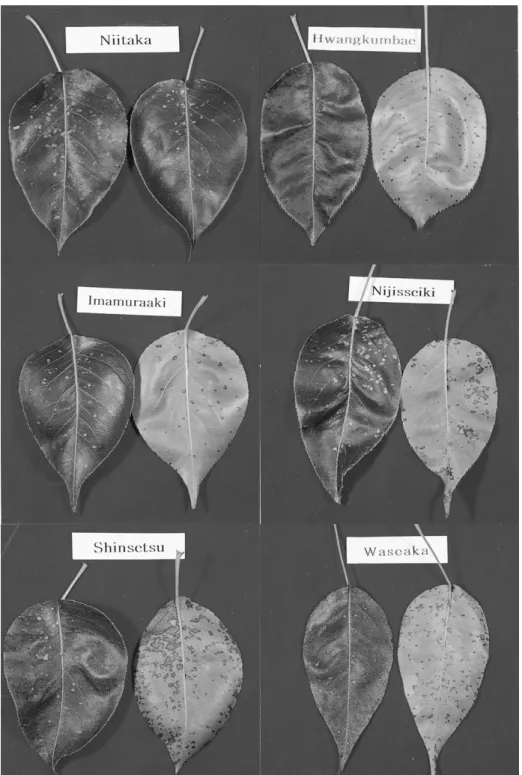
본 병의 저항성 검정을 위해서 본 바이러스를 접종한 결과 발현 성 품종은 Table 3 및 Fig. 1과 같다. 병징 발현이 빠르고 증세가 심한 품종은 조생적, 이십세기, 황금배 등이었다. 황금배는 최근 육 성된 품종으로 고접갱신할 경우 주의가 요망된다. 접목 접종하여도 발병하지 않는 품종은 수황배, 감천배, 장십랑 등 11품종이었다. 발 병 시기는 해에 따라 품종별로 약간의 차이가 있으나 5월 하순경 부터 발병이 시작되고, 6월 상, 중순이 발생 최성기였다. 발병한 품 종의 증상은 신고 품종의 증상과 대부분 같았으나, 각 품종에 따라 약간의 차이가 있었으며 그 차이는 그렇게 크지 않았다. 본 병의 증상이 전형적으로 나타나는 품종은 신고, 조생적, 이십세기였고, 반점의 모양과 발생 추이는 신고 품종과 비슷한 증상을 보였다.
배나무잎검은점병이 매년 발생하는 신고 품종에 저항성 품종인 수황배를 고접 갱신한 결과 고접 당년부터 3년 후까지 수황배 가 지에는 검은 반점이 발생하지 않았고(Table 4), 중간대목인 신고 품종은 검은반점이 심하게 발생하였다. 따라서 본 병에 대한 대책 의 하나로 심하게 발생하고 있는 신고 품종에 저항성 품종으로 고 접갱신하는 방법을 생각할 수 있을 것으로 사료된다.
고 찰
과수 바이러스병의 대책으로는 바이러스 무독모수의 탐색, 격리 및 보존, 바이러스 무독묘 공급 등을 들 수 있다. 배나무에 나타나 는 각종 바이러스병은 일반적으로 40 30℃의 변온 처리를 3 4 주간 실시한 후 신장한 가지의 신초를 채취 접목하는 방법으로 무 독화가 가능하다(三浦와 丸山, 1960; Posnette, 1963; Yanase 등, 1988). 사과의 경우는 37℃ 전후의 열처리에 의해서 각종 바이러 스가 무독화되었고(Campbell과 Best, 1964: Posnette 등, 1962;
Yanase 등, 1988), 복숭아에서의 바이러스 무독화는 38/35℃에서 4 5주간의 열처리가 필요하다. 따라서 이러한 바이러스의 무독화 는 시간과 기술을 필요로 한다. 그래서 본 시험에서는 배 생산 주 산단지에서 본 바이러스병에 감염이 안된 나무를 선발하고, 모수로 선정하고자 시험을 수행하였다. 본 바이러스병의 지표식물인 PS-95를 이용하여 현재까지 배나무잎검은점병이 발생하지 않는 배 나무를 대상으로 검정한 결과 무병주인 것이 확인되었다(Table 1).
우리 나라에서는 매년 약 100만본의 배나무 묘목이 생산되고 있으 나 이들의 모수 및 묘목에 대하여 바이러스 검정은 아직 이루어지 지 않고 있는 실정이다. 따라서 본 시험에서 검정한 나무를 접수 채취용 모수로 지정하여 이용하면 건전한 묘목 생산이 가능할 것으 로 사료된다. 바이러스를 무독화하기 위해서는 40/32℃, 37/30℃, 35/30℃에서 3 5주간 열처리하여 무독 개체를 얻을 수 있었다.
Moriguchi 등(1989)은 38/33℃에서 10주간의 열처리에 의하여 배 ASGV가 무독화되었고, 바이러스 종류에 따라서 열처리의 온도와 기간이 다르다고 보고하였다. 본 시험에서는 40/32℃ 의 3주간 항 온 조건에서 2개체, 37/30℃ 의 4주간 항온 조건에서 1개체의 바 이러스 무독개체를 획득하였다. 그러나 35/30℃ 의 5주간 항온 조 건에서는 무독개체를 얻지 못하였다. 본 바이러스를 무독화하기 위 해서는 37/30℃에서 4주간 이상 열처리가 필요한 것으로 생각된다.
본 시험에서 얻은 배나무잎검은점병에 대한 무독개체는 다른 바이 러스병에 대해서도 무독화되었을 가능성이 높다. 본 병의 예방 또
Fig. 1. Symptoms of pear black leaf spots on leaves of various varieties after artificial inoculation.
는 방제 대책으로는 먼저 재배 품종의 저항성 유무를 검정할 필요 가 있다고 생각된다. 중요한 품종에 대하여 저항성 품종을 검정한 결과 신고 등 7품종이 이병성으로 밝혀졌고, 11품종은 잠복성 품종 으로 구분되었으며 그 중에 신품종인 수황배, 감천배 등이 포함되 었다. 이들 2품종은 현재 배나무잎검은점병이 발생하고 있는 성목 에 고접 갱신하여도 문제가 없을 것으로 생각된다. 실제 농가의 과 수원에서 시험한 결과 현재 배나무잎검은점병이 심하게 발생되고 있는 신고 품종에 수황배를 고접해도 수황배에는 전혀 문제가 없었
다. 따라서 품질이 신고보다 나쁘지 않은 새로운 저항성 품종으로 고접갱신하는 방법이 현재로는 배나무잎검은점병에 대한 유일한 방제 대책으로 생각된다.
초 록
배나무잎검은점병에 대한 종합방제 대책을 수립하고자 시험을 수행하였다. 배 생산단지로부터 무독모수를 선발하기 위해서 본
병에 대한 감염 여부를 검정한 결과, 배나무잎검은점병이 발생하 지 않는 6주를 확인하였다. 본 바이러스는 40/32℃에서 3주간, 37/30℃에서 4주간 변온처리에 의해서 무독화가 가능하였으나 신 초의 활착률이 매우 낮았다. 본 바이러스를 접종하여 병징이 발현 하는 품종은 신고 등 7품종이었고, 발현하지 않는 품종은 수황배 등 11종이었다. 품질이 우수한 저항성 품종인 수황배를 배나무잎 검은점병이 발생하고 있는 신고 배나무에 고접한 결과 배나무잎검 은점병이 전혀 발생하지 않았다.
추가 주요어:열처리, 고접, 바이러스무독화
인용문헌
Campbell, A.I. and M.W. Best. 1964. The effect of heat therapy on several apple viruses. Ann. Rpt. Long Ashton Res. Stn. 1963:
65-70.
Fridlund, P.R. 1967. The relationship of inoculum-receptor contact period to the rate of graft transmission of twelve Prunus viruses.
Phytopathology 57:1296-1299.
Hong, K.H., Y.S. Kim, W.C. Kim, J.B. Lee, U.J. Lee, E.J. Lee, W.D. Cho, and E.K. Cho. 1985. Studies on the abnormal spot disease in pear leaf. Res. Rpt. RDA (Hort.) 27:46-55.
Kishi, K., K. Takanashi, and K. Abiko. 1972. Studies on pear necrotic spot. Bull. Hort. Res. Stn. A 11:139-147.
Kishi, K., K. Takanashi, and K. Abiko, 1976. Pear necrotic spot, A new virus disease in Japan. Acta Hort. 67:269-273.
Meer, F. A. van der. 1975. Plant species outside the genus Malus as indicators for latent viruses of apple. Acta Hort. 44:213-220.
三浦小四郞, 丸山和雄. 1960. 梨葉に發生する一つ病害. 農業及び園 藝 35(3):553-554.
Moriguchi, T., Y. Ohtsu, and K. Takanashi. 1989. Development of pear plant tree from apple stem grooving virus (ASGV). Bull.
Fruit Tree Res. Stn. A 16:25-30.
Murashige, T., W.P. Bitters, E. M. Rangan, E.M. Nauer, C.N.
Roistacher, and P.B. Holliday. 1972. A technique of shoot apex grafting and its utilization towards recovering virus free Citrus
clones. HortScience 7:118-119.
Nam, K.W. and C.H. Kim. 1994. Studies on the pear abnormal leaf spot disease. 1. Occurrence and damage. Kor. J. Plant Pathol.
10:169-174.
Nam, K.W. and C.H. Kim. 1995a. Studies on the pear abnormal leaf spot disease. 2. Identification of causal agent. Kor. J. Plant Pathol. 11:210-216.
Nam, K.W. and C.H. Kim. 1995b. Studies on the pear abnormal leaf spot disease. 3. Graft transmissiblity of the causal agent.
Kor. J. Plant Pathol. 11:217-223.
Nam, K.W. and C.H. Kim. 1996. Studies on the pear abnormal leaf spot disease. 4. Influence of temperature, soil moisture and chemical properties of soil. Kor. J. Plant Pathol. 12:209-213.
Nam, K.W., C.H. Kim and H.S. Hwang. 1996a. Studies on the pear abnormal leaf spot disease. 5. Selection of indicator plants. Kor.
J. Plant Pathol. 12:214-218.
Nam, K.W., C.H. Kim, and F. Mizutani. 1996b. Studies on the pear abnormal leaf spot disease. 6. Development of simple detection method. Kor. J. Plant Pathol. 12:363-367.
Nam, K.W., C.H. Kim, and K.S. Kim. 1996c. Studies on the pear black necrotic spot (Former: abnormal leaf spot) disease. 7.
Identification of causal virus. Kor. J. Plant Pathol. 12:368-373.
Posnette, A.E., R. Cropley, and L.D. Wolfswinkel 1962. Heat inactivation of some apple and pear viruses. Ann. Rpt. E.
Malling 1961:94-96.
Posnette, A.E. 1963. Virus disease of apples and pears. Common- wealth Agricultural Bureaux. p. 141.
Werthein, S.J. and H.J. Oosten 1986. Comparison of virus-free and virus-infected clones of two pear cultivars. Acta Hort. 180:51- 60.
Yanase, H. 1974. Studies on apple latent viruses in Japan. The association of apple topworking disease with apple latent viruses. Bull. Fruit Tree Res. Stn. Jpn. Ser. C1:47-109.
Yanase, H., H. Koganezawa, and P.R. Fridlund. 1988. Correlation of pear necrotic spot with pear vein yellows and apple stem pitting, and a flexuous filamentous associated with them. Acta Hort. 235:157.