• 검색 결과가 없습니다.

Effect of 1-MCP and Temperature on the Quality of Red-fleshed Kiwifruit (Actinidia chinensis)

N/A
N/A
Protected

Academic year: 2021

Share "Effect of 1-MCP and Temperature on the Quality of Red-fleshed Kiwifruit (Actinidia chinensis)"

Copied!
11
0
0

로드 중.... (전체 텍스트 보기)

전체 글

(1)

Effect of 1-MCP and Temperature on the Quality of Red-fleshed Kiwifruit ( Actinidia chinensis)

Prangthong Kwanhong, Byung-Seon Lim

*

, Jin-Su Lee, Hee-Ju Park, and Mi-Hee Choi

National Institute of Horticultural & Herbal Science (NIHHS), Rural Development Administration (RDA), Wanju-gun, 55365, Korea

*Corresponding author: [email protected]

This study detailed the effects of 1-methylcyclopropene (1-MCP) on ripening and fruit quality in red-fleshed kiwifruit ( Actinidia chinensis ) stored at 0 or 10°C for 20 days, and 20°C for 13 days. The quality of the fruit was assessed by measuring ethylene production, respiration rate, weight loss, firmness, flesh color, soluble solids content (SSC), and titratable acidity (TA), along with a sensory evaluation. Compared to untreated kiwifruit, fruit treated with 1 µL·L

-

¹ 1-MCP for 24h at 20°C prior to storage showed a delay in ripening and maintained fruit quality during storage. Ethylene production and respiration rate were affected by 1-MCP treatment only in fruit stored at 20°C, where the values were markedly higher compared to kiwifruit stored at 0 and 10°C. 1-MCP treatment resulted in a clear reduction in weight loss due to a delay in fruit ripening. The firmness of kiwifruit stored at 10 and 20°C decreased significantly compared to fruit stored at 0°C, but 1-MCP treatment led to a reduction in this loss. Upon storage, SSC increased while TA decreased across all treatments. Sensory evaluation scores increased with decreasing firmness and acidity and increasing SSC. The shelf life of kiwifruit stored at 0°C was extended without any chilling injury or color changes. In summary, the results show that 1-MCP treatment can potentially maintain quality and delay ripening of red-fleshed kiwifruit stored at all storage temperatures.

This study was carried out with support from the “Cooperative Research Program for Agriculture Science & Technology Development” (Project No. PJ011699), RDA, Republic of Korea.

HORTICULTURAL SCIENCE and TECHNOLOGY 35(2):199-209, 2017

URL: http://www.kjhst.org pISSN : 1226-8763 eISSN : 2465-8588

This is an Open-Access article distributed under the terms of the Creative Commons Attribution NonCommercial License which permits unrestricted non-commercial use, distribution, and reproduction in any medium, provided the original work is properly cited.

Copyrightⓒ2017 Korean Society for Horticultural Science.

OPEN ACCESS Received:

Revised:

Accepted:

May 12. 2016 January 17. 2017 January 25. 2017

Abstract

Additional key words: Red-fleshed kiwifruit, Actinidia chinensis , Hongyang, 1-Methylcyclopropene, Ripening

Introduction

Red - fleshed kiwifruit (Actinidia chinensis Planch . ‘ Hongyang ʼ) is one of the crops cultivated in the southeast of Korea . Kiwifruit cultivars generally have fruit with green or yellow flesh when ripe . A small number of genotypes also have red pigments , which are usually restricted to the inner pericarp but can vary in intensity and distribution within the fruit ( Montefiori et al ., 2005 ). The commercial production of kiwifruit has spread to various countries due to kiwifruit ’ s health benefits . Kiwifruit are rich in vitamin C and are also a good source of other nutrients such as folate , potassium , and dietary fiber ( Lim et al ., 2016 ).

Green - fleshed kiwifruit cultivars have dominated the worldwide commercial market . However , in recent

years , consumers have shown interest in fruit with high levels of anthocyanin accumulation , due to their

(2)

antioxidant and health - promoting properties ( Montefiori et al ., 2011 ). Therefore , interest in the international market is shifting from green - to yellow - or red - fleshed cultivars ( Li et al ., 2015 ).

1 - Methylcyclopropene ( 1 - MCP ) prevents ethylene action in a range of fruits , vegetables , and floriculture crops ( Blankenship and Dole , 2003 ; Prange and DeLong , 2003 ; Park et al , 2016 ). Effective concentrations are low , ranging from 2 . 5 nL · L

-

¹ to 1 µL · L

-

¹, depending on the commodity , treatment time , temperature , and method of application . Generally , 1 - MCP is applied between 20 and 25 ° C , but can be used at lower temperatures in some commodities ( Blankenship and Dole , 2003 ). Treatment with 1 - MCP has been shown to maintain the post - harvest quality of many climacteric fruits , including apple , avocado , banana , nectarine , peach , pear , plum , and tomato ( Watkins , 2006 ; Dong et al , 2015 ). In kiwifruit , numerous studies have reported that the application of 1 - MCP could affect several fruit qualities and postharvest shelf - life . Kim et al . ( 2001 ) reported that 1 - MCP reduced ethylene production and softening in kiwifruit stored at 20 ° C but only minor differences were observed between 1 - MCP treated and untreated fruit stored at 0 ° C . Boquete et al . ( 2004 ) found that green - fleshed kiwifruit could be stored at low temperature and still respond to 1 - MCP , including extending the kiwifruit ’ s shelf - life . 1 - MCP application at harvest leads to positive effects on fruit quality after short - and medium - term cold storage by reducing ethylene production and delaying softening , decay development , and color changes without altering the soluble solids content ( SSC ). Generally , long - term cold storage showed little benefit from 1 - MCP application ( Koukounaras and Sfakiotakis , 2007 ). However , Cantin et al . ( 2011 ) reported that 1 - MCP was shown to extend the shelf - life of kiwifruit during cold storage lasting up to four months by maintaining firmness in fruit regardless of the presence of ethylene ( 1 µL · L

-

¹). Application of 1 - MCP remarkably inhibited fruit ripening and extended the shelf - life of kiwifruit by reducing respiration and ethylene production , and also led to higher fruit firmness , ascorbic acid , and total phenolic content compared to controls ( Lim et al ., 2016 ; Park et al ., 2015 ).

Thus , 1 - MCP has been shown to efficiently maintain the quality of green - fleshed kiwifruit . However , little information is available on the effects of 1 - MCP on the quality of red - fleshed kiwifruit . Therefore , the objective of this research was to investigate the effects of 1 - MCP on the postharvest changes in quality of red - fleshed kiwifruit at different storage temperatures .

Materials and Methods Plant Materials and Treatments

Red - fleshed kiwifruit were harvested in Jeju and transported to the laboratory on October 12 , 2015 . The fruit were placed in a hermetically sealed acrylic container ( 500 L ) and treated with 1 µL · L

-

¹ 1 - MCP ( SmartFresh ® with 3 . 3 % active ingredient formulations ) for 24 hours ( h ) at 20 ± 1 ° C . Afterwards , red - fleshed kiwifruit treated with or without 1 - MCP were stored at 0 , 10 , and 20 ° C for 20 , 20 , and 13 days , respectively . Five fruit from each treatment were used for a sensory evaluation and to measure flesh color , firmness , soluble solids content ( SSC ), and titratable acidity ( TA ). Three fruit per treatment were used to measure weight loss and ethylene ( C

2

H

4

) and carbon dioxide ( CO

2

) production .

Ethylene Production and Respiration Rates

Fruit from each treatment were weighed and sealed in 750 mL plastic jar for 1 h at each temperature . Headspace gas was then

sampled with a 1 mL syringe . Ethylene and CO

2

contents were determined using a gas chromatograph ( Bruker GC 450 , Varian

Inc ., USA ) equipped with a flame ionization detector ( FID ) for ethylene and a thermal conductivity detector ( TCD ) for CO

2

. The

(3)

columns were an active alumina packed column ( 2M × 1 / 8 ″ × 2 . 0 mm ) for ethylene and an active carbon packed column ( 2 M × 1 / 8 ″ × 2 . 0 mm ) for CO

2

. GC analysis conditions were as follows : the temperature of the injector , oven , and detector were 150 , 80 , and 200 ° C , respectively . Flow rate was 60 mL He / min . Ethylene production and respiration rate were expressed as μL · kg

-1

· h

-1

and mL · kg

-1

· h

-1

, respectively .

Weight Loss

Weight loss was evaluated by measuring the difference in fruit weight on the initial day of the experiment and at each sampling point . Each fruit was weighed using a compact balance ( CB - 3000 , A & D Co ., Korea ). Results were converted into percentages with the equation : % WL = [( W

i

- W

f

) / W

i

] × 100 , where % WL = percentage weight loss , W

i

= initial fruit weight in grams , and W

f

= final fruit weight in grams , at the indicated time point .

Firmness of Fruit Flesh

The firmness of the fruit flesh was measured using a texture analyzer ( TA plus , Lloyd Instruments Ltd ., UK ) with a 5 mm - diameter probe on two opposite sides ( cheeks ) of each fruit after skin removal . Means were calculated and expressed in Newtons ( N ).

Flesh Color

Fruit color was measured at two opposite sides of each fruit with a portable CR - 400 colorimeter ( Konica Minolta CR - 400 , Konica Minolta Sensing Inc ., Japan ). Color changes were quantified in the L *, a *, and b * color space ( CIELab ). The L * refers to the lightness , ranging from black ( 0 ) to white ( 100 ); a * indicates greenness (-) to redness (+); and b * indicates blueness (-) to yellowness (+).

Soluble Solids Content (SSC) and Titratable Acidity (TA)

Peeled fruit were homogenized and filtered through cheesecloth in order to obtain a clear homogenate for the determination of TA and SSC . SSC was measured and expressed as degrees BrixBrix ) using a digital refractometer ( RA520 , Kyoto Electronic , Japan ). TA was measured by diluting 5 mL of homogenate to 20 mL with distilled water , and then titrating with 0 . 1 N sodium hydroxide ( NaOH ) to an end point of pH 8 . 2 . Results are expressed as percent malic acid .

Sensory Evaluation

Sensory quality was evaluated by a subjective test of appearance and taste ( softness , sourness , and juiciness ) with ratings of +++ = high , ++ = medium , + = low , and - = none .

Statistical Analysis

The experiments were designed to be completely randomized . Data were expressed as means ± standard error of mean

( S . E . M .) with 3 or 5 fruit per treatment . Statistical comparisons were performed via one - way analysis of variance ( ANOVA )

followed by Duncan ’ s multiple range test . P - values less than 0 . 05 were considered significant .

(4)

Results

Ethylene Production and Respiration Rates

Ethylene production in red - fleshed kiwifruit stored at 0 and 10 ° C was not significantly affected by 1 - MCP treatment , with averages of 0 . 19 ± 0 . 1 μL · kg

-1

· h

-1

at 0 ° C and 0 . 27 ± 0 . 2 μL · kg

-1

· h

-1

at 10 ° C ( Fig . 1A ). At 20 ° C , treated and untreated kiwifruit displayed a slight increase in ethylene production at six days of storage . Afterwards , at 13 days of storage , ethylene production of untreated kiwifruit increased significantly to 16 . 7 ± 2 . 7 μL · kg

-1

· h

-1

, much higher than the treated fruit at 2 . 0 ± 0 . 5 μL · kg

-1

· h

-1

(p <

0 . 05 ) ( Fig . 1A ) .

There was no statistically significant difference in the respiration rate of treated and untreated kiwifruit stored at 0 and 10 ° C (p > 0 . 05 ) ( Fig . 1B ). However , the respiration rate of kiwifruit stored at 20 ° C was higher than that of fruit stored at lower temperatures . The respiration rate of treated and untreated kiwifruit stored at 0 ° C ranged from 19 . 4 ± 1 . 6 mL · kg

-1

· h

-1

to 22 . 7 ± 2 . 7 mL · kg

-1

· h

-1

and 18 . 7 ± 3 . 8 mL · kg

-1

· h

-1

to 19 . 9 ± 0 . 9 mL · kg

-1

· h

-1

, respectively . At 10 ° C , the respiration rate of treated kiwifruit ranged from 23 . 7 ± 2 . 5 mL · kg

-1

· h

-1

on the first day to 8 . 9 ± 1 . 3 mL · kg

-1

· h

-1

after 20 days of storage , while untreated kiwifruit ranged from 24 . 4 ± 5 . 7 mL · kg

-1

· h

-1

to 8 . 1 ± 0 . 4 mL · kg

-1

· h

-1

. In kiwifruit stored at 20 ° C , the respiration rate of untreated fruit was lower than treated fruit for the first six days of storage , after which it dramatically increased ( 29 . 1 ± 4 . 3 mL · kg

-1

· h

-1

on the first day to 57 . 3 ± 6 . 6 mL · kg

-1

· h

-1

after 13 days of storage ). The respiration rate of treated kiwifruit increased moderately from 34 . 4 ± 3 . 1 mL · kg

-1

· h

-1

to 42 . 7 ± 1 . 3 mL · kg

-1

· h

-1

( Fig . 1B ) .

Fig. 1. Changes in ethylene production (A) and respiration rate (B) of red-fleshed kiwifruit, treated with or without 1 µL·L

-

¹ 1-MCP for 24 h at 20°C before storage at 0, 10, and 20°C. Each line represents the mean ± standard error of mean (S.E.M.), n = 3 for each treatment. Different lowercase letters within each evaluation (days) represent means with statistically significant differences using Duncan’s multiple range test ( p < 0.05).

Ethylene Production ( μL·kg

-1

·h

-1

)

0 15 30 45 60 75

Respiration rate ( mL·kg

-1

·h

-1

)

0 4 8 12 16 20

0 2 4 6 13 20 0 2 4 6 13 20 0 2 4 6 13 20

A

B

0 °C 10 °C 20 °C

0 °C 10 °C 20 °C

a

b

a

a b b 0 µL·L

-1

1-MCP

Days after 24 h of 1-MCP treatment 1 µL·L

-1

1-MCP

Days after 24 h of 1-MCP treatment Days after 24 h of 1-MCP treatment

(5)

Weight Loss

Fig . 2 shows the effect of 1 - MCP treatment on the weight loss of red - fleshed kiwifruit stored for 20 days at 0 ° C , 20 days at 10 ° C , and 13 days at 20 ° C . At all temperatures , weight loss increased during storage . At 0 and 10 ° C , no difference in weight loss between treated and untreated kiwifruit was observed , except after 20 days of storage at 10 ° C , where untreated fruit ( 4 . 6 ± 0 . 5 %) had a significant increase compared to treated kiwifruit ( 4 . 0 ± 0 . 4 %). Meanwhile , untreated kiwifruit stored at 20 ° C clearly showed a higher rate of weight loss ( 2 . 6 ± 0 . 4 %) compared to treated fruit ( 1 . 7 ± 0 . 0 %) after 13 days of storage .

Firmness of Fruit Flesh

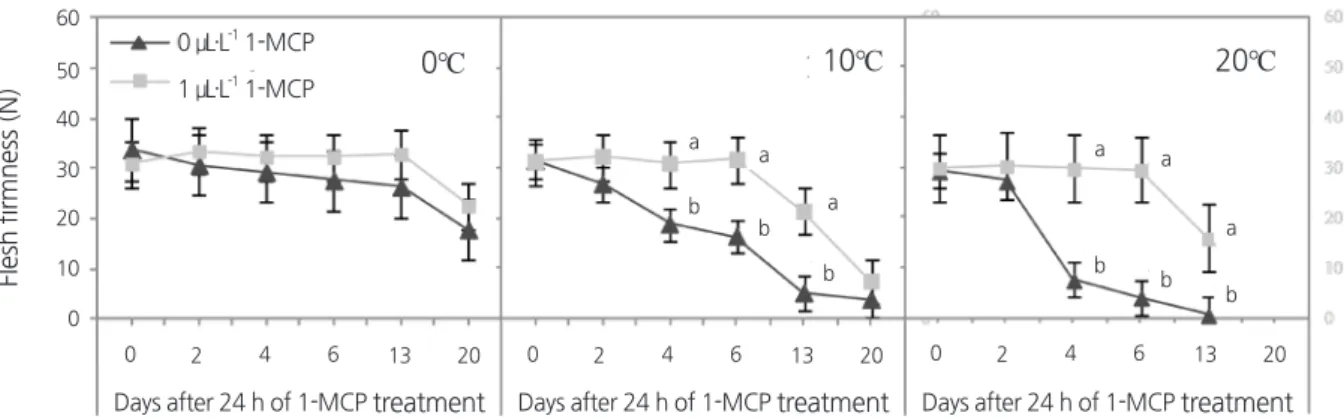
The firmness of treated and untreated red - fleshed kiwifruit decreased during storage at all temperatures , but untreated fruit were softer than treated fruit . The firmness of fruit stored at 10 and 20 ° C decreased significantly more than fruit stored at 0 ° C ( Fig . 3 ). The firmness of kiwifruit stored at 0 ° C decreased slightly over the 20 days of storage , with no significant differences between treated and untreated fruit (p > 0 . 05 ). 1 - MCP treatment clearly affected the firmness of fruit stored at 10 and 20 ° C . The firmness of untreated kiwifruit decreased dramatically from 31 . 4 ± 2 . 1 N on the initial day to 5 . 1 ± 3 . 6 N after 13 days of storage at 10 ° C and 29 . 3 ± 2 . 0 N to 0 . 7 ± 0 . 1 N at 20 ° C . In contrast , treated kiwifruit stored at 10 and 20 ° C maintained their firmness . The

Fig. 2. Changes in weight loss of red-fleshed kiwifruit treated with or without 1 µL·L

-

¹ 1-MCP for 24 h at 20°C before storage at 0, 10, and 20°C. Each line represents the mean ± S.E.M., n = 3 for each treatment. Different lowercase letters within each evaluation (days) represent means with statistically significant differences using Duncan’s multiple range test ( p < 0.05).

Fig. 3. Changes in flesh firmness of red-fleshed kiwifruit treated with or without 1 µL·L

-

¹ 1-MCP for 24 h at 20°C before storage at 0, 10, and 20°C. Each line represents the means ± S.E.M., n = 5 for each treatment. Different lowercase letters within each evaluation (days) represent means with statistically significant differences using Duncan’s multiple range test ( p < 0.05).

W eight loss (% )

0 1 2 3 4 5

Days after 24 h of 1-MCP treatment Days after 24 h of 1-MCP treatment Days after 24 h of 1-MCP treatment

2 4 6 13 20 2 4 6 13 20 2 4 6 13 20

0 µL·L

-1

1-MCP

1 µL·L

-1

1-MCP 0 °C 10 °C a 20 °C

b

a b

0 µL·L

-1

1-MCP

1 µL·L

-1

1-MCP 0 °C 10 °C 20 °C

2 4 6 13 20

0 0 2 4 6 13 20 0 2 4 6 13 20

Days after 24 h of 1-MCP treatment Days after 24 h of 1-MCP treatment Days after 24 h of 1-MCP treatment

Flesh firmness (N )

a

b a

b a

b

a

b a

b a

b 0

10

20

30

40

50

60

(6)

range of firmness after 13 days of storage at 10 ° C and 20 ° C were between 31 . 2 ± 4 . 1 N and 21 . 3 ± 5 . 5 N and 30 . 0 ± 3 . 3 N and 16 . 0 ± 10 . 2 N , respectively ( Fig . 3 ) .

Flesh Color

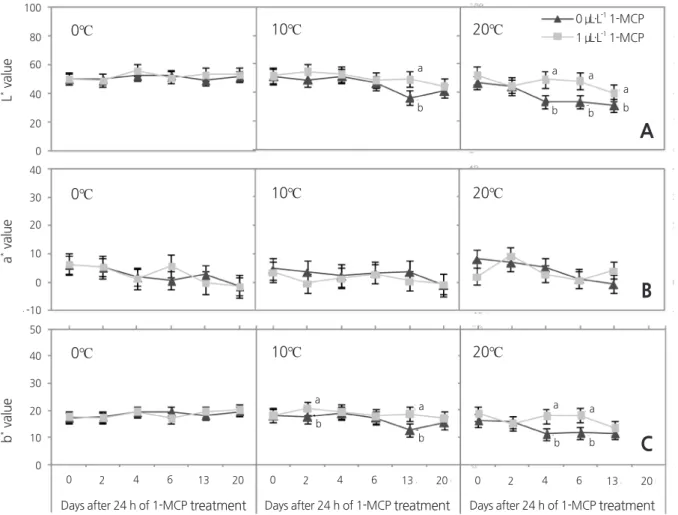
Changes in the flesh color of red - fleshed kiwifruit were monitored by measuring L *, a *, and b * values ( Fig . 4 ) . All storage temperatures showed a similar pattern through the duration of the experiment . In fruit stored at 10 and 20 ° C , treated kiwifruit had slightly higher L * and b * values and lower a * value than untreated controls . However , there were no significant differences between treated and untreated fruit at 0 ° C (p > 0 . 05 ). These results indicate that 1 - MCP treatment substantially retards the ripening process and delays color changes compared to untreated fruit . As shown in Fig . 5 , 1 - MCP treated and untreated kiwifruit stored at 0 ° C showed no changes in flesh color over 20 days of storage ( Fig . 5A ). In contrast , untreated kiwifruit ripened and showed color changes after 13 days at 10 ° C and 4 days at 20 ° C , while treated kiwifruit showed a clear delay in changes in flesh color and ripening until 20 and 6 days , respectively . ( Fig . 5B and 5C ).

Fig. 4. Changes in skin color in L

*

(A), a

*

(B), and b

*

(C) values of red-fleshed kiwifruit treated with or without 1 µL·L

-

¹ 1-MCP for 24 h at 20°C before storage at 0, 10, and 20°C. Each line represents the mean ± S.E.M., n = 5 for each treatment. Different lowercase letters within each evaluation (days) represent means with statistically significant differences using Duncan’s multiple range test ( p < 0.05).

Days after 24 h of 1-MCP treatment Days after 24 h of 1-MCP treatment Days after 24 h of 1-MCP treatment

2 4 6 13 20

0 0 2 4 6 13 20 0 2 4 6 13 20

A

B

C

0 °C 10 °C 20 °C

0 °C 10 °C 20 °C

0 °C 10 °C 20 °C

0 µL·L

-1

1-MCP 1 µL·L

-1

1-MCP

b

*

value

0 10 20 30 40 50

a

*

value

-10 0 10 20 30 40

L

*

value

0 20 40 60 80 100

a

b

a

b a

b a b

a

b

a

b

a

b a

b

(7)

Soluble Solids Content (SSC) and Titratable Acidity (TA)

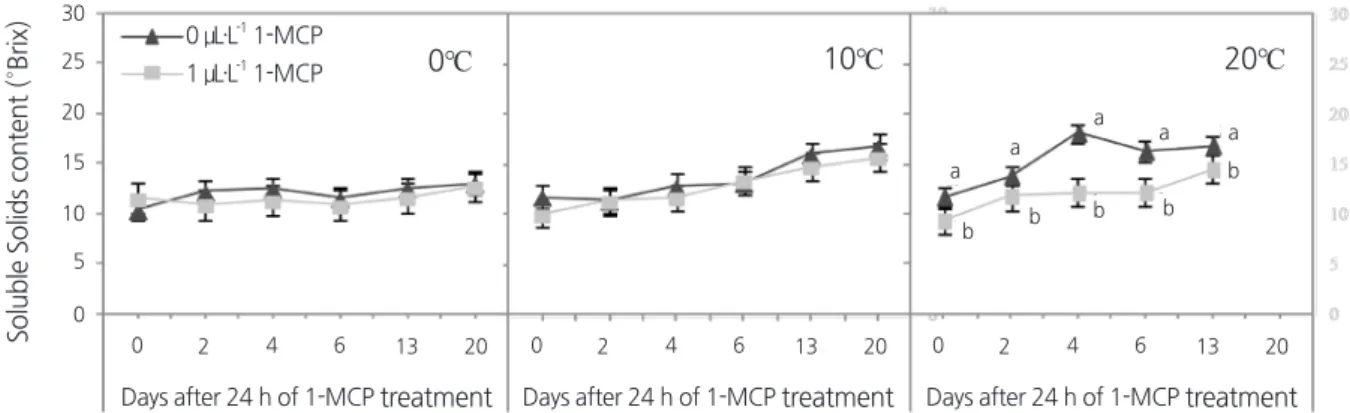
The SSC in treated fruit was significantly lower than untreated fruit stored at 20 ° C , whereas SSC did not show significant differences at 0 and 10 ° C ( Fig . 6 ). At 0 ° C , the SSC of treated and untreated kiwifruit insignificantly increased from 11 . 5 ± 0 . 9 to 13 . 0 ± 1 . 5 ° Brix and from 10 . 4 ± 1 . 0 to 13 . 0 ± 1 . 5 ° Brix after 20 days of storage , respectively (p > 0 . 05 ). At 10 ° C , the SSC of 1 - MCP - treated and untreated kiwifruit also increased from 10 . 0 ± 1 . 4 to 15 . 7 ± 0 . 9 ° Brix and from 11 . 8 ± 1 . 5 to 16 . 7 ± 1 . 3 ° Brix with storage time , respectively . Meanwhile , at 20 ° C , the treated fruit clearly had lower SSC than the untreated fruit from the first day through the last day of storage , 9 . 3 ± 1 . 2 to 14 . 5 ± 1 . 8 ° Brix for treated fruit and 11 . 7 ± 1 . 0 to 16 . 9 ± 0 . 4 ° Brix for untreated fruit ( Fig . 6 ).

In contrast , the TA of red - fleshed kiwifruit gradually decreased from the first day to the end of the experiment across all temperatures . The TA was also higher in treated fruit than in untreated fruit ( Fig . 7 ). No significant differences in TA were observed between treated and untreated kiwifruit stored at 0 and 10 ° C , while treated kiwifruit stored at 20 ° C had a significantly higher TA than untreated fruit , ranging from 1 . 3 ± 0 . 2 % on the first day to 1 . 2 ± 0 . 2 % after 13 days of storage for treated fruit and from 1 . 1 ± 0 . 2 % to 0 . 7 ± 0 . 2 % for untreated fruit ( Fig . 7 ) .

Fig. 5. Changes in flesh color of red-fleshed kiwifruit treated with or without 1 µL·L

-

¹ 1-MCP for 24 h at 20°C before storage at 0 (A), 10 (B), and 20°C (C).

Storage day after treated with 0 µL·L

-1

1-MCP at 0 °C 0 day 2 days 4 days 6 days 13 days 20 days

Storage day after treated with 1 µL·L

-1

1-MCP at 0 °C 0 day 2 days 4 days 6 days 13 days 20 days

Storage day after treated with 0 µL·L

-1

1-MCP at 10 °C 0 day 2 days 4 days 6 days 13 days 20 days

Storage day after treated with 1 µL·L

-1

1-MCP at 10 °C 0 day 2 days 4 days 6 days 13 days 20 days

Storage day after treated with 0 µL·L

-1

1-MCP at 20 °C 0 day 2 days 4 days 6 days 13 days

Storage day after treated with 1 µL·L

-1

1-MCP at 20 °C 0 day 2 days 4 days 6 days 13 days

A

B

C

(8)

Sensory Evaluation

Cold storage had a measurable effect on the quality of the fruit . The results show that 1 - MCP - treated fruit were harder , sourer , and less juicy than untreated fruit , especially for fruit stored at 20 ° C . This suggests that 1 - MCP treatment could delay softening and sourness in fruit stored at all temperatures . However , the 1 - MCP treatment did not affect the juiciness of the fruit , except for fruit stored at 20 ° C which were less juicy ( Fig . 8 ).

Discussion

Ethylene production in kiwifruit increases towards the end of ripening due to the climacteric stage ( Pratt and Reid , 1974 ). This pattern was observed in untreated red - fleshed kiwifruit stored at 20 ° C , which showed an increase in ethylene production after ripening . The fruit produced lower levels of ethylene until the initiation of the ripening , at which point ethylene production progressively increased to the climacteric peak before senescence ( Wills et al ., 2007 ). However , ethylene production and respiration rate in kiwifruit are temperature - sensitive . Kiwifruit differs from other climacteric fruits in that they show no Fig. 6. Changes in soluble solids content of red-fleshed kiwifruit treated with or without 1 µL·L

-

¹ 1-MCP for 24 h at 20°C before

storage at 0, 10, and 20°C. Each line represents the mean ± S.E.M., n = 5 for each treatment. Different lowercase letters within each evaluation (days) represent means with statistically significant differences using Duncan’s multiple range test ( p <

0.05).

Fig. 7. Changes in titratable acidity of red-fleshed kiwifruit treated with or without 1 µL·L

-

¹ 1-MCP for 24 h at 20°C before storage at 0, 10, and 20°C. Each line represents the mean ± S.E.M., n = 5 for each treatment. Different lowercase letters within each evaluation (days) represent means with statistically significant differences using Duncan’s multiple range test ( p < 0.05).

Days after 24 h of 1-MCP treatment

2 4 6 13 20

0

Days after 24 h of 1-MCP treatment

2 4 6 13 20

0

Days after 24 h of 1-MCP treatment

2 4 6 13 20

0 0

5 10 15 20 25 30

0 °C 10 °C 20 °C

0 µL·L

-1

1-MCP 1 µL·L

-1

1-MCP

Soluble Solids content ( °Brix)

0 °C 10 °C 20 °C

Days after 24 h of 1-MCP treatment

2 4 6 13 20

0

Days after 24 h of 1-MCP treatment

2 4 6 13 20

0

Days after 24 h of 1-MCP treatment

2 4 6 13 20

0 0 µL·L

-1

1-MCP

1 µL·L

-1

1-MCP

0.0 0.5 1.0 1.5 2.0 2.5

Soluble Solids content ( °Brix)

a

b a

b a

b a

b a b

a b

a b

a b

a b

a

b

(9)

increase in ethylene production or respiration rate during cold storage . The fruit shows a typical climacteric rise in respiration rate and ethylene production at temperatures between 17 - 34 ° C while at temperatures lower than 11 - 14 . 5 ° C they behave as non - climacteric fruit ( Sfakiotakis et al ., 2001 ). Similar to previous reports ( Kim et al ., 2001 ; Koukounaras and Sfakiotakis , 2007 ; Park et al ., 2015 ), 1 - MCP application reduced respiration and ethylene production in kiwifruit stored at 20 ° C , with only minor differences observed after treatment in fruit stored at 0 ° C . In addition , the respiration rate also influences the loss of weight due to carbon losses ; however , the major factor for weight loss is the loss of water vapor . Weight loss is an important contributor to the maintenance of fruit quality during postharvest storage ( Brackmann et al ., 2014 ; Lebibet et al ., 1995 ). The weight of the fruit progressively declined during postharvest storage across all temperatures , but the lower temperature showed less weight loss than the higher temperature . In this study , 1 - MCP application delayed weight loss in fruit stored at 20 ° C , similar to its reported effect in green - fleshed kiwifruitAllison ’ ( Jhalegar et al ., 2011 ).

Loss of texture is one of the main factors limiting quality and the postharvest shelf life of kiwifruit . Korsak and Park ( 2010 ) demonstrated that kiwifruits produce little amount of ethylene at harvest , but they are very sensitive to postharvest ethylene treatment . The ripening of kiwifruit is also induced by a very low concentration of exogenous ethylene . For that reason , it is important to delay flesh softening by controlling ethylene . In this study , 1 - MCP treatment effectively delayed the rate of fruit Fig. 8. Changes in sensory evaluation for softness, sourness, and juiciness of red-fleshed kiwifruit treated with or without 1 µL·L

-

¹

1-MCP for 24 h at 20°C before storage at 0, 10, and 20°C.

0 °C

10 °C

20 °C

0 µL·L

-1

1-MCP 1 µL·L

-1

1-MCP

2 4 6 13 20

0 0 2 4 6 13 20 0 2 4 6 13 20

+ ++

+++

Score

- + ++

+++

Score

- + ++

+++

Score

-

Storage time (days)

Softness Sourness Juiciness

(10)

softening in red - fleshed kiwifruit by suppressing ethylene biosynthesis during storage at all temperatures . This result is consistent with previous research suggesting that postharvest application of 1 - MCP in green - fleshed kiwifruit decreased fruit softening and maintained firmness during storage ( Cantin et al ., 2011 ; Çelikel et al ., 2010 ; Deng et al ., 2015 ; Koukounaras and Sfakiotakis , 2007 ; Lim et al ., 2016 ; Park et al ., 2015 ; Sharma et al ., 2012 ). However , although firmness was maintained by 1 - MCP treatment during cold storage , treatment did not perfectly prevent fruit softening after storage and treated fruit had a lower consumer acceptance due to reduced fruit quality compared to untreated fruit ( Cantin et al ., 2011 ; Deng et al ., 2015 ).

The application of 1 - MCP was very effective in delaying fruit ripening and senescence , especially at higher storage temperatures above 10 ° C . According to the study of Boquete et al . ( 2004 ), ripening of green - fleshed ‘ Hayward ’ kiwifruit treated with 1 - MCP after cold storage was significantly delayed due to low ethylene production as well as the inhibition of enzyme activity necessary for cell wall degradation . Furthermore , 1 - MCP treatment resulted in down - regulation of AcACO , AcACS , and AcLOX , genes which are associated with ripening or senescence in fruits ( Schröder and Atkinson , 2006 ). It was also noted that 1 - MCP extended the cold storage time of fruit by minimizing softening and nutritional losses ( Lim et al ., 2016 ).

As shown in this study , 1 - MCP treatment also influenced both SSC and TA of red - fleshed kiwifruit . The fruit reached full ripeness when the SSC level increased to 15 ° Brix . This study demonstrates that application of 1 - MCP could delay the increase of SSC and decrease acidity . Fruit treated with 1 - MCP had lower SSC and higher TA than untreated fruit during storage at all temperatures , similar to previous studies on ‘ Hayward ’ ( Koukounaras and Sfakiotakis , 2007 ) and ‘ Allison ’ kiwifruit ( Sharma et al ., 2012 ). In contrast , Deng et al . ( 2015 ) reported that 1 - MCP had no significant effect on green - fleshedQinmeikiwifruit after storage at 0 ° C . These different results may be due differences in the cultivars . Fruit stored at lower temperatures also had lower SSC and higher TA than fruit stored at higher temperatures . Fisk et al . ( 2006 ) also demonstrated that green - fleshed kiwifruit stored under lower temperatures received higher ratings in aroma and flavor than those stored under higher temperatures . According to Crisosto and Crisosto ( 2001 ) and Fisk et al . ( 2006 ), SSC of green - fleshed kiwifruit is considered an index for fruit ripening . An increase in SSC corresponds to a conversion of starch to soluble sugars , which are a key component underlying consumer preference of kiwifruit , as the flavor of kiwifruit is based on a sugar - acid balance . Also worth noting is that consumer preference for ripe kiwifruit corresponds to SSC ranging from 13 to 16 ° Brix . However , at low SSC , consumer acceptance is dependent on the acidity ; lower SSC fruit is more acceptable if the acidity is also low ( Crisosto and Crisosto , 2001 ).

In summary , this study supports and validates previous research on the beneficial effects of 1 - MCP application in delaying ripening and postharvest quality loss of red - fleshed kiwifruit , and can extend its storage life .

Literature Cited

Blankenship SM, Dole JM (2003) 1-Methylcyclopropene: a review. Postharvest Biol Technol 28: 1-25. doi:10.1016 /S0925-5214(02)00246-6

Boquete EJ, Trinchero GD, Fraschina AA, Vilella F, Sozzi GO (2004) Ripening of ‘Hayward’ kiwifruit treated with 1-methylcyclopropene after cold storage. Postharvest Biol Technol 32: 57-65. doi:10.1016/j.postharvbio.2003.09.013

Brackmann A, Thewes FR, de Oliveira Anese R, Both V, de Gasperin AR (2014) Respiration rate and its effect on mass loss and chemical qualities of ‘Fuyu’ persimmon fruit stored in controlled atmosphere. Ci nc Rural 44: 612-615. doi:10.1590 /S0103-84782014000400006

Cantin CM, Holcroft D, Crisosto CH (2011) Postharvest application of 1-methylcyclopropene (1-MCP) extends shelf life of kiwifruit.

Acta Hortic 913: 621-626. doi:10.17660/ActaHortic.2011.913.85

Elikel FG, Acıcan T, Aslım AS (2010) Effect of 1-MCP (1-methylcyclopropene) pretreatment on cold storage of kiwifruit. Acta Hortic 876: 237-242. doi:10.17660/ActaHortic.2010.876.31

Crisosto CH, Crisosto GM (2001) Understanding consumer acceptance of early harvested ‘Hayward’ kiwifruit. Postharvest Biol Technol

(11)

22: 205-213. doi:10.1016/S0925-5214(01)00097-7

Deng L, Jiang CZ, Mu W, Wang Q (2015) Influence of 1-MCP treatments on eating quality and consumer preferences of ‘Qinmei’

kiwifruit during shelf life. J Food Sci Technol 52: 335-342. doi:10.1007/s13197-013-0986-y

Dong, Y, Liu, LQ, Zhao, Z, Zhi, HH, Guan, JF (2015) Effects of 1-MCP on reactive oxygen species, polyphenol oxidase activity, and cellular ultra-structure of core tissue in ‘Yali’ pear ( Pyrus bretschneideri Rehd.) during storage. Hortic Environ Biotechnol 56: 207- 215. doi: 10.1007/s13580-015-0094-1

Fisk CL, McDaniel MR, Strik BC, Zhao Y (2006) Physicochemical, sensory, and nutritive qualities of hardy kiwifruit ( Actinidia arguta

‘Ananasnaya’) as affected by harvest maturity and storage. J Food Sci 71: 204-210. doi:10.1111/j.1365-2621.2006.tb15642.x Jhalegar MJ, Sharma RR, Pal RK (2011) 1-MCP delays ripening and enhances shelf life and quality of kiwifruit. Acta Hortic 913: 373-

377. doi:10.17660/ActaHortic.2011.913.49

Korsak T, Park YS (2010) Ethylene metabolism and bioactive compounds in ethylene-treated ‘Hayward’ kiwifruit during ripening. Hortic Environ Biotechnol 51: 89-94

Kim HO, Hewett EW, Lallu N (2001) Softening and ethylene production of kiwifruit reduced with 1-methylcyclopropene. Acta Hortic 553: 167-170. doi:10.17660/ActaHortic.2001.553.34

Koukounaras A, Sfakiotakis E (2007) Effect of 1-MCP prestorage treatment on ethylene and CO

2

production and quality of ‘Hayward’

kiwifruit during shelf-life after short-, medium- and long-term cold storage. Postharvest Biol Technol 46: 174-180. doi:10.1016/

j.postharvbio.2007.05.002

Lebibet D, Metzidakis I, Gerasopoulos D (1995) Effect of storage temperatures on the ripening response of banana ( Musa. sp.) fruit grown in the mild winter climate of Crete. Acta Hortic 379: 521-526. doi:10.17660/ActaHortic.1995.379.65

Li W, Liu Y, Zeng S, Xiao G, Wang G, Wang Y, Peng M, Huang H (2015) Gene expression profiling of development and anthocyanin accumulation in kiwifruit ( Actinidia chinensis ) based on transcriptome sequencing. PLoS One (in press). doi:10.1371/

journal.pone.0136439

Lim SY, Han SH, Kim JY, Lee HJ, Lee JG, Lee EJ (2016) Inhibition of hardy kiwifruit ( Actinidia aruguta ) ripening by 1-methylcyclopropene during cold storage and anticancer properties of the fruit extract. Food Chem 190: 150-157. doi:10.1016/

j.foodchem.2015.05.085

Montefiori M, Espley RV, Stevenson D, Cooney J, Datson PM, Saiz A, Atkinson RG, Hellens RP, Allan AC (2011) Identification and characterisation of F3GT1 and F3GGT1, two glycosyltransferases responsible for anthocyanin biosynthesis in red-fleshed kiwifruit ( Actinidia chinensis ). Plant J 65: 106-118. doi:10.1111/j.1365-313X.2010.04409.x

Montefiori M, McGhie TK, Costa G, Ferguson AR (2005) Pigments in the fruit of red-fleshed kiwifruit ( Actinidia chinensis and Actinidia deliciosa ). J Agric Food Chem 53: 9526-9530. doi:10.1021/jf051629u

Park, CY, Kim, YJ, Shin, YJ (2016) Effects of an ethylene absorbent and 1-methylcyclopropene on tomato quality and antioxidant contents during storage. Hortic Environ Biotechnol 57: 38-45. doi: 10.1007/s13580-016-0130-9

Park, YS, Im MH, Gorinstein S (2015) Shelf life extension and antioxidant activity of ‘Hayward’ kiwi fruit as a result of prestorage conditioning and 1-methylcyclopropene treatment. J Food Sci Technol 52: 2711-2720. doi:10.1007/s13197-014-1300-3

Prange RK, DeLong M (2003) 1-Methylcyclopropene: the magic bullet for horticultural products. Chron Hortic 43: 11-14

Pratt HK, Reid MS (1974) Chinese gooseberry: Seasonal patterns in fruit growth and maturation, ripening, respiration and the role of ethylene. J Sci Food Agric 25: 747-757. doi:10.1002/jsfa.2740250702

Schr der R, Atkinson RG (2006) Kiwifruit cell walls: toward an understanding of softening? New Zeal J For Sci 36: 112-129

Sfakiotakis E, Antunes MD, Stavroulakis G, Niklis N (2001) Ethylene biosynthesis. Role in ripening and quality of “Hayward” kiwifruit after harvest, during storage and shelf life. In Dris R, Niskanen R, Jain SM, ed, Crop management and postharvest handling of horticultural products, Ed 1, Vol 1. Science Pub Inc., Enfield, USA, pp 263-287

Sharma RR, Jhalegar MJ, Pal RK (2012) Response of kiwifruit ( Actinidia deliciosa cv. Allison) to postharvest treatment with 1-methylcyclopropene. J Hortic Sci Biotechnol 87: 278-284. doi:10.1080/14620316.2012.11512865

Watkins CB (2006) The use of 1-methylcyclopropene (1-MCP) on fruits and vegetables. Biotechnol Adv 24: 389-409. doi:10.1016/

j.biotechadv.2006.01.005

Wills R, McGlasson B, Graham D, Joyce D (2007) Physiology and biochemistry. In R Wills, B McGlasson, D Graham, D Joyce, ed,

Postharvest: An introduction to physiology and handling of fruits, vegetables and ornamentals, Ed 5. CABI, Wallingford, UK, pp

202

수치

Fig. 1. Changes in ethylene production (A) and respiration rate (B) of red-fleshed kiwifruit, treated with or without 1 µL·L - ¹  1-MCP for 24 h at 20°C before storage at 0, 10, and 20°C
Fig. 2. Changes in weight loss of red-fleshed kiwifruit treated with or without 1 µL·L - ¹ 1-MCP for 24 h at 20°C before storage  at 0, 10, and 20°C
Fig. 4. Changes in skin color in L *  (A), a *  (B), and b *  (C) values of red-fleshed kiwifruit treated with or without 1 µL·L - ¹ 1-MCP for  24 h at 20°C before storage at 0, 10, and 20°C
Fig. 5. Changes in flesh color of red-fleshed kiwifruit treated with or without 1 µL·L - ¹ 1-MCP for 24 h at 20°C before storage at 0  (A), 10 (B), and 20°C (C).
+2

참조

관련 문서

본 실험에서는 불소이온의 흡착능력을 증대시키기 위하여 대나무 탄화물 제조를 다르게 하였다. Effect of temperature of heat treatment on the adsorption of F - by

The average tensile strength value before heat treatment of PLA output was 9.67 N/㎟, and the average tensile strength value after heat treatment was 24.17 N/㎟, which

As a result of comparing the number of treatments per person by treatment behavior, the fluoride application during the preventive dental operation period was significantly

Although lifelong learning had no direct impact on basic skills, it showed indirect effect by strongly influencing the utilization of skills at workplace

In this study, a fine Ce 3 Al 11 phase catalyst was synthesized by mechanochemical reaction and the influence of the catalyst on the NaAlH 4 hydrogen storage properties

Biological treatment of wastewater is an economical green technology, however, the effluent water quality of a biological wastewater treatment facility is

Ø By letting-down the pressure of chilled and highly compressed refrigerant, we can obtain a cold..

Accordingly, by outgrowing not only quantitative development but also simple storage function of cold and frozen storage warehouse businesses, it is necessary