A Faunistic Study of Insects of Uninhabited Islands in the Docho-myeon, Sinan-gun, Jeollanam-do, Korea
1Youngho Cho2a, Youngjin Kim2a, Heon-Myoung Lim3, Yong-Gu Han3, Min-Joo Choi2, Sang-Ho Nam2*
전라남도 신안군 도초면 일대 무인도서의 곤충상
1조영호2a․김영진2a․임헌명3․한용구3․최민주2․남상호2*
ABSTRACT
Shinan-gun in Jeollanam-do has 1,004 islands which is the biggest number in the whole country. As most of the islands in Korea are secluded from the mainland or other islands, biological surveys are very important for the biogeographical perspective. Especially, the species diversity of insecta on an island plays an important role in the food stability of top predators, including birds. This study provides baseline academic resources for the preservation and management of uninhabited islands by providing information about the status of insects on the uninhabited islands in Docho-myeon, Jeollanam-do, Korea. As far as the appearance aspects of the insects in 28 uninhabited islands were 921 individuals, 122 species, 60 families or 12 orders. Ga Island showed the highest appearance as 32 species, 22 families or 9 orders. Appearance of specific insects was investigated unknown species: 1 species, southern characteristic species: 3 species, coastal dune species: 1 species, climate-sensitive indicator species: 1 species
KEY WORDS: INSECT FAUNA, SOUTHERN CHARACTERISTIC SPECIES, COASTAL SPECIES, CLIMATE-SENSITIVE INDICATOR SPECIES
1 접수 2011년 4월 30일, 수정(1차: 2011년 9월 7일, 2차: 2011년 9월 26일), 게재확정 2011년 9월 27일
Received 30 April 2011; Revised(1st: 7 September 2011, 2nd: 26 September 2011); Accepted 27 September 2011 2 대전대학교 생명과학과 Dept. of Biology, Daejeon University, Daejeon(300-716), Korea([email protected])
3 국립환경과학원 National Institute of Environment Research, Incheon(404-708), Korea a These authors contributed equally to this paper
* 교신저자 Corresponding author([email protected])
요 약
전라남도 신안군은 전국에서 가장 많은 총 1004개의 도서가 위치하고 있다. 이처럼 국내 대부분 섬들은 일정한
지역에 밀집이 되어있으나 각각의 섬들은 육지 또는 타도와 격리되어 있기 때문에 생물상의 조사는 생물지리학적으로 매우 중요하다. 특히 섬 생태계에서 곤충류의 종다양성은 조류를 포함한 상위포식자의 생태계 먹이 안정성에 매우 중요한 역할을 한다고 볼 수 있다. 본 연구는 전라남도 신안군 도초면 일대 28개 무인도서의 곤충상을 확인하여 무인도서 의 보존 및 관리방안 설정에 따른 기초자료를 제공하고자 한다. 조사된 28개 무인도서의 곤충류 출현 양상은 총 12목 60과 122종 921개체가 조사되었으며 가도에서 9목 22과 32종으로 가장 높게 나타났다. 특정 곤충종의 출현 현황은 국내 미기록 1종, 남방계 특성종 3종, 해안사구 지표종 1종, 기후변화 지표종 1종이 조사되었다.
주요어: 곤충상, 남방계 특성종, 해안사구 지표종, 기후변화 지표종
674 Youngho Cho, Youngjin Kim, Heon-Myoung Lim, Yong-Gu Han, Min-Joo Choi, Sang-Ho Nam 한국환경생태학회지 25(5) 2011
Figure 1. Survey Islands in Docho-myeon, Sinan- gun, Jeollanam-do
(1. Umul, 2. Baekkgaeyak, 3. Oegaeyak, 4. Mal, 5. Maesil, 6.
Migi_1, 7. Migi, 8. Meonge, 9. Nongganbawi, 10. Ttandae, 11. Seokhwang, 12. Ru, 13. Soru, 14. Gyeongchi, 15. Tokki, 16. Ga, 17. Song, 18. Baek, 19. Jakeunhui, 20. Mo, 21.
Ttanmok, 22. Seung, 23. Hang, 24. Hwa, 25. Bi, 26. Cheong, 27. No, 28. Juk)
INTRODUCTION
South Korea is surrounded by seas on three sides containing a total of 3,358 islands, of which 482 are inhabited and 2,876 are uninhabited islands (85.65%).
Most of the islands are concentrated in west and south coasts (1,744 islands off Jeollanam-do and 484 islands off Gyeongsangnam-do). Especially Shinan-gun has 1,004 islands (72 inhabited 932 uninhabited) which is the biggest number in the whole country. Furthermore, Docho-myeon in Shinan-gun has 62 islands (4 inhabited, 58 uninhabited) most of which are located in Dadohae Marine National Park(MMAF, 2007). As most of the islands in Korea are secluded from the mainland or other islands, biological surveys are very important for the biogeographical perspective(Kim and Lee, 1979). Chilbal, Gugul and Chilsan Islands became natural preserves as they are breeding places of marine birds(CHA, 2009). Out of the aforementioned marine birds, Apus pacificus, Larus crassirostris and Egretta eulophotes take Insecta as their source of protein. In particular, A. pacificus is known to eat flying insects including those within the orders Homoptera, Coleoptera, Hymenoptera and Lepidoptera(Gang, 1962; Yoon, 1996; Lee et al., 2000). Therefore, the species diversity of insecta on an island plays an important role in the food stability of top predators, including birds.
Additionally, as it is difficult for the insects to move to other regions, they can often be differentiated to subspecies when they are located in secluded areas. All this means that they have very important significance in that they allow us to observe long-term changes, for example, those related to climate change. However, recently even uninhabited islands which used to be less impacted by external forces, and whose original ecosystem and geographical landscapes used to be well preserved, reckless grazing, fishing and other damage now threaten the habitats of various biological species. Accordingly, this study provides baseline academic resources for the preservation and management of uninhabited islands by providing information about the status of insects on the uninhabited islands in Docho-myeon, South Korea.
MATERIALS AND METHODS
1. Survey areas
This survey includes work performed on 28 uninhabited Islands located in Docho-myeon, Shinan-gun, Jeollanam- do(Figure 1).
2. Survey methods
The surveys were performed three times from August to October when the insect species diversity is the highest, but excluding days with bad weather such as high wind and rain. However surveys of uninhabited islands are also affected by the weather because ships must be used to transports the workers. Because of the tidal effects and the unique landscape of each island, it was often difficult to get from the transport ships to the islands. Depending on the size of each island, it took from one to four hours to survey terrestrial insects on each island. To collect terrestrial insects, we used air nets for flying insects, and sweeping and beating methods where insects were not visible because of dense herbaceous plants. The adult
Islands Orders Families Species
Umul 8 16 21
Baekkgaeyak 6 8 8
Oegaeyak 6 8 12
Mal 11 23 31
Maesil 5 7 8
Migi_1 2 2 2
Migi 7 19 22
Meonge 5 8 9
Nongganbawi 2 3 3
Ttandae 6 11 12
Seokhwang 8 26 28
Ru 4 9 10
Soru 5 9 9
Gyeongchi 6 16 21
Tokki 2 3 3
Ga 9 22 32
Song 9 16 19
Baek 8 14 23
Jakeunhui 3 4 5
Mo 5 8 8
Ttanmok 4 7 10
Seung 3 6 6
Hang 2 3 5
Hwa 7 9 23
Bi 8 17 22
Cheong 7 11 11
No 3 6 7
Juk 5 16 21
Table 1. Composition of insect fauna on uninhabited islands
insects collected were made into dried specimens, which were then identified. The specimens were stored in the Insect Specimen Room of the Animal and Ecology laboratory at Daejeon University, Daejeon, South Korea.
The insect list was made based on the Checklist of Insects from Korea(1994).
RESULTS AND DISCUSSION
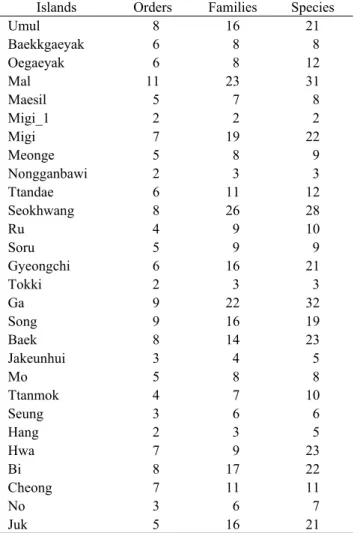
1. Appearance of the insects in uninhabited islands As far as the appearance aspects of the insects in 28 uninhabited islands is concerned, Ga Island showed the highest appearance as 32 species, 22 families or 9 orders.
The order of the islands are Mal Island as 31 species, 23 families or 11 orders, Seokhwang Island as 28 species, 26 families or 8 orders, Baik Island and Hwa Island as 23 species, 14 families or 8 orders and as 23 species, 9 families or 7 orders respectively, Bi Island and Migi Island as 22 species, 17 families or 8 orders and as 22 species, 19 families or 7 orders respectively and then Umul Island, Gyeongchi Island and Juk Island as 21 species, 16 families or 8 orders, as 21 species, 16 families or 6 orders and as 21 species, 16 families or 5 orders respectively(Table 1).
Ga Island has abundant flora and a well-developed evergreen broad-leaved forest such as Machilus thunbergii and Celtis sinensis communities. Compared to other islands, it has very stable habitats for the insects there. Additionally, as underground water flows nearby, it is highly favorable for various aquatic insects to inhabit the area. As it is adjacent to an inhabited island named Ui, there may be frequent movement of insects between the two islands and high populations of insects that could be used as food sources by the upper level predators.
As aforementioned, most of 28 islands in this survey with dense insect populations have well developed evergreen broad-leaved forest in the warm temperate region, and the Pinus thunbergii community frequently found on islands.
As herbaceous plants such as the Miscanthus sinensis and Imperata cylindrica communities are dense under the trees, the insects living on herbaceous plants, such as Parnara guttata eating Cyperaceae, Ossoides lineatus and Mimophantia maritima occur in high numbers. The average area of the ten islands with high species density was 83,525㎡. This is bigger than the average area of the 28
islands (48,079㎡). This is consistent with the Equilibrium Theory by MacArthur and Wilson(1967) which points out the correlation between the size of islands and the number of species found on them. In other words, as the area of the island increases, the habitats become more diversified because of heterogeneity of geography and geology, which leads to an increase in the number of species. In particular, this is supported by research on Lepidoptera, which is a macro taxonomic group used as an indicator to identify the effects on ecosystems because 120,000 species have already been reported throughout the world and taxonomic and ecological research on them has been widely performed (Kitching et al., 2000; Summerville et al., 2001;
Summerville and Crist, 2002). The most influential factors on Lepidoptera on islands have been reported to be the composition of plant species and the size of the island
676 Youngho Cho, Youngjin Kim, Heon-Myoung Lim, Yong-Gu Han, Min-Joo Choi, Sang-Ho Nam 한국환경생태학회지 25(5) 2011
Islands Orders Families Species
Kim and Lee(1979)
Docho 6 12 15
Bigeum 6 26 60
Ui 7 39 60
Chilbal 8 15 23
Cheong and Lee(1997)
Imja 5 17 30
Ji 2 4 10
Jeung 2 2 2
Maehwa 1 4 13
Nam et al.
(2002) Chilbal 8 19 25
Sohn et al.
(2005) Jin 1 37 573
Lim(2007) Aphae 1 16 339
Lim(2009) Aphae 1 18 563
KNPS (2009)
Docho, Bigeum, Ui Daya, Sin, Gwanmae
13 88 423
Table 2. Insect faunas of around islands in Sinan-gun, Jeollanam-do, Korea
Scientific name Islands
Unknown species Grammodes geometrica (Fabricius) Jakeunhui
Southern characteristic species
Cantao ocellatus (Thunberg) Hwa
Graphium sarpedon (Linné) Gyeongchi, Bi, Juk, Ga, Seung, Hwa Papilio protenor Cramer Gyeongchi, Bi, Ttanmok
Coastal dune species Scepticus uniformis Kono Migi
Climate-sensitive indicator species Eurema hecabe (Linné) Migi, Mal, Gyeongchi Table 3. Appearance of specific insects of particular interest by island
(Reed, 1985; Choi and Shin, 1993; Dennis and Shreeve, 1997; Choi, 2000).
2. Comparison of insects fauna around the islands The terrestrial insects identified in 28 uninhabited islands were 921 individuals, 122 species, 60 families or 12 orders. Up to now, the insects reported in southwest islands in Korea are 15 species in Docho Island, an inhabited island, 60 species in Bigeum Island and Ui Island, and 23 species in Chilbal Island in Shinan-gun by Kim and Lee(1979), 30 species in Imja Island, 10 species in Ji Island, 2 species in Jeung Island and 13 species in Maehwa Island by Jung and Lee(1997), 25 species in Chilbal Island by Nam(2002), 573 species in Jin Island by Sohn et al.(2005), 339 species and 563 species in Aphae Island by Lim(2007, 2009), 423 species in Bigeum
Island and Docho Island and Ui Island and Daeya Island and Gwanmae Island and Sin Island by KNPS(Table 2).
Jin Island showed an unusually high number of species because the figure reported is the summary of all the research on Lepidoptera of that island. Additionally, although Jin-do used to be a true island, it is now connected to the mainland by a causeway, and two-way movement of insects is now frequent. In the case of Aphae Island, the high number reported is the result of studies on the moth fauna. It showed high species density because Aphae Island is very near the mainlan, only 8km from Mokpo city. Furtheremore this research was not a conventional fragmentary study, but included multiple surveys performed more than once a month. Additionally, in Maehwa Island, Aphae-myeon, Shinan-gun, Cheonnam, Fabriciana nerippe which is a second grade endangered wild species designated by the Ministry of Environment, was reported by Cheong and Lee(1997).
3. Appearance of specific insects
Appearance of specific insects was investigated unknown species: 1 species, southern characteristic species: 3 species, coastal dune species: 1 species, climate-sensitive indicator species: 1 species(Table 3).
1) Unknown Species
Grammodes geometrica (Fabricius) (Noctuidae, Lepidoptera) inhabit China, Japan, India, region of the Mediterranean and Australia(Rose, 2002). It was identified in Jakeunhi Island in this survey. It has a wingspan of approximately 42㎜, brown thread-shaped antennae and light brown body color. On the fore-wings there are black triangles on a brown base, with two white bands in the middle of the triangle. The hind wings are dark brown and there is white fur on the termen. This species is a
polyphagous insect eating Phyllanthus, Sapium, Ricinus of Euphorbiaceae, Cistus of Cistaceae, Diospyros of Ebenaceae, Oryza of Gramineae, Polygonum of Polygonaceae, Ziziphus of Rhamnaceae, Tamarix of Tamaricaceae and Cirtus reticulata Blanco which is a famous fruit belonging to Rutaceae and is known as Mandarin in Korea(Koshino, 1999; Robinson et al., 2001; Aran et al, 2005). As there is no record regarding this species in Korea, it is judged an unrecorded species.
2) Southern Characteristic Species (1) Cantao ocellatus (Thunberg)
C. ocellatus (Thunberg) was collected on Hwa Island in this survey. This species is common and frequently observed in Japan. Only a few individuals have been collected on Jeju Island and the south coast of Korea.
Mallotus japonicus is known as its host plant. They usually compose a community and live in the community. It is an insect with strong maternal instinct and stays around her eggs until they are hatched(An, 2010). It is a rather large species among the insects of Hemiptera. It has splendid body color and the black on its body has many variations. The ecological information of this species is not well known. Further researches are needed as to why it has been identified only in the southern parts of the Korean Peninsula.
(2) Graphium sarpedon (Linné)
G. sarpedon (Linné) is a butterfly (Papilionidae). Only species has been found in Korea, while more than 102 species are reported as Graphium genus in the world. They occur on southwest islands including Jeju Island and Uleung Island in South Korea. Overseas, they occur mostly in Asia, Oceania and Africa(Saigusa et al., 1981;
Kim, 2002). In this survey there were collected on Gyeongchi, Bi, Juk, Ga, Seung and Hwa Islands. The host plants of G. sarpedon are Machilus thunbergii and Cinnamomum camphora of Lauraceae, and Aucuba japonica of Cornaceae, which occur in evergreen broad- leaved forests distribute along the southern coast and islands. Therefore, it can be said that the habitat of G.
sarpedon is somewhat restricted. However, outbreaks of G. sarpedon occurs twice to four times a year according to its region(Joo et al., 2002; Kim, 2002). Yukawa(2000) recorded that this species can change the times of outbreak and that its geographical distribution pattern is affected
by global warming. Thus, as this species inhabits the southern part of Korea only at present, it can be used as an indicator species for estimating change in the weather.
(3) Papilio protenor Cramer
Four subspecies of the butterfly P. protenor (Papilionidae) are known in Korea while more than 210 species within the genus Papilio are known in the world. They are normally observed on Jeju Island, as well as the south and west coast of Korea. Individuals moving in from original habitats are occasionally observed in the southern part of Korea and middle of the Korean Peninsula(Kim, 2002;
Paek and Shin, 2010). In this survey they were identified in Gyeongchi, Bi and Ddanmok Islands. P. xuthus is a polyphagous insect which has diversified host plants such as Zanthoxylum schinifolium, Phellodendron amurense, Z.
piperitum, Poncirus trifoliata, Citrus junos, Z. ailanthoides, and Dichroa febrifuga of Rutaceae, Lia kiusiana of Tiliaceae, and Clerodendrum trichotomum of Verbenaceae.
3) Coastal dune species
Scepticus uniformis (Kono) is beetle genus of Scepticus (Coleoptera). Three species of this genus are known in Korea. Secepticus genus includes species having special habitats in the sand on islands and coastal dunes. However they showed variation in density according to the place of collection. It is known that its density has something to do with the distribution of specific plants rather than the habitats themselves(Kim, 1981). Bigot(1971) reported this species as the basic species in coastal dunes in work on the coastal ecology by habitats in Camargue Region, France. S. uniformis is a species with extraordinary habitats such as costal dunes and the changes in the coastal dunes resulting from environmental effects and human damages could cause extinction of the species.
4) Climate-sensitive indicator species
Eurema hecabe (Linné) is a butterfly (Coliadinae, Pieridae).
Eleven species within four genera of them are known in Korea. They are distributed in the area below 37°, particularly Uleung Island and the Taean Peninsula on the west coast of Korea. Overseas they occur widely in Southern China, Taiwan, Japan, Australia and Africa. The host plants of E. hecabe are known as Lespedeza cuneata, L. pilosa, L. bicolor, L. virgata, Albizia julibrissin, Cassian obtusifolia, Caesalpinia decapetala, Cassia minosoides, L.
678 Youngho Cho, Youngjin Kim, Heon-Myoung Lim, Yong-Gu Han, Min-Joo Choi, Sang-Ho Nam 한국환경생태학회지 25(5) 2011
cyrtobotrya falling under Leguminosae(Sohn and Park, 1993; Joo et al., 2002; Kim, 2002). This species is a CBIS(Climate-sensitive Biological Indicator Species) designated by the Korean Ministry of Environment in 2010. It inhabits the southern part of Korea including Jeju Island, Cheollanam-do and Gyeongsangnam-do. It seems that their habitats has expanded to islands off Gyeoggi-do and the eastern part of Gangwon-do. However, Choi(2011) reported that they have been constantly identified in some parts of Gyeoggi-do and Gangwon-do since the 1960s. It seems that the eligibility of E. hecabe to be a CBIS should be reconsidered.
LITERATURE CITED
An, S.J.(2010) Hemiptera of Korea. Piltong Publishing, Seoul, 125pp. (in Korean)
Aran, N., B. Barrett, S. Permkam, N. Suthapradit and R. Nilla(2005) A Preliminary study on some ecological aspects of the fruit piercing moths in Songkhla Province of Southern Thailand. J.
Sci. Technol. 27(6): 1135-1145.
Bigot, L.(1971) Ecologie des Milieux Terrestres Salés. I. Les hab- itats Halophile de la Camargue. Bull. Soc. Ecol. 3(2-3): 99-121.
CHA(2009) National Treasures Books and Manuscripts(National Monument). CHA Annual Rep., Korea. (in Korean)
Cheong, S. W. and J. H. Lee(1997) A Fauna of Insects in Sinan, Mt.
Daedun region. The 2nd National Ecosystem Survey. Rep. The Ministry of Environment, Korea. (in Korean)
Choi, M.J.(2011) Distribution and Reestablishment of endangered species of butteries in Korea. Master degree thesis, Univ. of Daejeon, Daejeon, Korea, pp. 35-37. (in Korean with English summary)
Choi, S.U. and Y.H. Shin(1993) The study of the Species-Area rela- tion for Butterflies in the Korean Archipelago (Lepidoptera).
Gbo Hwang Non Jib, Kyung Hee Graduate School 13: 283-292.
(in Korean with English abstract)
Choi, S.U.(2000) Study on the Ecological Influences on the Butterfly Fauna of Islands in Korea. Kor. J. Environ. Biol.
18(2): 237-246. (in Korean with English abstract).
Dennis, R.L.H. and T.G. Shreeve(1997) Diversity of butterflies on British island: ecological influences underlying the roles of area, isolation and the size of the faunal source. Biological Journal of the Linnean Society 60: 257-275.
Gang, Y.S.(1962) Illustrated Encyclopedia The Fauna of Korea(3) Aves. Ministry of Education. Korea, 705pp. (in Korean) Joo, H.Z., S.S. Kim and J.D. Sohn(2002) Butterflies of Korea.
Kyo-Hak publishing Co., Ltd., Seoul, 40pp. (in Korean)
Kim, J.I.(1981) Etude sur les insects sabulicoles de la Coreé: (4) Faune da la dune du sable littoral de la Mer de Jaune. Ent. Res.
Bulletin 8: 61-62. (in Korean with English abstract)
Kim, J.I. and J.W. Lee(1979) The insects fauna of the islands from Sinan Gun in the summer season, 1979. The Report of the KACN 16. (in Korean)
Kim, Y.S.(2002) Illustrated Book of Korean Butterflies in Color.
Kyo-Hak publishing Co., Ltd., Seoul, 39pp. (in Korean) Kitching, R.L., A.G. Orr, L. Thaib, H. Mitchell, M.S. Hopkins and
A.W. Graham(2000) Moth assemblages as indicators of envi- ronment quality of Australian rain forest. J. Appl. Ecol. 37:
284-297.
KNPS(2009) 2rd Dadohae National Marine Park nature resource investigation Report. Korea. (in Korean)
Koshino, R.L.(1999) Rearing larvae of Grammodes geometrica (Fabricius) (Noctuidae, Catocalinae) on Spium sebiferum (Euphorbiaceae). Japan Heterocerists J. 202: 31-32.
Lee, W.S., T.H. Koo and J.Y. Park(2000) A field guide to the birds of Korea. LG Evergreen Foundation, Seoul, 190pp. (in Korean) Lim, J.T.(2007) A Faunistic Study on the Lepidoptera (Insecta) of the Aphae Islands Sinan-gun, Jeollanam-do, Korea. Master de- gree thesis, Univ. of Mokpo National, Mokpo, Korea. (in Korean with English summary)
Lim, J.T.(2009) A Biodiversity Study on the Moth (Lepidoptera) of the Aphae-do(ISl.) Sinan-gun, Jellanam-do, Korea. Ph. D. the- sis, Univ. of Mokpo National, Mokpo, Korea. (in Korean with English summary)
MacArther, R.H. and E.O. Wilson(1967) The Theory of Island Biogeography. Princeton University Press, Priceton, New Jersey, USA.
MLTM(2010) Uninhabited Island comprehensive management plan(2010~2019). MLTM Annual Rep. Korea, pp. 6-7. (in Korean) MMAF(2007) 2007 Research Project for Designating Management
Types of Uninhabited Islands, Docho-Myeon, Sinan-Gun, Jeollanam-Do. Rep. Korea, pp. 1-7. (in Korean)
Nam, S.H.(2002) The Study on the Breeding Status and Management of the Natural Monument Bird. Rep. The Cultural Properties Administration. Korea, pp. 267-275. (in Korean) Paek, M.K. and Y.H. Shin(2010) Butterflies of the Korean
Pennisula. Natural and Ecology Publishing, Seoul, 96pp. (in Korean)
Reed, T.M.(1985) The number of butterfly species on British island.
Proceedings of third congress of European Lepidopterology, pp. 146-152.
Robinson, G.S., P.R. Ackery, I.J. Kitching, G.W. Beccaloni and L.M. Hernndez(2001) Hostplants of the moth and butterfly cat- erpillars of the Oriental Region. Rep. Kuala Lumpur:
Southdene and The Natural History Museum, Malaysia.
Rose, H.S.(2002) An Inventory of the moth fauna (Lepidoptera) of Jatinga, Assam, India. Zoos' Print J. 17(2): 707-721.
Saigusa, T., A. Nakanishi, H. Shima and O. Yata(1981) Phylogeny and Geographical distribution of the swallow-tail subgeneus Graphium (Lepidoptera: Papilionidae). Ent. Gen. 8(1): 59-69.
Sohn, J.C., Y.E. Han, E.J. Im and S.W. Cho(2005) A Faunistic Study of Lepidoptera (Insecta) in Is. Jin-do, Korea. Kor. J. Syst.
Zool. 5: 81-104. (in Korean with English abstract)
Sohn, J.D. and K.T. Park(1993) Miscellaneous note on the food plant and the early stages of Korean butterflies(III). J. Amat.
Lepid. Soc. Korea. 6: 13-16. (in Korean with English abstract) Summerville, K.S. and T.O. Crist(2002) Effects of timber harvest
on forest Lepidoptera: Community, guild and species response.
Ecol. Apps. 12: 820-835.
Summerville, K.S., E.H. Metzler and T.O. Crist(2001) Diversity of forest Lepidoptera at local and region scales: How Heterogeneous is fauna. Ann. Entomol. Soc. Am. 94: 583-591.
The Entomological Society of Korea and Korean Society of Applied Entomology(1994) Check List of Insects from Korea.
Kon-Kuk University Press, Seoul. (in Korean)
Yoon, M.B.(1996) Wild Birds of Korea in Color. Kyo-Hak Publishing Co., Ltd., Seoul, 288pp. (in Korean)
Yukawa, J.(2000) Global Warming and Insects. The Ent. Soc.
Korea and Kor. Soc. App. Ent. program and Abstracts, 13pp.
680 Youngho Cho, Youngjin Kim, Heon-Myoung Lim, Yong-Gu Han, Min-Joo Choi, Sang-Ho Nam 한국환경생태학회지 25(5) 2011
Scientific nameKorean nameUmu.Bae.Oeg.MalMae.Mig.Mi.Meo.Non.Tta.Seo.RuSor.Gye.Tok.GaSon.Ba.Jak.MoTt.Seu.Han.HwaBiChe.NoJuk Order Odonata 잠자리목
Family Coenagrionidae
실잠자리과
Ischnura asiatica (Brauer)아시아실잠자리1712 Family Aeshnidae 왕잠자리과
Anax parthenope julius Brauer왕잠자리1311411 Family Libellulidae 잠자리과
Orthetrum albistylum speciosum (Uhler)밀잠자리1 Pantala flavescens (Fabricius)된장잠자리361156513411162553461 Order Blattaria 바퀴목 Family Blattellidae 바퀴과
Blattella germanica (Linné)바퀴1 Order Mantodea사마귀목 Family Mantidae 사마귀과
Statilia maculata (Thunberg)좀사마귀1 Tenodera angustipennis Saussure사마귀11111 Tenodera aridifolia (Stoll)왕사마귀11111 Order Orthoptera메뚜기목 Family Tettigoniidae 여치과
Holochlora longifissa Matsumura et Shiraki 날베짱이1 Phaneroptera falcata (Poda)실베짱이11 Phaneroptera nigroantennata Brunner검은다리실베짱이11111 Tettigonia viridissima (Linné)중베짱이1 Family Oecanthidae 긴꼬리과
Oecanthus indicus Saussure긴꼬리5131115 Family Gryllidae 귀뚜라미과
Velarifictorus aspersus (Walker)귀뚜라미1 Teleogryllus emma (Ohmachi et al.)왕귀뚜라미11 Ornebius kanetataki (Matsumura)어리귀뚜라미1 Family Pyrgomorphidae 섬서구메뚜기과
Atractomorpha lata (Motschulsky)섬서구메뚜기223114 Family Acrididae 메뚜기과
Acrida cinerea cinerea (Thunberg)방아깨비111512 Patanga japonica (Bolivar)각시메뚜기213122 Locusta migratoria (Linné)풀무치111111211 Oedaleus infernalis Saussure팥중이11 Order psocoptera 다듬이벌레목 Family psocidae 다듬이벌레과
Metylophorus nebulosus (Stephens)다듬이벌레2428 Order Hemiptera노린재목 Family Gerridae 소금쟁이과
Appendix 1. List of insects species of 28 uninhabited islands
Scientific nameKorean nameUmu.Bae.Oeg.MalMae.Mig.Mi.Meo.Non.Tta.Seo.RuSor.Gye.Tok.GaSon.Ba.Jak.MoTt.Seu.Han.HwaBiChe.NoJuk Aquarius paludum (Fabricius)소금쟁이11 Gerris (Gerris) latiabdominis Miyamoto애소금쟁이11 Family Lygaeidae 긴노린재과
Geocoris (Piocoris) varius (Uhler)큰딱부리긴노린재11 Lygaeus hanseni Jakovlev애십자무늬긴노린재1 Nysius (Nysius) expressus Distant북쪽애긴노린재431 Family Coreidae
허리노린재과
Cletus schmidti Kiritshenko우리가시허리노린재111 Homoeocerus unipunctatus (Thunberg)두점배허리노린재212 Family Alydidae 호리허리노린재과
Riptortus clavatus (Thunberg)톱다리개미허리노린재11 Family Rhopalidae 잡초노린재과
Stictopleurus crassicornis (Linné)흑다리잡초노린재131 Family Plataspididae 알노린재과
Megacopta punctatissima (Montandon)무당알노린재281111 Family Scutelleridae 광대노린재과
Cantao ocellatus (Thunberg)방패광대노린재1 Family Phyllocephalidae 억새노린재과
Gonopsis affinis (Uhler)억새노린재2115 Family Pentatomidae 노린재과
Graphosoma rubrolineatum (Westwood)홍줄노린재6717 Order Homoptera매미목 Family Aphrophoridae 거품벌레과
Aphrophora maritima (Matsumura)갈잎거품벌레297 Family Cicadellidae 매미충과
Nephotettix cincticeps (Uhler)끝동매미충1 Amimenus mojiensis (Matsumura)소백알락매미충1 Family Ricaniidae 큰날개매미충과
Orosanga japonica (Melichar)일본날개매미충1 Family Derbidae 긴날개멸구과
Diostrombus politus Uhler주홍긴날개멸구21 Family Flatidae 선녀벌레과
Mimophantia maritima Matsumura봉화선녀벌레416224121858 Family Fulgoridae 꽃매미과
Limois emelianovi Oshanin꽃매미1 Family Tropiduchidae 방패멸구과
Ossoides lineatus Bierman운계방패멸구6122795336291424 Family Dictyopharidae 상투벌레과
Orthopagus lunulifer Uhler깃동상투벌레2211 Dictyophara nakanonis Matsumura나카노상투벌레122 Family Cicadidae 매미과
Appendix 1. (Continued)
682 Youngho Cho, Youngjin Kim, Heon-Myoung Lim, Yong-Gu Han, Min-Joo Choi, Sang-Ho Nam 한국환경생태학회지 25(5) 2011
Scientific nameKorean nameUmu.Bae.Oeg.MalMae.Mig.Mi.Meo.Non.Tta.Seo.RuSor.Gye.Tok.GaSon.Ba.Jak.MoTt.Seu.Han.HwaBiChe.NoJuk Meimuna opalifera (Walker) 애매미111 Tibicen japonicus (Kato)깽깽매미111 Order Neuroptera풀잠자리목 Family Chrysopidae 풀잠자리과
Chrysopa (Chrysopa) intima MacLachlan풀잠자리31 Family Myrmeleontidae 명주잠자리과
Hagenomyia sp.명주잠자리류3 Family Ascalaphidae
뿔잠자리과
Ascalaphus sibiricus Eversmann노랑뿔잠자리1 Hybris subjacens (Walker)뿔잠자리1111 Order Coleoptera딱정벌레목 Family Rutelidae 풍뎅이과
Popillia mutans Mewmann콩풍뎅이1122 Family Cetoniidae 꽃무지과
Eucetonia pilifera (Motschulsky)꽃무지1 Gametis jucunda Faldermann풀색꽃무지1 Protaetia brevitarsis seulensis (Kolbe)흰점박이꽃무지1 Protaetia orientalis submarmorea (Burmeister)점박이꽃무지1 Family Coccinellidae 무당벌레과
Harmonia axyridis (Pallas)무당벌레1 Family Languriidae 방아벌레붙이과
Anadastus praeustus (Crotch)끝검은방아벌레붙이11511 Family Chrysomelidae 잎벌레과
Physosmaragdina nigrifrons (Hope)밤나무잎벌레1412 Oides decempunctatus (Billberg)열점박이별잎벌레11 Ophrida spectabilis (Baly)왕벼룩잎벌레3 Family Curculionidae 바구미과
Scepticus uniformis Kôno천궁표주박바구미1 Pseudocneorhinus setosus Roelofs가시털바구미1 Anthonomus bisignifer Schenkling딸기꽃바구미1 Order Hymenoptera 벌목
Family Eumenidae
호리병벌과
Oreumenes decoratus (Smith)호리병벌11 Eumenes pomiformis Fabricius애호리병벌11 Eumenes punctata Saussure국명미정1 Family Vespidae 말벌과
Vespa mandarinia Cameron장수말벌1 Polistes jadwigae jadwigae Dalla Torre등검정쌍살벌10 Family Apidae 끌벌과
Eucera spuratipes Perez수염줄벌1
Appendix 1. (Continued)
Scientific nameKorean nameUmu.Bae.Oeg.MalMae.Mig.Mi.Meo.Non.Tta.Seo.RuSor.Gye.Tok.GaSon.Ba.Jak.MoTt.Seu.Han.HwaBiChe.NoJuk Colletes patellatus Perez수중다리어리꿀벌1 Xylocopa appendiculata circumvolans Smith어리호박벌111 Family Scoliidae 배벌과
Campsomeris (Megacampsemeris) prismatica Smith금테줄배벌1 Family Braconidae 고치벌과
Tropobracon jokohamensis (Cameron)요꼬하마고치벌11 Family Formicidae 개미과
Camponotus (Camponotus) japonicus Mayr일본왕개미11 Order Diptera파리목 Family Tephritidae 과실파리과
Oedaspis japonica Shiraki혹과실파리1 Campiglossa hirayamae (Matsumura)국화과실파리1 Oxyna parietina (Linné)산과실파리1 Family Calliphoridae 검정파리과
Lucilia illustris (Meigen)연두금파리1 Family Asilidae 파리매과
Cophinopoda chinensis (Fabricius)왕파리매1 Promachus yesonicus Bigot파리매111 Family Syrphidae 꽃등에과
Allograpta balteata (de Geer)호리꽃등에111 Sphaerophoria menthastri (Linné)꼬마꽃등에1 Order Lepidoptera나비목 Family Pyralidae 명나방과
Cnaphalocrocis medinalis (Guenée)혹명나방164245961322 Hymenia recurvalis (Fabricius)흰띠명나방85413513136435134113 Palpita indica (Saunder)목화바둑명나방2131 Maruca testulalis Geyer콩명나방3116 Endotricha olivacealis (Bremer)검은점뾰족명나방1 Family Thyrididae 창나방과
Thyris fenestrella seoulensis Park et Byun깜둥이창나방1 Family Sphingidae 박각시과
Clanis bilineata (Walker)콩박각시11 Family Notodontidae 재주나방과
Fentonia ocypete (Bremer)밤나무재주나방1 Family Lymantriidae 독나방과
Euproctis subflava (Bremer)독나방1 Family Arctiidae 불나방과
Stigmatophora flava (Bremer et Grey)알락노랑불나방1 Family Noctuidae 밤나방과
Metopta rectifasciata (Ménétriès)흰줄태극나방1
Appendix 1. (Continued)