• 검색 결과가 없습니다.

The Impact of Environmental Protection Tax on Plastic Bag Use: A Case Study of Vietnam

N/A
N/A
Protected

Academic year: 2021

Share "The Impact of Environmental Protection Tax on Plastic Bag Use: A Case Study of Vietnam"

Copied!
9
0
0

로드 중.... (전체 텍스트 보기)

전체 글

(1)

Print ISSN: 2288-4637 / Online ISSN 2288-4645 doi:10.13106/jafeb.2021.vol8.no2.0213

The Impact of Environmental Protection Tax on Plastic Bag Use:

A Case Study of Vietnam*

Hong Lam TONG

1

, Tien Ha My DUONG

2

Received: November 05, 2020 Revised: December 30, 2020 Accepted: January 08, 2021

Abstract

The study investigates the impact of the environmental protection tax, along with other factors such as attitude, subjective norm, environmental concern, and the availability of substitutes on the use of plastic bags in Vietnam. To achieve this objective, a questionnaire was prepared for data collection. The questionnaire employed a 5-point Likert scale with “completely disagree” at 1 and “completely agree” at 5. A total of 327 questionnaires were returned. However, only 291 valid responders were used in the analysis. The Cronbach’s Alpha and the exploratory factor analysis were applied to test the scale reliability and discover the structure of the scales. Afterwards, we conducted the confirmatory factor analysis and the structural equation modeling to analyze collected data. The study shows that attitude is an important factor influencing the plastic bag use of consumers. Other factors that also lead to a decline in plastic bags are subjective norm and environmental concern. Meanwhile, the availability of substitutes does not affect consumers’ green behavior. Moreover, the major findings of the research suggest the relationship between the environmental protection tax and the use of plastic bags is not statistically significant. In other words, tax policy may fail to change the habit of using plastic bags in Vietnam.

Keywords: Plastic Bag Use, Environmental Tax, Attitude, Subjective Norm, Environmental Concern JEL Classification Code: H23, D70, Q56

the environment. Plastic bags are non-biodegradable wastes in natural conditions. Hence, when they are treated by landfilling, they will negatively affect the soil and water environment. On the other hand, if plastic bags are processed by burning, they will create exhaust gases containing dioxins and furans, which harm human health. If this waste is discharged into ponds, lakes, rivers or oceans, it will damage aquatic organisms and severely affect the marine ecosystem as well as disrupt the natural environment. These negative impacts force the governments to conduct environmental protection policies to reduce the plastic bag waste.

There are a number of measures that the authorities can employ to manage environmental issues. Among these measures, tax is considered as an effective economic tool, which has been applied by many countries around the world (Earth Policy Institute, 2014; Welsh Government, 2016; Smithers, 2020). An environmental protection tax policy regulates the production, sales and consumption of products, which are harmful to the environment in order to reduce environmental pollution. This, in turn, may promote the production and consumption of environmentally friendly products.

*Acknowledgments:

This research is funded by Ho Chi Minh City Open University under the grant number T2020.02.1.

1

First Author. Lecturer, Faculty of Economics and Public Management, Ho Chi Minh City Open University, Ho Chi Minh City, Vietnam.

Email: [email protected]

2

Corresponding Author. Lecturer, Faculty of Economics and Public Management, Ho Chi Minh City Open University, Ho Chi Minh City, Vietnam [Postal Address: 35-37 Ho Hao Hon, Co Giang Ward, District 1, Ho Chi Minh City, 71013, Vietnam]

Email: [email protected]

© Copyright: The Author(s)

This is an Open Access article distributed under the terms of the Creative Commons Attribution Non-Commercial License (https://creativecommons.org/licenses/by-nc/4.0/) which permits unrestricted non-commercial use, distribution, and reproduction in any medium, provided the original work is properly cited.
1. Introduction

Environmental pollution from plastic bag waste is a

problem attracting the attention of many countries around the

world. Due to their convenience and low cost, plastic bags have

long been widely used in daily activities. The consumption

of plastic bags is constantly increasing, leading to a large

volume of plastic bags being produced and discharged into

(2)

Vietnam generates about 3.27 million tons of plastic waste each year, much of which is not properly processed (Jambeck et al., 2015). Meanwhile, according to the Ministry of Natural Resources and Environment, on average, each Vietnamese household uses approximately one kilogram of plastic bags/

month. Particularly in Hanoi and Ho Chi Minh City, around 80 tons of plastic and nylon have been discharged into the environment every day (Ministry of Natural Resources and Environment, 2019). The use of plastic bags is considered a habit of many Vietnamese people because these bags are cheap, popular and convenient (Nguyen, 2018). However, this waste can seriously threaten human health, the ecosystem and the sustainable development of the country.

In such a context, the Vietnamese government has enacted policies to promote the green consumption behavior of individuals. Vietnam’s Law on Environmental Protection Tax, which came into effect from January 1, 2012, is a legal document that directly regulates products that cause environmental pollution including plastic bags. Afterwards, in early 2019, the Ministry of Finance raised taxes on plastic bags. However, the impact of the tax policy is still controversial. Furthermore, the revenue from the tax seems to be disproportionate to the damage caused by this waste.

To the best of the authors’ knowledge, there is no current study that analyzes the impact of the environmental protection tax on plastic bags consumption in Vietnam. The paper fills this gap by providing an assessment of whether this tax policy changes consumers’ habit as regards using plastic bags. Findings from the research can provide useful information about the effectiveness of the tax policy.

2. Literature Review 2.1. Attitude (ATT)

Attitude toward the behavior is defined as “the degree to which a person has a favorable or unfavorable evaluation of the behavior in question” (Ajzen, 1991, p.188). The theory of reasoned action (TRA developed by Fishbein (1967) is one of the first theories to include “attitude” to explain human behavior. The theory was then modified and extended by Ajzen and Fishbein (1975). The authors state that personal attitude can affect people’s behavior through behavioral intention. This statement is also expressed in the theory of planned behavior (TPB) developed by Ajzen (1991). Notably, it is concluded that individual attitude is a vital factor that can adjust one’s behavior.

Afterwards, various studies have developed conceptual frameworks to examine the green intention and behavior of consumers. Kotchen and Reiling (2000) claim that attitude is a vital determinant of individuals’ intention and behavior.

Other authors indicate that consumers’ attitude is positively related to pro-environmental intention (Paul, Modi, &

Patel, 2016; Pham, 2020). Similarly, Nguyen, Nguyen, Trinh, Tran, & Cao (2020) suggest the attitude toward buying green can enhance the intention to purchase green products of consumers. In terms of green behavior, Mostafa (2009) believes that individuals’ environmental attitude and environmental concern are important factors that can influence the green purchase behavior. Birgelen, Semeijn, and Keicher (2009) support this conclusion by showing that if consumers have positive attitude towards environmental protection, they prefer beverages with environmentally friendly packaging. Zhao, Gao, Wu, Wang, and Zhu (2014) study the factors influencing green consumption behavior in China. The authors propose that attitude is the most important predictor of pro-environmental behavior. Meanwhile, Le (2018) examines 237 people in Vietnam to explore factors that impact biodegradable bag consumption. The author concludes that eco-friendly attitude and subjective norm can enhance the use of biodegradable bag. Based on these findings, the following hypothesis is formulated:

H1. The attitude is positively associated with a decline in plastic bag use.

2.2. Subjective Norm (SN)

The TRA and TPB models indicate that subjective norm is another factor that influences individuals’ behavior.

Subjective norm refers to “the perceived social pressure to perform or not to perform the behavior” (Ajzen, 1991, p.188). Subjective norm can be influenced by factors such as culture, education and social interactions. (Ajzen, 1991;

Hee, 2000)

Previous studies suggest subjective norm can be a predictor of environmental behavior. For instance, Biel and Thøgersen (2007) advocate subjective norm as a construct used to predict green consumption. Meanwhile, Smith and Paladino (2010) argue that environmental concern and subjective norm are main drivers of consumers’ green purchase behavior. Other studies conclude that subjective norm has a positive impact on green purchase behavior (Eze

& Ndubisi, 2013; Welsch & Kühling, 2009).

Meanwhile, there are still debates about the impact of subjective norm on pro-environmental behavior in Vietnam. Some researchers show that subjective norm can enhance individuals’ green consumption (Le, 2018; Ho &

Phan, 2018). However, Hoang, Huynh, and Huynh (2018) challenge these claims by indicating that this factor may not affect consumers’ green behavior. This paper expects that subjective norm positively affects green behavior, therefore the following hypothesis is developed:

H2. The subjective norm is positively associated with a

decline in plastic bag use.

(3)

2.3. Environmental Concern (EC)

Previous studies show that environmental concern is another factor that can affect pro-environmental behavior.

Environmental concern is referred as “the degree to which people are aware of problems regarding the environment and support efforts to solve them and or indicate the willingness to contribute personally to their solution” (Dunlap & Jones, 2002, p.485). In a number of studies, this factor has been shown to directly affect green purchasing behavior (e.g., Hines, Hungerford, & Tomera, 1987; Kim & Choi, 2005).

Meanwhile, other authors suggest environmental concern is an important determinant of green consumption (Mostafa, 2009; Paul, Modi & Patel, 2016).

Hansla, Gamble, Juliusson, and Garling (2008) use this factor to predict consumers’ green behavior. The authors show that environmental concern and green behavior have a significant positive relationship. Similarly, Hu, Parsa, and Self (2010) argue that environmental concern can enhance individuals to patronize green restaurants. Lee and Lim (2020) examine the effect of environmental concern on green supply chain management and consumer purchasing behavior. The authors suggest consumers’ environmental concerns are positively related to a company’s internal environmental management image and eco-design image, which in turn can encourage consumer-purchasing behavior.

Other studies show that environmental concern can promote pro-environmental behavior in Vietnam. Luong (2013) surveys the plastic bag consumption of residents in Hanoi in daily activities. The author suggests environmental concern is an important factor affecting people’s readiness to pay for plastic bag use. Hoang (2016) examines green consumption intention and behavior in Vietnam. The author indicates that environmental concern can promote consumers’ green behavior through their intentions. Hoang, Huynh, and Huynh (2018) claim that green consumption behavior is affected by two main factors, namely attitude towards behavior and environmental concern. Thus, the hypothesis is proposed as follow:

H3. The environmental concern is positively associated with a decline in plastic bag use.

2.4. The Availability of Substitutes (AS)

The availability of green products used as a substitute for plastic bags may impact green purchase behavior. De Pelsmacker, Driesen, and Rayp (2005) indicate reasons that can deter green behavior, namely, the unavailability of green products and lack of information. Young, Hwang, Donald, and Otaes (2010) show that green consumption can be prevented by barriers such as lack of information and time, high prices and lack of availability of green products. A study

by Gleim, Smith, Andrews, and Cronin (2013) advocate this statement. The authors suggest if consumers propose that green products are unavailable or are overvalued, their pro- environmental behavior will be negatively affected. The authors also claim that factors such as time and effort to find and evaluate green substitutes can hinder green consumption.

The availability of substitutes is considered in many studies on green behavior in Vietnam. However, the impact of this factor is still controversial. Vu, Nguyen, and Nguyen (2012) propose that the availability of green products can be a predictor of green behavior. Meanwhile, Hoang (2016) argues that the availability of substitutes is positively related to customers’ green purchase behavior. Nevertheless, other studies indicate that this factor may not influence individuals’

pro-environmental behavior in Vietnam (Hoang, Huynh, &

Huynh, 2018; Le, 2018). Based on these claims, the authors suggest the following hypothesis:

H4. The availability of substitutes is positively associated with a decline in plastic bag use.

2.5. Environmental Protection Tax (EPT)

Research on factors influencing green consumer behavior has received increasing attention in recent years.

However, little empirical research has examined the effect of environmental protection policy on consumers’

green behaviors. Among these studies, it is shown that the efficacy of levies on plastic bags is very potential. In 2002, Ireland issued a tax policy on plastic bags, which led to an immediate decline in the use of plastic bags, from approximately 328 bags to 21 bags per capita. The tax was then increased from €0.15 in 2002 to €0.44 in 2009 while the bag use dropped to 14 per capita in 2014 (Earth Policy Institute, 2014). In October 2011, the Welsh government introduced a five pence levy on carrier bags.

This policy caused carrier bags consumption to decrease by approximately 70% between October 2011 and January 2015 (Welsh Government, 2016). Similarly, a five pence levy on plastic bags was introduced in England in 2015.

Consequently, the consumption of plastic bags at major supermarkets has declined by 95% since the introduction of five pence charge (Smithers, 2020). To summarize, the environmental protection tax should be positively related to a reduction in plastic bag use. Hence, we propose the following hypothesis in the model:

H5. The environmental protection tax is positively associated with a decline in plastic bag use.

Based on previous studies and assessment of the factors

affecting green consumption behavior in Vietnam, the study

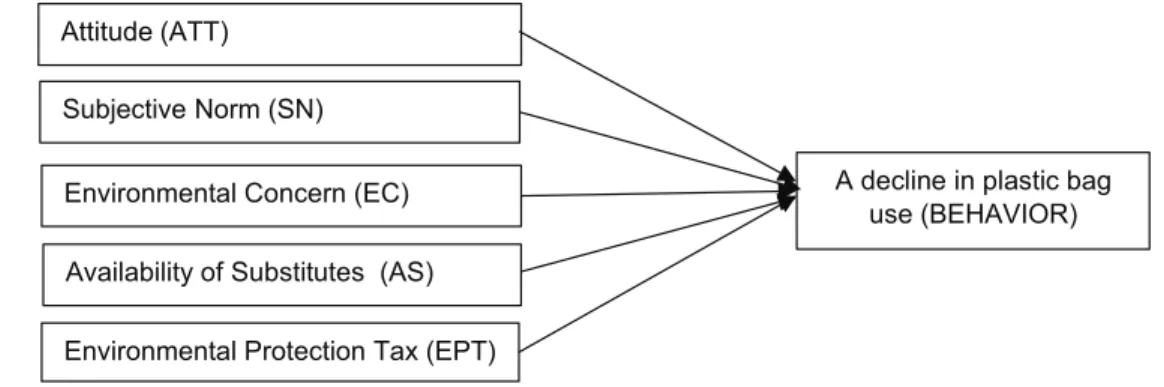
formulates the research model as described in Figure 1.

(4)

3. Research Methodology

A questionnaire used to collect data was designed with two parts. Part 1 included assessments of individuals on the research features (attitude, subjective norm, environmental concern, the availability of substitutes, the environmental protection tax policy and the plastic bag use). These indicators were measured using a five-point Likert scale, with “completely disagree” at 1 and “completely agree” at 5. Part 2 included personal information (gender, age and income).

The collected data was processed using the statistical analysis software SPSS and Amos. First, Cronbach’s Alpha was measured to test the scale reliability. Afterwards, we conducted the Exploratory Factor Analysis (EFA) using the Principle Axis Factoring (PAF) and Promax methods to uncover the structure of the scales. In other words, this analysis was implemented to ensure that each variable loaded on only one factor. The Confirmatory Factor Analysis (CFA) was then implemented to verify the study model. Finally, the Structural Equation Modeling (SEM) was applied to determine the factors influencing the consumption behavior of plastic bags.

4. Results and Discussion

4.1. Description of Research Sample

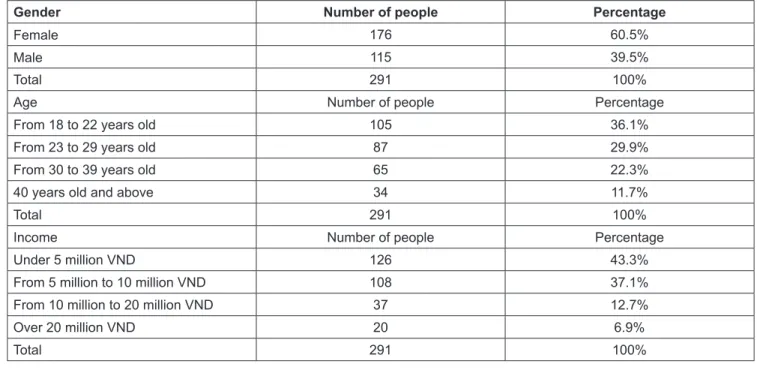
There were 327 questionnaires returned. However, after data screening, only 291 valid responders were employed in the analysis. Table 1 describes the information of participants in the survey. Notably, the sample consists of 115 male responders (39.5%) and 176 female responders (60.5%). There are 105 responders (36.1%) aged 18 to 22;

87 responders (29.9%) aged 23 to 29; 65 responders (22.3%)

aged 30 to 39, and 34 responders aged 40 and older. Most respondents (93.1%) report that their monthly income is less than or equal to VND20 million.

4.2. Results and Discussion

To assess the quality of the questionnaire, we first test the scale’s reliability. Cronbach’s Alpha (α) values of the variables should be higher than the minimum 0.7 standard (Hair, Anderson, Tatham, & Black, 1998). The results show that all variables reach the 0.7 standard and their corrected item-total correlations are higher than 0.3.

Hence, the variables are eligible to be analyzed in the next steps.

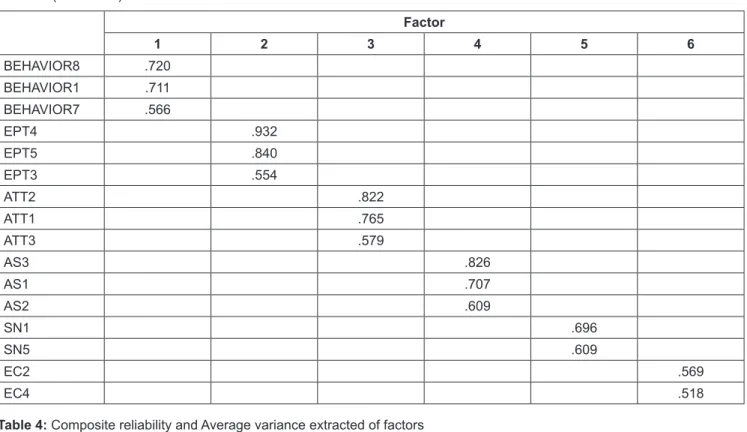
Next, we implement the EFA analysis to verify the structure of the scales. Factors excluded from the study model are SN2, SN3, SN4, EC1, EC3, EPT1 and EPT2. The final EFA results indicate that KMO and the Bartlett values reach 0.894 (>0.5) and Sig. = 0.000 (<0.05), respectively. At the Eigenvalues = 1.050 (>1), the corresponding total variance is 61.325% (>50%).

Moreover, the factor loadings of variables range from 0.518 to 0.932, which are higher than 0.5. Thus, all variables are interrelated and groups of factors can be used for further analysis. Results from the EFA analysis are exhibited in table 2 and table 3.

We then conduct the CFA analysis to test the differentiation and reliability of the structure. After adjusting the covariance between errors of variables based on modification indices, it is shown that the chi-square/df=2.525 < 3, p-value=0.000, TLI=0.901, CFI=0.920 > 0.9 and RMSEA=0.073 < 0.8.

These indicators all satisfy the applicable conditions, thus the research model can be considered as consistent with the collected data.

Attitude (ATT) Subjective Norm (SN) Environmental Concern (EC) Availability of Substitutes (AS) Environmental Protection Tax (EPT)

A decline in plastic bag use (BEHAVIOR)

Figure 1: Research model

(5)

Table 1: Description of research sample

Gender Number of people Percentage

Female 176 60.5%

Male 115 39.5%

Total 291 100%

Age Number of people Percentage

From 18 to 22 years old 105 36.1%

From 23 to 29 years old 87 29.9%

From 30 to 39 years old 65 22.3%

40 years old and above 34 11.7%

Total 291 100%

Income Number of people Percentage

Under 5 million VND 126 43.3%

From 5 million to 10 million VND 108 37.1%

From 10 million to 20 million VND 37 12.7%

Over 20 million VND 20 6.9%

Total 291 100%

Table 2: Total Variance Explained

Factor Initial Eigenvalues Extraction Sums of Squared Loadings Rotation Sums of Squared

Loadings

a

Total % of Variance Cumulative % Total % of Variance Cumulative % Total

1 7.987 38.035 38.035 7.629 36.329 36.329 6.999

2 1.948 9.278 47.313 1.630 7.764 44.093 3.504

3 1.786 8.505 55.819 1.411 6.717 50.810 4.670

4 1.409 6.710 62.528 1.010 4.809 55.619 2.447

5 1.074 5.113 67.641 .645 3.070 58.689 2.577

6 1.050 4.998 72.639 .554 2.636 61.325 3.059

7 .662 3.152 75.792

Table 3: Pattern Matrix

Factor

1 2 3 4 5 6

BEHAVIOR4 .910

BEHAVIOR3 .859

BEHAVIOR5 .836

BEHAVIOR6 .770

BEHAVIOR2 .724

(6)

Also, we estimate the composite reliability (CR) and the average variance extracted (AVE) to test the reliability of the scale. Generally, the CR should be greater than 0.7, however the CR values of 0.60 to 0.70 are also considered acceptable (Nunnally & Bernstein, 1994; Hair, Sarstedt, Hopkins,

& Kuppelwieser, 2014). Meanwhile, the AVE should be higher than 0.50. If the AVE is below 0.5 but the CR is above the acceptable level of 0.6, the convergent validity of the construct is acceptable (Fornell & Larcker, 1981;

Lam, 2012). Table 4 exhibits the results of these analyses.

Generally, the CR and AVE of all factors satisfy the above requirements. Therefore, they are kept in the research model.

Next, we test the discriminant validity of the scales. All correlation coefficients are lower than 1 and statistically significant (p <0.05). Furthermore, the square root of the AVE is more potent than the corresponding variables

correlation. Hence, these constructs satisfy the discriminant validity requirements.

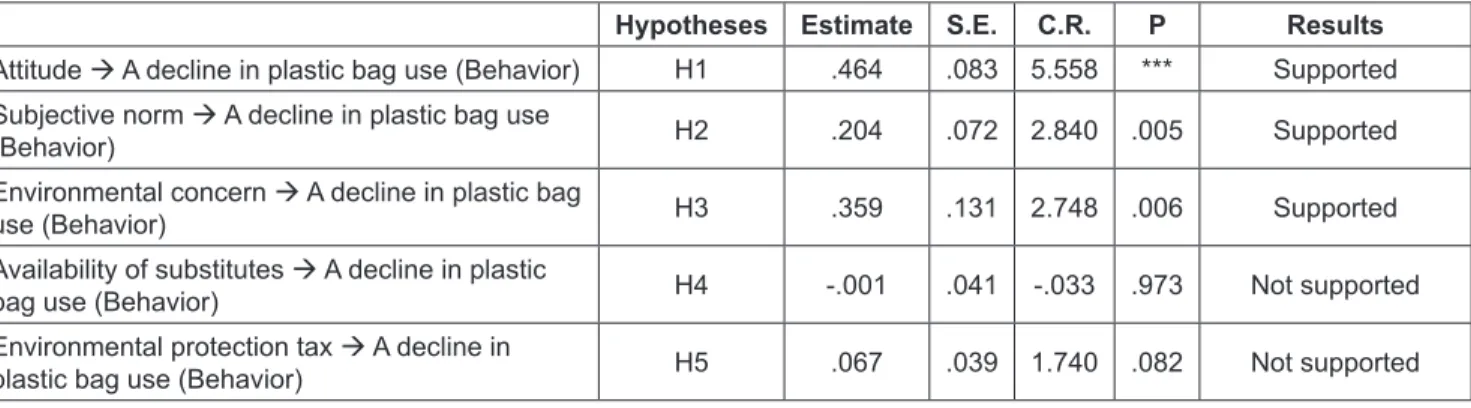
Based on the above tests, we run the SEM model to determine the factors affecting the consumption behavior of plastic bags. The regression results show that p-values of two factors, namely the availability of substitutes and the environmental protection tax are greater than 0.05.

Hence, the availability of substitutes and the environmental protection tax have no effect on the use of plastic bags. In other words, hypotheses H4 and H5 are not supported, and thus they are excluded from the model.

We then rerun the SEM model, which removes the above factors. It is shown that p-values of attitude, subjective norm and environmental concern are all lower than 0.05. Also, the C.R. values of these factors are 5.967, 3.507 and 2.714, respectively. Hence, it can be concluded that the results are statistically significant.

Factor

1 2 3 4 5 6

BEHAVIOR8 .720

BEHAVIOR1 .711

BEHAVIOR7 .566

EPT4 .932

EPT5 .840

EPT3 .554

ATT2 .822

ATT1 .765

ATT3 .579

AS3 .826

AS1 .707

AS2 .609

SN1 .696

SN5 .609

EC2 .569

EC4 .518

Table 4: Composite reliability and Average variance extracted of factors

Factor Composite reliability (CR) Average variance extracted (AVE)

Behavior 0.924 0.604

Attitude 0.799 0.571

Subjective norm 0.643 0.475

Environmental concern 0.666 0.528

Availability of substitutes 0.760 0.513

Environmental protection tax 0.852 0.663

Table 3: (Continued)

(7)

Moreover, non-standardized weights of attitude, subjective norm and environmental concern have positive signs. Among these factors, attitude is the most influential factor in individuals’ plastic bag use. Indeed, the regression weight of attitude after removing the availability of substitutes and the environmental protection tax is .496. Meanwhile, the regression weights of subjective norm and environmental concern are .224 and .352, respectively. Therefore, attitude, subjective norm and environmental concern are positively associated with the decline in plastic bag use.

Furthermore, the value of R-Square for the overall model is 0.611, which means that 61.1% of the decrease in plastic bag use can be explained by factors in the constructs while the remaining 38.9% is affected by other factors that are not mentioned in the model.

The results of this study are consistent with earlier research that indicates a strong positive relationship between attitude and green consumption behavior (Kotchen &

Reiling, 2000; Mostafa, 2009; Zhao, Gao, Wu, Wang, &

Zhu, 2014; Paul, Modi, & Patel, 2016; Le, 2018). Similarly, researchers claim that subjective norm positively affects pro- environmental behavior (Smith & Paladino, 2010; Welsch &

Kühling, 2009; Eze & Ndubisi, 2013; Paul, Modi, & Patel, 2016; Le, 2018; Ho & Phan, 2018). In a number of studies, it is shown that environmental concern can enhance green behavior (Hines, Hungerford, & Tomera, 1987; Kim & Choi, 2005; Mostafa, 2009; Hu, Parsa, & Self, 2010; Paul, Modi, &

Patel, 2016). Luong (2013) and Hoang, Huynh, and Huynh (2018) support this statement by saying that the factor is positively related to green consumption in Vietnam.

Also, the study indicates that the availability of substitutes does not affect consumers’ green behavior. This result is similar to that of Hoang, Huynh, and Huynh (2018) and Le (2018).

Notably, the authors suggest the factor is not associated with pro-environmental behavior in Vietnam. The major finding of the study is that the environmental protection tax may not foster a decline in plastic bag use of individuals. Although this is contrary to the initial prediction, it is consistent with reviews by local experts (Tuoi Tre reporters, 2019; Do, 2019). In other

words, the environmental protection tax may fail to change the habit of using plastic bags in Vietnam. Indeed, despite the environmental protection tax, the price of plastic bags is very cheap, ranging from VND18,000-45,000/kg (Tuoi Tre reporters, 2019). Consequently, the use of plastic bags is still very popular in Vietnam. On average, a Vietnamese household uses one kilogram of plastic bags/month (Ministry of Natural Resources and Environment, 2019). This leads to negative consequences for the living environment of the local people and it will take a long time to deal with such pollution problem (ANTV reporters, 2019).

5. Conclusion

The research examines factors that affect the consumption of plastic bags in Vietnam. Notably, it is shown that the attitude seems to be the most influential factor in plastic bag use, as predicted by previous studies. Other factors that can also enhance green behavior of consumers are subjective norm and environmental concern. In contrast, the availability of substitutes may not encourage individuals to use green products. Moreover, the study suggests the environmental protection tax that Vietnam is applying has not promoted the reduction of plastic bag use. As a result, plastic bags are still very popular in Vietnam due to their convenience and cheap prices. This in turn can cause enormous harm to the local people’s living environment.

Thus, in order to change consumer behavior toward plastic bag use, the government may need to consider more appropriate adjustments. This can include changes in taxable subjects and tax rates to limit the production and consumption of plastic bags. In addition, the government should focus on the management and supervision of stakeholders to ensure that the tax policy is implemented effectively. Finally, it is necessary to increase communication and education activities, which can positively impact individuals’ attitudes, subjective norms and environmental concern. This will help the community better understand the harms of non- biodegradable plastic bags, thereby encouraging them to use more environmentally friendly products.

Table 5: The outcomes of hypothesis testing

Hypotheses Estimate S.E. C.R. P Results Attitude  A decline in plastic bag use (Behavior) H1 .464 .083 5.558 *** Supported Subjective norm  A decline in plastic bag use

(Behavior) H2 .204 .072 2.840 .005 Supported

Environmental concern  A decline in plastic bag

use (Behavior) H3 .359 .131 2.748 .006 Supported

Availability of substitutes  A decline in plastic

bag use (Behavior) H4 -.001 .041 -.033 .973 Not supported

Environmental protection tax  A decline in

plastic bag use (Behavior) H5 .067 .039 1.740 .082 Not supported

(8)

References

Ajzen, I. (1991). The theory of planned behavior. Organizational Behavior and Human Decision Processes, 50(2), 179–

211. https://doi.org/10.1016/0749-5978(91)90020-T

ANTV Reporters (2019). “White pollution” - the numbers are alarming. Retrieved December 1, 2020 from http://www.antv.

gov.vn/tin-tuc/xa-hoi/o-nhiem-trang-%E2%80%93-nhung- con-so-dang-bao-dong-300119.html

Biel, A., & Thøgersen, J., 2007. Activation of social norms in social dilemmas: a review of the evidence and reflections on the implications for environmental behaviour. Journal of Economic Psychology, 28, 93–112.

Birgelen, M., Semeijn, J., & Keicher, M. (2009). Packaging and Pro-environmental Consumption Behavior:

Investigating Purchase and Disposal Decisions for Beverages. Environment and Behavior, 41(1), 125–146. https://

doi.org/10.1177/0013916507311140.

De Pelsmacker, P., Driesen, L., & Rayp, G. (2005). Do consumers care about ethics? Willingness to pay for fair-trade coffee.

Journal of Consumer Affairs, 39(2), 363–385. DOI:

10.1111/j.1745-6606.2005.00019.x

Do, L. (2019). Public reluctance impedes fight against plastic.

Retrieved December 1, 2020 from https://e.vnexpress.net/

news/life/trend/public-reluctance-impedes-fight-against- plastic-4001319.html

Dunlap, R. E., & Jones, R. E. (2002). Environmental concern:

conceptual and measurement issues. In: R. E. Dunlap & W.

Michelson (Eds.), Handbook of Environmental Sociology (pp.

482-524). Westport, CT: Greenwood Press.

Earth Policy Institute. (2014). Plastic bag regulations worldwide.

Retrieved November 25, 2020 from http:// www.earth-policy.

org/data_center/C26.

Eze, U. C., & Ndubisi, N. O. (2013). Green buyer behavior:

evidence from Asia consumers. Journal of Asian and African Studies, 48(4), 413-426.

Fishbein, M. (1967). A behavior theory approach to the relations between beliefs about an object and the attitude toward the object. In: M. Fishbein (Ed.), Readings in attitude theory and measurement (pp. 389-400). New York, NY: John Wiley & Sons.

Fishbein, M., & Ajzen, I. (1975). Belief, Attitude, Intention And Behavior. Boston, MA: Addison-Wesley.

Fornell, C., & Larcker, D. F. (1981). Structural equation models with unobservable variables and measurement error: Algebra and statistics. Journal of Marketing Research, 18(3), 382–388.

https://doi.org/10.2307/3150980.

Gleim, M. R., Smith, J. S., Andrews, D., & Cronin, J. J., Jr.

(2013). Against the green: A multi-method examination of the barriers to green consumption. Journal of Retailing, 89(1), 44–

61. https://doi.org/10.1016/j.jretai.2012.10.001.

Hair, J. F., Anderson, R. E., Tatham, R. L., & Black, W. C (1998).

Multivariate Data Analysis. Englewood Cliffs, NJ: Prentice- Hall International.

Hair, J. F., Sarstedt, M., Hopkins, L., & Kuppelwieser, V. G. (2014).

Partial least squares structural equation modeling (PLS-SEM):

An emerging tool in business research. European Business Review, 26(2), 106–121.

Hansla, A., Gamble, A., Juliusson, A., & Garling, T. (2008).

The Relationships between Awareness of Consequences, Environmental Concern, and Value Orientations. Journal of Environmental Psychology, 28, 1–9. http://dx.doi.org/10.1016/j.

jenvp.2007.08.004.

Hoang, T. B. T (2016). Factors affecting the relationship between Vietnamese consumers’ green consumption intentions and behaviors. Doctoral thesis. VNU University of Economics and Business.

Hoang, T. H., Huynh, T. T. Q and Huynh, T. N. (2018). Factors affecting green consumption behavior of consumers in Hue city. Hue University Journal of Science, 127(5A), 1999–212.

Hee, S. P. (2000). Relationships among attitudes and subjective norm: Testing the theory of reasoned action across cultures.

Communication Studies, 51(2), 162–175.

Hines, J., Hungerford, H., & Tomera, A. (1987). Analysis and Syntheses of research on environmental behaviour: A meta- analysis. Journal of Environmental Education, 18(2), 1–8.

Ho, L. T. T., & Phan, T. P. T. (2018). Applying the theory of planned behavior (TPB) to analyze pro-environmental behavioral intentions of domestic tourists in Can Tho city. Can Tho University Journal of Science, 54(9D), 124–132.

Hu, H. H., Parsa, H. G., & Self, J. (2010). The Dynamics of Green Restaurant Patronage. Cornell Hospitality Quarterly, 51(3), 344–362.

Jambeck, J. R., Andrady, A., Geyer, R., Narayan, R., Perryman, M., Siegler, T., Wilcox, C., & Lavender, K. (2015). Plastic waste inputs from land into the ocean, Science, 347, 768–771.

Kim, Y., & Choi, S. R. (2005). Antecedents of green purchase behaviour: An examination of collectivism, environmental concern and PCE. Advances in Consumer Research, 32(1), 592–599.

Kotchen, M., & Reiling, S. D. (2000). Environmental Attitudes, Motivations, and Contingent Valuation of Nonuse Values:

A Case Study Involving Endangered Species. Ecological Economics, 32, 93–107. http://dx.doi.org/10.1016/S0921- 8009(99)00069-5

Lam, L. W. (2012). Impact of competitiveness on salespeople’s commitment and performance. Journal of Business Research, 65(9), 1328–1334. https://doi.org/10.1016/j.

jbusres.2011.10.026

Le, T. D. T. (2018). The relationship between the intentions and the

use of biodegradable bags. Master’s thesis. Ho Chi Minh City

Open University.

(9)

Lee, C. J., & Lim, S. Y (2020). Impact of Environmental Concern on Image of Internal GSCM Practices and Consumer Purchasing Behavior. Journal of Asian Finance, Economics and Business, 7(6), 241–254. https://doi.org/10.13106/jafeb.2020.vol7.

no6.241

Luong, T. B. V. (2013). Assessment of the impact of the environmental protection tax policy on the use of plastic bags in Hanoi. Master Thesis. VNU University of Science.

Ministry of Natural Resources and Environment (2019). Joint action against plastic waste for a green Vietnam. Retrieved November 24, 2020 from http://www.monre.gov.vn/Pages/

chung-tay-hanh-dong-chong-rac-thai-nhua-vi-mot-viet-nam- xanh.aspx

Mostafa, M. M. (2009). Shades of green: A psychographic segmentation of the green consumer in Kuwait using self-organizing maps. Expert Systems with Applications, 36(8), 11030–11038.

Nunnally, J. C., & Bernstein, I. H. (1994). The Assessment of Reliability. Psychometric Theory, 3, 248–292.

Nguyen, D. (2018). Why Vietnamese prefer using plastic bags.

Retrieved November 24, 2020 from https://tuoitrenews.vn/

news/society/20180803/why-vietnamese-prefer-using-plastic- bags/46871.html

Nguyen, T. K. C., Nguyen, D. M., Trinh, V. T, Tran, T. P. D., & Cao, T. P. (2020). Factors Affecting Intention to Purchase Green Products in Vietnam. Journal of Asian Finance, Economics and Business, 7(4), 205–211. https://doi.org/10.13106/jafeb.2020.

vol7.no4.205

Paul, J., Modi, A., & Patel, J. (2016). Predicting green product consumption using theory of planned behavior and reasoned action. Journal of Retailing and Consumer Services, 29(C), 123–134.

Pham, H. C. (2020). Antecedents of Organic Food Products Intention and Behaviors: Evidence from Vietnam. Journal

of Asian Finance, Economics and Business, 7(11), 429–437.

https://doi.org/10.13106/jafeb.2020.vol7.no11.429

Smithers, R. (2020). England’s Plastic Bag Usage Drops 85% since 5p Charge Introduced. Retrieved November 30, 2020 from https://www.theguardian.com/environment/2020/jul/30/use-of- plastic-bags-in-england-drops-by-59-in-a-year.

Smith, S., & Paladino, A. (2010). Eating clean and green?

Investigating consumer motivations towards the purchase of organic food. Australasian Marketing Journal, 18(2), 93–104.

https://doi.org/10.1016/j.ausmj.2010.01.001.

Tuoi Tre Reporters. (2019). Plastic bag reductions: Tax does not work!. Retrieved December 1, 2020 from https://

tuoitre.vn/han-che-tui-nilong-danh-thue-cung-nhu- khong-2019092308472249.htm

Vu, A. D., Nguyen, T. H., & Nguyen, N. A. (2012). Test the model of factors affecting green consumption behavior. Vietnam Economic Review, 7(195), 30–52.

Welsch, H., & Kühling, J. (2009). Determinants of pro- environmental consumption: The role of reference groups and routine behavior. Ecological Economics, 69(1), 166–176.

Welsh Government (2016). Post-Implementation Review of the Single Use Carrier Bag Charge in Wales. Retrieved January 2, 2021 from https://gov.wales/sites/default/files/statistics-and- research/2019-07/160314-post-implementation-review-single- use-carrier-bag-charge-en.pdf.

Young W., Hwang K., Donald S. M., and Otaes C. J. (2010).

Sustainable Consumption: Green Consumer Behaviour when Purchasing Product. Sustainable Development, 18, 20–31.

Zhao, H., Gao, Q., Wu, Y., Wang, Y., & Zhu, X. (2014). What affects green consumer behavior in China? A case study from Qingdao. Journal of Cleaner Production, 63, 143–151.

doi: 10.1016/j.jclepro.2013.05.021

수치

Figure 1: Research model
Table 1: Description of research sample
Table 4: Composite reliability and Average variance extracted of factors
Table 5: The outcomes of hypothesis testing

참조

관련 문서

- The level of radioactivation, along with other radioactivity aspects such as the T inventory will be a key factor in determining the environmental impact of fusion

- The level of radioactivation, along with other radioactivity aspects such as the T inventory will be a key factor in determining the environmental impact of fusion

출처 : IAEA 발표 자료(Comprehensive inspection exercise at bulk handling facilities, “U-235 Enrichment measurements by gamma-ray spectroscopy”) 13.  Uranium

※ Keywords : Marine Environmental Assessment(MEA), Evaluation of Legislat- ion, Deliberation System on Marine and Coastal Area Utilization (DSM), Environmental

It considers the energy use of the different components that are involved in the distribution and viewing of video content: data centres and content delivery networks

S국은 국내법에 따라 과세할 권리를 기지고 있 지 않기 때문에 , 그리고 조세조약에 따라 소득이 귀속될 S국에 있는 Tco가 S국에 고정사업장을 가지고 있지

After first field tests, we expect electric passenger drones or eVTOL aircraft (short for electric vertical take-off and landing) to start providing commercial mobility

1 John Owen, Justification by Faith Alone, in The Works of John Owen, ed. John Bolt, trans. Scott Clark, &#34;Do This and Live: Christ's Active Obedience as the