• 검색 결과가 없습니다.

A Preliminary Study on the Correlation Between ICF and Functions of Upper Limbs of Chronic Stroke Patients : ICF Activities, Participations, and Environmental Factors

N/A
N/A
Protected

Academic year: 2021

Share "A Preliminary Study on the Correlation Between ICF and Functions of Upper Limbs of Chronic Stroke Patients : ICF Activities, Participations, and Environmental Factors"

Copied!
9
0
0

로드 중.... (전체 텍스트 보기)

전체 글

(1)

Original Article Open Access

만성 뇌졸중 환자의 상지 기능과 ICF와의 상관관계 예비 연구 : ICF 활동, 참여 및 환경영역 중심으로

임종우⋅윤성경 1 ⋅이영민 2†

1)

예성병원 물리치료실, 1 다산 하늘센터 물리치료실, 2 한림대학교 춘천성심병원 물리치료실

A Preliminary Study on the Correlation Between ICF and Functions of Upper Limbs of Chronic Stroke Patients : ICF Activities, Participations, and Environmental Factors

Jong-Woo Im⋅Kyu-Hyun Shin 1 ⋅Young-Min Lee 2†

Dept. of Physical Therapy, Yeseong Sanitarium Hospital

1 Dept. of Physical Therapy, Dasan Welfare Foundation

2 Dept. of Physical Therapy, Hallym University Chuncheon Sacred Heart Hospital

Received: October 20, 2018 / Revised: November 26, 2018 / Accepted: November 27, 2018

ⓒ 2018 Journal of Korea Proprioceptive Neuromuscular Facilitation Association

This is an Open Access article distributed under the terms of the Creative Commons Attribution Non-Commercial License (http://creativecommons.org/licenses/by-nc/3.0) which permits unrestricted non-commercial use, distribution, and reproduction in any medium, provided the original work is properly cited.

| Abstract |

Purpose: This study provides a treatment for central nervous system development in patients with chronic stroke by investigating changes in the upper limb function over time. The correlations among the activities, participation, and environmental factors of the international classification of functioning (ICF), disability and health are also examined.

Methods: The subjects of this study are 18 patients with chronic stroke who were hospitalized and treated at 00 hospital in the Chungcheongbuk-do province. Their upper extremity functions are evaluated using the manual function test (MFT). The activities, participation, and environmental factors are evaluated using the ICF generic form. The correlations between the total scores of the affected and unaffected sides and the ICF items are analyzed using the Pearson correlation analysis. The significance level is p<0.05.

Results: When the correlations between the activities and participation areas of ICF and the total score of the affected side of MFT were examined, significant correlations (p<0.05) were found in the following items: changing basic body position (D410), lifting and carrying objects (D430), moving around using equipment (D465), using transportation (D470), washing oneself (D510), caring for body parts (D520), and dressing (D540). When the correlations between the activities and participation areas of ICF and the total score of the unaffected side of MFT were examined, significant correlations (p<0.05) were found among writing (D170), speaking (D330), eating (D550), and drinking (D560). In addition, when the correlation between the environment area of ICF and the total score of the unaffected side of the MFT were examined, significant correlations (p<0.05) were found between products and technology for personal use in daily living (E115) and immediate family (E310).

Conclusion: The MFT of patients with chronic stroke is closely correlated with the activities, participation, and environmental factors of ICF. This result suggests that ICF can be used as a useful tool to comprehensively evaluate the abilities of the patient, including the upper extremity function.

Key Words: Stroke patients, Upper limbs, ICF

†Corresponding Author : Young-Min Lee ([email protected])

(2)

Ⅰ. 서론

뇌졸중은 뇌혈관 손상에 의해 발생되며, 환자의 증 상과 예후는 손상으로 인한 병변의 기전, 위치, 손상의 정도에 따라 결정된다(Trombly & Radomski, 2002). 뇌 졸중 환자의 상지기능은 마비측 상지의 사용감소로 인해 근력감소, 손과 전완의 움직임 감소, 경직의 증가, 연부조직 단축, 비정상적인 움직임, 기능적 움직임의 소실 등과 같은 문제를 일으키게 된다(Gjelsvik, 2008).

뇌졸중 환자의 약 88% 정도가 여러 수준에서 장애를 나타내고, 상지의 운동, 기능회복을 하지 못한다 (Pendleton & Schultz-Krohn, 2014). 이는 식사하기, 옷 입기, 개인관리와 같은 독립적인 일상생활에 중요한 영향을 미치게 된다(Cooper et al., 1993). 환자들은 일상 생활 동작에서 마비측 손을 잘 사용하지 못하고 일상 생활의 대부분을 다른 보조수단이나 비마비측 상지를 이용해야 하는 어려움이 있다(Lee & Kim, 2001).

이와 같이 뇌졸중 환자의 신체기능 손상은 나타나 는 양상이 다양하여 객관적이고 체계적이며 일관된 기능 평가와 치료적 접근이 필요하다. 과제수행과 신 체장애에 대한 정보는 진단, 치료계획, 치료효과를 평 가하기 위해 필수적이다(Barak and Duncan, 2006). 이 에 2001년 세계보건기구(World Health Organization, WHO)에서는 국제 기능, 장애, 건강분류(international classification of functioning, disability and health, ICF)라 는 건강 및 건강 관련 상태를 표현하는 체계와 통일된 표준분류를 제시하였다. ICF에서는 제 1부 기능 (functioning)과 장애(disability), 제 2부 배경요인 (contextual factors)으로 구성되며, 제 1부 기능과 장애 의 구성요소는 신체계통의 기능적 분류와 구조적 분 류로 나누고, 활동 및 참여 요소는 개인적·사회적 관점 에서 기능적인 측면과 관련된 모든 영역을 포함하고 있다. 제 2부 배경요인의 구성요소는 환경요인과 개인 요인으로 이루어져 있다(WHO, 2001). 환자의 체계적 인 평가 과정을 통해 기존의 평가도구들이 기능적인 수행 평가에 치중하였다면 ICF는 신체기능적인 요소 와 개인의 배경요인을 파악하여 다양한 정보를 수집

할 수 있는 장점이 있다(Ustun et al., 2003).

ICF는 항목들을 체계적으로 분류하였지만 그 양이 약 1,500개로 방대하여 임상에 적용하기에는 한계가 있다. 이전의 선행 연구들에서는 ICF를 통해 장애의 개념을 재정립하고 질병 코드 분류, 기능 평가를 위한 ICF의 코드 분류 작업과 장애인의 기능 상태와 관련 요인 조사(Cieza et al., 2005)가 있었고, 뇌졸중 환자를 평가하기 위한 ICF 평가 항목 추출 연구(Salter et al., 2005; Salter et al., 2005a, 2005b), ICF 평가 항목과 수정 바델지수(modified Barthel index, MBI), 기능적 독립성 측정도구(functional independence measure, FIM), 일상 생활동작 지수, 운동 기능, 균형 및 이동능력, 삶의 질 만족도, 일어서서 걷기 검사(timed up and go test, TUG)간의 항목 추출과 비교 연구(Schepers et al., 2007) 를 비롯하여 다각적인 연구들이 있었다. ICF 항목의 체계적인 측정을 위하여 기존의 기능적 평가도구들과 짝지어 평가하는 방법을 이용한 다양한 연구들이 있 지만 이는 평가 방법을 위한 연구들이다. ICF 항목과 기존의 평가도구와의 상관관계를 분석하여 치료의 목 표로 제시하고 있는 연구들은 부족한 실정이다.

본 연구는 만성 뇌졸중 환자들의 상지기능과 ICF의 활동, 참여 및 환경요인 중 상지기능과 관련이 있는 항목들 간의 상관관계를 분석하였다. 이를 토대로 뇌 졸중 환자의 마비측과 비마비측 상지 기능수행 정도 에 따른 활동, 참여 및 환경요인의 상관관계에 따라 연관성이 있는 ICF 항목들을 분석하였다. 최종적으로 상지기능을 ICF 활동, 참여영역에 따라 환자의 치료적 목표로 설정하고, 환자 개개인별 환경요인을 고려하 여 일상생활이나 사회생활을 하는데 도움이 되도록 함에 있다.

Ⅱ. 연구 방법

1. 연구대상

연구대상자는 충청북도 00시에 소재하고 있는 00

(3)

병원의 만성뇌졸중환자(발병 후 1년 이상) 18명을 대 상으로 진행하였다. 대상자는 편마비를 가지고 있고 뇌졸중 이외에 다른 신경학적 병변이 없는 사람들로 선정하였다. 실험에 앞서 실험 참가자들에게 본 연구 의 목적을 설명하고 실험참여에 대한 동의를 얻었다.

2. 측정방법 및 도구

1) 상지기능 측정

상지기능평가(manual function test, MFT)는 작업치료 사 1명에 의해 측정되었다. 본 연구에는 Kim (1994) 에 의해 한글로 번역된 한글 MFT 검사방법을 기준으로 검 사를 시행하였다. 검사-재검사 신뢰도, 검사자간 신뢰도 는 모두 r=0.95 이상으로 나타났다(Miyamoto et al., 2009) MFT는 “상지 앞으로 올리기”(forward elevation of the upper extremity, FE), “ 상지 옆으로 올리기”(lateral elevation of the upper extremity, LE) “ 손바닥을 후두부 로 가져가기”(touching the occiput with the palm, PO),

“손바닥을 등에 가져가기”(touching the dorsum with the palm, PD) 상지의 운동 4항목, “쥐기”(grasping a ball, GR), “ 잡기”(pinching a pencil, needle, and coin, PI) 장악력 2항목, “입방체 옮기기”(carrying a cube, CC), “페그보드 수행”(Peg board, PP) 손가락 조작 2항 목으로 이루어져 있으며, 만점은 32점이다. 검사의 순 서는 비마비측에서 마비측으로 진행하며, 각 항목을 평가할 때 구두 지시와 검사자가 시범을 보인 이후 시작하였다.

2) ICF 활동, 참여요인

한국형 ICF 핵심지표(ICF generic form) 활동, 참여 영역 16항목 능력 평가치(National Rehabilitation Center, 2006) 는 ICF 평가에 대해 교육을 받은 물리치료사 1명 에 의해 측정되었다.

ICF generic form는 2006년도에 국립재활원에서 우 리나라 특성에 맞게 ICF코드를 선정하여 개발한 도구

이다. 내용은 신체기능 영역 9항목, 활동 및 참여 영역 16항목, 환경요인 9항목으로 총 34항목과 뇌병변 장애 와 근 골격계 장애에서 각각 2항목을 추가하여 만들어 졌다. 본 연구에서는 ICF generic form중에서 뇌병변에 포함된 36항목 중 활동 및 참여 16개 항목의 능력 평가 치를 측정하였다. 항목별 내용은 “쓰기”(writing, D170),

“구두로 전달받은 메시지로 의사소통”(communicating with –receiving–spoken massages, D310), “비언어적 전달 메시지로 의사소통”(communicating with–receiving–nonverbal massages, D315), “말하기”(speaking, D330), “기본적인 자세변화”(changing basic body position, D410), “물건 들어 올려 나르기”(liffting and carrying objects, D430),

“ 걷기”(walking, D450), “장비를 이용한 이동”(moving around using equipment, D465), “운송수단 이용”(using transportation, D470), “씻기”(washing onesalf, D510),

“신체일부관리”(caring for body parts, D520), “대소변 처리”(toileting, D530), “몸단장”(dressing, D540), “먹 기”(eating, D550), “마시기”(drinking, D560), “기본적 인 대인관계”(basic interpersonal interactions, D710)로 구성되어 있다.

0 점(무손상, 어려움이 없거나 무시할만한) ~ 4점(완 전손상, 완전한 어려움)으로 5점 척도로 평가하였으며 활동수행의 어려움 정도가 심할수록 평가점수는 높아 진다. 각 항목의 기준은 국립재활원 (2006)에서 정한 ICF generic form 항목의 평가기준을 따랐다.

3) ICF 환경요인

ICF generic form 환경요인 9항목 능력 평가치 (National Rehabilitation Center, 2006) 는 ICF 평가에 대 해 교육을 받은 물리치료사 1명에 의해 측정되었다.

본 연구에서는 ICF generic form중에서 뇌병변에 포

함된 36항목 환경요인 9개 항목으로 평가하였다. 항목

별 내용은 “개인소비용품 또는 물질”(products or

substances for personal consumption, E110), “ 개인일상

생활용품 및 기술”(products and technology for personal

use in daily living, E115), “공공건물설계, 축조, 건축

(4)

관련 제품 및 기술”(design, construction and building products and technology of buildings for public use, E150), “개인용 건물설계, 축조, 건축 관련 제품 및 기술”(design, construction and building products and technology of buildings for private use, E155), “ 자 산”(assets, E165), “직계가족”(immediate family, E310),

“개인적 도움제공자 및 개인 보조원”(personal care providers and personal assistants, E340), “ 보건전문 가”(health professionals, E355), “사회보장서비스, 시스 템 및 정책”(social security services, systems and policies, E570)으로 구성되어 있다.

환경요인에서는 촉진요인 1점 ~ 4점, 장애요인 –1점

~ –4점, 장애도 도움도 아닐 경우 0점으로 최소값 –4점 에서 최대값 4점까지의 범위로 총 9점 척도로 측정하 였다. 각 항목의 기준은 National Rehabilitation Center (2006)에서 정한 ICF generic form 항목의 평가기준을 따랐다.

3. 실험 절차

본 연구는 MFT를 이용하여 상지기능을 평가하고, 10 분이 경과한 뒤 ICF generic form을 이용하여 활동 및 참여, 환경요인을 평가하였다.

4. 자료 분석

본 연구에서 수집된 자료는 SPSS 12.0 for Windows 프로그램을 이용하여 대상자의 일반적 특성, MFT와 ICF 활동 및 참여, 환경요인은 기술통계로 하였으며, 의학적 특성은 빈도분석을 실시하였다. ICF의 활동, 참여 및 환경요인과 MFT와의 상관관계를 알아보기 위하여 데이터를 가지고 피어슨 상관분석(Pearson correlation analysis)을 실시하였다. 통계적 유의수준은 α=0.05로 하였다.

Ⅲ. 연구 결과

1. 연구 대상자의 일반적인 특성 및 의학적 특성

본 연구에 참가한 환자들은 18명의 뇌졸중 환자로 일반적 특성에서 성별은 남자 11명(61.1%), 여자 7명 (38.9%)이고, 평균 연령은 57.7±8.5세, 신장 167.3±

9.1cm, 체중 62.2±6.3로 나타났다. 또한 환자의 의학적 특성에서 발병원인은 뇌경색 10명(55.6%), 뇌출혈 8명 (44.4%) 으로 나타났고, 마비측은 오른쪽 10명(55.6%), 왼쪽 8명(44.4%), 유병기간은 12~24개월 4명(22.2%), 25~36개월 12명(66.7%), 36개월 이상 2명(11.1%)로 나 타났다(Table 1).

Characteristics Mean±SD

Sex

Male 11(61.1%)

Female 7(38.9%)

Stroke

Infarction 10(55.6%) Hemorrhage 8(44.4%)

Hemiplegic side

Right 10(55.6%) Left 8(44.4%) Duration (months)

12 ~ 24 4(22.2%)

24 ~ 36 12(66.7%)

36 ~ 2(11.1%) Age (years) 57.7±8.5 Height ( ) 167.3±9.1 Weight ( ) 62.2±6.3 Table 1. General characteristics of subjects (n=18)

2. 연구 대상자의 MFT 평가 결과

연구 대상자의 MFT 평가 결과이다. 항목별 점수는

마비측에서 상지 앞으로 올리기는 2.44±0.92점, 상지

옆으로 올리기는 2.27±0.82점, 손바닥을 후두부로 가

(5)

져가기는 2.16±0.98점, 손바닥을 등에 가져가기는 2.38±0.91점, 쥐기는 1.22±1.11점, 잡기는 0.38±0.69점 입방체 옮기기는 0.88±0.96점, 페그보드 수행은 0.50±0.98 점 총점은 12.27±6.47점으로 나타났다. 비마 비측의 항목별 점수는 상지 앞으로 올리기는 4.00±0.00점, 상지 옆으로 올리기는 4.00±0.00점, 손바 닥을 후두부로 가져가기는 4.00±0.00점, 손바닥을 등 에 가져가기는 3.94±0.23점, 쥐기는 3.00±0.00점, 잡기 는 2.83±0.38점 입방체 옮기기는 3.11±0.67점, 페그보 드 수행은 4.66±1.18점 총점은 29.55±1.94점으로 나타 났다(Table 2).

Item Hemiplegic side Non-hemiplegic side

FE 2.44±0.92 4.00±0.00

LE 2.27±0.82 4.00±0.00

PO 2.16±0.98 4.00±0.00

PD 2.38±0.91 3.94±0.23

GR 1.22±1.11 3.00±0.00

PI 0.38±0.69 2.83±0.38

CC 0.88±0.96 3.11±0.67

PP 0.50±0.98 4.66±1.18

Total

score 12.27±6.47 29.55±1.94

FE: forward elevation of th upper extremity, LE: lateral elevation of the upper extremity, PO: touching the occiput with the palm, PD: touching the dorsum with the palm, GR:

grasping a ball, Pinching a pencil, needle, and coin, CC:

carrying a cube, PP: Peg-board Table 2. MFT score by item

3. 연구 대상자의 ICF 활동, 참여영역 평가 결과

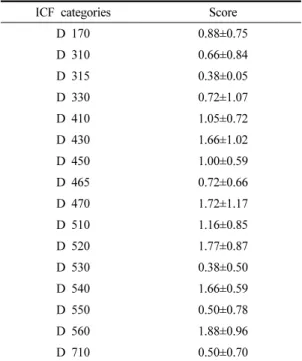
ICF의 활동, 참여영역의 평가 결과는 쓰기 0.88±

0.75점, 구두로 전달받은 메시지로 의사소통 0.66±0.84 점, 비언어적 전달메시지로 의사소통 0.38±0.05점, 말 하기 0.72±1.07점, 기본적인 자세변화 1.05±0.72점, 물 건 들어 올려 나르기 1.66±1.02점, 걷기 1.00±0.59점, 장비를 이용한 이동 0.72±0.66점, 운송수단 이용 1.72±

1.17 점, 씻기 1.16±0.85점, 신체일부관리 1.77±0.87점, 대소변 처리 0.38±0.50점, 몸단장 1.66±0.59점, 먹기

0.50±0.78점, 마시기 1.88±0.96점, 기본적인 대인관계 0.50±0.70점으로 나타났다(Table 3).

ICF categories Score

D 170 0.88±0.75

D 310 0.66±0.84

D 315 0.38±0.05

D 330 0.72±1.07

D 410 1.05±0.72

D 430 1.66±1.02

D 450 1.00±0.59

D 465 0.72±0.66

D 470 1.72±1.17

D 510 1.16±0.85

D 520 1.77±0.87

D 530 0.38±0.50

D 540 1.66±0.59

D 550 0.50±0.78

D 560 1.88±0.96

D 710 0.50±0.70

D170: writing, D315: communicating with receiving nonverbal messages, D310: communicating with receiving spoken messages, D410: changing basic body position, D330: speaking, D430: lifting and carrying objects, D450: walking, D465: moving around using equipment, D470: using transportation, D510: washing oneself, D520: caring for body parts, D530: toileting, D540: dressing, D550: eating, D710: basic interpersonal interactions, D560: drinking

Table 3. ICF activity, participation factors score by item

4. 연구 대상자의 ICF 환경요인 평가 결과

ICF의 환경요인의 평가 결과에서 개인소비용품 또

는 물질 1.55±1.42점, 개인일상생활용품 및 기술

2.22±1.39 점, 공공건물설계, 축조, 건축 관련 제품 및

기술 2.22±1.43점, 개인용 건물설계, 축조, 건축 관련

제품 및 기술 -1.22±1.98점, 자산 0.05±2.57점, 직계가족

2.11±2.08점, 개인적 도움제공자 및 개인 보조원

1.22±1.30 점, 보건전문가 2.88±0.75점, 사회보장서비스,

시스템 및 정책 1.66±1.94점으로 나타났다(Table 4).

(6)

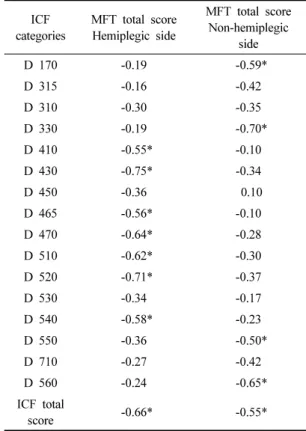
ICF categories

MFT total score Hemiplegic side

MFT total score Non-hemiplegic

side

D 170 -0.19 -0.59*

D 315 -0.16 -0.42

D 310 -0.30 -0.35

D 330 -0.19 -0.70*

D 410 -0.55* -0.10

D 430 -0.75* -0.34

D 450 -0.36 0.10

D 465 -0.56* -0.10

D 470 -0.64* -0.28

D 510 -0.62* -0.30

D 520 -0.71* -0.37

D 530 -0.34 -0.17

D 540 -0.58* -0.23

D 550 -0.36 -0.50*

D 710 -0.27 -0.42

D 560 -0.24 -0.65*

ICF total

score -0.66* -0.55*

D170: writing, D315: communicating with receiving nonverbal messages, D310: communicating with receiving spoken messages, D410: changing basic body position, D330: speaking, D430: lifting and carrying objects, D450: walking, D465:

moving around using equipment, D470: using transportation, D510: washing oneself, D520: caring for body parts, D530:

toileting, D540: dressing, D550: eating, D710: basic interpersonal interactions, D560: drinking

* p<0.05

Table 5 Correlation of ICF activities, participation and MFT

ICF categories Score

E110 1.55±1.42

E115 2.22±1.39

E150 2.22±1.43

E155 -1.22±1.98

E165 0.05±2.57

E310 2.11±2.08

E340 1.22±1.30

E355 2.88±0.75

E570 1.66±1.94

E110: products or substances for personal consumption, E115: products and technology for personal use in daily living, E150: design, construction and building products and technology of buildings for public use, E155: design, construction and building products and technology of buildings for private use, E165: assets, E310: immediate family, E340: personal care providers and personal assistants, E355: health professionals, E570: social security services, systems and policies

Table 4. ICF environment factors score by item

5. ICF 활동, 참여영역과 MFT의 상관관계

ICF 활동, 참여영역과 MFT 총점(마비측) 중에는 기본적인 자세변화(r=-0.55), 물건 들어 올려 나르기 (r=-0.75), 장비를 이용한 이동(r=-0.56), 운송수단 이용 (r=-0.64), 씻기(r=-0.62), 신체일부관리(r=-0.71), 몸단 장(r=-0.58), 총점(r=-0.66)이 유의한 음의 상관관계가 나타났다. 나머지 ICF 활동, 참여영역과는 낮은 상관 관계를 보였다. ICF 활동, 참여영역과 MFT 총점(비마 비측) 중에는 쓰기(r=-0.59), 말하기(r=-0.70), 먹기 (r=-0.50), 마시기(r=-0.65), 총점(r=-0.55)이 유의한 음 의 상관관계가 나타났다(Table 5).

6. ICF 환경요인과 MFT의 상관관계

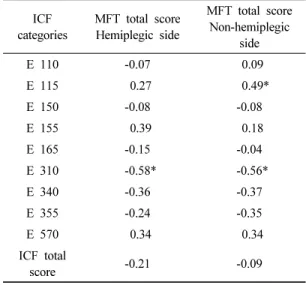
ICF 환경요소와 MFT 총점(마비측) 중에서는 직계 가족(r=-0.58)이 유의한 음의 상관관계로 나타났으며, ICF 환경요소와 MFT 총점(비마비측) 중에서는 개인 일상생활용품 및 기술(r=0.49)이 양의 상관관계로 나

타났고, 직계 가족(r=-0.56)이 음의 상관관계로 나타났 다(Table 6).

Ⅳ. 고찰

만성뇌졸중 환자들의 신체기능 향상은 일상생활이

나 사회복귀에서 중요한 목표이다. 특히 상지의 근력

약화, 관절가동범위 축소, 손과 전완의 움직임 감소

등의 문제점을 나타내며(Gjelsvik, 2008), 이로 인해 사

(7)

ICF categories

MFT total score Hemiplegic side

MFT total score Non-hemiplegic

side

E 110 -0.07 0.09

E 115 0.27 0.49*

E 150 -0.08 -0.08

E 155 0.39 0.18

E 165 -0.15 -0.04

E 310 -0.58* -0.56*

E 340 -0.36 -0.37

E 355 -0.24 -0.35

E 570 0.34 0.34

ICF total

score -0.21 -0.09

E110: products or substances for personal consumption, E115: products and technology for personal use in daily living, E150: design, construction and building products and technology of buildings for public use, E155: design, construction and building products and technology of buildings for private use, E165: assets, E310: immediate family, E340: personal care providers and personal assistants, E355: health professionals, E570:

social security services, systems and policies

* p<0.05

Table 6. Correlation of ICF environment factors and MFT

회활동과 일상생활활동에서 제약을 나타낼 수 있다 (Dijkerman et al., 2004).

본 연구에서는 상지기능의 문제점으로 인해 일상 생활이나 사회생활에 제약이 있는 뇌졸중 환자를 대 상으로 현재 임상에서 상지기능의 평가를 위해 보편 적으로 사용되고 있는 MFT와 신체 기능적 장애보다 그로 인한 건강과 생활 활동 수준을 평가하는데 초점 을 맞추고 있는 ICF (Ustun et al., 2003)를 활용하여 활동, 참여, 환경요인의 평가하였다. 이를 토대로 두 평가도구의 평가결과를 상관관계 분석하여 상지기능 에만 초점을 맞추는 것이 아닌 상지기능 결손의 결과 로 환자의 일상생활, 사회생활에서의 참여영역과 환 경영역에서 어떠한 문제를 가지고 있는지 분석하고자 하였다.

첫 번째로 본 연구에서 나타난 MFT 평가 결과 마비

측 상지운동능력에서 상지의 운동 4항목(FE, LE, PO, PD)의 점수가 장악력 2항목(GR, PI), 손가락 조작 2항 목(CC, PP)에서 보다 평균점수가 높게 나타났다. 이는 주로 대근육 운동인 상지의 운동이, 소근육 운동인 장악력, 손가락 조작의 항목보다 발달되어 있다고 생 각한다. 상지 기능의 회복에서 굽힘근을 이용하여 운 동할 때 손목과 손가락 폄근의 운동 방해로 수의적인 운동 조절과 미세운동을 어렵게 하여 집기나 쥐기 같 은 기능적인 동작들을 어렵게 만들고 일상생활활동을 수행하는데 방해요인이 된다고 하였다(Nelles et al., 2001).

ICF 활동, 참여 영역과 MFT 총점의 상관관계에서 는 기본적인 자세변화, 물건 들어 올려 나르기, 씻기, 신체일부관리, 몸단장 항목에서 유의한 음의 상관관 계가 나타났다. 이는 마비측의 상지 기능이 만성 뇌졸 중 환자의 일상생활에서 미치는 영향이 크다는 것을 알 수 있었다. 또한 MFT의 평가 결과와 마찬가지로 소근육보다 대근육을 사용하는 항목에서 신체기능의 점수가 더 높은 값을 얻을 수 있었다. 그리고 MFT의 비마비측 총점과 ICF의 활동·참여 영역의 쓰기, 먹기, 마시기의 경우 유의한 음의 상관관계를 나타냈는데, 이는 뇌졸중 환자들이 소근육을 사용해야하는 집기, 쥐기 등의 상황에서는 마비측보다 비마비측의 상지기 능 사용에 더 의존적이라 할 수 있다. 일상생활 영역에 서 비마비측으로 수행하는 활동으로 인해 환자들은 마비측 상지의 기능 감소가 심화된다. 이는 대근육보 다 소근육에서 더 많이 나타난다. 뇌졸중 환자는 마비 측을 사용하는 자체를 잊어버리기 때문에 마비측 상 지의 잠재적인 회복 능력을 높여 주기 위해서는 마비 측에 더 많은 과제를 수행하도록 해야 한다(Kang, 2001). 뇌졸중 환자의 마비측 상지기능 향상을 위해서 는 마비측 상지 사용을 극대화시킬 수 있는 치료 프로 그램이 필요하다(Jackson et al., 1999).

ICF 환경영역에서 항목별 점수에서는 보건전문가

가 2.88±0.75점으로 가장 높게 나왔다. Kim (2008) 등은

장애인의 기능 및 환경요인 분석에서 ICF 환경요소

중 직계가족, 보건전문가의 영향이 장애인의 수행능

(8)

력에 있어서 가장 큰 영향을 미친다고 하였다. 이는 환자들이 일상생활을 영위하는데 있어서 가족들의 역 할이 큰 영향을 미친다고 할 수 있다고 하였다. 보건전 문가의 점수가 높은 것 또한 우리나라의 재활 체계가 주로 병원의 치료에 의존적이기 때문이라 하였다. 그 리고 개인일상생활용품 또는 물질, 공공건물 설계, 축 조, 건축 관련 제품 및 기술에서 각각 2.22 ± 1.39, 2.22

± 1.43 점으로 높게 나왔는데 이는 가전제품, 생활편의 용품의 사용이나 공공기관의 이용에서 환자에게 긍정 적인 영향을 미친다고 생각한다. 하지만 개인용 건물 설계, 축조, 건축 관련 제품 및 기술에서 –1.22 ± 1.98점 으로 방해요인이 되는 것으로 나타났다. 환자들이 개 인의 건축물(집, 상점, 식당 등)을 이용하는데 편리하 도록 환경개선이 이루어져야 할 것으로 생각된다.

ICF 환경영역과 MFT 총점의 상관관계에서는 직계 가족의 경우 MFT 마비측, 비마비측 모두 유의한 음의 상관관계로 나타났다. 이는 상지 기능을 활용한 활동 에서 가족들의 도움에 의존적이기 때문이라 생각된 다. 다른 항목들에서는 MFT 비마비측 총점과 개인일 상생활용품 또는 물질이 유의한 양의 상관관계를 나 타내었다. 이는 비마비측을 활용한 가전제품, 생활편 의 용품, 일상생활 용품 등을 이용하는데 있어서 마비 측보다 비마비측으로 이용한다고 생각하며, 마비측 상지의 기능적 사용능력이 제한된다는 것을 의미한다 고 할 수 있다.

본 연구는 ICF 활용에 있어서 상지기능과 ICF의 상관관계를 파악하고 환자의 활동 및 참여, 환경요소 분석을 통하여 환자의 일상생활능력, 개인적·사회적 측면에서 평가하여 기존의 평가도구들과는 달리 다각 적인 측면에서 환자의 상태를 고려하여 치료에 대한 접근의 폭이 넓어질 수 있을 것이라 생각된다.

Ⅴ. 결론

ICF 의 활동 및 참여 영역의 코드들과 마비측, 비마 비측 상지 기능을 비교하였을 때 여러 항목에서 상관

관계가 있었다. 이는 상지기능을 이용한 일상생활 능 력과 ICF 활동·참여 영역과 환경영역에서 밀접한 관련 이 있음을 나타냈다. ICF를 이용한 평가가 환자의 상 지기능 능력과 환자의 기능과 활동에 영향을 주는 배 경을 파악하는데 유용한 평가도구가 될 수 있을 것이 라 생각된다.

앞으로는 본 연구의 문제점을 보완하여 환자의 기 능적 측면과 활동 및 참여, 환경요소에 관한 객관적인 평가를 통하여 치료의 방향을 결정하는데 있어서 중 요한 역할을 할 수 있는 ICF 평가도구에 대한 연구가 이루어지기를 바란다.

Reference

Barak S, Duncan PW. Issues in selecting outcome measures to assess functional recovery after stroke. NeuroRX.

2006;3(4):505-524.

Cieza A, Geyh S, Chatterji S, et al. ICF linkage rules: an update based on lessons learned. Journal of Rehabilitation Medicine. 2005;37(4):212-218.

Cooper BY, Glendinning DS, Vierck CJ Jr. Finger movement deficits in the stumptail macaque following lesions of the fasciculus cuneatus. Somatosensory and Motor Research. 1993;10(1):17-29.

Dijkerman HC, Ietswaart M, Johnston M, et al. Does motor imagery training improve hand function in chronic stroke patients? A pilot study. Clinical Rehabilitation.

2004;18(5):538-549.

Gjelsvik B. The Bobath concept in adult neurology. New York.

Georg Thieme Verlag. 2008.

Jackson GM, Jackson SR, Kritikos A. Attention for action:

coordination bimanualreach to grasp movement.

British Journal of Psychology. 1999;90(2):247-270.

Kang JH. Effects of improvement of the affected arm function

on activities of daily living with stroke patients. Yongin

University. Dissertation of Master's Degree. 2001.

(9)

Kim MY. A study of manual functional test for C.V.A.. Journal of Korean Academy of Occupational Therapy.

1994;2(1):19-26.

Kim WH, An MR, Kim ES, et al. Function and environmental factors analysis using ICF (inernational classification of functioning, disability and health) for people with disabilities. Journal of Korean Academy of Rehabilitation Medicine. 2008;32(1):100-105.

Lee TY, Kim JH. Factor analysis of elements affecting activities of daily living in stroke patients. Journal of Korean Academy of Occupational Therapy. 2001;9(1):25-36.

National Rehabilitation Center. Clinical application of ICF on disability evaluation and rehabilitation services.

Seoul. Ministry of Health and Welfare National Rehabilitation Center. 2006.

Nelles G, Jentzen W, Jueptner M, et al. Arm training induced brain plasticity in stroke studied with serial position emission tomography. Neuroimage. 2001;13(6):

1146-1154.

Miyamoto S, Kondo T, Suzukamo Y, et al. Reliability and validity of the manual function test in patients with stroke. American Journal of Physical Medicine &

Rehabilitation. 2009;88(3):247-255.

Pendleton HM, Schultz-Krohn W. Occupational therapy practice skills for physical dysfunction. Missouri.

Mosbi. 2014.

Salter K, Jutai JW, Teasell R, et al. Issues for selection of outcome measures in stroke rehabilitation: ICF body fuctions. Disability and Rehabilitation. 2005;27(4):

191-207.

Salter K, Jutai JW, Teasell R, et al. Issues for selection of outcome measures in stroke rehabilitation: ICF activity. Disability and Rehabilitation. 2005a;27(6):

315-340.

Salter K, Jutai JW, Teasell R, et al. Issues for selection of outcome measures in stroke rehabilitation: ICF Participation. Disability and Rehabilitation. 2005b;

27(9):507-535.

Schepers VPM, Ketelaar M, van de Port IGL, et al. Comparing contents of functional outcome measures in stroke rehabilitation using the international classification of functioning, disability and health. Disability and Rehabilitation. 2007;29(3):221-251.

Trombly CA, Radomski MV. Occupational therapy for physical dysfunction, 5th ed. Baltimore. Lippincott. 2002.

Ustun TB, Chatterji S, Bickenbach J, et al. The international classification of functioning, disability and health:

a new tool for understanding disability and health.

Disability and Rehabilitation. 2003;25(11-12):565 -636.

World Health Organization. International classification of functioning, disability and fealth. Geneva. WHO.

2001.

수치

Table 3. ICF activity, participation factors score by item
Table 5 Correlation of ICF activities, participation and MFT
Table 6. Correlation of ICF environment factors and MFT

참조

관련 문서

Comparison of clinical risk factors and distribution of age, sex of patients aged ≧80 years and &lt;80 years... Comparison of the stroke subtype and thrombolysis of

Third, among the four autonomous curriculum of the free learning semester systems, the art and sports activities were the most popular, followed by the activities of club

And, it also verified that there are positive moderating effects of internal situational factors on the relationship of entrepreneurship and the performance

The purpose of this study is to analyze the relationship between dance performances, which is a part of social contribution activities of local governments,

Objective: This study examined the current status of depression and related factors affecting children's depression among children using Community child center.. Methods:

이하선의 실질 속에서 하악경의 후내측에서 나와 하악지의 내측면을 따라 앞으로 간다. (귀밑샘 부위에서 갈라져 나와

1 John Owen, Justification by Faith Alone, in The Works of John Owen, ed. John Bolt, trans. Scott Clark, &#34;Do This and Live: Christ's Active Obedience as the

The study analyzed how the individual, environmental and regional factors that constitute career decision factors affect career determination of students