Article
DOI: 10.4217/OPR.2010.32.3.291
Distribution of Dissolved Organic Carbon (DOC) in the Southwestern East Sea in Summer
Tae-Hoon Kim and Guebuem Kim
*School of Earth and Environmental Sciences/Research Institute of Oceanography Seoul National University, Seoul 151-747, Korea
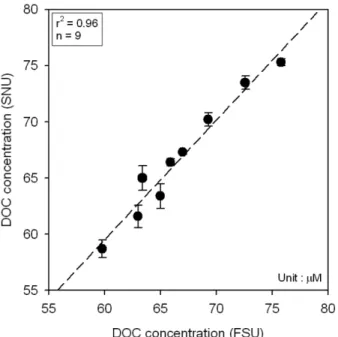
Abstract : In the summer of 2008 (August 4-14), vertical and horizontal distributions of inorganic nutrients and dissolved organic carbon (DOC) were measured in the southwestern East Sea. Concentrations of DOC were determined for the first time in the southwestern East Sea using the high-temperature combustion oxidation (HTCO) method, and results were compared with those measured by another laboratory.
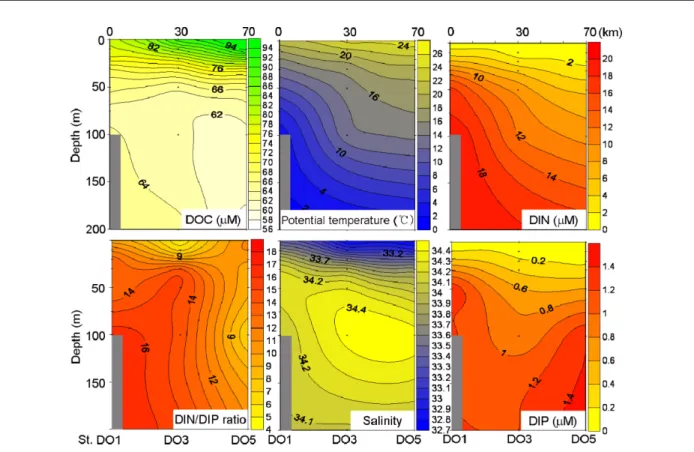
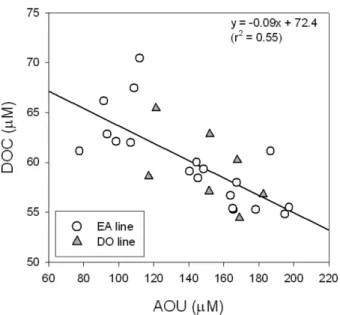
Concentrations of DOC ranged from 58 to 104 µM in the upper 200 m, showing a typical decreasing pattern with depth. Generally, concentrations of DOC were relatively lower, with higher nutrient concentrations, in the upper layer of the coastal upwelling zone. Concentrations of DOC ranged from 54 to 64 µM in the deep Ulleung Basin (200-1500 m), and were higher than those in the Pacific and Atlantic oceans. In association with rapid vertical ventilation of the euphotic, this difference indicates a larger accumulation of semi-labile DOC in the deep East Sea than in the major oceans. A correlation between apparent oxygen utilization (AOU) and DOC in the deep ocean of the East Sea revealed that only a small portion (<10%) of the sinking DOC, relative to the sinking particulate organic carbon (POC), contributes to microbial degradation. Our results present an important data set of DOC in the East Sea, which plays a critical role in carbon cycle modeling and sequestration.
Key words : dissolved organic carbon, nutrients, coastal upwelling, apparent oxygen utilization, East Sea
1. Introduction
Surrounded by Korea, Japan, and Russia, the East Sea is an almost completely enclosed marginal sea located in the northwestern Pacific Ocean. The East Sea has a maximum depth of approximately 3700 m with three major basins over 2000 m deep: the Japan Basin (which is almost 4000 m deep) in the northern half, the Ulleung Basin in the southwest, and the Yamato Basin in the southeast. The Tsushima Current Water (TCW) is present in the upper 150 m of the Ulleung and Yamato Basins, and encounters the cold northern surface water at the sub- polar front (approximately 40
oN). The TCW consists of the lower salinity and high temperature Tsushima Surface Water and the high salinity Tsushima Middle Water (>34.5) below the seasonal thermocline in the East Sea
(Chang et al. 2002). The Tsushima Surface Water, occurring in the southwestern East Sea, often exhibits low salinity from the influence of the Yangtze and Korean rivers, particularly in summer (Lim 1971; Ahn et al . 2008).
Turnover time for water in the East Sea is about 100 years (Watanabe et al. 1991; Tsunogai et al. 1993; Kim et al. 2001), which is much faster than the global ocean conveyer belt. The recent slowdown of deep water formation in the East Sea has been well documented using changes in dissolved oxygen concentrations in deep water masses (Kim and Kim 1996; Chen et al. 1999; Gamo 1999; Kim et al. 1999; Kim et al. 2001; Kang et al. 2004).
As such, the anthropogenic CO
2accumulation rate in the deep water of the East Sea has considerably decreased in the last few decades (Park et al. 2008).
Measurements of export production based on
3H and
3