https://doi.org/10.4174/astr.2021.100.4.228 Annals of Surgical Treatment and Research
Perforation on the superior side of duodenum is a risk factor of laparoscopic primary repair for duodenal ulcer perforation
Hyun Il Kim1, Yu Jeong Cho1, Jong Hoon Yeom2, Woo Jae Jeon2, Min Gyu Kim1
1Department of Surgery, Hanyang University Guri Hospital, Hanyang University School of Medicine, Guri, Korea
2Department of Anesthesiology, Hanyang University Guri Hospital, Hanyang University School of Medicine, Guri, Korea
INTRODUCTION
The incidence of peptic ulcers decreases each year, but 2%–14%
of ulcer patients develop perforations due to ulcers [1]. Peptic ulcer perforations are associated with mortality rates that range from 10% to 30% [2], with a previous report finding that duodenal ulcer perforation results in postoperative mortality rates of 2.7%–13.8% [3].
In practice, several surgical methods are recommended
depending on the size of the duodenal ulcer perforation [4].
According to the Sabiston textbook [4], primary repair with omentopexy is recommended when the size of the perforation is less than 1 cm. It is also reported that primary repair can be performed through laparoscopic surgery. Some studies indicate that laparoscopic surgery results in shorter operating time, less postoperative pain, and faster recovery compared to open surgery [5,6]. Therefore, most clinical physicians prefer to perform laparoscopic primary repair as an emergency surgical
Received November 23, 2020, Revised December 29, 2020, Accepted January 12, 2021
Corresponding Author: Min Gyu Kim
Department of Surgery, Hanyang University Guri Hospital, 153 Gyeongchun-ro, Guri 11923, Korea
Tel: +82-31-560-2294, Fax: +82-31-566-4409 E-mail: [email protected]
ORCID: https://orcid.org/0000-0001-9943-0083
Copyright ⓒ 2021, the Korean Surgical Society
cc Annals of Surgical Treatment and Research is an Open Access Journal. All articles are distributed under the terms of the Creative Commons Attribution Non- Commercial License (http://creativecommons.org/licenses/by-nc/4.0/) which permits unrestricted non-commercial use, distribution, and reproduction in any medium, provided the original work is properly cited.
Purpose: Primary repair is the standard surgical method for treating duodenal ulcer perforations, with very good results usually anticipated because of the simplicity of the associated surgical techniques. Therefore, this study aimed to analyze the risk factors that affect laparoscopic primary repair outcomes for duodenal ulcer perforation.
Methods: Between June 2010 and June 2020, 124 patients who underwent laparoscopic primary repair for duodenal ulcer perforations were reviewed. Early surgical outcomes were evaluated and risk factors for postoperative complications were assessed.
Results: All surgeries were performed laparoscopically without open conversion. Multivariate analysis showed that the elderly (over 70 years), and perforations that needed more than 2 stitches for closure were risk factors for overall postoperative complications. Perforations that needed more than 2 stitches and perforations on the superior side of the duodenum were major risk factors for severe postoperative complications. Severe postoperative complications occurred in 6 of the patients, and 1 of them died of multiorgan failure.
Conclusion: Based on our results, we suggest that laparoscopic primary repair can be safely performed in duodenal ulcer perforation. However, more careful surgery and postoperative care are needed to improve the surgical outcomes of patients who need more than 2 stitches to close their perforation or who have perforations on the superior side of the duodenum.
[Ann Surg Treat Res 2021;100(4):228-234]
Key Words: Complications, Duodenal ulcer perforation, Laparoscopy, Primary repair, Risk factors
method for treating duodenal ulcer perforations.
There are several known risk factors for postoperative complications of peptic ulcer perforation treatment [7-9]. In particular, there is controversy over applying laparoscopic surgery as the procedure of choice for duodenal ulcer perforation [5,10-14]. According to a recent meta-analysis, laparoscopic primary repair can be applied in low-risk patients [10].
In actual clinical practice, most emergency surgeries with low severity are performed by inexperienced surgeons who are not experts [15]. For these reasons, it is not easy to apply laparoscopic surgery as a top choice for duodenal ulcer perforation. Especially, laparoscopic surgery requires a long learning period.
Therefore, this study was designed to analyze the risk factors associated with laparoscopic duodenal ulcer perforation surgery by evaluating the surgical outcomes of laparoscopic primary repair performed by a single gastric surgery expert.
METHODS
Patients
We retrospectively reviewed and prospectively collected data for 180 patients who underwent surgery for duodenal ulcer perforations between June 2010 and June 2020 at Hanyang University Guri Hospital. This study enrolled 124 patients who underwent laparoscopic primary repair. All surgeries were performed by a single surgeon who is an expert in laparoscopic gastric surgery [16,17]. Laparoscopic primary repair was attempted in all patients, regardless of previous abdominal surgical history.
Forty-eight patients who underwent other types of surgical methods including gastrectomy were excluded from this study. In addition, 8 patients who were forced to undergo only primary repair due to unstable hemodynamic conditions were also excluded from this study. Among patients who had hypotension in the emergency department, patients who returned to normal blood pressure in response to simple fluid therapy were enrolled in this study.
Approval for this study was obtained from the Institutional Review Board of Hanyang University Guri Hospital in Guri, Korea (No. 2020-05-007). The requirement for informed consent was waived because of the retrospective nature of the study.
Surgical techniques
Three trocars were used for laparoscopic primary repair, and the size of the perforation was measured using surgical suture material. One or more stitches were used to close the perforation site. We did not select the size of perforation as a variable factor, because the size of an ulcer is not proportional to the size of the perforation hole. Instead of the size, we
used the number of stitches needed to close the perforation.
Black silk (3-0, 26 mm, 75 cm; Mersilk, Ethicon, Sommerville, NJ, USA) was used to close the site. Following closure of the perforation site, peritoneal irrigation was undertaken with a large volume of saline (usually 1- or 2-L) to minimize any infection source. A large mass of omentum was then placed above the primary suture site. We have previously published a paper that detailed these surgical techniques [18].
Primary repair has not been selected as a treatment method in the following cases. First, it is impossible to close the perforation despite multiple stitches due to a large perforation size. The second is when the ulcer tissues are crushed during the primary repair process, resulting in a larger hole.
In this study, shock was defined as a state of low blood pressure (systolic blood pressure below 90 mmHg or a diastolic blood pressure below 60 mmHg) in the emergency room.
Laparoscopic surgery has been tried in all patients who were hemodynamically stable. Open surgery was applied in all hemodynamically unstable patients who required inotropic agents.
Surgical outcomes
Clinical data obtained from medical records included patient age, sex, body mass index, history of previous major abdominal surgery, American Society of Anesthesiologists (ASA) physical status (PS) classification, and others. Early surgical outcomes included operation time, postoperative complications, day of commencement of a soft diet, and postoperative hospital stay.
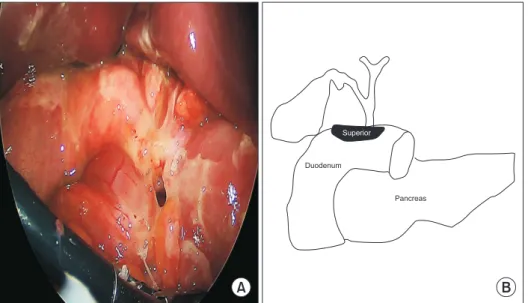
The location of the perforation was defined as the superior side when it occurred toward the hepatoduodenal ligament (Fig. 1).
Postoperative surgical complications were graded according to the Clavien-Dindo classification. Postoperative mortality was defined as any death, regardless of cause, that occurred within 30 days after surgery [19,20].
Statistical analysis
Statistical analyses were performed using IBM SPSS Statistics for Windows ver. 21.0 (IBM Corp., Armonk, NY, USA). All values are expressed as mean ± standard deviation. Categorical variables were assessed with the chi-square test and all continuous variables were assessed using the Student t-test, depending on the data. Multivariate analyses were performed to identify prognostic factors associated with postoperative complications. The Cox proportional hazards model was employed for multivariate regression analysis. Hazard ratios with 95% confidence intervals were estimated for each variable in the multivariate analysis. A P-value of <0.05 was considered statistically significant.
RESULTS
Preoperative and intraoperative clinical characteristics
Patient clinical characteristics are presented in Table 1.
Median age was 53.0 years and most patients (78.2%) were male. About half of the patients had comorbidities. Thirteen patients (10.5%) had histories of ulcer treatment. Twenty- three patients (18.5%) were taking NSAIDs. Forty-two patients (33.9%) were heavy drinkers, and 77 patients (62.1%) were heavy smokers. Forty patients (32.3%) had an ASA PS classification of 3 or higher. Twenty-one patients (16.9%) arrived at the emergency department 2 days after the onset of symptoms.
Twenty-two patients (17.7%) had ulcer perforations on the superior side of the duodenum. Fourteen patients (11.3%) showed hypoalbuminemia and 8 patients (6.5%) had an elevated creatinine level (over 1.5 mg/dL).
Surgical outcomes
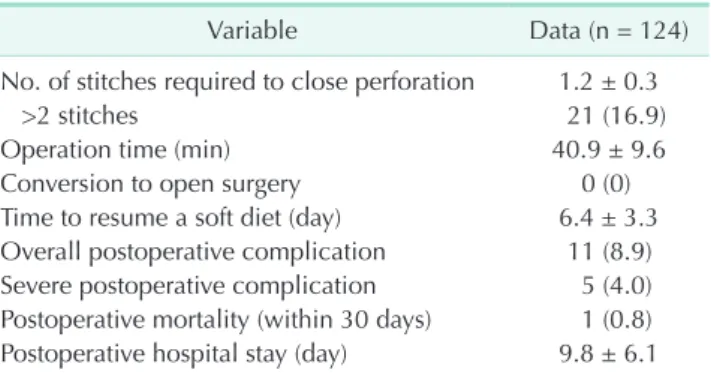
One stitch was sufficient to close the perforation site in all patients except for 21 patients. The mean operation time was 40.9 minutes. There were no cases of conversion to open surgery. Postoperative complications occurred in 11
patients (8.9%). Eight of 11 patients had severe postoperative complications. One patient died within 1 month after surgery (Table 2).
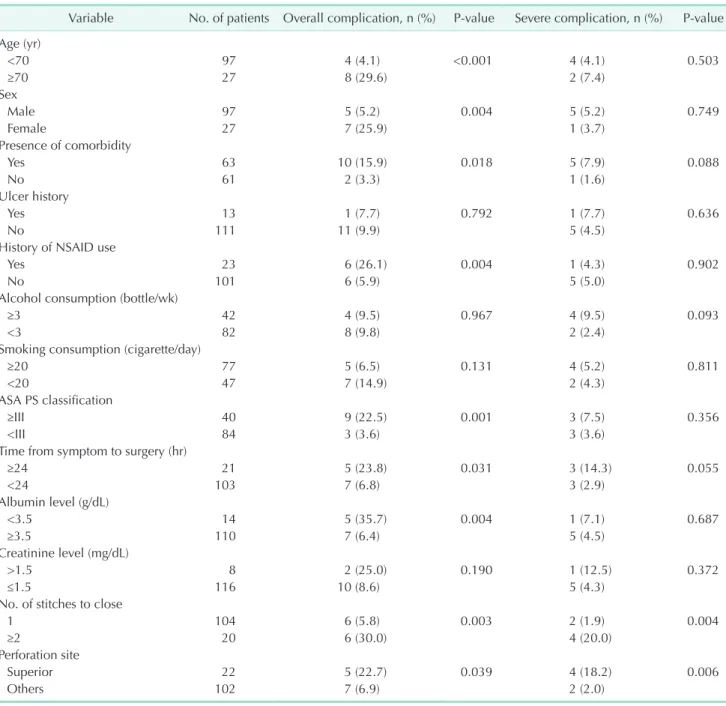
Univariate analysis of postoperative complications
Table 3 lists the risk factors for early surgical outcomes. A statistically significant postoperative complication rate was observed in patients who were elderly, females, patients with comorbidities, NSAIDs users, patients with high ASA PS classification, delayed operation times, low albumin levels, over 2 stitches, and superior perforations. The rate of severe postoperative complications was significantly higher in perforations which needed more than 2 stitches, and perforations on the superior side of the duodenum.
Multivariate analysis of postoperative surgical complications
The results of multivariate analysis of complication risk factors are listed in Table 4. Being elderly, and a perforation which needed more than 2 stitches were significant risk factors for overall postoperative complications. Perforations which needed more than 2 stitches and perforations on the superior side of the duodenum were significant risk factors for severe postoperative complications.
Details of severe postoperative complications
Severe postoperative complications occurred in 6 of all patients (Table 5). Except for one, most of the patients had comorbidities. Two patients who underwent reoperation had comorbidities and their perforation sites were on the superior side of the duodenum. Especially, 1 of them underwent choledocojejunostomy due to common bile duct injury caused by the suturing process. Eventually, he did not recover after reoperation and died of septic shock and multiorgan failure.
Table 1. Pre and intraoperative characteristics of patients who underwent laparoscopic primary repair
Variable Data
No. of patients 124
Age (yr) 53.0 (15–97)
>70 yr 27 (21.8)
Sex
Male 97 (78.2)
Female 27 (21.8)
Comorbidity 63 (50.8)
Body mass index (kg/m2) 22.6 ± 3.6
History of ulcer treatment 13 (10.5)
History of major abdominal surgery 4 (3.2)
Current NSAID user 23 (18.5)
Alcohol consumption, >3 bottles/wka) 42 (33.9) Smoking consumption, >20 cigarette/day 77 (62.1) ASA PS classification
I or II 84 (67.7)
≥III 40 (32.3)
Duration from symptom onset to surgery, >24 hr 21 (16.9) Location
Superior part 22 (17.7)
Others 102 (82.3)
Serum albumin levelb), <3.5 g/dL 14 (11.3) Serum creatinine levelc), >1.5 mg/dL 8 (6.5) Values are presented as number only, median (range), number (%), or mean ± standard deviation.
a)Alcohol contents, 21%; 360 mL per bottle. b)Normal > 3.5.
c)Normal < 1.0.
Table 2. Short and longterm outcomes of patients who underwent laparoscopic primary repair
Variable Data (n = 124)
No. of stitches required to close perforation 1.2 ± 0.3
>2 stitches 21 (16.9)
Operation time (min) 40.9 ± 9.6
Conversion to open surgery 0 (0)
Time to resume a soft diet (day) 6.4 ± 3.3 Overall postoperative complication 11 (8.9) Severe postoperative complication 5 (4.0) Postoperative mortality (within 30 days) 1 (0.8) Postoperative hospital stay (day) 9.8 ± 6.1 Values are presented as mean ± standard deviation or number (%).
Table 3. Univariate analysis of risk factors for postoperative complications
Variable No. of patients Overall complication, n (%) Pvalue Severe complication, n (%) Pvalue Age (yr)
<70 97 4 (4.1) <0.001 4 (4.1) 0.503
≥70 27 8 (29.6) 2 (7.4)
Sex
Male 97 5 (5.2) 0.004 5 (5.2) 0.749
Female 27 7 (25.9) 1 (3.7)
Presence of comorbidity
Yes 63 10 (15.9) 0.018 5 (7.9) 0.088
No 61 2 (3.3) 1 (1.6)
Ulcer history
Yes 13 1 (7.7) 0.792 1 (7.7) 0.636
No 111 11 (9.9) 5 (4.5)
History of NSAID use
Yes 23 6 (26.1) 0.004 1 (4.3) 0.902
No 101 6 (5.9) 5 (5.0)
Alcohol consumption (bottle/wk)
≥3 42 4 (9.5) 0.967 4 (9.5) 0.093
<3 82 8 (9.8) 2 (2.4)
Smoking consumption (cigarette/day)
≥20 77 5 (6.5) 0.131 4 (5.2) 0.811
<20 47 7 (14.9) 2 (4.3)
ASA PS classification
≥III 40 9 (22.5) 0.001 3 (7.5) 0.356
<III 84 3 (3.6) 3 (3.6)
Time from symptom to surgery (hr)
≥24 21 5 (23.8) 0.031 3 (14.3) 0.055
<24 103 7 (6.8) 3 (2.9)
Albumin level (g/dL)
<3.5 14 5 (35.7) 0.004 1 (7.1) 0.687
≥3.5 110 7 (6.4) 5 (4.5)
Creatinine level (mg/dL)
>1.5 8 2 (25.0) 0.190 1 (12.5) 0.372
≤1.5 116 10 (8.6) 5 (4.3)
No. of stitches to close
1 104 6 (5.8) 0.003 2 (1.9) 0.004
≥2 20 6 (30.0) 4 (20.0)
Perforation site
Superior 22 5 (22.7) 0.039 4 (18.2) 0.006
Others 102 7 (6.9) 2 (2.0)
ASA, American Society of Anesthesiologists; PS, physical status.
Table 4. Multivariate analysis of risk factors for postoperative complications
Variable Overall postoperative complication Severe postoperative complication
RR 95% CI Pvalue RR 95% CI Pvalue
Old age, ≥70 yr 5.912 1.137–26.136 0.019
No. of stitches, >2 4.951 1.161–21.114 0.031 7.925 1.216–51.656 0.030
Perforation site, superior vs. others 6.707 1.276–88.035 0.047
RR, relative risk; CI, confidence interval.
DISCUSSION
Up to now, many papers have been published on surgical methods, surgical outcomes, and risk factors for duodenal ulcer perforation. Based on the evidence of several published reports and the views of surgeons, primary repair is strongly recommended for duodenal ulcer perforations with small perforation size [5,18].
Combining the results of several studies [2,3,21-24], high ASA PS classification (over 3), elderly status (65 years), large perforation size (over 0.9–1.0 cm), shock on admission, and blood test abnormalities are considered to affect postoperative complications and mortality. Our analyses also showed similar results compared with previous studies.
Our multivariate analysis confirmed that elderly patients (over 70 years old), and perforations which needed more than 2 stitches were significant risk factors for overall postoperative complications. Especially, it was confirmed that perforations which needed more than 2 stitches, and perforations on the superior side of the duodenum were major significant risk factors for severe postoperative complications.
There are some reports that complication rates of primary repair can be increased when perforation size is greater than 1.0–1.5 cm [24,25]. Therefore, most surgeons consider primary repair to be a very safe procedure if the size of the perforation is less than 1 cm. In this study, we did not use length of perforation as an objective variable factor. It is very difficult to measure the perforation size laparoscopically in emergency situations. Moreover, the size of a perforation is not proportional to the size of a duodenal ulcer. There was a report that simple closure with or without omental patch is a safe surgical procedure in duodenal ulcer perforations up to 2 cm in size [26]. In practice, we experienced that a perforation larger than 1.0 cm can be closed easily with 1 stitch, or even a perforation smaller than 1.0 cm can be closed by over 2 stitches.
Several authors suggested their perforation cutoff sizes predicted conversion to open surgery [5,8,24]. They proposed a cutoff perforation size of 1 cm. However, we have never experienced conversion to open surgery. Therefore, we are confident that the size of perforation is not related to conversion to open surgery. In practice, most cases of primary repair were performed by trainee surgeons [27,28]. On the other hand, our surgeries (more than 100 cases) were performed by a single expert surgeon.
Our study suggests a new risk factor that differs from those of previous studies. It was confirmed that the location of the duodenal perforation could be an important risk factor for severe postoperative complications. From the experiences of 124 laparoscopic primary repair cases, we have found that a perforation on the superior side needs to be closed very carefully. Especially, injury to the common bile duct may occur
Table 5. Details of severe postoperative complications
Case No.
Sex
Age (yr) Onset (hr)
Comorbidity
Location of perfor
ation
No. of stitc
hesComplicationTreatmentMortalityHospital stay (day) 1Male5872Alcoholic LC B, DementiaOthers2LeakagePigtail insertion and antibioticsNo18 2Female8072HTN, RA, adrenal insufficiencyOthers3LeakagePigtail insertion and antibioticsNo27 3Male4012Grave’s diseaseSuperior2LeakageDistal gastrectomyNo34 4Male5512Superior2LeakageConservative treatment (observation)No17 5Male4648DM, alcoholic LC BSuperior2Intraabdominal abscessPigtail insertion and antibioticsNo46 6Male7772DM, HTNSuperior1CBD injury, and luminal bleedingDistal gastrectomy, choledocojejunostomyYes25 LC, liver cirrhosis; HTN, hypertension; RA, rheumatoid arthritis; DM, diabetes mellitus; CBD, common bile duct.
during the suturing process due to severe adhesion of the perforation site. Therefore, if the perforation occurs on the superior side of the duodenum (Fig. 1), the duodenum including the ulcer should be separated from the hepatoduodenal ligament area to expose the perforation site. After that, the degree of perforation should be re-evaluated and the appropriate surgical method must be selected.
Based on our experiences and analysis of surgical outcomes, we suggest that the primary duodenal ulcer repair method can be safely performed laparoscopically. However, more careful surgical techniques and postoperative care are needed to improve surgical outcomes of patients who need more than 2 stitches to close a perforation or who have a perforation on the superior side of the duodenum.
ACKNOWLEDGEMENTS
Conflict of Interest
No potential conflict of interest relevant to this article was
reported.
ORCID iD
Hyun Il Kim: https://orcid.org/0000-0002-2186-5842 Yu Jeong Cho: https://orcid.org/0000-0001-6823-2746 Jong Hoon Yeom: https://orcid.org/0000-0003-3159-2072 Woo Jae Jeon: https://orcid.org/0000-0002-9662-4197 Min Gyu Kim: https://orcid.org/0000-0001-9943-0083
Author Contribution
Conceptualization: MGK, HIK Formal Analysis: YJC, JHY Investigation: WJJ Methodology: MGK, YJC
Project Administration: MGK, JHY, WJJ Writing – Original Draft: MGK, HIK, YJC Writing – Review & Editing: JHY, WJJ
REFERENCES
1. Bertleff MJ, Lange JF. Perforated peptic ulcer disease: a review of history and treatment. Dig Surg 2010;27:161-9.
2. Møller MH, Shah K, Bendix J, Jensen AG, Zimmermann-Nielsen E, Adamsen S, et al. Risk factors in patients surgically treated for peptic ulcer perforation. Scand J Gastroenterol 2009;44:145-52.
3. Boey J, Choi SK, Poon A, Alagaratnam TT.
Risk stratification in perforated duodenal ulcers: a prospective validation of predictive factors. Ann Surg 1987;205:22- 6.
4. Townsend CM Jr, Beauchamp RD, Evers BM, Mattox KL. Sabiston textbook of surgery: the biological basis of modern surgical practice. 20th ed. Philadelphia (PA): Elsevier Saunders; 2017.
5. Siu WT, Leong HT, Law BK, Chau CH, Li AC, Fung KH, et al. Laparoscopic repair for perforated peptic ulcer: a randomized controlled trial. Ann Surg 2002;235:313-9.
6. Bertleff MJ, Halm JA, Bemelman WA, van der Ham AC, van der Harst E, Oei HI, et al.
Randomized clinical trial of laparoscopic versus open repair of the perforated peptic ulcer: the LAMA Trial. World J Surg
Duodenum
Pancreas Superior
A B
Fig. 1. Ulcer perforation on the superior side of the duodenum.
(A) Laparoscopic image. (B) Detailed illustration.
2009;33:1368-73.
7. Kim MG. Laparoscopic surgery for perforated duodenal ulcer disease:
analysis of 70 consecutive cases from a single surgeon. Surg Laparosc Endosc Percutan Tech 2015;25:331-6.
8. Lee FY, Leung KL, Lai PB, Lau JW.
Selection of patients for laparoscopic repair of perforated peptic ulcer. Br J Surg 2001;88:133-6.
9. Lunevicius R, Morkevicius M. Systematic review comparing laparoscopic and open repair for perforated peptic ulcer. Br J Surg 2005;92:1195-207.
10. Lau H. Laparoscopic repair of perforated peptic ulcer: a meta-analysis. Surg Endosc 2004;18:1013-21.
11. Lau WY, Leung KL, Kwong KH, Davey IC, Robertson C, Dawson JJ, et al. A randomized study comparing laparoscopic versus open repair of perforated peptic ulcer using suture or sutureless technique.
Ann Surg 1996;224:131-8.
12. Matsuda M, Nishiyama M, Hanai T, Saeki S, Watanabe T. Laparoscopic omental patch repair for perforated peptic ulcer.
Ann Surg 1995;221:236-40.
13. Michelet I, Agresta F. Perforated peptic ulcer: laparoscopic approach. Eur J Surg 2000;166:405-8.
14. Siu WT, Chau CH, Law BK, Tang CN, Ha PY, Li MK. Routine use of laparoscopic repair for perforated peptic ulcer. Br J Surg 2004;91:481-4.
15. Kim HS, Lee JH, Kim MG. Outcomes of laparoscopic primary gastrectomy with curative intent for gastric perforation:
experience from a single surgeon. Surg Endosc 2020 Aug 28 [Epub]. https://doi.
org/10.1007/s00464-020-07902-z.
16. Lee HH, Son SY, Lee JH, Kim MG, Hur H, Park DJ. Surgeon’s experience overrides the effect of hospital volume for postoperative outcomes of laparoscopic surger y in gastric c ancer: mult i- institutional study. Ann Surg Oncol 2017;24:1010-7.
17. Kim MG, Kim KC, Yook JH, Kim BS, Kim TH, Kim BS. A practical way to overcome the learning period of laparoscopic gastrectomy for gastric cancer. Surg Endosc 2011;25:3838-44.
18. Ma CH, Kim MG. Laparoscopic primary repair with omentopexy for duodenal ulcer perforation: a single institution experience of 21 cases. J Gastric Cancer 2012;12:237-42.
19. Clavien PA, Barkun J, de Oliveira ML, Vauthey JN, Dindo D, Schulick RD, et al. The Clavien-Dindo classification of surgical complications: five-year experience. Ann Surg 2009;250:187-96.
20. Clavien PA, Strasberg SM. Severity grading of surgical complications. Ann Surg 2009;250:197-8.
21. Sharma SS, Mamtani MR, Sharma MS, Kulkarni H. A prospective cohort study of postoperative complications in the
management of perforated peptic ulcer.
BMC Surg 2006;6:8.
22. Hermansson M, Staël von Holstein C, Zilling T. Surgical approach and prognostic factors after peptic ulcer perforation. Eur J Surg 1999;165:566-72.
23. Blomgren LG. Perforated peptic ulcer:
long-term results after simple closure in the elderly. World J Surg 1997;21:412-5.
24. Kim JH, Chin HM, Bae YJ, Jun KH. Risk factors associated with conversion of laparoscopic simple closure in perforated duodenal ulcer. Int J Surg 2015;15:40-4.
25. Abd Ellatif ME, Salama AF, Elezaby AF, El-Kaffas HF, Hassan A, Magdy A, et al.
Laparoscopic repair of perforated peptic ulcer: patch versus simple closure. Int J Surg 2013;11:948-51.
26. Sartelli M, Viale P, Catena F, Ansaloni L, Moore E, Malangoni M, et al. 2013 WSES guidelines for management of intra- abdominal infections. World J Emerg Surg 2013;8:3.
27. Sauerland S, Agresta F, Bergamaschi R, Borzellino G, Budzynski A, Champault G, et al. Laparoscopy for abdominal emergencies: evidence-based guidelines of the European Association for Endoscopic Surgery. Surg Endosc 2006;20:14-29.
28. Søreide K, Thorsen K, Søreide JA.
Strategies to improve the outcome of emergency surgery for perforated peptic ulcer. Br J Surg 2014;101:e51-64.