Research Article Open Access
The Analysis of severity of forward head posture with observation and photographic method
Han-suk Lee, PT, PhD
†⋅Hyung-kuk Chung, PT, PhD
1⋅Sun-wook Park, PT, M.S
2Department of Physical Therapy, Faculty of Health Science, Eulji University
1
Department of Physical Therapy, Ansan University
2
Department of Physical therapy, Sam Sung Seoul Hospital
Received: June 28, 2015 / Revised: July 1, 2015 / Accepted: July 20, 2015
ⓒ 2015 J Korean Soc Phys Med
| Abstract |
1)PURPOSE: This paper aims to present the available angle to evaluate the severity of forward head posture (FHP) with the observation method and photographic method.
METHODS: A cross-sectional observation research design study consisted of 29 subjects who was divided two groups (slight FHP group, moderate FHP group) in Eulji university was used. We evaluated the FHP and the angles including CranioVertebral Angle (CVA), Head Tilting Angle (HTA), Head Position Angle (HPA) and Forward Shoulder Angle (FSA) with the Body style S-8.0 (South Korea, LU Commerce).
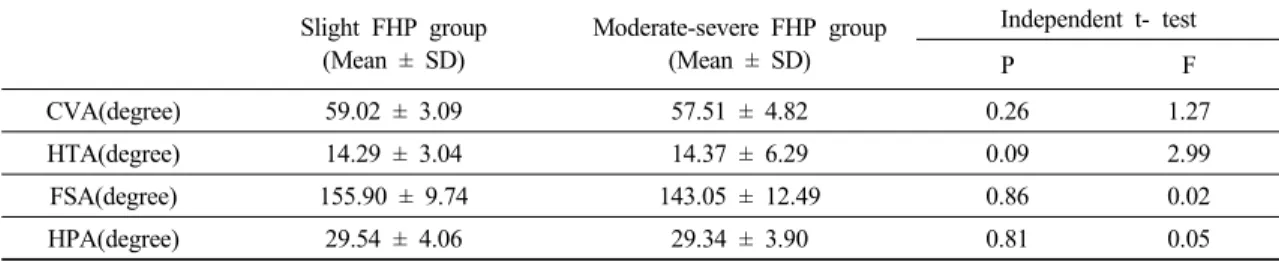
RESULTS: The mean of CVA, FSA from the slight FHP group was shown higher than moderate severe FHP group.
According to independent t-test result, but there was no difference among all angles in two groups. The linear discriminate analysis showed the size of distinction of FSA was the biggest, and then CVA, HTA and HPA were in the
†Corresponding Author: [email protected]
This is an Open Access article distributed under the terms of the Creative Commons Attribution Non-Commercial License (http://creativecommons.org/licenses/by-nc/3.0) which permits unrestricted non-commercial use, distribution, and reproduction in any medium, provided the original work is properly cited.
order. 55.6% of FSA is properly classified in the slight FHP group.
CONCLUSION: The FSA is the best to distinguish the severity of FHP and then CVA as the second best. Therefore, FSA is recommended to check the FHP.
Key Words: Posture, Evaluate, Angle
Ⅰ. Introduction
The forward head posture (FHP) is that the head shown on the sagittal plane is not stable, which appeared by the external auditory meatus that passes through the shoulder joint before the plumb line. Until today, the numbers of the patients who have FHP has been increasing due to the multiplied usage of the electric devices like cellphones and computers. The FHP is absolutely harmful for human's body. So it has to be taken good care of foremost because it deals a lot with not only cervical problems, but also the causation of the temporomandibular joint dysfunction, thoracic kyphosis, and decrease in vital capacity (Pamela and Norkin, 2011).
There are quite many methods to evaluate such atypical
posture problems, but the observational method along with
visual assessment to analyze the posture by using anatomical landmark suggested by Kendal is most frequently used in the clinic (Salahzadeh et al, 2014) because of the technical and cost problem (Gadotti and Magee, 2008). However, Gadotti and Biasotto-Gonzalez (2010) mentioned that there was a disadvantage to find out the difference between the slight FHP and Healthy Neck Posture (HNP) while it was pretty easy to figure out the difference between FHP and HNP by using the observational method.
The second easiest and simplest way of analyzing the FHP in clinic is the photographic method (Gadotti and Biasotto-Gonzalez, 2010). It was reported that this method has high reliability (Gadotti and Magee, 2008; Refshauge et al, 1994; do Rosario, 2014) and validity (Grimmer- Somers et al, 2008). However, the accuracy might markedly differ in the way that it really depends on where the adhesive markers are attatched to the patient's body (Rosário et al, 2012). The used angles to analyze the FHP while using photographic method is Craniovertebral angle (CVA), Head position angle (HPA), and Head tilt angle (HTA). CVA is used most frequently (Brink et al, 2009; Gadotti and Biasotto-Gonzalez, 2010; Salahzadeh et al, 2014; Gadotti and Magee, 2008; Cuccia and Carola, 2009; Cheung Lau et al, 2009; Silva et al, 2010).
Salahzadeh et al, (2014) believed measuring CVA is a better way than checking the both HPA and HTA to distinguish between the normal head neck posture and the severe FHP. It means that CVA could be used as a great indicator on FHP (Gadotti and Biasotto-Gonzalez, 2010;
Gadotti and Magee, 2008). However the good indicator to assess FHP except CVA has not researched yet.
According to, Szeto et al (2002), in the case of the office worker who has been dealing a lot with FHP and cervical discomfort, his acromion is protracted. Moreover, as Thigpen et al (2010) said, the most ideal Forward Shoulder Angle (FSA) is 14.9 degrees. When the person with FHP has the protracted shoulder problem, the angle
goes up to 57.5 degrees. Because this type of deformation can affect the scapular position and kinematic, it can even cause shoulder impingement. That is why it really is imperative to check on not only the cervical angle, but the posture of shoulders too.
Because both observation and photographic methods are pragmatic in a clinic, it is absolutely more preferable to use both ways than just one. So providing any false idea would not happen when analyzing the posture. Besides it is crucial to use both methods not to drop a clanger when the best way should be found and is used to estimate the severity of FHP.
Therefore, this paper aims to present the available angle to evaluate the severity of FHP with the observation method and photographic method
Ⅱ. Method
1. Subject
This is a cross-sectional observational research design study consisted of 29 subjects in Eulji university. This study was approved by the ethical committee from Eulji University and this study adhered to the ethical principles of the Declaration of Helsinki.
The subjects were informed about the experiment before their agreement to participate. Inclusion criteria were: FHP above 2.5 cm; NDI above 3 score; no history of concussion or mild neck injury in 12 months; no severe thoracic kyphosis and persistent respiratory problems (Cuccia and Carola, 2009; Salahzadeh et al, 2014).
2. Measurement
1) Photogrammetry
We measured the posture with the Body style
S-8.0(South Korea, LU Commerce) and used the Body
Style analyzer (system software) to evaluate the FHP. The
○ Spinal process of C7
●Tragus of ear
A : CranioVertebral Angle (CVA)
○ Tragus of ear
●Canthus of eye
B : Head Tilt Angle (HTA)
○ Spinal process of C7
●The midpoint of humerus
C : Forward Shoulder Angel (FSA)
○ Tragus of ear
●Mentum of chin
■Manubrium
D : Head Position Angle (HPA) Fig. 1. Photogrammetric method for measuring the four postural angles.
subjects were instructed to stand in their natural standing position on postural pad and took pictures of lateral view of the subjects. The intrarater and interrater evaluations of photogrammetry findings in the standing sagittal posture of the cervical spine were found to be reliable (Ruivo et al, 2015; do Rosario, 2014). Data of photography was transferred to the Body Style analyzer and analyzed. We used body markers using double side tape over each landmark, including the tragus of the ear, the spinous process of the C7 vertebra, the external corner of the eye, the tragus of the ear, the sternal notch of the manubrium, the center point of shin and acromion. The plumb line defined the true vertical line on digital images in order to detecting FHP. Normal posture is that the external ear meatus must be in vertical alignment with the middle of the shoulder by Kendall’s definition (Gadotti and
Biasotto-Gonzalez, 2010)
2) Forward head posture measurement
Posture in photographs was assessed by one evaluator.
FHP was determined on digital images based on observation and reviewing the status of the participant’s head and neck compared to the plumb line. The distance from the line through acromion to the line through the external auditory meatus was measured for the FHP. FHP was calculated using the Body Style Analyzer with markings at the ear tragus and the acromion. If the distance was above 2.5-5 cm, it was defined FHP.
After FHP was assessed, subjects were divided to 2 groups: slight FHP group and moderate- severe FHP group.
If the distance was 2.5-5 cm, it was defined as slight FHP
and if the distance was >5cm, it was defined as
Table 1. The general characteristics of the subjects(Mean ± SD)
Group Age(years) Height(cm) Weight(kg)
Group 1(n=9) 23.88±2.11 173.77±6.90 70.22±9.27
Group 2(N=20) 23.20±3.50 173.37±7.52 67.85±11.94
SD: Standard Deviation
Table 2. Descriptive characteristics of CVA, HTA, HPA, FSA and demographic statistics in two groups and results of independent t-test
Slight FHP group (Mean ± SD)
Moderate-severe FHP group (Mean ± SD)
Independent t- test
P F
CVA(degree) 59.02 ± 3.09 57.51 ± 4.82 0.26 1.27
HTA(degree) 14.29 ± 3.04 14.37 ± 6.29 0.09 2.99
FSA(degree) 155.90 ± 9.74 143.05 ± 12.49 0.86 0.02
HPA(degree) 29.54 ± 4.06 29.34 ± 3.90 0.81 0.05
※ CVA : Craniovertebral Angle , HTA : Head Tilt Angle, HPA : Head Position Angle, FSA : Forward Shoulder Angle, FHP : Forward Head Posture
SD: Standard Deviation
Table 3. Homogeneity Test of Mean value of varables
Wilk’s Lamda F P
CVA 0.97 0.74 0.39
HTA 1.00 0.00 0.97
FSA 0.78 7.41 0.01*
HPA 0.99 0.01 0.90
* P<0.05
CVA : Craniovertebral Angle, HTA : Head Tilt Angle, HPA : Head Position Angle, FSA : Forward Shoulder Angle
moderate-severe FHP (Kim, 2012).
3) Angle analysis
Posture in photographs was assessed by one evaluator and reliability analysis of the angles measured on the photographs was performed previously. The ICC was 0.99 with a standard error of measurement of 0.45 (Ruivo et al, 2015).
The craniovertebral angle (CVA) refers to the degree of FHP and is defined as the angle between the true horizontal through the spinous process of C7, with a line connecting spinous process of C7 with the tragus on photographs (Brink et al, 2009; Gadotti and Biasotto-
Gonzalez, 2010; Salahzadeh et al, 2014; Gadotti and Magee, 2008; Cuccia and Carola, 2009; Cheung Lau et al, 2009; Silva et al, 2010). In general, subjects with smaller the CVA indicates more FHP (Gadotti and Biasotto- Gonzalez, 2010; Salahzadeh et al, 2014; Gadotti and Magee, 2008) (Fig. 1-A).
The head tilt angle (HTA: gaze angle) is the angle which is used to evaluate the head tilt and represents the upper cervical flexion or extension position(Brink et al, 2009;
Salahzadeh et al, 2014). The angle is defined the angle
between the line connecting the tragus of the ear to the
canthus of the eye and the horizontal line passing through
the tragus (Salahzadeh et al, 2014; Raine and Twomey,
Table 4. The canonical discriminate functions for Forward Shoulder Angle (FAS) Predictable
variable Wilk’s Lamda** Chi-sguare df Canonical
correlation sig Box’s M sig
FSA 0.78 6.42 1.00 0.46*** 0.01* 0.43****
* The result indicates the significant wilk’s Lamda for FSA variable
** Wilk’s Lamda indicate the significant of canonical discriminate function
*** Canonical correlation 0.46 shows the FSA explains the 21.52% of variation of two groups (the larger canonical correlation, the more discriminate accuracy)
**** The result indicates the significant Box’s M for FSA variable
Table 5. Structure matrix
Discriminant function
Forward Shoulder Angle (FSA) 1.00
Head Position Angle (HPA) -0.19
Head Tilt Angle (HTA) -0.05
Craniovertebral Angle (CVA) -0.02
Table 6. Cross – Validation result of Linear discriminate analysis for Forward Shoulder Angle (FSA)
Group Predicted Group Membership (%)
Slight FHP group Moderate – Severe FHP group
Slight FHP group 55.55 44.44
Moderate –Severe FHP group 25.00 75.00
※ FHP : Forward Head Posture