임상화학검사항목의 최소검출농도에 대한 연구
녹십자의료재단, 고객지원 및 QA부, 임상화학검사실1
장상우․김남용․권선득1․이희경
A Study of Lower Limit of Detection(LLD) in Clinical Chemistry Laboratories
Chang, Sang Wu., Kim, Nam Yong., Kwon, Sun Deuk
1., Lee, Hee Kyung
Technical Information and QA Division and Clinical Chemistry Laboratory
1, Green Cross Reference Laboratories
Limit of detection is the single result which, with a stated probability, can be distnguished from a suitable blank. Limit of detection is the lowest amount of analyte in a sample that can be detected, but not be quantified as an exact value. This value is also referred to as the Minimum Detactable Activity(MDA, LLD).
Once this value is determined, the linear range of an assay extends from the value for the MDA(LLD) to the value for the highest calibrator concentration. The concentration up to which the method has been shown previously to maintain acceptable linearity. The analytical sensitivity is simply stated as, the positivity of disease; the probability that the test is positive when the disease is present. The analytical sensitivity is determined as the concentration equivalent to the mean counts obtained from the zero sample plus 2 SD for immunometric and chemical assays or the mean minus 2 SD for competitive assays. Analytical sensitivity is also referred to as the Lower Limit of Detection(LLD, MDA). The formal definition of analytical sensitivity is, "the lowest concentration that can be distinguished from background noise." This concentration is properly termed the assay's detection limit, but it is most commonly referred to as sensitivity. Typically, this value is established by assaying replicates of a sample that is known to have no analyte present.
Analytical specificity refers to the freedom of the method from interference from commonly occurring[e.g.
lipids(lipemia), hemoglobin(hemolysis), bilirubin(icterus)] and commonly occurring [e.g. lipids (lipemia), hemoglobin (hemolysis), bilirubin (icterus)] and uncommonly occurring substances. The results of MDA that were studied on 18 tests in clinical chemistry are as follows: ALT, Albumin, ALP, IP, Amylase, Glucose, Cholesterol, Uric Acid, UN, Creatinine, and CK. Total Proteins were 0, AST (11.0 U/L), Total Bilirubin (0.7 mg/dL), GGT(2.3 mg/dL), LD(2.3 U/L), Triglyceride(1.0 mg/dL), and Calcium(0.2 mg/dL).
Key Words:
Minmum detectable activity (MDA), Lower limit of detection (LLD), Analytical sensitivity, Analytical specificity임상병리검사과학회지 : 35권 제1호, 29-33, 2003
1)
교신저자 : 장상우, (우)135-260 서울특별시 강남구 포이동 126-10번지 녹십자의료재단 고객지원 및 QA부
Tel : 02-578-0131
E-mail : [email protected]
I. 서 론
최소검출농도란 용어는 lower limit of detection (LLD), minimum detectable activity(MDA), minimum detectable concentration(MDC), minimum detection limit(MDL), limit of detection(LOD) 등으로 표현한다. 최소검출농도에 대하 여 국제임상화학연맹(IFCC)은 “최소검출농도(LOD)란 신 뢰하는 확률로서 적절한 맹검으로부터 측정될 수 있는 단일의 최소 결과치이다"라고 정의하였다.
최소검출농도(LLD)란 정확한 수치로 정량화할 수는 없 어도 하나의 시료내에서 검출될 수 있는 분석물질의 최 소량을 말한다. 최소검출농도는 분석적 민감도와 최저검 출농도와 관련된다. 분석적 특이도(analytical specificity) 란 간섭, 지질, 용혈, 황달과 비 일상적으로 출현하는 물 질로부터 영향을 받지 않는 특성과 관련된다.
검출한계가 한번 결정되면, 측정의 직선성의 범위는 최 저검출농도로부터 최대농도의 검량물질을 위한 수치의 범위이며, 검사방법이 다양하게 직선성을 수용할 수 있는 농도까지이다. 진단적 민감도(diagnostic sensitivity)란 단 순하게 말하면 질병에서 검사결과의 양성은 질병이 존재 할 때에 검사결과가 양성으로 나올 수 있는 확률이다.
분석적 민감도(analytical sensitivity)란 95% 신뢰수준에 서 검사방법이나 분석기가 0농도를 진실로 식별할 수 있 는 최소량의 분석과 관련된다. 그래서 분석민감도는 최저 검출농도와 관련된다.
최소검출농도(LLD)의 실험 목적은 측정되어질 분석물 질의 최소농도를 평가하기 위하여 실행된다. 최소검출농 도는 약물검사나 종양인자들의 검사에 명백하게 중요한 의미를 부여해준다. 최소검출농도에서의 분석수행도는 특히 종양표시자(tumor markers) 검사에 중요하며 치료후 의 경과판정에 이용된다.
미국에서는 법률로서 분석민감도에 대한 최소검출농도 를 검증할 것을 FDA나 CLIA에서 정도관리를 위하여 요 구하고 있다. 제조회사에서는 다양한 용어로 사용되는데 민감도, 분석민감도, 최소검출농도, 검출한계, 정량화의 한계라고 부른다. 현재는 표준적인 용어가 없으나 실제적 인 실험과정을 찾아내고 필요하면 자료를 계산하는 것이 다. 이러한 자료의 평가방법과 평가는 검사의 의학적 적 용에 유용하다.
연구자들은 임상화학검사실에서 사용되는 18개의 일상 적인 검사항목들에 대하여 최소검출농도를 연구대상으로 하였다.
II. 본 론
1. 대상
실험연구는 Bayer corporation의 ADVIA 1650 system으 로 자가제조한 생리식염수(isotonic saline)을 시료로 사용 하여 10회를 측정하고 임상화학검사실에서 일상적으로 사용되는 검사항목들 18가지를 대상으로 하여 실험을 실 시하였다.
2. 방법
1) 관리시료와 검량물질
관리시료는 Bayer diagnostics의 Testpoint assay control seerum을 사용하였고, 검량물질은 Setpoint calibrator를 사 용하였고, 통계량에 의한 관리허용범위내에 들어옴을 확 인하고 시료를 검사하였다.
측정방법으로 ALT는 modified IFCC, albumin- BCG Dye, ALP-IFCC AMP, amylase-enzymatic C, AST-modi- fied IFCC, bilirubin는 total-diazo, calcium는 OCPC, cholesterol는 enzymatic, CK는 NAC Act., DGKC, crea- tinine는 Jaffe kinetic, glucose는 hexokinase, GGT는 Szasz, SCE, LD는 SFBC(PL), IP는 molybdate reaction, total protein는 biuret, TG는 enzymatic glycerol 비소거법, UN는 kinetic UV, uric Acid는 PAP법을 사용하였다.
ALT, albumin, ALP, amylase, AST, bilirubin, calcium, cholesterol, CK, creatinine, glucose, GGT, LD, IP, total protein, TG, UN, uric acid의 18개 항목에 대한 시약의 제 조회사는 Bayer corporation의 것을 사용하였다.
2) 분석기
분석기(autoanalyzer)는 Bayer corporation의 ADVIA
1650 system 을 사용하였다.
Table 1.
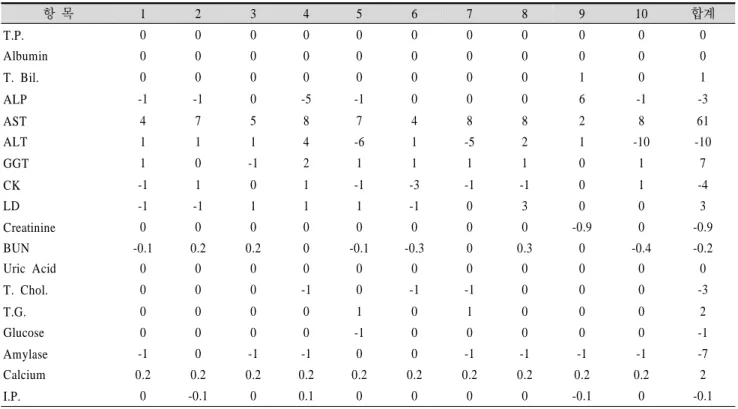
최소검출농도의 예비자료표항 목 1 2 3 4 5 6 7 8 9 10 합계
T.P. 0 0 0 0 0 0 0 0 0 0 0
Albumin 0 0 0 0 0 0 0 0 0 0 0
T. Bil. 0 0 0 0 0 0 0 0 1 0 1
ALP -1 -1 0 -5 -1 0 0 0 6 -1 -3
AST 4 7 5 8 7 4 8 8 2 8 61
ALT 1 1 1 4 -6 1 -5 2 1 -10 -10
GGT 1 0 -1 2 1 1 1 1 0 1 7
CK -1 1 0 1 -1 -3 -1 -1 0 1 -4
LD -1 -1 1 1 1 -1 0 3 0 0 3
Creatinine 0 0 0 0 0 0 0 0 -0.9 0 -0.9
BUN -0.1 0.2 0.2 0 -0.1 -0.3 0 0.3 0 -0.4 -0.2
Uric Acid 0 0 0 0 0 0 0 0 0 0 0
T. Chol. 0 0 0 -1 0 -1 -1 0 0 0 -3
T.G. 0 0 0 0 1 0 1 0 0 0 2
Glucose 0 0 0 0 -1 0 0 0 0 0 -1
Amylase -1 0 -1 -1 0 0 -1 -1 -1 -1 -7
Calcium 0.2 0.2 0.2 0.2 0.2 0.2 0.2 0.2 0.2 0.2 2
I.P. 0 -0.1 0 0.1 0 0 0 0 -0.1 0 -0.1
3) 실험시료
실험시료는 미국의 TEDIA company의 NaCl 8.5 gm을 Human Science 사의 water purification system에 의하여 정제된 증류수 1 liter에 용해한 isotonic normal saline를 사용하였다.
III. 결 과
1. 최소검출농도(LLD)의 계산방법
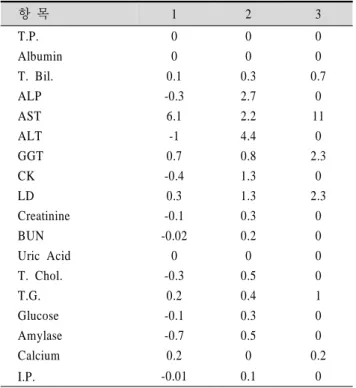
최소검출농도(LLD)는 맹검시료의 평균에 맹검 시료로 부터 얻어진 표준편차(s)의 2배로 평가하였다. 즉 LLD = 맹검의 X + (Z값 × 맹검의 s) = X blk + (Z값 × sblk) 으로 일반적으로 Z값이 2일 때이다. 이러한 용어는 정확 한 검사결과가 0일 때 가능한 수의 범위를 묘사하는 검출 부재한계(limit of absence)로 표현된다(Westgard, 2001).
2. 연구결과의 분석
18개 항목에 대한 ALT, albumin, ALP, amylase, AST,
bilirubin, calcium, cholesterol, CK, creatinine, glucose, GGT, LD, IP, total protein, TG, BUN, uric acid의 최소검 출농도의 예비자료는 Table 1과 같다.
즉 Table 1과 같이 각 검사항목에 대하여 검사한 결과 시료에 대한 검사결과는 4가지로 대별할 수 있었다. 첫째 는 10회 측정치 모두가 양의 수를 가지는 검사항목, 둘째 는 시료의 측정치가 모두 0인 검사항목, 셋째는 음과 양 의 수가 결합된 검사항목, 넷째는 시료의 측정치가 0과 음의 수 그리고 양의 수가 결합한 검사항목, 다섯째는 시 료의 결과치가 음과 0으로 나타났다.
모두 양의 결과치를 보이는 검사항목은 AST와 calcium 이었으며, 10회 측정치가 모두 0인 검사항목은 total protein, albumin, uric acid이었으며, 음과 양의 수가 결합 한 검사항목은 ALT이고, 시료의 결과치가 음과 0으로 나 타난 검사항목은 creatinine, cholesterol, glucose, amylase이 었으며, 시료의 측정치가 0과 음의 수 그리고 양의 수가 결합한 검사항목으로 나타난 것은 ALP, GGT, CK, LD, UN, IP이었으며, 시료의 측정치가 음과 양의 결과치로 나 타난 검사항목은 bilirubin, TG으로 나타났다.
Table 2에서 보는바와 같이 18개의 검사항목들에 대한
최소검출농도(LLD)는 ALT, albumin, ALP, IP, amylase,
Table 2.
최소검출농도의 계산표항 목 1 2 3
T.P. 0 0 0
Albumin 0 0 0
T. Bil. 0.1 0.3 0.7
ALP -0.3 2.7 0
AST 6.1 2.2 11
ALT -1 4.4 0
GGT 0.7 0.8 2.3
CK -0.4 1.3 0
LD 0.3 1.3 2.3
Creatinine -0.1 0.3 0
BUN -0.02 0.2 0
Uric Acid 0 0 0
T. Chol. -0.3 0.5 0
T.G. 0.2 0.4 1
Glucose -0.1 0.3 0
Amylase -0.7 0.5 0
Calcium 0.2 0 0.2
I.P. -0.01 0.1 0