© 2010 The Korean Academy of Medical Sciences.
This is an Open Access article distributed under the terms of the Creative Commons Attribution Non-Commercial License (http://creativecommons.org/licenses/by-nc/3.0) which permits unrestricted non-commercial use, distribution, and reproduction in any medium, provided the original work is properly cited.
pISSN 1011-8934 eISSN 1598-6357
Cornelia de Lange Syndrome with NIPBL Gene Mutation:
A Case Report
Cornelia de Lange Syndrome (CdLS) is a multiple congenital anomaly characterized by distinctive facial features, upper limb malformations, growth and cognitive retardation.
The diagnosis of the syndrome is based on the distinctive clinical features. The etiology is still not clear. Mutations in the sister chromatid cohesion factor genes NIPBL, SMC1A (also called SMC1L1) and SMC3 have been suggested as probable cause of this syndrome. We experienced a case of newborn with CdLS showing bushy eyebrows and synophrys, long curly eyelashes, long philtrum, downturned angles of the mouth and thin upper lips, cleft palate, micrognathia, excessive body hair, micromelia of both hands, flexion contracture of elbows and hypertonicity. We detected a NIPBL gene mutation in a present neonate with CdLS, the first report in Korea.
Key Words: De Lange Syndrome; Genes; NIPBL Kyung-Hee Park1, Seung-Tae Lee2,
Chang-Seok Ki2, and Shin-Yun Byun3 Department of Pediatrics1, Pusan National University Hospital, Busan; Department of Laboratory Medicine2, Samsung Medical Center, Sungkyunkwan University, Seoul; Department of Pediatrics3, Pusan National University Yangsan Hospital, Yangsan, Korea
Received: 24 March 2010 Accepted: 24 May 2010 Address for Correspondence:
Shin-Yun Byun, M.D.
Department of Pediatrics, Pusan National University Yangsan Hospital, Beomeo-ri, Mulgeum-eup, Yangsan 626-770, Korea Tel: +82.55-360-2180, Fax: +82.55-360-2181
E-mail: [email protected]
DOI: 10.3346/jkms.2010.25.12.1821 • J Korean Med Sci 2010; 25: 1821-1823
CASE REPORT
Pediatrics
INTRODUCTION
Cornelia de Lange Syndrome (CdLS) is a multiple congenital anomaly characterized by distinctive facial features, upper limb malformations, growth and cognitive retardation (1, 2). The syn- drome has unknown genetic and molecular pathogenesis. Di- agnosis is based on the distinctive clinical features and lack of a definitive laboratory marker. Most cases are sporadic, although autosomal dominant inheritance mutations in Nipped-B ho- molog (NIPBL), which is located at 5p13, have been suggested (3, 4). Since CdLS was first described in Korea in 1967, several cases have been reported (5). The majority of these previous re- ports concerned the accompanying anomaly associated with CdLS. These included a case of CdLS with imperforate anus and a case of CdLS with entropion, which was reported by a pedia- trician and ophthalmologist respectively (6, 7). However, there is no report regarding the genetic analysis of CdLS in the Kore- an population. The present report is the first description of a NIPBL gene mutation in a neonate with CdLS in Korea.
CASE REPORT
A 1,840 g male was delivered via normal vaginal delivery in our hospital at 32 weeks gestational age at May 2009. His mother was 40-yr-old, and had gestational diabetes mellitus and poly- hydramnios. Apgar scores were 2 and 4 at 1 and 5 min, respec- tively. The patient presented with cyanosis and respiratory dif-
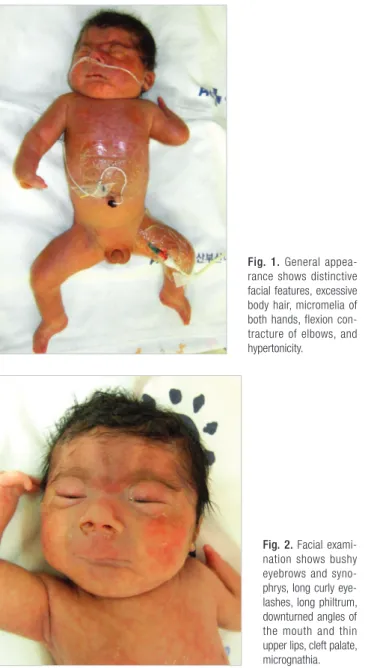
ficulty requiring continuous positive airway pressure. No evi- dence of respiratory distress syndrome was noted on a chest ra- diograph. A laryngeal anomaly and large tongue base were evi- dent, which nearly obstructed the vocal cord. A physical exami- nation revealed bushy eyebrows and synophrys, long curly eye- lashes, long philtrum, downturned angles of the mouth and thin upper lips, cleft palate, micrognathia, excessive body hair, micro- melia of both hands, flexion contracture of elbows and hyper- tonicity (Figs. 1, 2).
The patient had no relevant family history. The patient has two siblings born of a different father. They are healthy, morpho- logically normal children.
A brain sonogram revealed increased periventricular echo- genicity. Computed tomography (CT) of the neck revealed no abnormality in upper airway except micrognathia. However, the patient had suffered from upper airway obstruction due to secre- tion from 1 month of age, which led to tracheostomy at 3 months of age. The patient exhibited feeding intolerance. Abdominal ultrasonography and upper GI series showed gastroesophageal reflux but no other abnormalities. Chromosome analysis showed a normal karyotype, 46, XY. The parents rejected their gene anal- ysis. The patient had been hospitalized for 5 months due to re- current sepsis and respiratory problems. At 5 months of age, the patient was discharged and did not visit for 5 months after dis- charge.
To analyze gene mutation, peripheral blood samples were obtained from the patient with the informed consent of the fam-
Park K-H, et al. • Cornelia de Lange Syndrome with NIPBL Gene Mutation
1822 http://jkms.org DOI: 10.3346/jkms.2010.25.12.1821
ily. Genomic DNA was isolated from peripheral blood leuko- cytes using the Wizard Genomic DNA purification kit according to the manufacturer’s instructions (Promega, Madison, WI, USA).
Polymerase chain reaction (PCR) was performed using a Model 9600 thermal cycler (Applied Biosystems, Foster City, CA, USA), and direct sequencing of all coding exons and their flanking se- quences of the NIPBL gene was accomplished using author-de- signed primer pairs (sequences available upon request) in an ABI Prism 3100 Genetic Analyzer with a BigDye Terminator Cy- cle Sequencing Ready Reaction kit (Applied Biosystems). Se- quence variations were analyzed with reference to the wild type sequence (GenBank accession No. NM_002529) using the Se- quencher program (Gene Codes, Ann Arbor, MI, USA).
Sequence analysis of the NIPBL gene revealed a heterozygous C→G transversion at nucleotide number 7178, which substitut- ed the 2393rd serine to form a stop codon (Fig. 3). This is a nov-
el mutation that has not reported elsewhere.
DISCUSSION
CdLS formerly described a child with similar features at autop- sy in 1916, was first reported in 1933 by Cornelia de Lange (8).
This syndrome is a multiple congenital anomaly characterized by distinctive facial features, hirsutism, upper limb malforma- tions, gastroesophageal dysfunction, growth retardation, and neurodevelopmental delay. The facial features are characteris- tic and easily recognizable, with microcephaly, bushy eyebrows and synophrys, long and curly eyelashes, anteverted nares, long philtrum, thin lips, downturned angles of mouth, and microgna- thia.
The feature of CdLS is expressed by a variable phenotype and ranges from mild to severe. Van Allen et al. (9) proposed a classi- fication system based on the clinical variability. Type I or classic CdLS patients have the characteristic facial and skeletal chang- es. Type II or mild CdLS patients have similar facial features but minor skeletal abnormalities to those seen in Type I. Type III or phenoscopy CdLS have phenotypic manifestations of CdLS that are causally related to chromosomal aneuploidies or teratogen- ic exposures. Our patient exhibited characteristic facial features and severe skeletal symptoms as abscent forearm, which is com- patable with Type I.
The incidence of CdLS is reported to be one in 10,000-100,000 births, although the exact incidence is unknown (10, 11). The etiology of CdLS is still not clear. Recently, heterozygous muta- tions in cohesin regulator and cohesin structural components have been linked to CdLS (3, 4, 12-15). Cohesin regulates sister chromatid cohesion during the mitotic cell cycle and is a multi- subunit protein complex (12). In 2004, two independent groups reported that CdLS is caused by mutations in the NIPBL gene located on 5p13.2 (3, 4). The NIPBL gene is the human homo- logue of the Drosophila Nipped-B gene and belongs to the fam- ily of chromosomal adherins involved in chromatid cohesion processes and enhancer-promoter communications (13, 14). In addition, X-linked CdLS can arise from mutations in the SMC1A gene that encodes a subunit of the cohesion complex (15).
Approximately 60% of the probands with CdLS have hetero- zygous mutations in the NIPBL gene, while a smaller percent of Fig. 1. General appea
rance shows distinctive facial features, excessive body hair, micromelia of both hands, flexion con
tracture of elbows, and hypertonicity.
Fig. 2. Facial exami
nation shows bushy eyebrows and syno
phrys, long curly eye
lashes, long philtrum, downturned angles of the mouth and thin upper lips, cleft palate, micrognathia.
c.7178C>G; p.Ser2393X
Fig. 3. Sequence analysis of the NIPBL gene identified a heterozygous nonsense mu
tation generating a premature stop codon (c.7178C>G; p.Ser2393X).
Park K-H, et al. • Cornelia de Lange Syndrome with NIPBL Gene Mutation
http://jkms.org 1823
DOI: 10.3346/jkms.2010.25.12.1821
cases exhibit mutations in the SMC1A or SMC3 cohesin subunit genes (3). There has been concern about genotype-phenotype correlation. Gillis et al. reported a significant differences between subjects with and without mutations in terms of the degree of growth retardation and developmental delay (16).
It has been demonstrated that mutations in NIPBL cause both mild and severe forms (9, 17). SMC1A and SMC3 mutations con- tribute to 5% of cases of CdLS and result in a consistently mild phenotype with absence of major structural anomalies (15, 18).
However, another study reported that, in 53% of the mutations analyzed, 55% demonstrated a detectable mutation in NIPBL or SMC1A, and individuals with missense mutations in NIPBL and SMC1A presented with milder symptoms than exhibited with other mutations (19). In the latter study, two patients had nonsense mutations; both patients had a very small stature and had major malformations such as absent forearm and cleft pal- ate.
Previous reports of NIPBL gene defects have identified 25 mis- sense mutations, 19 nonsense mutations, 13 splicing mutations, 26 deletions mutations, and 16 insertion mutations (20). In the present patient, a novel and unreported mutation has been iden- tified. To our knowledge, this is the first report of a CdLS con- firmed NIPBL mutation in Korea. The present patient provides further evidence that more severe symptoms (very small stat- ure, absent forearm and cleft palate) are associated with muta- tions, especially nonsense type, in NIPBL.
Diagnosis of CdLS is confirmed clinically, based on unique and easily recognizable features. Analysis of mutations in genes such as NIPBL and SMC1A gene are not necessary to diagnose CdLS. Indeed, the ability to analyze for mutation in the NIPBL, SMC1A and SMC3 genes does not currently exist in Korea. This capability would be advantageous, as it would facilitate family counseling and more definitive predictive prognosis.
REFERENCES
1. Jackson L, Kline AD, Barr MA, Koch S. de Lange syndrome: a clinical re- view of 310 individuals. Am J Med Genet 1993; 47: 940-6.
2. Ireland M, Donnai D, Burn J. Brachmann-de Lange syndrome. Delinea- tion of the clinical phenotype. Am J Med Genet 1993; 47: 959-64.
3. Krantz ID, McCallum J, DeScipio C, Kaur M, Gillis LA, Yaeger D, Jukof- sky L, Wasserman N, Bottani A, Morris CA, Nowaczyk MJ, Toriello H, Bamshad MJ, Carey JC, Rappaport E, Kawauchi S, Lander AD, Calof AL, Li HH, Devoto M, Jackson LG. Cornelia de Lange syndrome is caused by mutations in NIPBL, the human homolog of Drosophila melanogaster Nipped-B. Nat Genet 2004; 36: 631-5.
4. Tonkin ET, Wang TJ, Lisgo S, Bamshad MJ, Strachan T. NIPBL, encoding a homolog of fungal Scc2-type sister chromatid cohesion proteins and fly
Nipped-B, is mutated in Cornelia de Lange syndrome. Nat Genet 2004;
36: 636-41.
5. Mun YR, Ahn SI, Yang KS. De Lange syndrome. J Korean Med Assoc 1967;
10: 455-60.
6. Lee SH, Jang JW, Kim IS, Kim WD, Lee SG. A case of Cornelia de Lange syndrome with imperforate anus. J Korean Soc Neonatol 2007; 14: 253-7.
7. Kim IT, Park JW, Choi WC. A Korean case of Cornelia de Lange syndrome.
Korean J Ophthalmol 2005; 19: 153-5.
8. Braddock SR, Lachman RS, Stoppenhagen CC, Carey JC, Ireland M, Moeschler JB, Cunniff C, Graham JM Jr. Radiological features in Brach- mann-de Lange syndrome. Am J Med Genet 1993; 47: 1006-13.
9. Van Allen MI, Filippi G, Siegel-Bartelt J, Yong SL, McGillivray B, Zuker RM, Smith CR, Magee JF, Ritchie S, Toi A, Reynolds JF. Clinical variabil- ity within Brachmann-de Lange syndrome: a proposed classification system. Am J Med Genet 1993; 47: 947-58.
10. Beck B. Epidermiology of Cornelia de Lange’s syndrome. Acta Paediatr Scand 1976; 65: 631-8.
11. Opitz JM. The Brachmann-de Lange Syndrome. Am J Med Genet 1985;
22: 89-102.
12. Liu J, Zhang Z, Bando M, Itoh T, Deardorff MA, Clark D, Kaur M, Tandy S, Kondoh T, Rappaport E, Spinner NB, Vega H, Jackson LG, Shirahige K, Krantz ID. Transcriptional dysregulation in NIPBL and cohesin mu- tant human cells. PLoS Biol 2009; 7: e1000119.
13. Rollins RA, Morcillo P, Dorsett D. Nipped-B, a Drosophila homologue of chromosomal adherins, participates in activation by remote enhancers in the cut and Ultrabithorax genes. Genetics 1999; 152: 577-93.
14. Strachan T. Cornelia de Lange syndrome and the link between chromo- somal function, DNA repair and developmental gene regulation. Curr Opin Genet Dev 2005; 15: 258-64.
15. Musio A, Selicorni A, Focarelli ML, Gervasini C, Milani D, Russo S, Vez- zoni P, Larizza L. X-linked Cornelia de Lange syndrome owing to SMC1L1 mutations. Nat Genet 2006; 38: 528-30.
16. Gillis LA, McCallum J, Kaur M, DeScipio C, Yaeger D, Mariani A, Kline AD, Li HH, Devoto M, Jackson LG, Krantz ID. NIPBL mutational analy- sis in 120 individuals with Cornelia de Lange syndrome and evaluation of genotype phenotype correlations. Am J Hum Genet 2004; 75: 610-23.
17. Uzun H, Senses DA, Uluba M, Kocabay K. A newborn with Cornelia de Lange syndrome: a case report. Cases J 2008; 1: 329.
18. Deardorff MA, Kaur M, Yaeger D, Rampuria A, Korolev S, Pie J, Gil-Ro- dríguez C, Arnedo M, Loeys B, Kline AD, Wilson M, Lillquist K, Siu V, Ramos FJ, Musio A, Jackson LS, Dorsett D, Krantz ID. Mutations in co- hesion complex members SMC3 and SMC1A cause a mild variant of Cor- nelia de Lange syndrome with predominant mental retardation. Am J Hum Genet 2007; 80: 485-94.
19. Kline AD, Grados M, Sponseller P, Levy HP, Blagowidow N, Schoedel C, Rampolla J, Clemens DK, Krantz I, Kimball A, Pichard C, Tuchman D.
Natural history of aging in Cornelia de Lange syndrome. Am J Med Gen- et C Semin Med Genet 2007; 145C: 248-60.
20. Su PH, Yu JS, Chen SJ, Chen JY. Identification of a novel mutation and polymorphic change in the NIPBL gene of subjects with Cornelia de Lange syndrome. Genes Genomics 2008; 30: 253-60.