Prevalence of Snoring and High Risk of Obstructive Sleep Apnea Syndrome in Young Male Soldiers in Korea
There are little information on prevalence of obstructive sleep apnea syndrome (OSAS) and clinical features in the young military population. The purpose of this study was to estimate the prevalence of snoring and high risk of OSAS in young male soldiers in Korea and to identify the risk factors of OSAS. A total of 665 participants (aged 20-23 yr) who visited the Armed Forces Ildong Hospital for regular physical examination were enrolled. All participants completed the Berlin Questionnaire and underwent a physical examination.
The participants with high risk for OSAS completed portable sleep monitoring. The prevalence of snoring and high risk of OSAS in young male soldiers in Korea was 13.5%
and 8.1%, respectively. The prevalence of high arched palate, tongue indentation, long uvula, large tonsil and retrognathia was significantly higher in the high risk OSAS group.
High arched palate, long uvula or low lying soft palate, tonsil size III or IV, Epworth Sleepiness Scale score > 10 and obesity (BMI > 27 kg/m2) were found to independently predict OSAS. For early identification and treatment of young soldiers with OSAS in a military environment, a precise screening by questionnaire and physical examination is needed.
Key Words: Prevalence; Snoring; Sleep Apnea Syndrome; Sleep Apnea, Obstructive;
Military Personnel; Korea Young Chan Lee, Young Gyu Eun,
Seung Youp Shin, and Sung Wan Kim Department of Otolaryngology-Head and Neck Surgery, Kyung Hee University School of Medicine, Seoul, Korea
Received: 22 May 2012 Accepted: 3 July 2013 Address for Correspondence:
Sung Wan Kim, MD
Department of Otolaryngology-Head and Neck Surgery, Kyung Hee University School of Medicine, 26 Kyungheedae-ro, Dongdaemun-gu, Seoul 130-701, Korea
Tel: +82.2-958-8471, Fax: +82.2-958-8470 E-mail: [email protected]
http://dx.doi.org/10.3346/jkms.2013.28.9.1373 • J Korean Med Sci 2013; 28: 1373-1377
INTRODUCTION
Snoring and sleep disordered breathing (SDB) are common among middle-aged adults and are characterized by repeated cessations of breathing during sleep. Obstructive sleep apnea syndrome (OSAS), the most common form of SDB, can cause serious adverse consequences including an increased risk of cardiovascular diseases and neurocognitive morbidities (1,2).
In a large population study, the prevalence of SDB was 4% in men and 2% in woman (3).
Several reports showed that OSAS was associated with higher risks of traffic accidents and involvement in occupational acci- dents due to excessive daytime sleepiness (EDS) and cognitive impairment (4-6). Due to the nature of group accommodation in military environment, sleep deprivation can result in EDS for the patients with OSAS and persons sharing the same room.
However, there are little information on prevalence of OSAS and clinical features in the military population. Therefore, it is necessary to determine the associated risk factors of OSAS in active duty military personnel for early diagnosis and treatment.
The purpose of this study was to estimate the prevalence of snor- ing and high risk of OSAS in young male soldiers in Korea and identify the risk factors of OSAS.
MATERIALS AND METHODS Subjects
A total of 665 participants aged 20 to 23 yr who went to the Armed Forces Il Dong Hospital for their regular physical examination were studied from July to September 2011. All participants com- pleted the Korean version of the Berlin Questionnaire and Ep- worth Sleepiness Scale (ESS). They underwent otorhinolaryn- gologic evaluation by a specialist. Fifty participants who were identified as high-risk for OSAS by the Berlin Questionnaire completed portable sleep monitoring, Stardust II (Respironics Inc., Murraysville, PA, USA).
Symptom measurement
The questionnaire used to evaluate the risk of OSAS was the Ko- rean version of the Berlin questionnaire. It has been previously validated in several surveys. The content of the Berlin question- naire has been previously described in detail (7). Briefly, the questionnaire is divided into three sections. In section 1, respon- dents are asked whether they snore. Those who respond affir- matively are asked how loud the snoring is, how often it occurs, and whether their snoring bothers other people. Respondents are also asked whether anyone has ever noticed cessation of their breathing during sleep. In section 2, respondents are asked
how often they feel tired or fatigued right after sleep, how often they feel tired, fatigued, or not up to par during wake time, and whether they ever fall asleep driving a car. In section 3, respon- dents are asked about a personal history of hypertension, as well as their height, weight, age, and sex. Body mass index (BMI) was calculated from the information in section 3. A section was con- sidered positive if there were two affirmative answers in either section 1 or 2, or one affirmative response in section 3. Individu- als who had positive scores in two of the three sections were considered to be at risk for OSAS. Daytime sleepiness was esti- mated using the Epworth sleepiness scale (8). Habitual snoring was defined as a snoring frequency ≥ 4 days per week.
Physical examination
A single otorhinolaryngologist performed all examinations. Ton- sillar size and palatal position were classified into 4 grades ac- cording to Friedman’s grade. The uvula was considered long if it was more than 1.5 cm in length. The soft palate was consid- ered low lying if greater than one-third of the uvula extended below the level of the mandibular occlusal plane. Subjects were evaluated for tongue indentation by oral cavity examination.
The mandible retrognathia was investigated by placing the pa- tient seated in the Frankfort horizontal position with a virtual vertical line dropped from the vermilion border of the lower lip to the chin. If the anterior prominence of the chin (soft tissue pogonion) is great than 2 mm behind this line, mandibular ret- rodisplacement may be present (9). High arched palate was de- fined by the presence of all the following features: 1) a narrow and high palatal vault, 2) a corresponding narrow arch form, and 3) unilateral or bilateral buccal tilting of the maxillary alve- olar arches with posterior teeth in crossbite (10). A BMI ≥ 27 was defined as obesity.
Portable sleep monitoring
The Stardust II (STD II) (Respironics Inc., Murraysville, PA, USA) is a type 3 portable monitoring (PM) that is designed to mea- sure and record 5 diagnostic parameters: SpO2 (via finger probe), pulse rate (from the oximeter probe), airflow (pressure based airflow through a nasal cannula), respiratory effort (piezoelec- tric sensor in a belt placed mid-thorax), and body position (mer- cury switch built into the STD II unit and worn mid-sternum).
An internal 9 V battery powers the STD II and allows up to 10 hr
of data collection. Data are collected and stored on internal me- mory in the device. The data are then downloaded to a compu- ter for automated analysis by the host software (Stardust Host Software, Respironics, Inc.). Manual review and validation of the automatically scored data can be performed. A research as- sistant instructed the participants how to use the STD II at home.
The explanation consisted of consistent verbal and written in- structions illustrating the correct hook-up of the STD II, and in- cluded diagrams and a brief demonstration (11).
For STD II scoring, hypopnea was defined as more than a 50% discernable decrement in airflow lasting ≥ 10 sec with a 3%
reduction in SpO2. Apneas were required to show cessation of airflow ≥ 10 sec (whether central, obstructive, or mixed). The total recording time was used in the denominator to calculate the apnea-hypopnea index (AHI).
Statistical analysis
Statistical analyses were performed using SPSS version 18.0 for Windows (SPSS Inc., Chicago, IL, USA). Categorical data were analyzed using the chi-square test, and continuous data using the independent t test. Logistic regression analysis was used to identify variables independently correlated with OSAS. Results were presented as mean ± SD or as an adjusted odds ratio and corresponding 95% confidence intervals. P values of < 0.05 were considered as having statistical significance.
Ethics statement
This study protocol was reviewed and approved by the institu- tional review board of the Armed Forces Medical Command (AFMC-11-IRB-024). Informed consent was obtained from all participants according to the Declaration of Helsinki.
RESULTS
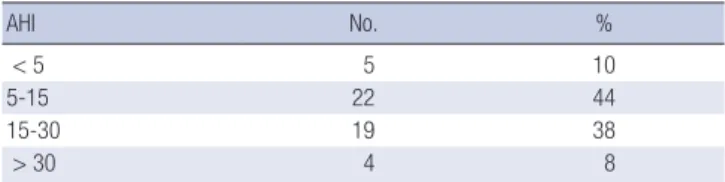
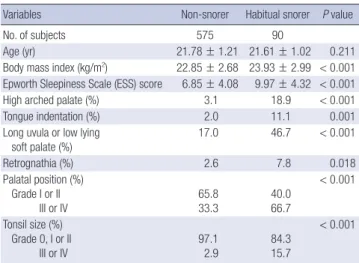
Ninety subjects (13.5%) of all participants reported habitual snor- ing. Fifty subjects (8.1%) were predicted to be at high risk of OS- AS by the questionnaire (Table 1). All subjects classified as be- ing at high risk of OSAS underwent portable monitoring. Among the 50 subjects, 45 persons were found to have AHI ≥ 5. The distribution of the AHI in subjects at high risk of obstructive sleep apnea syndrome shows in Table 2. Table 3 shows the clin- ical differences between the groups of non-snorers and habitu-
Table 1. Distribution of habitual snorers and high risk of obstructive sleep apnea syn- drome
No. %
Total 665
Habitual snorer* 90 13.5
High risk of OSAS 50 8.1
*Habitual snoring was defined as a snoring frequency ≥ 4 days per week. OSAS, ob- structive sleep apnea syndrome.
Table 2. Distribution of the AHI in subjects at high risk of obstructive sleep apnea syndrome
AHI No. %
< 5 5 10
5-15 22 44
15-30 19 38
> 30 4 8
AHI, apnea hypopnea index.
al snorers. The mean ages were 21.7 and 21.6 yr in the non-snor- ers and habitual snorers, respectively. There was no significant difference between the groups in age. BMI and ESS score were significantly higher in habitual snorers. The prevalence of high arched palate, tongue indentation, long uvula or low lying soft palate and retrognathia was significantly higher in habitual snor- ers. In addition, the prevalence of grade III or IV in palatal posi- tion and tonsil size was higher in habitual snorers. Table 4 shows the clinical differences between the high risk OSAS group and non-high risk OSAS group. The results of the comparison be- tween the two groups showed that they were similar results in Table 3.
To identify predictive factors associated with OSAS in sub- jects, we divided the subjects into two groups according to the presence of OSAS. We utilized the backward stepwise method of multiple logistic regression analysis. Finally, high arched pal- ate (odds ratio [OR] = 5.300; P = 0.005), long uvula or low lying soft palate (OR = 2.579; P = 0.022), tonsil size III or IV (OR = 5.351;
P = 0.012), ESS > 10 (OR = 4.152; P < 0.001) and obesity (BMI >
27 kg/m2) (OR = 3.157; P = 0.039) were found to independently predict OSAS in subjects (Table 5).
DISCUSSION
The aim of this study was to estimate the prevalence and risk factors of snoring and high risk of OSAS in young male soldiers in Korea. The prevalence of habitual snoring was 13.5% and high risk of OSAS by the Berlin questionnaire was 8.1%.
To our knowledge, this study is the first report on the preva- lence and risk factors of OSAS in the young military population in Korea. There have been many previous epidemiologic stud- ies of the prevalence of SDB, but there is little data on its preva- lence in young adults.
In a study on the prevalence of snoring and SDB in a univer- sity student population using a questionnaire survey followed
by home sleep monitoring, overall, 25.7% of subjects reported snoring, and the prevalence of SDB in monitored subjects was 2.3% (12). The questionnaire used in this study was the Sleep and Health Questionnaire. In this questionnaire, questions are categorized into mild, moderate, and severe according to the severity of snoring. Therefore, it did not estimate the frequency of snoring. In our study, the habitual snorer was defined as a person who snores frequently (4-5/week) or always (6-7/week).
In addition, the female to male ratio in the population was 1.8:1.
Therefore, it is likely that our results of the young adult male po- pulation show a higher prevalence rate compared with that of the university student population. According to results from the National Sleep Foundation Sleep in America 2005 poll, of the 1,506 respondents, 26% (31% of the men and 21% of the wom- en) met the Berlin questionnaire criteria (13). Particularly, 18%
of those persons 18 to 29 yr of age were at high risk. Moreno et al. (14) applied the Berlin Questionnaire to 10,101 truck drivers and reported that 26% were high risk for OSAS. When our re- sults are compared with those of the previous two studies, the prevalence of high risk for OSAS in our study shows a lower rate.
The possible reason for having a lower prevalence of high risk for OSAS compared with western studies may be due to the dif- ference in the prevalence of obesity, a strong risk factor for OSAS.
Table 3. Clinical difference between non-snorers and habitual snorers
Variables Non-snorer Habitual snorer P value
No. of subjects 575 90
Age (yr) 21.78 ± 1.21 21.61 ± 1.02 0.211
Body mass index (kg/m2) 22.85 ± 2.68 23.93 ± 2.99 < 0.001 Epworth Sleepiness Scale (ESS) score 6.85 ± 4.08 9.97 ± 4.32 < 0.001
High arched palate (%) 3.1 18.9 < 0.001
Tongue indentation (%) 2.0 11.1 0.001
Long uvula or low lying soft palate (%)
17.0 46.7 < 0.001
Retrognathia (%) 2.6 7.8 0.018
Palatal position (%) Grade I or II
III or IV 65.8
33.3 40.0
66.7
< 0.001
Tonsil size (%) Grade 0, I or II
III or IV 97.1
2.9 84.3
15.7
< 0.001
Table 4. Clinical differences between the high risk OSAS group and non-high risk OSAS group
Parameters Non-high risk
OSAS
High risk
OSAS P value
No. 620 45
Age (yr) 21.77 ± 1.19 21.50 ± 1.09 0.112
Body mass index (kg/m2) 22.88 ± 2.67 24.51 ± 3.64 < 0.001 Epworth Sleepiness Scale (ESS) score 6.87 ± 4.05 11.37 ± 4.51 < 0.001
High arched palate (%) 3.8 17.8 < 0.001
Tongue indentation (%) 2.6 11.1 0.003
Long uvula or low lying soft palate (%) 18.9 42.2 < 0.001
Retrognathia (%) 2.9 11.1 0.007
Palatal position (%) Grade I or II
III or IV 63.1
36.9 35.6
64.4
< 0.001
Tonsil size (%) Grade 0, I or II
III or IV 96.2
3.8 88.9
11.1
0.025
OSAS, Obstructive Sleep Apnea Syndrome.
Table 5. Logistic regression analysis for prediction of obstructive sleep apnea syn- drome
Variables OR 95% CI for OR
P value Lower Upper
High arched palate 5.300 1.635 17.175 0.005
Long uvula or low lying soft palate 2.579 1.146 5.801 0.022
Tonsil size III or IV 4.516 1.439 19.894 0.012
ESS > 10 4.241 1.931 9.317 < 0.001
Obesity (BMI ≥ 27 kg/m2) 3.157 1.057 9.428 0.039 ESS,Epworth Sleepiness Scale; BMI, Body mass index; CI, Confidence Interval; OR, Odds Ratio.
Moreover, the mean BMI of our subjects was 21.98 ± 2.5 which was lower than that of the Korean adult population (15).
The significance of physical examination for detection of OSAS is controversial. While Viner et al. (16), Friedman et al.
(17), and Zonato et al. (18) concluded that it is possible to iden- tify patients with OSAS based on the history and anatomical findings, Dreher et al. (19) claimed that medical history and an- atomical findings are insufficient to adequately predict the pre- sence or absence of OSAS (19). However, for the otorhinolaryn- gologist, routine physical examination and history taking are essential to identify OSAS in patients seeking treatment for snor- ing. These examinations allow for better treatment prioritisa- tion and a more evidence-based approach in patient manage- ment. In our results, all variables of upper airway bony and soft tissue structural abnormalities that we checked were signifi- cantly more frequent in subjects with a higher risk of OSAS.
If there were any obstructions in the nasal or nasopharyngeal pathways such as adenotonsillar hypertrophy or allergic rhinitis in childhood, the nasal breathing pattern might be changed to a mouth breathing pattern (20). Mouth-breathing individuals have been classically described as having a narrow, V-shaped maxillary arch, a high palatal vault, proclined upper incisors and a Class II occlusal relationship (21). High arched palate from among these can be a major reason for high nasal airway resis- tance that may contribute to the development of obstructive sleep apnea (OSA). Also, Cistulli et al. (22) observed modest correlations between indexes of maxillary constriction and sleep apnea severity. It is known that a long uvula or low lying soft palate and enlarged tonsil can be lead to airway obstruction by decreasing airway caliber. Previous pathologic studies have de- monstrated thickening, fibrosis and fat deposition in the uvula and soft palate of the patient with OSA (23). Tonsil hypertrophy is the most common risk factor for sleep-disordered breathing in children (24). But in previous studies, in which the study po- pulation was mainly middle aged, enlarged tonsil was more in- frequent than in our study (19, 25). A possible reason for this might be that enlarged tonsil was an independent predictive value in our study unlike other studies.
Overall, we found that the prevalence of snoring and high risk of OSAS in young male soldiers in Korea was 13.5% and 8.1%, respectively. It is not a low prevalence, considering the populations are young and non-overweight individuals. High arched palate, long uvula or low lying soft palate, tonsil size III or IV, ESS >10 and obesity were independent predictive factors of OSAS. For early identification and treatment of young sol- diers with OSAS in a military environment, a precise screening by questionnaire and physical examination is needed.
DISCLOSURE
The authors have no conflicts of interest to disclose.
REFERENCES
1. Peppard PE, Young T, Palta M, Skatrud J. Prospective study of the associ- ation between sleep-disordered breathing and hypertension. N Engl J Med 2000; 342: 1378-84.
2. Canessa N, Castronovo V, Cappa SF, Aloia MS, Marelli S, Falini A, Ale- manno F, Ferini-Strambi L. Obstructive sleep apnea: brain structural changes and neurocognitive function before and after treatment. Am J Respir Crit Care Med 2011; 183: 1419-26.
3. Young T, Palta M, Dempsey J, Skatrud J, Weber S, Badr S. The occurrence of sleep-disordered breathing among middle-aged adults. N Engl J Med 1993; 328: 1230-5.
4. Findley LJ, Barth JT, Powers DC, Wilhoit SC, Boyd DG, Suratt PM. Cog- nitive impairment in patients with obstructive sleep apnea and associ- ated hypoxemia. Chest 1986; 90: 686-90.
5. Ulfberg J, Carter N, Edling C. Sleep-disordered breathing and occupa- tional accidents. Scand J Work Environ Health 2000; 26: 237-42 . 6. Haraldsson PO, Carenfelt C, Diderichsen F, Nygren A, Tingvall C. Clini-
cal symptoms of sleep apnea syndrome and automobile accidents. ORL J Otorhinolaryngol Relat Spec 1990; 52: 57-62 .
7. Netzer NC, Stoohs RA, Netzer CM, Clark K, Strohl KP. Using the Berlin Questionnaire to identify patients at risk for the sleep apnea syndrome.
Ann Intern Med 1999; 131: 485-91.
8. Johns MW. A new method for measuring daytime sleepiness: the Epworth sleepiness scale. Sleep 1991; 14: 540-5.
9. Ridley MB. Aesthetic facial proportions. In: Papel ID, Nachlas NE, edi- tors. Facial plastic and reconstructive surgery. St Louis: Mosby-Year Book, 1992, p106.
10. Seto BH, Gotsopoulos H, Sims MR, Cistulli PA. Maxillary morphology in obstructive sleep apnoea syndrome. Eur J Orthod 2001; 23: 703-14.
11. Ahmed M, Patel NP, Rosen I. Portable monitors in the diagnosis of ob- structive sleep apnea. Chest 2007; 132: 1672-7.
12. Hui DS, Chan JK, Ho AS, Choy DK, Lai CK, Leung RC. Prevalence of snor- ing and sleep-disordered breathing in a student population. Chest 1999;
116: 1530-6.
13. Hiestand DM, Britz P, Goldman M, Phillips B. Prevalence of symptoms and risk of sleep apnea in the US population: results from the national sleep foundation sleep in America 2005 poll. Chest 2006; 130: 780-6.
14. Moreno CR, Carvalho FA, Lorenzi C, Matuzaki LS, Prezotti S, Bighetti P, Louzada FM, Lorenzi-Filho G. High risk for obstructive sleep apnea in truck drivers estimated by the Berlin questionnaire: prevalence and as- sociated factors. Chronobiol Int 2004; 21: 871-9.
15. Moon OR, Kim NS, Jang SM, Yoon TH, Kim SO. The relationship between body mass index and the prevalence of obesity-related diseases based on the 1995 National Health Interview Survey in Korea. Obes Rev 2002; 3:
191-6.
16. Viner S, Szalai JP, Hoffstein V. Are history and physical examination a good screening test for sleep apnea? Ann Intern Med 1991; 115: 356-9.
17. Friedman M, Tanyeri H, La Rosa M, Landsberg R, Vaidyanathan K, Pieri S, Caldarelli D. Clinical predictors of obstructive sleep apnea. Laryngo- scope 1999; 109: 1901-7.
18. Zonato AI, Bittencourt LR, Martinho FL, Júnior JF, Gregório LC, Tufik S.
Association of systematic head and neck physical examination with se- verity of obstructive sleep apnea-hypopnea syndrome. Laryngoscope 2003;
113: 973-80.
19. Dreher A, de la Chaux R, Klemens C, Werner R, Baker F, Barthlen G, Rasp G. Correlation between otorhinolaryngologic evaluation and se- verity of obstructive sleep apnea syndrome in snorers. Arch Otolaryngol Head Neck Surg 2005; 131: 95-8.
20. Harvold EP, Tomer BS, Vargervik K, Chierici G. Primate experiments on oral respiration. Am J Orthod 1981; 79: 359-72.
21. McNamara JA. Influence of respiratory pattern on craniofacial growth.
Angle Orthod 1981; 51: 269-300.
22. Cistulli PA, Richards GN, Palmisano RG, Unger G, Berthon-Jones M, Sullivan CE. Influence of maxillary constriction on nasal resistance and
sleep apnea severity in patients with Marfan’s syndrome. Chest 1996; 110:
1184-8.
23. Stauffer JL, Buick MK, Bixler EO, Sharkey FE, Abt AB, Manders EK, Kales A, Cadieux RJ, Barry JD, Zwillich CW. Morphology of the uvula in ob- structive sleep apnea. Am Rev Respir Dis 1989; 140: 724-8.
24. Potsic WP, Wetmore RF. Sleep disorders and airway obstruction in chil- dren. Otolaryngol Clin North Am 1990; 23: 651-63.
25. Schellenberg JB, Maislin G, Schwab RJ. Physical findings and the risk for obstructive sleep apnea. The importance of oropharyngeal structures. Am J Respir Crit Care Med 2000; 162: 740-8.