
Printed in the Republic of Korea https://doi.org/10.5012/jkcs.2018.62.6.427
Synthesis and Characterization of Nickel(II) Tetraaza Macrocyclic Complex with 1,1-Cyclohexanediacetate Ligand
In-Taek Lim†, Chong-Hyeak Kim‡, and Ki-Young Choi§,*
†Department of Center for Teaching and Learning, Chunnam Techno University, Gokseong 57500, Korea
‡Center for Chemical Analysis, Korea Research Institute of Chemical Technology (KRICT), 141 Gajeong-Ro, Yuseong-Gu, Daejeon 34114, Korea
§Department of Chemistry Education, Kongju National University, Kongju 32588, Korea.
*E-mail: [email protected]
(Received August 31, 2018; Accepted September 16, 2018)
ABSTRACT. The reaction of [Ni(L)]Cl2·2H2O (L = 3,14-dimethyl-2,6,13,17-tetraazatricyclo[14,4,01.18,07.12]docosane) with 1,1-cyclohexanediacetic acid (H2cda) yields mononuclear nickel(II) complex, [Ni(L)(Hcda-)2] (1). This complex has been characterized by X-ray crystallography, electronic absorption, cyclic voltammetry and thermogravimetric analyzer. The crystal structure of 1 exhibits a distorted octahedral geometry with four nitrogen atoms of the macrocycle and two 1,1-cyclohexanedi- acetate ligands. It crystallizes in the triclinic system P-1 with a = 11.3918(7), b = 12.6196(8), c = 12.8700(8) Å, V = 1579.9(2) Å3, Z = 2. Electronic spectrum of 1 also reveals a high-spin octahedral environment. Cyclic voltammetry of 1 undergoes one wave of a one-electron transfer corresponding to NiII/NiIII process. TGA curve for 1 shows three-step weight loss. The electronic spectra, electrochemical and TGA behavior of the complex are significantly affected by the nature of the axial Hcda- ligand.
Key words: Crystal structure, Nickel(II) complex, Octahedral complex, Tetraaza macrocycle, 1,1-cyclohexanediacetic acid
INTRODUCTION
The transition metal(II) polyaza macrocyclic complexes with axial ligands have attracted considerable attention because of their structural and chemical properties, which are often quite different from those complexes with unco- ordinated axial sites.1−16 Recently, we reported the syn- thesis and crystal structure of [Ni(L)(ONO)2]·2H2O3, in which the nickel ion reveals a distorted octahedral geom- etry with four nitrogen atoms of the macrocycle and two axial nitrito groups. The compound [Ni(Me8cyclam)(h2- NO2)]Cl·H2O (Me8cyclam = 3,5,7,7,10,12,14,14-octamethyl- 1,4,8,11-tetraazacyclotetradecane)4 shows that the coor- dination geometry of the nickel atom is six-coordinated bicapped square-pyramidal with two oxygen atoms of the bidentate nitrito group. In isocynato nickel(II) complexes [Ni(cyclam)(NCO)(H2O]](ClO4) and [Ni(Me4cyclam) (NCO)]
(ClO4) (Me4cyclam = 1,4,8,11-tetramethyl-1,4,8,11-ter- aazacycloteradecane),5 the coordination environment around the nickel(II) ion show a distorted octahedral and square pyramidal geometry, respectively. Furthermore, the aliphatic oxalate-bridged nickel(II) complexes [Ni(L) (oxalato)]n· nH2O6 and [Ni2(cyclam)2(oxalato)](NO3)27 exhibit one-dimen- sional polymeric and dinuclear structures with nickel cen- ters and bridging oxalate ligand. It was thought that the
different molecular topologies in the complexes may be due to the stereochemical rigidity of the macrocycle and different coordination modes of the axial ligands. In order to better understand some aspects of different molecular topologies, we investigated the synthesis, properties and crystal structure of mononuclear nickel(II) complex [Ni(L)(Hcda-)2] (1) (L = 3,14-dimethyl-2,6,13,17-tetraazatricyclo [14,4,01.18,07.12]docosane; H2cda = 1,1-cyclohexanediacetic acid).
EXPERIMENTAL Materials and Physical Measurements
All chemicals used in the synthesis were of reagent grade and were used without further purification. The complex [Ni(L)]Cl2·2H2O was prepared according to literature method.17 IR spectra were recorded as KBr pellets on a
Perkin-Elmer Paragon 1000 FT-IR spectrometer. The solution electronic and diffuse reflectance spectra were obtained on a Jasco V-550 spectrophotometer. Electrochemical measurements were accomplished with a three electrode potentiostat BAS-100BW system. A 3-mm Pt disk was used as the working electrode. The counter electrode was a coiled Pt wire and a Ag/AgCl electrode was used as a ref- erence electrode. Cyclic voltammetric data were obtained in DMSO solution with 0.10 M tetraethylammonium per- chlorate(TEAP) as supporting electrolyte at 20.0±0.1 °C.
The solution was degassed with high purity N2 prior to carrying out the electrochemical measurements. DSC and TGA were performed under flowing nitrogen at a heating rate of 10 min-1 using an SDT 2960 Thermogravimetric Analyzer. Elemental analyses (C, H, N) were carried out on a Perkin-Elmer CHN-2400 analyzer.
Synthesis of [Ni(L)(Hcda-)2](1)
1,1-cyclohexanediacetic acid (200 mg, 1 mmol) was added to a water solution (20 mL) of [Ni(L)]Cl2·2H2O (251 mg, 0.5 mmol) and the mixture was refluxed for 1 h. The solu- tion was filtered and allowed to stand for a few days to precipitate a quantity of purple crystals. The product was filtered and recrystallized from a hot H2O/CH3CN (1:1 v/v, 10 mL) mixture. Yield: 68%. Calc. (found) for C30H54N4-
NiO4: C, 60.72 (60.81); H, 9.17 (9.24); N, 9.44 (9.54)%. IR (KBr, cm-1): 3414(s), 3216(m), 2925(s), 2856(m), 1570(s), 1447(w), 1380(m), 1303(w), 1270(w), 1210(w), 1151(w), 1113(m), 996(w), 947(w), 894(w), 738(m), 678(w), 520(w).
Crystallography
Single crystal X-ray diffraction measurement for 1 was carried out on a Bruker APEX II CCD diffractometer using graphite-monochromated Mo-Kα radiation (λ = 0.71073 Å).
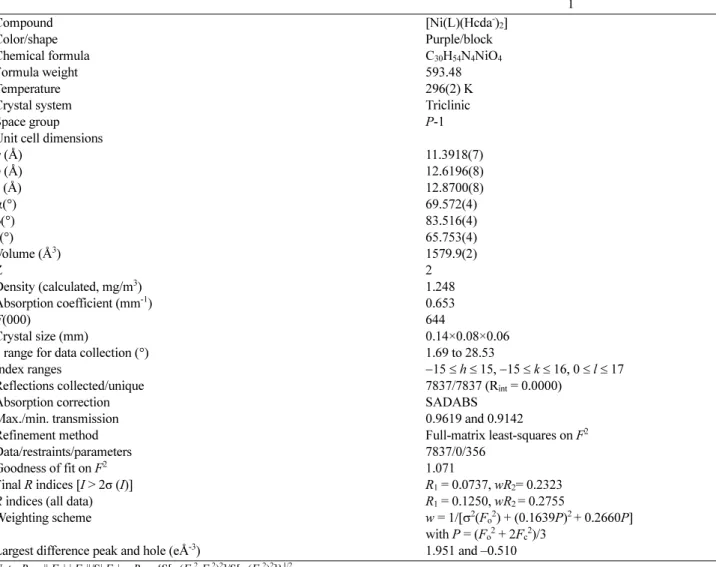
Table 1. Crystallographic data
1 Compound
Color/shape Chemical formula Formula weight Temperature Crystal system Space group Unit cell dimensions a (Å)
b (Å) c (Å) α(°) β(°) γ(°) Volume (Å3) Z
Density (calculated, mg/m3) Absorption coefficient (mm-1) F(000)
Crystal size (mm)
θ range for data collection (°) Index ranges
Reflections collected/unique Absorption correction Max./min. transmission Refinement method Data/restraints/parameters Goodness of fit on F2 Final R indices [I > 2σ (I)]
R indices (all data) Weighting scheme
Largest difference peak and hole (eÅ-3)
[Ni(L)(Hcda-)2] Purple/block C30H54N4NiO4 593.48 296(2) K Triclinic P-1
11.3918(7) 12.6196(8) 12.8700(8) 69.572(4) 83.516(4) 65.753(4) 1579.9(2) 2 1.248 0.653 644
0.14×0.08×0.06 1.69 to 28.53
−15 ≤ h ≤ 15, −15 ≤ k ≤ 16, 0 ≤ l ≤ 17 7837/7837 (Rint = 0.0000)
SADABS 0.9619 and 0.9142
Full-matrix least-squares on F2 7837/0/356
1.071
R1 = 0.0737, wR2= 0.2323 R1 = 0.1250, wR2 = 0.2755
w = 1/[σ2(Fo2) + (0.1639P)2 + 0.2660P]
with P = (Fo2 + 2Fc2)/3 1.951 and –0.510 Note.R1 = || Fo |-| Fc ||/S| Fo |. wR2 = {S[w(Fo2-Fc2)2]/S[w(Fo2)2]}1/2.
Intensity data were measured at 100(2) K by ω-2θ tech- nique. Accurate cell parameters and an orientation matrix were determined by the least-squares fit of 25 reflections.
The intensity data were corrected for Lorentz and polar- ization effects. An empirical absorption correction was applied with the SADABS program.18 The structure was solved by direct methods19 and the least-squares refine- ment of the structure was performed by the SHELXL-97 program.20 All atoms except all hydrogen atoms were refined anisotropically. The hydrogen atoms were placed in cal- culated positions allowing them to ride on their parent C atoms with Uiso(H) = 1.2Ueq(C or N). The crystallographic data, conditions used for the intensity collection, and some features of the structure refinement are listed in Table 1.
Crystallographic data for the structural analysis have been deposited with Cambridge Crystallographic Data Center, CCDC No. 1864424 for compound 1. Copies of this infor- mation may be obtained free of charge from the Director, CCDC, 12 Union Road, Cambridge, CB2, 1EZ, UK (fax:
+44-1223-336033; e-mail: [email protected] or http:/
/www.ccdc.cam.ac.uk).
RESULTS AND DISCUSSION
An ORTEP drawing21 of [Ni(L)(cda)2](1) with the atomic numbering scheme is shown in Fig. 1. Selected bond lengths and angles are listed in Table 2. The structure of 1 shows that the central nickel(II) ion is coordinated axially by two Hcda- ligands. The macrocyclic ligand skeleton in 1 takes the most stable trans-III (R,R,S,S) conformation
as usual. Both independent molecules lie on a center of inversion. The coordination environment around the cen- tral nickel(II) ion reveals a distorted octahedron with four Ni-N and two Ni-O bonds. The nickel atom and the four nitrogen atoms of the macrocycle are exactly in a plane.
The average Ni-N distance of 2.078(3) Å is significantly longer than in the square-planar geometry of [Ni(L)]Cl2· 2H2O [1.948(4) Å),17 but is similar to those observed for high-spin octahedral nickel (II) complexes with 14-mem- bered tetraaza macrocyclic ligands.9−11 The average Ni-O distance of 2.181(3) Å is longer than the NiN4 plane (2.078(3) Å) to give an axially elongated octahedron. The N-Ni-N
Figure 1. An ORTEP view of [Ni(L)(Hcda-)2](1) with the atomic numbering scheme (30% probability ellipsoids shown).
Table 2. Selected bond distances (Å) and angles (°) for [Ni(L) (cda)2](1)
Bond lengths Ni(1)-N(1) Ni(1)-N(2) Ni(1)-O(1) C(21)-O(1) C(21)-O(2)
Bond angles N(1)-Ni(1)-N(2) N(1)-Ni(1)-N(2)i N(1)-Ni(1)-O(1) N(1)i-Ni(1)-O(1) N(2)-Ni(1)-O(1) N(2)i-Ni(1)-O(1) Ni(1)-O(1)-C(21) O(1)-C(21)-O(2)
2.064(3) 2.097(4) 2.211(3) 1.271(5) 1.248(6)
95.5(1) 84.5(1) 91.2(1) 88.8(1) 82.6(1) 97.4(1) 130.8(3) 123.4(4)
Ni(2)-N(3) Ni(2)-N(4) Ni(2)-O(3) C(23)-O(3) C(23)-O(4)
N(3)-Ni(2)-N(4) N(3)ii-Ni(2)-N(4) N(3)-Ni(2)-O(3) N(3)ii-Ni(2)-O(3) N(4)-Ni(2)-O(3) N(4)ii-Ni(2)-O(3) Ni(2)-O(3)-C(23) O(3)-C(23)-O(4)
2.054(4) 2.096(3) 2.150(3) 1.264(5) 1.257(5)
84.0(1) 96.0(1) 92.0(1) 88.0(1) 97.9(1) 82.1(1) 133.4(3) 123.4(4) Symmetry codes: (i) -x+1, -y, -z+1 (ii) -x, -y+1, -z.
angles of the six-membered chelate rings are larger than those of the five-membered chelate rings. The dihedral angles between the plane of the carboxylate group and NiN4
plane involving Ni(1) and Ni(2) are 82.7(1) and 89.6(1)°, respectively. The two Ni(1)-O(1) and Ni(2)-O(3) linkages are bent slightly off the perpendicular to the NiN4 plane by 1.2-7.4° and 2.0-7.9°, respectively. The two Ni-O-C angles related to the Hcda- ligands are Ni(1)-O(1)-C(21) [130.8(3)°] and Ni(2)-O(3)-C(23) [133.4(3)°]. Interest- ingly, the secondary amines of the macrocycle are hydro- gen bonded to the carboxylate oxygen and nitrogen atoms of the Hcba- ligand [N(1)-H(1)…O(2) 2.785(5) Å, 156.6°];
N(5)-H(33)…O(4)v 2.856(6) Å, 154.0°; N(2)-H(32)… N(8)vi 3.263(6) Å, 167.7°; symmetry codes (v) x, y, z; (vi) -x+1, -y+1, -z+1]. It was also observed that the secondary amines of the macrocycle N(2) and N(3) form intermo- lecular hydrogen bonds with the uncoordinated carbox- ylate oxygen atom O(4) of the Hcba- ligand [N(2)-H(2)
…O(4) 3.127(5) Å, 155.8°; N(3)-H(3)…O(4)2.888(5) Å, 152.8°]. This interaction gives rise to a 1D hydrogen-bonded infinite chain (Fig. 2 and Table 3).
The IR spectra of 1 shows a band at ca. 3216 cm-1, which is assigned to the ν(N-H) of the coordinated sec- ondary amines of the macrocycle. Two strong ν(COO) band at 1570 cm-1 are associated with the coordinated Hcda- ligand, which is consistent with the crystal structure of 1.
The UV-Vis spectral data and solid state spectra data of 1 are shown in Table 4 and Fig. 3. The UV spectrum of 1 shows an absorption maximum at 262 nm attributed to a ligand-metal charge transfer associated with nitrogen and oxygen donors.22,23 As shown in Fig. 3, the solid electronic spectrum of 1 in the visible region reveals three absorption bands at 348, 544, and 754 nm assignable to the 3B1g→
3Eg(T1g(P)), 1B2g→ 1B1g, 3B1g→ 3B2g(T2g(F)) transitions, which are characteristic spectrum expected a high-spin d8 nickel(II) ion in D4h environment.24,25 However, the vis- Figure 2. A Parking diagram of [Ni(L)(Hcda-)2](1). The hydrogen bonds are shown as dashed lines.
Table 3. Hydrogen bonding parameters (Å, °) for [Ni(L)(Hcda-)2](1)
D-H…A D-H (Å) H…A (Å) D…A (Å) D-H…A (°)
N(1)-H(1)…O(2) N(2)-H(2)…O(4) N(3)-H(3)…O(4)
0.93 0.93 0.93
1.91 2.26 2.03
2.785(5) 3.127(5) 2.888(5)
156.6 155.8 152.8
ible spectrum of 1 in water solution displays a broad band 462 nm, which has a low-spin d8 nickel(II) ion in a square- planar environment of [Ni(L)](ClO4)2 (463 nm).26 This fact can be understood in terms of dissociation of the Hcda- ligand at water solution.
Cyclic voltammetric data for the nickel(II) complexes in 0.10 M TEAP-DMSO solution are listed in Table 5.
Cyclic voltammogram of 1 is shown in Fig. 4. The com- plex 1 exhibits one one-electron wave corresponding to NiII/NiIII process. The oxidation potential for 1 are con- siderably more positive than that for the square-planar [Ni(L)](ClO4)2,26 indicating that this complex makes the oxidation of Ni(II) to Ni(III) easily. This fact may be attributed to the coordination of the axial Hcda- ligand, which is in agreement with the crystal structure of 1. Sim- ilar results are also observed for tetraaza macrocyclic
nickel(II) complexes containing axial groups.5,13 The TGA diagram of compound 1 is shown in Fig. 5.
The compound was heated in the temperature range 30- 1000 °C in nitrogen gas. TGA curve for 1 shows a first weight loss of 56.5% (calculated 56.7%) over ca. 242- 431 °C, which is due to the loss of the macrocycle. A sec- ond weight loss corresponding to the1,1-cyclohexanedi- acetate ligands (observed 31.2%, calculated 33.4%) is found in the temperature range 489-656 °C. A final residue (observed 11.2%, calculated 9.9%) was remained above 656 °C with NiO composition.
CONCLUSION
The crystal structure of 1 has a six-coordinated octa- hedral geometry with bonds from the nickel(II) ion to the secondary amines of the macrocycle and to the two 1,1- Table 4. Electronic spectral dataa
Complex State λmax, nm (ε = M-1 cm-1) [Ni(L)](ClO4)2b
[Ni(L)(Hcda-)2] (1)
H2O MeNO2
H2O Solid
459(70) 463(73) 243(7.3×10³), 462(68)
262, 348, 544, 754
aSolution = H2O at 20±0.1 °C; solid = diffuse reflectance.
bRef. [26].
Figure 3. Solid state electronic absorption spectra of [Ni(L) (Hcda-)2](1) by the diffuse reflectance method at 20.0 ±0.1 °C.
Table 5. Cyclic voltammetric dataa
Complex Potentials (V) versus Ag/AgCl
Ni(II)/Ni(III) Ni(II)/Ni(I) [Ni(L)](ClO4)2b
[Ni(L)(Hcda-)2] (1)
+0.73
+1.20(i)c −1.63
aMeasured in 0.10 M TEAP-DMSO solution at 20.0±0.1 °C.
bRef. [26]. These values are reduced from those of Ag/AgCl reference elec- trodes.
ci = irreversible.
Figure 4. Cyclic voltammogram of [Ni(L)(Hcda-)2](1) in 0.1 M TEAP-DMSO solution at 20.0±0.1 °C. The scan rate is 100 mV/s.
Figure 5. Thermogravimetric curve of [Ni(L)(Hcda-)2](1)
cyclohexanediacetate ligands. The intermolecular hydro- gen bonds for 1 give rise to a 1D hydrogen-bonded infinite chain. The solid electronic spectra of 1 in the visible region exhibit three absorption bands. However, the visible spec- trum of 1 in water solution displays a broad band 458 nm, which has a low-spin d8 nickel(II) ion in a square-planar environment. The cyclic voltammogram for 1 reveals one- electron wave. TGA curve for 1 shows three-step weight loss. The electronic spectrum, electrochemical and TGA behaviors of the complex 1 are significantly affected by the nature of the axial Hcda- ligand.
Supporting Information. Additional supporting infor- mation is available in the online version of this article.
REFERENCES
1. Escuer, A.; Vicente, R.; Ribas, J.; El Fallah, M. S.; Solans, X. Inorg. Chem. 1993, 32, 1033.
2. Bernhardt, P. V.; Hetherington, J. C.; Jones, L. A. J. Chem.
Soc., Dalton Trans. 1996, 4325.
3. Choi, K.-Y.; Kim, Y.-J.; Ryu, H.; Suh, I.-H. Inorg. Chem.
Commun. 1999, 2, 176.
4. Choi, K.-Y.; Chun, K. M.; Suh, I.-H. Inorg. Chem. Commun.
1999, 2, 210.
5. Vicente, R.; Escuer, A.; El Fallah, M. S.; Solans, X.;
Font-Bardia, M. J. Inorg. Chim. Acta 1997, 261, 227.
6. Kim, J. C.; Cho, J.; Lough, A. J. Inorg. Chim. Acta 2001, 317, 252.
7. Battaglia, L. P.; Bianchi, A.; Corradi, A. B.; Garcia-España, E. Inorg. Chem. 1988, 27, 4174.
8. Fallis, I. A.; Farrugia, L. J.; Macdonald, N. M.; Peacock, R. D. J. Chem. Soc., Dalton Trans. 1993, 2759.
9. Jide, X.; Shisheng, N.; Yuguan, L. Inorg. Chem. 1988, 27,
4651.
10. Choi, K.-Y.; Chun, K. M.; Suh, I.-H. Polyhedron 2001, 20, 57.
11. Choi, K.-Y.; Ryu, H.; Lim, Y. M.; Sung, N. D.; Shin, U.
S.; Suh, M. Inorg. Chem. Commun. 2003, 6, 412.
12. Choi, K.-Y.; Kim, M. J.; Kim, D. S.; Kim, Y. S.; Kim, J.
H.; Ryu, H.; Lim, Y. M.; Kang, S. G.; Shin, U. S.; Lee, K.
C.; Hong, C. P. Bull. Korean Chem. Soc. 2002, 23, 1062.
13. Choi, K.-Y.; Choi, J.-H.; Lee, Y.-J.; Lee, J.-W.; Yun, J.- H.; Lim, I.-T.; Kim, K.-J. Transition Met. Chem. 2008, 33, 61.
14. Lim, I.-T.; Kim, C.-H.; Choi, K.-Y. Polyhedron 2015, 100, 43.
15. Lim, I.-T.; Choi, K.-Y. Polyhedron 2017, 127, 361.
16. Lim, I.-T.; Park, J.-H.; Choi, K.-Y.; Kim, C.-H.; Choi, Y.- M. Transition Met. Chem. 2018, 43, 323.
17. Choi, K.-Y.; Kim, J. C.; Jensen, W. P.; Suh, I.-H.; Choi, S.-S. Acta Cryst.1996, C52, 2166.
18. Sheldrick, G. M. SADABS, University of Göttingen, Ger- many, 1996.
19. Sheldrick, G. M. SHELXL-97, Program for crystal struc- ture solution, University of Göttingen, Germany, 2008.
20. Sheldrick, G. M. SHELXL-97, Program for the refinement of crystal structures. University of Göttingen, Germany, 2008.
21. Farrugia, L. J. J. Appl Cryst. 1997, 30, 565
22. Donlevy, T. M.; Gahan, L. R.; Hambley, T. W.; Hanson, G. R.; McMahon, K. L.; Stranger, R. Inorg. Chem. 1994, 33, 5131.
23. Cao, R.; Shi, Q.; Sun, D.; Hong, M.; Bi, W.; Zhao, Y.
Inorg. Chem. 2002, 41, 6161.
24. Mochizuki, K.; Kondo, T. Inorg. Chem. 1995, 34, 6241.
25. Martin, L. Y.; Sperati, C. R.; Busch, D. H. J. Am. Chem.
Soc. 1977, 99, 2968.
26. Kang, S.-G.; Kweon, K. K.; Jung, S. K. Bull. Korean Chem.
Soc. 1991, 12, 483.
![Table 2. Selected bond distances (Å) and angles (°) for [Ni(L) (cda) 2 ] ( 1) Bond lengths Ni(1)-N(1) Ni(1)-N(2) Ni(1)-O(1) C(21)-O(1) C(21)-O(2) Bond angles N(1)-Ni(1)-N(2) N(1)-Ni(1)-N(2) i N(1)-Ni(1)-O(1) N(1) i -Ni(1)-O(1) N(2)-Ni(1)-O(1) N(2) i -Ni(1)](https://thumb-ap.123doks.com/thumbv2/123dokinfo/5298338.153891/3.892.171.725.754.1080/table-selected-distances-angles-bond-lengths-bond-angles.webp)
![Table 3. Hydrogen bonding parameters (Å, °) for [Ni(L)(Hcda - ) 2 ] ( 1)](https://thumb-ap.123doks.com/thumbv2/123dokinfo/5298338.153891/4.892.168.723.147.573/table-hydrogen-bonding-parameters-å-l-hcda.webp)
![Figure 3. Solid state electronic absorption spectra of [Ni(L) (Hcda - ) 2 ] ( 1) by the diffuse reflectance method at 20.0 ±0.1 °C.](https://thumb-ap.123doks.com/thumbv2/123dokinfo/5298338.153891/5.892.473.795.148.394/figure-solid-electronic-absorption-spectra-diffuse-reflectance-method.webp)
