• 검색 결과가 없습니다.

The Effect of Proprioceptive Position Sense by Lumbar Flexors and Extensors J K S P T

N/A
N/A
Protected

Academic year: 2021

Share "The Effect of Proprioceptive Position Sense by Lumbar Flexors and Extensors J K S P T"

Copied!
5
0
0

로드 중.... (전체 텍스트 보기)

전체 글

(1)

The Effect of Proprioceptive Position Sense by Lumbar Flexors and Extensors

Ji-Won Park

1

, Yu-Min Ko

2

, Seol Park

2

1

Department of Physical Therapy, College of Medical Science, Catholic University of Daegu,

2

Department of Physical Therapy, Graduate School, Catholic University of Daegu

Purpose: Muscle fatigue affects proprioception, and it causes problems in spinal stability. The purpose of this study was to examine the effect on the accuracy of reproducing the lumbar angles before lumbar exercise and after fatiguing isokinetic lumbar exercise.

Methods: Thirty healthy adults participated in this study. Before induction of fatigue by exercise, the proprioception was measured by Biodex. Lumbar positions were passively maintained on stimulation position (25

o

flexion and 25

o

extension), and back to the starting position. Subjects actively repositioned the remembered stimulation position, and error degrees between the stimulation position and reposition were measured. Using an isokinetic device at 120

o

/sec of velocity of angle lumbar flexion/extension exercise resulted in muscle fatigue. The post-fatigue proprioceptive position sense was used in the same way as in pre-fatigue measurement.

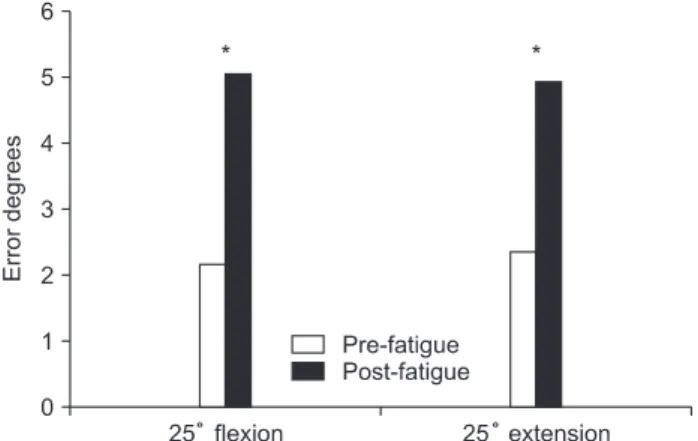
Results: Means of position sense of pre-fatigue were 2.19±1.97 on flexion angle, and 5.04±2.84 on extension angle. After exercise induced fatigue, means of position sense were 2.37±1.83 on flexion angle, and 4.93±2.57 on extension angle.

Results of this study showed significant differences of lumbar proprioceptive position sense between pre- and post-fatigue.

Conclusion: Lumbar proprioception sense in active repositioning in flexion and extension was affected in the presence of muscle fatigue. Therefore, it should be noted that therapeutic exercise for patients with abnormal proprioceptive sense or elderly people must be performed with care because muscle fatigue can cause secondary damage.

Keywords: Muscle fatigue, Proprioception, Lumbosacral region

I. Introduction

Proprioceptive sense means to distinguish the joint movement or posture, including the direction, size, velocity, and tension of movements, and it plays an important role in reduction of joint function instability or recurrence.

1-3

In particular, the input of proprioceptive sense on spine is a critical factor for stability and coordination, and it controls proper spinal movement.

3,4

This proprioceptive sense is located on anatomical structures such as muscle, joint, and skin; its

disability of proprioception is caused by injuries of muscle and joint. Proprioceptive sense is decreased by impairment of axons, and impairment of tissue on distributing receptors or changes of structures.

4,5

Impairment of proprioceptive sense interrupts coordination with muscle groups in its associated region, therefore, an appropriate response regarding cooperative action cannot be made in order to meet the need. The loss of position sense causes difficulty in performance of activities of daily life, and causes degenerative changes because it reduces the effects of new motor learning.

6

Individuals with low back pain have weakness on lumbar muscles as well as higher muscle fatigue on lumbar flexors and extensors.

7

Muscle fatigue affects coordination ability and proprioceptive sense, sports activities, daily life, and rehabilitation treatments.

8

And reduction of the ability to maintain muscle strength or proprioceptive sense due to Received December 7, 2012 Revised December 17, 2012

Accepted December 19, 2012

Corresponding author Seol Park, [email protected]

Copyright © 2012 by The Korean Society of Physical Therapy

This is an Open Access article distributed under the terms of the Creative Commons Attribution Non-Commercial License (http://creativecommons.org/licenses/by-nc/3.0/) which permits unrestricted non-commercial use, distribution, and reproduction in any medium, provided the original work is properly cited.

The J ournal of K orean S ociety of P hysical T herapy Original Article

(2)

muscle fatigue decreases the ability to control motor, and affects control of postural sway.

9-11

In particular, the deep muscles in individuals with low back pain are weaker and have imbalances, compared with healthy individuals, and the ability of reposition sense in individuals with low back pain decreases due to reduction of the proprioceptive function.

Therefore, they have problems in spinal stability.

12

As a result, the proprioceptive sense on the spine involves lumbar stability, and treatment and prevention of low back pain is important.

Many studies of the effect of proprioception on muscle fatigue, such as muscle fatigue on shoulder and knee joint, have been conducted.

13-16

In addition, studies of the relation between muscle fatigue and proprioception on the lumbar region have been conducted. Kim

17

reported that lumbar pain affects the reduction of the coordination ability of lower extremities and proprioceptive sense. Hart et al.

18

reported that muscle fatigue on paraspinal muscles induced experiment inhibit quadriceps femoris. Park et al.

19

reported that lumbar extensor fatigue decreases the coordination ability for examination of the motor control of lower extremities, however, it did not induce a reduction of proprioceptive sense. In order to treat and prevent low back pain, conduct of studies of muscle fatigue and proprioceptive sense has shown a steady increase, however, the effects of lumbar muscle fatigue on proprioceptive sense have not yet been reported. Therefore, the purpose of this study was to recognize the effects of lumbar muscle fatigue on proprioceptive sense in healthy young adults.

II. Materials and Methods

1. Subjects

Thirty healthy adults who were in agreement with the purpose of this study, and do not have problems on position sense and back injuries participated in this study.

2. Experimental methods 1) Experimental equipment

Biodex (Biodex Inc., Shirley, NY, USA) was used to measure position sense. This equipment uses the isokinetic principle

for diagnosis and analysis of seven major joints in humans and muscle power, endurance, and so on.

2) Procedure

While lumbar positions were passively maintained for 3 seconds on 25

o

flexion and 25

o

extension, which is the stimulation position, subjects had to remember the stimulation position. And lumbar positions were back to the starting position. Subjects actively repositioned the remembered stimulation position, and error degrees between the stimulation position and reposition were measured using the biodex system. Measurements were performed three times and used mean of the error degrees. It was the proprioceptive position sense of pre-fatigue. Both eyes of subjects were blinded during measurement of the position sense.

Lumbar muscle fatigue occurred using the Biodex system set at 120

o

/sec of angular velocity. Subjects continuously repeated lumbar flexion and extension for 20 times at their maximal strength. The post-fatigue proprioceptive position sense was used in the same way as in measurement of pre- fatigue.

3. Statistical analysis

IBM SPSS 19.0 for Windows (IBM Co., Armonk, NY, USA) and paired t-test were used for comparison of the proprioceptive position sense between pre- and post-fatigue. Significant level was 0.05.

III. Results

1. Characteristics of the subjects

The subjects included 30 healthy adults (16 male, 14 female), and characteristics of subjects are shown in Table 1.

Table 1. Characteristics of the subjects

Variable Male (n=16) Female (n=14)

Height (cm) Weight (kg) Age (yr)

174.8±5.4 68.2±10.6 24.4±4.3

161.3±4.6

51.9±3.6

24.4±2.2

Values are presented as mean±standard deviation.

(3)

2. Changes of position sense between pre-fatigue and post-fatigue (Figure 1)

Means of position sense of pre-fatigue were 2.19±1.97 on flexion angle, and 5.04±2.84 on extension angle. After exercise induced fatigue, means of position sense were 2.37

±1.83 on flexion angle, and 4.93±2.57 on extension angle.

Significant differences of position sense were observed between pre- and post-fatigue.

IV. Discussion

The spine is fixed for muscles and ligaments on the pelvis, however, the lumbosacral region is used to stress and heavy load by weight, gravity, and moment.

20

Intervertebral joints limit movement of each segment, so that each movement on motion segments causes a full range of motion. A combination is needed on each segment. Therefore, the lumbosacral region has interactive conflicting characteristics that require mobility and stability at the same time. In daily life, these structural features play a role for more efficient function of various spinal movements and activities. Deep muscles on the lumbar spine stabilize the lumbar region, and weakness of these deep muscles causes lumbar instability. In addition, it causes low back pain. Deep muscles in patients with low back pain are weaker, with greater imbalance, compared with healthy individuals, and decrease reposition sense for reduction of proprioception. As a result, they have problems on spinal stability, and this is the reason for recurrence.

12

Proprioception is defined as the sense that mechanore- ceptors detect joint position and movement through conscious/

unconscious process on the sensorimotor system. It is classified as a kinesthesia for detection of limb movement and a joint position sense for detection of static limb position. It plays a greater role than pain related to prevention of impairments, the etiology of chronic damage, and degenerative joint diseases. However, if the function of proprioceptive sense is that input by appropriate response as movements is reduced by abnormal structures around joints due to lesion or disease, balance ability for postural control, protective reaction and joint motion ability, and altering postural sway might decrease.

14,21-25

In this study, in order to recognize the effects of proprio- ceptive position sense on muscle fatigue, lumbar position sense was measured as experimentally generated muscle fatigue on the lumbar region. Significant differences in position sense were observed between pre- and post-fatigue.

Sterner et al.

26

reported that joint position sense does not have an effect on muscle fatigue. However, Voight et al.

2

reported significant differences in reposition of active and passive joint angle between pre- and post-fatigue. Miura et al.

27

reported changes in proprioceptive sense between pre- and post-application of local load. Johnston et al.

28

reported that proprioceptive sense has effects on muscle fatigue, and causes reduction of muscle response and ability to maintain balance. In addition, many previous studies have reported on the effects of proprioceptive sense on muscle fatigue;

results of these studies were consistent with the results of this study.

15-19,29,30

Lumbar muscles in individuals with low back pain become fatigued by consistent activities of lumbar flexors and extensors, which is accompanied by weakness of the muscles. Because it decreases lumbar proprioceptive sense and reposition sense, it causes spinal stability. Eventually, it is the reason for recurrence.

12

Therefore, many research studies investigating spinal proprioceptive training, local muscle strengthening, and lumbar stabilization training have been conducted for treatment and prevention of low back pain.

31-35

In addition, many physical therapists have administered treatment in the same manner. The results

Figure 1. The changes of position sense between pre- and post-

fatigue. *p<0.05.

(4)

of this study showed that lumbar muscle fatigue induced a decrease in proprioceptive position sense; these results indicate that muscle fatigue can cause disability in motor or postural control. In particular, muscle fatigue decreases proprioceptive sense and ability of motor performance in patients in whom muscle fatigue is easily generated or injured professional athletes, as well as patients with low back pain.

Therefore, it should be noted that therapeutic exercise for patients with abnormal proprioceptive sense or elderly people must be performed with care because muscle fatigue can cause secondary damage. Conduct of future studies will be needed in order to prove the relationship between muscle fatigue and proprioception in patients in whom muscle fatigue is easily generated or elderly people.

Acknowledgements

This work was supported by research grants from the Catholic University of Daegu in 2011.

References

1. Smith LK, Weiss EL, Lehmkuhl LD. Brunnstrom’s clinical kinesiology.

Philadelphia, F. A. Davis, 1996.

2. Voight ML, Hardin JA, Blackburn TA et al. The effects of muscle fatigue on and the relationship of arm dominance to shoulder proprioception. J Orthop Sports Phys Ther. 1996;23(6):348-52.

3. Hjortskov N, Hye-Knudsen C, Fallentin N. Lumbar position sense acuity during an electrical shock stressor. BMC Musculoskelet Disord. 2005;6:37.

4. Leaderman E. Fundamentals of manual therapy. New York, Churchill Livingstone, 1997.

5. Liebenson C. Rehabilitation and chiropractic practice. J Manipulative Physiol Ther. 1996;19(2):134-40.

6. Barrett DS, Cobb AG, Bentley G. Joint proprioception in normal, osteoarthritic and replaced knees. J Bone Joint Surg Br. 1991;73(1):

53-6.

7. Kankaanpää M, Taimela S, Laaksonen D et al. Back and hip extensor fatigability in chronic low back pain patients and controls.

Arch Phys Med Rehabil. 1998;79(4):412-7.

8. Marks R. Effect of exercise-induced fatigue on position sense of the knee. Aust J Physiother. 1994;40(3):175-81.

9. Lattanzio PJ, Petrella RJ, Sproule JR et al. Effects of fatigue on knee proprioception. Clin J Sport Med. 1997;7(1):22-7.

10. Sharpe MH, Miles TS. Position sense at the elbow after fatiguing contractions. Exp Brain Res. 1993;94(1):179-82.

11. Adlerton AK, Moritz U. Does calf-muscle fatigue affect standing

balance? Scand J Med Sci Sports. 1996;6(4):211-5.

12. O’Sullivan PB, Burnett A, Floyd AN et al. Lumbar repositioning deficit in a specific low back pain population. Spine (Phila Pa 1976). 2003;28(10):1074-9.

13. Carpenter JE, Blasier RB, Pellizzon GG. The effects of muscle fatigue on shoulder joint position sense. Am J Sports Med. 1998;26(2):262- 5.

14. Park JW. Correlation between joint position sense and severity of pain and range of motion in patients with shoulder dysfunction. J Korea Sport Res. 2007;18(6):443-50.

15. Ribeiro F, Mota J, Oliveira J. Effect of exercise-induced fatigue on position sense of the knee in the elderly. Eur J Appl Physiol.

2007;99(4):379-85.

16. Choi BO, Kim MW, Hong HS. The effects of lower extremity muscular fatigue on proprioceptive position sense of the knee joint. J Korean Soc Sports Phys Ther. 2009;5(1):19-25.

17. Kim HJ. The changes of proprioception and coordination by experimentally induced lumbar pain. Catholic University of Pusan.

Dissertation of Master’s Degree. 2006.

18. Hart JM, Fritz JM, Kerrigan DC et al. Reduced quadriceps activation after lumbar paraspinal fatiguing exercise. J Athl Train. 2006;41(1):

79-86.

19. Park MC, Kim HS, Lee SY et al. Effect of paraspinal muscle fatigue on proprioception and coordination of the lower limb. J Korean Soc Phys Med. 2008;3(4):255-60.

20. Taylor JR, Twomey LT. Physical therapy of the low back. New York, Churchill Livingstone, 2000.

21. Bae YS, Um KM, Kim NS. The effect of proprioceptive exercise of ankle joint on postural alignment in woman elderly person. J Korean Soc Phys Ther. 2009;21(3):53-60.

22. Jung JH, Yu JH. The effects of hippotherapy over 8 weeks on trunk proprioception, stability and posture in cerebral palsy patients. J Korean Soc Phys Ther. 2010;22(5):63-70.

23. Lee JP, Kim JY, Lee KT. Effects of ballet participation on foot joint angles, isokinetic strength and proprioception in females. Korean J Sports Med. 2008;26(2):146-53.

24. Callaghan MJ, Selfe J, McHenry A et al. Effects of patellar taping on knee joint proprioception in patients with patellofemoral pain syndrome. Man Ther. 2008;13(3):192-9.

25. Wingert JR, Burton H, Sinclair RJ et al. Joint-position sense and kinesthesia in cerebral palsy. Arch Phys Med Rehabil. 2009;90(3):

447-53.

26. Sterner RL, Pincivero DM, Lephart SM. The effects of muscular fatigue on shoulder proprioception. Clin J Sport Med. 1998;8(2):96- 101.

27. Miura K, Ishibashi Y, Tsuda E et al. The effect of local and general fatigue on knee proprioception. Arthroscopy. 2004;20(4):414-8.

28. Johnston RB 3rd, Howard ME, Cawley PW et al. Effect of lower extremity muscular fatigue on motor control performance. Med Sci Sports Exerc. 1998;30(12):1703-7.

29. Skinner HB, Wyatt MP, Hodgdon JA et al. Effect of fatigue on joint position sense of the knee. J Orthop Res. 1986;4(1):112-8.

30. Yi CH, Choi JD, Lee KN et al. The effect of graded exercise-

induced fatigue on position sense of the knee. J Korean Acad

(5)

Rehabil Med. 1999;6(3):22-37.

31. Koh EH, Jang JH, Jung DY. Effect of abdominal hollowing on muscle activity of gluteus maximus and erector spinae during bridging exercise. J Korean Soc Phys Ther. 2012;24(5):319-24.

32. Ko YM, Park S, Kim YJ et al. Effects of lumbar position sense on swing chair in healthy adults. J Korean Soc Phys Ther. 2012;24(3):

235-9.

33. Lee MY. Effect of abdominal muscle activity in combination with

the abdominal drawing-in maneuver for grip strength in healthy young adults. J Korean Soc Phys Ther. 2012;24(1):1-6.

34. Park SH, Yuk GC, Ahn SH et al. Lumbar spine kinematics during anterior and posterior pelvic tilting in supine and prone positions. J Korean Soc Phys Ther. 2011;23(6):9-14.

35. Seo JK, Kim SY. The relationship between hip abductor muscle

strength and lumbar instability in patients with chronic low back

pain. J Korean Soc Phys Ther. 2011;23(4):15-22.

수치

Table 1.  Characteristics of the subjects
Figure 1. The changes of position sense between pre- and post- post-fatigue. *p&lt;0.05.

참조

관련 문서

Autho: Effectiveness of surgery for lumbar stenosis and degenerative spondylolisthesis in the octogenarian population: analysis of the Spine Patient Outcomes Research

• 이명의 치료에 대한 매커니즘과 디지털 음향 기술에 대한 상업적으로의 급속한 발전으로 인해 치료 옵션은 증가했 지만, 선택 가이드 라인은 거의 없음.. •

웹 표준을 지원하는 플랫폼에서 큰 수정없이 실행 가능함 패키징을 통해 다양한 기기를 위한 앱을 작성할 수 있음 네이티브 앱과

_____ culture appears to be attractive (도시의) to the

• Lumbar vertebrae have massive wide bodies, suitable for supporting the entire superimposed weight of the head, trunk, and arms. • The total mass of the five lumbar

【판결요지】[1] [다수의견] 동일인의 소유에 속하는 토지 및 그 지상 건물에 관하여 공동저 당권이 설정된 후 그 지상 건물이 철거되고 새로 건물이 신축된 경우에는

Diffuse pain in lumbar muscles;some radiation to buttocks Localized lumbar pain: similar findings to lumbar strain Leg pain often worse than back

1 John Owen, Justification by Faith Alone, in The Works of John Owen, ed. John Bolt, trans. Scott Clark, &#34;Do This and Live: Christ's Active Obedience as the