대한화상학회지 제 18 권 제 1 호
35
Journal of Korean Burn SocietyVol. 18, No. 1, 35-37, 2015
Corresponding author: Youngjoon Kim, Department of Plastic and Reconstructive Surgery, Sanggye Paik Hospital, Inje University College of Medicine, 1342, Dongil-ro, Nowon-gu, Seoul 139-707, Korea
Tel: 82-2-950-1048, Fax: 82-2-932-6373
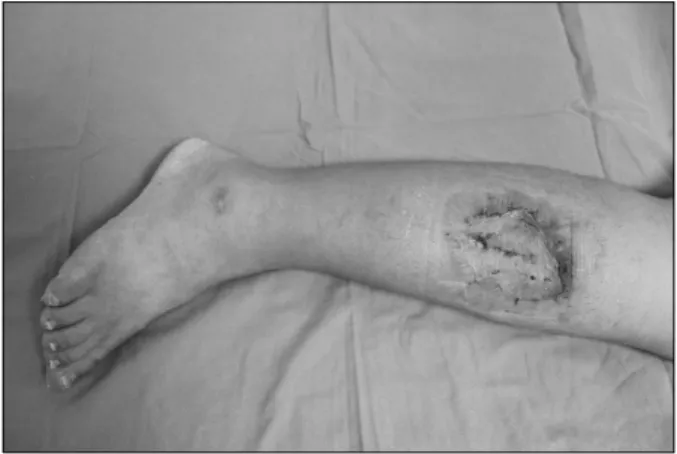
E-mail: [email protected] Fig. 1. Initial clinical photo of the wound.
Alcaligenes Xylosoxidans 감염에 합병된 피부 궤양 증례
김준현ㆍ최성훈ㆍ김영준
인제대학교 의과대학 상계백병원 성형외과
A Skin Ulceration Complicated by Alcaligenes Xylosoxidans Infection
Joonhyon Kim, M.D., Sunghoon Choi, M.D. and Youngjoon Kim, M.D., Ph.D.
Department of Plastic and Reconstructive Surgery, Sanggye Paik Hospital, Inje University College of Medicine, Seoul, Korea A. xylosoxidans infection can result in potentially severe se- quelae, especially in unhealthy populations. We present a rare case of infectious skin ulceration with scar contracture due to A. xylosoxidans in a healthy patient. A 53-year-old male patient without underlying disease and trauma history visited our department for an irritating skin ulcer with purulent discharge on the right lower leg. The chronic wound on the leg exists since he got contact burn 30 years ago. The wound did not respond to treatment, and the wound culture results indicated A. xylosoxidans. Given the incurable character of A.
xylosoxidans, we performed a wide excision and split thick- ness skin graft with collagen-elastin matrix (MatridermⓇ). A.
xylosoxidans is an opportunistic, aerobic, gram-negative, rod-shaped bacterium that is oxidase positive. According to reports, A. xylosoxidans is not sensitive to many antibiotics and can cause bacteremia. It is suggested that the blood supply is compromised near a scar lesion despite the fact that blood flow is rather increased during the initial scar for- mation phase. Therefore, we presumed that the infection was most likely caused by low blood circulation due to scar contracture. Thus, when a scar contracture is present, A. xy- losoxidans infection can manifest in a healthy patient. (J Korean Burn Soc 2015;18:35 -37)
Key Words: Infection, Skin, Alcaligenes
INTRODUCTION
Achromobacter xylosoxidans (Alcaligenes xylosoxidans, A. xylosoxidans) is member of an emerging group of Gram- negative water-borne bacteria that belong to the genus Alcaligenes. A. xylosoxidans is often confused with Pseudo- monas aeruginosa and other Gram-negative pathogens. A.
xylosoxidans is also called xylosoxidans due to its ability
to oxidize xylose. A. xylosoxidans exhibits a different anti-
biotic sensitivity profile compared with Pseudomonas aeru-
ginosa and other Gram-negative pathogens. A. xylosoxidans
infection can result in potentially severe sequelae, espe-
cially in unhealthy populations
1). It rarely causes infection
in humans but has been known to cause opportunistic in-
fections in patients with tumors, hematologic disease, or-
gan transplants, hypogammaglobulinemia, or acquired
immunodeficiency syndrome (AIDS)
2). Severe sequelae oc-
cur in unhealthy as well as healthy individuals. However,
skin and soft tissue infections in healthy patients caused
by A. xylosoxidans are rare. We present a rare case of in-
fectious skin ulceration with scar contracture due to A. xy-
36
대한화상학회지 Vol. 18, No. 1, 2015Fig. 2. Skin ulcer with purulent discharge. Fig. 3. Completely healed state after wide excision and split thickness skin graft with collagen-elastin matrix (Matriderm®).
losoxidans in a healthy patient.
CASE
A 53-year-old male patient visited our department for an irritating skin ulcer with purulent discharge on the right lower leg (Fig. 1, 2). His past history included contact burn on his right lower leg from carbon monoxide poisoning 30 years ago. Debridement was performed in local clinic, but other treatments, such as skin graft, were refused by pa- tient at that time. With the exception of the burn scar con- tracture, he was a generally healthy patient. No problems with the scar were noted, but skin ulceration formed in July 2014 without any additional trauma history.
He was treated in local clinic, but the wound did not heal. The wound became worse and presented with mu- copurulent discharge and redness. We considered the di- agnosis of an anaerobic skin wound infection, so we per- formed a wound culture, administered empirical anti- biotics therapy, and applied wound dressing. We sec- ondarily presumed Marjolin’s ulcer, but no repeated trau- ma history was evident. Hence, we considered the possi- bility of Marjolin’s ulcer to be low.
The wound did not respond to treatment, and the wound culture results indicated A. xylosoxidans. Given the incurable character of A. xylosoxidans, we performed a wide excision and split thickness skin graft with collagen-elastin matrix (Matriderm
®). We performed a frozen biopsy given the possibility, albeit low, of Marjolin’s ulcer. Negative findings were confirmed by a pathologist. After 2 weeks
of treatment, the ulcer completely healed (Fig. 3).
DISCUSSION
A. xylosoxidans was first described and named in 1971 by Yabuuchi and Ohyama, who isolated the organism from purulent ear discharges of 7 patients. A. xylosoxidans can be found in any contaminated place, though it is mainly noted in soil and water. Nosocomial infections from dialysis, saline, and humidifier solutions were re- cently reported
3). In particular, dialysis solutions can serve as an ideal medium for A. xylosoxidans growth; thus, peritonitis cases have been reported
4).
A. xylosoxidans is an opportunistic, aerobic, gram-neg- ative, rod-shaped bacterium that is oxidase positive.
According to reports, A. xylosoxidans is not sensitive to many antibiotics and can cause bacteremia
2). Immuno- compromised patients are typically infected; this bacte- rium is rarely isolated in healthy patients.
Marjolin’s ulcers typically develop in contracture scars
as well as traumatic wounds or ischemic areas
5). It is sug-
gested that the blood supply is compromised near a scar
lesion despite the fact that blood flow is rather increased
during the initial scar formation phase. Therefore, we pre-
sumed that the infection was most likely caused by low
blood circulation due to scar contracture. Thus, when a
scar contracture is present, A. xylosoxidans infection can
manifest in a healthy patient.
Joonhyon Kim, et al:A Rare Skin Infection by Alcaligenes Xyloxidans
37
REFERENCES
1) Hsu CK, Chang YH, Chen JT. Scleral buckle infection with Alcaligenes xylosoxidans. Indian J Ophthalmol. 2014;62:739- 741.
2) Zhi Yang Ng, George Fang, Kah Woon Leo. Resolution of concomitant Achromobacter xylosoxidans burn wound infection without adjustment of antimicrobial therapy. Indian J Plast Surg. 2014;47:137-140.
3) Claassen SL, Reese JM, Mysliwiec V, Mahlen SD. Achromobacter xylosoxidans infection presenting as a pulmonary nodule mimicking cancer. J Clin Microbiol. 2011;49:2751-2754.
4) Jeon JM, Park YK, Oh JS, Kim SM, Sin YH, Kim JK. Peritonitis by Achromobacter xylosoxidans in a Patient Undergoing Continuous Ambulatory Peritoneal Dialysis (CAPD): A Case Report. The Korean Journal of Nephrology. 2011;30:215-219.
5) Chase Tobin, BS; and James R. Sanger, MD. Marjolin’s Ulcers:
A Case Series and Literature Review. WOUNDS. 2014;26:248-254.