• 검색 결과가 없습니다.

Heart Transplantation in a Patient with Persistent Left Superior Vena Cava

N/A
N/A
Protected

Academic year: 2021

Share "Heart Transplantation in a Patient with Persistent Left Superior Vena Cava"

Copied!
3
0
0

로드 중.... (전체 텍스트 보기)

전체 글

(1)

ISSN: 2233-601X (Print) ISSN: 2093-6516 (Online)

− 533 −

Departments of

1

Thoracic and Cardiovascular Surgery,

2

Radiology, and

3

Internal Medicine and Cardiovascular Center, Seoul National University Hospital

†This paper was presented in the 261th Monthly Case Conference of Seoul-Kyeonki District Chamber of The Korean Society for Thoracic and Cardiovascular Surgery.

Received: October 29, 2013, Revised: February 4, 2014, Accepted: February 10, 2014, Published online: December 5, 2014

Corresponding author: Ho Young Hwang, Department of Thoracic and Cardiovascular Surgery, Seoul National University Hospital, Seoul National University College of Medicine, 101 Daehak-ro, Jongno-gu, Seoul 110-744, Korea

(Tel) 82-2-2072-3020 (Fax) 82-2-764-3664 (E-mail) [email protected]

C

The Korean Society for Thoracic and Cardiovascular Surgery. 2014. All right reserved.

CC
This is an open access article distributed under the terms of the Creative Commons Attribution Non-Commercial License (http://creative- commons.org/licenses/by-nc/3.0) which permits unrestricted non-commercial use, distribution, and reproduction in any medium, provided the original work is properly cited.

Heart Transplantation in a Patient with Persistent Left Superior Vena Cava

Jae-Hong Lee, M.D.

1

, Eun-Ah Park, M.D.

2

, Whal Lee, M.D., Ph.D.

2

, Hyun-Jai Cho, M.D., Ph.D.

3

, Ki-Bong Kim, M.D., Ph.D.

1

, Ho Young Hwang, M.D., Ph.D.

1

A 56-year-old male presented with severe exertional dyspnea and pitting edema in the lower extremities. The pre- operative evaluation demonstrated biventricular dysfunction associated with severe tricuspid valve regurgitation and a persistent left superior vena cava. He was registered as a transplantation candidate, and orthotopic heart trans- plantation was performed using the standard bicaval technique. The left superior vena cava was connected to the right atrial appendage after the construction of a conduit using the recipient’s autologous coronary sinus tissue.

One-month postoperatively, computed tomography imagery demonstrated a patent conduit between the left superior vena cava and right atrial appendage.

Key words: 1. Heart transplantation 2. Tricuspid valve

CASE REPORT

A 56-year-old male visited our hospital with New York Heart Association functional class IV dyspnea and pitting edema in his lower extremities. The patient had been diag- nosed with tricuspid valve regurgitation and atrial fibrillation at an outside institution 10 years ago. However, the patient had refused surgical treatment at that time. Physical examina- tion and laboratory tests demonstrated severe hepatomegaly, ascites, azotemia, and cardiac cirrhosis (Child-Pugh class B).

Echocardiography and cardiac magnetic resonance imaging showed severe tricuspid valve regurgitation, with a persistent left superior vena cava (SVC) draining into the coronary si- nus and absence of the innominate vein. Magnetic resonance

imaging revealed left and right ventricular ejection fractions of 31.5% and 34.2%, respectively. Heart transplantation rather than a tricuspid valve surgery was recommended because of the biventricular dysfunction.

Preoperative computed tomographic venography of the neck and brain was performed to evaluate the probable risk of a left SVC ligation. The diameters of the right and left SVCs were 17 mm and 16 mm, respectively. Abundant collaterals were built up at the sigmoid sinus, which was considered adequate for draining venous blood from the left part of the head to the right SVC. This finding suggested that the risk of cere- bral venous congestion after left SVC ligation was minimal.

When opening the pericardium during heart transplantation, the recipient heart showed a large dilated distal part of the

Korean J Thorac Cardiovasc Surg 2014;47:533-535 □ Case Report □

http://dx.doi.org/10.5090/kjtcs.2014.47.6.533

(2)

Jae-Hong Lee, et al

− 534 − Fig. 1. Anastomosis of the LSVC with the right atrial appendage in an end-to-end fashion (asterisk). AO, ascending aorta; LSVC, left superior vena cava; RAA, right atrial appendage; RSVC, right superior vena cava.

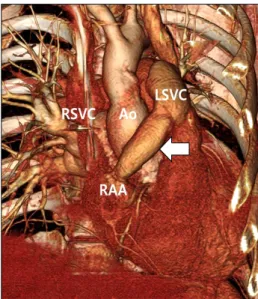
Fig. 2. Postoperative computed tomographic angiogram performed one month after heart transplantation demonstrated a patent con- duit interconnected between the left superior vena cava and right atrial appendage (arrow). AO, ascending aorta; LSVC, left superior vena cava; RAA, right atrial appendage; RSVC, right superior vena cava.

left SVC draining into the coronary sinus. Under moderate hypothermia, orthotopic heart transplantation was performed with the standard aorto-bicaval cannulation technique using an additional venous cannula on the left SVC. The donor heart was implanted using the standard bicaval technique. Despite the preoperative evaluation suggesting left SVC ligation would be safe in this patient, the left SVC was anastomosed to the right atrial appendage using an interconnecting conduit (Fig. 1). A tubular conduit 16 mm in diameter and 4 cm in length was constructed using the resected coronary sinus tis- sue to avoid size discrepancy and kinking. After the ortho- topic cardiac transplantation was completed using the bicaval anastomosis technique, the tubular conduit was anastomosed to the distal part of the left SVC and to the right atrial ap- pendage using continuous 5-0 polypropylene sutures. The car- diopulmonary bypass and donor ischemic times were 354 mi- nutes and 125 minutes, respectively. The postoperative course was uneventful. A computed tomography angiogram at one month after the surgery demonstrated a patent conduit be- tween the left SVC and right atrial appendage (Fig. 2). The patient was discharged without any complications and did not show any sign of upper-body venous congestion at the six- month follow-up visit.

DISCUSSION

A left SVC is an infrequent congenital abnormality with a prevalence of 0.3% to 0.5% in the normal population and 2.8% to 4.3% in patients with congenital heart disease [1]. In the setting of cardiac transplantation, a persistent left SVC deserves consideration to determine the level of venous return during bypass as well as the bicaval anastomosis.

If a well-developed innominate vein is present, occlusion of the left SVC by simple ligation or division will recreate a nor- mal venous drainage through the innominate vein. However, if the innominate vein is small or absent, occluding the left SVC may increase the risk of neurovascular complications [2].

A persistent left SVC can be preserved with several surgi- cal techniques during orthotopic heart transplantation. These surgical approaches include end-to-side anastomosis of the left SVC to the right SVC, end-to-end anastomosis of the left SVC to the right atrial appendage (direct anastomosis or anas- tomosis using a conduit), and anastomosis of both right and left SVCs to the innominate vein of the donor graft [2-6].

A previous study presented a case of orthotopic heart trans-

(3)

HTPL in a Patient with Left SVC

− 535 − plantation in a patient with a persistent left SVC [6]. In that patient, the left SVC was passed between the ascending aorta and pulmonary artery, and anastomosed to the right SVC in an end-to-side fashion.

In the present case, there were abundant collaterals present at the sigmoid sinus, which might have prevented venous congestion if the left SVC was occluded. However, we de- cided to preserve the left SVC to minimize this risk.

Connecting the left SVC to the right SVC behind the ascend- ing aorta was avoided because its passage was right-angled and posed a risk of compression by the aorta and pulmonary artery. In addition, we constructed an interconnecting graft in- stead of using an in situ conduit, because there were issues such as a size discrepancy and risks of kinking and resultant blood stasis. The coronary sinus tissue was resected, made in- to a tubular conduit with a diameter of 16 mm, and placed between the left SVC and the right atrial appendage.

Artificial conduits were not considered due to the risk of thrombo-occlusion and infection.

In conclusion, we successfully performed an orthotopic heart transplantation in a patient with a persistent left SVC by reconstructing the left SVC with an interconnecting con- duit made from autologous coronary sinus tissue, which was anastomosed to the distal part of the left SVC and to the right atrial appendage.

CONFLICT OF INTEREST

No potential conflict of interest relevant to this article was reported.

REFERENCES

1. Hammon J, Bender HW. Major anomalies of pulmonary and thoracic systemic veins. In: Sabiston DC, Spencer FC, Gibbon JH, editors. Surgery of the chest. 5th ed. Philadel- phia: Saunders; 1990. p. 1274-96.

2. Raisky O, Tamisier D, Vouhe PR. Orthotopic heart trans- plantation for congenital heart defects: anomalies of the sys- temic venous return. Multimed Man Cardiothorac Surg 2006;2006:mmcts.2005.001578.

3. Vargas FJ. Reconstructive methods for anomalous systemic venous return: surgical management of persistent left superi- or vena cava. Semin Thorac Cardiovasc Surg Pediatr Card Surg Annu 2008;11:31-8.

4. Rabago G, Martin-Trenor A, Lopez-Coronado JL, Macias A, Cosin-Sales J, Herreros JM. Bicaval anastomosis in a heart transplant recipient with left superior vena cava. Ann Thorac Surg 2002;74:1242-4.

5. Menkis AH, McKenzie FN, Novick RJ, et al. Special con- siderations for heart transplantation in congenital heart disease. The Paediatric Heart Transplant Group. J Heart Transplant 1990;9:602-7.

6. Joo S, Kim GS, Lim JY, et al. Orthotopic cardiac trans-

plantation after inter-caval anastomosis in a patient with hy-

pertrophic cardiomyopathy and persistent left superior vena

cava. Korean J Thorac Cardiovasc Surg 2010;43:522-4.

수치

Fig. 2. Postoperative computed tomographic angiogram performed  one month after heart transplantation demonstrated a patent  con-duit interconnected between the left superior vena cava and right  atrial appendage (arrow)

참조

관련 문서

However, CT scan which was performed after successful pacemaker implantation, revealed that the tined lead penetrated the SVC wall and it caused focal hematoma in

AVNRT, atrioventricular nodal reentrant tachycardia; SP, slow pathway; AVRT, atrioventricular reentrant tachycardia; AP, accessory pathway; AFL, atrial flutter; CTI,

We report on a fulminant myocarditis patient presenting shock mimicking acute coronary syndrome, finally bridging to orthotopic heart transplantation; the pathological substratum

Three-dimensional volume-rendered images show the anomalous vein (white arrows in Figure 2A, 2B) which is an exten- sion of the left subclavian vein and left internal jugular

Left lateral thoracic vein (open arrow), left internal mammary vein (small solid ar- row), and left superior intercostal vein (small open arrow) are dilated with contrast medium..

The combination of coronary arteriovenous fistula to the coronary sinus (CS), dilatation of the entire length of coronary artery, coronary aneurysm and persistent left superior

draining into the left atrium without arterial oxygen unsatu- ration. Persistierende linke ober hohlvene und mitralstenose. Sinus node dysfunction associated with absence of

We report a case of high-output chylothorax associated with thrombo-occlusion of the superior vena cava (SVC) and left innominate vein (LIV) following an