ORIGINAL ARTICLE
대장 폴립절제술 후 예방적 클립 사용 없이 발생한 지연 출혈:
단일기관에서의 관찰 연구
김현진*, 김재현*, 최윤정, 권혜정, 장희경1, 김성은, 문원, 박무인, 박선자
고신대학교 의과대학 내과학교실, 병리과학교실1
Risk of Delayed Bleeding after a Colorectal Endoscopic Mucosal Resection without Prophylactic Clipping: Single Center, Observational Study
Hyeonjin Kim*, Jae Hyun Kim*, Youn Jung Choi, Hye Jung Kwon, Hee Kyung Chang1, Sung Eun Kim, Won Moon, Moo In Park and Seun Ja Park
Departments of Internal Medicine and Pathology1, Kosin University College of Medicine, Busan, Korea
Background/Aims: Bleeding is one of the major complications of a colorectal polypectomy. The aim of this study was to identify the risk of delayed bleeding, particularly after a colorectal endoscopic mucosal resection (EMR) without prophylactic clipping.
Methods: Between April 2014 and August 2014, patients who underwent colorectal EMR (≥6 mm and <2 cm) without prophy- lactic clipping were included. This study evaluated the incidence of delayed bleeding and the associated factors after colorectal EMR without prophylactic clipping.
Results: A total of 717 colorectal polyps (≥6 mm and <2 cm) of 243 patients resected by colorectal EMR in the study period were evaluated. The mean age of the patients was 63 years; 165 patients were men and 78 patients were women. The mean polyp size removed by colorectal EMR was 9.0 mm (range 6.0-19.0), and the number of polyps larger than 1 cm was 212 (29.6%). Delayed bleeding after colorectal EMR occurred in 12 polyps (1.7%) in eight patients (3.3%), and there were no significant risk factors af- fecting delayed bleeding.
Conclusions: This study identified that the incidence of delayed bleeding on colorectal polyps (≥6 mm and <2 cm) after EMR without prophylactic clipping was 3.3%, but no significant risk factors affecting delayed bleeding were found. (Korean J Gastroenterol 2019;74:326-332)
Key Words: Colonic polyps; Endoscopic mucosal resection; Hemorrhage
Received May 28, 2019. Revised July 29, 2019. Accepted September 2, 2019.
CC This is an open access article distributed under the terms of the Creative Commons Attribution Non-Commercial License (http://creativecommons.org/licenses/
by-nc/4.0) which permits unrestricted non-commercial use, distribution, and reproduction in any medium, provided the original work is properly cited.
Copyright © 2019. Korean Society of Gastroenterology.
교신저자: 박선자, 49267, 부산시 서구 감천로 262, 고신대학교 의과대학 내과학교실
Correspondence to: Seun Ja Park, Department of Internal Medicine, Kosin University College of Medicine, 262 Gamcheon-ro, Seo-gu, Busan 49267, Korea. Tel:
+82-51-990-5061, Fax: +82-51-990-5055, E-mail: [email protected], ORCID: https://orcid.org/0000-0003-3217-5115 Financial support: None. Conflict of interest: None.
* The first two authors contributed equally to this work as co-first authors of this paper.
INTRODUCTION
Colonoscopic polypectomy is useful for reducing the in- cidence and mortality of colorectal cancer.1 Most colorectal polyps detected during colonoscopy can be removed safely
by polypectomy. On the other hand, several complications can occur after colonoscopic polypectomy, which include perfo- ration, hemorrhage, or postpolypectomy electrocoagulation syndrome.2 Postpolypectomy bleeding is the most common complication of a polypectomy, which can be classified by imme-
diate and delayed bleeding.3,4 These complications can help decrease the compliance performing colonoscopy. Immediate bleeding commonly occurs within a few minutes after a poly- pectomy, and an epinephrine injection or clipping can control it during colonoscopy.5 Delayed bleeding commonly occurs with- in 5-7 days after a polypectomy, but it can also occur within a few hours or after 17 days.6,7 According to recent studies, the rate of immediate bleeding and delayed bleeding has been reported to be 1.5-2.8% and up to 2.0%, respectively.8-10
Hayashi11 first reported the use of hemoclips for the treatment of gastrointestinal bleeding in 1975, and Wang et al.12 described the first prophylactic use of hemoclips to prevent delayed bleeding after a polypectomy in 1997.
Hemoclips are useful in the management of gastric ulcer bleeding, Mallory-Weiss syndrome, and bleeding of Dieulafoy’s lesion,13-15 but studies on the effects of prophylactic clip- ping to prevent delayed bleeding are limited in number and are controversial. Some studies reported that the use of hemoclips is useful for preventing delayed bleeding on large (≥2 cm) pedunculated or sessile polyps,16,17 and oth- er studies reported that prophylactic hemoclips placement did not decrease the occurrence of delayed bleeding after colonoscopic polypectomy.18,19 Old age, polyps at a right-sid- ed colon, sessile or large (≥2 cm) polyps, hypertension, and the use of anticoagulants are known risk factors for delayed bleeding.3,7,20 Despite these reports, there is little information on the delayed bleeding of polyps (<2 cm) af- ter endoscopic mucosal resection (EMR) without prophy- lactic clipping.
Regarding the polypectomy technique according to the size of the polyp, although the polypectomy technique for diminu- tive and small polyps is highly variable among endoscopists, polyps ≥6 mm have been removed using a snare polypectomy including EMR as the technique of choice and diminutive pol- yps have been removed commonly by cold biopsy forceps.21-23 This study suggests that the use of prophylactic hemoclips is not helpful for preventing delayed bleeding of colorectal polyps (≥6 mm and <2 cm) after EMR. In addition, an attempt was made to determine the risk of delayed bleeding after colorectal EMR without prophylactic clipping.
SUBJECTS AND METHODS
1. Patients and data collection
This was an observational study performed in a single center. Between April 2014 and August 2014, patients who underwent colorectal EMR at Kosin University Gospel Hospital in Korea were included. A study investigator (HK) collected the detailed clinical data, including age, gender, presence of comorbidities (hypertension, diabetes mellitus, cardiovascular disease, cerebrovascular disease, and chronic kidney dis- ease), and the use of anticoagulant therapy (e.g., aspirin, clo- pidogrel, ticlopidin, cilostazole, and warfarin). Patients were instructed to discontinue anticoagulants before the colono- scopy, according to the guidelines.23 Aspirin was continued;
clipidogrel or ticlopidin was stopped 5 to 7 days before the colonoscopy and restarted at the day after the procedure.
Cilostazole was stopped 2 days before the colonoscopy and restarted at the day after the procedure, and warfarin was stopped 5 days before the colonoscopy and restarted at the evening of the procedure day. Patients who had large (≥2 cm) polyps or diminutive (≤5 mm) polyps detected during colono- scopy, and patients who had bleeding that continued for more than 1 minute after EMR and needed to perform clipping were excluded from the analysis. The Institutional Review Board of Kosin University Gospel Hospital approved this study (KUGH 2019-01-001).
2. Colonoscopic EMR
Three experienced endoscopists (JHK, HJK, and YJC) per- formed all colonoscopies at the endoscopy center of Kosin University Gospel Hospital using an EVIS LUCERA CV-260 colonoscope (Olympus, Tokyo, Japan). During the colonoscopy, the number, size, location, and morphology of all polyps de- tected were recorded, and EMR removed polyps larger than 6 mm after saline injection. EMR was performed by a snare (crescent type, Finemedix, Daegu, Korea) resection using a combination of an Endocut-Q (effect 2, duration 2, interval 6) and forced coagulation (effect 2, 40 W) current (ERBE VIO300D; Erbe Elektromedizin GmbH, Tübingen, Germany) af- ter a submucosal injection of a lifting solution by an injection needle (Finemedix). The lifting solution contained a solute (e.g., 3% NaCl) and a contrast agent (e.g., indigo carmine).
The size of the cutting section after EMR was also recorded.
An experienced pathologist evaluated all specimens histologically.
Fig. 1. Flowchart of the study.
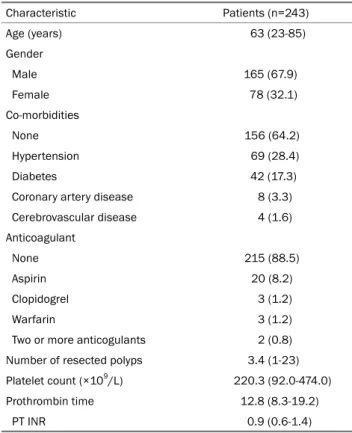
Table 1. Characteristics of Patients according to the Presence of Delayed Bleeding after Colorectal Endoscopic Mucosal Resection
Characteristic Patients (n=243)
Age (years) 63 (23-85)
Gender
Male 165 (67.9)
Female 78 (32.1)
Co-morbidities
None 156 (64.2)
Hypertension 69 (28.4)
Diabetes 42 (17.3)
Coronary artery disease 8 (3.3) Cerebrovascular disease 4 (1.6) Anticoagulant
None 215 (88.5)
Aspirin 20 (8.2)
Clopidogrel 3 (1.2)
Warfarin 3 (1.2)
Two or more anticogulants 2 (0.8) Number of resected polyps 3.4 (1-23) Platelet count (×109/L) 220.3 (92.0-474.0) Prothrombin time 12.8 (8.3-19.2)
PT INR 0.9 (0.6-1.4)
Values are presented as median (range) or n (%).
PT, prothrombin time; INR, international normalized ratio.
3. Endpoints
The primary endpoint in this study was the incidence of delayed bleeding after colorectal EMR without prophylactic clipping. Delayed bleeding was defined as lower gastro- intestinal bleeding presented by the melena or hematochezia that occurs between 6 hours and 14 days after EMR. The secondary endpoints were the factors affecting delayed bleed- ing after EMR.
4. Statistical analysis
Continuous data with normal distributions are expressed as the mean±standard deviation, and categorical data are presented as the number of patients (%). A Student’s t-test and chi-square test were performed for the continuous and categorical variables, where appropriate. A Fisher’s exact test was also performed in the case that the expected value of each category was less than 5. Univariate and multivariate logistic regression analyses were performed to analyze the factors associated with delayed bleeding after colorectal EMR.
p-values <0.05 were considered significant. Statistical analy- ses were performed using SPSS version 23.0 (IBM Co., Armonk, NY, USA).
RESULTS
1. Baseline characteristics
Between April 2014 and August 2014, 910 colorectal pol- yps (≥6 mm and <2 cm) in 296 patients were removed by EMR, and 193 colorectal polyps in 53 patients were excluded because these lesions showed immediate bleeding and re- quired a hemostatic procedure using by hemoclips (Fig. 1).
As shown in Table 1, the mean age of the patients was 63 years; 165 patients were men and 78 patients were women. The numbers of patients with hypertension and dia- betes were 69 (28.4%) and 42 (17.3%), respectively. Among 243 patients, 20 patients (8.2%) had taken aspirin, three pa- tients (1.2%) had taken clopidogrel, three patients (1.2%) had taken warfarin, and two patients (0.8%) had taken two or more anticoagulants.
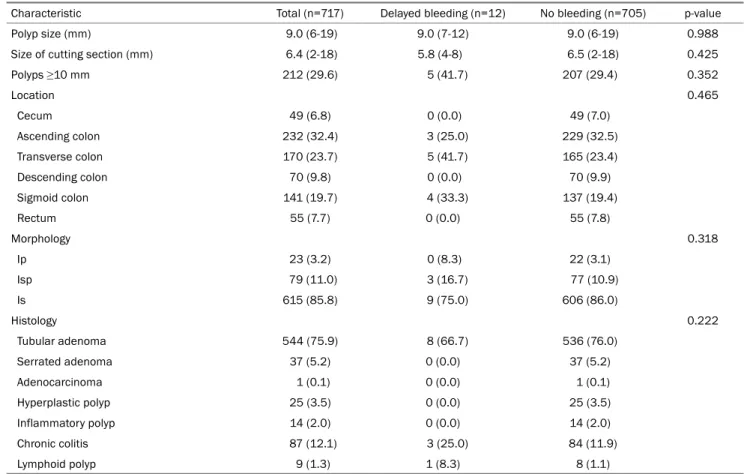
The mean polyp size removed by colorectal EMR was 9.0 mm (range 6.0-19.0) and the size of the cutting section after colorectal EMR was 6.4 mm (range 2.0-18.0). The num- ber of polyps larger than 1 cm was 212 (29.6%). Table 2
Table 2. Characteristics of the Polyps according to the Presence of Delayed Bleeding after Colorectal Endoscopic Mucosal Resection
Characteristic Total (n=717) Delayed bleeding (n=12) No bleeding (n=705) p-value
Polyp size (mm) 9.0 (6-19) 9.0 (7-12) 9.0 (6-19) 0.988
Size of cutting section (mm) 6.4 (2-18) 5.8 (4-8) 6.5 (2-18) 0.425
Polyps ≥10 mm 212 (29.6) 5 (41.7) 207 (29.4) 0.352
Location 0.465
Cecum 49 (6.8) 0 (0.0) 49 (7.0)
Ascending colon 232 (32.4) 3 (25.0) 229 (32.5)
Transverse colon 170 (23.7) 5 (41.7) 165 (23.4)
Descending colon 70 (9.8) 0 (0.0) 70 (9.9)
Sigmoid colon 141 (19.7) 4 (33.3) 137 (19.4)
Rectum 55 (7.7) 0 (0.0) 55 (7.8)
Morphology 0.318
Ip 23 (3.2) 0 (8.3) 22 (3.1)
Isp 79 (11.0) 3 (16.7) 77 (10.9)
Is 615 (85.8) 9 (75.0) 606 (86.0)
Histology 0.222
Tubular adenoma 544 (75.9) 8 (66.7) 536 (76.0)
Serrated adenoma 37 (5.2) 0 (0.0) 37 (5.2)
Adenocarcinoma 1 (0.1) 0 (0.0) 1 (0.1)
Hyperplastic polyp 25 (3.5) 0 (0.0) 25 (3.5)
Inflammatory polyp 14 (2.0) 0 (0.0) 14 (2.0)
Chronic colitis 87 (12.1) 3 (25.0) 84 (11.9)
Lymphoid polyp 9 (1.3) 1 (8.3) 8 (1.1)
Values are presented as median (range) or n (%).
Ip, pedunculated type; Isp, semi-pedunculated type; Is, sessile type.
Fig. 2. Proportion of delayed bleeding on the polyps (≥6 mm and
<2 cm) after a colorectal endoscopic mucosal resection.
lists the location, morphology, and histology of the polyps.
A review of all polyps resected revealed no case of incomplete resection.
2. Endpoints
Delayed bleeding after colorectal EMR occurred in 12 pol- yps (1.7%) in eight patients (3.3%) (Fig. 2), and all patients had colonoscopic bleeding control performed. The size, size of the cutting section, location, macroscopic form, and histol- ogy were similar in the polyps with delayed bleeding and those with no bleeding (Table 2). Table 3 provides details of patients who exhibited delayed post-EMR bleeding. Delayed bleeding occurred between 15 hours and 4 days after EMR and was most prevalent between 1 and 2 days. The locations of the polyps that showed delayed bleeding ranged from the ascend- ing colon to the sigmoid colon. The hemoglobin level was de- creased by one or more in three patients, but no transfusion was needed.
Univariate and multivariate logistic regression analyses
Table 3. Details on Patients Who Underwent Delayed Postpolypectomy Bleeding Sex/age Co-morbidity Anticoagulant Number
of polyps
Time
to bleeding Location Macroscopic form
Polyp size (mm)
Size of cutting
section (mm) Histology
M/57 None None 11 40 hours A-colon Is 9 5 SSA
T-colon Is 6 4 TA with LGD
M/53 None None 1 25 hours S-Colon Isp 15 8 TA with LGD
M/67 None None 11 52 hours S-Colon Is 8 5 TA with LGD
M/59 CAD Aspirin 8 24 hours T-Colon Isp 12 6 TA with LGD
T-Colon Is 6 5 TA with LGD
M/64 CAD Ticlopidine 5 15 hours T-Colon Isp 7 7 Lymphoid polyp
M/33 DM None 1 92 hours S-Colon Isp 8 6 TA with LGD
M/57 None None 2 19 hours T-colon Is 8 6 Chronic colitis
M/48 HTN Aspirin 1 42 hours S-Colon Is 10 8 TA with LGD
M/65 None None 17 24 hours A-colon Is 9 5 TA with LGD
T-Colon Is 8 4 Chronic colitis
M, male; A-colon, ascending colon; Is, sessile type; SSA, sessile serrated adenoma; T-colon, transverse colon; TA, tubular adenoma; LGD, low grade dysplasia; S-colon, sigmoid colon; Isp, semi-pedunculated type; CAD, coronary artery disease; DM, diabetes mellitus; HTN, hypertension.
Table 4. Risk Factors Associated with Delayed Postpolypectomy Bleeding
Predictor Univariate analysis Multivariate analysis
OR (95% CI) p-value OR (95% CI) p-value
Age (years) 0.94 (0.88-1.01) 0.056
Use of anticoagulants 4.44 (1.0-19.58) 0.049 1.88 (0.25-14.06) 0.539
Co-morbidities
Hypertension 2.85 (0.34-23.61) 0.332
Diabetes 1.48 (0.18-12.35) 0.718
Coronary artery disease 12.72 (2.12-76.50) 0.005 5.66 (0.53-60.65) 0.152
Number of resected polyps (≥5) 3.61 (0.87-14.93) 0.077 2.99 (0.52-17.23) 0.220
Size of resected polys (≥1 cm) 1.16 (0.27-4.99) 0.839 1.44 (0.28-7.34) 0.658
Size of cutting section (≥6 mm) 0.67 (0.16-2.73) 0.573 1.41 (0.30-6.71) 0.664
Location (right vs. left) 1.20 (0.24-6.08) 0.829 1.27 (0.18-8.88) 0.809
Morphology (Ip & Isp vs. Is) 1.91 (0.37-9.82) 0.441
Platelet 0.99 (0.98-1.01) 0.182
Prothrombin time 0.55 (0.27-1.12) 0.101
PT INR 0.72 (0.01-543.57) 0.922
OR, odds ratio; CI, confidence interval; Ip, pedunculated type; Isp, semi-pedunculated type; Is, sessile type; PT, prothrombin time; INR, international normalized ratio.
were performed to evaluate the risk factors associated with delayed post-EMR bleeding. On the other hand, multivariate analyses revealed no significant risk factors affecting delayed bleeding (Table 4).
DISCUSSION
The incidence of delayed bleeding on colorectal polyps (≥6 mm and <2 cm) after EMR without prophylactic clipping
was 3.3%. On the other hand, the risk factors associated with delayed bleeding after colorectal EMR were not identified.
This study was an observation study, in which one investigator managed the study protocol thoroughly and collected the clin- ical data, including colorectal EMR between April 2014 and August 2014. Therefore, the data for the incidence of delayed bleeding after colorectal EMR without prophylactic clipping of this study is believed to be accurate and reliable.
This study evaluated the risk of delayed bleeding after col-
orectal EMR without prophylactic clipping. Eight patients showed delayed bleeding after a colorectal EMR in 243 pa- tients (3.3%), and 12 polyps showed delayed bleeding after colorectal EMR in 717 polyps (1.7%). Further treatment, in- cluding transfusion, was not needed in the patients with de- layed bleeding. According to a recent systematic review and meta-analysis, the pooled delayed postpolypectomy bleeding rate was 1.5%.10 The delayed bleeding rate after colorectal EMR in the present study was higher than that reported in a previous study. In this study, all colorectal EMR procedures were performed without prophylactic clipping, and most pa- tients underwent colorectal EMR with admission, which makes it possible to detect even a negligible amount of bleed- ing by medical staff. These might be causes of the high de- layed bleeding rate after colorectal EMR in this study.
Bleeding is the most common complication after colono- scopic EMR. Immediate bleeding occurring during the proce- dure could be treated by endoscopists, whereas delayed bleeding occurring after polypectomy might increase the mor- tality of the patient.24,25 To prevent delayed bleeding, prophy- lactic hemostatic procedures, including epinephrine-mixed saline injection, argon plasma coagulation, hemoclips, or en- do-loop, could be performed after a polypectomy.25 The use of hemoclips might be more effective for hemostasis without the risk of perforation than thermal or injection methods.26 Cardiovascular disease, hypertension, polyps size >10 mm, and polyps located in the right colon are significant risk fac- tors associated with delayed bleeding after polypectomy.10 In this study, the delayed bleeding risk of polyps larger than 1 cm after EMR and polyps (≥6 mm and <1 cm) was 2.3%
(5/212) and 1.4% (7/505), respectively, and there was no significant difference. The reasons for these observations are unclear, but the lesions showed immediate bleeding and re- quired a hemostatic procedure using hemoclips were excluded. Therefore, the exclusion criteria might have affected the results. An attempt was made to identify the risk factors affecting delayed bleeding by univariate and multivariate logis- tic regression, but there was no significant risk factor affecting delayed bleeding according to multivariate analyses.
This study had some limitations. First, the number of pa- tients might be insufficient to assess the risk of delayed bleed- ing after colorectal EMR. On the other hand, all polyps in patients performed by colorectal EMR without prophylactic clipping between April 2014 and August 2014 were evaluated.
Therefore, the data of this study is reliable. Second, patients with prophylactic clipping were excluded from the analysis.
Therefore, selection bias could not be avoided when collecting information on patients who underwent colorectal EMR.
In conclusion, this study identified the incidence of delayed bleeding on colorectal polyps (≥6 mm and <2 cm) after EMR without prophylactic clipping. Although the significant factors associated with delayed bleeding after colorectal EMR were not found, these results could help predict the risk of delayed bleeding on polyps (≥6 mm and <2 cm) after colorectal EMR without prophylactic clipping. In addition, well-designed pro- spective studies will be needed to clarify the significant fac- tors associated with delayed bleeding after colorectal EMR.
REFERENCES
1. Winawer SJ, Zauber AG, Ho MN, et al. Prevention of colorectal cancer by colonoscopic polypectomy. The National Polyp Study Workgroup. N Engl J Med 1993;329:1977-1981.
2. ASGE Standards of Practice Committee, Fisher DA, Maple JT, et al. Complications of colonoscopy. Gastrointest Endosc 2011;74:
745-752.
3. Sorbi D, Norton I, Conio M, Balm R, Zinsmeister A, Gostout CJ.
Postpolypectomy lower GI bleeding: descriptive analysis.
Gastrointest Endosc 2000;51:690-696.
4. Levin TR, Zhao W, Conell C, et al. Complications of colonoscopy in an integrated health care delivery system. Ann Intern Med 2006;145:880-886.
5. Hong SP. How do I manage post-polypectomy bleeding? Clin Endosc 2012;45:282-284.
6. Macrae FA, Tan KG, Williams CB. Towards safer colonoscopy: a report on the complications of 5000 diagnostic or therapeutic colonoscopies. Gut 1983;24:376-383.
7. Watabe H, Yamaji Y, Okamoto M, et al. Risk assessment for de- layed hemorrhagic complication of colonic polypectomy: pol- yp-related factors and patient-related factors. Gastrointest Endosc 2006;64:73-78.
8. Wu XR, Church JM, Jarrar A, Liang J, Kalady MF. Risk factors for delayed postpolypectomy bleeding: how to minimize your pa- tients' risk. Int J Colorectal Dis 2013;28:1127-1134.
9. Waye JD, Lewis BS, Yessayan S. Colonoscopy: a prospective re- port of complications. J Clin Gastroenterol 1992;15:347-351.
10. Jaruvongvanich V, Prasitlumkum N, Assavapongpaiboon B, Suchartlikitwong S, Sanguankeo A, Upala S. Risk factors for de- layed colonic post-polypectomy bleeding: a systematic review and meta-analysis. Int J Colorectal Dis 2017;32:1399-1406.
11. Hayashi T. The study on stanch clips for the treatment by endoscopy. Gastroenterol Endosc 1975;17:92-101.
12. Wang YG, Binmoeller KF, Li ZL, Soehendra N. Endoscopic haemo- clip ligation of pedunculated polyp before polypectomy. World J Gastroenterol 1997;3:200.
13. Cipolletta L, Bianco MA, Marmo R, et al. Endoclips versus heater probe in preventing early recurrent bleeding from peptic ulcer: a prospective and randomized trial. Gastrointest Endosc 2001;53:147-151.
14. Chou YC, Hsu PI, Lai KH, et al. A prospective, randomized trial of endoscopic hemoclip placement and distilled water injection for treatment of high-risk bleeding ulcers. Gastrointest Endosc 2003;57:324-328.
15. Kaltenbach T, Friedland S, Barro J, Soetikno R. Clipping for upper gastrointestinal bleeding. Am J Gastroenterol 2006;101:915-918.
16. Kouklakis G, Mpoumponaris A, Gatopoulou A, Efraimidou E, Manolas K, Lirantzopoulos N. Endoscopic resection of large pe- dunculated colonic polyps and risk of postpolypectomy bleeding with adrenaline injection versus endoloop and hemoclip: a pro- spective, randomized study. Surg Endosc 2009;23:2732-2737.
17. Liaquat H, Rohn E, Rex DK. Prophylactic clip closure reduced the risk of delayed postpolypectomy hemorrhage: experience in 277 clipped large sessile or flat colorectal lesions and 247 control lesions. Gastrointest Endosc 2013;77:401-407.
18. Shioji K, Suzuki Y, Kobayashi M, et al. Prophylactic clip applica- tion does not decrease delayed bleeding after colonoscopic polypectomy. Gastrointest Endosc 2003;57:691-694.
19. Feagins LA, Nguyen AD, Iqbal R, Spechler SJ. The prophylactic
placement of hemoclips to prevent delayed post-polypectomy bleeding: an unnecessary practice? A case control study. Dig Dis Sci 2014;59:823-828.
20. Buddingh KT, Herngreen T, Haringsma J, et al. Location in the right hemi-colon is an independent risk factor for delayed post-polypectomy hemorrhage: a multi-center case-control study. Am J Gastroenterol 2011;106:1119-1124.
21. Uraoka T, Ramberan H, Matsuda T, Fujii T, Yahagi N. Cold poly- pectomy techniques for diminutive polyps in the colorectum. Dig Endosc 2014;26 Suppl 2:98-103.
22. Hewett DG. Colonoscopic polypectomy: current techniques and controversies. Gastroenterol Clin North Am 2013;42:443-458.
23. Singh N, Harrison M, Rex DK. A survey of colonoscopic poly- pectomy practices among clinical gastroenterologists. Gastro- intest Endosc 2004;60:414-418.
24. Park DI. What are the risk factors for delayed post-polypectomy bleeding? Korean J Gastroenterol 2012;59:393-394.
25. Li LY, Liu QS, Li L, et al. A meta-analysis and systematic review of prophylactic endoscopic treatments for postpolypectomy bleeding. Int J Colorectal Dis 2011;26:709-719.
26. Parra-Blanco A, Kaminaga N, Kojima T, et al. Hemoclipping for postpolypectomy and postbiopsy colonic bleeding. Gastrointest Endosc 2000;51:37-41.