- 47 -
Effects of Low-Dose Long-Term Macrolide Therapy
on the Postoperative Symptom Change, Mucociliary Clearance and Polyp Regrowth
Young Hwan Lim, M.D.1, Jae Myeong Kim, M.D.1, Jun Yeon Hwang, M.D.1, Tae Young Kwon M.D.1, Yong Bok Kim, M.D.2 and Sung Wan Kim, M.D.1
ABSTRACT
Low-dose long-term macrolide therapy (LDLMT) has been reported as an effective treatment in chronic respiratory tract diseases such as diffuse panbronchiolitis and chronic paranasal sinusitis. The mechanism of action of LDLMT is not fully revealed. The aim of this study was to evaluate the clinical effect of LDLMT on the postoperative patients of chronic sinusitis with polyp. Thirty eight control groups were defined empirically treated with antibiotics after endoscopic sinus surgery (ESS) and 62 experimental group were defined 8 weeks LDLMT (Clarithromycin 250 mg ) after postoperative 2 weeks in ESS patients.
Preoperatively, we checked mucociliary clearance with saccharine test (MCT ), symptom scores and sinus CT scan and total IgE, and allerg ic skin test were evaluated for allergy. After ESS, MCT and symptom scores were checked on postoperative patients at 2, 6 and 10 weeks, respectively. Recurrence of polyp was also evaluated with endoscopic examination. The improvement rate (IR) of MCT was s ignificantly higher in the experimental group than in the control group, but the IR of symptom scores was not significant statistically. High total IgE affected the IR of MCT and symptom scores in the experimental group. Allergy proven by allergic skin test also affected the IR of MCT, but the IR of symptom scores was not affected in the experimental group. The polyp recurrence rate was significantly higher in the control group compared to the experimental group. We can conclude that LDLMT has a beneficial affect on the postoperative treatment of sinusitis patients and high total IgE and allergy may affect the effect of LDLMT in postoperative patients who have undergone ESS.
KEY WORDS:Macrolide・Anti-inflammatory effect・Chronic sinusitis ・Nasal polyps.
INTRODUCTION
Based on recent numerous studies, macrolides with 14-membered rings such as erythromycin and clari- thromycin have been proven to be effective not only in chronic paranasal sinusitis,1) but also in chronic airway diseases such as chronic bronchitis, bronchiectasis,
bronchial asthma, sinobronchial syndrome.2-4) After treatment, the amount of secreted mucus, sputum and rhinorrhea all subsided.1) However, its clinical efficacy and effect according to the patient’s pathologic char- acteristics as a treatment modality after surgery in paranasal sinusitis patients is still obscure.
Therefore, based on the anti-inflammatory action of low-dose long-term macrolide therapy in chronic par- anasal sinusitis with polyp, we anticipate to inquire its effect in postoperative polyp recurrence and postoper- ative symptoms.
MATERIAL AND METHOD Experimental group and control group
This study was executed based on 100 patients the have undergone ESS due to chronic paranasal sinusitis
1Department of Otolaryngology-Head and Neck Surgery, Kang- Nam General Hospital, Public Corporation, Seoul, 2Depart- ment of Otolaryngology-Head and Neck Surgery, College of Medicine, Hallym Unversity, Hangang Sacred Heart Hospital, Seoul, Korea
Address correspondences and reprint request to Sung Wan Kim, M.D., Department of Otolaryngology-Head and Neck Surgery, KangNam General Hospital, Public Corporation, 171-1 Sam- sung-dong, Kangnam-ku, Seoul 135-090, Korea
Tel:82-2-3430-0673, Fax:82-2-539-5256 E-mail:[email protected]
Accepted for publication on August 10, 2002
with polyp from February to September of 2000. Two months of progress observation was possible with these patients. Among these patients, 62 and 38 patients with the same sex and similar age distribution were each established into an experimental and control group.
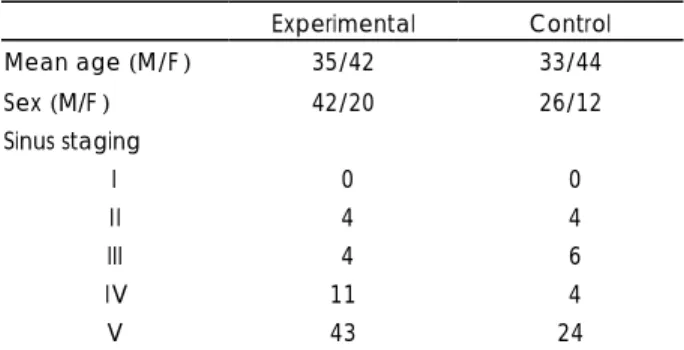
The age distribution of the experimental group was 19 to 65 years old with 42 men and 20 women (average age 38 years old). Among the 38 patients in the control group 26 were men and 12 were women. The age distribution was 18 to 65 years old (average age 39 years old)(Table 1).
Experimental method
Before surgery was executed, total eosinophil and total IgE were tested in the peripheral blood and the degree of paranasal sinus disease was classified accor- ding to PNS CT. According to the OMU (ostiomeatal unit) area and the number of paranasal sinus invasion, stage I is where only the OMU has been invaded and stage II-V is designated according to the number of dependent sinus (frontal, maxillary, posterior ethmoid, sphenoid sinus) invasion (Table 1).5)
Also, the mucociliary clearance was measured by a saccharine test where the time until the patient was able to taste the saccharine solution that has been smeared on the anterosuperior portion of the inferior turbinate has been measured. The symptom score was classified into 4 stages through a survey (Table 2)5) in accordance to nasal obstruction, rhinorrhea and po- stnasal drip, where severe is 3 points, moderate 2 po- ints, mild 1 points and no symptoms 0 points. The scores were then summed up for measurement.
For 2 weeks after surgery, both groups were treated with common amounts of antibiotics. The control group continued with antibiotics treatment according
to the condition of the operation site and the exper- imental group was treated with Clarithromycin (250 mg) once daily from post-operation 3 weeks up to 8 weeks. At post-operation 2, 6 and 10 weeks, a sacc- harine test and symptom score was carried out as did before surgery. The improvement rate (IR) was cal- culated by the following formula:(measured value before surgery-measured value after surgery)/(mea- sured value before surgery)×100 (%). Recurrence of polyp was confirmed through endoscopy 10 weeks after surgery. Also, we analyzed the effects of total IgE and allergic skin test results may have on low-dose long- term macrolide therapy.
Statistical analysis
The measured value was expressed as average±
standard deviation and the statistical significancy was analyzed by the Student t-test and was considered statistically significant when the p-value was below 0.05.
RESULTS
Comparison of improvement rate of mucociliary clearance
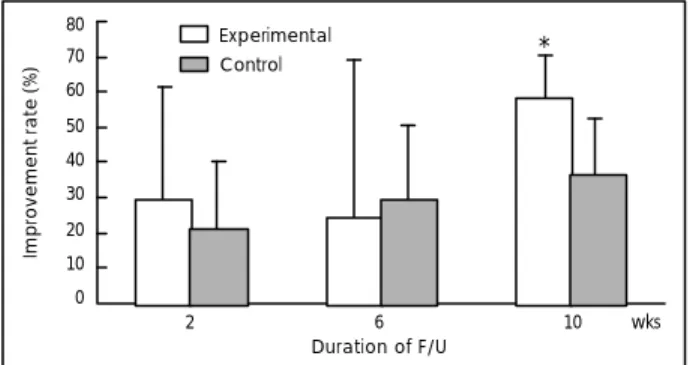
There was no significant difference post-operation 2 and 6 weeks, however, the experimental group showed
Table 1. Age and sex distribution and sinus staging by PNS CT of control and experimental group
Experimental Control
Mean age (M/F) 35/42 33/44
Sex (M/F ) 42/20 26/12
Sinus staging
I 0 0
II 4 4
III 4 6
IV 11 4
V 43 24
Table 2. The questionnaire for symptom severity assessment Check the category that you consider yourself applicable to.
Nasal Obstruction 0. None
1. Difficulty breathing with not much inconvenience 2. Need to breath through mouth due to nasal obstruction 3. Unable to breathe through nose accompanied by sleeping
disturbance, voice change and changes in smell.
Nose dripping or rhinorrhea 0. None
1. Nose dripping or use of tissue 1-4 times a day.
2. Nose dripping or use of tissue 5-10 times a day
3. Continuous rhinorrhea despite use of handkerchief or tissue Post-nasal drip ( nose running back to throat)
0. None.
1. Slightly noticeable or tickling sensation in throat.
2. Becomes troublesome because often needed to be spit out.
3. Discomfort due to frequent nausea and cough.
a statistically significant improvement compared to the control group 10 weeks after surgery (p=0.04213, Fig. 1).
Comparison of improvement rate of symptom score
The experimental group showed a slight improve- ment at post-operation 6 and 10 weeks compared to the control group. However, there was no statistically significant difference (Fig. 2).
Comparison of improvement rate of mucociliary clearance and symptom score between high and low IgE patients
The experimental group was classified into a high IgE group and low IgE group based on a standard of serum IgE 250 U/ml. The improvement rate of mu- cociliary clearance showed no significant difference in both groups post-operation 2 and 6 weeks, however, at
post-operation 10 weeks, the low IgE group showed a statistically significant improvement compared to the high IgE group (p=0.02741, Fig. 3). The improvement rate of the symptom score showed a slight improve- ment in the low IgE group post-operation 2, 6 and 10 weeks, however, there was no statistically significant difference (Fig. 3).
Comparison of improvement rate of mucociliary clearance and symptom score between allergic and non-allergic patients
The experimental group was classified into an all- ergic group and non-allergic group based on the results of an allergic skin prick test. The improvement rate of mucociliary clearance showed an improving appear- ance at post-operation 2, 6 and 10 weeks in the non- allergic group, however, only at post-operation 10 weeks were the differences statistically significant (p=0.02850, Fig. 4). The improvement rate of the symptom score showed an improving finding at post-operation 2, 6
2 6 10 wks Duration of F/U
80 70 60 50 40 30 20 10 0
Experimental *
Control
Improvement rate (%)
2 6 10 wks Duration of F/U
100 80 60 40 20 0
Experimental Control
Improvement rate (%)
Fig. 1. Comparsion of improvement rate of mucociliary clear- ance between experimental and control group. The improve- ment rate (IR) of MCT was significantly higher in experimental group than in control group.
Fig. 2. Comparsion of improvement rate of symptom score be- tween experimental and control group. The improvement rate (IR) of symptom scores was not significant statistically.
Fig. 4. Comparsion of improvement rate of mucociliary clear- ance and symptom score between allergic and non-allergic patients in experimental group. Allergy affected the improve- ment rate (IR) of MCT, but IR of symptom scores did not affected in experimental group.
Fig. 3. Comparsion of improvement rate of mucociliary clear- ance and symptom score between high and low IgE patients in experimental group. The high total IgE affected the impro- vement rate (IR) of MCT and symptom scores in experimental group.
*
2 6 10 wks Duration of F/U
100 80 60 40 20 0
Improvement rate (%)
MCT of High lgE MCT of Low lgE SX of High lgE SX of Low lgE
*
2 6 10 wks Duration of F/U
100 80 60 40 20 0
Improvement rate (%)
ARMCT NARMCT ARSX NARSX
*
and 10 weeks rather in the allergic group with the differences showing a statistical significancy only at post-operation 10 weeks (p=0.04162, Fig. 4).
Comparison of nasal polyp regrowth at post- operation 10 weeks
As a result of endoscopic confirmation at post-ope- ration 10 weeks, 12 patients (32%) among 38 patients of the control group and 7 patients among 62 patients (11%) of the experimental group all had regrowth of nasal polyp with the experimental group having a lower recurrence rate.
DISCUSSION
The action of macrolide that reacts to respiratory tract inflammations are known to be by the means of its anti-bactericidal action along with its anti-inflam- matory action.6) Recently, it has been reported that low-dose long-term macrolide therapy is effective in chronic respiratory tract diseases.7) The mechanism of the anti-inflammatory action of macrolide is still ob- scure, however, Nagai et al.,4) reported that the dose of erythromycin of the serum and sputum of low-dose macrolide therapy is effective also in a condition where it is lower than the minimum inhibitory concentration of clinically isolated bacteria. Since a macrolide-re- sistant bacteria such as Pseudomonas areuginosa is often discovered in diffuse panbronchiolitis,3)4) it can be proven that the effect of macrolide is not simply based on its anti-bactericidal action.
Macrolide has a diverse effect on immunocompetent cells, inflammatory cells and airway epithelial cells and it also controls the effects of monocyte and macrophage proliferation and differentiation, cytokine production and phagocytosis.8) Also, it improves the ciliary move- ment of the airway epithelium9) and inhibits the se- cretion of ion and mucus from the epithelial cells10) and the bacterial adherence to nasal epithelial cells11) and the neutrophil exudation to the diseased area in chronic upper and lower respiratory diseases.3) Re- cently, it has been stated that IL-8 contributes in neu- trophil recruitment in situ12) and that low -dose macro- lide has an inhibitory effect of IL-8 secretion from nasal epithelial cells and ion secretion from nasal gland cells.10)
On the other hand, the decrease of mucociliary clear- ance in chronic paranasal sinusitis13) may be due to an impairment of the interaction between the mucus and ciliary activity14) and rheological abnormalities of nasal mucus may also be a cause.15) Macrolide therapy incr- eases nasal mucus spinability and provides an appro- priate nasal mucus value to mucoc iliary clearance.16) Also in this study, it can be noticed that the improve- ment rate of mucociliary clearance has significantly increased statistically post-operation 10 weeks in the group treated with macrolide after surgery.
LDLMT has been proven to be effective in sym- ptoms such as nasal obstruction, rhinorrhea and so forth.1) However, in this study, the experimental group did not show a significant difference compared to the control group.
Suzuki et al.,17) reported that macrolide therapy in chronic paranasal sinusitis treatment varies according to the serum IgE level. In this study, it has been no- ticed that serum IgE level affects LDLMT after sur- gery. There was no difference in the symptom score improvement rate between patients with a normal IgE level compared to patients with a high IgE level, ho- wever, a significant increase in the mucociliary clear- ance improvement rate was noticed. Likewise, a de- crease in mucociliary clearance improvement rate in allergic patients was noticed, however, the symptom score improvement rate rather increased in allergic patients and this is considered to be so due to a rela- tively high symptom score before surgery in paranasal sinusitis patients with allergy.
Yamada et al.,18) reported that macrolide therapy decreas ed the size of nasal polyp in 40% of chronic paranasal sinusitis patients accompanying nasal polyp and the cause of such reaction has been reported to be related to secretion inhibition of IL-8. Nonaka et al.,19) reported that macrolide experimentally inhibited the growth of nasal polyp fibroblast. Also in this study, the recurrence rate after surgery showed a remarkable di- fference in the experimental group compared to the con- trol group.
CONCLUSION
Based on this study, it can be evaluated that low -dose long-term therapy of macrolides such as clarithromycin has a significant effect in the treatment of chronic pa-
ranasal sinusitis after surgery. It is also considered that the serum IgE level and allergy in patients that have undergone endoscopic sinus surgery affects the effect of low -dose long-term macrolide therapy.
REFERENCES
1) Kikuchi S, Suzaki H, Normura Y. Clinical effect of long-term low dose erythromycin therapy for chronic sinusitis (in japanese with English abstract ). Pract Otol (Kyoto) 1991;81:41-7.
2) Fujii T, Kadota J, Kohno S. Long term effect of erythromycin therapy in patients with chronic Pseudomonas aeruginosa infection. Thorax 1995;50:1246-52.
3) Kadota JI, Sakito O, Kohno S. A mechanism of erythromycin treat- ment in patients with diffuse panbronchiolitis. Am Rev Respir Dis 1993;147:153-9.
4) Nagai H, Shishido H, Yoneda R. Long-term low dose administration of erythromycin to patients with diffuse panbronchiolitis. Respiration 1991;58:145-9.
5) Ikeda K, Kondo Y, Sunose H, Hirano K, Oshima T, Shimomura A et al. Subjective and objective evaluation in endoscopic sinus sur- gery. Am J Rhinol 1996;10:217-20.
6) Black PN. Anti-inflammatory effects of macrolide antibiotics. Eur Respir J 1997;10:971-2.
7) Kudoh S, Uetake T, Hirayama M, Kimura H, Symposium H. Sin- obronchial syndrome and its related subjects: Therapy of sinob- ronchial syndrome low-dose long-term chemotherapy of erythro- mycin in diffuse panbronchiolitis. J Jpn Bronchoesophagol Soc 1987; 38:193-6.
8) Iino Y, Toriyama M, Kudo K. Erythromycin inhibition of lipopoly- saccharide-stimulated tumor necrosis factor α production by human monocytes in vitro. Ann Otol Rhinol Laryngol 1992;157(suppl):
16-20.
9) Takeyama K, Tamaoki J, Chiyotani A. Effect of macrolide anti- biotics on ciliary motility of rabbit airway epithelium in vitro. J Pharmcol 1993;45:756-8.
10) Ikeda K, Wu D, Takasaka T. Inhibition of acetylcholine-evoked Cl- currents by 14-membered macrolide antibiotics in isolated acinar cells of the guinea pig nasal gland. Am J Respir Cell Biol 1995;13:
449-54.
11) Ishida LK, Ikeda K, Tanno N. Erythromycin inhibits adhesion of Pseudomonas aeruginosa and Branhamella catarrhalis to human nasal epithelial cells. Am J Rhinol 1995;9:53-5.
12) Suzuki H, Takahashi Y, Wataya H. Mechanism of neutrophil re- cruitment induced by IL-8 in chronic sinusitis. J Allergy Clin Imm- unol 1996;98:659-70.
13) Sakakura Y, Ukai K, Majima Y, Murai S, Harada T, Miyoshi T.
Nasal mucociliary clearance under various conditions. Acta Oto- laryngol (Stockh) 1983;96:167-73.
14) Majima Y, Sakakura Y, Matsubara T, Miyoshi T. Possible mech- anism of reduction of nasal mucociliary clearance in chronic sin- usitis. Clin Otolaryngol 1986;11:55-60.
15) Majima Y, Hirata K, Tacheuchi K, Hattori M, Sakakura Y. Effects of orally administrated drugs on dynamic viscoelasticity of human nasal mucus. Am Rev Respir Dis 1990;141:79-83.
16) Rhee CS, Majima Y, Arima S, Jung HW, Jinn TH, Min YG, et al.
Effect of clarithromycin on rheological properties of nasal mucus in patients with chronic sinusitis. Ann Otol Rhinol Laryngol 2000;
109:484-7.
17) Suzuki H, Ikeda K, Honma R, Gotoh S, Oshima T, Furukawa M, et al. Prognostic factors of chronic rhinosinusitis under long-term low- dose macrolide therapy. Otol Rhinol Laryngol 2000;62:121-7.
18) Yamada T, Fujieda S, Mori S, Yamamoto H, Saito H. Macrolide treatment decreased the size of nasal polyps and IL-8 levels in nasal lavage. Am J Rhinol 2000;14:143-8.
19) Nonaka M, Pawankar R, Tomiyama S, Yagi T. A macrolide antibiotic, roxithromycin, inhibits the growth of nasal polyp fibroblasts. Am J Rhinol 1999;13:267-72.