<접수일:2007년 5월 22일, 심사통과일:2007년 6월 25일>
※통신저자:최 정 윤
대구광역시 남구 대명 4동 3056-6 대구가톨릭대학교 의과대학 내과학교실
Tel:053) 650-4577, Fax:053) 629-8248, E-mail:[email protected]
한국인 조기 류마티스관절염에서 항CCP항체의 진단적 의의
대구가톨릭대학교 의과대학 내과학교실, 진단검사의학교실*, 의학통계학교실**
박성훈ㆍ김지영ㆍ김성규ㆍ최정윤ㆍ김상경*ㆍ신임희**
= Abstract =
Diagnostic Significance of Anti-CCP Antibody in Korean Early Rheumatoid Arthritis
Sung-Hoon Park, Ji-Young Kim, Seong-Kyu Kim, Jung-Yoon Choe, Sang Kyung Kim*, Im-Hee Shin**
Departments of Internal Medicine, Laboratory Diagnostics*, and Medical Statistics**, School of Medicine, The Catholic University of Daegu, Daegu, Korea
Objective: To identify the sensitivity and specificity of the anti-cyclic citrullinated peptide antibody (anti-CCP) and rheumatoid factor (RF) in a diagnosis of Korean early rheumatoid arthritis (RA).
Methods: Two hundred and sixty two patients diagnosed with RA were examined retrospectively and classified by three groups. A group 1 had a disease duration<24 months, and group 2 had a duration>24 months, and the third was a group of total patients. The sensitivity and specificity of the RF and anti-CCP in each group of RA were identified. Patients of the connective tissue disease other than rheumatoid arthritis were tested with RF and anti-CCP.
Results: The sensitivity/specificity of RF and the anti-CCP in early RA were 90.4%/68.0%
and 87.5%/89.3%, 91.3%/68.0%, 81.7%/89.3% in each, and 90.4%/68.0% and 84.7%/89.3% in the total RA patients. The accurate diagnosis rate, which is defined as (number of true positives plus true negatives)/ the total number of patients), of the RF and anti-CCP was 79.2%/88.4%
in the early RA group, and 79.4% and 89.0% in the total patients group.
Conclusion: Anti-CCP is more specific than RF in diagnosing RA. Although it is not statistically significant, diagnositc sensitivity of anti-CCP in early RA group is higher than that of established RA group.
Key Words: Rheumatoid arthritis, Rheumatoid factor, Anti-cyclic citrullinated peptide antibody
서 론
류마티스관절염은 관절의 만성적 염증을 유발하는 자가면역질환으로 전 인구의 약 0.5∼1% 정도를 이 환하며 (1), 활막의 만성적 염증으로 연골의 파괴와 골미란을 초래하여 영구적인 장애를 유발할 수 있 다. 따라서 류마티스관절염의 치료 목표는 가능한 한 발병 초기에 진단을 확립하고 치료적 개입을 시 작하여 관절의 파괴와 변형을 막고 기능을 보존하는 데 있다.
류마티스관절염의 진단은 1987년 미국 류마티스학 회(American College of Rheumatology, ACR)에서 개 정된 분류기준을 따르고 있다 (2). 이 기준은 기본적 으로 임상적인 증상들을 위주로 구성되어 있으며 이 런 증상들은 흔히 질환이 이환된 지 상당기간이 경 과한 후에야 명확히 드러나 진단이 확립될 시기에는 이미 관절 파괴가 진행되기 시작한 경우가 많다. 따 라서 이런 분류기준은 관절염의 조기 진단에는 적합 하지 않을 수 있다 (3). 분류기준에 포함된 유일한 혈청학적 검사인 류마티스 인자는 면역글로불린 G 분자의 Fc 부분에 대한 자가항체이며, 낮은 민감도 (50∼80%)와 중등도의 특이도(70∼80%)를 가진다.
또한 류마티스 인자는 다른 결체조직 질환이나 고령 의 정상인에서도 나타날 수 있다.
항Cyclic Ctrullinated Peptide (CCP) 항체는 citrulline residue를 포함하는 항원결정기에 반응하는 자가항체 로 항fillagrin 항체의 한 종류이다. 최근 류마티스 인 자와 비슷한 민감도를 보이면서 더 우수한 특이도 (81∼100%)를 가진 2세대 항CCP항체가 개발되어 연 구에 이용되고 있다 (4). 항CCP항체는 높은 진단 특 이도와 더불어 환자들의 기능적 상태와도 관련이 있 으며 (5), 조기 류마티스관절염 환자에서 관절 손상 과도 관계가 있는 것으로 알려지고 있다 (6-10).
저자들은 본 연구에서 조기 류마티스관절염 환자 들에 있어 항CCP항체의 민감도와 특이도를 류마티 스 인자와 비교하여 임상적 의의를 찾아보고자 한 다.
대상 및 방법 1. 연구 대상
2005년 10월부터 2006년 9월까지 본원에서 1987년 미국 류마티스학회에서 개정된 분류기준에 의해 류 마티스관절염으로 진단된 환자 262명을 후향적으로 조사하였다. 진료기록부 검토를 통해 류마티스관절 염 환자군을 발병 24개월 이내의 조기 환자군과 그 이상 환자군, 그리고 전체환자군의 3군으로 분류하 였다. 류마티스관절염 이외의 결체조직 질환으로 진 단된 122명의 검사 결과를 비교하였다.
2. 연구 방법
류마티스관절염 환자군과 비환자군의 진단 당시의 류마티스 인자, 적혈구 침강속도, C-반응단백, 항 CCP항체를 조사하였다. 대조군의 검체는 80oC에서 보관 후 류마티스 인자 및 항CCP항체를 검사하였 다. 류마티스 인자는 면역혼탁도 측정법(immunotu- rbidometry)에 의해 Cobas integra RFII (Roche Diagn- ostics GmbH, Germany)로 검사하였고, 항CCP 항체는 DIASTATTM (Axis-Shield Diagnostics, United King- dom)을 사용하였으며 ELISA 법으로 검사하였다. 류 마티스 인자와 항CCP항체 검사의 결과는 제조사의 권고에 따라 각각 10 IU/mL, 5 U/mL 이상을 양성으 로 판정하였다. 환자군의 진단에 있어 류마티스 인 자와 항CCP항체의 민감도와 특이도, 진단의 정확도 (11)를 알아보고 이환 기간에 따라 조기 관절염의 진단에 있어 류마티스 인자와 항CCP항체의 민감도 와 특이도의 차이를 비교해 보았다.
3. 통계분석
각 그룹의 일반적인 특성 및 검사실적 소견에 대 해서는 도수(백분율) 및 평균(표준편차)을 제시하였 고, 독립 t-test 및 Chi-square test로 비교하였다. 각 그룹간의 검사실적 소견의 비교를 위해서는 두 표본 t-test 및 Chi-square test를 이용하여 분석하였다. 또한 각 그룹에서, RF와 anti-CCP에 대한 민감도(sensiti- vity)와 특이도(specificity)를 구하고, receiver operating characteristics 곡선(ROC curve)과 더불어 곡선하 면 적을 제시, 비교하였다. 모든 분석에 이용된 통계패
Table 2. Comparison of laboratory parameters in each group of patients
RF (IU/mL) Positive Anti‐CCP (U/mL) Positive CRP (mg/L) ESR (mm) Group
mean (SD) rate (%) mean (SD) rate (%) mean (SD) mean (SD) 1. RA≤24 Mo 148.77 (172.65) 90.44 62.35 (41.29) 87.50 13.81 (23.69) 37.34 (27.87) 2. RA>24 Mo 150.50 (220.08) 91.27 64.30 (42.43) 81.75 14.77 (21.43) 36.94 (29.78) 3. Total RA 149.60 (196.51) 92.36 63.29 (41.77) 84.73 14.27 (22.59) 37.15 (28.57) 4. Other connective
35.64 (176.27) 30.33 4.39 (13.75) 9.02 11.86 (49.36) 15.80 (16.39) tissue disease (CTD)
AOSD* 18.00 (16.94) 66.67 8.44 (10.62) 33.33 0.30 (0.17) 23.00 (14.80) BD 6.71 (1.26) 0 0.80 (0.58) 0 1.71 (2.34) 9.13 (7.83) FMS 16.49 (24.89) 30.77 3.64 (8.17) 11.54 3.82 (7.63) 19.31 (20.00) Gout 5.96 (1.95) 0 1.78 (1.27) 0 3.66 (7.06) 16.22 (18.35) JRA* 8.27 (2.71) 25 1.33 (0.53) 0 1.36 (1.57) 3.50 (1.73) PMR 5.90 (0.57) 0 3.09 (1.75) 0 2.35 (1.34) 13.50 (4.95) PR* 56.137 (264.99) 35.29 4.68 (15.11) 7.84 20.43 (73.87) 13.86 (12.91) PsA 8.03 (2.29) 33.33 0.97 (1.04) 0 48.67 (57.09) 50.67 (42.16) SLE* 14.70 (6.78) 100 3.67 (2.37) 33.33 9.00 (9.42) 16.67 (9.29) SSc 11.90 () 100 7.80 () 100 7.60 () 30.00 () MCTD* 122.25 (212.58) 50 26.13 (49.25) 25 10.90 (13.54) 13.50 (17.00) UCTD* 22.38 (27.59) 37.50 2.34 (1.46) 12.5 2.95 (5.61) 13.00 (7.48)
*Diseases that can show RF positivity
AOSD: Adult onset Still’s disease, BD: Behçet’s disease, FMS: Fibromyalgia syndrome, JRA: Juvenile rheumatoid arthritis, PMR: Polymyalgia rheumatica, PR: Palindromic rheumatism, PsA: Psoriatic arthritis, SLE: Systemic lupus erythematosus, SSc: Systemic sclerosis, MCTD: Mixed connective tissue disease, UCTD: Undifferentiated connective tissue Disease
Table 1. Baseline characterisrics of studied patients
Total Male Female Male (age) Female (age) Total (age)
Group p‐value*
n n (%) n (%) mean (SD) mean (SD) mean (SD)
1. RA≤24 Mo 136 32 (23.5) 104 (76.5) 50.78 (12.57) 48.19 (13.65) 48.80 (13.41) 0.341 2. RA>24 Mo 126 18 (14.3) 108 (85.7) 54.28 (12.54) 51.31 (11.74) 51.73 (11.85) 0.326 3. Other connective
122 32 (26.2) 90 (73.8) 42.31 (12.12) 45.41 (12.87) 44.60 (12.70) 0.237 tissue disease
*Two sample t-test between male and female age
Other connective tissue disease : 3 Adult onset Still’s disease, 8 Behçet’s disease, 26 Fibromyalgia syndrome, 9 Gout, 4 Juvenile rheumatoid arthritis, 4 Mixed connective tissue disease, 2 Polymyalgia rheumatica, 51 Palindromic rheumatism, 3 Psoriatic arthritis, 3 Systemic lupus erythematosus, 1 Systemic sclerosis, 8 Undifferentiated connective tissue Disease
키지는 SPSS Win. Ver. 12.0이었으며, 통계적 유의성 을 위하여 설정된 유의수준은 0.05였다.
결 과
연구에 포함 류마티스관절염 환자군과 기타 결체 조직 질환 환자의 남녀비와 연령은 표 1과 같으며
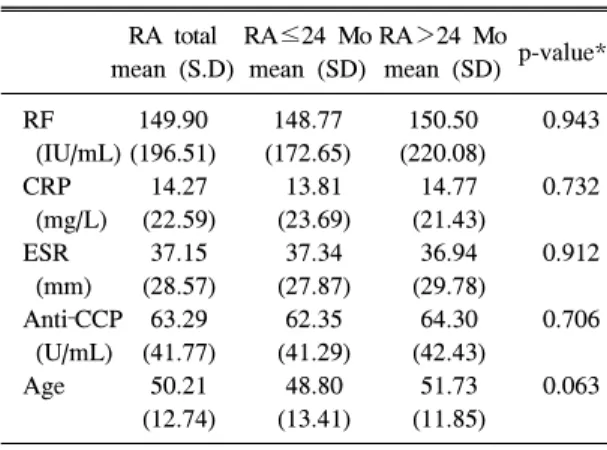
각 군에서 남녀비나 연령 분포에 있어 통계적인 차 이는 없었다(p=0.34, 0.33). 이환 기간에 따른 류마티 스관절염군과 기타 결체조직 질환군의 검사실 소견 과 나이의 비교는 표 2, 3과 같으며 류마티스관절염 환자군에서 이환 기간을 제외하고는(p<0.05) 통계적 으로 유의한 차이가 없었다.
기타 결체조직 질환으로 진단된 122명은 성인형
Table 5. Sensitivities, specificities and accurate diagnosis rate of RF and CCP Ab in each group of RA patients
Sensitivity Specificity ADR
(%) (%) (%)
RA≤24 Mo
RF 90.0 68.0 79.2
Anti-CCP 87.5 89.3 88.4
RF or Anti-CCP 92.6 65.6 79.1 RA>24 Mo
RF 91.3 68 79.7
Anti-CCP 81.7 89.3 85.5
RF or Anti-CCP 93.7 65.6 79.6 RA total
RF 90.8 68 79.4
Anti-CCP 84.7 89.3 87.0
RF or Anti-CCP 93.1 65.6 79.3 RF: Rheuamtoid factor, Anti-CCP: Anti-cyclic citrulli- nated peptide, ADR: Acurate diagnosis rate
Table 4. Positive rate of RF and anti‐CCP antibody in each group of RA patients
RA≤24 Mo RA>24 Mo RA total n (%) n (%) n (%) Anti-CCP ()
RF () 10 (7.4) 8 (6.3) 18 (6.9) RF (+) 7 (5.1) 15 (11.9) 22 (8.4) Anti-CCP (+)
RF () 3 (2.2) 3 (2.4) 6 (2.3) RF (+) 116 (85.3) 100 (79.4) 216 (82.4) Total 136 (100.0) 126 (100.0) 262 (100.0) Anti-CCP: Anti-cyclic citrullinated peptide, RF: Rheua- mtoid factor
Table 3. Comparison of laboratory parameters in each group of RA patients
RA total RA≤24 Mo RA>24 Mo p-value*
mean (S.D) mean (SD) mean (SD) RF 149.90 148.77 150.50 0.943 (IU/mL) (196.51) (172.65) (220.08)
CRP 14.27 13.81 14.77 0.732 (mg/L) (22.59) (23.69) (21.43)
ESR 37.15 37.34 36.94 0.912 (mm) (28.57) (27.87) (29.78)
Anti‐CCP 63.29 62.35 64.30 0.706 (U/mL) (41.77) (41.29) (42.43)
Age 50.21 48.80 51.73 0.063 (12.74) (13.41) (11.85)
*Two sample t‐test between RA≤24 Mo and RA>24 Mo.
RF: Rheuamtoid factor, CRP: C-reactive protein, ESR:
Erythrocyte sedimentation rate, Anti-CCP: Anti- cyclic citrullinated peptide
스틸병(adult onset still's disease, AOSD) 3명, 베체트 병(Behcet's disease, BD) 8명, 섬유조직염(fibromy- algia syndrome, FMS) 26명, 통풍(gout) 9명, 소아기 류마티스관절염(juvenile rheumatoid arthritis, JRA) 4 명, 혼합 결체조직질환(mixed connective tissue dise- ase, MCTD) 4명, 류마티스성 다발성 근육통(polym- yalgia rheumatica, PMR) 2명, 재발성 류마티즘(palind- romic rheumatism, PR) 51명, 건선성 관절염(psoriatic arthritis, PsA) 3명, 전신홍반루푸스(systemic lupus ery- thematosus, SLE) 3명, 전신성 경화증(systemic sclerosis,
SSc) 1명, 미분화 결체조직 질환(undifferentiated con- nective tissue disease, UCTD) 8명 이었다.
항CCP항체 음성인 환자군에서 류마티스 인자는 24개월 이하 류마티스관절염 환자군에서 5.1%, 24개 월 초과 환자군에서 11.9%가 양성으로 나타나 이환 기간이 긴 군에서 류마티스 인자의 양성율이 더 높 은 것으로 나타났고(표 4), 이에 비해 류마티스 인자 음성인 환자군에서 항 CCP항체의 양성율은 이환 기 간에 따라 각각 2.2%, 2.4%로 차이가 없었다, 이환기간 24개월 이하의 조기 류마티스관절염 환 자군에서 류마티스 인자와 항CCP항체의 민감도/특 이도는 각각 90.4%/68.0%, 87.5%/89.3%이었고, 전체 류마티스관절염군에서의 민감도/특이도는 각각 90.8%/
68.0%, 84.7%/89.3%로 나타났다(표 5). 각 검사법의 진단의 정확도(acurate diagnosis rate, 전체 환자에 대 한 진양성과 진음성 환자 합의 비)는 각 군에서 류 마티스 인자/항CCP항체가 79.2%/88.4%, 79.7%/89.5%, 79.4%/87.0%로 항CCP항체가 류마티스 인자보다 더 높은 것으로 나타났다(표 5).
각 검사 결과의 ROC 곡선은 그림 1과 같으며 각 각의 곡선하 면적은 그림 1에 표시된 바와 같다. 각 곡선하 면적은 0.5 이상(p<0.05) 값을 나타내어 통 계적으로 유의한 ROC 곡선의 형태를 보였다.
고 찰
류마티스관절염은 이환 이후 환자들마다 매우 다 양한 임상양상을 가진다. 상당수의 환자에서 피로감, 비특이적인 근육통 및, 관절 증상 등의 전구 증상이 서서히 진행하여 이 단계에는 조기 진단이 어려울 수 있다. 일부의 환자에서는 증상이 급성으로 나타 날 수 있고, 일부에서는 수 년간 재발성 류마티즘의 양상으로 발현한 뒤 류마티스관절염으로 발전하기도 한다. 발병기전은 아직 정확하게 알려져 있지 않으 나 유전적인 요인과 감염, 흡연과 같은 환경적인 요 인이 같이 작용하는 것으로 생각되어지고 있다 (12).
관절염의 진행으로 인한 관절 파괴로 환자의 삶의 질과 사회 경제적 비용이 증가함에 따라 가능한 한 발병 초기에 진단을 확립하여 항류마티스약물을 비 롯한 치료를 시작함으로써 질병 활성도를 조절하고
관절 손상을 막는 것이 효과적인 것으로 알려지고 있다 (13,14). 그러나 현재까지는 혈청학적 진단 요 소로 류마티스 인자가 유일하게 이용되어질 수 있어 조기진단에 어려움이 있다.
최근 류마티스관절염의 치료에 대한 개념의 변화 로 가능한 한 빨리 항류마티스약물을 비롯한 치료를 시작하는 것이 기능적 장애의 진행을 늦추는 것으로 알려지고 있다 (15-18). 그러기 위해서는 염증성 관 절염의 이환 초기에 신뢰성 있는 감별 진단을 할 수 있어야 하지만 발병 초기에는 특징적인 임상 양상을 나타내지 않는 경우가 많다. 이럴 경우 상당한 시간 이 경과하여 관절손상이 나타나기 시작해서야 임상 양상들을 중심으로 구성된 분류기준을 만족하여 치 료가 시작되는 경우가 많다. 그럼에도 불구하고 류 마티스 인자는 그 역가가 높아짐에 따라 관절 손상 이나 장애와 같은 나쁜 예후와 관련이 있고 쉽게 이 Fig 1. Receiver operator characteristics (ROC) curves of RF and anti-CCP. (A) RA≤24 Mo, (B) RA>24 Mo, (C) RA total.
용될 수 있는 혈청학적 표지자가 없어 현재까지도 분류기준에 포함되어 있다 (19).
류마티스관절염에서 발견되어지는 자가항체로 인 간 구강점막 상피세포의 핵주위 과립에 대한 anti- perinuclear factor와 인간 표피세포의 filagrin에 대한 항체인 항keratin항체가 이용될 수 있으며 (20,21), 류 마티스관절염의 진단에 높은 특이도를 보이는 것으 로 보고되었으나 (22) 검사 방법상의 문제 등으로 일반적으로 이용하기에는 어려움이 있다. 최근 filag- grin의 arginine residues가 peptidylarginine deiminase (PADI)에 의해 citrulline residues로 변화가 일어나고 이런 citrullinated residue을 포함한 기질에 반응하는 항체가 밝혀지면서, 여기서 변형된 cyclic citrullinated peptide에 대한 항체가 류마티스관절염 환자의 진단 에 이용되고 있다 (23).
국내에서 최 등은 연구에서 류마티스 인자의 민감 도, 특이도가 각각 80.6%, 78.5%인데 비해 항CCP항 체의 민감도, 특이도는 각각 72.8%, 92%로 보고하였 고, 두 가지 검사를 같이 적용할 경우 각각 79.3%, 96.4%로 높아지는 것으로 보고하였다 (24). Avouac 등이 최근까지 발표된 연구결과들을 분석한 바에 따 르면 류마티스관절염의 진단에 있어 항CCP항체의 민감도는 39∼94%, 특이도는 81∼100% 까지 보고되 고 있고, 미분화 관절염으로부터 류마티스관절염으 로의 변화와도 유의하게 관련되어 있으며 (4) 건강 대조군의 류마티스관절염의 발병의 예측하는데도 류 마티스 인자보다 높은 민감도를 나타내는 것으로 보 고되었다 (25). 이와 같이 높은 특이도 때문에 항 CCP항체가 류마티스관절염의 병인과도 관련이 있을 것으로 추정되기도 하는데, Suzuki 등은 PADI type4 의 한 일배체가 정상인에서 보다 류마티스관절염 환 자에서 더 의미있게 관찰되는 것으로 보아 류마티스 관절염 환자에서 단백질이 더 쉽게 citrulline화되고 과도하게 citrulline화된 단백질들이 관절내에서 비정 상적인 면역 반응을 유발시킬 수 있을 가능성을 시 사하였다 (26).
본 연구에서 류마티스관절염의 이환기간에 따른 류마티스 인자와 항CCP항체의 검사결과에 따르면 진단적 특이도가 각각 68%, 89.3%로 항CCP항체가 더 높으며, 민감도에 있어서는 류마티스 인자가 이 환기간에 따라 각각 90.5%, 91.3%로 항CCP항체에
비해 높으나, 항CCP항체의 경우, 이환 24개월이 지 난 환자군에서의 민감도가 81.7%인 것에 비해 조기 환자군에서는 87.5%로 나타났다. 이환 기간에 따른 각 군에서 항CCP항체는 류마티스 인자보다 높은 진 단적 특이도를 가지며, 민감도에 있어서는 류마티스 인자보다 낮은 수치를 보이나 조기 환자군으로 환자 군을 제한하여 전체환자군보다 통계적으로 유의하지 는 않으나 민감도가 높게 나타나는 것으로 보아 조 기 환자군의 진단에 도움이 될 것으로 생각된다. 전 체 류마티스 환자군과 비류마티스 결체조직 환자군 에 대한 진양성과 진음성의 비(진단의 정확도, acurate diagnosis rate)는 모든 군에서 항 CCP항체나 류마티스 인자간에 차이가 없었다.
본 연구에서 미비한 사항으로 류마티스관절염 환 자군과 기타 결체조직 질환 군에서 류마티스 인자의 양성률이 기존에 알려진 결과보다 높게 측정된 점을 들 수 있다. 이는 연구대상에 포함된 환자들 중 상당 수가 이전 의료기관에서 류마티스 인자 양성도를 확 인하고 전원된 환자들이기 때문인 것으로 추측된다.
또한 대조군을 건강한 정상인 집단으로 하지 않고 결체조직 질환으로 진단된 환자를 대상으로 하여, 일 부 환자에서는 류마티스 인자가 양성으로 나타날 수 있고, 환자수가 적어 결과에 영향을 미칠 수 있을 것 으로 생각된다. 따라서 향후에는 더 많은 조기 류마 티스관절염 환자군과 대조군으로 연구가 행해져야 할 것으로 생각되며, 진단에 있어 항CCP 항체의 역 가에 따른 류마티스 인자와의 비교나 임상양상의 정 도와의 연관성 등도 연구되어져야 할 것으로 생각된 다.
결 론
류마티스관절염의 진단에 있어 항CCP항체는 류마 티스 인자보다 더 진단적 특이도와 정확도가 높다.
그리고 조기 질환군에서의 항CCP항체는 전체 질환 군에서의 항CCP항체보다 더 높은 민감도를 가진다.
REFERENCES
1) Kvien TK. Epidemiology and burden of illness of rheumatoid arthritis. Pharmacoeconomics 2004;22:1-12.
2) Arnett FC, Edworthy SM, Bloch DA, McShane DJ, Fries JF, Cooper NS, et al. The American Rheu- matism Association 1987 revised criteria for the classification of rheumatoid arthritis. Arthritis Rheum 1988;31:315-24.
3) Visser H, le Cessie S, Vos K, Breedveld FC, Hazes JM. How to diagnose rheumatoid arthritis early: a prediction model for persistent (erosive) arthritis.
Arthritis Rheum 2002;46:357-65.
4) Avouac J, Gossec L, Dougados M. Diagnostic and predictive value of anti-cyclic citrullinated protein antibodies in rheumatoid arthritis: a systematic literature review. Ann Rheum Dis 2006;65:845-51.
5) 김경희, 이성원, 정원태. Association of Anti-cyclic Citrullinated Peptide (CCP) Antibodies and Func- tional Status in Rheumatoid Arthritis. 대한류마티스 학회지 2006; 13: 46-51.
6) Forslind K, Ahlmen M, Eberhardt K, Hafstrom I, Svensson B. Prediction of radiological outcome in early rheumatoid arthritis in clinical practice: role of antibodies to citrullinated peptides (anti-CCP). Ann Rheum Dis 2004;63:1090-5.
7) Lindqvist E, Eberhardt K, Bendtzen K, Heinegard D, Saxne T. Prognostic laboratory markers of joint damage in rheumatoid arthritis. Ann Rheum Dis 2005;64:196-201.
8) Quinn MA, Gough AK, Green MJ, Devlin J, Hensor EM, Greenstein A, et al. Anti-CCP antibodies measured at disease onset help identify seronegative rheumatoid arthritis and predict radiological and functional outcome. Rheumatology (Oxford) 2006;
45:478-80.
9) Meyer O, Nicaise-Roland P, Santos MD, Labarre C, Dougados M, Goupille P, et al. Serial determination of cyclic citrullinated peptide autoantibodies pred- icted five-year radiological outcomes in a prospective cohort of patients with early rheumatoid arthritis.
Arthritis Res Ther 2006;8:R40.
10) Bongi SM, Manetti R, Melchiorre D, Turchini S, Boccaccini P, Vanni L, et al. Anti-cyclic citrullinated peptide antibodies are highly associated with severe bone lesions in rheumatoid arthritis anti-CCP and bone damage in RA. Autoimmunity 2004;37:495- 501.
11) Matsui T, Shimada K, Ozawa N, Hayakawa H, Hagiwara F, Nakayama H, et al. Diagnostic utility of anti-cyclic citrullinated peptide antibodies for very early rheumatoid arthritis. J Rheumatol 2006;33:
2390-7.
12) Padyukov L, Silva C, Stolt P, Alfredsson L, Klare- skog L. A gene-environment interaction between smoking and shared epitope genes in HLA-DR pro- vides a high risk of seropositive rheumatoid arthritis.
Arthritis Rheum 2004;50:3085-92.
13) Emery P. The Roche Rheumatology Prize Lecture.
The optimal management of early rheumatoid disease:
the key to preventing disability. Br J Rheumatol 1994;
33:765-8.
14) van der Heide A, Jacobs JW, Bijlsma JW, Heurkens AH, van Booma-Frankfort C, van der Veen MJ, et al.
The effectiveness of early treatment with “second- line” antirheumatic drugs. A randomized, controlled trial. Ann Int Med 1996;124:699-707.
15) O'Dell JR. Therapeutic strategies for rheumatoid arthritis. New Engl J Med 2004;350:2591-602.
16) Nell VP, Machold KP, Stamm TA, Eberl G, Heinzl H, Uffmann M, et al. Autoantibody profiling as early diagnostic and prognostic tool for rheumatoid arthritis. Ann Rheum Dis 2005;64:1731-6.
17) van Aken J, Lard LR, le Cessie S, Hazes JM, Breedveld FC, Huizinga TW. Radiological outcome after four years of early versus delayed treatment strategy in patients with recent onset rheumatoid arthritis. Ann Rheum Dis 2004;63:274-9.
18) Nell VP, Machold KP, Eberl G, Stamm TA, Uffmann M, Smolen JS. Benefit of very early referral and very early therapy with disease-modifying anti-rheumatic drugs in patients with early rheumatoid arthritis.
Rheumatology (Oxford) 2004;43:906-14.
19) Scott DL, Symmons DP, Coulton BL, Popert AJ.
Long-term outcome of treating rheumatoid arthritis:
results after 20 years. Lancet 1987;1:1108-11.
20) Nienhuis RL, Mandema E. A new serum factor in patients with rheumatoid arthritis; the antiperinuclear factor. Ann Rheum Dis 1964;23:302-5.
21) Young BJ, Mallya RK, Leslie RD, Clark CJ, Hamblin TJ. Anti-keratin antibodies in rheumatoid arthritis. Br Med J 1979;2:97-9.
22) Vincent C, de Keyser F, Masson-Bessiere C, Sebbag M, Veys EM, Serre G. Anti-perinuclear factor compared with the so called "antikeratin" antibodies and antibodies to human epidermis filaggrin, in the diagnosis of arthritides. Ann Rheum Dis 1999;
58:42-8.
23) Schellekens GA, de Jong BA, van den Hoogen FH, van de Putte LB, van Venrooij WJ. Citrulline is an essential constituent of antigenic determinants recogn- ized by rheumatoid arthritis-specific autoantibodies. J
Clin Invest 1998;101:273-81.
24) 최석우, 임미경, 신동혁, 임춘화, 심승철. 류마티스 관절염 환자에서 Anti-cyclic citrullinated peptide antibodies 검사의 진단적 유용성. 대한진단검사의 학회지 2003; 2: 132-8.
25) Rantapaa-Dahlqvist S, de Jong BA, Berglin E, Hallmans G, Wadell G, Stenlund H, et al. Antibodies against cyclic citrullinated peptide and IgA rheuma-
toid factor predict the development of rheumatoid arthritis. Arthritis Rheum 2003;48:2741-9.
26) Suzuki A, Yamada R, Chang X, Tokuhiro S, Sawada T, Suzuki M, et al. Functional haplotypes of PADI4, encoding citrullinating enzyme peptidylarginine dei- minase 4, are associated with rheumatoid arthritis.
Nature Genetics 2003;34:395-402.