ISSN 2234-3806 • eISSN 2234-3814
https://doi.org/10.3343/alm.2017.37.1.63 www.annlabmed.org 63
Ann Lab Med 2017;37:63-65
https://doi.org/10.3343/alm.2017.37.1.63
Case Report
Diagnostic Genetics
First Report of Familial Dysalbuminemic Hyperthyroxinemia With an ALB Variant
Yoon Young Cho, M.D.1,2,*, Ju-Sun Song, M.D.3,*, Hyung-Doo Park, M.D.3, Young Nam Kim, M.D.1, Hye-In Kim, M.D.1, Tae Hyuk Kim, M.D.1, Jae Hoon Chung, M.D.1, Chang-Seok Ki, M.D.3, and Sun Wook Kim, M.D.1
Division of Endocrinology and Metabolism1, Department of Medicine, Thyroid Center, Samsung Medical Center, Sungkyunkwan University School of Medicine, Seoul; Division of Endocrinology and Metabolism2, Department of Medicine, Gyeongsang National University School of Medicine, Jinju;
Department of Laboratory Medicine and Genetics3, Samsung Medical Center, Sungkyunkwan University School of Medicine, Seoul, Korea
Familial dysalbuminemic hyperthyroxinemia (FDH) is an inherited disease characterized by increased circulating total thyroxine (T4) levels and normal physiological thyroid func- tion. Heterozygous albumin gene (ALB) variants have been reported to be the underlying cause of FDH. To our knowledge, there have been no confirmed FDH cases in Korea. We recently observed a female patient with mild T4 elevation (1.2 to 1.4-fold) and variable levels of free T4 according to different assay methods. Upon Sanger sequencing of her ALB, a heterozygous c.725G>A (p.Arg242His) variant was identified. The patient’s father and eldest son had similar thyroid function test results and were confirmed to have the same variant. Although the prevalence of FDH might be very low in the Korean popula- tion, clinical suspicion is important to avoid unnecessary evaluation and treatment.
Key Words: Abnormal thyroid function test, Albumin gene, Familial dysalbuminemic hy- perthyroxinemia, Variant
Received: April 4, 2016 Revision received: May 20, 2016 Accepted: October 19, 2016 Corresponding author: Sun Wook Kim Division of Endocrinology and Metabolism, Department of Medicine, Thyroid Center, Samsung Medical Center, Sungkyunkwan University School of Medicine, 81, Irwon- ro, Gangnam-gu, Seoul 06351, Korea Tel: +82-10-9933-1653
Fax: +82-2-3410-3849 E-mail: [email protected]
Co-corresponding author: Chang-Seok Ki Department of Laboratory Medicine and Genetics, Samsung Medical Center, Sungkyunkwan University School of Medicine, 81, Irwon-ro, Gangnam-gu, Seoul 06351, Korea
Tel: +82-2-3410-2709 Fax: +82-2-3410-2719 E-mail: [email protected]
* The first two authors equally contributed to this work.
© The Korean Society for Laboratory Medicine This is an Open Access article distributed under the terms of the Creative Commons Attribution Non-Commercial License (http://creativecom- mons.org/licenses/by-nc/4.0) which permits unrestricted non-commercial use, distribution, and reproduction in any medium, provided the original work is properly cited.
Familial dysalbuminemic hyperthyroxinemia (FDH) is the most common inherited cause of high serum total thyroxine (T4) con- centrations in clinically euthyroid subjects, showing an autoso- mal dominant transmission with an estimated prevalence of 1 in 10,000 [1]. Spurious TFT may lead to inappropriate treatments including medical or ablative therapy [2].
Variants at codons 90, 242, and 246 (conventional codons
66, 218, and 222, respectively) in the albumin gene (ALB) have been reported to be underlying causes of FDH, mainly by pro- ducing an abnormal human serum albumin (HSA) with enhan- ced T4 binding affinity. In 1994, two independent groups de- scribed a p.Arg242His variant in Caucasian individuals [3, 4]
followed by reports in Hispanic/Puerto Rican [5] and Chinese subjects [6]. In 1997, Wada et al [7] reported a p.Arg242Pro
Cho YY, et al.
Familial dysalbuminemic hyperthyroxinemia in Korea
64 www.annlabmed.org https://doi.org/10.3343/alm.2017.37.1.63 variant in Japanese cases, showing 80-fold increased T4 bind-
ing affinity, and subsequent cases were described in a Swiss family [8]. In 1998, another ALB variant (p.Leu90Pro) produc- ing an HSA with increased affinity for T3 was found in the Thai population [9]. Recently, a novel variant in codon 242 (p.Arg- 242Ser) [10] and another variant in codon 246 (p.Arg246Ile) have also been reported [11].
Although FDH might not be rare in the Korean population, there have been no confirmed cases in Korea. We recently found a Korean family with FDH. The proband (II-2) was a 38-yr-old Ko- rean woman. Five years ago, she was transferred to a tertiary hospital owing to abnormal TFT results; however, her thyroid function was normal when examined by a different assay. Resis-
tance to thyroid hormone (RTH) was excluded with a negative result upon thyroid hormone receptor β gene (THRB) analysis.
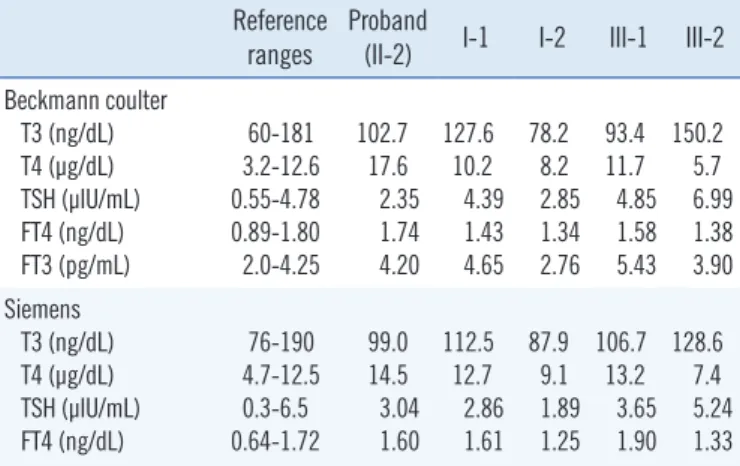
This year, she underwent a routine check-up for TFT and had a high FT4 of 2.55 ng/dL (reference range 0.95-1.57 ng/dL) with normal TSH as determined by using the Roche e601 Co- bas 6000 (Roche Diagnostics, West Sussex, England). Then she was transferred to our institution, and her blood sample was tested with two different TFT assays (Table 1).
Using the Beckman Coulter RIA kit (Beckman Coulter, Brea, CA, USA), TFT results were as follows: 102.7 ng/dL for T3 (ref- erence range 60-181 ng/dL), 17.6 µg/dL for T4 (reference range 3.2-12.6 µg/dL), 2.35 µIU/mL TSH (reference range 0.55-4.78 µIU/mL), 1.74 ng/dL FT4 (reference range 0.89-1.80 ng/dL), and 4.20 pg/mL FT3 (reference range 2.0-4.25 ng/dL). With the Siemens AG ADVIA Centaur kit (ADVIA Centaur AG, Munich, Germany), TFT values were as follows: 99 ng/dL T3 (reference range 76-190 ng/dL), 14.5 µg/dL T4 (reference range 4.7-12.5 µg/dL), 3.04 µIU/mL TSH (reference range 0.3-6.5 µIU/mL), and 1.60 ng/dL FT4 (reference range 0.64-1.72 ng/dL). A re- peated test of the same blood sample with the Roche e601 Co- bas 6000 showed a high FT4 (2.49-2.68 ng/dL, reference range 0.95-1.57 ng/dL).
Among first-degree relatives tested (I-1, I-2, III-1, and III-2;
Fig. 1), the proband’s father (I-1) and eldest son (III-1) showed similar TFT patterns with slightly elevated T4 (12.7 and 13.2 µg/
dL, respectively with the Siemens AG ADVIA Centaur kit), but normal TSH and T3. The eldest son had a high FT4 of 1.90 ng/
dL using the Siemens AG ADVIA Centaur kit. Nevertheless, two individuals were in a clinically euthyroid state.
Table 1. Thyroid function tests for the proband and family mem- bers with familial dysalbuminemic hyperthyroxinemia
Reference ranges Proband
(II-2) I-1 I-2 III-1 III-2 Beckmann coulter
T3 (ng/dL) T4 (µg/dL) TSH (µIU/mL) FT4 (ng/dL) FT3 (pg/mL)
60-181 3.2-12.6 0.55-4.78 0.89-1.80 2.0-4.25
102.7 17.6 2.35 1.74 4.20
127.6 10.2 4.39 1.43 4.65
78.2 8.2 2.85 1.34 2.76
93.4 11.7 4.85 1.58 5.43
150.2 5.7 6.99 1.38 3.90 Siemens
T3 (ng/dL) T4 (µg/dL) TSH (µIU/mL) FT4 (ng/dL)
76-190 4.7-12.5 0.3-6.5 0.64-1.72
99.0 14.5 3.04 1.60
112.5 12.7 2.86 1.61
87.9 9.1 1.89 1.25
106.7 13.2 3.65 1.90
128.6 7.4 5.24 1.33 Abbreviations: T3, total triiodothyronine; T4, total thyroxine; TSH, thyrotro- pin; FT4, free T4; FT3, free T3.
Fig. 1. Pedigree of the familial dysalbuminemic hyperthyroxinemia (FDH) family and albumin gene (ALB) mutation analysis for the pro- band. Half-closed and open squares indicate male subjects with and without FDH, respectively. Half-closed and open circles represent fe- male subjects with and without FDH, respectively. Grey squares indicate male subjects who were not tested for thyroid function or ALB mu- tation. The arrow indicates the proband. Sequencing analysis identified the c.725G>A (p.Arg242His) mutation (arrow).
I
II
III
1
1
1
2
2
2
3 4
II-2 (Proband)
I-1 (Father)
III-1 (Eldest son) ALB c.725G>A (p.Arg242His)
Cho YY, et al.
Familial dysalbuminemic hyperthyroxinemia in Korea
https://doi.org/10.3343/alm.2017.37.1.63 www.annlabmed.org 65
In order to confirm FDH, ABL was analyzed by using Sanger sequencing. After obtaining informed consent, genomic DNA was extracted from peripheral blood leukocytes by using the Wizard Genomic DNA Purification kit (Promega, Madison, WI, USA) according to the manufacturer’s instructions. Considering that the p.Arg242 residue is a hotspot in FDH, exon 7 of the ALB containing this residue was PCR-amplified and sequenced on an ABI 3730xL Genetic Analyzer (Applied Biosystems, Foster City, CA, USA) using a BigDye Terminator Cycle Sequencing Ready Reaction kit (Applied Biosystems), and the sequencing results revealed the c.725G>A (p.Arg242His) variant in the pro- band (Fig. 1).
This variant was not present in data from 622 Korean control exomes or approximately 8,600 East Asian alleles from the Exome Aggregation Consortium (ExAC). The proband’s father and el- dest son with elevated T4 were also heterozygous for this vari- ant; however, the proband’s mother and younger son who had normal TFT results did not have this variant.
The p.Arg242His variant results in a mild form of FDH that produces HSA with enhanced affinity for T4 (10- to 15-fold in- crease) and results in high T4 levels with a 2-fold increase [3, 4, 6]. In our report, the proband had T4 levels that were increased 1.2- to 1.4-fold, which exceeded the upper reference limit. Two affected family members (I-1, III-1) also had slightly elevated T4 values. Using the two kits from Beckmann Coulter and Siemens, FT4 levels were normal in the proband, although the concentra- tions were close to upper normal limits in each assay. Notably, her FT4 level was above the reference interval using the Roche kit, even with the same blood sample.
Different FT4 assays have considerable variation in measure- ments. Generally, 2-step assays, in which a washing step imme- diately after capture prevents the T4 analog and serum albumin from coming into contact, are expected to yield normal FT4 lev- els in FDH patients. However, according to a study by Cartwright et al [12] that examined free T4 values in FDH individuals using different assays, including 1- and 2-step methodologies, some 2-step assays yielded spuriously high values in individuals with this condition. The Siemens Centaur 1-step assay performed considerably better than some of the other 2-step methods. This result is likely because inhibitors of T4 and T4 analogs bind to the albumin, and the chloride concentration in the incubation buffer plays a role [13].
Accurate FDH diagnosis is important because the affected in- dividual can undergo unnecessary evaluation and treatment due to misdiagnosis. T4 concentrations vary according to the foci of FDH variants, and the results of FT4 are unreliable between dif-
ferent assays; therefore, clinical suspicion is critical. We believe that FDH cases are underestimated and underdiagnosed owing to insufficient clinical suspicion. Clinicians should consider the possibility of FDH in subjects with a clinically euthyroid state, but with abnormal TFT results.
Authors’ Disclosures of Potential Conflicts of Interest
No potential conflicts of interest relevant to this article were re- ported.
REFERENCES
1. Jensen IW and Faber J. Familial dysalbuminaemic hyperthyroxinaemia:
a review. J R Soc Med 1988;81:34-7.
2. Wood DF, Zalin AM, Ratcliffe WA, Sheppard MC. Elevation of free thy- roxine measurements in patients without thyrotoxicosis. Q J Med 1987;
65:863-70.
3. Petersen CE, Scottolini AG, Cody LR, Mandel M, Reimer N, Bhagavan NV. A point mutation in the human serum albumin gene results in famil- ial dysalbuminaemic hyperthyroxinaemia. J Med Genet 1994;31:355-9.
4. Sunthornthepvarakul T, Angkeow P, Weiss RE, Hayashi Y, Refetoff S. An identical missense mutation in the albumin gene results in familial dys- albuminemic hyperthyroxinemia in 8 unrelated families. Biochem Bio- phys Res Commun 1994;202:781-7.
5. DeCosimo DR, Fang SL, Braverman LE. Prevalence of familial dysalbu- minemic hyperthyroxinemia in Hispanics. Ann Intern Med 1987;107:
780-1.
6. Tiu SC, Choi KL, Shek CC, Lau TC. A Chinese family with familial dysal- buminaemic hyperthyroxinaemia. Hong Kong Med J 2003;9:464-7.
7. Wada N, Chiba H, Shimizu C, Kijima H, Kubo M, Koike T. A novel mis- sense mutation in codon 218 of the albumin gene in a distinct pheno- type of familial dysalbuminemic hyperthyroxinemia in a Japanese kin- dred. J Clin Endocrinol Metab 1997;82:3246-50.
8. Pannain S, Feldman M, Eiholzer U, Weiss RE, Scherberg NH, Refetoff S.
Familial dysalbuminemic hyperthyroxinemia in a Swiss family caused by a mutant albumin (R218P) shows an apparent discrepancy between serum concentration and affinity for thyroxine. J Clin Endocrinol Metab 2000;85:2786-92.
9. Sunthornthepvarakul T, Likitmaskul S, Ngowngarmratana S, Angsusing- ha K, Kitvitayasak S, Scherberg NH, et al. Familial dysalbuminemic hy- pertriiodothyroninemia: a new, dominantly inherited albumin defect. J Clin Endocrinol Metab 1998;83:1448-54.
10. Greenberg SM, Ferrara AM, Nicholas ES, Dumitrescu AM, Cody V, Weiss RE, et al. A novel mutation in the Albumin gene (R218S) causing famil- ial dysalbuminemic hyperthyroxinemia in a family of Bangladeshi ex- traction. Thyroid 2014;24:945-50.
11. Schoenmakers N, Moran C, Campi I, Agostini M, Bacon O, Rajanayagam O, et al. A novel albumin gene mutation (R222I) in familial dysalbumin- emic hyperthyroxinemia. J Clin Endocrinol Metab 2014;99:E1381-6.
12. Cartwright D, O’Shea P, Rajanayagam O, Agostini M, Barker P, Moran C, et al. Familial dysalbuminemic hyperthyroxinemia: a persistent diagnos- tic challenge. Clin Chem 2009;55:1044-6.
13. Ross HA, de Rijke YB, Sweep FC. Spuriously high free thyroxine values in familial dysalbuminemic hyperthyroxinemia. Clin Chem 2011;57:524-5.