ISSN 2234-3806 • eISSN 2234-3814
490 www.annlabmed.org https://doi.org/10.3343/alm.2020.40.6.490 Ann Lab Med 2020;40:490-492
https://doi.org/10.3343/alm.2020.40.6.490
Letter to the Editor
Clinical Microbiology
Quality of Ribonucleic Acid Extraction for Real-Time Reverse Transcription-PCR (rRT-PCR) of SARS-CoV-2:
Importance of Internal Control Monitoring
Yeon Joo Lee , B.Sc.1, Youngeun Lim , M.T.2, Kyu Wha Hur , M.D.2, Heungsup Sung , M.D.2, and Mi-Na Kim , M.D.2
1Konkuk University School of Medicine, Seoul, Korea; 2Department of Laboratory Medicine, University of Ulsan, College of Medicine and Asan Medical Center, Seoul, Korea
Dear Editor,
Severe acute respiratory syndrome coronavirus 2 (SARS-CoV-2) emerged as a novel virus causing pneumonia in December 2019 in Wuhan city, Hubei province, China, which led to a huge out- break of the disease, now widely known as COVID-19, spread- ing to 46 countries by 26th February 2020 [1]. The WHO rec- ommends nucleic acid amplification tests for laboratory confir- mation of COVID-19 [2]. Over nine days, from 18th-26th Febru- ary 2020, approximately 50,000 tests for suspected cases of COVID-19 were performed in Korea, resulting in a diagnosis of 1,742 new cases in this period [3, 4]. On 6th February 2020, Emergency Use Authorization (EUA) for COVID-19 testing was implemented in Korea, permitting rapid expansion of capacity in clinical and public health laboratories [5]. Such a surge in de- mand for laboratory diagnostic tests inevitably results in insuffi- cient validation of new tests accompanied by lack of resources.
On 17th February 2020, real-time reverse transcription (rRT)- PCR was set up for SARS-CoV-2 detection by Allplex 2019-nCoV
assay (Seegene, Seoul, Korea) using the CFX96 Touch Real-Time PCR Detection System (Bio-Rad, Hercules, CA, USA) in the clinical laboratory in Asan Medical Center, Seoul, Korea. How- ever, we experienced cycle threshold (Ct) prolongation of the in- ternal control (IC) and therefore investigated the cause. The In- stitutional Review Board of Asan Medical Center (IRB No. 2020- 0370) exempted the study from further review and the need for informed consent.
Sputum samples collected without preservation and nasopha- ryngeal (NP) samples collected using flocked swabs were trans- ported in a UTM Viral Transport system (Copan, Brescia, Italy).
Each sample was first spiked with the IC in Allplex kit, and then RNA was extracted with the automated silica-coated magnetic bead system of Real-Prep (BioSewoom Inc., Seoul, Korea) us- ing Real-Prep Viral DNA/RNA kit (BioSewoom). This system was first introduced in the laboratory on 14th February 2020 for SARS- CoV-2 rRT-PCR. For rRT-PCR, 8 μL of the RNA extract was man- ually added to PCR mixtures in Allplex kit, and Ct values of IC
Received: March 12, 2020 Revision received: April 6, 2020 Accepted: May 19, 2020
Corresponding author: Mi-Na Kim, M.D.
Department of Laboratory Medicine, University of Ulsan, College of Medicine and Asan Medical Center, 88 Olympic-ro 43 gil, Songpa-gu, Seoul 05505, Korea
Tel: +82-2-3010-4511, Fax: +82-2-478-0884, E-mail: [email protected]
Co-corresponding author: Heungsup Sung, M.D.
Department of Laboratory Medicine, University of Ulsan, College of Medicine and Asan Medical Center, 88 Olympic-ro 43 gil, Songpa-gu, Seoul 05505, Korea
Tel:+82-2-3010-4499, Fax: +82-2-478-0884, E-mail: [email protected]
© Korean Society for Laboratory Medicine
This is an Open Access article distributed under the terms of the Creative Commons Attribution Non-Commercial License (https://creativecommons.org/licenses/by-nc/4.0) which permits unrestricted non-commercial use, distribution, and reproduction in any medium, provided the original work is properly cited.
Lee YJ, et al.
Internal control monitoring in SARS-CoV-2 rRT-PCR
https://doi.org/10.3343/alm.2020.40.6.490 www.annlabmed.org 491
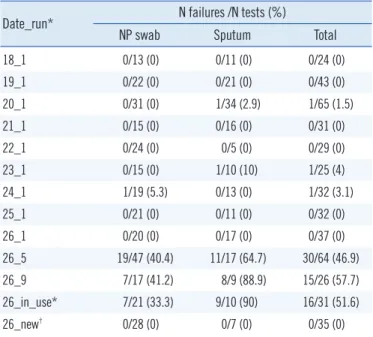
were monitored for all samples. Ninety-four runs comprising 3,345 tests were performed over nine days from 18th-26th Feb- ruary 2020. There were no positive clinical samples. The aver- age Ct value of IC was 22.60 ±0.99 at the first run, which in- creased to a maximum of 34.97 ±2.99 among the runs per- formed on 26th February 2020 for NP samples; a similar incre- ase from 23.94±1.48 to 38.67 was detected for sputum sam- ples (Fig. 1). There was an increased failure in amplification of IC during the same period, with a maximum failure rate of 41.2%
for NP and 88.9% for sputum samples on 26th February 2020 (Table 1).
To evaluate the performance of the RNA extraction step, 31 and 35 samples were prepared using the Real-Prep-in-use and the new Real-Prep system, respectively, and all 66 eluates were submitted to the same run of rRT-PCR. The IC failure rate of NP samples was 51.6% with an average Ct value of 35.4±2.00 us- ing Real-Prep-in-use, but it was 0% with a Ct value of 30.24±1.77 using the new Real-Prep system (Fig. 1). Examination of the Real-Prep-in-use by the manufacturer revealed that all mag- netic rods were coated with a substantial number of magnetic beads, which would hamper the ability to hold magnetic beads.
Therefore, Ct prolongation and failure of IC were attributed to
Table 1. Failure rates of IC for SARS-CoV-2 rRT-PCR for nine days in February 2020
Date_run* N failures /N tests (%)
NP swab Sputum Total
18_1 0/13 (0) 0/11 (0) 0/24 (0)
19_1 0/22 (0) 0/21 (0) 0/43 (0)
20_1 0/31 (0) 1/34 (2.9) 1/65 (1.5)
21_1 0/15 (0) 0/16 (0) 0/31 (0)
22_1 0/24 (0) 0/5 (0) 0/29 (0)
23_1 0/15 (0) 1/10 (10) 1/25 (4)
24_1 1/19 (5.3) 0/13 (0) 1/32 (3.1)
25_1 0/21 (0) 0/11 (0) 0/32 (0)
26_1 0/20 (0) 0/17 (0) 0/37 (0)
26_5 19/47 (40.4) 11/17 (64.7) 30/64 (46.9)
26_9 7/17 (41.2) 8/9 (88.9) 15/26 (57.7)
26_in_use* 7/21 (33.3) 9/10 (90) 16/31 (51.6)
26_new† 0/28 (0) 0/7 (0) 0/35 (0)
*RNA of all runs was extracted with the Real-Prep in use (Biosewoom, Seoul, Korea) including Feb 26_in_use except †Feb 26_new, for which RNA was extracted with the new Real-Prep system.
Abbreviations: IC, internal control; rRT-PCR, real-time reverse transcription PCR; SARS-CoV-2, severe acute respiratory syndrome coronavirus 2; NP, nasopharyngeal.
Fig. 1. Trends of Ct values of the IC in rRT-PCR for SARS-CoV-2 detection. At the end of 26th February 2020, in 31 samples, RNA was ex- tracted using the Real-Prep (BioSewoom, Seoul, Korea) system in use, 2-26 (in use), and in 35 samples, RNA was extracted using the new Real-Prep system, 2-26 (new); all of these were submitted to a single run of PCR for comparison.
Abbreviations: Ct, cycle threshold; IC, internal control; rRT-PCR, real-time reverse transcription PCR; SARS-CoV-2, severe acute respiratory syndrome coro- navirus 2; NP, nasopharyngeal.
45
40
35
30
25
20
15
10
5
0 18_1 19_1 20_1 21_1 22_1 23_1 24_1 25_1 26_1 26_5 26_9 26_in_use 26_new
Date_run in February 2020
Ct (mean±SD)
NP Swab Sputum
Lee YJ, et al.
Internal control monitoring in SARS-CoV-2 rRT-PCR
492 www.annlabmed.org https://doi.org/10.3343/alm.2020.40.6.490 the poor quality of the RNA extraction step.
The purpose of IC is to validate nucleic acid extraction and the efficiency of PCR [6]. For this purpose, housekeeping genes intrinsic to samples are used as IC, or artificial IC can be spiked in the samples before preparation. Therefore, a well-designed IC is an essential component of PCR kits to detect viral target genes [7]. This is particularly relevant for EUA-approved kits, which are exempt from clinical validation requirements. Although five SARS-CoV-2 rRT-PCR have been approved by the EUA as of 23rd March 2020 in Korea [8], RNA bacteriophage as an IC is available with the Allplex kit only, monitoring the entire pro- cess from RNA extraction to PCR (http://www.seegene.com/as- says/allplex_2019_ncov_assay). The analytical performance of PCR is largely dependent on the quality of the sample and nu- cleic acid extraction efficiency [9]. We found more prominent deterioration in PCR efficiency of IC with sputum samples than with NP samples. Both sputum and NP samples were recom- mended with same cut-off of Ct value <40 by the manufacturer, but sputum samples require homogenization, which critically influences the efficiency to extract nucleic acids and eliminate interferents that can inhibit PCR [7, 9]. Contamination of mag- netic rods is an additional concern that could lead to false posi- tivity, although no positive samples were detected during this in- vestigation.
As the experience of the Middle East Respiratory Syndrome outbreak of 2015 in Korea, an epidemic of emerging infectious diseases necessitates clinical laboratories to conduct new tests at a large scale in a short period of time with kits and equipment that have not been thoroughly validated [10]. This situation poses a risk affecting the quality of the diagnostic tests approved by the EUA. Accordingly, EUA-approved kits should include ade- quate ICs to allow for monitoring of the overall analytical perfor- mance. Clinical microbiologists should closely monitor the ICs for each run with products under an EUA condition.
ACKNOWLEDGEMENTS
None.
AUTHOR CONTRIBUTIONS
MNK and HS led the entire study from ideation to writing this paper. YJL mainly wrote this paper. YJL conducted the experi- ments and KWH analyzed the data.
CONFLICTS OF INTEREST
The authors declare no conflict of interest.
RESEARCH FUNDING
None declared.
ORCID
Yeon Joo Lee https://orcid.org/0000-0002-8066-0724 Youngeun Lim https://orcid.org/0000-0001-9000-6809 Kyu Wha Hur https://orcid.org/0000-0002-2159-3592 Heungsup Sung https://orcid.org/0000-0002-6062-4451 Mi-Na Kim https://orcid.org/0000-0002-4624-6925
REFERENCES
1. World Health Organization. Coronavirus disease 2019 (COVID-19) Situ- ation Report–38. https://www.who.int/docs/default-source/coronaviruse/
situation-reports/20200227-sitrep-38-covid-19.pdf?sfvrsn=9f98940c_4 (Updated on 27 Feb 2020).
2. World Health Organization. Laboratory testing for coronavirus disease 2019 (COVID-19) in suspected human cases. Interim guidance. https://
apps.who.int/iris/handle/10665/331329 (Updated on 2 Mar 2020).
3. Korea Centers for Disease Control and Prevention. The 15 new cases of COVID-19 have been confirmed in Korea. https://www.cdc.go.kr/board/
board.es?mid=a30402000000&bid=0030&act=view&list_no=366239
&tag=&nPage=1 (Updated on 19 Feb 2020).
4. Korea Centers for Disease Control and Prevention. The Updates of CO- VID-19 in Republic of Korea as of 26 February, 2020. https://www.cdc.
go.kr/board/board.es?mid=a30402000000&bid=0030&act=view&list_
no=366350&tag=&nPage=1 (Updated on 26 Feb 2020).
5. JS Park, YS Choi, Yoo CK. Emergency use authorization of in-vitro diag- nostics for infectious disease. Public Health Weekly Report 2017;10:
555-9.
6. CLSI. Quantitative molecular methods for infectious disease. Approved guideline. 2nd ed. CLSI MM06-A2. Wayne, PA: Clinical and Laboratory Standards Institute. 2010.
7. Kim MN, Ko YJ, Seong MW, Kim JS, Shin BM, Sung H. Analytical and clinical validation of six commercial Middle East Respiratory Syndrome coronavirus RNA detection kits based on real-time reverse-transcription PCR. Ann Lab Med 2016;36:450-6.
8. Kim YJ, Sung H, Ki CS, Hur M. COVID-19 testing in South Korea: cur- rent status and the need for faster diagnostics. Ann Lab Med 2020;40:
349-3509.
9. Sung H, Yong D, Ki CS, Kim JS, Seong MW, Lee H, et al. Comparative evaluation of three homogenization methods for isolating Middle East Respiratory Syndrome coronavirus nucleic acids from sputum samples for real-time reverse transcription PCR. Ann Lab Med 2016;36:457-62.
10. Lee MK, Kim S, Kim MN, Kweon OJ, Lim YK, Ki CS, et al. Survey of clinical laboratory practices for 2015 Middle East Respiratory Syndrome coronavirus outbreak in the Republic of Korea. Ann Lab Med 2016;36:
154-61.