서 론
현장검사(Point of care testing, POCT)란 중앙검사실을 벗
어나 진료가 이루어지는 장소에서 시행되는 진단검사로 지난 20년 동안 그 적용범위가 늘어나고 있다[1]. 신속하게 결과를 보고할 수 있는 현장검사는 환자의 진단과 치료에 빠르게 적용 할 수 있으며, 채혈량을 줄임으로써 환자들의 만족도 향상에 기 여하며, 더 많은 환자를 진료하여야 하는 임상의사들의 신속한 검사 결과의 요구에도 부합한다. 현장검사는 여러 장점들로 인 하여 세계 체외검사 시장의 약 3분의 1을 차지하고 있으며 매년 9%씩 성장하고 있다[1]. 또한 국내에서는 2002년 한 해 동안에 진단검사 시장의 17.8%를 현장검사가 차지하였다[2]. 진단검사
430 DOI 10.3343/kjlm.2009.29.5.430
430 430 430 Received :June 29, 2009 Manuscript No :KJLM09-082 Revision received :August 10, 2009
Accepted :September 8, 2009
Corresponding author :Sang Hoon Song, M.D.
Department of Laboratory Medicine, Seoul National University Bundang Hospital, 300 Gumi-dong, Bundang-gu, Seongnam 463-707, Korea
Tel : +82-31-787-7693, Fax : +82-31-787-4015 E-mail : [email protected]
현장검사 화학 분석 장비 Piccolo xpress Chemistry Analyzer 성능 평가
Performance Evaluation of the Piccolo xpress Point-of-care Chemistry Analyzer
Hyunwoong Park, M.D.
1,2, Dae-Hyun Ko, M.D.
1,2, Jin Q Kim, M.D.
1,3, and Sang Hoon Song, M.D.
1,2Department of Laboratory Medicine1, Seoul National University College of Medicine, Seoul; Department of Laboratory Medicine2, Seoul National University Bundang Hospital, Seongnam; Department of Laboratory Medicine3, Seoul National University Hospital, Seoul, Korea
박현웅
1,2∙고대현
1,2∙김진규
1,3∙송상훈
1,2서울대학교 의과대학 검사의학교실1, 분당서울대학교병원 진단검사의학과2, 서울대학교병원 진단검사의학과3
Background : Point-of-care (POC) tests are used increasingly due to fast results and simple test procedures, which enables rapid diagnosis and therapeutic monitoring. We evaluated the perfor- mance of the Piccolo xpress Chemistry Analyzer (Abaxis, USA) a POC chemistry analyzer.
Methods : Fourteen analytes, Na+, K+, Cl-, Ca2+, total carbon dioxide, AST, ALT, total bilirubin, alka- line phosphatase, blood urea nitrogen, creatinine, albumin, total protein, and glucose; were measured simultaneously with a 100 μL of whole blood sample using a Comprehensive Metabolic Reagent disk.
Within-run and total precision and linearity were evaluated according to CLSI EP15-A and EP6-A guidelines, respectively. Comparison with a central laboratory chemistry analyzer was performed using 144 patient samples.
Results : The coefficients of variations of within-run and total precision were all within 5% for three levels except for total carbon dioxide, ALT, alkaline phosphatase, total bilirubin, and creatinine in low level, and creatinine in middle level. The results of 14 analytes were linear within a commonly en- countered range in clinical samples (r2≥0.98). More than 10% of samples in Na+, AST, ALT, glucose, BUN did not satisfy CLIA analytical quality requirement.
Conclusions : The Piccolo xpress Chemistry Analyzer can analyze multiple analytes with a mini- mal amount of whole blood in a short time. It showed an acceptable performance for precision, lin- earity and comparison with central laboratory analyzer. It can be useful as a screening tests modal- ity in mobile clinics, ambulances, and field clinics for military use, and for pediatric patients from whom enough sample volume is difficult to obtain. (Korean J Lab Med 2009;29:430-8)
Key Words : Point-of-care systems, Analytical chemistry, Evaluation studies
의학과에서 실시하는 검사 중 약 60-70%를 차지하는 분야가 임상화학검사이며, 이 중 전해질 검사와 간기능검사, 신기능검 사, 혈당검사는 대부분의 의료 환경에서 기본적인 환자의 상태 를 알 수 있는 검사로 매우 중요하다[2]. 그러나 혈당측정기를 이용한 혈당검사와 동맥혈가스분석기에 포함된 전해질 등의 검 사 이외에 포괄적으로 임상화학검사가 가능한 현장검사 장비는 거의 소개된 적이 없다.
본 연구에서는 임상화학 현장검사 장비인 Piccolo xpress Chemistry Analyzer (Abaxis, Union city, CA, USA)를 이용 하여 나트륨(Na+), 칼륨(K+), 염소(Cl-), 칼슘(Ca2+), 총 이산화 탄소(total carbon dioxide, tCO2), AST, ALT, 알칼리인산분 해효소(alkaline phosphatase, ALP), 총 빌리루빈(total biliru- bin), 알부민(albumin), 총 단백질(total protein), 혈액요소질 소(blood urea nitrogen, BUN), 크레아티닌(Cr), 혈당(glucose) 농도를 측정하여 수행능을 평가하였다.
재료 및 방법
1. 장비 및 시약Piccolo xpress Chemistry Analyzer는 전혈, 혈장, 혈청 검 체에 대하여 12분 이내에 2-14종의 화학검사 항목의 패널에 대 하여 검사를 시행한다. 원심분리를 할 필요가 없이 원하는 검사 항목의 패널에 100 μL의 검체를 넣어준 후 기계에 삽입하면 자동 으로 모든 검사가 이루어지며, 매 검사 시마다 기계의 화학적, 광 학적, 전자적인 성능이 적합한지 확인하며, 검체량이 적합한지, 검체의 용혈, 황달혈, 지질혈 여부를 확인한다. Piccolo xpress Chemistry Analyzer는 사용되는 패널 디스크의 종류에 따라서 2가지에서 14가지 항목의 검사를 시행할 수 있다. 약 32×20×
15 cm의 크기로 이동이 가능하며 15 volt 전원의 공급으로 작동 이 가능하다. 검체는 100 μL의 전혈, 혈장, 혈청 모두 가능하며 약 12분 이내에 결과를 확인할 수 있다. 각 항목의 측정가능범
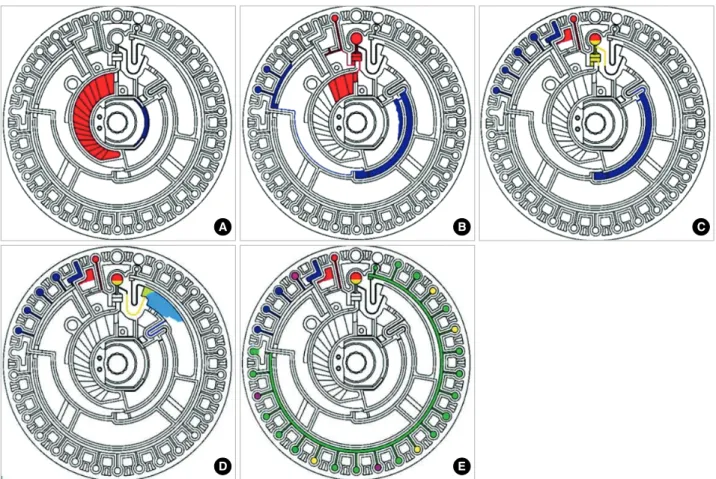
Fig. 1. Measuring sequence of Piccolo xpress Chemistry Analyzer. (A) Blood sample is applied and diluent container is opened. (B) Dilu- ent and blood sample enter the quality control cuvettes and blood sample enters the centrifugal chamber. (C) Centrifuge is performed.
(D) Centrifuged sample and diluent are mixed. (E) The assay cuvettes are filled and analysis is performed (This schematic diagram was permitted from Abaxis system).
A B
D E
C
위는 Na+110-170 mmol/L, K+1.5-8.5 mmol/ L, Cl-80-135 mmol/L, Ca2+4.0-16.0 mg/dL, tCO25-40 mmol/L, AST 5-2,000 U/L, ALT 5-2,000 U/L, ALP 5-2,400 U/L, total bilirubin 0.1-30 mg/dL, glucose 10-700 mg/dL, BUN 2- 180 mg/dL, Cr 0.2-20 mg/dL, albumin 1-6.5 g/dL, total protein 2-14 g/dL로 임상적으로 충분한 범위를 포함하고 있다.
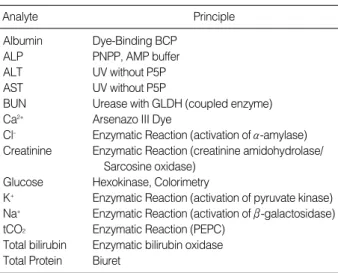
Piccolo xpress Chemistry Analyzer의 검사순서는 100 μL 의 검체를 디스크에 삽입하면 검체의 일부와 반응희석시약의 일 부가 큐벳(cuvette)에서 검체의 용혈, 황달혈, 지질혈 여부를 확 인하며 반응 시약에 대한 적절성 평가가 이루어진다. 그 후, 검체 는 원심분리가 이루어지며, 반응희석시약과 혼합되며, 각 반응 큐 벳으로 이동하여 각 검사 항목에 대하여 측정이 이루어진다(Fig.
1). 각 항목별 측정 원리는 Table 1과 같다. 본 연구에서는 14종 의 Comprehensive Metabolic Panel 디스크를 사용하였다.
2. 정밀도(Precision)
정밀도의 평가는 Clinical and Laboratory Standards Insti- tute (CLSI) EP15-A2에 준하여 정도관리 물질 Liquid Unas- sayed Multiqual�(Bio-Rad Laboratories, Irvine, CA, USA) 을 이용하여 5일간 하루에 2회씩 매 검사마다 2회씩 반복 측정 하여 검사차례내 정밀도와 총 정밀도를 구하였다[3]. Cl-의 경우 상기 정도관리 물질의 저농도가 Piccolo xpress Chemistry Analyzer의 측정가능범위보다 낮았기 때문에 저농도와 중간농 도를 3:2로 혼합한 물질을 제조하여 저농도로 사용하였다. 또한
실제 환자 검체 1개를 임의로 선택하여 10회 반복 측정을 실시 하여 전혈에서의 검사차례내 정밀도를 평가하였다.
3. 직선성(Linearity)
직선성의 평가는 CLSI EP6-A에 준하여 평가하였다[4]. 저농 도로 사용할 물질은 상기 14 종목의 저농도의 환자 검체를 선별 하였으며, AST, ALT, ALP, total bilirubin, tCO2, BUN, Cr의 항목은 고농도의 환자 검체를 선별하였다. Na+, K+, Cl-, Ca2+, glucose, albumin, total protein은 Piccolo xpress Chemistry Analyzer의 측정 상한 값에 이르는 환자 검체를 선별할 수 없 었기 때문에 환자 혈청에 측정 상한 값보다 조금 낮도록 NaCl (Sigma-Adrich Co., St. Louis, MO, USA), KHCO3(Sam- chun pure chemical Co., Ltd., Pyeongtaek, Korea), calci- um gluconate (Daehan Pharm Co., Ltd., Seoul, Korea), D-(+)-glucose (Sigma-Aldrich Co., St. Louis, MO, USA), albumin (Sigma-Aldrich Co., St. Louis, MO, USA)을 적당량 첨가하여 Na+161 mmol/L, Cl-125 mmol/L, K+8.3 mmol/L, Ca2+16.0 mg/dL, glucose 495 mg/dL, albumin 6.2 g/dL, total protein 9.3 g/dL의 고농도 혈청을 제조하였다. 준비된 저농도 고농도의 혈청에 각각 O형 적혈구를 헤마토크릿이 32- 34%가 되도록 혼합하여 전혈을 제조하였다. 그 후 저농도와 고 농도의 전혈을 각각 4:0, 3:1, 2:2, 1:3, 0:4의 비율로 혼합한 5가 지 단계 물질을 제조한 후 각각의 단계에 대하여 TBA 200-FR (Toshiba Co., Tokyo, Japan)으로 농도를 측정하였으며, Pi- ccolo xpress Chemistry Analyzer로 4회씩 반복 측정하여 직 선성의 범위를 확인하였다.
4. 상관성(Method comparison)
상관성의 평가는 CLSI EP9-A2에 준하였다[5]. 기준 장비인 TBA 200-FR로 측정한 결과를 기준으로 144개의 리튬 헤파린 관에 환자 검체를 수집하였다. 같은 날 동시에 채혈된 검체에 대하여 TBA 200-FR에 측정할 검체는 혈청분리관에 운반하였 고, Piccolo xpress Chemistry Analyzer에 측정할 검체는 리 튬 헤파린관으로 운반하여 전혈 상태로 측정하였다.
5. 통계 처리
통계 처리는 Excel 2003 (Microsoft Corporation, Redmond, WA, USA)와 EP evaluator 8 (David G. Rhoads Associates, Abbreviations: ALP, alkaline phosphatase; BUN, blood urea nitrogen;
tCO2, total carbon dioxide.
Analyte Principle
Albumin Dye-Binding BCP
ALP PNPP, AMP buffer
ALT UV without P5P
AST UV without P5P
BUN Urease with GLDH (coupled enzyme) Ca2+ Arsenazo III Dye
Cl- Enzymatic Reaction (activation of α-amylase) Creatinine Enzymatic Reaction (creatinine amidohydrolase/
Sarcosine oxidase) Glucose Hexokinase, Colorimetry
K+ Enzymatic Reaction (activation of pyruvate kinase) Na+ Enzymatic Reaction (activation of β-galactosidase) tCO2 Enzymatic Reaction (PEPC)
Total bilirubin Enzymatic bilirubin oxidase Total Protein Biuret
Table 1. Principles of procedures of Piccolo xpress Chemistry Analyzer
Inc., Kennett square, PA, USA) 프로그램을 이용하였다. 직 선성의 평가에는 선형회귀분석을 이용하였고 회귀방정식과 결 정계수를 구하였다. 상관성의 평가에는 Deming 회귀분석을 시 행하여 회귀선의 기울기, 절편, 상관계수를 구하고 TBA 200- FR을 기준으로 한 오차의 평균과 표준편차를 구하였다.
결 과
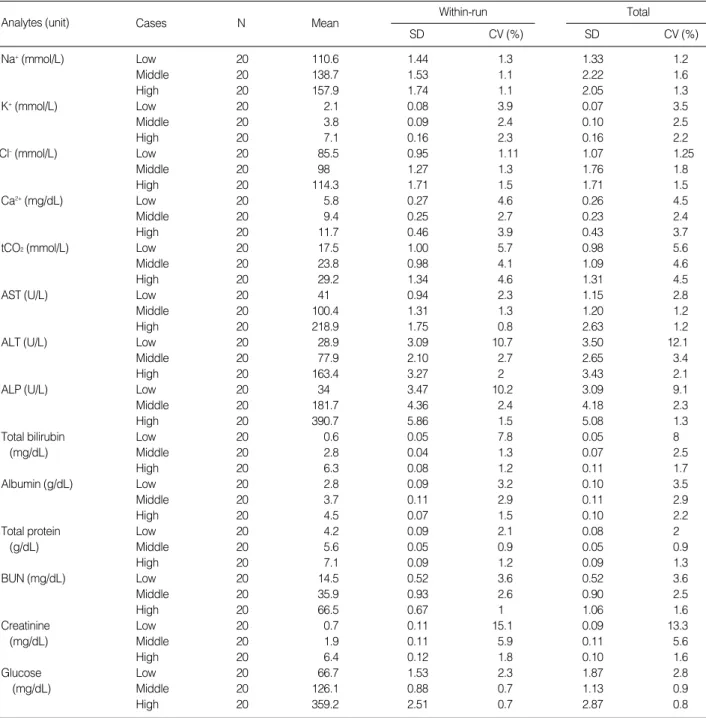
1. 정밀도저농도, 중간농도, 고농도의 정도관리 물질에 대한 Na+, K+, Cl-, Ca2+, tCO2, AST, ALT, ALP, total bilirubin, albumin, total protein, BUN, Cr, glucose 항목의 검사차례내 및 총 변
Analytes (unit) Cases N Mean
Within-run
SD CV (%)
Total
SD CV (%)
Na+(mmol/L) Low 20 110.6 1.44 1.3 1.33 1.2
Middle 20 138.7 1.53 1.1 2.22 1.6
High 20 157.9 1.74 1.1 2.05 1.3
K+(mmol/L) Low 20 2.1 0.08 3.9 0.07 3.5
Middle 20 3.8 0.09 2.4 0.10 2.5
High 20 7.1 0.16 2.3 0.16 2.2
Cl-(mmol/L) Low 20 85.5 0.95 1.11 1.07 1.25
Middle 20 98 1.27 1.3 1.76 1.8
High 20 114.3 1.71 1.5 1.71 1.5
Ca2+(mg/dL) Low 20 5.8 0.27 4.6 0.26 4.5
Middle 20 9.4 0.25 2.7 0.23 2.4
High 20 11.7 0.46 3.9 0.43 3.7
tCO2(mmol/L) Low 20 17.5 1.00 5.7 0.98 5.6
Middle 20 23.8 0.98 4.1 1.09 4.6
High 20 29.2 1.34 4.6 1.31 4.5
AST (U/L) Low 20 41 0.94 2.3 1.15 2.8
Middle 20 100.4 1.31 1.3 1.20 1.2
High 20 218.9 1.75 0.8 2.63 1.2
ALT (U/L) Low 20 28.9 3.09 10.7 3.50 12.1
Middle 20 77.9 2.10 2.7 2.65 3.4
High 20 163.4 3.27 2 3.43 2.1
ALP (U/L) Low 20 34 3.47 10.2 3.09 9.1
Middle 20 181.7 4.36 2.4 4.18 2.3
High 20 390.7 5.86 1.5 5.08 1.3
Total bilirubin Low 20 0.6 0.05 7.8 0.05 8
(mg/dL) Middle 20 2.8 0.04 1.3 0.07 2.5
High 20 6.3 0.08 1.2 0.11 1.7
Albumin (g/dL) Low 20 2.8 0.09 3.2 0.10 3.5
Middle 20 3.7 0.11 2.9 0.11 2.9
High 20 4.5 0.07 1.5 0.10 2.2
Total protein Low 20 4.2 0.09 2.1 0.08 2
(g/dL) Middle 20 5.6 0.05 0.9 0.05 0.9
High 20 7.1 0.09 1.2 0.09 1.3
BUN (mg/dL) Low 20 14.5 0.52 3.6 0.52 3.6
Middle 20 35.9 0.93 2.6 0.90 2.5
High 20 66.5 0.67 1 1.06 1.6
Creatinine Low 20 0.7 0.11 15.1 0.09 13.3
(mg/dL) Middle 20 1.9 0.11 5.9 0.11 5.6
High 20 6.4 0.12 1.8 0.10 1.6
Glucose Low 20 66.7 1.53 2.3 1.87 2.8
(mg/dL) Middle 20 126.1 0.88 0.7 1.13 0.9
High 20 359.2 2.51 0.7 2.87 0.8
Table 2. Precision of the Piccolo xpress Chemistry Analyzer by Liquid Unassayed Multiqual�
Abbreviations: tCO2, total carbon dioxide; ALP, alkaline phosphatase; BUN, blood urea nitrogen.
이계수는 대부분 우수하였다(Table 2). 저농도에서는 tCO2, ALT, ALP, total bilirubin, Cr의 검사차례내 및 총 변이계수 가 5%를 넘었으며, 나머지 9개의 항목에서는 5% 미만이었다.
중간농도에서는 Cr만이 검사차례내 및 총 변이계수가 5% 정도 였으며, 나머지 13개의 항목 모두 5% 미만이었다. 고농도에서
는 모든 항목의 변이계수가 5% 미만으로 우수하였다. 모든 항 목에서의 검사차례내 변이계수와 총 변이계수는 차이가 없었다.
실제 환자 검체를 이용하여 10회 반복 측정하였을 때에도 검사 차례내 변이계수는 정도관리 물질을 사용하였을 때와 비교하여 유의한 차이를 보여주지는 않았다.
Abbreviations: tCO2, total carbon dioxide; ALP, alkaline phosphatase; BUN, blood urea nitrogen.
Analytes Unit Range Slope Intercept R2 Analytes Unit Range Slope Intercept R2
ALP U/L 29.5-827.5 1.000 <0.001 0.9997
Total bilirubin mg/dL 0.6-5.1 1.000 <0.001 0.9995 Glucose g/dL 74.0-495.8 1.000 <0.001 0.9999
BUN g/dL 8.3-51.5 1.000 <0.001 0.9987
Creatinine mg/dL 0.6-8.9 1.000 <0.001 0.9988 Albumin mg/dL 3.7-5.7 1.000 <0.001 0.9933 Total protein mg/dL 7.1-9.0 1.000 <0.001 0.9905 Table 3. Linearity of the Piccolo xpress Chemistry Analyzer
Analytes
Percent of samples not
satisfying CLIA requirement�
R
Unit Range Slope
(95% CI)
Intercept (95% CI)
Bias
(Mean±SD) P value* Bias%
(Mean±SD)
CLIA requirement
Na+ mmol/L 110-170 0.977 6.0 2.9±4.0 <0.001 2.1±3.2 Target±4 34.7 0.9355
(0.919-1.036) (-2.1-14.2)
K+ mmol/L 2.9-8.5 0.968 0.19 0.0±0.2 0.198 0.8±5.1 Target±0.5 1.4 0.9874
(0.942-0.993) (0.05-0.33)
Cl- mmol/L 80-133 0.943 4.8 -1.4±2.8 <0.001 -1.3±2.6 Target±5% 4.2 0.9748
(0.907-0.978) (1.0-8.7)
Ca2+ mg/dL 6.4-16.0 0.955 0.75 0.3±0.5 <0.001 3.4±5.5 Target±1.0 3.5 0.9879
(0.930-0.980) (0.49-1.01)
tCO2 mmol/L 10-37 0.696 9.4 2.3±3.5 <0.001 11.9±16.5 NA NA 0.6534
(0.592-0.799) (7.0-11.9)
AST U/L 16-269 0.889 11.8 8.0±5.1 <0.001 41.9±28.2 Target±20% 10.5 0.9966
(0.877-0.902) (11.2-12.4)
ALT U/L 8-560 0.846 11.2 5.5±10.9 <0.001 47.6±56.1 Target±20% 42.7 0.9965
(0.834-0.858) (10.4-12.1)
ALP U/L 30-601 0.798 5.4 -19.4±25.4 <0.001 -13.4±7.0 Target±30% 0 0.9960
(0.786-0.810) (3.4-7.4)
Total mg/dL 0.4-13.4 0.902 0.17 0.1±0.23 0.006 19.5±26.8 Target±0.4 or 1.4 0.9973
bilirubin (0.891-0.913) (0.15-0.20) ±20% (greater)
Glucose g/dL 44-451 0.938 -0.5 -7.9±9.4 <0.001 -1.9±58.2 Target±6 or 25.0 0.9905
(0.916-0.960) (-3.5-2.5) ±10% (greater)
BUN g/dL 5-101 0.982 -0.9 -1.3±1.4 <0.001 -6.3±11.8 Target±2 or 14.7 0.9963
(0.968-0.997) (-1.3~-0.6) ±9% (greater)
Creatinine mg/dL 0.2-10.8 1.045 -0.26 -0.2±0.2 <0.001 -21.1±15.9 Target±0.3 or 2.2 0.9978
(1.033-1.057) (-0.28~-0.23) ±15% (greater)
Albumin mg/dL 1.6-4.9 1.058 -0.61 -0.4±0.2 <0.001 -10.1±6.9 Target±10% 3.5 0.9646 (1.011-1.105) (-0.80~-0.42)
Total mg/dL 4.3-9.5 1.080 -0.34 0.2±0.3 <0.001 3.0±4.0 Target±10% 2.8 0.9520
protein (1.024-1.136) (-0.72-0.04)
Table 4. Correlations between Piccolo xpress Chemistry Analyzer and TBA 200-FR
*P values were determined by using the paired t-test. �Percentage of the samples which does not satisfy CLIA requirement derived from the regres- sion equation.
Abbreviations: tCO2, total carbon dioxide; ALP, alkaline phosphatase; BUN, blood urea nitrogen.
Na+ mmol/L 132.2-162.3 1.000 <0.001 0.9900 K+ mmol/L 4.3-8.3 1.000 <0.001 0.9821 Cl- mmol/L 101.3-123.0 1.000 <0.001 0.9759 Ca2+ mg/dL 9.3-14.8 1.000 <0.001 0.9955 tCO2 mmol/L 19.3-30.5 1.000 <0.001 0.9829 AST U/L 25.8-1,093.3 1.000 <0.001 0.9998 ALT U/L 21.0-1,931.8 1.000 <0.001 0.9999
2. 직선성
상기 14 항목은 임상검체에서 흔하게 측정되는 범위에서 대 체적으로 만족할만한 직선성을 나타냈다(Table 3). 결정계수는 K+의 r2=0.98, Cl-의 r2=0.98, tCO2의 r2=0.98인 것을 제외하 고 11항목 모두의 r2=0.99 이상이었다.
3. 상관성
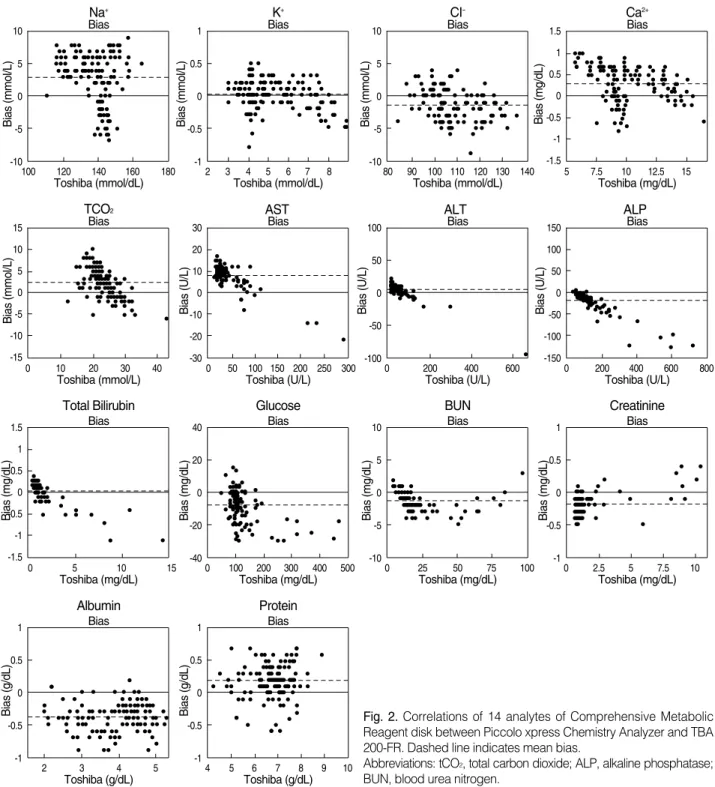
Piccolo xpress Chemistry Analyzer와 TBA 200-FR과의 상관성 평가 결과 Na+과 tCO2를 제외하고 12개 항목의 상관계 수가 모두 0.95 이상이었다(Table 4, Fig. 2). Na+과 tCO2의 상 관계수는 각각 0.94, 0.65이었다. 14개 항목의 회귀곡선의 기
Fig. 2. Correlations of 14 analytes of Comprehensive Metabolic Reagent disk between Piccolo xpress Chemistry Analyzer and TBA 200-FR. Dashed line indicates mean bias.
Abbreviations: tCO2, total carbon dioxide; ALP, alkaline phosphatase;
BUN, blood urea nitrogen.
10
5
0
-5
-10
100 120 140 160 180
Toshiba (mmol/dL) Na+
TCO2
Total Bilirubin Glucose BUN Creatinine
AST ALT ALP
K+ CI- Ca2+
Bias 1
0.5
0
-0.5
-1
2 3 4 5 6 7 8
Toshiba (mmol/dL)
Bias 10
5
0
-5
-10
80 90 100 110 120 130 140 Toshiba (mmol/dL)
Bias 1.5
1 0.5 0 -0.5 -1 -1.5
5 7.5 10 12.5 15
Toshiba (mg/dL) Bias
Bias (mmol/L)
15 10 5 0 -5 -10 -15
0 10 20 30 40
Toshiba (mmol/L) Bias
Bias (U/L)
30 20 10 0 -10 -20 -30
0 50 100 150 200 250 300 Toshiba (U/L)
Bias
Bias (U/L)
100
50
0
-50
-1000 200 400 600
Toshiba (U/L) Bias
Bias (U/L)
150 100 50 0 -50 -100 -150
0 200 400 600 800
Toshiba (U/L) Bias
Bias (mg/dL)
1.5 1 0.5 0 -0.5 -1 -1.5
0 5 10 15
Toshiba (mg/dL) Bias
Bias (mg/dL)
40
20
0
-20
-400 100 200 300 400 500 Toshiba (mg/dL)
Bias
Bias (mg/dL)
10
5
0
-5
-100 25 50 75 100
Toshiba (mg/dL) Bias
Bias (mg/dL)
1
0.5
0
-0.5
-10 2.5 5 7.5 10
Toshiba (mg/dL) Bias
Albumin Protein
Bias (g/dL)
1
0.5
0
-0.5
-1 2 3 4 5
Toshiba (g/dL) Bias
Bias (g/dL)
1
0.5
0
-0.5
-14 5 6 7 8 9 10
Toshiba (g/dL) Bias
Bias (mmol/L) Bias (mmol/L) Bias (mmol/L) Bias (mg/dL)
울기는 0.70에서 1.08이었으며, 평균 오차와 그 통계적 의미는 Table 4와 같았다.
고 찰
전혈을 이용한 현장검사를 이용하면 임상 진료진이 응급상황 에서 빠른 결과를 도출할 수 있으므로 즉각적인 판단과 치료에 도움이 된다[6]. 특히 응급상황에서 검체 운반 시간과 검체가 바 뀌는 등의 검사전오류를 최소화할 수 있다. 대부분의 현장검사 장비들이 소량의 검체로도 검사가 가능하기 때문에 환자의 혈액 을 낭비하지 않는 점에도 도움이 된다[7]. 현장검사 기기의 장점 들로 인하여 응급실, 중환자실, 수술실, 외래 진료실, 가정 등에 서 혈액가스분석기, 임신반응검사키트, 휴대용 혈당측정기, 심 장효소검사, 감염진단 기기의 사용이 증가하는 추세이다[1]. 특 히 가장 기본이 되는 화학검사 결과는 병원에 도착하기 전의 구 급차 혹은 야외 진료소에서 환자의 응급한 정도를 구별하는데 크게 기여할 수 있다[8].
Piccolo xpress Chemistry Analyzer의 분석능력 평가 결과, 정도관리 물질을 이용한 정밀도 평가의 경우 낮은 농도에서의 tCO2, ALT, ALP, total bilirubin, Cr, 중간농도의 Cr을 제외 한 모든 항목의 검사차례내 및 총 변이계수가 5% 미만이었다. 각 검사 항목 별 정밀도 변이계수의 목표 값은 저농도와 중간농도, 고농도에서의 값을 각각 모두 설정할 수는 없었으나 Na+1.3- 1.4%, K+2.2-3.7%, Cl-1.3-1.6%, Ca2+0.81-0.86%, tCO2
3.2-4.0%, AST 6.0%, ALT 10.3-12.7%, ALP 3.2%, total bilirubin 6.0-10.5%, glucose 2.7-3.2%, BUN 6.2%, Cr 14.0- 15.4%, albumin 3.5-3.7%, total protein 2.1-2.9%로 설정하 였다[9-11]. 이에 따라서 각 항목을 평가해보면, 저농도, 중간농 도, 고농도에서 Na+, K+, Cl-, AST, ALT, total bilirubin, glu- cose, BUN, Cr, albumin, total protein의 11가지 항목에서 정밀도 변이계수가 목표 값 내에 있었다. 그러나 Ca2+의 변이계 수가 2.7-4.6%, tCO24.1-5.7%, ALP의 저농도에서 변이계수 가 10.2%로 정밀도 변이계수의 목표 값보다 약간 높았기 때문에 임상에서 적용 시 주의가 필요할 것이다. 정밀도 변이계수의 목 표 값으로 설정에는 포함되었으나 저농도에서 15.1%의 변이계 수를 보인 Cr의 경우 본 기기의 검사법(creatinine amiodohy- drolase/sarcosine oxidase 반응 후 생성된 H2O2을 peroxi- dase로 dye를 측정)과 유사한(creatinine amiodohydrolase/
sarcosine oxidase 반응 후 생성된 H2O2을 전극에서 전압을 측정) 현장검사기기로 측정한 결과 총 변이계수가 저농도에서 13.8%, 고농도에서 9.5%이었다는 보고가 있다[6]. 또 다른 현장
검사기기의 연구에서도 Cr의 변이계수는 4개의 연구센터에서 측정한 결과 총 변이계수가 4.7-9.4%이었다는 보고가 있다[12].
Cr의 경우 임상적으로 문제가 되는 경우는 대부분 높은 농도이 고 선별검사를 위해서 주로 사용한다면 실제 사용하는 데에는 큰 문제는 없을 것으로 생각된다. 환자의 전혈을 이용하여 10회 반복 측정한 정밀도 평가에서도 정도관리 물질을 이용하여 측정 한 결과와 거의 차이가 없었다. Cr의 경우에 변이계수가 19.6%
이었으나 이는 농도가 낮기 때문으로 평균은 0.58 mg/dL, 표 준편차는 0.11 mg/dL이었다. 직선성 평가에서 14항목 모두에 서 넓은 측정범위에서 결정계수(R2)가 0.98 이상으로 우수하였 다. 특히 K+, Cl-, tCO2를 제외한 11가지 항목에서는 모두 결정 계수가 0.99 이상으로 매우 우수하였다.
또한 중앙검사실의 TBA 200-FR과의 비교 평가에서 Na+, tCO2를 제외한 12가지 항목에서 상관계수가 모두 0.95 이상으 로 높은 상관성을 보여주었다. 상관계수에 대하여 Zady의 평가 기준에 따르면, tCO2의 항목은 moderate correlation, 나머지 13항목은 very high correlation으로 분류할 수 있었다[13]. 또 한 K+항목을 제외한 13항목에서 유의확률이 <0.01로 유의한 관계를 보였다. Na+과 tCO2의 항목에서 상관계수가 0.94와 0.65 로 낮은 이유로는 중앙검사실의 방법과 측정 원리가 다르거나 측정한 값의 범위가 좁기 때문일 것으로 생각된다. 각 항목을 회 귀방정식을 구한 결과에 맞추어 값을 변경한 후, CLIA에서 요 구하는 수행능에 맞춰 평가한 결과 Na+, AST, ALT, glucose, BUN의 경우 CLIA의 요구조건에 부합하지 않는 검체가 10%
이상인 점은 임상에서의 사용 시에 주의가 필요할 것으로 생각 된다[14].
본 연구에서 사용한 장비는 임상에서 가장 흔하게 의뢰하는 검사들을 패널 디스크로 구성하여 동시에 여러 항목을 측정할 수 있는 장점이 있다. 특히 소량의 검체를 사용하기 때문에 상대적 으로 혈액량이 적고 혈액을 채취하기 어려운 신생아 검사에서 유 용하게 사용할 수 있다. 신생아의 소량의 검체로 검사가 가능한 장비로는 i-STAT (i-STAT Corporation, Princeton, NJ, USA), Stat Profile Critical Care Xpress analyzer (STP CCX; Nova Biomedical, Waltham, MA, USA) 등이 있으나 검사 가능한 화학검사 항목이 본 장비보다 많지 않다[15, 16]. 본 장비에서 EDTA, 헤파린 나트륨, 구연산 등의 항응고제는 Na+, K+, Ca2+
의 결과에 영향을 미치기 때문에 각 패널에 포함된 검사항목을 고려하여 항응고제를 선택해야 한다. 전혈을 이용한 검사에서 미국식품의약국에서 검사실 밖에서도 측정 가능한 POCT 장비 용으로 승인 받은 항응고제가 리튬 헤파린인데 상기 검사항목 들에 대한 영향을 최소화시키기 위한 것으로 생각된다. 국내에
서 리튬 헤파린을 항응고제로 사용하는 기관이 많지 않기 때문 에 EDTA 검체를 사용하는 것을 고려해볼 수 있다. 저자들이 예 비 실험한 바에 의하면 AST, ALT, albumin, total protein, BUN, Cr, glucose은 차이가 5% 미만이었다. 그러나 Na+, K+ 에서는 평균 19.1 mmol/L, 2.3 mmol/L 이상으로 일관되게 높 게 측정되었고, Ca2+, ALP에서는 거의 대부분의 검체에서 검출 한계 미만으로 측정되었다. Ca2+이 낮게 측정되는 것은 EDTA 의 킬레이트 효과로 쉽게 예측할 수 있고, K+이 높게 측정되는 것도 EDTA가 칼륨염의 형태로 첨가되어 있기 때문으로 생각된 다. 그리고 EDTA는 금속 이온을 킬레이션하여 여러 효소에 억 제제로 작용할 수 있음이 알려져 있는데, ALP에도 역시 억제작 용을 해 그 측정값을 떨어뜨리는 것으로 알려져 있다[17]. Na+이 높게 측정되는 원인은 명확하지 않으며 이에 관해서는 좀 더 연 구가 필요할 것으로 생각된다. 이런 결과들로 보아, 임상 현장에 서 위의 항목들을 제외한 10항목 중에서만 필요한 검사 항목이 있을 경우, EDTA 채혈관으로도 무리 없이 검사를 수행할 수 있 을 것으로 보인다. 정맥혈뿐만 아니라 모세혈관 혈액도 100 μL 이상을 채혈할 수 있으면 측정이 가능한데 최근에 출시되는 대 부분의 혈당측정기에서 10 μL 이하의 혈액을 채취하므로 바늘 형태의 천자 도구보다는 란셋 형태의 천자 도구를 사용하는 것 을 고려해볼 수 있으며 이러한 접근법의 가능성에 관한 검증이 필요하다.
내부정도관리는 적절한 정도관리물질을 사용할 수 있으며 검 사실 밖에서도 측정 가능한 POCT 장비용으로 사용할 경우에는 최소 30일 이내에 한 번, 검사실 환경에서 사용할 경우에는 검 사실의 방침에 따라 시행하도록 권장하고 있다. 장비의 기본적 인 화학적, 광학적, 전자적인 기능은 매 검사가 시작될 때에 자 동으로 확인하는 intelligent quality control (iQC) 기능이 내 장되어 있으므로 별도의 관리가 필요 없기 때문에 검사실 밖에 서도 유용하게 사용할 수 있다.
Piccolo xpress Chemistry Analyzer는 정밀도, 방법 간 비 교, 직선성 평가에서 대체적으로 우수한 성능을 보였다. 100 μL 의 소량의 전혈을 이용하여 원심분리할 필요가 없이 12분 이내 의 빠르고 신뢰성 있는 14종의 화학 분석 결과를 제공함으로써 이동식 진료실, 응급 후송차, 군대의 야전 진료소와 많은 양의 채혈이 어려운 소아 환자 검사 등에서 유용할 것으로 생각한다.
요 약
배경 : 현장검사는 신속하고 간편하여 환자의 진단과 치료효 과 판정에 빠르게 적용할 수 있기 때문에 점차 그 적용범위가 늘
어나고 있다. 저자들은 현장검사 화학분석장비인 Piccolo xpress Chemistry Analyzer (Abaxis, USA)의 성능을 평가하였다.
방법 : Comprehensive Metabolic Reagent 디스크에 100 mcL의 검체를 이용하여 14가지 항목(나트륨, 칼륨, 염소, 칼슘, 총 이산화탄소, AST, ALT, 알칼리인산분해효소, 총 빌리루빈, 혈당, 혈액요소질소, 크레아티닌, 알부민, 총 단백질)을 동시에 측정하였다. 검사차례내 정밀도와 총 정밀도는 CLSI EP15-A 에 준하여 평가하였으며, 직선성은 CLSI EP6-A에 준하여 평 가하였다. 중앙검사실 장비와의 상관성은 144개의 환자 검체를 이용하여 평가하였다.
결과 : 검사차례내 정밀도와 총 정밀도의 변이계수(CV)는 낮 은 농도의 총 이산화탄소, ALT, 알칼리인산분해효소, 총 빌리 루빈, 크레아티닌과 중간농도의 크레아티닌을 제외하고 모두 5% 미만이었다. 14가지 항목의 측정값은 임상 검체에서 흔하게 나타나는 범위에서 직선성을 유지하였다(r2≥0.98). 그러나 나 트륨, AST, ALT, 혈당, 혈액요소질소의 경우 CLIA의 수행능 평가 요구조건에 부합하지 않는 검체가 10% 이상인 점은 임상 환경에서 사용 시 주의가 필요하다.
결론 : Piccolo xpress Chemistry Analyzer는 소량의 전혈 로 짧은 시간에 여러 항목을 측정할 수 있다. 정밀도, 직선성, 중 앙검사실 장비와의 상관성은 수용할 만하였다. Piccolo xpress Chemistry Analyzer는 이동식 진료실, 응급 후송차, 군대의 야전 진료소와 많은 양의 채혈이 어려운 소아 환자 검사 등에서 유용할 것으로 생각한다.
참고문헌
1. Nichols JM. Point of care testing. Clin Lab Med 2007;27:893-908.
2. Min WK. The trend of clinical chemistry. Medical Postgraduates 2003;31:251-4. (민원기. 임상화학의현황. 녹십자의보 2003;31:251-4.) 3. Clinical and Laboratory Standards Institute. User verification of
performance for precision and trueness; Approved guideline-2nd edi. Document EP15-A2. Wayne, PA: Clinical and Laboratory Stan- dards Institute, 2005;25.
4. Clinical and Laboratory Standards Institute. Evaluation of the linear- ity of quantitative measurement procedures: a statistical approach;
Approved guideline. Document EP6-A. Wayne, PA: Clinical and Laboratory Standards Institute, 2003;23.
5. Clinical and Laboratory Standards Institute. Method comparison and bias estimation using patient samples; Approved guideline- 2nd edi. Document EP9-A2. Wayne, PA: Clinical and Laboratory
Standards Institute, 2002;22.
6. Mestric ZF and Perkov S. Comparability of point-of-care whole- blood electrolyte and substrate testing using a Stat Profile Critical Care Xpress analyzer and standard laboratory methods. Clin Chem Lab Med 2006;44:898-903.
7. Drenck NE. Point of care testing in critical care medicine: the clini- cian’s view. Clin Chim Acta 2001;307:3-7.
8. Tortella BJ, Lavery RF, Lavery RF, Siegel JH. Precision, accuracy, and managed care implications of a hand-held whole blood analyzer in the prehospital setting. Clin Chem 1996;106:124-7.
9. Ricos C, Alverez V, Caba F, Garcia-Lario JV, Hernandez A, Jiminez CV, et al. Current databases on biologic variation: pros, cons, and progress. Scand J Clin Lab Invest 1999;59:491-500.
10. Barrett AE, Cameron SJ, Fraser CG, Penberthy LA, Shand KL. A clin- ical view of analytical goals in clinical biochemistry. J Clin Pathol 1979;32:893-6.
11. Harding PJ and Fraser CG. Biological variation of blood acidbase status: consequences for analytical goal-setting and interpretation of results. Clin Chem 1987;33:1416-8.
12. Kost GJ, VU HT, Inn M, DuPlantier R, Fleisher M, Kroll MH, et al.
Multicenter study of whole-blood creatinine, total carbon dioxide content, and chemistry profiling for laboratory and point-of care testing in critical care in the United States. Crit Care Med 2000;28:
2379-89.
13. Zady FM. Z-STATS 12: correlation and simple least squares regres- sion. [Westgard Website]. Available at www.westgard.com/les- son42.htm. Accessed December 6, 2006.
14. Westgard J. Charts of operational process specifications (‘‘OPSpecs charts’’) for assessing the precision, accuracy, and quality control needed to satisfy proficiency testing performance criteria. Clin Chem 1992;38:1226-33.
15. Yi SG, Lee SY, Kim JW. Evaluation of the i-STAT point-of-care test- ing analyzer. Korean J Lab Med 2002;22:304-11. (이상곤, 이수연, 김종 원. 현장검사기기i-STAT의평가. 대한진단검사의학회지2002;22:304-11.) 16. Vanavanan S and Chittamma A. Performance of a multi-profile crit-
ical care testing analyzer. Clin Chem Lab Med 2008;46:9-14.
17. Burtis CA, Ashwood ER, et al. eds. Tietz Textbook of Clinical Chem- istry and Molecular Diagnostics. 4th ed. Missouri: Elsevier Saun- ders, 2006:47.