DOI : http://dx.doi.org/10.5394/KINPR.2016.40.5.305
Evaluation of Logistics Infrastructure of Container Terminals in Northern Vietnam
Minh Duc Nguyen *․†Sung-June Kim․Jung Sik Jeong**
* Graduate school of Mokpo National Maritime University, Mokpo 58628, Korea
†Assistant Professor of Mokpo National Maritime University, Mokpo 58628, Korea
** Professor of Mokpo National Maritime University, Mokpo 58628, Korea
Abstract: The sea-port in Northern Vietnam accounts for around one third of the total country’s cargo throughput and for many decades has been playing an important role in the logistics system of the country. 11 container terminals currently operate in Northern Vietnam, concentrating in Haiphong city and Quang Ninh province. Despite the increasing demand, the competition among these container terminals has become increasingly more critical. In recent years, massive investments from both government and operators have been made to improve the capability of the local sea-port’s logistics infrastructure. This critically needed comprehensive research evaluates the impact of the current logistics infrastructure condition on the competitiveness of terminals and quantitatively compares the competencies of these terminals. In order to meet such requirements, the paper first summarizes the indicators of the logistics infrastructures of the sea ports before developing and testing hypotheses to reveal the correlation between the given factors and the annual throughput of container terminals in the region. Factor analysis will then be applied to score the logistics infrastructure competency of each container terminal. A significant gap between logistics infrastructures among all container terminals was not observed and the competitiveness between container terminals is mostly driven by traditional activities including cargo handling and storage. According to the results, strategic thinking will be needed to contribute to related organizations for better decisions in investment, management, and operation.
Key words: Factor analysis, logistics infrastructure, container terminals, Northern Vietnam
* [email protected] 061)240-7352
†Corresponding Author : [email protected] 061)240-7352
** [email protected] 061)240-7173
Note) This paper was presented as the title of “Factor analysis on logistics infrastructure of container terminals in Northern Vietnam” in KINPR Annual Spring Conference Proceeding(BEXCO, Busan, May 19-20, 2016, pp.141-142).
1. Introduction
In recent years, the Northern Vietnam and Hochiminh city are the two largest sea-ports in Vietnam. The annual throughput of those ports together accounts for 97% of the national wide figure (Vietnam Port Association, 2016).
Although throughput capacity of Hochiminh city port in 2014 was only 1/4 of Hongkong’s and 1/6 of Singapore’s while Northern Vietnam’s capacity was around half of that of Hochiminh’s, annual throughput for these ports has seen remarkable growth (CBRE Research, 2016). Sea-ports in Northern Vietnam concentrate in two neighbouring provinces, Haiphong and Quangninh. In terms of containerized cargo, the container throughput of the area in 2014 rocketed by 550% compared with the figure in 2005 (Nguyen & Kim, 2015). There are 11 container terminals in Northern Vietnam, 9 of them are located in Haiphong city and the others are at Quangninh province. Five out of the 11 are under the control of Vietnam National Lines (Vinalines), the leading national corporation in the field of
maritime industry. Despite the increasing demand, the competition among the terminals has become more and more critical and Vinalines has lost its domination.
There might be many approaches to improve the competitiveness of sea-ports but an important one is to improve ports’ logistics advantages. Logistics infrastructure is an important part of logistics advantages, which can reflect not only the potential ability of terminals to satisfy customers but also attractiveness to logistics service providers to set up their business. In recent years, both of terminals’ operators in the area and the local government have presented their attention to logistics infrastructure with increasing investment. However, the current efforts on logistics infrastructure seem to be far from meeting the demand and research which can disclose problems as well as contribute to strategic thinking are, therefore, highly required.
The paper is going to evaluate the logistics infrastructure of container terminals in the Northern Vietnam. Firstly, hypotheses are made and tested in order to present the
Research
Number of port logistics competitivenes
s indicators
Port logistics infrastructures indicators
Tongzon (2005) 8 depth of navigational channel, land side accessibility
Ren et al.(2007) 12
number of berths, number of handling equipment, library field capacity, number of operating vessels
Xiao (2011) 17 number of berth, highway mileage
Lei (2011) 16
number of berth, channel depth, number of handling equipment, yard area, port information platform, international container liner route density
correlation between terminals’ throughput and usage of logistics infrastructure. The factors analysis is then applied to identify factors for the evaluation and evaluable the logistics infrastructure using the identified factors. By reviewing previous researches related in the topic of port competition and considering the real condition in Northern Vietnam, a set of factors are composed to do the analysis.
Factor analysis will be consequently applied to rank the level of the given terminals’ logistics infrastructure. The analysis results reveal not only the gap between local terminals in term of logistics infrastructure but also the terminals’ current operational situation in practice. For the conclusion, strategic thinking of terminals’ logistics competitiveness will be contributed to related organizations.
2. Port Logistics System in Northern Vietnam
2.1 Port Logistics System
Port in the future will not only provide traditional services to port users, but are expected to increase their provision of profitable nontraditional port activities such as tourist, re-creational and logistics activities (Talley, 2009).
Lee and Song (2015) described port logistics system including voyage support system, port entry system, stevedore system, transit system, storage system, inland transport connecting system and port information system.
Fig. 1 Port logistics system
Source: Lee & Song(2015)
Port logistics infrastructure, therefore, can be defined as all infrastructure that are employed in the system and to perform logistics activities in port area. They are included facilities to do not only traditional works as accommodating ships, handling cargoes and storage but also multi-modal transport connection and other value-added services.
In previous researches related to port logistics competitiveness, number of scholars proposed different logistics indicators. This can be summarized in Table 1.
Table 1 Literature review of port’s logistics infrastructure indicators
2.2 General Situation of Port Logistics Infrastructure in Northern Vietnam
In case of Northern Vietnam’s port, in recent years, series of investment have been made to improve the local logistics infrastructure by both government and operators.
The Catbi airport in Haiphong city which is only 10 kms far from the closest terminals has been upgraded to be an international one. The national road connecting Haiphong and Quangninh is also improved so that the time consumed to transport by road from Hanoi to these provinces is reduced from 2.5 hours to 1.5 hours and from 3.0 hours to 2.0 hours, respectively. Major facilities of all terminals in the area are also increased double or triple in the period of 2005~2014 (Nguyen & Kim, 2015). Information technologies are also widely installed and applied to all terminals.
However, limits are still remarkably. Nguyen (2016) indicated that Vietnamese ports in lack of deep-water terminals, specialized equipment and long quays to receive ships of more than 50,000 DWTs. Infrastructure hardwares and softwares for the development of logistics services are still limited. There are currently two terminals (Chuave in Haiphong and CICT in Quangninh) which have railway
Group Factors Explanation
Ship accommo-
dating &
Cargo handing
Number of berth Number of active berth Berth length Active length of berth Berth maximum draft Maximum depth of berth
Container Cranes Number of container cranes
Storage
Container Yard (CY) Container Yard area Container Freight
Station (CFS) CFS area
Transport connection
Rail connection Number of direct rail connection Air connection Number of local airport Road connection Time consumed to transport to Hanoi
No of berth
Berth
length Draft Cranes CY CFS Road Rail Air
Th'put
0.547 0.407 -0.468 0.738 0.650 0.712 -0.576 -0.058 0.576
connection. The airport located in Haiphong city brings advantages for Haiphong’s terminals only. Information technologies are not used synchronously in all operational activities and far from catching up with international leading ports.
3. Hypotheses
In this paper, the 11 container terminals’ logistics infrastructure in the area will be compared and evaluated.
The scope can be described as follows:
Ÿ Voyage supporting system and port entry system are not included because all terminals locate in the same port area.
Ÿ Information system is not considered due to lack of synchronous application in every terminals and a comprehensive measurement to evaluate.
The logistics infrastructure factors used to analyze in the paper are concluded in Table 2.
Table 2 Terminals logistics infrastructure factors
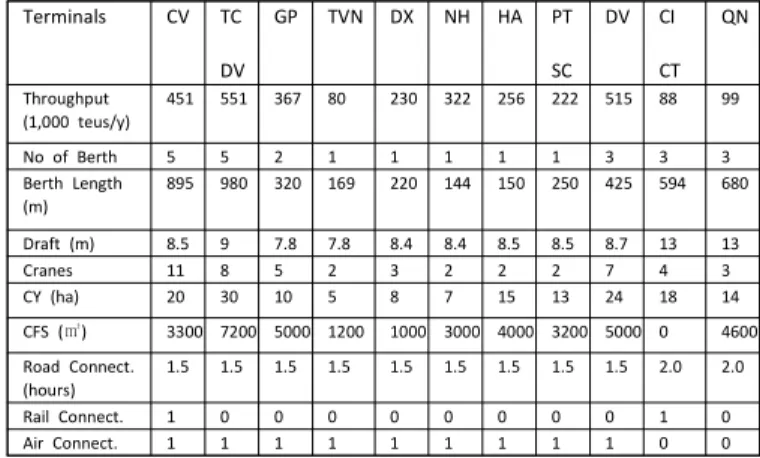
The collected data from the 11 container terminals in the Northern Vietnam are detailed in Table 3.
Some hypotheses are made as follows:
Ÿ Hypothesis 1: Terminals’ annual throughput has strong correlation with ships accommodating and cargo handling infrastructure
Ÿ Hypothesis 2: Terminal’s annual throughput has strong correlation with storage infrastructure.
Ÿ Hypothesis 3: Terminal’s annual throughput has strong correlation with transport connection.
Table 3 Statistics database of container terminals in Northern Vietnam
Terminals CV TC DV
GP TVN DX NH HA PT
SC
DV CI CT
QN
Throughput (1,000 teus/y)
451 551 367 80 230 322 256 222 515 88 99
No of Berth 5 5 2 1 1 1 1 1 3 3 3
Berth Length (m)
895 980 320 169 220 144 150 250 425 594 680
Draft (m) 8.5 9 7.8 7.8 8.4 8.4 8.5 8.5 8.7 13 13
Cranes 11 8 5 2 3 2 2 2 7 4 3
CY (ha) 20 30 10 5 8 7 15 13 24 18 14
CFS (㎡) 3300 7200 5000 1200 1000 3000 4000 3200 5000 0 4600 Road Connect.
(hours)
1.5 1.5 1.5 1.5 1.5 1.5 1.5 1.5 1.5 2.0 2.0
Rail Connect. 1 0 0 0 0 0 0 0 0 1 0
Air Connect. 1 1 1 1 1 1 1 1 1 0 0
CV: Chuave, TCDV: Tancang Dinhvu, GP: Green port, TVN: Transvina, DX: Doanxa, NH: Namhai, HA: Haian, PTSC: PetroVietnam Technical Services Corporation, DV:
Dinhvu, CICT: Cailan International Container Terminal, QN: Quangninh
The hypotheses are tested by Data Analysis in Microsoft Excel. The results are presented in Table 4.
Table 4 Correlation between terminals’ annual throughput and logistics infrastructure factors
Number of cranes, capacity of CFS, CY are the factors that have the most correlation to annual container throughput in terminals in Northern Vietnam. Maximum draft, road and rail connection are the ones that have no correlation while the others have medium correlation to the throughput. Consequently, the hypothesis 1,2,3 can be concluded as follows:
Ÿ Hypothesis 1’s conclusion: Ship accommodating &
cargo handling infrastructures have medium correlation to annual throughput.
Ÿ Hypothesis 2’s conclusion: Storage infrastructure has strong correlation to annual throughput.
Ÿ Hypothesis 3’s conclusion: Transport connection have very weak correlation to annual throughput.
4. Factor Analysis
4.1 Methodology
Factor analysis is a statistical method deployed to describe variability among observed variables. Factor analysis uses mathematical procedures for the simplification of interrelated measures to discover patterns in a set of variables (Child, 2006).
Suppose we have a set of m observed variables v1, v2, ...
vm. These varibales can be original or normalized data. f1, f2, ... fp are unobserved variables (m >p). e1, e2, ... em are independent distributed error terms with zero mean and finite variance. Factor analysis model is (Lochmuller, 1998):
v1 = a11f1 + a12f2 +...+ a1pfp + e1
v2 = a12f1 + a22f2 +...+ a2pfp + e2
...
vm =am1f1 + am2f2 +....+ ampfp + em
f1, f2, ... fp are called common factors which are independent and their variances are 1. aij are called factor loading which denote the coefficient between the ith variable and the jth factor. e1, e2, ... em are called special factors which are independent and disregarded in the results of factor analysis.
In this paper, the Factor analysis is carried out in the process as follows:
Ÿ To identify suitable indicators: in the Section 3, 9 indicators are listed, however, not all of them have strong correlation to the annual throughput. As the result, indicators that do not play important role in current competitiveness in this area will be removed.
The considered indicators, therefore, are: (1) number of berth, (2) berth length, (3) number of cranes, (4) CY area, (5) CFS area, (6) Air connection. The indicators’
value will be used as variables in the analysis.
Ÿ To normalize variables for equal footing
Ÿ To identify the common factors based on variance and component score coefficient analysis performed on SPSS.
Ÿ To build equation to calculate the Logistics Infrastructure Score (LIS) based on factors listed in previous step and component score coefficient.
Ÿ To calculate the LIS of each container terminal in Northern Vietnam and rank them according to the score.
In this step, the factors’ scores are standardized as:
f’i = (fi - fmin)/(fmax - fmin)
Where: f denotes the factor score, f’ denotes the standardized factor score
4.2 Analysis Result
After normalization variables, the database is solved by SPSS and the Total Variance Explained, Component Matrix and Component Score Coefficient Matrix are presented in Table 5, 6 and 7 respectively.
Table 5 Total Variance Explained
Table 6 Component Matrix
Table 7 Component Score Coefficient Matrix
There are 2 common factors extracted:
Ÿ Common factor 1 (F1): including number of berth, berth length, number of cranes, CY area. This common factor stands for the traditional operation of terminals. This common factor accounts for 63% of variance.
F1 = 0.26v1 + 0.25v2 + 0.23v3 + 0.24v4
Ÿ Common factor 2 (F2): including CFS area and air connection. This common factor stands for leading-edge services that terminals can provide to customers. This common factor accounts for 21% of variance.
F2 = 0.43v5 + 0.73v6
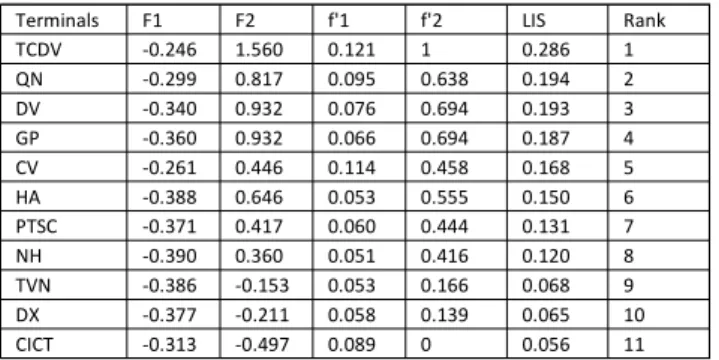
The Logistics Infrastructure Score can be calculated as follows: LIS = 0.63F1 + 0.21F2
Terminals F1 F2 f'1 f'2 LIS Rank
TCDV -0.246 1.560 0.121 1 0.286 1
QN -0.299 0.817 0.095 0.638 0.194 2
DV -0.340 0.932 0.076 0.694 0.193 3
GP -0.360 0.932 0.066 0.694 0.187 4
CV -0.261 0.446 0.114 0.458 0.168 5
HA -0.388 0.646 0.053 0.555 0.150 6
PTSC -0.371 0.417 0.060 0.444 0.131 7
NH -0.390 0.360 0.051 0.416 0.120 8
TVN -0.386 -0.153 0.053 0.166 0.068 9
DX -0.377 -0.211 0.058 0.139 0.065 10
CICT -0.313 -0.497 0.089 0 0.056 11
Researches Method Conclusions
Nguyen &
Kim (2015)
Data Envelopment
Analysis
Ÿ 2 terminals in Quangninh province: CICT &
Quangninh have very low rank of efficiency
Ÿ only 2 Vinalines’ terminals are relative efficient:
Dinhvu, Doanxa
Ÿ Greenport’s efficiency is ranked very high compared with others in the area
Nguyen et al (2015)
Hierarchical cluster analysis
Ÿ Dinhvu and TC Dinhvu are classified in the group that dominate the market by advantages of location, infrastruc- ture and productivity
The evaluation scores are presented in Table 8.
Table 8 Evaluation scores
CV: Chuave, TCDV: Tancang Dinhvu, GP: Green port, TVN: Transvina, DX: Doanxa, NH: Namhai, HA: Haian, PTSC: PetroVietnam Technical Services Corporation, DV:
Dinhvu, CICT: Cailan International Container Terminal, QN: Quangninh
5. Discussion
In previous researches about competitiveness of container terminals in Northern Vietnam, some conclusions are summarized in Table 9.
Table 9 Conclusions from previous research of
competitiveness between container terminals in Northern Vietnam
As can be seen from the hypotheses’ conclusions and factor analysis’ results, the authors can reveal some real condition of container terminals’ logistics infrastructure in Northern Vietnam:
Ÿ There is not a big gap between different terminals in terms of logistics infrastructure. Only Tancang Dinhvu shows the difference.
Ÿ The competency of terminals in providing traditional services including accommodating ships, handling cargo
and storage play an important role in terminals' competitiveness.
Ÿ The terminals’ capacity in providing leading-edge services including cargo breaking/ consolidation in CFS (container freight station) or multimodal transport connection does not impact considerably to terminals’
market share.
Ÿ 4/5 terminals ranked on top due to the Logistics Infrastructure Score are under the control of Vinalines.
The only two terminals that have railway connection are also Vinalines’ terminals. However, DoanXa and CaiLan International Container Terminal , the two others terminals of Vinalines, are ranked at the lowest position.
Strategic suggestions can be contributed to different related organizations as follows:
Ÿ To local government: Northen Vietnam’ port is considered as the international gateway to the world and logistics center of the country. More efforts should be made to improve the quality of transport connection to terminals. In the aspect of road connection, bad condition of congestion, high collected toll fee should be solved as soon as possible. The usage of railway should be improved for smooth connection to not only domestic but also China in the North, Laos, Cambodia and Thailand in the West. In terms of management, port logistics investment requires huge amount of finance and a flexible mechanism is always very important.
From all around the world, the success of Port Authority in ports’ management and development has been approved. Vietnam’s sea-ports might apply this mechanism to looking for a boost in performance.
Ÿ To terminals operators: logistics services still do not play an important role in enhancing competitiveness of terminals in the area. Therefore, in order to get the bigger market share, in short term, efforts should be made to increase terminals’ capacity but in long term, investment should focus on the information technologies, infrastructures to support value-added services.
Greenport is under control of Viconship, a Vietnam leading logistics provider. Customers are attracted to the terminals for not only efficient cargo handling and storage but also series of value-added services provided by Viconship. The success of Greenport in port operation is strictly accompanied with their leading logistics services. In addition, all the terminals should co-operate to shape a logistics infrastructure services network which can strengthen the competitiveness of the Northern Vietnam port and attract customers to the
area.
Ÿ To Vinalines: Vinalines is the biggest shareholder in 5 out of 11 container terminals in Northern Vietnam with the percentage of shareholding varies from 51 to 100%.
There are currently two problems that Vinalines is coping with: firstly, the poor operational results in some terminals such as Quangninh and CICT and secondly, lack of finance to invest in infrastructures. Privatization can be an effective way to solve both the problems.
6. Conclusion
The development and evolution of sea-ports in the world can be divided in three generations. The first one performs only cargo handling and storage, the second one presents other value-added services and in the third generation port, activities of production and transportation have linkage to form an international network (ESCAP, 2003). In the paper, hypotheses are made and tested and Factor analysis is carried out. The results show that the Northern Vietnam’s port has not fully reached the 3rd generation. The competitiveness of container terminals in the region focus mainly on the competency of cargo handling and storage.
There is no a big gap between terminals in terms of logistics infrastructures. The competitive advantages of terminals in the area mainly are based on terminals’
capacity and price of services offered. This condition raises number of strategic suggestions to not only local government but also terminals operators and Vinalines.
Future research, therefore, should pay more attention to competitiveness of price charged by terminals and game theory is highly recommended.
References
[1] CBRE research(2016), “Haiphong - Vietnam’s gateway to the world.“
[2] Child, D.(2006), The essential of factor analysis, 3rd edition, New York, NY: Continuum International Publishing Group.
[3] ESCAP(2003), “Commercial Development of Regional Ports as Logistics Centres”, United Nations, New York.
[4] Lee, E. S. & Song, D. W.(2015), Maritime Logistics Value in Knowledge Management, Routledge.
[5] Kim, J. G. & Lee, J. G.(2004), “A Study on the Competitiveness of ASEAN and Korea’ Container Ports in international Logistics Strategies”, Journal of Korean Navigation and Port Research, Vol. 28, No. 3, pp. 177-184.
[6] Lee, H. G.(2003), “Overall Analysis of Competitiveness of Asian Major Ports using the Hybrid Mechanism of FCM and AHP”, Journal of Korean Navigation and Port Research, Vol. 27, No. 2, pp. 185-191.
[7] Lee, M. S., Choi, H. D., Lim, D. S. and Kwak, K. S.(2010),
“A Study on Competitiveness of small ports-Focus on the Ports of Jeollado”, Journal of Korean Navigation and Port Research, Vol. 34, No. 10, pp. 817-821.
[8] Lei, Quanyong(2011), “Research on port logistics competitiveness of Jiangsu coastal based on the international trade”, China Business & Trade, 23: pp.
157-160.
[9] Lochmuller, C. H.(1998), “Introduction to factor analysis”, Critical reviews in analytical chemistry, Vol. 28, No.1, pp.
21-49.
[10] Nguyen, M. D. & Kim, S. J.(2015), “Comparative analysis of container terminals in Northern Vietnam, 2005-2014”, Journal of Navigation and Port Research, Vol. 39, No. 5, pp. 417-422.
[11] Nguyen, M. D., Kim, S. J. and Jeong, J. S.(2015),
“Hierarchical cluster analysis on competitiveness of container terminals in Northern Vietnam”, Journal of Navigation and Port Research, Vol. 40, No. 2, pp. 67-72.
[12] Nguyen, T. T.(2016), “An Investigation of the Vietnamese shipping industry and policy recommendations for profound participation into ASEAN integration”, The Asian Journal of Shipping and Logistics, Vol. 32, No. 2, pp. 81-88.
[13] Ren, W. & Wang, L. and Du, L.(2007), “Research on evaluation method of port logistics competitiveness research”, Market Modernization 112: pp. 146-147.
[14] Talley, Wayne K.(2009), Port Economics, Routledge:
London and New York.
[15] Tongzon, Jose Wuheng(2005), “Port privatization, efficiency and competitiveness: Some empirical evidence from container ports (terminals)”, Transportation Research Part A 39: pp. 405-424.
[16] Xiao, Haihui(2011), “Comparative study of the competitiveness of ports logistics between Pearl River Delta and Yangtze River Delta”, Guangdong University of Business: 4.
[17] Vietnam Port Association’s website:
http://www.vpa.org.vn/, last accessed in June 2016.
Received 13 July 2016 Revised 24 October 2016 Accepted 25 October 2016