http://dx.doi.org/10.7585/kjps.2013.17.4.307 Open Access
307
매실 중 살균제 azoxystrobin과 difenoconazole의 생산단계 잔류허용기준 설정
이동열1·김영진2·박민호3·이승화3·김상곤4·강남준5,6·강규영1,6*
1경상대학교 응용생명과학부(BK21플러스 농생명산업 차세대 인재육성사업단), 2동의과학대학교 동의분석센터,
3국립농산물품질관리원 경남지원, 4경상대학교 식물생명공학연구소, 5경상대학교 원예학과, 6경상대학교 농업생명과학연구원
Establishment of Pre-Harvest Residue Limit (PHRL) of Fungicides Azoxystrobin and Difenoconazole
on Prunus mume fruits
Dong Yeol Lee1, Yeong Jin Kim2, Min Ho Park3, Seung Hwa Lee3, Sang Gon Kim4, Nam Jun Kang5,6 and Kyu Young Kang1,6*
1Divison of Applied Life Science (BK21+ Program), Gyeongsang National University, Jinju 660-701, Korea
2Dong-Eui Institute of Technology Dong-Eui Analysis Center, Dong-Eui Institute of Technology, Busan 614-715, Korea
3Gyeongnam Provincial Office, National Agricultural Products Quality Management Service, Busan 611-084, Korea
4Plant Molecular Biology and Biotechnology Research Center, Gyeongsang National University, Jinju 660-701, Korea
5Department of Horticulture, Gyeongsang National University, Jinju 660-701, Korea
6Institute of Agriculture and Life Science, Gyeongsang National University, Jinju 660-701, Korea (Received on October 23, 2013. Revised on November 11, 2013. Accepted on November 20, 2013)
Abstract This study was carried out to investigate the residual characteristics of fungicide azoxystrobin and difenoconazole in Prunus mume fruits, and establish pre-harvest residue limits (PHRL) based on dissipation and biological half-lives of fungicide residues. The fungicides were sprayed onto the crop at recommended dosage once and 3 times in 7 days interval, respectively. The samples were harvested at 0, 1, 2, 4, 6, 8, 10, 12 and 14 days after treatment. These residual pesticides were extracted with QuEChERS method, clean-up with NH2 SPE cartridge, and residues were analyzed by HPLC/DAD and GLC/ECD, respectively. Method quantitative limits (MQL) of azoxystrobin were 0.03 mg kg−1 and of difenoconazole were 0.006 mg kg−1. Average recovery were 93.2± 2.49%, 85.5 ± 1.97% for azoxystrobin at fortification levels at 0.3 and 1.5 mg kg−1, and 100.8± 6.74%, 87.6 ± 9.92% for difenoconazole at fortification levels at 0.06 and 0.3 mg kg−1, respectively. The biological half-lives of azoxystrobin were 5.9 and 5.2 days at recommended dosage once and 3 times in 7 days interval, respectively. The biological half-lives of difenoconazole were 9.3 and 8.0 days at recommended dosage once and 3 times in 7 days interval, respectively. The PHRL of azoxystrobin and difenoconazole were recommended as 5.32 and 1.64 mg kg−1 for 10 days before harvest, respectively.
Key words Biological half-life, Pre-harvest residue limit, Azoxystrobin, Difenoconazole, Prunus mume
서 론
농약은 농산물의 재배에 있어 병, 해충, 잡초의 방제와 생 산량의 증대, 고품질 농산물 생산 및 농작업의 생력화 등을
위한 다양한 용도로 사용되고 있는 현대 농업의 필수적인 농업자재이다(Jeong 등, 2009; Lee 등, 2011).
그러나 이러한 농약은 여러 형태의 유기화학구조를 가지 고 있어 이로운 목적으로 작물에 살포된 후에 환경조건 등 에 의하여 각기 다른 분해 과정을 거치면서 소실되거나 수 계, 토양 및 작물에 잔류되는 경우가 발생한다(Kim 등, 1997; Kim 등, 2009).
농약이 잔류된 농산물이 유통되어 안전성 검사 시 식품의
*Corresponding author
Tel: +82-55-772-1961, Fax: +82-55-772-1969 E-mail: [email protected]
ORIGINAL ARTICLES / RESIDUE
약품안전처에서 고시한 잔류허용기준(Maximum Residue Limit, MRL) 이상으로 농약이 검출되면 부적합 농산물의 폐기처분 조치로 인해 생산자에 큰 경제적 손실이 발생될 수 있고, 부적합 농산물을 소비자가 섭취하였을 시에는 인 체 위해성 문제를 일으킬 수 있는 가능성을 내포하고 있다 (Lee 등, 2012). 이러한 문제점들을 해결하기 위해서는 농산 물에 대한 잔류농약 안전성 검사가 출하 전 생산단계에서 수행되는 것이 효율적이고, 따라서 각각의 농약에 대한 작 물별 MRL과 농산물 재배 시 사용하는 농약의 생물학적 반 감기에 근거한 생산단계 잔류허용기준(Pre-Harvest Residue Limit, PHRL) 설정이 필요할 것이다. 이러한 이유로 1999 년부터 생산단계 농산물의 잔류허용기준 설정연구가 수행되 고 있고, 식품의약품안전처에서는 ‘생산단계 농산물 등의 유해물질 잔류기준’을 고시하고 있다(Ko 등, 2004, Lee 등, 2013).
2013년 4월 현재 매실재배 중 사용되는 농약은 살균제 13개, 살충제 18개, 제초제 1개 상품이 등록되어 있고(한국 작물보호협회, 2013), 매실에는 38성분의 농약에 대하여 농약잔류허용기준(MRL)이 설정되어 있으며, 11성분의 농 약에 대하여 생산단계 잔류허용기준(PHRL)이 고시되어 있 다(식품의약품안전처, 2013).
본 연구는 매실에 등록되어 재배 중 탄저병 방제를 위해 사용되는 살균제인 azoxystrobin과 difenoconazole의 수확 전 잔류량을 예측하기 위하여 시험 농약을 야외포장에 살포 한 후 일정기간 동안의 잔류 특성을 조사하고 생물학적 반
감기를 산출한 후(Park 등, 2005; Yang 등, 1995) 생산단계 잔류허용기준(PHRL) 설정을 위한 기초자료로 활용하고자 수행하였다.
재료 및 방법
시험농약 및 시약
시험농약의 표준품은 Dr. Ehrenstorfer사(독일)로부터 스 트로빌루린계 살균제 azoxystrobin (99.0%)과 트리아졸계 살균제 difenoconazole (98.7%)을 구입하여 사용하였으며, 두 살균제의 화학구조식과 이화학적 특성은 Table 1과 같고 안전사용기준은 Table 2와 같다.
추출 및 정제를 위해 사용한 acetonitrile과 acetone은 Merck사(미국)로부터, dichloromethane, methanol, toluene 은 Burdick & Jackson사(미국)에서 HPLC급을 구입하여 사 용하였고, 정제를 위해 사용된 NH2 SPE cartridge (1 g, 6 mL)는 Agilent사(미국)에서 구입하여 사용하였다.
시험작물 및 재배조건
시험작물인 매실(Prunus mume, 품종 : 천매)은 경상남도 진주시 진성면 소재 과수원에서 무대재배하고 있는 6~8년 생 수령의 작물을 사용하였다. 시험포장의 시험구를 약제 처리별 3반복 배치하고, 각각의 처리구 사이에 교차오염 방 지를 위해 1그루의 매실 나무를 완충구로 두었다. 야외포장 의 환경적인 특성을 고려하여 시험기간 동안 강수량을 조사
Table 1. Chemical structure and physico-chemical properties of fungicide azoxystrobin and difenoconazole (Tomlin, 2009) Fungicide Chemical structure Mol. wt. V.p. (mPa) Kow logP Solubility
in water
azoxystrobin 403.4 1.1× 10⁻⁷
(20oC) 2.5 (20oC) 6 mg/L
difenoconazole 406.3 3.3× 10⁻⁵
(25oC) 4.4 (25oC) 15 mg/L
Table 2. Formulation and safe use guideline of fungicide azoxystrobin and difenoconazole on Prunus mume
Fungicide Formulation Target disease a.i.a)
(%) Dilution
Safe use guidelines PHIb)
(day)
MAFc) (time)
azoxystrobin SCd) Anthracnose, Scab 17.4 5 mL/20 L 7 4
difenoconazole SCd) Anthracnose 4.0 20 mL/20 L 21 3
a) a.i.: Active Ingredient
b) PHI: Pre-Harvest Interval
c) MAF: Maximum Application Frequency
d) SC: Suspension Concentrate
하고 평균온도와 습도를 측정하였다.
약제살포 및 시료채취
안전사용기준에 따라 표준희석살포액(기준량) 1회 처리 구간과, 7일 간격 3회 처리로 나누어 1회 처리 구간은 2012 년 5월 26일, 7일 간격 3회 처리 구간은 2012년 5월 12일, 19일, 26일에 약액이 충분히 흐를 정도로 살포하였다. 약제 살포 후 0(2시간 후), 1, 2, 4, 6, 8, 10, 12 그리고 14일째 시 료를 생육정도가 균일한 작물을 각 처리구간별로 1 kg 이상 채취하여 무게를 측정하고 꼭지와 씨를 분리한 후 과육을
−20oC에 보관하여 시험에 사용하였다.
표준검량선 작성 및 분석정량한계
시험농약의 표준물질인 azoxystrobin은 acetonitrile에 용 해하여 1,000 mg L−1 농도의 stock solution을 제조 후 0.05, 0.1, 0.2, 0.5, 1.0, 2.0, 5.0, 10.0 mg L−1 농도로 희석하여 각각의 working solution을 HPLC/DAD (Diode Array Detector)에, difenoconazole은 acetone에 용해하여 1,000 mg L−1 농도의 stock solution을 제조한 후 0.01, 0.05, 0.1, 0.2, 0.5, 1.0, 2.0, 5.0 mg L−1으로 희석하고 각각의 working solution을 GLC/
ECD (Electron Capture Detector)에 주입하여 크로마토그램상 에서 나타난 피크면적을 기준으로 표준검량선을 작성하였다.
정량분석한계 (Method Quantitative Limit, MQL)는 시료 를 대상으로 분석법상의 전체조작을 수행한 경우에 분석대 상 물질의 유무가 정확히 판단될 수 있는 최저 정량한계 농도 를 말하는 것으로, 정량한계 또는 시료량 및 분석조작중의 추 출용매량, 추출용매 분취량 등으로 산출하며 아래의 식과 같 이 산출하였다.
매실 중 잔류농약 분석
매실 중 잔류농약의 추출은 QuEChERS법을 응용하여 수 행하였다(Anastassiades et al., 2003; Lehotey, 2007). 마쇄 한 시료 15 g에 0.1% acetic acid가 함유된 acetonitrile 15 mL을 가하고 MgSO4 6 g, CH3COONa 1.5 g을 처리한 후 60분간 진탕 추출하여 원심분리 (4000 rpm, 10 min, 4oC)한 후 상등액 10 mL을 새로운 tube로 옮겨 질소미세 농축하였다.
Azoxystrobin은 농축시료를 dichloromethane 5 mL에 용 해한 후, dichloromethane 5 mL로 활성화한 NH2 SPE cartridge에 시료용액을 주입하고 dichloromethane/methanol (95/5, v/v) 20 mL로 용출하여 질소미세농축기로 농축하였 으며, difenoconazole은 농축시료를 acetonitrile/toluene (75/
25, v/v) 5 mL에 용해하여 acetonitrile/toluene (75/25, v/v)
5 mL로 활성화 시킨 NH2 SPE cartridge에 시료용액을 주입 하고 동일한 용매로 20 mL 용출시킨 후 질소미세 농축하였다.
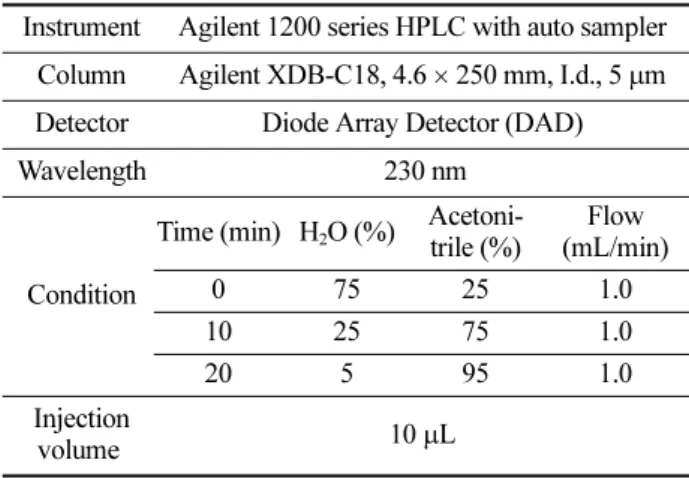
Azoxystrobin과 difenoconazole의 농축된 시료를 2 mL의 acetonitrile과 acetone 재용해하여 0.2 µm filter로 여과한 후 각 각 HPLC/DAD와 GLC/ECD를 이용하여 분석하였으며, 기기 분석 조건은 Table 3, Table 4와 같다.
회수율 시험
회수율 시험은 무처리 매실 시료에 정량분석한계의 10배, 50배 농도가 처리되도록 azoxystrobin은 0.3과 1.5 mg kg−1, difenoconazole은 0.06과 0.3 mg kg−1이 되도록 처리 후 균일 하게 혼화하여 상기 잔류농약 분석과정을 수행하여 회수율을 산출하였다.
매실 중 azoxystrobin과 difenoconazole의 희석효과 분석 수확 일자별 매실 시료의 중량 변화에 의한 희석효과를 고려한 azoxystrobin과 difenoconazole의 잔류량은 아래의 식에 의해 산출하고, 잔류회귀곡선을 작성하였다.
MQL (mg kg−1) =
정량한계 (ng) × 최종희석 용매량 (mL) × 추출용매량 (mL) 기기 주입량 (µL) × 추출용매 분취량 (mL) × 시료량 (g)
Table 3. HPLC conditions for the analysis of azoxystrobin in Prunus mume fruits
Instrument Agilent 1200 series HPLC with auto sampler Column Agilent XDB-C18, 4.6× 250 mm, I.d., 5 µm Detector Diode Array Detector (DAD)
Wavelength 230 nm
Condition
Time (min) H2O (%) Acetoni- trile (%)
Flow (mL/min)
0 75 25 1.0
10 25 75 1.0
20 5 95 1.0
Injection
volume 10µL
Table 4. GLC conditions for the analysis of difenoconazole in Prunus mume fruits
Instrument Varian CP-3800 GLC with auto sampler Column VF-5ms, 30 m× 0.25 mm i.d., 0.25 µm Detector Electron Capture Detector (ECD) Column flow Carrier N2 1.0 mL/min
Column oven
Temperature (oC)
Rate (oC/min)
Hold (min)
Total (min)
150 0 0
300 10.00 5.00 20.00 Injection oven : 250oC, Detector oven : 310oC
Split 10 : 1
Injection
volume 1µL
시험농약의 생물학적 반감기 및 생산단계 농약잔류허용 기준의 산출
매실 중 azoxystrobin과 difenoconazole의 생물학적 반감기 는 Microsoft사의 Microsoft Office Excel 2010을 이용하여 지수곡선식으로 산출하였고, 시험농약의 생산단계 잔류허용 기준은 국립농산물품질관리원의 SafeQ IN SPSS Statistics에 서 적용하여 설정하였다.
결과 및 고찰
표준검량선 작성
시험농약인 azoxystrobin과 difenoconazole의 표준검량선 의 직선식과 상관계수 (r2)는 Table 5와 같이 양호한 결과를 확인할 수 있었다.
정량분석한계 및 회수율
시험분석법의 정량분석한계는 azoxystrobin은 0.03 mg kg−1, difenoconazole은 0.006 mg kg−1이었고 HPLC 분석 조 건에서 azoxystrobin의 머무름 시간은 10.3 min, GLC 분석 조건에서 difenoconazole의 머무름 시간은 14.5 min이었으 며, 크로마토그램상에서 농약 피크를 방해하는 물질은 존재 하지 않는 것을 확인할 수 있었다(Fig. 1). 시험농약의 회수 율 시험결과 Table 6과 같은 회수율을 나타내었으며 두 시 험농약에서 모두 식품의약품안전처에서 권고하는 단성분 분 석 회수율 범위인 70~120%, 변이계수 10% 이내의 기준에 부합하여(Lee, 2009) 시험농약의 잔류량을 산출함에 있어 효율적인 방법이라고 판단된다.
시험기간 중 기상조건과 매실 열매 증체율
2012년 5월 12일부터 2012년 6월 9일까지의 시험기간 중 시험포장의 평균온도 범위는 14.5~22.4oC, 평균습도 범 위는 29.1~78.8%이었으며, 최소 강우는 0.1 mm, 최대 강우 는 6.5 mm이었으며 총 6일에 걸쳐 강우를 기록하였다. 또한 약제 살포 후 수확일별 채취 시료의 평균무게를 산출한 결 과는 Fig. 2와 같다. 0일차 시료의 무게는 14.9 g에서 14일 차에는 21.8 g까지 증가하였으며 살포일 대비 최종 수확일 까지의 증체율은 146.30% 이었다.
매실 재배 중 잔류량 변화
매실 재배 중 azoxystrobin과 difenoconazole을 기준량 1 회 처리와 동일 농도로 7일 간격 3회 처리한 후 일정 기간 동안 시험농약의 잔류량을 측정하고 잔류량 변화를 조사하 Table 5. Linear equations of calibration curve for the quantification of the fungicide residues in Prunus mume fruits
Fungicide Linear equations r2 azoxystrobin y = 45.062x + 1.066 0.9997 difenoconazole y = 37.674x− 0.725 0.9998 Table 6. Recovery rates and MQLs for azoxystrobin and difenoconazole in Prunus mume fruits
Fungicide
Fortification level (mg kg−1)
Recovery± CVa) (%)
MQLb) (mg kg−1)
azoxystrobin 0.3 093.2± 2.49 1.5 085.5± 1.97 0.03
difenoconazole 0.06 100.8± 6.74
0.006 0.3 087.6± 9.92
a) Coefficient of Variation = (standard deviation / average)× 100
b) Method Quantitative Limit
Fig. 1. HPLC/DAD chromatograms of azoxystrobin (A: control, B : standard 5 mg kg−1, C: recovery 1.5 mg kg−1 spiked) and GLC/
ECD chromatograms of difenoconazole (A: control, B: standard 2 mg kg−1, C: recovery 0.3 mg kg−1 spiked).
중량 변화에 의한 희석효과를 고려한 잔류량 (mg kg−1)
=
수확 일자별 매실
중량(g) × 수확 일자별
(mg kg잔류량−1) 0일차 매실 중량
(g)
였다. Azoxystrobin의 경우 기준량 1회 처리 시 0.12~
0.63 mg kg−1, 7일 간격 3회 처리 시 0.15~1.23 mg kg−1 수 준이었으며, difenoconazole의 경우 기준량 1회 처리 시 0.27~0.85 mg kg−1, 7일 간격 3회 처리 시 0.46~1.78 mg kg−1 수준으로 나타났다. Azoxystrobin은 두 처리 구간에서 MRL 인 2.0 mg kg−1보다 낮은 농도를 나타내었고, difenoconazole 은 기준량 1회 처리 구간에서는 MRL인 1.0 mg kg−1을 초과 하는 구간을 나타내지 않았지만, 7일 간격 3회 처리 구간에 서는 살포 후 8일 이후부터 MRL이하의 잔류량을 나타내었 다(Fig. 3).
잔류 소실 곡선에서 두 시험농약의 생물학적 반감기는 azoxystrobin은 기준량 1회 처리에서 5.9일, 7일 간격 3회 처리에서 5.2일이었고, 이는 기준량 1회 처리 시, Kang 등 (2011)이 보고한 풋마늘에서의 1.2일보다는 길게 나타났으 며, Lee 등(2011)의 연구에서 비가림 재배 시 포도에서의 15.5일보다 짧은 생물학적 반감기를 가지는 것을 확인하 였다. Difenoconazole은 기준량 1회 처리에서 9.3일, 7일 간 격 3회 처리에서 8.0일이었으며, 이는 Kang 등(2011)이 연 구한 풋마늘에서의 3.8일보다는 길게 나타났고, Chang 등 (2012)이 보고한 단감에서의 13.6일에 비해 짧은 생물학적 반감기를 나타내었다.
매실 증체율에 의한 azoxystrobin과 difenoconazole의 희석 효과
농약의 작물잔류에 영향을 미치는 인자 중 하나로 작물 의 비대생장에 의한 희석효과를 들 수 있다. 비대생장에 의 한 희석효과를 고려한 시험농약의 잔류 소실곡선은 Fig. 4과 같으며, 이 잔류 소실곡선에서 azoxystrobin과 difenoconazole 기준량 1회 처리 구간에서의 생물학적 반감기는 각각 7.8일, 15.0일로 희석효과를 배제하였을 때의 생물학적 반감기과 비교하였을 때 각각 1.9일과 5.7일이 길어진 것을 확인할 수 있었다.
시험 농약의 생산단계 잔류허용기준 산출
생산단계 잔류허용기준은 작물 수확 시 잔류량이 MRL을 초과하지 않도록 수확 전 일자별 잔류량을 설정한 기준 수
치로서 이를 이용하여 매실 재배 중 살균제 azoxystrobin과 difenoconazole의 생산단계 잔류허용기준을 Table 7과 같 이 추천할 수 있다. 매실에서 MRL이 2.0 mg kg−1 인 azoxystrobin의 경우 10일전 잔류량이 5.32 mg kg−1, MRL Fig. 2. Growth curve of Prunus mume fruits during cultivation
period.
Fig. 3. Dissipation curves of azoxystrobin (A) and difenoconazole (B) in Prunus mume fruits during cultivation periods.
Fig. 4. Dissipation curves of azoxystrobin (A) and difenoconazole (B) after subtraction of dilution effect in Prunus mume fruits during cultivation periods.
이 1.0 mg kg−1 인 difenoconazole은 10일전 잔류량이 1.64 mg kg−1 이하로 검출된다면 수확 시 잔류량이 MRL 수 준 이하로 잔류되어 안전한 농산물의 유통이 가능할 것으로 기대된다.
감사의 글
본 연구는 2012년 생산단계 농산물의 농약 잔류허용기준 설정 연구 결과의 일부이며, 국립농산물품질관리원의 연구 비 지원에 감사드립니다.
Literature Cited
Anatassiades, M., S. J. Lehotay, D. Stajnbaher and F. J. Scheck (2003) Fast and easy multiresidue method employing acetonitrile extraction/partitioning and “dispersive solid- phase extraction” for the determination of pesticide residues in produce. Journal of AOAC International. 86(1):412-431.
Chang, H. R., H. R. Kang., J. A. Do., J. H. Oh., I. K. Whang., K. S. Kwon., M. H. Lim and K. Kim (2012) Residue studies of difenoconazole and thiamethoxam during cultivation of sweet persimmon for export. Korean Journal of Environmental Agriculture. 31(3):248-254.
Hong, J. H., J. S. Lim, C. R. Lee, K. T. Han, Y. R. Lee and K. S.
Lee (2011) Study of pesticide residue allowed standard of methoxyfenozide and novaluron on Aster scaber during cultivation stage. Korean Journal of Pesticide Science.
15(1):8-14.
Jeong, Y. H., J. U. Kim, J. H. Kim, Y. D. Lee, C. H. Lim and J.
H. Hur (2004) Modern pesticide. pp.5, first edition, Sigma- press, Korea.
Kang, H. R., Y. J. Lee., Y. R. Lee., K. T. Han., H. R. Chang and K. Kim (2011) Dissipation pattern of azoxystrobin, difenoconazole and iprodione treated on field-grown green garlic. Korean Journal of Environmental Agriculture.
30(4):446-452.
Kim, J. B., B. H. Song, J. C. Chun, G. J. Im and Y. B. Im (1997) Effect of spryable formulations on pesticide adhesion and persistence in several crops. Korean Journal of Pesticide
Science. 1(1):35-40.
Kim, S. W., E. M. Lee, Y. Lin, H. W. Park, H. R. Lee, M. J. Riu, Y. R. Na, J. E., Noh, Y. S. Keum and J. H. Kim (2007) Establishment of pre-harvest residue limit (PHRL) of insecticide bifenthrin during cultivation of grape. Korean Journal of Pesticide Science. 13(4):241-248.
Ko, G. Y., K. H. Kim and K. S. Lee (2004) Residual pattern of procymidone and chlorothalonil in grape during the period of cultivation and storage. Korean Journal of Environmental Agriculture. 23(1):47-51.
Lee, C. R., J. H. Hong., J. S. Lim and K. S. Lee (2011) Residue pattern of azoxystrobin and cyenopyrafen in grape between rainshield and plastic house conditions. Korean Journal of Pesticide Science. 15(2):97-103.
Lee, D. Y., Y. J. Kim, S. J. Lee, K. S. Cho, S. G. Kim, M. H.
Park and K. Y. Kang (2012) Establishment of pre-harvest residue limit of fungicide pyrimethanil and trifloxystrobin during cultivation of persimmon. Korean Journal of Environmental Agriculture. 31(1):45-51.
Lee, D. Y., Y. J. Kim, S. G. Kim and K. Y. Kang (2013) Residual characteristics of insecticides used for oriental tobacco budworm control of paprika. Korean Journal of Environmental Agriculture. 32(1):84-93.
Lee, Y. D (2011) Handbook for the pesticide residue analytical methods of Food Code Index. pp. 80-82, third edition, National Institute of Food and Drug Safety Evaluation, Korea Lehotay, S. J (2003) Determination of pesticide residues in foods by acetonitrile extraction and partitioning with magnesium sulfate: collaborative study. Journal of AOAC International. 90(2):485-520.
Park, D. S., K. Y. Seong, K. I. Choi and J. H. Hur (2005) Field tolerance of pesticide in the strawberry and comparison of biological half-lives estimated from kinetic model. Korean Journal of Pesticide Science. 9(3):231-236.
Tomlin, C. D. S. (2009) The Pesticide Manual, pp. 62-64, pp 354-355, fifteenth edition. BCPC publication, UK.
Yang, J. E., D. S. Park. and D. S., Han (1995) Comparative assessment of biological half-lives estimated from kinetic models. Korean Journal of Environmental Agriculture.
14(1):37-48.
Table 7. Pre-Harvest Residue Limit (PHRL) of azoxystrobin and difeonconazole in Prunus mume fruits
Fungicide
Pre-Harvest Residue Limit (mg kg−1)
10 day 9 day 8 day 7 day 6 day 5 day 4 day 3 day 2 day 1 day Harvesting day azoxystrobin 5.32 4.83 4.38 3.97 3.60 3.26 2.96 2.68 2.43 2.21 2.0 difenoconazole 1.64 1.56 1.49 1.41 1.35 1.28 1.22 1.16 1.10 1.05 1.0
⊙ ··· ⊙
매실 중 살균제 azoxystrobin과 difenoconazole의 생산단계 잔류허용기준 설정
이동열1·김영진2·박민호3·이승화3·김상곤4·강남준5,6·강규영1,6*
1경상대학교 응용생명과학부(BK21플러스 농생명산업 차세대 인재육성사업단),
2동의과학대학교 동의분석센터, 3국립농산물품질관리원 경남지원,
4경상대학교 식물생명공학연구소, 5경상대학교 원예학과, 6경상대학교 농업생명과학연구원
요 약 본 연구는 매실 재배 중 사용되는 살균제인 azoxystrobin과 difenoconazole의 잔류특성을 알아보고 생산단 계 잔류허용기준(Pre-Harvest Residue Limit, PHRL) 설정을 통하여 생산단계에서 합리적인 잔류농약 관리기준을 마 련하기 위해 수행되었다. 먼저 두 살균제는 안전사용기준 농도로 희석하여 1회 살포와, 동일한 농도로 희석하여 7일 간격 3회 살포 구간으로 나누어 살포 후 0, 1, 2, 4, 6, 8, 10, 12, 14일에 시료를 채취하여 분석에 사용하였다. 매실 중 azoxystrobin과 difenoconazole은 QuEChERS 방법으로 추출하고 NH2 SPE cartridge를 이용하여 정제한 후 HPLC/DAD와 GLC/ECD로 각각 분석하였다. Azoxystrobin과 difenoconazole의 정량분석한계(Method Quantitative Limit, MQL)는 0.03 mg kg−1과 0.006 mg kg−1으로 나타났다. Azoxystrobin의 회수율은 0.3 및 1.5 mg kg−1수준에서 각각 93.2 ± 2.49%, 85.5 ± 1.97%이었으며, difenoconazole의 회수율은 0.06 및 0.3 mg kg−1 수준에서 각각 100.8± 6.74%, 87.6 ± 9.92%이었다. 매실에서 생물학적 반감기는 기준량 1회 처리와 기준량 7일 간격 3회 처리에서 azoxystrobin은 각각 5.9일과 5.2일, difenoconazole은 9.3일과 8.0일로 나타났다. 잔류회귀 감소식을 이용하여 생산단 계 잔류허용기준을 설정한다면 수확 10일전 azoxystrobin은 5.32 mg kg−1, difenoconazole은 1.64 mg kg−1이하로 잔 류할 때 수확 시 잔류농도가 잔류허용기준(Maximum Residue Limit, MRL) 이하로 잔류할 것으로 기대된다.
색인어 생물학적 반감기, 생산단계 잔류허용기준, 아족시스트로빈, 디페노코나졸, 매실
⊙ ··· ⊙