Received: May 24, 2021 Revised: June 03, 2021 Accepted: June 04, 2021
with disabilities
Jae-Young Lee
1†· Hye Ran Paik
2†· Young-Jae Kim
3· Bo-Hyoung Jin
41
Department of Dental Hygiene, Dankook University
2
Dental Research Institute, Seoul National University
3
Department of Pediatric Dentistry, School of Dentistry, Seoul National University
4
Department of Preventive and Public Health Dentistry, School of Dentistry, Seoul National University
Corresponding Author: Bo-Hyoung Jin, Department of Preventive & Public Health Dentistry, School of Dentistry, Seoul National University, 101 Daehakro, Jongno-gu, Seoul, 03080, Korea. Tel : +82-2-740-8783, Fax :+82-2-765-1722, E-mail : [email protected]
ABSTRACT
Objectives: To validate the role of a new information and communication technology platform that we created for the betterment of the oral health of persons with disabilities and for providing appropriate health care services. Methods: A Delphi survey was conducted among 16 people in various professions, including academia, government agencies, and dentistry, to evaluate the validity of the information and communication technology platform. Moreover, platform satisfaction was evaluated using a user experience questionnaire among 200 people, including persons with disabilities, parents, and public institutions. Results: Experts in consensus indicated a high validity for the categories of service provider (CV=0.29, CVR=0.69), service target (CV=0.29, CVR=0.38), service contests (CV=0.27, CVR=0.63), and financial support (CV=0.30, CVR=0.63) in our information and communication technology platform. In addition, information from questionnaires on user experience and communication technology satisfaction analysis showed that both users and providers were highly satisfied with the platform. Conclusions: The provision of oral health services based on the new information and communication technology platform has numerous advantages, in addition to providing adequate oral health care for the disabled. Furthermore, the social safety net for improved oral health may be further strengthened.
Key Words: Delphi technique, Disabled persons, eHealth, Oral health
J Korean Soc Dent Hyg 2021;21(3):211-25 https://doi.org/10.13065/jksdh.20210021 pISSN : 2287-1705 eISSN : 2288-2294
Introduction
With the emergence of coronavirus disease 2019, face-to-face interaction has become difficult; thus,
non-face-to-face methods using information and communication technology have been gaining
prominence, even in the medical field [1]. However, in the field of oral health care, research on non-
face-to-face methods is scarce; thus, such methods combining information and communication
technology are much needed. Collaborations between multi-disciplinary specialists is required for the appropriate diagnosis and treatment of dental patients. However, errors in interprofessional communication may result in delays in treatment, misdiagnosis, and errors in drug administration, resulting in the injury or even death of patients [2]. To reduce such errors, interprofessional workshops, interdisciplinary online modules and simulations, and interprofessional education must be given due focus.
Interdisciplinary communication and teamwork in the medical and dental fields, which require a patient-centered team approach, can have a significant impact on patient prognosis [3]. Interest in interprofessional education and awareness has increased, and measures have been proposed to facilitate communication by reviewing the differences, diversity, and roles among professionals.
Nevertheless, lack of experience, the complexity of health care and the health care environment, and lack of structure and standardization appear to be obstacles to interprofessional communication [4]. Although several studies have been conducted on multiple healthcare and communication issues among healthcare professionals, there is a lack of related research in dentistry to date.
Moreover, the Commission on Dental Accreditation and the American Dental Education Association reported a correlation between core competence of dentists with close relationships with other health care professionals and improved work skills [5]. Therefore, developing communication skills is indispensable for the betterment of oral health care, especially for persons with disabilities.
Interparticipant communication also plays an important role in improving the quality and prognosis of healthcare. Communication between the professional and the patient is a dominant factor in determining the cost, efficiency, and effectiveness of treatment, as well as patient satisfaction, and ways to improve these are actively being researched [6-8]. Telemedicine, which is based on information and communication technology (ICT) and has been proposed primarily for vulnerable classes unable to access medical services in a timely manner, has also been proposed as a solution to this problem of communication between patients and medical staff [9-11]. At the time as the current under COVID-19, it can bridge the medical/dental gap and is widely used in healthcare fields as a tool for continuous healthcare after treatment [12-15].
Persons with disabilities have poorer oral health than those without disabilities, and a survey of the needs of persons with disabilities has shown that access to dental care is limited [16]. This is common for people with disabilities in many countries [17-19]. To improve the accessibility of oral health care for persons with disabilities, ICT-based dental services may be used [20]. Improving communication using ICT in healthcare will assist patients in terms of improving their prognosis and providing a means of continuous health management [21].
The health care field requires advanced medical knowledge and specialized personnel, especially
for the analysis and management of information. ICT has developed and evolved to promote the
management of information. In this study, we created an ICT platform to review the appropriate
oral health care of persons with disabilities. Accordingly, we provided oral health care services and
investigated the validity of the ICT system.
Methods
The study was conducted over 6 months from January 2018 to August 2018 with the approval of the Seoul National University Clinical Research Ethics Committee (S-D20160014, S-D20170019, S-D20180023). We initially identified the types of oral health services required by disabled persons.
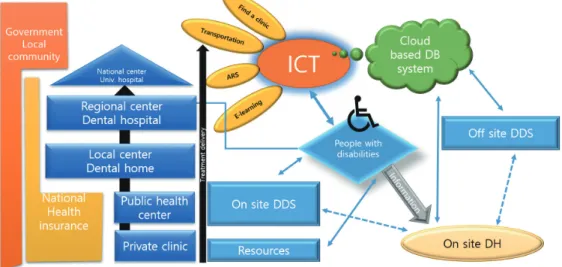
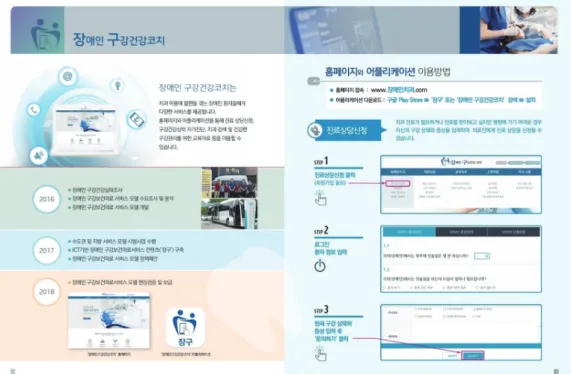
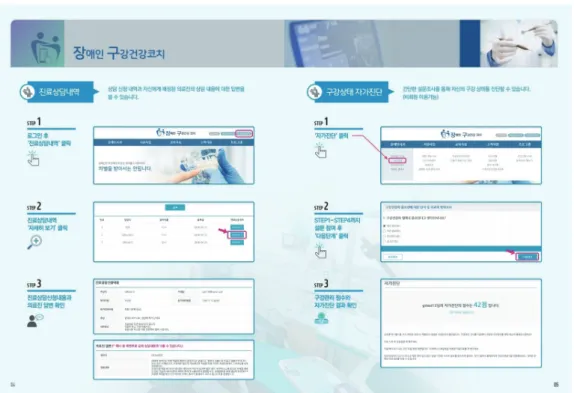
This was centered on providers and consumers and based on the results of an oral health survey of disabled persons. Based on this and after consulting with experts in the field, we devised a mobile application and web-based platform termed “Oral Health Coach for the Disabled” that utilizes ICT. We performed a manufacturing-oriented interprofessional platform evaluation from March 2016 to March 2017 with a survey of professionals with disabilities who work in the fields of dentistry and business modeling. The portal was subsequently used on a trial basis from 2017 to 2018 <Fig. 1>.
Fig. 1. An innovative and proactive dental service business model concept map for treatment of the disabled, using information communication technology. DB: database.
1. Delphi survey
To evaluate the developed model, a Delphi survey was conducted among 30 people, including those in academia, government agencies, and dentistry. Of these, 16 people made it clear that they wished to participate in the final panel. Two Delphi surveys were conducted. The evaluation items for ICT infrastructure services consisted of questions related to the cost of revenue and revenue sources, service provider, beneficiary of the service, content, and scope of the service provided.
Questions were evaluated on a seven-point scale. Stability of a question indicated expert agreement
with that question. The coefficient of variation (CV) is the ratio of the standard deviation to the
mean; 0 < CV ≤ 0.50 indicated high agreement. The Content Validity Ratio (CVR) determined
whether the content of each questionnaire item was appropriate. When less than 50% of the panel
responded positively, a negative value was assigned. In case, 50% responded positively, a zero value was assigned. If 100% responded positively, a value of one was assigned. The question had content validity when an answer was provided by more than 50% of the total response panel.
2. Satisfaction assessment of the platform
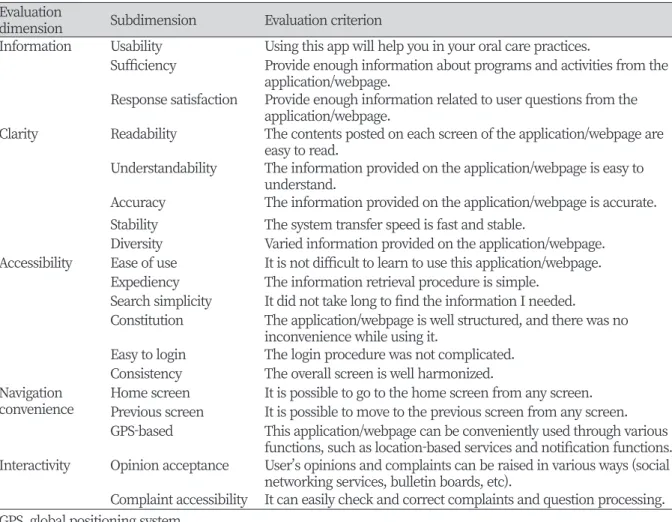
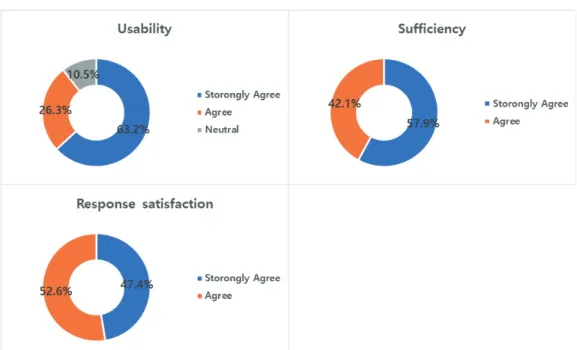
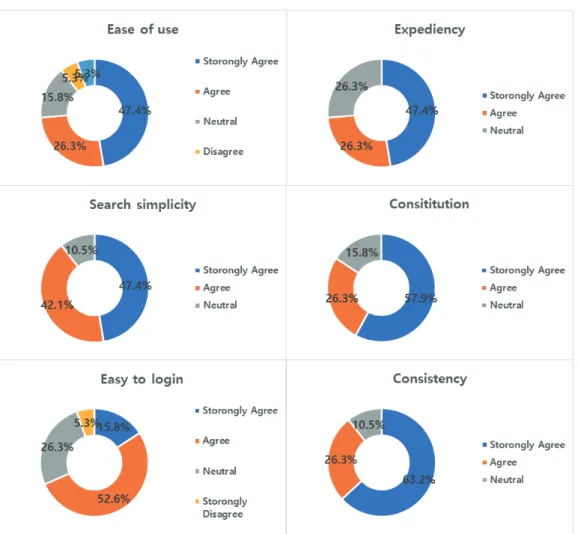
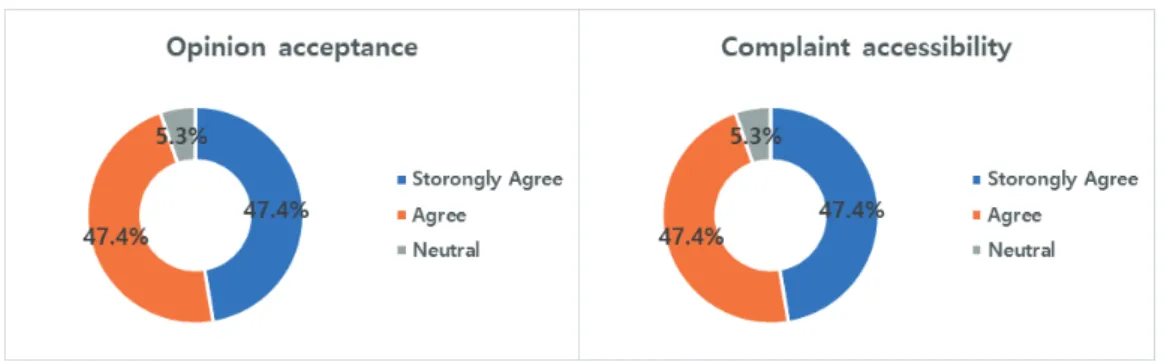
We conducted a satisfaction survey on 200 persons with disabilities, parents, and public institutions regarding the ICT-based oral health care service platform using the User Experience Questionnaire (UEQ). The criteria were information provided, clarity, design, navigation convenience, and interaction <Table 1> [22]. We subsequently conducted a multi-faceted satisfaction survey addressing various aspects of the service. Finally, an analysis of the most used function of the application or web platform was performed.
Table 1. Satisfaction assessment of the information and communication technology platform Evaluation
dimension Subdimension Evaluation criterion
Information Usability Using this app will help you in your oral care practices.
Sufficiency Provide enough information about programs and activities from the application/webpage.
Response satisfaction Provide enough information related to user questions from the application/webpage.
Clarity Readability The contents posted on each screen of the application/webpage are easy to read.
Understandability The information provided on the application/webpage is easy to understand.
Accuracy The information provided on the application/webpage is accurate.
Stability The system transfer speed is fast and stable.
Diversity Varied information provided on the application/webpage.
Accessibility Ease of use It is not difficult to learn to use this application/webpage.
Expediency The information retrieval procedure is simple.
Search simplicity It did not take long to find the information I needed.
Constitution The application/webpage is well structured, and there was no inconvenience while using it.
Easy to login The login procedure was not complicated.
Consistency The overall screen is well harmonized.
Navigation
convenience Home screen It is possible to go to the home screen from any screen.
Previous screen It is possible to move to the previous screen from any screen.
GPS-based This application/webpage can be conveniently used through various functions, such as location-based services and notification functions.
Interactivity Opinion acceptance User’s opinions and complaints can be raised in various ways (social networking services, bulletin boards, etc).
Complaint accessibility It can easily check and correct complaints and question processing.
GPS, global positioning system
Results
1. Assessing the validity of ICT using the Delphi survey
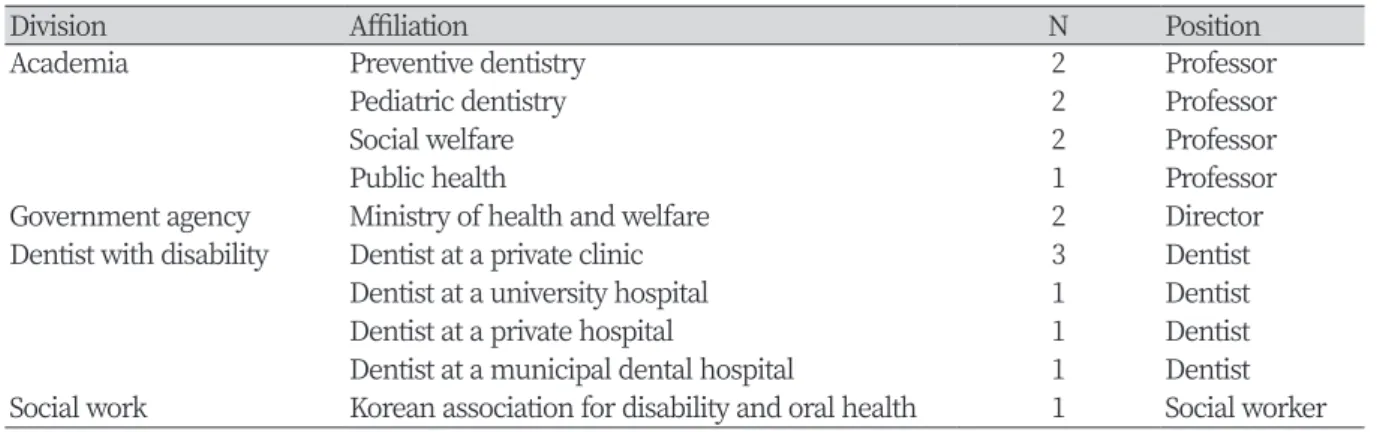
Of the 30 experts, 16 participated, and their characteristics are shown in <Table 2>. The first Delphi survey concerned policy-related issues, while the second dealt with an analysis of the items with CV ≤ 0.50 <Table 3>.
Table 2. Characteristics of participants of the Delphi survey
Division Affiliation N Position
Academia Preventive dentistry 2 Professor
Pediatric dentistry 2 Professor
Social welfare 2 Professor
Public health 1 Professor
Government agency Ministry of health and welfare 2 Director
Dentist with disability Dentist at a private clinic 3 Dentist
Dentist at a university hospital 1 Dentist
Dentist at a private hospital 1 Dentist
Dentist at a municipal dental hospital 1 Dentist
Social work Korean association for disability and oral health 1 Social worker Table 3. Delphi survey for oral health care services using information and communication technology Policy
direction Discussion points Mean (SD) CV
*CVR
**Service
provider A dentist and a dental hygienist from a health center visit patients at their
homes. 5.25 (1.39) 0.26 0.63
Starting with the second visit, the dental hygienist makes visits alone and performs screening tests and oral health care education under the online supervision of the dentist.
5.81 (1.83) 0.32 0.75
Total CVI
***5.53 (1.63) 0.29 0.69
Service
target The oral healthcare services based on information and communication
technology are targeted at all registered people with disabilities in a given region. 3.50 (1.76) 0.51 -0.25 The visiting oral healthcare services based on information and communication
technology are targeted at people with disabilities who cannot visit medical institutions because of mobility difficulties.
6.63 (0.50) 0.07 1.00
Total CVI
***5.06 (2.05) 0.29 0.38
Service
contents It is not advisable that dental hygienists from health centers perform the examination. A dental hygienist should oversee providing information regarding a referral from a dental institution and oral healthcare education. (A dentist must check the referral status based on uploaded patient oral health information and appropriately supervise the dental hygienist.)
5.63 (1.26) 0.22 0.63
An institutional framework must be established that allows dental hygienists to examine patients during the visiting oral healthcare services, following the initial visit wherein they are accompanied by a dentist, to expand the range of visiting home care services (A dentist must check the referral status based on uploaded patient oral health information and appropriately supervise the dental hygienist).
5.31 (1.70) 0.32 0.63
Total CVI
***5.47 (1.48) 0.27 0.63
Finance
support The central government provides financial support. 5.56 (1.71) 0.31 0.50 The central and local governments share the required finances. 5.69 (1.62) 0.29 0.75
Total CVI
***5.63 (1.64) 0.30 0.63
*