• 검색 결과가 없습니다.

A Study on the Influence of Cognitive on Repurchase Intension of New E-Commerce System: Focused on the Mediation Effect of Consumer Satisfaction and Quasi Social Relations

N/A
N/A
Protected

Academic year: 2021

Share "A Study on the Influence of Cognitive on Repurchase Intension of New E-Commerce System: Focused on the Mediation Effect of Consumer Satisfaction and Quasi Social Relations"

Copied!
8
0
0

로드 중.... (전체 텍스트 보기)

전체 글

(1)

JKSCI

A Study on the Influence of Cognitive on Repurchase Intension of New E-Commerce System: Focused on the Mediation Effect of Consumer

Satisfaction and Quasi Social Relations

1)

Yu Ying*

*PhD student, Dept. of Global Business Graduate School, Kyonggi University, Suwon, Korea [Abstract]

In this paper, we propose a study on the purchasing intent of the new e-commerce consumer, the coronavirus may once again drive the structural change of China's economy, and the new online marketing model will be noticed during the epidemic. Through 438 questionnaires collected on the Internet, frequency analysis, element analysis, reliability analysis and structural equation analysis were performed using SPSS V22.0 and AMOS V22.0 methods. Study the validation of hypotheses in the model to reveal the reasons why consumers in the new e-business are exposed.

The results show that e-commerce features of Internet celebrities and individual characteristics of Internet celebrities can only enhance consumers' satisfaction. Quasi social relationships only increase consumer satisfaction without generating the will to purchase directly. Consumer satisfaction is the core foundation that dominates long-term consumption. E-commerce should focus on the ability of online celebrities to sell their expertise and the adaptability of value and product characteristics when conducting online celebrity marketing.

▸Key words: New E-Commerce System, Service Quality, Expertise, Customer Satisfaction, Quasi social relations

[요 약]

2020년 신종 코로나 바이러스 감염증은 다시 한번 중국 경제의 구조 전환을 촉진했고 중국의

“인터넷+”업계의 경제 발전을 가속화하는 가운데, “패션 네트워크+플랫폼 마케팅”의 새로운 온라 인 마케팅 모델이 주목받고 있다. 본문은 인지 모형에 기초하여 인지, 감정, 그리고 행위의 세 단 계로부터 왕홍 경제 환경에서 소비자의 중복 구매에 대한 영향 요인을 분석하였다. 인터넷을 통 해 수집된 438부의 설문지는 SPSS V 22.0와 AMOS V 22.0를 사용하여 수집된 데이터에 대한 빈 도분석 , 요인분석, 신뢰도분석, 구조방정식 분석을 실행하였다. 연구에서 가정된 검증은 신형 전자 상 거래 사업자에서 소비자의 구매의도에 대한 흡인력을 제시한다.

본 연구는 실증 분석을 사용하여 인터넷을 통한 경제 환경에서 소비자의 중복 구매의도에 미치 는 영향 요인을 분석하였다. 그 결과 전자상 거래의 서비스 품질 중 전문성이 사회적 관계에 미 치는 영향과 인지된 상호작용성이 소비자의 만족도에 영향을 미치지 않는 것 외에 모든 요소가 사회적 관계와 소비자 만족도에 영향을 미치는 것으로 나타났다 . 사회적 관계와 소비자 만족도가 중복 구매의도에 영향을 미치는 것으로 나타났다 . 연구를 통해 전자상거래가 진행될 때에는 인터 넷 판매 전문 능력과 가치관, 제품 특징의 적절성을 중시해야 한다.

▸주제어: 신형 전자상거래 시스템, 서비스 품질, 전문성, 고객 만족도, 사회관계

∙First Author: Yu Ying, Corresponding Author: Yu Ying

*Yu Ying ([email protected]), Dept. of Global Business Graduate School, Kyonggi University

∙Received: 2020. 07. 06, Revised: 2020. 07. 28, Accepted: 2020. 07. 28.

Copyright ⓒ 2020 The Korea Society of Computer and Information http://www.ksci.re.kr pISSN:1598-849X | eISSN:2383-9945
(2)

I. Introduction

The sudden outbreak of public health has hindered the social and economic development of the new crown-pneumonia epidemic, which has many similarities to the 2003 SARS outbreak. The SARS epidemic in 2003 has driven the rise of domestic Internet companies, especially e-commerce, and this new outbreak of the disease will probably further push China's "Internet+" to upgrade, with the "down-line" turning point giving some of the "cloud industry" historic opportunities [1] . Due to the limitations of logistics and capacity, E-commerce has also been hit, but for many offline retail sales, which are basically zero in sales, live sales have become a major tool in the field of e-commerce during the epidemic prevention and control period. After this supply-side market education, many offline businesses will deepen their belief that the live broadcast will be a normal operating tool. Based on the consumer base and direct conversion advantages, the new type of e-commerce will be the biggest beneficiaries of this structural change. [2] .

Compared to traditional forms of shopping, Internet shopping is characterized by convenience, convenience, more choice, transparency of price, and sufficient information about products, which makes online consumers less motivated to make repeated purchases at the same store. Compared to other types of online merchants, the new type of e-commerce "fans" are characterized by high viscosity, high browsing, high conversion, and high sales explosive power. Store consumption is not an impulse purchase or a random purchase, but a continuous purchase [3] . While online consumption has benefited from the pneumonia epidemic, demand for these episodes can continue after the epidemic has ended. Faced with huge business profits and growing space, businesses of all kinds have been innovating to develop online marketing models to boost sales performance. Early studies of

first-time and repeat purchases, Geffen & Straub (2000) [4] , compared the costs of developing new and retaining older customers, apparently cost more.

Therefore, increasing the loyalty of older customers and motivating them to repeat purchases is the key to expanding competition among online merchants, so consumers' buying behavior in this context is also getting more and more and more.

Based on the marketing context of the e-commerce, this paper analyzes the influence factors, measuring cognition, emotion and behavior of consumers. The research results will help to understand the mechanism of the effect of new e-commerce on consumers' willingness to buy again, reveal the inducement of consumers' willingness to buy again, make suggestions on the marketing strategy of new e-commerce companies, and promote the sustainable development of the new economy.

II. Theoretical Basis and Research Assumptions

1. Theoretical Structure

The attitude model was referenced during the study, which suggested an analytical framework that affected consumers' Repurchase Intension from three stages: Cognitive, Emotional, and Behavioral.

Attitude modelling was developed by psychologists Hoffland and Luxembourg in 196. Cognitive attitude, consumer cognition, refers to a person's direct access to information related to an attitude object or other channel, and emotional attitude refers to the consumer's feelings or feelings about a particular product or brand, and intentional attitude refers to the possibility that the consumer may take some action against an attitude object.

2. Research hypothesis 2.1 Quality of Service

The quality of service in this article refers to the

new one. The reliability, responsiveness and

security of the service provided by the model

(3)

e-commerce vendor in the process of selling the product. Gounaris et al. (2010) studies of the online shopping environment showed that consumers would become bored and give up buying products if the financial payment link was too cumbersome and cumbersome [5] . Therefore, this paper establishes assumptions as follows:

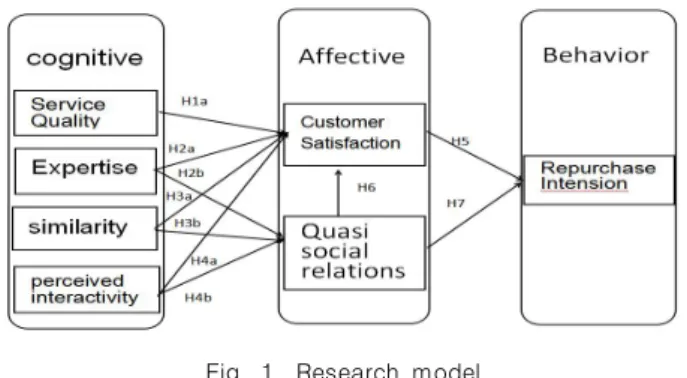
H1a: Service Quality have a positive effect on Customer Satisfaction.

2.2 Expertise

In this paper, Expertise is considered. Consumers are aware of the level of familiarity, expertise, including product knowledge, experience and experience of the e-commerce industry. XIANG &

ZHENG(2016) analyzed product knowledge mainly including familiarity and expertise, the former refers to the experience consumers have gained based on the previous use of similar products, and the latter refers to a deep understanding of the characteristics and attributes of product differentiation [6] . When consumers find that they don't know the recommended products and don't use them personally, consumers' satisfaction with the products will decrease, which in turn will affect their willingness to buy them [7] .

Consumers are more likely to get advice from experts with similar consumer experience when dealing with product information and are more susceptible to expert advice [8] . Research by Li Xiong and Xiaobing Zheng (2016) in social business communities also showed that more specialized users were more able to attract the interaction of community members [9] , which had a significant impact on the formation of quasi-social interaction relationships. Therefore, this paper establishes assumptions as follows:

H2a: Expertise have a positive effect on Customer Satisfaction.

H2b: Expertise have a positive effect on Quasi social relations.

2.3 Similarity

Rogers & BachIn his study, Oomik (1970) defined similarity as measuring the similarity of beliefs, educational backgrounds, social status, and preferences of a person who interacts with it [10] . Elal & Rubin(2003) analyzes the effect of similarity on social relations, and the similarity between TV viewers and TV characters can significantly affect the establishment of quasi-social relations between the two [11] . In the new e-commerce economic situation, If there is a similarity between the consumer preference and the consumer, the choice between the consumer and the consumer is more applicable to the consumer. Satisfaction will be higher. Therefore, this paper establishes assumptions as follows:

H3a: Similarity have a positive effect on Customer Satisfaction.

H3b: Similarity have a positive effect on Quasi social relations.

2.4 Perceived interactivity

Interaction in this article refers to the results of the interaction perceived by individuals in the Internet and the effects of perceived interaction.

According to Geffen & Straub (2000) [12] , interaction includes three dimensions: interaction involvement, interaction, and individualization, the three dimensions play a stable role in building a stable relationship and expressing satisfaction with interaction among the parties. The consumer perception of interaction and interaction with Internet reds will develop into Quasi Social Studies, which will eventually produce quasi-social attachment, which relies on the development of social media and interacting with fans to gain support. Therefore, this paper establishes assumptions as follows:

H4a: Perceived Interactivity have a positive effect on Customer Satisfaction.

H4b: Perceived Interactivity have a positive effect

on Quasi social relations.

(4)

2.5 Customer Satisfaction

Satisfaction is an important criterion for consumers to be satisfied with the new e-commerce system and to judge the effectiveness of online red e-commerce sales [13] . Li Yu-ping (2014) analyzes the factors influencing consumers' willingness to repeat their purchases from the perspective of the cost of online conversion, arguing that satisfied online consumption can increase the costs of transforming the business, and that trying to replace the business and products will bring uncertainty and risk to consumers, thereby making repeated purchases [14] . Therefore, this paper establishes assumptions as follows:

H5: Customer Satisfaction have a positive effect on Repurchase Intension.

2.6 Quasi social relations

Labreque (2014) study found that Quasi Social Relation promotes positive relationship results in social media environments and recommends that the Quasi Social Relation Theory be used as the basis for a successful social media strategy when establishing a consumer brand relationship [15] . Quasi Social Relations can strengthen contact, facilitate effective communication of information, enhance consumers' product promotion, and encourage consumers' buying activities [16] . Li et al.

(2016) study of the relationships among parties to social business platforms showed that quasi-social relationships formed among participants significantly affect the willingness to buy and hedge the willingness to buy. Therefore, this paper establishes assumptions as follows:

H6: Quasi social relations have a positive effect on Customer Satisfaction.

H7: Quasi social relations have a positive effect on Repurchase Intension.

III. research method

1. Research Model

Based on the above analysis, this paper

constructs the research model.

Fig. 1. Research model

2. Operational Definition and Measurement Scale of Variables

variable Definition reference

literature Service

Quality

Quality of service reflects reliability, responsiveness, security, and personalization

L i n g l i n g Gao (2015)

Experti se

Specialty is the degree of familiarity and expertise that the consumer perceives in the message carrier itself and provides beneficial consumer guidance information.

Li Xiang &

X i a b i n g Z h e n g (2016)

Similar ity

Measure the similarity of belief, educational background, social status, and preferences of a person who interacts with it.

Rogers &

Bhowmik(

1970) Q u a s i

s o c i a l relatio ns

Quasi-social relationship is the illusion that one has a face-to-face relationship with a media figure

Horton &

W o h l (1956) Table 1. Operational Definition and Measurement Scale of Variables

3. Analysis process

Through 438 questionnaires collected on the

Internet, frequency analysis, element analysis,

reliability analysis and structural equation analysis

were performed using SPSS V22.0 and AMOS V22.0

methods. This study used proven reliability and

feasibility scales from previous studies and selected

scales to be used in the final-stage analysis as a

scale-purification process. The scale purification

process of the study was carried out using

repetitive statistical techniques such as exploratory

factor analysis, Cronbach α, correlation analysis,

and positive factor analysis. In the first purification

(5)

process, individual measurement measures were reviewed on the premise of a single dimension, and secondly, the number of factors above 1 eigenvalue was determined based on the factor analysis. This also included items with factor loadings of .4 or higher. Thirdly, in the Wave 2 purification process, the primary and secondary purification processes were repeated on the premise of a single dimension, the measured items were considered, and the resulting measurement model was evaluated, where all items were selected as scales used in the final analysis without any modification of additional items.

IV. Analysis Result

1. Demographic Characteristics of The Sample In terms of the general characteristics of the subjects studied, 248(56.6%) of the 438 respondents were male and 190 (43.4%) were female. The ratio of men is higher than that of men. Meanwhile, the largest number of respondents aged 40 to 49 was 127 (36.8%). Next was 103(29.9%) aged 20 to 29. Then came 213 respondents, or 48.6 percent, aged 20 to 29. There were three respondents (2.7%) over the age of 50 with the lowest answer rate. In the academic degree survey, 296(67.6%) answered university graduates the most. The second was 90 graduates (2.5%) and 37 graduate students (8.4%). 15(3.4%) of high school graduates with the lowest answers.

2. Test on Reliability and Validity

2.1 Exploratory factor analysis and reliability analysis of exogenous variables

Force Actors and Relativity to see if the various measuring tools used in this study were consistent with the intent of this study. The criteria for evaluation of factor extraction are above Eign Value and above .5. In addition, to ensure reliability of the measured variables, the coefficient of Cronbach's Alpha coefficient, which represents the internal character, was determined. It is generally

considered that holding a price above .6 is more reliable and that holding a price above .7 is higher.

As a result, the extractive value of all factors is above .5 and the total explanatory power is 69.110%.In addition, the results of the reliability analysis of the test items showed that the Cronbach's Alpha coefficient was above .7.

2.2 Confirmatory Factor Analysis

In order to verify the convergence and discriminant appropriateness of measurement variables, the deterministic element analysis was carried out. It can be observed from <Table 5> that the suitability of the measurement model is x²=685.287, P=.000, DP=384, GFI=.903, AGFI=.882, IFI=.957, TLI=.951, CFI=.957, RMR=.046 The suitability of the measurement model can be evaluated as a more satisfactory fit. In addition, the measurement model X²(df) = shown in 685.287 (384), suggested that X²/d.f. be priced below 5 (large number of specimens), and 1.785. Confirming that the measurement model used in this study is good.

In addition, both the elements of the validation factor analysis and the inventory amount show the t-value that is statistically noted and confirm the rationality of convergence. The comprehensive trust was also evaluated through Amos. All items exceed the generally allowed .6, indicating that the result value is trustworthy. On the other hand, other values for convergent appropriateness The determination of the mean fractional extract (AVE) value is an indication of the potential concept. is said to be more than .5 before the size of the dispersion. The average divergent extract (AVE) value of all factors is above .5 in this study, ensuring convergence.

3. Research Hypothesis Verification

H1. Regarding the effect of service quality on

customer satisfaction, as observed in Table 5 , the

effect of service quality on customer satisfaction is

.153. These results are statistically significant at a

limited level of .05 (C.R=2.141, p<.05). Therefore, H1

is verified as expected.

(6)

Survey question

Estim

ate AVE CR

Repurchase Intension

Repurchase Intension1 .754

.577 .804 Repurchase Intension2 .748

Repurchase Intension3 .758 Service

Quality Service Quality4 .745

.519 .811 Service Quality3 .819

Service Quality2 .797 Service Quality1 .717

similarity similarity3 .789

.516 .761

similarity2 .828

similarity1 .697

perceived interactivity

perceived interactivity4 .825

.614 .864 perceived interactivity3 .758

perceived interactivity2 .818 perceived interactivity1 .834

Expertise Expertise3 .852

.636 .840

Expertise2 .816

Expertise1 .844

Customer Satisfaction

Customer Satisfaction1 .73

.539 .778 Customer Satisfaction2 .779

Customer Satisfaction3 .741 Quasi

social relations

Quasi social relations1 .695

.523 .916 Quasi social relations2 .712

Quasi social relations3 .681 Quasi social relations4 .755 Quasi social relations5 .693 Quasi social relations6 .731 Quasi social relations7 .729 Quasi social relations8 .779 Quasi social relations9 .725 Quasi socialrelations10 .81

x² =685.287, P=.000, DF=384, CMIN/DF=1.785, GFI=.903, AGFI=.882, IFI=.957, TLI=.951, CFI=.957, RMR=.046

*P<.05

Table 2. Confirmatory Factor Analysis

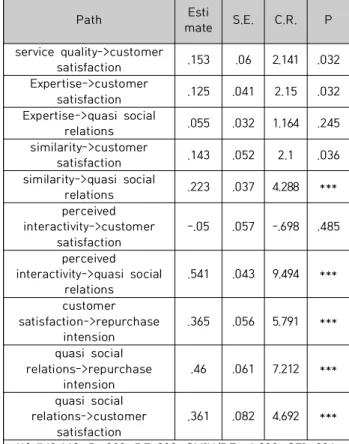
H2a. Regarding the effect of expertise on customer satisfaction that is .125 as observed in Table 5. The results of such a study were statistically meaningless at the level noted in .05 (C.R=2.15, p<.05).Therefore, H2a is verified as expected.

H2b. About the effect of Expertise on quasi social relations, as observed in Table 5, the effect of Expertise on quasi social relations is .0555. The results of such a study were statistically meaningless at the level noted in .05(C.R=1.164, p>.05).Therefore, H2b was rejected.

H3a. Regarding the effect of similarity on customer satisfaction, as observed in Table 5, the effect of similarity on customer satisfaction is .143.The results of such a study were statistically meaningful at a limited level of .05 (C.R=2.1, p<.05).

Therefore, H3a is verified as expected.

Path Esti

mate S.E. C.R. P

service quality->customer

satisfaction .153 .06 2.141 .032

Expertise->customer

satisfaction .125 .041 2.15 .032

Expertise->quasi social

relations .055 .032 1.164 .245

similarity->customer

satisfaction .143 .052 2.1 .036

similarity->quasi social

relations .223 .037 4.288 ***

perceived interactivity->customer

satisfaction

-.05 .057 -.698 .485

perceived interactivity->quasi social

relations .541 .043 9.494 ***

customer satisfaction->repurchase

intension .365 .056 5.791 ***

quasi social relations->repurchase

intension

.46 .061 7.212 ***

quasi social relations->customer

satisfaction

.361 .082 4.692 ***

X²=748.119, P=.000, DF=389, CMIN/DF =1.923, GFI=.896, AGFI=.875, NFI=.909, IFI=.949, CFI=.948, RMR=.063

*P<.05

Table 3. Structural model analysis result

H3b. Regarding the effect of similarity on quasi social relations, as observed in Table 5, the effect of similarity on quasi social relations is .223. Such research results were statistically significant at a limited level of .05 (C.R=4.288, p<.05). Therefore, H3b is verified as expected.

H4a. Regarding the effect of perceptional interaction on customer satisfaction, as observed in Table 5 , the effect of perceived interactivity on customer satisfaction is –.05. These results are not statistically significant at a limited level of .05 (C.R=-.698), p>.05). Therefore, H4a was rejected.

H4b. Regarding the effect of perceived interactivity on quasi social relations, as observed in Table 5, the effect of Periodic Interaction on quasi social relations is .541. These results are not statistically significant at a limited level of .05 (C.R=9.494, p<.05).

Therefore, H4b is verified as expected.

H5a. Assume 1. The effect of customer

satisfaction on repurchase intension, as observed

(7)

in Table 5, is .46. These results are statistically significant at a limited level of .05 (C.R=7.212, p<.05). Therefore, H5a is verified as expected.

H5b. Regarding the effect of quasi social relations on repurchase intension, as observed in Table 5, the effect of quasi social relations on repurchase intension is .361. These results are statistically significant at a limited level of .05 (C.R=4.692, p<.05) Therefore, H5b is verified as expected.

H6. Regarding the effect of quasi socialization on customer satisfaction, as observed in Table 5, quasi socialization has an effect of .365.These results are not statistically significant at a limited level of .05 (C.R=5.791, p<.05), Therefore, H6 is verified as expected.

V. Conclusion and Revelation

1. Conclusion

This paper studies the influence factors of the Repurchase Intension. Analyzing the approach from the two aspects of e-commerce characteristics and the new e-commerce individual characteristics, In addition to analyzing the impact of traditional Customer Satisfaction on the Repurchase Intension, it also focuses on the effect of Quasi Social Relations between network celebrities and consumers. New e-business features and personality traits of network celebrities simply enhance consumer satisfaction, But consumers are more concerned about the product itself and the Expertise of Internet celebrities in their interpretation of the product. In addition, online celebrities and consumers have established Quasi Social Relations, which will guide consumers to consume. But for the repurchase intension, quasi social relations will only increase consumer satisfaction without directly generating a willingness to buy.

2. Recommendations

In this study, the relation between internet red and consumer in the background of new type

e-commerce companies is studied theoretically, and the factors affecting consumers' willingness to buy again are analyzed.

1.Pay attention to the nature of economic phenomena. As we can see from the results of this study, the relationship between cyber celebrities and consumers is not leading, so we still need to focus on Service Quality and Expertise. 2.Drawing on the Marketing Characteristics of Network Celebrities.

From the results of this paper, it is found that businesses and businesses can learn from the network celebrities' operating models so that as many consumers can sense the Expertise of the merchants as possible. 3.Pay attention to the establishment of good relations with consumers.

From the results of this study, Quasi Social Relation will be significantly positive for satisfaction.

3. Research Limitations and Prospects

This paper is concerned with the study of consumer Repurchase Intension in the new e-commerce environment, and the new e-commerce celebrity model is a immature economic model in China, which makes the conclusion of this paper only adapt to the regions and countries that have already developed it.

REFERENCES

[1] G. Wagner, H. Schramm-Klein, & S. Steinmann, "Online retailing across e-channels and e-channel touchpoints: Empirical studies of consumer behavior in the multichannel e-commerce environment."

Journal of Business Research, vol. 107, pp. 256-270, Feb. 2020.

DOI: https://doi.org/1.1016/j.jbusres.2018.1.048

[2] J. Martínez-Navarro, E. Bigné, J. Guixeres, M. Alcañiz, & C.

Torrecilla, "The influence of virtual reality in e-commerce."

Journal of Business Research, Vol. 100, pp. 475-482, Jul. 2019.

DOI: https://doi.org/1.1016/j.jbusres.2018.1.054

[3] X. Lin, X. Wang, & N. Hajli, "Building E-commerce satisfaction and boosting sales: The role of social commerce trust and its antecedents." International Journal of Electronic Commerce, Vol.

23, No. 3, pp. 328-363, Jul. 2019. DOI: https://doi.org/1.1080/

10864415.2019.1619907

[4] L. Li, J. Lin, O. Turel, P. Liu, & X. Luo, "The impact of

e-commerce capabilities on agricultural firms’ performance gains:

(8)

the mediating role of organizational agility." Industrial Management & Data Systems. vol. 120, No. 7, pp. 1265-1286, Jul. 2020. DOI: https://doi.org/1.1108/IMDS-08-2019-0421 [5] A. Vohra, & N. Bhardwaj, "Customer engagement in an

e-commerce brand community: An empirical comparison of alternate models." Journal of Research in Interactive Marketing.

vol. 13, No. 1, pp. 2-25, Mar. 2019. DOI: https://doi.org/1.1108 /JRIM-01-2018-0003

[6] C. Prentice, X. Wang, & S. M. C. Loureiro, "The influence of brand experience and service quality on customer engagement."

Journal of Retailing and Consumer Services. vol. 50, pp. 50-59, Set. 2019. DOI: https://doi.org/1.1016/j.jretconser.2019.04.020 [7] D. M. Mansue, E. T. Sule, D. Kartini, Y. M. Oesman, A. H. P.

K. Putra, & N. Chamidah, "Moderating of the Role of Technology Theory to the Existence of Consumer Behavior on e-commerce."

Journal of Distribution Science. vol. 17, No. 7, pp. 15-25, Jun.

2020. DOI: http://dx.doi.org/1.15722/jds.17.07.201907.15 [8] A. A. Al-Tit, "E-commerce drivers and barriers and their impact

on e-customer loyalty in small and medium-sized enterprises (SMES)." Business: Theory and Practice. vol. 21, No. 1, pp.

146-157, Mar. 2020. DOI: DOI: https://doi.org/1.3846/btp.202.11 612

[9] M. N. Hadi, A. N. Hadi, & M. A. Abdulrab, "Effect of Vendor Characteristics and Relationship Quality on Consumer Re-Purchase Intention in the B2C E-Commerce in Yemen. "

International Journal of Research in Business and Social Science.

vol. 8, No. 4, pp. 172-184, Jul. 2019. DOI: https://doi.org/1.20 525/ijrbs.v8i4.288

[10] H. J. Huang, J. Yang, & B. Zheng, "Demand effects of product similarity network in e-commerce platform. " Electronic Commerce Research. vol. 5, No. 8, pp. 1-31, May. 2019. DOI:

https://doi.org/1.1007/s10660-019-09352-9

[11] S. Fu, Y. Xu, & Q. Yan, "Enhancing the parasocial interaction relationship between consumers through similarity effects in the context of social commerce: evidence from social commerce platforms in China." Journal of Strategic Marketing. vol. 27, No.

2, pp. 100-118, Jul. 2019. DOI: https://doi.org/1.1080/0965254X .2017.1384045

[12] L. Wu, "Website interactivity may compensate for consumers’

reduced control in E-Commerce." Journal of Retailing and Consumer Services. vol. 49, pp. 253-266, Jul. 2019. DOI:

https://doi.org/1.1016/j.jretconser.2019.04.003

[13] T. Gajewska, D. Zimon, G. Kaczor, & P. Madzík, "The impact of the level of customer satisfaction on the quality of e-commerce services." International Journal of Productivity and Performance Management. vol. 69, No. 4, pp. 666-684, Dec. 2019. DOI:

https://doi.org/1.1108/IJPPM-01-2019-0018

[14] Ι. Tzavlopoulos, K. Gotzamani, A. Andronikidis, & C.

Vassiliadis,, "Determining the impact of e-commerce quality on

customers’ perceived risk, satisfaction, value and loyalty."

International Journal of Quality and Service Sciences. vol. 69, No. 4, pp. 666-684, Dec. 2019. DOI: https://doi.org/1.1108/IJ PPM-01-2019-0018

[15] A. U. Zafar, J. Qiu, Y. Li, J. Wang, & M. Shahzad, "The impact of social media celebrities' posts and contextual interactions on impulse buying in social commerce." Computers in Human Behavior. vol. 23, pp. 106-178, Oct. 2019. DOI: https://doi.org/1 .1016/j.chb.2019.106178

[16] S. V. Jin, & E. Ryu, "Celebrity fashion brand endorsement in Facebook viral marketing and social commerce: Interactive effects of social identification, materialism, fashion involvement, and opinion leadership." Journal of Fashion Marketing and Management. vol. 23, No. 1, pp. 104-123, Mar. 2019. DOI:

https://doi.org/1.1108/JFMM-01-2018-0001

Authors

Yu Ying graduated from Liaoning Science and

Technology University in 1999, majoring in

Financial Management. She received a master's

degree of Education Management in Shenyang

Normal University in 2013. Since 2020,

she has been studying for a doctorate of Global Business at

Kyonggi University in South Korea. Since 1999, Yu Ying

has been working in the field of education management in

Anshan Normal University, and now she is Deputy Director

and Associate Professor of the Student Department. She is

mainly responsible for the daily affairs management of

students. She has a strong interest in learning business

management, especially in the research of Big Data Analysis

applied in enterprise decision-making and practical projects.

수치

Fig.  1.  Research  model
Table  2.  Confirmatory  Factor  Analysis

참조

관련 문서

In this regard, this study analyzes the effect of the job characteristics and work environment of workers with physical disabilities on job satisfaction

Through the use of social commerce by SNS, customers who use the courier service are satisfied with some characteristics of the courier service and

The purpose of this study is to determine customer satisfaction and repurchase intentions based on various characteristics when Korean Chinese consumers actually

웹 표준을 지원하는 플랫폼에서 큰 수정없이 실행 가능함 패키징을 통해 다양한 기기를 위한 앱을 작성할 수 있음 네이티브 앱과

_____ culture appears to be attractive (도시의) to the

It considers the energy use of the different components that are involved in the distribution and viewing of video content: data centres and content delivery networks

1 John Owen, Justification by Faith Alone, in The Works of John Owen, ed. John Bolt, trans. Scott Clark, &#34;Do This and Live: Christ's Active Obedience as the

The purpose of this study is to investigate the effect of online shopping mall characteristics on direct purchasing satisfaction of foreign consumers and purchase