Hypoglycemic and Hypolipidemic Effects of Jerusalem artichoke Composites in Streptozotocin induced Diabetic Rats
Wen-Si Hu
1†, Soo-Jung Lee
2†, Jae–Ho Pyo
3, Sung-Hee Kim
1,2and Nak-Ju Sung
1,4*
1Department of Food Science and Nutrition, Gyeongsang National University, Jinju 52828, Korea
2Institute of Agriculture and Life Science, Gyeongsang National University, Jinju 52828, Korea
3Sancheong of Functional Bean Farming Union Corporation, Sancheong-Gun, Samjang-myeon 52233, Korea
4Research Institute of Natural Science, Gyeongsang National University, Jinju 52828, Korea Received January 29, 2018 /Revised May 1, 2018 /Accepted May 24, 2018
Hypoglycemic and hypolipidemic effects of Jerusalem artichoke composites (JAP) with extracts of G.
procumbens (12.5%), M. charantia (12.5%), and C. longa (12.5%) to H. tuberosus concentrate (JA, 50%)
were evaluated in streptozotocin (STZ) induced diabetic rats. Rats were divided into seven groups:
normal (Normal), diabetic control (Diabetic), group fed G. procumbens extract (0.5 g/kg bw, D-GPE), group fed JAP (0.5 g/kg bw, D-JAP1; 1.5 g/kg bw, D-JAP2), group fed JA (0.5 g/kg bw, D-JA), and group fed Metformin (0.2 g/kg bw, D-MET) as a positive control. The blood glucose levels over 4 weeks were significantly decreased in the D-JAP2 and D-MET groups compared to the other groups after 3 weeks. The serum insulin level was not significant among the groups fed an experimental diet, but the HOMA-IR value was significantly decreased compared to the diabetic control group. AST and ALT activities in the serum were lowest in D-JAP1. Total lipid and triglyceride contents in the serum decreased in the groups fed an experimental diet, and the HDL-C contents of D-GPE, D-JAP1, and D-JAP2 were significantly increased compared to the diabetic control group. Triglyceride contents in the liver tissue were significantly lower in the D-GPE, D-JAP1, and D-JAP2 groups, and hepatic TBARS content was significantly decreased in the D-JAP1 and D-JAP2 groups compared to the dia- betic control group. Hepatic antioxidative enzyme levels, such as SOD, catalase, and GSH-Px, were significantly elevated in groups fed an experimental diet compared to the diabetic control group.
Therefore, JAP may be more effective than JA in the human body due to its hypoglycemic and hypo- lipidemic activities.
Key words : Gynura procumbens, hypoglycemic, hypolipidemic, Jerusalem artichoke composite
†Authors contributed equally.
*Corresponding author
*Tel : +82-55-772-1431, Fax : +82-55-772-1439
*E-mail : [email protected]
This is an Open-Access article distributed under the terms of the Creative Commons Attribution Non-Commercial License (http://creativecommons.org/licenses/by-nc/3.0) which permits unrestricted non-commercial use, distribution, and reproduction in any medium, provided the original work is properly cited.
Journal of Life Science 2018 Vol. 28. No. 6. 671~680 DOI : https://doi.org/10.5352/JLS.2018.28.6.671
서 론
췌장 세포의 기능부전에 의한 인슐린 분비 부족 및 인슐린 저항성 증가로 발병되는 인슐린 비의존형 당뇨병은 고혈당, 영양소 대사 장애뿐만 아니라 심혈관계, 신경계 등에 급·만성 적인 합병증을 초래하는 만성 퇴행성 질환으로 식이, 운동 및 약물요법에 따른 지속적인 관리가 요구되는 질환이다[42]. 당 뇨병의 관리를 위한 약물요법으로 혈당강하 약제의 사용은 부작용이 우려되는 바 점차적으로 한약재를 비롯한 천연 식물 체로 대체 사용되고 있으며[27, 31, 32], 현재 인슐린 비의존형 당뇨환자의 약 80%에서 대체요법에 의존하고 있는 실정이다
[34]. 당뇨 환자는 췌장 세포의 기능적 손상으로 산화적 스트레 스가 증가되어 생체 내 항산화 시스템이 약화되어 유리 라디 칼 및 지질과산화물의 생성이 증가되므로 일반인에 비해 체내 항산화 영양소의 소비가 빠르게 진행된다[45]. 따라서 항산화 및 혈당강하 활성이 있는 안전한 식물체의 이용으로 생체 내 산화적 손상의 감소와 혈당강하, 혈중 지질 수준의 조절 측면 에서 당뇨병의 관리는 당뇨병성 합병증의 발병지연 및 완화에 효과적이라 볼 수 있다.
항산화 및 항당뇨 활성이 있는 식물 소재로 알려져 있는
돼지감자(Helianthus tuberosus L.)는 fructose의 중합체인 in-
ulin이 괴경에 75%정도(건물량 기준) 함유되어 있어 혈당강하
효능이 있는 것으로 보고되어 있다[19, 20, 22]. 또한 명월초
(Gynura procumbens), 여주(Momordica charantia L.) 및 울금
(Curcuma longa L.)은 민간요법에서 흔히 사용되는 혈당강하
용 천연 식물류로 알려져 있으며[4, 6, 14], 여주의 경우 당뇨
환자의 30% 정도에서 대체요법으로 활용되고 있는 소재이다
[17]. 한편 이러한 식물체는 단일 소재보다는 유사한 활성을
갖고 있는 식물체들의 혼합사용 시 생리활성이 증대되었다고
보고되어 있다[6, 40].
Table 1. Experimental design for the supplementation of Jerusa- lem artichoke composite in STZ induced diabetic rats
Group Experimental design
Normal Diabetic D-GPE D-JAP1 D-JAP2 D-JA D-MET
Non diabetic control group
Diabetic control group + normal diet Diabetic + normal diet + GPE Diabetic + normal diet + JAP1 Diabetic + normal diet + JAP2 Diabetic + normal diet + JA Diabetic + normal diet + Metformin Normal : Normal diet (AIN-93G)
Diabetic : STZ 45 mg/kg bw ip + normal diet
GPE : 0.5 g/kg bw of Gynura procumbens ethanol extract JAP1 : 0.5 g/kg bw of Jerusalem artichoke composite (Jerusalem artichoke concentrate, 50%: Gynura procumbens extract, 25%:
Momordica charantia extract, 12.5%: Curcuma longa extract, 12.5%) JAP2 : 1.5 g/kg bw of Jerusalem artichoke composite JA : 0.5 g/kg bw of Jerusalem artichoke concentrate MET : Metformin 0.2 g/kg bw
따라서 본 연구에서는 혈당강하 활성이 증대된 기능성 제품 을 개발하기 위해서 선행 연구결과에서[29] 돼지감자와 명월 초, 여주 및 울금의 추출물이 다양한 농도비로 혼합된 복합물 이 in vitro에서 항산화 활성의 향상, 간 세포에서 AMPK 활성 화 및 근육세포에서 세포 내 당 유입을 유의적으로 증가시킨 바, 이를 streptozotocin (STZ) 유발 당뇨쥐에 급이하였을 때 생체 내 혈당강하 및 체내 지질 개선에 미치는 영향을 알아보 고자 하였다.
재료 및 방법
실험재료 및 돼지감자 복합물의 제조
돼지감자 농축액(60 brix)은 산청기능성콩영농조합법인에 서 시판되는 것을 사용하였으며 명월초, 여주 및 울금은 건조 상태의 시료를 진주시 소재의 한약 재료상에서 구입한 후, 70% 에탄올을 시료 중량에 대해 10배 가하여 60℃에서 6시간 씩 2회 반복 추출한 후 회전식 진공증발 농축기에서 완전건조 시켜 시료로 사용하였다.
돼지감자 복합물은 전보의 결과[29]에 따라 돼지감자 농축 액(50%): 명월초 추출물(25%): 여주 추출물(12.5%): 울금 추출 물(12.5%)의 비율로 혼합하여 -20℃에 보관해 두고 일정량씩 해동하여 실험식이로 사용하였다.
실험동물의 사양관리 및 처리
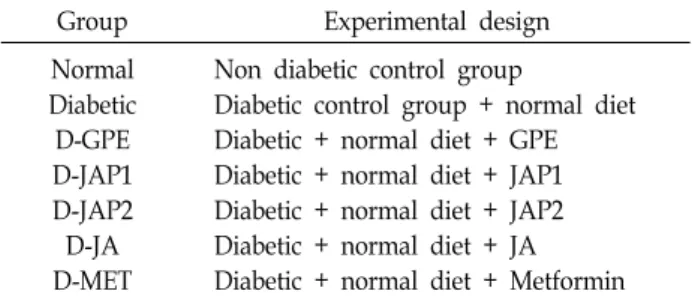
실험동물은 생후 5주령(체중 100~120 g)의 Sprague Daw- ley계 수컷 흰쥐를 ㈜코아텍(Pyeongtaek, Korea)로부터 구입 하여 경상대학교 동물실험윤리위원회의 승인(GNU-151006- R0059) 후 사육 최초 1주일간 고형사료(삼양사, Korea)로 예비 사육한 다음, STZ (Sigma-Aldrich Co., St. Louis, MO, USA)을 pH 4.5의 0.01 M citrate buffer에 용해하여 체중 kg당 45 mg을 복강주사하여 당뇨를 유발시켰다. 정상군은 동량의 citrate buffer를 복강주사하였으며, 48시간 후 꼬리정맥으로부터 혈 당을 측정하여(XEGU082-P04AE, Abbott Diabetes Care Ltd., Witney, US) 300 mg/dl 이상인 흰쥐를 당뇨 유발군로 하여 난괴법에 따라 각 군당 7마리씩 분류하였다. 실험군의 구성은 Table 1에 나타낸 바와 같이 정상군(Normal), 당뇨 대조군(D- control)과 당뇨 유발된 실험동물에 명월초 추출물 급이군(D- GPE; 0.5 g/kg bw), 돼지감자 복합물 급이군(D-JAP1; 0.5 g/
kg bw, D-JAP2; 1.5 g/kg bw), 돼지감자 농축액 급이군(D-JA;
0.5 g/kg bw) 및 양성 대조군으로서 혈당강하 약물로 사용되 는 메타포민(Metformin, Yuyu Co., Seoul, Korea) 급이군(D- MET; 0.2 g/kg bw)으로 구분하였다. 실험식이는 실험사육 4 주 동안 매일 일정시간에 경구투여하였으며, 사육기간 동안 고형사료와 물은 자유 급이시켰다.
실험동물은 사육 최종일에 16시간 절식시킨 후 에틸에테르 로 마취하여 심장 채혈한 후 빙수 중에 30분간 정치한 다음
980× g에서 15분간 원심분리(Mega 17R, HANIL, Incheon, Korea)하여 혈청을 얻었으며, 간 조직은 적출하여 생리식염수 로 혈액을 씻은 다음, 액체 질소로 급속동결하여 -70℃에 보관 해 두고 분석에 사용하였다.
체중측정, 식이섭취량 및 식이효율 측정
실험사육기간 동안 실험동물의 체중은 주 1회 오전 중에 측정하여 체중증가량으로 산출하였다. 식이섭취량은 2일에 1 회씩 잔량을 측정하였으며 1일 평균 식이섭취량은 실험사육 4주간의 총 식이섭취량(g)을 총 실험일수(day)로 나누어 계산 하였다. 식이효율(food efficiency ratio, FER)은 동일기간 동안 의 체중증가량을 총 식이섭취량으로 나누어 산출하였다.
혈당 변화 및 경구 당부하 검사
혈당 변화는 주 1회 일정시간에 꼬리정맥으로부터 혈당계 로 측정하였다. 경구당부하 검사는 실험사육 4주 후 12시간 절식시켜 공복혈당을 측정하고, 즉시 포도당 수용액(0.2 g/kg bw)을 경구투여하여 30, 60, 120 및 180분 경과 시마다 혈당을 측정하였다.
혈중 포도당, 인슐린 정량 및 HOMA-IR 측정
혈중 포도당 함량은 포도당 측정용 kit 시약(AM 201, Asan- pharm Co., Seoul, Korea)으로 측정하였다. 인슐린 함량은 인 슐린 측정용 kit 시약(Rat Insulin ELISA kit, Shibayagi Co.
Ltd., Japan)으로 측정하였으며, 인슐린 저항성지표(HOMA-
IR)는 (fasting serum insulin mU/l) × (fasting serum glucose
mmol/l)/22.5의 계산식에 따라 산출하였다.
AST, ALT, ALP 및 γ-GTP 활성 측정
간기능 평가를 위한 혈중 지표로 인지되는 AST (aspartate aminotransferase), ALT (alanine aminotransferase) 활성도는 AST 및 ALT 측정용 kit 시약(AM 101-k, Asanpharm Co.)으로 측정하여 혈액 1 ml당 Karmen unit로 나타내었다. ALP (alka- line phosphatase) 활성도는 ALP 측정용 kit 시약(AM 105S, Asanpharm Co.)으로 측정하여 혈액 1 ml당 K-A unit로 나타 내었다. γ-GTP (γ-glutamyl transpeptidase) 활성도는 5-ami- nosalicylate법을 이용한 kit 시약(AM 158, Asanpharm Co.)으 로 측정하여 혈액 1 ml당 mU로 나타내었다.
혈청 및 간 조직의 지질 성분 분석
혈청의 총 지질 함량은 혈청 20 μl에 진한 황산 0.2 ml를 가하여 100℃의 수욕상에서 10분간 분해 후 phospho-vanillin 시약 10 ml를 혼합한 다음 37℃에서 15분간 반응시켜 혈청 무첨가구를 대조로 하여 540 nm에서 흡광도를 측정하였다.
표준물질로 대두유(CJ, Seoul, Korea)를 사용하여 동일하게 분 석하여 얻은 검량선으로부터 총 지질 함량을 계산하였다[12].
중성지방 함량은 중성지방 측정용 kit 시약(AM 157S-k, Asan- pharm Co.), 총 콜레스테롤 함량은 총 콜레스테롤 측정용 kit 시약(AM 202-k, Asanpharm Co.), HDL-콜레스테롤 함량은 HDL-콜레스테롤 측정용 kit 시약(AM 203-k, Asanpharm Co.) 으로 각각 측정하였다. LDL-콜레스테롤 함량은 혈청 총 콜레 스테롤−(HDL-콜레스테롤+중성지방/5)의 계산식에 따라 산 출하였으며[11], 심혈관질환 위험지수는 총 콜레스테롤 함량 을 HDL-콜레스테롤 함량으로 나누어 계산하였다[18].
간 조직 중 지질은 간 조직 0.5 g에 chloroform : methanol 혼합액(C:M=2:1, v/v)을 가하여 Poter-Elvehjem tissue grind- er (Daihan, WOS 01010, Wonju, Korea)로 마쇄하여 30 ml로 정용한 다음 냉암소에 24시간 정치하여 지질을 추출하였다 [10]. 이를 여과한 후 일정량을 취하여 50℃에서 C:M용액을 완전제거 후 0.2 ml의 에탄올로 재용해한 다음 상기의 총 지질, 중성지방 및 총 콜레스테롤 측정법에 따라 분석하였다.
간 조직의 지질과산화물 정량
간 조직 중 지질과산화물 함량은 조직 1 g에 1.5% KCl 용액 을 가하여 10% 균질액을 만든 후, 균질액 0.5 ml에 1% phos- phoric acid 3 ml 및 0.6% thiobarbituric acid (TBA, Sigma- Aldrich Co.) 용액 1 ml를 혼합하여 95℃ 수욕상에서 45분간 반응시켰다. 이때 생성된 지질과산화물은 4 ml의 butanol에 이행시켜 532 nm에서 흡광도를 측정하였으며, 표준물질로써 1,1,3,3-tetraethoxypropane (TEP, Sigma-Aldrich Co.)에 의해 생성된 malondialdehyde (MDA) 함량(mmol/g)으로 계산하 였다[41].
간 조직의 항산화효소 수준 측정
간 조직의 항산화효소 수준은 간 조직 2 g에 0.25 M sucrose 및 1 mM EDTA를 포함한 50 mM의 인산 완충액(pH 7.4) 20 ml를 가하여 4℃ 이하에서 마쇄하여 10%(w/v) 균질액을 제조 하였다. 이를 1,100× g에서 10분간 원심분리하고 상층액은 12,000× g에서 20분간 재원심분리하였다. 이때 얻은 상층액을 다시 105,000× g에서 1시간 동안 초원심분리하여 얻은 상층액 을 cytosol 분획물로 하였다. 재원심분리 한 후 남은 잔사는 상기의 완충액을 가하여 12,000× g에서 20분간 원심분리하였 으며, 이때 잔사를 mitochondria 분획물로 구분하였다.
Superoxide dismutase (SOD) 활성 수준은 시료를 첨가하 지 않은 반응액의 pyrogallol 자동산화를 50% 억제하는 효소 의 함량(U/mg protein)으로 계산하였다[33]. Catalase 수준은 0.1 ml의 mitochondria 분획물을 사용하여 Abei [1]의 방법에 따라 분석하여 1분간 1 μM의 H
2O
2를 분해시키는데 소요되는 효소량(μM/min/mg protein)으로 나타내었다. Glutathione peroxidase (GSH-Px) 수준은 cytosol 분획물 0.05 ml를 사용하 여 Flohe 등[9]의 방법에 따라 측정하였다.
통계분석
반복실험을 통해 얻은 결과는 SPSS 12.0 (SPSS Inc., Chica- go, IL, USA)을 사용하여 평균±표준편차로 나타내었으며, 각 실험군의 분석 결과에 대한 통계적 유의성 검정은 일원배치 분산분석(one-way analysis of variance)을 한 후, p<0.05 수준 에서 Duncan's multiple range tests로 사후검정을 하였다.
결과 및 고찰
체중 변화, 식이섭취량 및 식이효율
STZ에 의한 당뇨유발 흰쥐에 명월초 추출물, 돼지감자 복 합물 및 돼지감자 농축액을 4주간 급이하였을 때 실험동물의 체중 변화, 식이섭취량 및 식이효율을 양성 대조군인 메타포 민 급이군과 비교한 결과는 Table 2와 같다. 당뇨유발 전 흰쥐 의 체중은 235.00~240.00 g이었으며, 당뇨유발 후 4주 동안 당 뇨 유발군의 체중증가량은 10.67~66.00 g으로 정상군에 비해 유의적으로 적었다. 반면 당뇨 대조군에 비해 D-GPE, D-JAP1, D-JAP2 및 D-MET군은 유의적인 체중증가 경향을 보였는데, 돼지감자 복합물 급이군은 D-MET군에 비해서는 낮은 수준이 었다. 1일 평균 식이섭취량은 당뇨 대조군에 비해 D-JAP2 및 D-MET군에서 유의적으로 감소된 경향이었다. 식이효율은 당 뇨 대조군(1.38%)에 비해 D-JA군을 제외한 모든 실험군에서 유의적으로 증가되었다.
정상군에 비해 당뇨 유발군에서 1일 식이섭취량은 증가되
었으나 체중증가량이 적었기 때문에 식이효율은 낮은 경향이
었다. 이는 당뇨병의 주된 증상인 다식 현상 및 체중감소와
관련된 결과로 생각되며, 당뇨유발에 의한 췌장 세포의 파괴
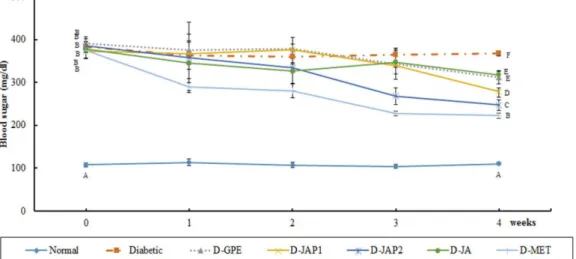
Fig. 1. Effect of the Jerusalem artichoke composite on blood glucose level in STZ induced diabetic rats during 4 weeks. A-FMeans with different superscript in the different groups are significantly different at p<0.05.
Table 2. Effect of the Jerusalem artichoke composite on the body weight, food intake and FER in STZ induced diabetic rats
Group1) Initial body weight (g)
Total body weight gain (g/4 weeks)
Food intake
(g/day) FER2)
Normal Diabetic D-GPE D-JAP1 D-JAP2 D-JA D-MET
236.67±10.23NS 238.33±4.08 238.33±4.08 240.00±6.32 235.00±8.37 238.33±4.08 238.33±4.08
106.67±16.07D 10.67±1.15A 29.00±4.58B 35.33±4.16B 26.33±3.21B 12.00±2.00A 66.00±4.58C
20.74±0.01A 27.28±2.06D 25.94±1.76D 26.04±2.33D 22.24±1.61AB 25.67±2.35CD 23.58±1.50BC
18.37±2.77D 1.38±0.13A 4.17±0.82B 4.69±0.51B 4.08±0.55B 1.57±0.26A 10.37±0.57C
1)Refer to the Table 1.
Values are mean ± SD (n=7).
NSNot significant
A-DMeans with different superscript in the same column are significantly different at p<0.05.
2)Food efficiency ratio = Total body weight gain (g/4 weeks)/food intake (g/4 weeks) ×100.
로 인슐린의 분비 이상, 당 대사의 불균형으로 체단백질 및 지방을 분해하는 퇴행적 대사가 진행되었기 때문이며[7], 당뇨 병의 진행에 따라 식이효율 및 체중이 감소된다는 보고[43]와 일치한 결과였다. 반면에 본 연구에서 명월초 추출물, 돼지감 자 복합물 급이군은 당뇨 대조군에 비해 유의적인 체중 증가 현상을 보였으나, D-JA군에서는 당뇨 대조군과 유의적인 차이 를 보이지 않았는데, 돼지감자 복합물로 구성된 명월초, 여주 및 울금의 상호작용에 기인한 결과라 사료된다.
혈당 변화 및 경구당부하 검사
STZ로 당뇨유발된 흰쥐에 돼지감자 복합물을 4주간 급이 하는 동안 혈당 변화 및 경구당부하 검사 결과는 Fig. 1 및 Fig. 2와 같다. 혈당 변화는 Fig. 1과 같이 STZ 주사 후 2일째 모든 당뇨 유발군에서 373.60~385.00 mg/dl의 범위였다. 실험 사육 4주 동안 정상군(104.00~113.40 mg/dl) 및 당뇨 대조군 (359.80 ~382.20 mg/dl)의 혈당 변화는 사육기간의 경과에 따
른 유의차가 없었다. D-JAP2군과 D-MET군은 3주 경과 후 혈 당감소가 두드러지게 나타났으며, 4주 이후에는 당뇨 대조군 에 비해 모든 실험군에서 유의적으로 감소되는 경향이었다.
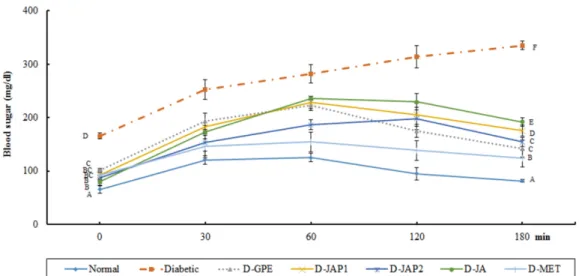
실험사육 4주 후 포도당 급이에 따른 경구당부하 검사 결과 는 Fig. 2에 나타낸 바와 같이 대부분의 실험동물에서 포도당 급이 60분 경과 후에 가장 높은 혈당 수준을 보였으나, D-GPE, D-JAP1 및 D-JA군에 비해 D-JAP2군은 현저히 낮은 수준이었 다. 120분 경과 후부터 혈당은 점차 감소되는 경향이었으며, 180분 경과 후에는 D-GPE 및 D-JAP2군에서 비슷한 경향이었 으며, 이는 D-JA 및 D-JAP1군에 비해 유의적으로 낮은 수준이 었다.
STZ에 의한 당뇨유발 흰쥐에 돼지감자 추출액의 경구투여
시 3주 경과 후 당뇨 대조군에 비해 31.0% 정도 유의적인 혈당
감소를 보였다는 보고가 있다[20]. 명월초잎의 물 추출물을
STZ로 당뇨유발된 흰쥐에 2주간 급이한 경우 당뇨 대조군에
비해 혈당이 감소되었는데[13], 이는 명월초에 함유된 astrga-
Fig. 2. Effect of the Jerusalem artichoke composite on oral glucose tolerance test (OGTT) in STZ induced diabetic rats. A-FMeans with different superscript in the different groups are significantly different at p<0.05.
Table 3. Effect of the Jerusalem artichoke composite on blood fasting glucose, serum insulin and HOMA-IR levels in STZ induced diabetic rats
Group1) Serum glucose (mg/dl)
Serum insulin
(ng/ml) HOMA-IR
Normal Diabetic D-GPE D-JAP1 D-JAP2 D-JA D-MET
73.20±3.70A 189.60±13.83E 103.20±3.63C 96.40±5.03C 84.80±5.63B 128.40±5.41D 83.40±3.51B
2.45±0.49B 1.31±0.11A 1.55±0.12A 1.47±0.10A 1.62±0.36A 1.41±0.10A 1.63±0.17A
11.83±1.87BC 18.33±1.48D 11.85±0.88BC 10.54±0.44AB 9.64±1.83A 13.05±0.50C 10.26±0.97AB
1)Refer to the Table 1.
Values are mean ± SD (n=7).
A-EMeans with different superscript in the same column are sig- nificantly different at p<0.05.
lin, isoquercitin, kaempferol 및 rutin 등과 같은 플라보노이드 성분과 관련된 것으로 보고되어 있다[15]. 여주의 유산균 발효 물을 alloxane에 의한 당뇨쥐에게 급이하였을 때 2주 경과 후 혈당증가가 완화되었는데[36], 이는 여주의 카란틴 성분과 관 련이 있다는 보고도 있다[28]. 더욱이 명월초[21], 여주[2], 울금 [37]은 in vitro에서 α-glucosidase 저해활성이 높은 것으로 알 려져 있으며, 본 연구에서 돼지감자 복합물의 혈당강하 활성 은 이들 시료가 간세포에서 AMPK 활성화 및 근육세포에서 세포 내 당 유입을 유의적으로 증가시켰다는 결과[29]와 관련 성이 큰 것으로 판단된다.
혈당, 인슐린 함량 및 HOMA-IR 수준
STZ에 의한 당뇨쥐에 명월초 추출물 및 돼지감자 복합물을 급이하였을 때 혈청 인슐린 함량 및 인슐린 저항성 지표인 HOMA-IR에 대한 결과는 Table 3과 같다. 혈당 함량은 당뇨
대조군(189.60 mg/dl)이 정상군(73.20 mg/dl)보다 약 2.5배 높 았다. D-GPE군(103.20 mg/dl) 및 D-JAP1군(96.40 mg/dl)은 당뇨 대조군에 비해 각각 45.6% 및 49.1% 정도 감소된 수준이 었으며, D-JAP2 및 D-MET군은 50% 이상 감소되었다. 혈청 인슐린 함량은 실험식이의 종류에 따른 유의차를 보이지 않았 다. HOMA-IR 값은 당뇨 대조군에 비해 실험식이 급이군에서 유의적으로 감소되었는데, D-GPE, D-JAP1 및 D-JA군은 정상 군과 유사한 수준이었으며 D-JAP2군은 정상군보다 유의적으 로 낮은 경향이었다.
명월초의 물 추출물은 HepG2 간세포에서 당대사 관련 효 소인 glucokinase (GCK), pyruvate dehydrogenase (PDH), acetyl-CoA carboxylase (ACC) mRNA의 발현을 증가시킴으 로써 혈당강하 효과를 발휘하며[21], 에탄올 추출물은 3T3- F442A 지방세포주에서 당 흡수 정도를 향상시켜 항당뇨 활성 이 있는 것으로 알려져 있다[4]. 여주 추출물은 제 2형당뇨 모 델인 db/db 마우스에게 8주간 급이하였을 때 혈당 및 인슐린 수준을 감소시켜 인슐린 저항성 개선에 효과적이었다고 보고 되어 있다[16]. 울금의 50%에탄올 추출물은 db/db 마우스를 대 상으로 고지방식이에 1.5% 수준으로 혼합하여 8주간 급이하 였을 때 공복혈당 및 hemoglobin A1C 수준이 당뇨 대조군에 비해 유의적으로 감소된다고 보고되어 있다[44].
따라서 본 연구에서 돼지감자 복합물의 급이 시 인슐린 저 항성이 낮았던 것도 복합물 중 명월초를 비롯한 여러 식물체 의 혼합된 성분에 의한 것으로 추정된다.
혈청 AST, ALT, ALP 및 γ-GTP 활성도
STZ 유발 당뇨쥐에게 명월초 추출물 및 돼지감자 복합물의
급이 시 간기능 지표효소인 AST, ALT, ALP 및 γ-GTP 활성을
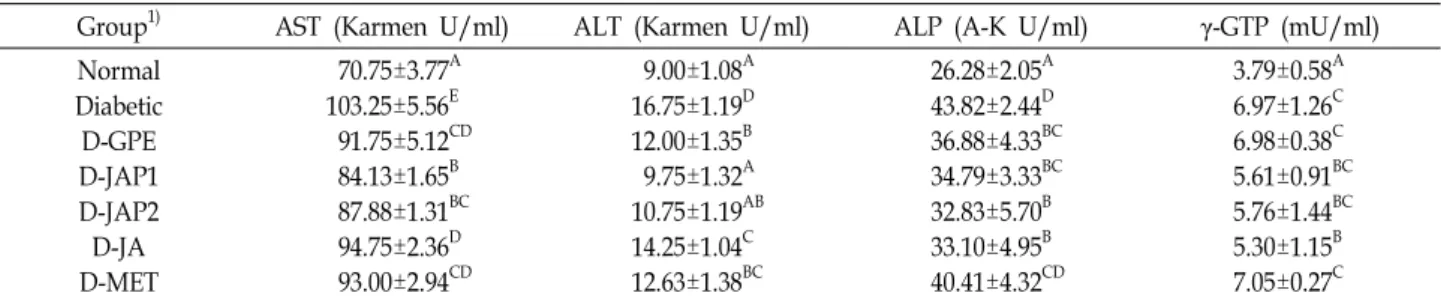
측정한 결과는 Table 4와 같다. AST 및 ALT 활성은 당뇨 대조
군에 비해 실험식이 급이군에서 모두 유의적으로 감소되었는
Table 4. Effect of the Jerusalem artichoke composite on AST, ALT, ALP and γ-GTP activities in STZ induced diabetic rats
Group1) AST (Karmen U/ml) ALT (Karmen U/ml) ALP (A-K U/ml) γ-GTP (mU/ml)
Normal Diabetic D-GPE D-JAP1 D-JAP2 D-JA D-MET
70.75±3.77A 103.25±5.56E 91.75±5.12CD 84.13±1.65B 87.88±1.31BC 94.75±2.36D 93.00±2.94CD
9.00±1.08A 16.75±1.19D 12.00±1.35B 9.75±1.32A 10.75±1.19AB 14.25±1.04C 12.63±1.38BC
26.28±2.05A 43.82±2.44D 36.88±4.33BC 34.79±3.33BC 32.83±5.70B 33.10±4.95B 40.41±4.32CD
3.79±0.58A 6.97±1.26C 6.98±0.38C 5.61±0.91BC 5.76±1.44BC 5.30±1.15B 7.05±0.27C
1)Refer to the Table 1.
Values are mean ± SD (n=7).
A-EMeans with different superscript in the same column are significantly different at p<0.05.
Table 5. Effect of the Jerusalem artichoke composite on the serum lipid profiles in STZ induced diabetic rats
Group1) Total lipid (mg/dl)
Triglyceride (mg/dl)
Total cholesterol (mg/dl)
HDL-C (mg/dl)
LDL-C
(mg/dl) CRF
Normal Diabetic D-GPE D-JAP1 D-JAP2 D-JA D-MET
264.75±17.55A 413.75±42.99D 294.25±14.64AB 297.25±33.85AB 354.75±64.58C 336.75±45.71BC 296.25±44.63AB
73.50±6.11A 195.79±8.80F 106.50±3.61B 128.93±5.14C 112.22±6.07B 156.57±4.21E 141.43±8.37D
68.10±3.93A 91.65±3.86B 68.35±2.73A 73.30±4.64A 67.50±2.66A 72.60±4.07A 70.90±2.82A
35.71±0.97E 27.50±2.28A 32.09±2.60CD 31.73±2.58BCD 34.16±0.98DE 28.75±3.31ABC 28.57±1.62AB
17.69±3.02B 24.99±7.19C 14.96±2.96AB 15.78±4.10AB 10.90±2.27A 12.54±2.07AB 14.04±3.99AB
1.91±0.10A 3.36±0.42D 2.14±0.15AB 2.32±0.17BC 1.98±0.08A 2.54±0.2C 2.49±0.14C
1)Refer to the Table 1.
Values are mean ± SD (n=7).
CRF : cardiac risk factor
A-EMeans with different superscript in the same column are significantly different at p<0.05.
데, 특히 D-JAP1군에서 가장 낮은 수준이었다. ALP 활성은 D-GPE, D-JAP1, D-JAP2 및 D-MET군간에 유의차가 없었다.
γ-GTP 활성은 D-JA군이 당뇨 대조군에 비해 유의적으로 낮은 경향이었다.
STZ에 의한 당뇨쥐에 돼지감자 열수 추출물을 4주간 급이 하였을 때 혈중 AST 및 ALT 활성은 당뇨 대조군에 비해 각각 14.3% 및 27.3% 정도 유의적으로 감소된 것으로 보고되어 있 다[20]. 2형당뇨 모델 db/db 마우스에서 여주 추출물을 10~250 mg/kg씩 8주간 급이하였을 때 AST 및 ALT 활성은 당뇨 대조 군에 비해 유의적으로 감소되었다는 보고도 있다[16].
당뇨쥐에 돼지감자 복합물의 급이 시 복합물의 농도에 따른 유의차는 없었으나, 적은 농도의 시료 급이 시 오히려 AST 및 ALT 활성의 안정화에 효과적인 것으로 생각되며, 본 실험 에서 설정한 복합물의 섭취량이 체내 간 기능 손상에 영향을 주지는 않는 것으로 사료된다.
혈청 및 간 조직의 지질 함량
당뇨유발 흰쥐에 명월초 추출물 및 돼지감자 복합물을 4주 간 급이한 후 혈청 및 간조직의 지질 성분을 분석한 결과는 Table 5 및 Table 6과 같다. 혈청 총 지질 및 중성지방 함량은 당뇨 대조군에 비해 실험식이 급이군에서 유의적으로 감소되
었으며, 특히 D-GPE군에서 가장 낮았다. 총 지질 함량은 D-GPE, D-JAP1, D-JA 및 D-MET군간에 비슷한 수준이었으 며, 중성지방 함량은 D-GPE과 D-JAP2군간에 유의차를 보이 지 않았다. 총 콜레스테롤 및 LDL-콜레스테롤 함량은 실험식 이 급이군간에 유의차가 없었다. HDL-콜레스테롤 함량은 당 뇨 대조군에 비해 D-GPE, D-JAP1 및 D-JAP2군에서 유의적으 로 증가되는 경향이었다. 심혈관질환 위험지수는 당뇨 대조군 에 비해 실험식이 급이군에서 유의적으로 감소되었으며, 특히 D-GPE 및 D-JAP2군에서 정상군과 유사한 수준을 보였다 (Table 5).
간 조직의 지질 성분은 Table 6에 나타낸 바와 같이, 총 지질 함량은 실험식이 급이군과 당뇨 대조군간에 유의차가 없었으 며, 중성지방 함량은 당뇨 대조군에 비해 실험식이의 급이에 따라 유의적으로 감소되었다. 특히 D-GPE, D-JAP1 및 D-JAP2 군은 D-MET군과 유사한 수준으로 감소되었다. 총 콜레스테 롤 함량은 D-GPE군에서만 유의적인 감소를 보였다.
당뇨병에서 혈중 총 콜레스테롤이 상승하는 것은 탄수화물
의 이용이 원활하지 못하고 유리지방산이 에너지로 사용되면
서 콜레스테롤 합성이 증가되기 때문으로 알려져 있다[8]. 당
뇨성 흰쥐에 돼지감자의 열수 추출물을 4주간 급이하였을 때
혈중 중성지방, HDL- 및 LDL-콜레스테롤 함량은 당뇨 대조군
Table 6. Effect of the Jerusalem artichoke composite on the hep- atic lipid profiles in STZ induced diabetic rats
(mg/g, wet liver tissue) Group1) Total lipid Triglyceride Total cholesterol Normal
Diabetic D-GPE D-JAP1 D-JAP2 D-JA D-MET
21.80±1.90A 27.03±1.02B 24.63±1.02AB 24.64±4.76AB 24.23±2.15AB 26.64±1.38B 23.90±1.98AB
9.63±1.80A 14.49±0.66C 10.00±1.17A 10.43±0.77A 10.26±0.85A 12.02±0.90B 9.15±0.97A
1.71±0.18A 2.24±0.06BC 1.74±0.23A 2.26±0.23BC 2.10±0.29BC 2.33±0.20C 2.00±0.10B
1)Refer to the Table 1.
Values are mean ± SD (n=7).
A-CMeans with different superscript in the same column are sig- nificantly different at p<0.05.
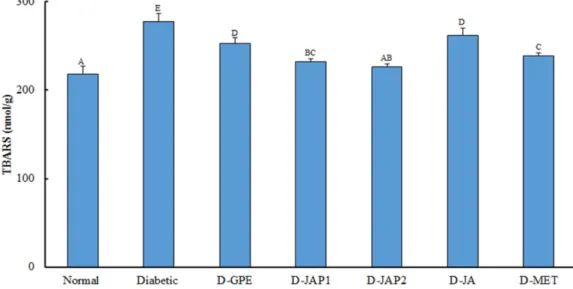
Fig. 3. Effect of the Jerusalem artichoke composite on TBARS content in liver tissue of the STZ induced diabetic rats. A-EMeans with different superscript in the different groups are significantly different at p<0.05.
에 비해 각각 25.4%, 31.8% 및 56.6%의 유의적인 감소를 보였 다는 보고도 있다[20]. 여주 분말은 STZ에 의한 당뇨성 흰쥐에 5% 수준으로 식이에 혼합급이하였을 때 혈중 HDL-콜레스테 롤 함량이 정상군보다 유의적으로 증가되었으며[24], 당뇨쥐 에 0.5%의 울금 분말을 함유하는 식이가 급이된 경우에도 혈 중 중성지방, 총 콜레스테롤 및 LDL-콜레스테롤 수준이 유의 적으로 감소되었는데[3], 이는 울금 중 커큐민(curcumin) 성분 에 의한 담즙분비 촉진 및 혈중 콜레스테롤의 감소와 관련된 것으로 알려져 있다[38]. 여주 추출물은 C57BL/6J db/db 마우 스에 10~250 mg/kg 수준으로 8주간 급이되었을 때 간 조직 중 지방공포의 형성을 현저하게 저해시켰다는 보고도 있다 [16].
당뇨쥐에 녹차 분말의 혼합급이 시 간 조직의 지질 수준이 유의적으로 감소된 것은 시료 중의 식이섬유소와 페놀화합물 의 상호작용에 기인된 것으로 보고되어 있다[25]. 본 연구결과
당뇨유발 흰쥐에 명월초 추출물, 돼지감자 복합물 및 농축물 의 급이는 체내 지질 성분의 함량 조절에 효과적이었는데, 이 는 여러 식물체의 상호작용에 의한 것으로 여겨지며[29], D- GPE군에서 혈중 지질 수준이 유의적으로 낮았던 것은 돼지감 자 복합물의 활성에서 명월초의 영향이 더 크게 작용되었기 때문이라 추정된다.
간 조직의 지질과산화물 함량
STZ에 의한 당뇨쥐에 명월초 추출물 및 돼지감자 복합물의 급이 후 간 조직의 지질과산화물 함량을 측정한 결과는 Fig.
3과 같다. 정상군(218.44 nmol/g)에 비해 당뇨 대조군은 277.59 nmol/g으로 유의적으로 증가되었으나, 실험식이 급이군에서 는 당뇨 대조군에 비해 유의적인 감소를 보였다. 특히 돼지감 자 복합물 급이군에서 가장 낮은 수준이었으며, 복합물의 농 도에 따른 유의차는 없었다.
STZ에 의한 당뇨쥐에 와송과 생약재 추출물의 혼합물을 급이하였을 때 간 조직 내 지질과산화물 함량이 유의적으로 감소되었는데, 시료 중 플라보노이드를 비롯한 페놀 화합물에 의한 항산화 활성과 비례적인 것으로 보고된 바 있다[39]. 또한 약용식물 추출물을 각각 2종씩 동량으로 혼합하여 혼합 전·후 의 항산화 활성을 측정한 결과, 혼합 전에 비해 큰 차이는 없으 나, 혼합으로 인해 생리활성의 안정화가 가능해졌다는 보고도 있다[23]. 명월초, 여주 및 울금 중 총 페놀 및 플라보노이드 성분은 돼지감자에 비해 많은 함량으로 돼지감자 복합물의 항산화 활성과 상관관계가 큰 것으로 보고되어 있다[29].
생체 내에서 초래되는 유리 라디칼은 세포막의 불포화지방
산을 산화적 분해하여 산화적 스트레스를 일으켜 간, 신장 및
기타 조직에서의 지질과산화물 함량이 증가하게 된다[5]. 따라
서 본 연구에서 당뇨쥐에 돼지감자 복합물의 급이 시 간 조직
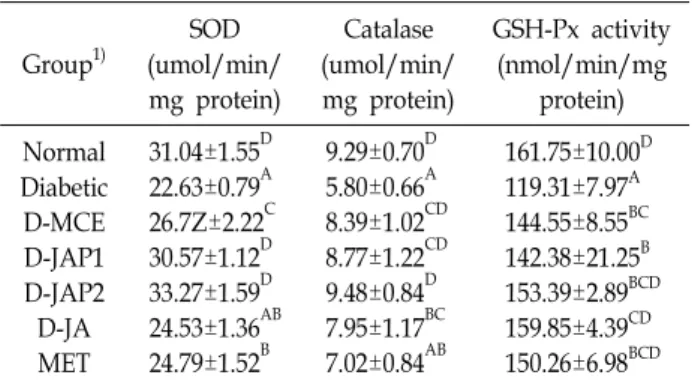
Table 7. Effect of the Jerusalem artichoke composite on the hep- atic SOD, catalase and GSH-Px levels in the STZ in- duced diabetic rats
Group1)
SOD (umol/min/
mg protein)
Catalase (umol/min/
mg protein)
GSH-Px activity (nmol/min/mg
protein) Normal
Diabetic D-MCE D-JAP1 D-JAP2 D-JA MET
31.04±1.55D 22.63±0.79A 26.7Z±2.22C 30.57±1.12D 33.27±1.59D 24.53±1.36AB 24.79±1.52B
9.29±0.70D 5.80±0.66A 8.39±1.02CD 8.77±1.22CD 9.48±0.84D 7.95±1.17BC 7.02±0.84AB
161.75±10.00D 119.31±7.97A 144.55±8.55BC 142.38±21.25B 153.39±2.89BCD 159.85±4.39CD 150.26±6.98BCD
1)Refer to the Table 1.
Values are mean ± SD (n=7).
A-DMeans with different superscript in the same column are sig- nificantly different at p<0.05.
내 지질과산화물의 생성이 감소된 것은 이들 시료 중 항산화 성 물질이 체내 조직의 보호 및 항산화 작용에 관여하였기 때문이라 해석된다.
간 조직의 항산화효소 수준
STZ에 의한 당뇨쥐에 명월초 추출물 및 돼지감자 복합물의 급이 시 간 조직의 항산화효소 수준에 미치는 영향을 측정한 결과는 Table 7과 같다. 간 조직의 항산화효소로써 SOD, cata- lase 및 GSH-Px 수준은 정상군에 비해 당뇨 대조군에서 유의 적으로 감소되었으나, 실험식이의 급이로 증가되는 경향이었 다. SOD 및 catalase 수준은 D-GPE, D-JAP1 및 D-JAP2군에서 당뇨 대조군에 비해 유의적으로 증가되었으며, GSH-Px 수준 은 모든 실험식이 급이군에서 유의적으로 증가되었다.
여주 분말을 STZ에 의한 당뇨쥐에 5~10% 수준으로 혼합급 이 시 간 조직의 SOD 수준은 당뇨 대조군과 유의차를 보이지 않았으나, xanthine oxidase 및 glutathione-S-transferase 수준 은 여주 첨가량에 비례적으로 증가된 경향이었는데, 이는 시 료 투여에 의한 체내 산화적 손상에 대한 방어작용인 것으로 고찰된 바 있다[24].
생물체는 유리기에 노출되었을 때 자신을 스스로 보호할 수 있는 기능이 생체 내에 존재하는데, 그 방어기전은 활성 산소의 발생을 저해하는 기능과 생성된 활성산소를 소거하는 기능으로 크게 구별된다. 본 연구에서 당뇨 유발 시 간 조직 내 SOD 수준은 돼지감자 복합물 급이군에서 증가되는 경향을 보였다. 만성 당뇨상태나 노령화될수록 GSH-Px 수준은 감소 된다고 보고되어 있는데[26], 이는 혈당 상승과 상관관계가 높 다는 보고가 있다[30]. 또한 catalase나 GSH-Px는 생체 내 과산 화수소를 분해시킴으로써 지질과산화를 유도하는 활성산소 의 생성을 저해하는 것으로 알려져 있다[35]. 따라서 만성적인 당뇨 환자에서 돼지감자 복합물의 지속적인 섭취는 간 조직
내 항산화효소 수준의 증가와 혈당 조절에 관여함으로써 항당 뇨 활성에 도움이 될 것으로 기대된다.
감사의 글
본 연구는 2015년도 경상남도 항노화바이오산업육성사업 의 지원으로 수행된 연구결과이며, 이에 감사 드립니다.
References
1. Abei, H. 1974. Catalase in vitro methods. Bergmeyer, H.
U. ed. Methods of Enzymatic Analysis. Academic Press, Inc., New York, USA. 2, 673-684.
2. Ahn, M. J., Yuk, H. J., Lee, H. Y., Hwang, C. E., Jeong, Y.
S., Hong, S. Y., Kwon, O. K., Kang, S. S., Kim, H. R., Park, D. S. and Cho. K. M. 2015. Effect of the enhanced biological activities and reduced bitter taste of bitter melon (Momordica charantia L.) by roasting. J. Agric. Life Sci. 49, 107-119.
3. Babu, P. S. and Srinivasan, K. 1997. Hypolipidemic action of curcumin, the active principle of turmeric (Curcuma longa) in streptozotocin induced diabetic rats. Mol. Cell. Biochem.
166, 169-175.
4. Bohari, M., Pauliena, S., Muhajir, H., Khozirah, S. and Lajis, N. 2006. Glucose uptake: stimulatory Activity of Gynura pro- cumbens in 3T3-F442A adipocytes. In: Fasihuddin Ahmad, Z.B., Laily Din, Ikram Said (Eds.), Malaysian Medicinal Plants: Chemistry and Biological activity. Universiti Malaysia, Sarawak, Malaysia.
5. Celik, S., Baydas, G. and Yilmaz, O. 2002. Influence of vita- min E on the levels of fatty acids and MDA in some tissues of diabetic rats. Cell Biochem. Funct. 20, 67-71.
6. Cha, J. Y., Jin, J. S. and Cho, Y. S. 2011. Biological activity of methanolic extract from Ganoderma lucidum, Momordica charantia, Fagopyrum tatricum, and their mixtures. J. Life Sci.
21, 1016-1024.
7. Cho, Y. J. and Bang, M. A. 2004. Hypoglycemic and anti- oxidative effects of dietary sea-tangle extracts supplementa- tion in streptozotocin-induced diabetic rats. Kor. J. Nutr. 37, 5-14.
8. Choi, K. S. 2013. Effects of coated liposome from Discorea rhizoma extract (DRE)-on hypoglycemic, serum insulin, and lipid levels in streptozotocin-induced. Kor. J. Food Nutr. 26, 310-317.
9. Flohe, L., Wolfgang, A. and Gunzler, W. A. 1984. Assay of glutathione peroxidase. Packer L. ed. Methods Enzymology.
Academic Press, Inc., New York, USA. 105, 114-121.
10. Folch, J., Lees, M. and Stanley, G. H. 1957. A simple method for the isolation and purification of total lipids from animal tissues. J. Biol. Chem. 226, 497-502.
11. Friedewald, W. T., Levy, R. I. and Fredrickson, D. S. 1972.
Estimation of the concentration of low density lipoprotein cholesterol in plasma, without use of the preparative ultracentrifuge. Clin. Chem. 18, 499-502.
12. Frings, C. S., Fendley, T. W., Dunn, R. T. and Queen, C.
A. 1972. Improved determination of total serum lipids by the sulfo-phospho-vanillin reaction. Clin. Chem. 18, 763-764.
13. Hassan, Z., Yam, M. F., Ahmad, M. and Yusof, A. P. M.
2010. Antidiabetic properties and mechanism of action of Gynura procumbens water extract in streptozotocin-induced diabetic rats. Molecules 15, 9008-9023.
14. Hyun, M. R. 2012. Effects of curcumin on high glucose-in- duced podocyte injury. MS dissertation, Soonchunhyang University, Asan, Korea.
15. Jeon, H. J., Cha, Y. H. and Jang, H. R. 2016. Isolation and rutin quantitative analysis of antioxidants substances from Gynura procumbens extract. J. Welliness 11, 165-466.
16. Jeong, J. H., Lee, S. H., Hue, J. J., Lee, K. N., Nam, S. Y., Yun, Y. W., Jeong, S. W., Lee, Y. H. and Lee, B. J. 2008.
Effect of bitter melon (Momordica charantia) on anti-diabetic activity in C57BL/6J db/db mice. Kor. J. Vet. Res. 48, 327-336.
17. Joseph, B. and Jini, D. 2013. Antidiabetic effects of Momordia charantia (bitter melon) and its medicinal potency. Asian Pac.
J. Trop. Dis. 3, 93-102.
18. Kang, S. M., Shim, J. Y., Hwang, S. J., Hong, S. G., Jang, H. E. and Park, M. H. 2003. Effects of Saengshik supple- mentation on health improvement in diet-induced hyper- cholesterolemic rats. J. Kor. Soc. Food Sci. Nutr. 32, 906-912.
19. Kim, C. G., Kim, S. I. and Shin, H. K. 1993. Effect of fructoo- ligosaccharide-inulin of Jerusalem artichoke on the growth of intestinal microorganisms of pig. Kor. J. Food Sci. Technol.
25, 395-399.
20. Kim, H. J., Kim, D. I. and Yon, J. M. 2015. Effects of Jerusalem artichoke (Helianthus tuberosus L.) extracts on blood glucose and lipid metabolism in STZ-induced diabetic rats. Kor. J. Clin. Lab. Sci. 47, 203-208.
21. Kim, H. S., Kim, T. W., Kim, D. J., Lee, J. S., Kim, K. K.
and Choe, M. 2013. Antioxidant activities and α-glucosidase inhibitory effect of water extracts from medicinal plants.
Kor. J. Med. Crop Sci. 21, 197-203.
22. Kim, J. L., Bae, C. R. and Cha, Y. S. 2010. Helianthus tuberosus extract has antidiabetes effects in HIT-T15 cells. J. Kor. Soc.
Food Sci. Nutr. 39, 31-35.
23. Kim, K. D. 2007. Research of efficacy & stability about mixed medicinal plants extracts. J. Kor. Soc. Cosm. 13, 601-608.
24. Kim, M. W. 2014. Effect of dietary supplementation with bitter melon on lipids and hepatic enzyme levels in strepto- zotocin induced diabetic rats. J. East Asian Soc. Diet. Life 24, 759-767.
25. Kim, S. H. 2008. Effects of green tea a powder on plasma and liver lipid concentration in diabetic rats. MS Thesis, Keimyung University, Daegu, Korea.
26. Kinalski, M., Sledziewski, A., Telejko, B., Zarzycki, W. and Kinalska, I. 2000. Lipid peroxidation and scavenging en- zyme activity in streptozotocin-induced diabetes. Acta Diabetol. 37, 179-183.
27. Kwon, G. J., Choi, D. S. and Wang, M. H. 2007. Biological activities of hot water extracts from Euonymus alatus leaf.
Kor. J. Food Sci. Technol. 39, 569-574.
28. Lee, H. J., Moon, J. H., Lee, W. M., Lee, S. G., Kim, A. K., Woo, Y. H. and Park, D. K. 2012. Charantin contents and
fruit characteristics of bitter gourd (Momordica charantia L.) accessions. J. Bio-environment Control 21, 379-84.
29. Lee, S. J., Hu, W. S., Pyo, J. H., Ryu, J. H., Kang, D., Jeong, B. Y. and Sung, N. J. 2018. Anti-oxidant and anti-diabetic activities of Jerusalem artichoke composites containing Gynura procumbens, Momordica charantia and Curcuma longa via AMPK activation. J. Sci. Life 28, 26-36.
30. Lee, S. J., Shin, J. H., Ju, J. C., Kang, S. K. and Sung, N.
J. 2013. Hypoglycemic and hypolipidemic effects of Orosta- chys japonicus with medicinal herbs in streptozotocin-in- duced diabetic rats. J. Kor. Soc. Food Sci. Nutr. 42, 587-594.
31. Lee, W. Y., Ahn, J. K., Park, Y., Park, S. Y., Kim, Y. M. and Rhee, H. I. 2004. Inhibitory effects of proanthocyanidin ex- tracted from Distylium racemosum on α-amylase and α-gluco- sidase activities. Kor. J. Phamacogn. 35, 271-275.
32. Lim, S. J., Han, H. K. and Ko, J. H. 2003. Effects of edible and medicinal plants intake on blood glucose, glycogen and protein levels in streptozotocin induced diabetic rats. Kor.
J. Nutr. 36, 981-989.
33. Marklund, S. and Marklund, G. 1974. Involvement of super- oxide anion radical in the oxidation of pyrogallol and a con- venient assay for superoxide dismutase. Eur. J. Biochem. 47, 469-474.
34. Meena, A. K., Bansal, P. and Kumar, S. 2009. Plants-herbal wealth as a potential source of ayurvedic drugs. Asian Pac.
J. Trop. Med. 4, 152-170.
35. Nam, A. M., Kim, J. G., Ham, S. S., Kim, S. J., Chung, M.
E. and Chung, C. K. 1999. Effects of Artemisia iwayomogi ex- tracts on antioxidant enzymes in rats administered benzo (α)pyrene. J. Kor. Soc. Food Sci. Nutr. 28, 199-204.
36. Park, H. S., Kim, W. K., Kim, H. P. and Yoon, Y. G. 2015.
The efficacy of lowering blood glucose levels using the ex- tracts of fermented bitter melon in the diabetic mice. J. Appl.
Biol. Chem. 58, 259-265.
37. Petnual, P., Sangvanich, P. and Karnchanatat, A. 2010. A lectin from the rhizomes of turmeric (Curcuma longa L.) and its antifungal, antibacterial, and α-glucosidase inhibitory activities. Food Sci. Biotechnol. 19, 907-916.
38. Rao, D. S., Sekhara, N. C., Satyanarayana, M. N. and Srini- vasan, M. 1970. Effect of curcumin on serum and liver cho- lesterol levels in the rat. J. Nutr. 100, 1307-1315.
39. Shin, J. H., Lee, S. J., Seo, J. K., Lee, H. J., Ju, J. C. and Sung, N. J. 2012. Effect of a combined extract of Orostachys japonicus with medicinal plants on the lipid composition of the liver and kidney from streptozotocin-induced diabetic rats. J. Kor. Soc. Food Sci. Nutr. 41, 510-518.
40. Son, H. K., Han, J. H. and Lee, J. J. 2014. Anti-diabetic effect of the mixture of mulberry leaf and green tea powder in rats with streptozotocin-induced diabetes. Kor. J. Food Preserv. 21, 549-559.
41. Uchiyama, M. and Mihara, M. 1978. Determination of ma- londialdehyde precursor in tissues by TBA test. Anal.
Biochem. 86, 271-278.
42. Yoo, J. W. 2013. What is needed for early detection of dia- betes complications? J. Kor. Diabetes 14, 32-35.
43. Yoon, J. A. and Son, Y. S. 2009. Effects of fruits and stems
초록:명월초, 여주 및 울금을 포함하는 돼지감자 복합물의 streptozotocin 유발 당뇨쥐에서 혈당강하 및 체내 지질개선에 미치는 영향
호문사
1†․이수정
2†․표재호
3․김성희
1,2․성낙주
1,4*
(1경상대학교 식품영양학과, 2경상대학교 농업생명과학연구원, 3산청기능성콩영농조합법인, 4경상대학교 기초과학
연구소)
돼지감자 농축액(JA, 50%)에 명월초(12.5%), 여주(12.5%), 울금(12.5%) 추출물이 혼합된 돼지감자 복합물(JAP) 을 streptozotocin (STZ)으로 당뇨 유발된 흰쥐에 4주간 급이하였을 때 혈당강하 및 지질개선에 미치는 영향을 분석하였다. 실험군은 정상군(Normal), 당뇨 대조군(Diabetic), 당뇨 유발된 흰쥐에 명월초 추출물 급이군(D-GPE), 돼지감자 복합물 급이군(0.5 g/kg, D-JAP1; 1.5 g/kg, D-JAP2), 돼지감자 농축액 급이군(D-JA) 및 메타포민 급이군 (D-MET)으로 구분하였다. 실험사육 4주 동안 혈당 변화는 D-JAP2군 및 D-MET군에서 3주간 실험식이 급이 후 두드러진 감소현상을 보였다. 혈청 인슐린 함량은 실험식이의 급이에 따른 유의차가 없었으나, HOMA-IR값은 당 뇨 대조군에 비해 실험식이 급이군에서 유의적으로 감소되었다. 혈청의 AST 및 ALT 활성은 D-JAP1군에서 가장 낮았다. 혈청의 총 지질 및 중성지방 함량은 당뇨 대조군에 비해 시료 급이군에서 유의적으로 감소되었으며, HDL-콜레스테롤 함량은 당뇨 대조군에 비해 D-GPE, D-JAP1 및 D-JAP2군에서 유의적으로 증가되었다. 간 조직 중 중성지방 함량은 당뇨 대조군에 비해 D-GPE, D-JAP1 및 D-JAP2군에서 유의적으로 감소되었으며, 지질과산화 물의 함량은 당뇨 대조군에 비해 D-JAP1 및 D-JAP2군에서 유의적으로 감소되었다. 간 조직의 SOD 및 catalase 수준은 당뇨 대조군에 비해 D-GPE, D-JAP1 및 D-JAP2군에서, GSH-Px 수준은 모든 실험식이 급이군에서 유의적 으로 증가되었다. 이상의 결과에서 돼지감자 복합물은 돼지감자 농축액에 비해 혈당강하 및 당뇨로 인한 지질개 선에 효과적인 것으로 판단된다.
of Opuntia ficus-indica on blood glucose and lipid metabo- lism in streptozotocin-induced diabetic rats. J. Kor. Soc. Food Sci. Nutr. 38, 146-153.
44. You, M. K., Kim, M. S., Rhyu, D. Y. and Kim, H. A. 2013.
Effect of Curcuma longa L. on the obesity and insulin resist- ance in Sprague-Dawley rats and db/db mice. Kor. J. Food
Preserv. 20, 1-6.
45. Zadch, J. N., Rahimi, A., Sarmadil, J. T., Tritschler, H., Rosen, P., Halliwell, B. and Betteridge, D. J. 1997.
Relationships between plasma measures of oxidative stress and metabolic control in NIDDM. Diabetologia 40, 647-653.