Changes in Blood Lipid Profile and Hepatic Enzyme Levels after Oriental Medical Treatment to Metabolic Syndrome Patients
with Abnormal Liver Function
Dong Woung Kim*
Department of Internal Medicine, College of Oriental Medicine, Wonkwang University
Among patients who are receiving treatments at an oriental medical hospital for various symptoms and diseases, patients whose main disease is accompanied by metabolic syndrome with abnormal liver function. This research was performed in order to observe the progression of changes in the liver function and serum lipid profile after the oriental medical treatments to patients who have been receiving oriental medical treatment for various other diseases and have been diagnosed as having metabolic syndrome at their first visit to the hospital based on NCEP ATP III diagnosis criteria and WHO Asia Pacific region criteria. Total number of subject patients were 39cases(mean age:55.58±2.09 years) which had 20 male and 19 female. For the references for hepatic enzyme levels and blood lipid profile were measured in before treatment and four times after treatments(every 2.31±06.17 weeks). Serum AST was 48.86±7.46 IU/L before oriental medical treatment. After the treatment, 40.63±4.69, 43.12±5.46, 37.82±4.52 IU/L were measured where although the level decreased to the normal level compared to pre-treatment, the value was not significant statistically(P>0.05). ALT was 66.26±11.01 IU/L before oriental medical treatment. After the treatment 62.10±8.20, 61.10±8.76, 43.79±5.68 were measured where although the level decreased, abnormally high level was maintained.
The last result was significant statistically(P<0.05) compared to pre-treatment. ALP was 193.06±14.20 IU/L before oriental medical treatment. After the treatment, 176.80±6.48, 177.46±11.81, 162.41±9.06 where although compared to pre-treatment the last result was significant statistically(P<0.05), the change was within the normal range. γ-GGT was 87.83±12.59 IU/L before oriental medical treatment. After the treatment, progressively near normal level was achieved with 118.73±46.45, 85.03±17.12, 70.64±10.93 and the last result was statistically significant compared to pre-treatment (P<0.05). Blood triglyceride was 217.63±32.18 mg/dL before oriental medical treatment. After treatment 215.09±22.18, 189.93±22.44, 191.22±18.51 where abnormal values continued even after treatment although results was not statistically significant compared to pre-treatment(P>0.05). Total-cholesterol was 197.28±9.24 mg/dL before oriental medical treatment, after treatment 201.55±11.13, 186.87±8.77 and 186.68±7.61 were measured that results were not statistically significant compared to pre-treatment(P>0.05). HDL-cholesterol was 41.88±2.38 mg/dL before oriental medical treatment, after treatment 48.75±4.22, 44.10±1.91, 48.00±2.06 the results were not statistically significant compared to pre-treatment(P>0.05). LDL-cholesterol was 111.66±13.08 mg/dL before oriental medical treatment, after treatment 109.94±10.18, 101.79±8.63, 104.00±6.98 the results were not statistically significant compared to pre-treatment(P>0.05). With such results, even if common oriental medical treatments were given to metabolic syndrome patients with abnormal liver function, the liver function was confirmed not to be aggravated, and the concentration of lipids in the blood was confirmed not to be affected in most patients.
Key words : metabolic syndrome, oriental medicine, liver function, lipid profile
* To whom correspondence should be addressed at : Dong Woung Kim, Department of Internal Medicine, GwangJu Orinetal Medicine Hospital, Wonkwang University, 543-8, Juwhel-Dong, Nam-Gu, Gwangju-City, Korea
․E-mail : [email protected], ․Tel : 062-670-6484
․Received : 2008/09/17 ․Revised : 2008/10/20 ․Accepted : 2008/11/21
Introduction
Metabolic syndrome, also known as syndrome X, insulin
resistance syndrome and cardiovascular metabolic syndrome, is a set of syndromes which simultaneously possess clinical traits such as hypertension, dyslipidemia, glucose intolerance and abdominal obesity1). The clinical significance increases the risk and the resulting mortality rate for stroke and ischemic heart disease such as angina pectoris2). However, the mechanism of the physiopathology is not defined in detail but is known to be caused by genetic factors and various acquired factors3,4).
According to previous studies, the most important factor in the mechanism for onset of the syndrome is the insulin resistance.
Therefore, the evaluation of insulin resistance is clinically significant because it can be a prospect factor for geriatric diseases5,6). Currently 20.1% of men and 23.9% of women in Korea has metabolic syndrome and the incidence of the syndrome is expected to increase in the future7).
Recently, interests and studies about metabolic syndrome and its associated disease, non-alcoholic fatty liver disease with abnormal liver functions, are continuously increasing8,9). Non-alcoholic fatty liver disease(NAFLD) is a disease which Ludwing10) first reported and shows pathological findings similar to fatty liver independent of alcohol ingestion. Various conditions of the disease which include simple steatosis, nonalcoholic steatohepatitis(NASH), advanced fibrosis and cirrhosis of liver are present.
Lately, among patients who are receiving treatments at an oriental medical hospital for various symptoms and diseases, patients whose main disease is accompanied by metabolic syndrome during the diagnostic process are encountered frequently. Also, because many patients among them show abnormal laboratory liver function test results, there are instances where the administration of herb medicine including the decoction requires careful attention in prescription and observation. But, because until recently there has been no research on the effect of herb medicine administration in patients with abnormal liver function who are suspected of non-alcoholic fatty liver disease associated with metabolic syndrome, therefore its results have many interests and questions.
This research was performed in order to observe the progression of changes in the liver function and blood lipid profile after the oriental medical treatments to patients who have been receiving oriental medical treatment for various other diseases and have been diagnosed as having metabolic syndrome at their first visit to the hospital based on NCEP ATP III11) diagnosis criteria and WHO Asia Pacific criteria12).
Materials and Methods
1. Subject
Between April , 2007 to August, 2008, 39 subjects were selected from patients who visited the oriental medical hospital for oriental medical treatments in each clinical department and were diagnosed as having metabolic syndrome based on anthropometric measurement, blood pressure, blood glucose and the concentration of blood lipid profile. In addition, any patients with viral hepatitis were excluded after performing
the surface antigen test of type B viral hepatitis and the antibody test of type C viral hepatitis. Also, any patients with a history of liver diseases such as alcoholic liver diseases and cirrhosis of liver were disqualified.
1) Diagnosis Criteria
Although the clinical diagnostic criteria from American NCEP ATP III11) were applied, WHO Asia-Pacific region criteria12) which were reported as appropriate for Asians were applied for the waist circumference. From following 5 risk factors, the patient was diagnoses as having metabolic syndrome when 3 or more factors apply(Table 1).
Table 1. Clinical Diagnostic Criteria of NCEP ATP III and WHO Asian-Pacific Region
Risk Factors Defining level by NCEP ATP III
Defining level by WHO Asia-Pacific region Blood Pressure
SBP ≥130 mmHg
DBP ≥85 mmHg
Fasting Glucose ≥110 mg/dL Triglyceride ≥150 mg/dL Waist circumference
Men >102 cm >90 cm(35 inch<) Women >88 cm >80 cm(31 inch<) HDL-Cholesterol
Men <40 mg/dL
Women <50 mg/dL
2) Measurement Methods
After the patient is stabilized, the blood pressure was measured twice for an average. The blood sample was collected in the morning following 12 hours of fasting after previous day's dinner. Various tests were done using a blood chemistry auto-analyzer (Hitachi 7060, Hitachi, Tokyo, Japan).
For the blood glucose, hexokinase colorimetry method was used. NPP DEA buffer method for ALT(alanine aminotransferase) and AST(aspartate aminotransferase), UV without PSP method for ALP(alkaline phosphatase) and γ -glutamyl-carboxy-nitroanilide method for GGT(γ-glutamyl transferase) were used respectively. For measurements of total cholesterol, HLD-cholesterol and LDL-cholesterol, enzyme assay was used. The sample blank method was used to measure triglyceride. The waist circumference was measured in the midpoint between the lower margin of rib cage and superior anterior iliac crest.
3) Comparison of liver function test results and blood lipid profile before and after the oriental medical treatment For the references for liver function test and serum lipid profile, ALP, AST, ALT, GGT, triglyceride and the levels of total cholesterol, HDL-cholesterol and LDL-cholesterol were measured in pre-treatment subjects. Then, after the oriental medical treatments, blood samples were collected to compare
measured ALP, AST, ALT and GGT using the same method.
4) Statistical analysis
All results were expressed as mean± standard deviation(SD) and mean± standard error(SE). In the comparison of men and women, student‘s t‐test was used, and for the comparison of before and after treatment in the same group, the paired t‐test was used. p values <0.05 were considered to be statistically significant.
Results
1. Characteristics and Diagnostic Distribution of Subjects Total number of subject patients were 39cases (mean age:
55.58±2.09 years) which had 20 male(mean age: 53.48±2.94 years) and 19 female(mean age: 59.19±2.39 years). At the time of visit to the hospital, diagnoses were 14cases with stroke sequelae, 9cases with low back pain, 6cases with chronic osteoarthritis, 4cases with cervicalgia, 3cases with irritable bowel syndrome and another 3cases with tension headache.
The average period of observation was 31.10±6.52days(Table 2).
Table 2. Characteristics and Diagnostic Distribution of Subjects Total 39(100%) Age(years±SE)
Sex male 20(51) 53.48±2.94
female 19(49) 59.19±2.39
Diagnosis
stroke sequelae 14(35) low back pain 9(23) chronic osteoarthritis 6(15)
cervicalgia 4(10)
irritable bowel syndrome 3(8) tension headache 3(8)
2. Prevalence Rate according to Anthropometry and Risk Factors in Subjects
Among all subject patients, prevalence rate was high in patients with high blood pressure, high serum triglyceride, high blood glucose, obesity and low HDL-cholesterol in descending order. All patients had 3 or more risk factors their 39(100%)cases had more than 3 factors and 34(87%)cases had more than 4 factors. 31(79%)cases had 5 factors. For the differences between sexes, more female with 19cases had higher blood glucose than men, and more male with 14cases had higher HDL-cholesterol compared to female(Table 3).
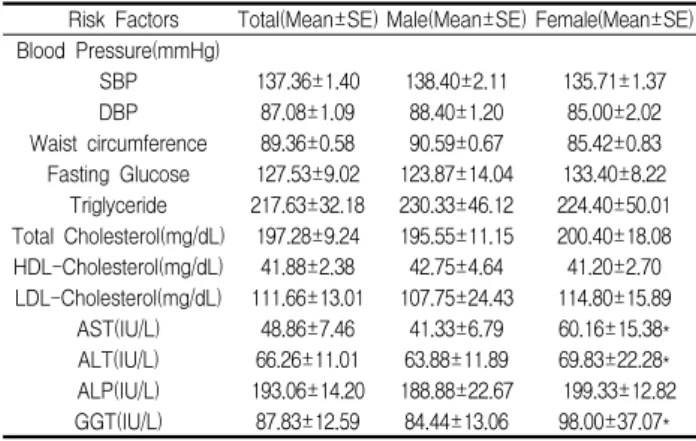
3. Risk Factor Values and Hepatic Enzyme Levels of Subjects At the time of first hospital visit, values for each risk factors were 137.36±1.40 mmHg for systolic blood pressure, 87.08±1.09 mmHg for diastolic blood pressure, 89.36±0.58 cm for waist circumference, 127.53±9.02 mg/dL for fasting blood glucose, 217.63±32.18 mg/dL for triglyceride, 197.28±9.24 mg/dL for Total-cholesterol, and 41.88±2.38 mg/dL for
HDL-cholesterol, 111.66±13.01 mg/dL for LDL-cholesterol. The hepatic enzyme levels were 48.86±7.46 IU/L for AST, 66.26±11.01 IU/L for ALT, 193.06±14.20 IU/L for ALP and 87.83±12.59 IU/L for GGT(Table 4).
Table 3. Prevalence Rate according to Anthropometry and Risk Factors in Subjects
Risk Factor Total Number(%) Male(n=20) Female(n=19) Blood Pressure 130/85 mmHg
Waist Circumference (cm) Fasting Glucose 110 mg/dL
Triglyceride 150 mg/dL Low HDL-Cholesterol Risk Factor Number
3 4 5
36(92) 32(82) 34(87) 35(90) 24(62) 39(100) 34(87) 31(79)
19 17 15 17 14 20 18 17
17 15 19 18 10 19 16 14
Table 4. Risk Factor Values and Lipid profile, Hepatic Enzyme Levels of Subjects
Risk Factors Total(Mean±SE) Male(Mean±SE) Female(Mean±SE) Blood Pressure(mmHg)
SBP 137.36±1.40 138.40±2.11 135.71±1.37
DBP 87.08±1.09 88.40±1.20 85.00±2.02
Waist circumference 89.36±0.58 90.59±0.67 85.42±0.83 Fasting Glucose 127.53±9.02 123.87±14.04 133.40±8.22
Triglyceride 217.63±32.18 230.33±46.12 224.40±50.01 Total Cholesterol(mg/dL) 197.28±9.24 195.55±11.15 200.40±18.08 HDL-Cholesterol(mg/dL) 41.88±2.38 42.75±4.64 41.20±2.70 LDL-Cholesterol(mg/dL) 111.66±13.01 107.75±24.43 114.80±15.89
AST(IU/L) 48.86±7.46 41.33±6.79 60.16±15.38*
ALT(IU/L) 66.26±11.01 63.88±11.89 69.83±22.28*
ALP(IU/L) 193.06±14.20 188.88±22.67 199.33±12.82 GGT(IU/L) 87.83±12.59 84.44±13.06 98.00±37.07*
*P<0.05
4. Method of Administration and Period for the Treatments to the Subjects
The periods of oriental medical treatments were 28.25±3.49 days on average. Ingredients which were included in the prescription of herbal treatment were an average of 12.65+2.93 different kinds. One dose of decoction had about 120-140 ml and it was administered one hour after each meal 3 times a day. The herb medicines which were administered during the observation period were common prescriptions by each clinical department and had some exceptions and additions to patients' medicines according to oriental medical diagnoses.
5. Meals and Food Intake of Patients with Metabolic Syndrome During the observation period, in-patients had meals which were prepared according to hospital diet to include 1800-2000 kcal, and out-patients were directed to maintain their normal diet habit at home.
6. Changes in Hepatic Enzyme Levels after Oriental Medical Treatment
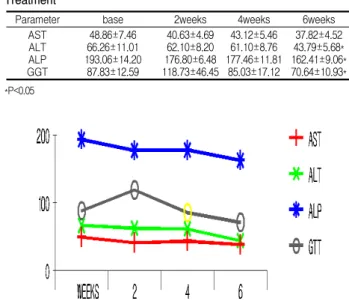
In order to observe changes in hepatic enzyme levels of subject patients, tests were administered using the identical method as the first hospital visit every 2.31±06.17 weeks four times. Serum AST was 48.86±7.46 IU/L before oriental medical treatment. And on each test after the treatment, 40.63±4.69, 43.12±5.46 and 37.82±4.52 IU/L were measured where although the level decreased to the normal level compared to pre-treatment, the value was not significant statistically(P>0.05).
Serum ALT was 66.26±12.01 IU/L before oriental medical treatment. And on each test after the treatment, 62.10±8.20, 61.10±8.76 and 43.79±5.68 were measured where although the level decreased, abnormally high level was maintained. The value was significant statistically(P<0.05) compared to pre-treatment. Serum ALP was 193.06±14.20 IU/L before oriental medical treatment. And on each test after the treatment, the level decreased to 176.80±6.48, 177.46±11.81 and 162.41±9.06 where although compared to pre-treatment the value was significant statistically(P<0.05), the change was within the normal range. Serum GGT was 87.83±12.59 IU/L before oriental medical treatment. After the treatment, near normal level was achieved with 118.73±46.45, 85.03±17.12 and 70.64±10.93, and the drop was statistically significant compared to pre-treatment (P<0.05)(Table 5)(Fig. 1).
Table 5. Changes in Hepatic Enzyme Levels after Oriental Medical Treatment
Parameter base 2weeks 4weeks 6weeks
AST ALT ALP GGT
48.86±7.46 66.26±11.01 193.06±14.20
87.83±12.59
40.63±4.69 62.10±8.20 176.80±6.48 118.73±46.45
43.12±5.46 61.10±8.76 177.46±11.81
85.03±17.12
37.82±4.52 43.79±5.68*
162.41±9.06*
70.64±10.93*
*P<0.05
Fig. 1. Change of serum hepatic enzyme levels after oriental medicine treatment
7. Observation of Change Progression in Blood Lipid Profile after Oriental Medical Treatment
In order to observe change progression in blood lipid profile of subject patients, tests were administered using the identical method as the first hospital visit every 2.31±06.17 weeks four times. Blood triglyceride was 217.63±32.18 mg/dL
before oriental medical treatment. And on each test after the treatment, the concentration decreased to 215.09±22.18, 189.93±22.44 and 191.22±18.51 where abnormal values continued even after the treatment although the value was not statistically significant compared to pre-treatment(P>0.05).
Blood total cholesterol was 197.28±9.24 mg/dL before oriental medical treatment. And on each test after the treatment, 201.55±11.13, 186.87±8.77 and 186.68±7.61 were measured where values were not statistically significant compared to pre-treatment(P>0.05). Blood HDL-cholesterol was 41.88±2.38 mg/dL before oriental medical treatment. And although on each test after the treatment, the concentration increases to 48.75±4.22, 44.10±1.91 and 48.00±2.06, values were not statistically significant compared to pre-treatment(P>0.05).
Blood LDL-cholesterol was 111.66±13.08 mg/dL at the time of admission to the hospital. And on each test after the treatment, although the concentration decreased to 109.94±10.18, 101.79±8.63 and 104.00±6.98, values were not statistically significant compared to pre-treatment(P>0.05)(Table 6)(Fig. 2).
Table 6. Changes in Blood Lipid Concentration after Oriental Medical Treatment
Parameter base 2weeks 4weeks 6weeks
T-cholesterol(mg/dL) Triglyceride(mg/dL) HDL-cholesterol(mg/dL) LDL-cholesterol(mg/dL)
197.28±9.24 217.63±32.18 41.88±2.38 111.66±13.08
201.55±11.13 215.09±22.18 48.75±4.22 109.94±10.18
186.87±8.77 189.93±22.44
44.10±1.91 101.79±8.63
186.68±7.61 191.22±18.51
48.00±2.06 104.00±6.98
Fig. 2. Change in Blood lipid profile after oriental medicine treatment
Discussion
With the increase in the instances of taking medicine for various purposes which not only include medical treatment and diagnosis but also improving health and supplementary treatment, an interest in hepatic injuries such as drug induced hepatitis and toxic hepatitis has been increasing caused by medication. According to domestic studies13,14), the effect of oriental medicine compounds on the liver function has shown that long-term oriental medicine treatments do not cause any significant abnormalities of liver function in most patients who
had shown normal liver function. Also, Kim and colleagues14) reported that the liver function level after a certain period of oriental medical treatments to type B virus hepatitis surface antigen positive patients was identical to the liver function level of surface antigen negative patients. Such studies were aimed at patients, who showed normal liver function test with no liver disease history at the time of research, and observed changes in liver function after oriental medical treatment.
Unlike previous studies, this study is aimed at metabolic syndrome patients with abnormally high ALT level before oriental medical treatment. The elevation of ALT in blood of metabolic syndrome patients which corresponds to non-alcoholic fatty liver disease(NAFLD) together with habits and hereditary factors act to develop a kind of metabolic disease in the liver15). Metabolic syndrome and its accompanying non-alcoholic fatty liver disease, which have increasing interests recently, are widely called as "non-alcoholic steatohepatitis(NASH)" which was first named by Ludwig10) while reporting on diseases with liver biopsy findings like alcoholic hepatitis in patients who did not drink alcohol in 1980.
NAFLD is classified as simple fatty liver which accumulated lipids in the hepatocyte and steatohepatitis which accompany inflammation and necrosis of liver cells with fatty liver. NAFLD is defined to include cirrhosis of liver and hepatic fibrosis caused by simple fatty liver and steatohepatitis.
NASH is clinically more advanced state than simple fatty liver, is a main cause for obesity, insulin independent diabetes mellitus and hyperlipidemia and require attention due to a possibility of advancing to cirrhosis of liver16). Most patients with NAFLD do not show any symptoms while some patients occasionally report light pain in the right upper quadrant or chronic fatigue. With the blood test findings, AST and ALT increase to 2-4 times, and unlike alcoholic fatty liver, the identifying characteristic is that the ratio between serum AST and ALT is below 1.0 times17). Although the mechanism for development of such fatty liver has not been defined clearly yet, it is known to be caused by either from the inflow of lipids which has been accumulating in the abdominal cavity through portal vein into the liver18) or the insulin resistance which is related to intra-hepatic toxicity against glucose19). With the recent increased interest in this matter, the rise of ALT and GGT levels above normal levels is reported to be related to insulin resistance and oxidation together with glucose intolerance and metabolic syndrome20-22).
As in previous findings, the levels of enzymes such as serum ALT, GGT and AST increase to indicate the condition of the damaged hepatocyte in liver diseases developed from
alcohol consumption. However, there is a study result in which although the prevalence rate of metabolic syndrome does not significantly increase with the alcohol consumption alone, it shows a correlation with other elements such as blood pressure, triglyceride, fasting blood glucose and HDL-cholesterol concentration which diagnose metabolic syndrome, and moderate or more consumption of alcohol not only increase the risk for metabolic syndrome but also levels of ALT and GGT in the serum significantly increase23).
In the studies of Korean patients with NASH, Nam and others23) reported 50.7±37.0 IU/L, 80.2±65 IU/L of ALT and GGT in the blood which were lower levels than this research, and 64.88±56.4 IU/L and 99.28±71.94 IU/L from Moon and others24) were similar levels although there were little differences in comparison to this research.
In our research, patients who had abnormally high levels of ALT and GGT in the blood with 66.26±11.01 IU/L and 87.83±12.59 IU/L before taking herb medicine showed statistically significant decrease to 43.79±5.68 IU/L and 70.64±10.93 IU/L at the test about 6 weeks after taking herb medicine. In addition, although AST, which is generally another enzyme of liver function indication, also decreased from 48.86±7.46 IU/L pre-medication to 37.82±4.52 IU/L post-medication, the result was not statistical significant, and the level of ALP with 193.06±14.20 IU/L pre-medication and 162.41±9.06 IU/L post-medication changed to decrease only within the normal range. With such results, frequent common prescriptions to patients with metabolic syndrome showing abnormal liver function for treating various other diseases were found to be relatively safe. Therefore, the concern that the liver function will get worse if an oriental medical treatment was administered to a patient showing abnormal liver function values such as a metabolic syndrome patient with non-alcoholic fatty liver disease(NAFLD) was found to be incorrect.
The dyslipidemia in metabolic syndrome is characterized by low blood HDL-cholesterol level and hypertriglyceridemia.
Because the lipoprotein synthesis in the liver and the lysis of lipoprotein in the blood were affected by the action of insulin, the size and component of lipoprotein have been known to have a relationship with insulin resistance. Especially, insulin is known to be an important controller of serum VLDL concentration and control the inflow of required substrate for synthesis of triglyceride into the liver and the lysis of fatty acid from the fatty tissue25). However, although the fact that the hypertriglyceridemia is related to insulin resistance has not been proven clearly, there is a report that transporting disorder of fatty acids in the blood which is involved in
hypertriglyceridemia could increase the insulin resistance26). In this research, serum triglyceride, total cholesterol, HDL-cholesterol and LDL-cholesterol before oriental medical treatment were 217.63±32.18 mg/dL, 197.28±9.24 mg/dL and 41.88±2.38 mg/dL, 111.66±13.08 mg/dL. In the previous report by Lee and others27) with modified-ATPIII application, serum triglyceride, total cholesterol, HDL-cholesterol and LDL-cholesterol in patients with metabolic syndrome who are older than 40 years old are 210.6 mg/dL, 205.4 mg/dL, 43.7 mg/dL and 128.3 mg/dL where this research showed a little higher concentration of serum triglyceride.
Also when compared with serum triglyceride, total cholesterol and HDL-cholesterol of patients with NAFLD from the report by Moon and others24) each being 187.76 mg/dL, 200.16 mg/dL and 45.72 mg/dL, higher serum triglyceride and lower HDL-cholesterol levels appeared. The reason is thought to have some relationship with the fact that the subject patients of this research were metabolic syndrome patients with old age and high obesity rate who visited the hospital to treat various diseases in each clinic departments while the previous research was on normal people who underwent medical examination without any existing diseases. After the treatment, levels of serum triglyceride, total cholesterol, HDL-cholesterol and LDL-cholesterol in the blood were 191.22±18.51 mg/dL, 186.68±7.61, 48.00±2.06 and 104.00±6.98, and there were no significant change compared to pre-treatment.
With such results, even if common oriental medical treatments were given to metabolic syndrome patients with abnormal liver function, the liver function was confirmed not to be aggravated, and the concentration of lipids in the blood was confirmed not to be affected in most patients.
Acknowledgements
This paper was supported by Wonkwang University in 2008.
References
1. Reaven, G.M. Role of insuline resistance in human disease.
diabetes 37: 1595-1607, 1988.
2. Isoma, B., Almgren, P., Tuomi, T. Cardiovascular morbidity associated with the metabolic syndrome. Diabetes Care 24:
683-689, 2001.
3. Liese, A.D., Mayer-Davis, E.J., Tyroler, H.A., Davis, C.E., Keil, U., Schmit, M.I., Brancati, F.L., Heiss, G. Familial components of the multiple metabolic syndrome: The
ARIC study. Diabetologia 40: 963-970, 1997.
4. Hong, Y., Pedersen, N.L., Brismar, K., De Faire, U. Genetic and environmental architecture of the features of the insulin-resistance sydrome. Am J Hum Genet 60: 143-152, 1997.
5. Facchini, F.S., Hua, N., Abbasi, F., Reaven, G.M. Insulin resistance as a predictor of age-related diseases. J Clin Endocrinol Metab 86: 3574-3578, 2001.
6. Yip, J., Facchini, F.S., Reaven, G.M. Resistance to insulin mediated glucose disposal as a predictor of cardiovascular disease. J Clin Endocrinol Metab 83: 2773-2776, 1998.
7. H.S. Park, S.W. OH, J.H. Kang, Y.W. Park, J.M. Choi, Y.S.
Kim, W.H. Choi, H.J. Yoo, Y.S. Kim. Prevalence and associated factors with metabolic syndrome in south korea (-from the korean national health and nutrition examination survay, 1998-) Korean J of Obesity. 12(1):1-14, 2003.
8. Saito, T., Misawa, K., Kawata, S. Fatty liver and non-alcoholic steatohepatitis. Inter Med 46: 101-103, 2007.
9. Kang, H., Greenson, J.K., Omo, J.T., Chao, C., Peterman, D., Anderson, L., Foess-Wood, L., Sherbondy, M.A., Conjeevaram, H.S. Metabolic syndrome is associated with greater histologic severity, higher carbohydrate, and lower fat diet in patients with NAFLD. Am J Gastroenterol 101:
2247-2253, 2006.
10. Ludwing, J., Viggiano, T.R., McGill, D.B., Oh, B.J.
Nonalcoholic steatohepatitis: Mayo Clinic experiences with an hitherto unnamed disease. Mayo Clin Proc 55: 434-438, 1980.
11. Executive Summary of the Third Report of the National Cholesterol Education Program(NCEP) Expert Panel on Detection, Evaluation, and treatment of high blood cholesterol in adults(Adult Treatment Pannel III). JAMA 28: 2486-2497, 2001.
12. International Obesity Task Force. The Asia-Pacific perspective: Redefining obesity and its treatment. Western Pacific Region. 2000.
13. D.W. Kim, L.J. Lee, I.H. An, J.S. Ban, C.Y. Rheu, S.M. Kim, S.M. Lee. The change of liver function in patients with long term herb medication by frequently prescribed formular. J of Korean Oriental Medicine 14(2):245-253, 1993.
14. Dong Woung Kim, Kwan Sik Kim. The clinical study of long term herb medication in the B viral hepatitis health carrier, Korean J. Oriental Medical Pathology 13(2):128-133, 1999.
15. Marchesini, G., Brizi, M., Bianchi, G., Tomassetti, S., Bugianesi, E., Lenzi, M. et al. Nonacoholic fatty liver disease: a feature of the metabolic syndrome. Diabetes 50(8):1844-1850, 2001.
16. Angulo, P. Nonalcoholic fatty liver disease. N Engl J Med
346: 1221-1231, 2002.
17. Contos, M.J., Sanyal, A.J. The clinicopathologic spectrum and management of nonalcoholic fatty liver disease. Adv Anat pathol 9: 37-51, 2002.
18. Herbert, Jr. L.F., Daniels, M.C., Zhou, J., Crook, E.D., Turner, R.L., Simmons, S.T., Neidigh, J.L., Zhu, J.S., Baron, A.D., McClain, D.A. Over-expression of glutamine:
fructose-6 phosphate aminotransferase in transgenic mice leads to insulin resistance. J Clin Invest 98: 930-936, 1996.
19. Bjorntorp, P. portal adipose tissue as a generator of risk factors for cardiovascular disease and diabetes(editorial).
Atherosclerosis 10: 493-496, 1990.
20. Lim, J.S., Yang, J.H., Chun, B.Y., Kam, S., Jacobs, D.R. Jr., Lee, D.H. Is serum γ-glutamyltransferase inversely associated with serum antioxidants as a marker of oxidative stress? Free Radic Biol Med 37: 1018-1023, 2004.
21. Lee, D.H., Ha, M.H., Kim, J.H., Christiani, D.C., Gross, M.D., Steffes, M., Blomhoff, R., Jacobs, D.R. γ- glutamyltransdferase and diabetes- a 4 year follow -up study. Diabetologia 46: 359-364, 2003.
22. Lee, D.H., Steffen, L.M., Jacobs, D.R. Jr., Association between serum γ-glutamyltransferase and diatary factors:
The coronary artery risk development in young adults
(CARDIA) study. Am J Clin Nutr 79: 600-605, 2004.
23. S.M. Nam., H.Y. Yu., M.Y. Lee., J.H. Koh., J.Y.l. Shin., Y.G.
Shin., C.H. Chung. Alcohol Consumption, Liver Enzymes, and Prevalence of Metabolic Syndrome in Korean Adult Men, Kor Diabetes Assoc 31(3):253-260, 2007.
24. K.W. Moon., J.M. Leem., S.S. Bae., K.M. Lee., S.H. kim., H.B. Chae., S.M. Park., S.J. Youn. The prevalence of Metabolic Syndrome in Patients with Nonalcoholic Fatty Liver Disease. Korean J Hepatol 10(3):197-206, 2004.
25. Lewis G.F., Steiner, G. Acute effects of insulin in the control of VLDL production in humans. Implications for insulin-resistance state. Diabetes Care 19: 390-393, 1996.
26. Steiner, G., Altering triglyceride concentrations changes insulin-glucose relationships in hypertriglyceridemic patients.
Double blind study with gemfibrozil with implications for lipoproteins. Curr Opin lipidol 4: 252-257, 1994.
27. H.J. Lee, H.S. Kwon, Y.M. Park, H.N. Chun, Y.H. Choi, S.H. Ko, J.M. Lee, K.H. Yoon, B.Y. Cha, W.C. Lee, K.W.
Lee, H.Y. Son, S.K. Kang, M.S. Ahn, J.M. Kang, D.S. Kim.
Waist circumference as a risk factor for metabolic syndrome in korean adult ; evaluation from 5 different criteria of metabolic syndrome. J Kor Diabetes Assoc 29:
48-56, 2005.