김치에서 분리된 젖산균의 β-glucuronidase 활성 탐색
김은정1, 신인웅1, 권세영1, 박은희1, 이재형2, 김명동1*
1강원대학교바이오산업공학부
2강원도농업기술원인삼약초연구소
Received: January 7, 2019 / Revised: February 2, 2019 / Accepted: February 27, 2019
김치는우리나라고유의전통발효식품으로섬유소, 비타 민, 무기질등의공급원으로알려져있으며[1, 2], 배추, 무등 의주재료와고추, 파, 마늘등의향신료, 젓갈, 소금등의조 미료, 기타부재료를원료로사용하며원료에포함된미생물
에의하여발효된다[3, 4]. 김치발효에서중요한역할을수
행하는젖산균은정상적인장관등에서미생물균총을유지 하고, 항암, 콜레스테롤감소및면역증진등의유익한효 능이보고되었다[5−7]. 또한, 인삼의진세노사이드[8], GABA (γ-aminobutyric acid) [9] 등다양한유용물질생산을위한
스타터균주로서개발된바있다[10].
생물전환은미생물이보유하고있는효소를이용하여기
질로부터목적하는물질을제조하는기술을의미하며[11],
유용물질생산을위한방법으로서상대적으로안전성이우 수한전통식품유래의미생물을이용하는연구가증가하고 있다[12]. 곰팡이를이용한생물전환연구로는 Aspergillus usamii KCTC 6954 균주를 이용하여 ginsenoside Rb1을
compound K로전환한연구[13]와 Aspergillus niger 균주의 hemicellulase계효소를이용한자일로즈생산[14]에대한연 구등이보고되었다.
생물전환균주로젖산균을사용하기위하여β-xylosidase
[15], β-galactosidase[16], β-arabinofuranosidase [17], β-
glucosidase [18] 등의효소활성에대한연구가보고되었으
며, 녹차추출물을 Leuconostoc mesenteroides 균주로생물 전환하여카테킨함량을증대시킨연구[16]와 Lactobacillus plantarum 균주를이용하여 GABA를생산한연구결과[9]가 보고되었다.
β-Glucuronidase (EC 3.2.1.31)는동물, 식물, 미생물등의 다양한 종에서 보고되었으며, β-형태 1번 탄소에 결합한 glucuronide 단위를가수분해하는효소이다[19]. 동물에서는
간장과 신장에서 주로 발견되며[19], 지용성 독성물질에
glucuronic acid, sulfuric acid와같은친수성물질들을포함 시켜소변으로배출을촉진시키는것으로알려져있다[20].
이때 배출되지 못한 독성물질이 β-glucoside 배당체와
glucuronic acid 화합물의결합을분해하여암을유발하는것
으로알려져있다[21].
암을유발시키는것과관련이있는장내미생물이생산하 Exploration of β-Glucuronidase Activity of Lactic Acid Bacteria Isolated from Kimchi
Eun-Jung Kim1, In-Ung Shin1, Se-Young Kwun1, Eun-Hee Park1, Jae-Hyoung Yi2, and Myoung-Dong Kim1*
1Division of Food Biotechnology and Biosystems Engineering, Kangwon National University, Chuncheon 24341, Republic of Korea
2Ginseng and Medicinal Plant Research Institute, Gangwon Agricultural Research & Extension Services, Cheorwon 24054, Republic of Korea
Lactic acid bacteria (LAB) isolated from kimchi were studied for their β-glucuronidase activity. Among the 156 strains tested, 52 strains utilized glucuronic acid as a carbon source and their intracellular β-glucuroni- dase activities were significantly higher than their extracellular activities. Leuconostoc mesenteroides KFRI 73007 isolated from turnip kimchi exhibited the highest intracellular β-glucuronidase activity of 0.77± 0.01 U/mg protein, which was further increased to 1.14 ± 0.01 U/mg protein under optimized reaction conditions (pH 7, 37℃). The activity of β-glucuronidase was notably decreased by the addition of divalent cations, and glucuronic acid was the best carbon source to produce β-glucuronidase in Leu. mesenteroides KFRI 73007.
Keywords: β-Glucuronidase, Kimchi, Lactic acid bacteria, Leuconostoc mesenteroides
*Corresponding author
Tel: +82-33-250-6458, Fax: +82-33-259-5565 E-mail: [email protected]
© 2019, The Korean Society for Microbiology and Biotechnology
β-Glucuronidase Activity of Lactic Acid Bacteria 435
는물질중의하나인β-glucuronidase는 Clostridium spp.에 서활성을보였으며, Bifidobacterium spp. 등에서는활성을 나타내지않았다[22]. 종양에서β-glucuronidase는염증세포 에의해괴사부위에서세포외로분비되고건강한조직에 서는 lysosome에서활성이보고되었다[23].
미생물에서는 Asp. niger [24], Lactobacillus gasseri [25], Escherichia coli 등에서β-glucuronidase 효소가보고 되었으며[26], 감초와 대추의 분획물의 Escherichia coli HGU-3의β-glucuronidase 활성에대한유의적인저해효과 가보고되었다[27]. 또한장내미생물에의한대사산물생성, 항산화효소를이용한방어기전생성및효소의불활성화등 이암유발을감소시키는방안으로보고된바있다[22].
체내혈청에서β-glucuronidase 활성의범위는 0.8−2.3 U/l로 보고되었으며[28], 간암, 결장암등에의해증가되는것으로 나타나종양마커로활용될수있는것으로알려졌으며, 암의 조기진단및임상요법의효능을평가하는방법으로서관련 연구가지속되고있다[29]. Jeffrey 등[30]의연구에따르면
linker drug는효소에의한가수분해를통해항체-약물간해
리현상에의해타깃암세포에약효를나타내는것으로보고 되었다. β-Glucuronidase에의해가수분해되는 glucuronide는 친수성이커서소수성의성질이높은약물과결합시키면항 체-약물복합체의용해도가증가하는것으로보고되었다[30].
황금추출물을원료로사용한기존연구에서곰팡이유래
의 β-glucuronidase를 이용하여 황금추출물의 성분인
baicalin, wogonoside를비배당체인 baicalein, wogonin으로 전환시키는 내용이 보고되었으나[31], 세균 유래의 β- glucuronidase를이용한생물전환연구는충분하지않다.
본연구에서는김치에서분리된젖산균의 β-glucuronidase 활성을탐색하여황금추출물등배당체기질을비배당체생 산물로효율적으로전환시키는스타터균주로서의가능성을 평가하였다.
한국생명공학연구원미생물자원센터(Korean Collection for Type Cultures, KCTC) 및한국식품연구원(Korea Food Research Institute, KFRI)에기탁되어있는김치에서분리 된 Lactobacillus, Leuconostoc, Weissella속등 156점의 균 주를분양받아사용하였다.
균주는 -80℃냉동고(Ilshin, Korea)에보관하였고, MRS (BD Diagnostic Systems, USA) 배지에접종한후, 진탕배양 기(Hanbaek Scientific Co., Korea)를 사용하여 30℃에서 10시간배양하였다. 배양액의흡광도(OD600)를측정하고적 정량의배양액을취한후원심분리(16,000 ×g, 4℃, 15분)하 여세포를회수하였다. 회수한세포를멸균증류수로 2회세 척후 glucuronic acid (Sigma-Aldrich, USA) 0.1% (w/v)가 첨가된 MRS 배지에세포의초기흡광도(OD600)가 0.1이되 도록접종하였다. 진탕배양기를이용하여세포흡광도(OD600)
가 1이될때까지 30℃에서배양한후원심분리하여세포와 상등액을확보하였다.
세포외β-glucuronidase 효소활성은 Kim 등[31]의방법 을일부수정하여측정하였다. 세포를파쇄한후, 원심분리 하여상등액을회수하고조효소액으로이용하였다. 기질은 ρ-nitrophenyl-β-D-glucuronide (Sigma-Aldrich)를 sodium acetate/acetic acid 완충액(50 mM, pH 5)에 5 mM이되도 록용해시켜사용하였다. 조효소액 70 μl에기질용액을 30μl 첨가하여 37℃에서 30분동안반응하였다. 효소반응은 0.5 M Na2CO3 (Korea) 100 μl를주입하여종결하였다. 생성된ρ- nitrophenol 농도는 405 nm에서흡광도를측정하고표준선 을이용하여결정하였다. 1 unit의효소활성은 37℃, pH 5 조건에서 1분동안 1 μmole의ρ-nitrophenol을생성하는효 소의양으로정의하였다.
세포내효소활성측정을위해배양액을원심분리하여얻 은 세포에 700 μl의 sodium acetate/acetic acid 완충액 (50 mM, pH 5)과 0.2 mm stainless beads (Nextadvance, USA)를 0.25 g을주입한후, 균질기(Nextadvance, USA)를 이용하여 3분동안파쇄하였다. 세포파쇄물을회수하고원 심분리(16,000 ×g, 4℃, 15분)하여조효소액을얻었다.
반응조건이효소활성에미치는영향을조사하기위하여 pH 3−9의 완충액(pH 3: sodium citrate/HCl, pH 4:
sodium citrate/citric acid, pH 5: sodium acetate/acetic acid, pH 6, 7, 8: sodium phosphate, pH 9: Tris/HCl)을 사용하여효소활성을조사하고[15], 반응온도에따른효소활 성을측정하였다. 금속이온의영향을조사하기위하여반응 액에 ZnCl2, CaCl2, CuCl2, MnCl2, MgCl2, CoCl2및 FeCl2
의최종농도가각각 2 mM이되도록첨가하였다. 단백질농
도는 Bradford dye reagent (Bio-Rad, USA)를사용하여측 정하였으며, 표준선은 bovine serum albumin (Bio-Rad)을 사용하여작성하였다. 모든측정은 5회이상반복하여평균 과표준오차를결정하였으며, 통계분석은 SigmaPlot (Ver.
14; SPSS Inc., USA)을사용하였다.
MRS 배지에포함된포도당을 glucuronic acid로대체하 고젖산균의 glucuronic acid 대사능을조사하였다. 젖산균 156점중 glucuronic acid를탄소원으로이용한균주는 52점 이었으며, 이들균주세포내외의β-glucuronidase 효소활성 을측정하였다(Fig. 1).
대부분의젖산균들은세포외보다세포내β-glucuronidase 효소활성이상대적으로높았다. Lactobacillus 속젖산균중 에서 L. brevis 균주들의세포내β-glucuronidase 효소활성 이상대적으로 높게 나타났으며, L. brevis KFRI 200117, KFRI 62001, KFRI 200127의균주들에서 0.21−0.24 U/mg protein의효소활성을나타냈다. 그러나, Lactobacillus 속젖
산균들은 Leuconostoc 속의젖산균들보다상대적으로낮은
효소활성을나타냈다. Leuconostoc 속의젖산균중에서 Leu.
mesenteroides 젖산균들의세포내β-glucuronidase 효소활성
이 높았으며, Leu. mesenteroides KFRI 73007 균주는 0.77±0.01 U/mg protein으로가장높은효소활성을나타내 Fig. 1. β-Glucuronidase activities of LAB isolated from kimchi. Data for Lactobacillus strains are shown in panel A. Panel B shows data for Leuconostoc and Pediococcus strains. Averages and standard errors determined from five independent cultures grown in MRS medium at 30℃ to OD600= 1 were shown. The bars indicate extracellular-(Open, □) and intracellular-(Closed, ■) enzyme activity, respectively. Different letters indicate significant difference between averages.
β-Glucuronidase Activity of Lactic Acid Bacteria 437
었다(Fig. 1B). 그러나 Leu. mesenteroides KFRI 73007 균 주의세포외β-glucuronidase 효소활성은 0.01 ± 0.00 U/mg
protein으로 52점의젖산균중에서가장낮은활성을나타냈
다. Leu. mesenteroides KFRI 73007 균주는β-glucuronidase 효소를생산하지만세포외부로분비하는능력이낮은것으 로 판단되었다. 효소활성이 가장 높은 균주로서 Leu.
mesenteroides KFRI 73007 균주를선발하고, 효소활성의특 성에대하여조사하였다.
효소활성이 가장 높은 Leu. mesenteroides KFRI 73007 균주를이용하여반응조건에따른효소활성의변화를조사 하였다(Fig. 2). 반응용액의 pH에대한 Leu. mesenteroides KFRI 73007 균주의 β-glucuronidase의활성은 pH 7에서 1.03 ± 0.01 U/mg protein으로가장높았으며, pH 5−7 범위 에서효소활성이전반적으로높게나타났다(Fig. 2A). 그러 나 pH 4 이하와 pH 8 이상에서는 효소활성이 0.2 U/mg protein 이하로나타났다.
L. gasseri ADH 유래의β-glucuronidase 효소는 pH 5에 서가장높은활성을나타냈으며, pH 6 이상에서는활성이 감소하는경향을나타냈다[32]. 곰팡이인 Asp. niger 유래의 β-glucuronidase는 pH 3−4에서가장높은효소활성을나타 냈으며[33], Streptococcus equi subsp. zooepidermicus 균
주의β-glucuronidase는 pH 5.6에서가장높은활성을나타 냈다[34].
효소활성이 가장 높았던 pH 7에서 반응온도에 따른 β- glucuronidase 효소활성의변화를조사하였다(Fig. 2B). Leu.
mesenteroides KFRI 73007 균주는 37℃에서 1.14 ± 0.01 U/mg protein으로 가장 높은β-glucuronidase 효소활성을 나타냈으며, 반응온도가증가함에따라서효소의활성이유 의적으로감소하였다. 반응온도 50℃에서는 37℃에서측정 된β-glucuronidase 효소활성의약 50% 수준인 0.64 ± 0.01 U/mg protein으로나타났으며, 60℃에서는 0.47 ± 0.01 U/
mg protein으로 더 낮은 활성을 나타냈다. 따라서, β- glucuronidase 효소의최적반응조건을 pH 7, 반응온도 37℃ 로판단하였다.
L. brevis 유래의β-glucuronidase를대장균에서발현하였 을때 37℃에서가장높은활성을나타냈으며[31], 유전자조 작을통하여 L. gasseri ADH 균주유래의β-glucuronidase 가 65℃의고온에서도활성을나타내도록개량한연구결과 가보고된바있다[25].
금속이온에대한 Leu. mesenteroides KFRI 73007 균주의 β-glucuronidase 효소활성변화를조사하기위해 pH 7로조 정된반응액을이용하여금속이온을각각첨가한후 37℃에 Fig. 1. Continued.
서효소활성을측정하였다(Fig. 2C). 금속이온이첨가된경 우, 효소의활성이감소하는경향을나타냈으며, Zn2+, Ca2+, Mg2+을첨가한효소반응에서대조구와비교하여약 87% 감 소하였다.
장내에서분리된 E. coli HGU-3 유래의β-glucuronidase 효소는 Mg2+이온과 Ca2+이온을첨가한경우, 각각 24.8%,
14.8%의효소활성감소를나타낸것으로 보고되었다[35].
Aspergillus terreus 유래의 β-glucuronidase 효소는 Na+, Co2+, Cu2+, Al3+등의금속이온에의한효소활성이유의적 으로감소하였다[36].
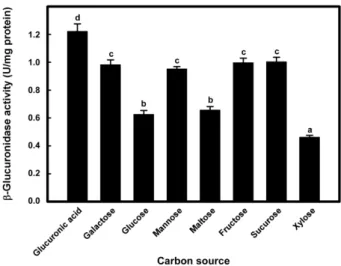
다양한 탄소원을 사용하여 배양한 Leu. mesenteroides
KFRI 73007 균주의β-glucuronidase의효소활성을조사하 였다(Fig. 3). 실험에사용한 8가지의탄소원중에서 glucuronic acid를 탄소원으로 배양한 후 확보한 균체의 세포내 β- glucuronidase 효소활성은 pH 7, 반응온도 37℃에서측정하 였을때 1.22 ± 0.05 U/mg protein으로서가장높았다. 그러 나탄소원으로갈락토스, 만노스, 과당및설탕을사용한경 우는효소활성의유의적인차이가없었으며, 자일로즈를탄 소원으로사용한경우 0.46 ± 0.01 U/mg protein으로가장 낮은효소활성을나타냈다.
Lee 등[20]의 연구에 따르면 장내 유해 효소인 β-
glucuronidase의활성이김치섭취시약 20% 감소하였다. 이러한 연구결과는 발암과 관련된 인자로 알려진 β-
glucuronidase가김치와같은발효식품에포함된젖산균에
의해영향을받은것으로추정된다.
본연구에서는김치에서분리된젖산균의 β-glucuronidase 의효소활성탐색을통해배당체기질을효율적으로분해하 여부가가치가높은비배당체소재를경제적으로생산할수 Fig. 2. Effect of pH (A, 30℃), temperature (B, pH 7), and diva-
lent cations (C, pH 7, 37℃) on intracellular β-glucuronidase activity of Leu. mesenteroides KFRI 73007. Each cation was added to the reaction mixture at final concentration of 2 mM.
Averages and standard errors determined from five independent experiments are shown. Different letters indicate significant dif- ference between averages.
Fig. 3. Intracellular β-glucuronidase activity of Leu. mesen- teroides KFRI 73007 grown in different carbon sources. Each carbon source was added to glucose-free MRS medium at a con- centration of 2% (w/v) except glucuronic acid (0.1%). Enzyme activities were assayed at pH 7 and 37℃. Averages and standard errors determined from five independent measurements are shown. Different letters indicate significant difference between averages.
β-Glucuronidase Activity of Lactic Acid Bacteria 439
있는공정을활용하기위한기반을확보하였다.
요 약
전통발효식품인 김치에서 분리된 젖산균으로부터 β-
glucuronidase 효소활성이높은균주를선발하였다. 김치에
서 분리된 156점의 젖산균 중 52점의 균주가 glucuronic acid를탄소원으로대사하였으며, 대부분의젖산균은세포내
β-glucuronidase 활성이세포외활성보다유의적으로높았
다. 순무김치에서분리된 Leu. mesenteroides KFRI 73007 균주가 0.77 ± 0.01 U/mg protein로서가장높은세포내β- glucuronidase 효소활성을나타내었다. 최적반응조건은 pH 7, 37℃이었으며 1.14 ± 0.01 U/mg protein의효소활성을나 타냈다. 양이온금속이온은β-glucuronidase 효소활성을약 70% 이상저해하였으며, 균주배양에사용한탄소원중β- glucuronidase 생산을 위한 최적의 탄소원은 glucuronic acid이었다.
Acknowledgments
This research was financially supported by the Ministry of Trade, Industry, and Energy (MOTIE), Korea, under the “Regional Specialized Industry Development Program” (reference number P0002815) supervised by the Korea Institute for Advancement of Technology (KIAT).
Conflict of Interest
The authors have no financial conflicts of interest to declare.
References
1. Cheigh HS, Park KY. 1994. Biochemical, microbiological, and nutritional aspects of kimchi (Korean fermented vegetable products). Crit. Rev. Food Sci. Nutr. 34: 175-203.
2. Son KH. 1991. Types and usage of kimchi. J. Korean Soc. Food Cult. 6: 503-520.
3. Lee EH, Lee MJ, Song YO. 2012. Comparison of fermentation properties of winter kimchi stored for 6 months in a kimchi refrigerator under ripening mode or storage mode. J. Korean Soc. Food Sci. Nutr. 41: 1619-1625.
4. Lee CH. 1986. Kimchi; Korean fermented vegetable foods.
Korean J. Diet Cult. 1: 395-402.
5. Shon MY, Nam SH, Lee SW. 2007. Antioxidant, anticancer activities and nitric oxide production of Euphoria longana fermented with lactic acid bacteria and Bacillus subtilis.
Korean J. Food Preserv. 14: 531-537.
6. Kim MJ , Kim GR. 2006. In vitro evaluation of cholesterol reduc- tion by lactic acid bacteria extracted from kimchi. Culi. Sci. Hos
Res. 12: 259-268.
7. Lee HY, Lee JS, Kim DH, Lee SG, Lee YJ, Kim MD. 2012.
Extraction methods influence inhibitory effects of Agrimonia pilosa on the growths of meat-poisoning lactic acid bacteria.
Food Eng. Prog. 16: 180-184.
8. Park B, Hwang H, Lee J, Sohn SO, Lee SH, Jung MY, et al. 2017.
Evaluation of ginsenoside bioconversion of lactic acid bacteria isolated from kimchi. J. Ginseng. Res. 41: 524-530.
9. Park EJ, Lee SO, Lee SP. 2017. Development of natural fer- mented seasoning with Flammulina velutipes powder fortified with γ-aminobutyric acid (GABA) by lactic acid fermentation.
Korean J. Food Preserv. 24: 237-245.
10. Jin HS, Kim JB, Yun YJ, Lee KJ. 2008. Selection of Kimchi starters based on the microbial composition of Kimchi and their effects. J. Korean Soc. Food Sci. Nutr. 37: 671-675.
11. Jung BH, Hong SG, Sung MH. 1995. Research status of bio- transformation technology and industrial utilization technol- ogy. Korean Soc. Microbiol. Biotechnol. 8: 4057-4067.
12. Lee JH, Jo EH, Hong EJ, Kim KM, Lee IH. 2014. Safety evaluation of filamentous fungi isolated from industrial doenjang koji.
J. Microbiol. Biotechnol. 24: 1397-1404.
13. Jo MN, Jung JE, Yoon HJ, Chang KH, Jae HS, Kim KT, et al. 2014.
Bioconversion of ginsenoside Rb1 to the pharmaceutical gin- senoside compound K using Aspergillus usamii KCTC 6954.
Korean J. Microbiol. Biotechnol. 42: 347-353.
14. Han MH, Choi YD, Park MO. 1983. Studies on hemicellulase sys- tem in Aspergillus niger. Korean J. Appl. Microbiol. Bioeng. 11:
193-199.
15. Jang MH, Kim MD. 2011. β-1,4-Xylosidase activity of Leuconos- toc lactic acid bacteria isolated from kimchi. Korean J. Food Sci.
Technol. 43: 169-175.
16. Choi CY, Park EH, Ju YW, Kim MD. 2016. Increase of epigallocat- echin in green tea extract by lactic acid bacteria fermentation.
Microbiol. Biotechnol. Lett. 44: 62-67.
17. Marcolongo L, Ionata E, La Cara F, Amore A, Giacobbe S, Pepe O, et al. 2014. The effect of Pleurotus ostreatus arabinofuranosi- dase and its evolved variant in lignocellulosic biomasses con- version. Fungal Genet. Biol. 72: 162-167.
18. Jang MH, Kim MD. 2010. Exploration of β-glucosidase activity of lactic acid bacteria isolated from kimchi. Food Eng. Prog.
14: 243-248.
19. Oh EH, Park JM, Kim SH, Song IG, Han NS. 2012. Biological activities of Phellinus linteus mycelium culture with cassiae semen extract on β-glucuronidase inhibitory activity. Korean J.
Food Nutr. 25: 620-628.
20. Lee KE, Choi UH, Ji GE. 1996. Effect of kimchi intake on the com- position of human large intestinal bacteria. Korean J. Food Sci.
Technol. 28: 981-986.
21. Nanno M, Morotomi M, Takayama H, Kuroshima T, Tanaka R, Mutai M. 1986. Mutagenic activation of biliary metabolites of benzo(a)pyrene by β-glucuronidase-positive bacteria in human faeces. J. Med. Microbiol. 22: 351-355.
22. Myung DS, Joo YE. 2012. Gut microbial influence and probiot-
ics on colorectal cancer. Korean J. Gastroenterol. 60: 275-284.
23. Tranoy-Opalinski I, Legigan T, Barat R, Clarhaut J, Thomas M, Renoux B, et al. 2014. β-Glucuronidase-responsive prodrugs for selective cancer chemotherapy: an update. Eur. J. Med. Chem.
74: 302-313.
24. Kuroyama H, Tsutsui N, Hashimoto Y, Tsumuraya Y. 2001. Purifi- cation and characterization of a β-glucuronidase from Aspergil- lus niger. Carbohydr. Res. 333: 27-39.
25. Russell WM, Klaenhammer TR. 2001. Identification and cloning of gusA, encoding a new β-glucuronidase from Lactobacillus gasseri ADH. Appl. Environ. Microbiol. 67: 1253-1261.
26. Tryland I, Fiksdal L. 1998. Enzyme characteristics of β-D-galac- tosidase- and β-D-glucuronidase-positive bacteria and their interference in rapid methods for detection of waterborne coliforms and Escherichia coli. Appl. Environ. Microbiol. 64:
1018-1023.
27. Rhee YK, Kim DH, Han MJ. 1998. Inhibitory effect of Zizyphi fru- cus on β-glucuronidase and tryptophanase of human intesti- nal bacteria. Korean J. Food Sci. Technol. 30: 199-205.
28. Falkenbach A, Wigand R, Unkelbach U, Jorgens K, Martinovic A, Scheuermann EH, et al. 1993. Cyclosporin treatment in rheu- matoid arthritis is associated with an increased serum activity of β-glucuronidase. Scand. J. Rheumatol. 22: 83-85.
29. Baharudin MS, Taha M, Imran S, Ismail NH, Rahim F, Javid MT, et al. 2017. Synthesis of indole analogs as potent β-glucuroni- dase inhibitors. Bioorg. Chem. 72: 323-332.
30. Jeffrey SC, Andreyka JB, Bernhardt SX, Kissler KM, Kline T, Lenox JS, et al. 2006. Development and properties of β-glucuronide linkers for monoclonal antibody-drug conjugates. Bioconjug.
Chem. 17: 831-840.
31. Kim HS, Kim JY, Park MS, Zheng H, Ji GE. 2009. Cloning and expression of β-glucuronidase from Lactobacillus brevis in E.
coli and application in the bioconversion of baicalin and wogonoside. J. Microbiol. Biotechnol. 19: 1650-1655.
32. Callanan MJ, Russell WM, Klaenhanmmer TR. 2007. Modifica- tion of Lactobacillus β-glucuronidase activity by random muta- genesis. Gene 389: 122-127.
33. Konishi T, Kotake T, Soraya D, Matsuoka K, Koyama T, Kaneko S, et al. 2008. Properties of family 79 β-glucuronidases that hydrolyze β-glucuronosyl and 4-O-methyl-β-glucuronosyl resi- dues of arabinogalactan-protein. Carbohydr. Res. 343: 1191- 1201.
34. Krahulec J, Krahulcova J. 2007. Characterization of the new β- glucuronidase from Streptococcus equi subsp. zooepidemicus.
Appl. Microbiol. Biotechnol. 74: 1016-1022.
35. Kim DH, Jin YH, Jung EA, Han MJ, Kobashi K. 1995. Purification and characterization of β-glucuronidase from Escherichia coli HGU-3, a human intestinal bacterium. Biol. Pharm. Bull. 18: 1184- 1188.
36. Xu Y, Liu Y, Rasool A, E W, Li C. 2017. Sequence editing strategy for improving performance of β-glucuronidase from Aspergillus terreus. Chem. Eng. Sci. 167: 145-153.