서 론
잉어과 Cyprinidae 모래무지아과 Gobioninae에 속하는 모래 주사속 Microphysogobio 어류는 주로 동아시아에 분포하고 있 으며, 소형의 저서성 1차 담수어류이다(Uchida, 1939; Cheng and Zheng, 1987; Howes, 1991; Banarescu, 1992). 우리나라 에는 배가사리 M. longidorsalis, 경모치 M. jeoni, 모래주사 M. koreensis, 돌마자 M. yaluensis, 여울마자 M. rapidus 5종이 서식하는 것으로 알려져 있다(Kim and Yang, 1999; Kim and Park, 2007).
이 중 여울마자는 돌마자와 형태적으로 매우 유사하나 산 란기 체색의 차이와 윗입술 피질돌기의 수, 측선상부 비늘
수, 항문에서 뒷지느러미 기점까지의 거리 등이 형태적 차 이가 나타나며, 생물 지리적으로 낙동강에만 제한적으로 분 포하는 점을 들어 독립된 종인 여울마자로 신종 보고되었 다(Chae and Yang, 1999). 본 종은 최근 서식지 개발과 환경 오염 등으로 개체수가 급감하고 있어서 환경부는 2012년 멸 종위기 야생생물 I급으로 새롭게 지정하여 보호하고 있으며 (ME, 2012), 한국의 멸종위기 야생동·식물 적색자료집(Red Data Book Endangered Fishes in Korea)에서는 위급(Critically Endangered, CR)종에 해당되었음에도 불구하고(NIBR, 2011) 환경부의 전국자연환경조사(ME, 1997~2008)의 출현기록, 모래주사속 어류의 재검토(Kim and Yang, 1999) 및 버들매치 속 Abbottina과 모래주사속 어류의 분자계통학적 연구(Kim and Bang, 2010) 등 주로 계통분류학적 연구에 한정되어 있을 뿐 초기생활사를 포함한 기타 연구는 전무한 실정이다.
어류의 초기생활사 연구는 분류학적으로 구분이 어려운 자 매종이나 유사종 사이의 종을 구분하거나 유연관계를 연구
—86 — http://www.fishkorea.or.kr
멸종위기어류 여울마자 Microphysogobio rapidus (Cyprinidae)의 난 발생 및 초기생활사
홍양기·고명훈·박상용·방인철
*
순천향대학교 생명시스템학과
Egg Development and Early Life History of the Endangered Species, Microphysogobio rapidus (Cypri
nidae) by Yang-Ki Hong, Myeong-Hun Ko, Sang-Yong Park and In-Chul Bang* (Department of Life Science and Biotechnology, Soonchunhyang University, Asan 336-745, Korea)
AbstrAct
Egg development and early life history of the endangered species, Microphysogobio
rapidus was investigated to get a basic information for biological characteristics and recoverystrategy. Eggs were obtained from females by injecting Ovaprim (0.5 mL/kg) and artificially fertilized by dry method in the laboratory. The mature eggs were slightly adhesive and separated with light bluish green and 0.63±0.02 mm (n =20) in diameter. Number of eggs in the ovaries were 3,827±1,225 (2,850 ~ 5,916). The hatching occurred at 72 hours after fertilization under water temperature of 21±1°C. The newly-hatched larvae were 2.79±0.04 mm (n =10) in total length. At 5 days after hatching, they were average 4.10±0.07 mm (n =10) in TL and their yolk sacs were completely absorbed. 30 days after hatching, they became to juvenile stage and reached 9.74±0.24 mm (n =10) in TL. At 100 days after hatching, the band patterns and external form were similar to those of adults, average 27.00±1.94 mm (n =10) in TL.
Key words : Endangered species, Microphysogobio rapidus, egg development, early life history
* Corresponding author: In-Chul Bang Tel: 82-41-530-1286, Fax: 82-41-530-1638, E-mail: [email protected]
Accepted: June 22, 2015
하는데 있어 매우 유용하며, 특히 근연종들의 분류학적 유연 관계를 밝히는데 중요한 기초자료를 제공한다(Blaxter, 1974;
Balon, 1985). 또한 난의 특성 및 발생과정 중 일어나는 종 고 유의 특징 등의 생물학적 자료를 기반으로 추후 종 보존, 보 호 및 증식 등에 활용이 가능하다(Song and Choi, 2000). 이러 한 중요성에도 불구하고 난 발생과 초기생활사 연구를 위하여 성숙한 친어의 확보, 산란 유도 및 채란, 부화된 자어의 초기 사육의 어려움 등으로 국내 담수 어류의 난 발생과 초기생활 사에 대한 연구는 부족한 실정이다(Lee et al., 2013). 근래 멸 종위기어류에 대한 인공증식 및 복원 연구의 일환으로 초기생 활사에 대한 연구가 진행되어 멸종위기어류의 종 복원을 위한 기초자료를 제공하고 있으나(ME, 2006, 2009; MLTM, 2010, 2011; Kim et al., 2012), 최근 하천개발과 환경오염에 따른 서 식지 감소와 개체군의 축소가 진행되고 있는 본 종의 산란과 발생, 성장 등에 관한 초기 생활사 특성에 대한 연구는 진행된 바 없다.
따라서 본 연구에서는 멸종위기어류 여울마자의 난 발생 및 초기생활사를 조사하여 모래무지아과 내의 근연종과 그 특징 을 비교함으로써 종의 생물학적 특성을 밝히고 추후 본 종의 복원 및 인공증식을 위한 기초자료를 확보하고자 한다.
재료 및 방법
본 실험에 사용된 여울마자는 환경부 멸종위기 야생생물 I 급으로 지정되어 있기 때문에 낙동강유역환경청(허가번호 제 2013-2호)의 포획허가를 받은 후 2013년 5월 경상남도 산청군 남강 일원에서 이루어졌으며, 개체군의 보호를 위해 자세한 지명과 위치를 나타내는 지도는 표시하지 않았다. 채집은 투 망(망목, 7×7mm)과 족대(망목, 4×4mm)를 이용하여 암컷 과 수컷을 포획하였으며, 채집된 개체 중 현장에서 복부를 압 박하여 정액 또는 성숙란이 체외로 배출되는 친어를 선별하였 다. 급격한 수온 변화에 따른 스트레스를 최소화하기 위해 선 별 즉시 하천수를 이용하여 산포 포장한 후 아이스박스에 담 아 운반하였다. 실험실로 운반된 친어는 체중 1kg 당 Ovaprim (Syndel, Canada)을 0.5mL을 주사한 후, 12시간 경과 후에 암 컷을 복부압박법으로 채란하고 여기에 수컷으로부터 얻은 정 액을 Ringer solution에 100배 희석시켜 건식법으로 인공 수정 시켰다.
수정란은 직경 15cm 패트리디쉬에 분산 수용하여 사육시 켰으며, 부화 후 20일까지 소형수조(60×45×45cm), 치어기 이후에는 원형수조(Ø 1,800×800mm)로 옮겨 사육하였다. 난 황흡수가 끝난 자어는 윤충(Rotifer)을 공급하였고 이후 brine shrimp(Artemia nauplii) 유생과 배합사료를 순차적으로 공급 하여 사육하였다. 사육수는 부화 후 20일까지는 매일 1/2씩 환
수하였으며, 원형수조에서는 유수식으로 관리하였고, 사육수 온은 21±1°C로 관리하였다.
포란수는 5개체를 조사하였으며, 성숙란의 크기는 무작위 로 20개를 측정하였다. 난 발생 및 자치어 발달과정은 해부현 미경(Olympus SZX9, Japan)하에서 디지털카메라(Olympus DP72, Japan)로 촬영하였다. 부화 직후부터 부화 후 100일까 지 각 단계별 무작위로 10개체를 선별한 후 MS-222(Syndel, Canada)로 마취하여 전장과 체중을 측정하였다.
결 과
1. 성숙개체의 크기 및 성숙란의 특징
성숙한 여울마자의 암컷(n =5)은 전장 71.4 ~101.9mm, 체중 3.2 ~10.0g이었으며, 수컷(n =5)은 전장 64.9 ~70.1 mm, 체중 2.3 ~3.5g으로 나타나 암컷이 수컷에 비해 약 간 큰 것으로 나타났다. 포란수(n =5)는 평균 3,827±
1,225(2,850 ~5,916)개였고, 성숙란의 크기는 0.63±0.02 (0.59~0.66, n=20)mm였으며, 산란 유도된 성숙란은 약한 점착성을 가지며 밝은 청록색을 띤 구형의 분리침성란이었다.
2. 난 발생 과정
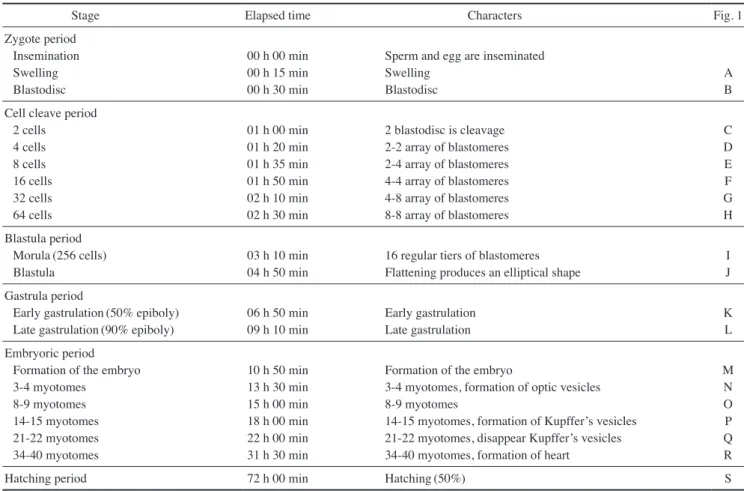
여울마자의 성숙란은 수정 후 15분 후에 물을 완전히 흡수 하여 1.15±0.03(1.1~1.21)mm로 팽창되었다(Table 1, Fig.
1A). 수정 후 30분이 경과하자 세포질이 동물극(animal pole) 쪽으로 끌려 배반(blastodisc, 1세포기)이 형성되었으며(Fig.
1B), 2세포기는 1시간 후에 배반에 난할이 일어나 형성되었 다(Fig. 1C) 4세포기는 1시간 20분 경할을 통하여 형성되었 고(Fig. 1D), 8세포기는 1시간 35분 후에 위할을 통하여(Fig.
1E), 16세포기는 1시간 50분 후에 경할을 통하여 형성되었다 (Fig. 1F). 32세포기는 2시간 10분 후에(Fig. 1G), 64세포기는 2시간 30분 후에 형성되었으며(Fig. 1H), 상실기(morula, 256 세포기)는 3시간 10분 후에 형성되었고(Fig. 1I), 이후 난할을 계속하여 4시간 50분 후에는 포배기(blastula)가 형성되었다 (Fig. 1J). 6시간 50분 후에는 낭배기(gastrula)가 형성되어 식 물극(vegetal pole) 쪽으로 덮기 시작하였으며(Fig. 1K), 이후 9시간 10분 후에는 90% 이상을 덮어 낭배 말기에 도달되었다 (Fig. 1L). 10시간 50분 후에는 원구가 폐쇄되고 배체(embryo) 의 윤곽이 뚜렷해졌으며(Fig. 1M), 13시간 30분 후에는 근절 (myotomes)이 3~4개가 생기고 안포(optic vesicle)가 형성되 었다(Fig. 1N). 15시간 후에는 8~9개의 근절이 형성되었다 (Fig. 1O), 18시간 후에는 근절이 14~15개가 생기고 미병부 뒤쪽으로 Kupper’s vesicle이 형성되었다(Fig. 1P). 19시간 30 분 후에는 근절수가 17~18개로 증가하였고 안포 뒤쪽으로
이포(auditory vesicle)가 형성되었다. 이후 22시간 후에는 근 절수가 21~22개로 Kupper’s vesicle이 사라지고 눈에 렌즈가 형성되었으며 꼬리부분이 난황으로부터 분리되기 시작하면서 난내 운동을 시작하였다(Fig. 1Q). 31시간 30분 후에는 심장 이 형성되었으며, 난 막 안에서 활발하게 움직이기 시작하였 다(Fig. 1R). 48시간 후에는 눈에 색소가 침착되고 가슴지느러 미 원기가 형성되었다. 수정 후 72시간에는 꼬리를 이용하여 난막(chorion)을 뚫고 전체의 50%가 부화하였다(Fig. 1S).
3. 자어와 치어의 발달 1) 전기 자어기
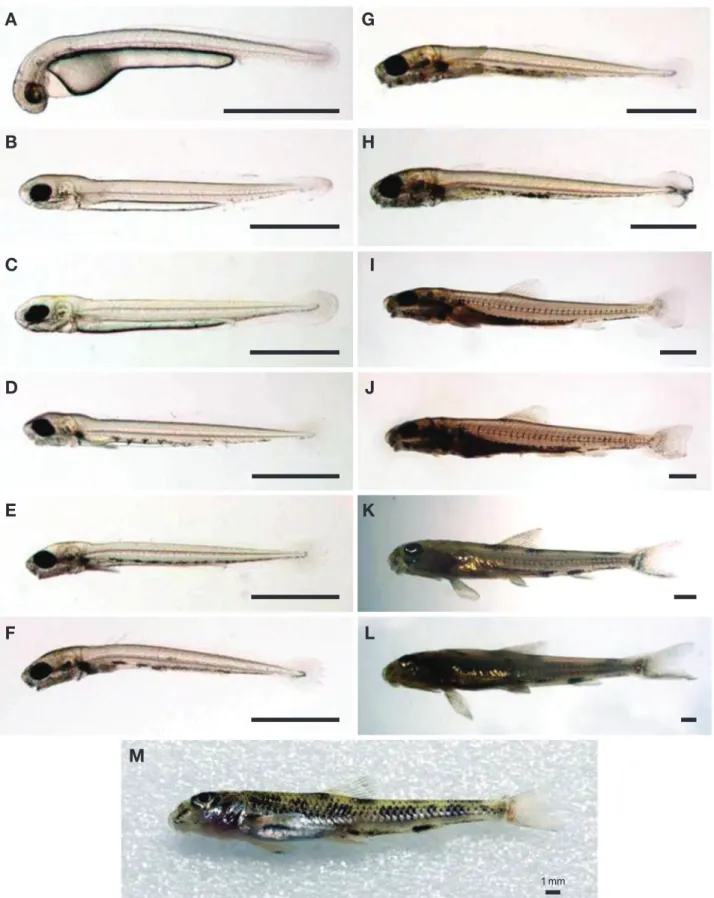
부화 직후 자어는 전장 2.79±0.04mm(n=10)로 몸이 휘어 져 있었고 몸은 무색으로 입과 항문은 열리지 않았으며 몸의 중앙과 뒤쪽에 막 지느러미가 형성되었다(Fig. 2A). 부화 1일 후 자어는 전장 3.62±0.08mm(n=10)로 몸이 일자로 펴졌고 가슴지느러미가 안경의 1.5배 이상으로 발달하였고 안구에 색 소가 약하게 침착되었다(Fig. 2B). 2일 후는 전장 3.79±0.05 mm(n=10)로 난황이 2/3이상 흡수되었고 가슴지느러미가 안 경의 2배 이상으로 발달하였으며 두부 쪽으로 엷은 노란색이
착색되었다(Fig. 2C). 3일 후에는 전장 3.88±0.05mm(n=10) 로 난황이 거의 흡수되었고 입과 항문이 열리면서 먹이(윤충, Rotifer)를 섭식하기 시작하였다(Fig. 2D).
2) 후기 자어기
부화 후 5일째에는 전장 4.10±0.07mm(n=10)로 난황을 모두 흡수하여 후기자어기로 이행되었으며, 대부분의 개체가 활발한 먹이활동을 보였다. 또한 배면 아래는 전체적으로 검 게 착색되었으며 꼬리지느러미 원기가 관찰되었다(Fig. 2E).
7일 후에는 전장 4.49±0.06mm(n=10)로 성장하였고 배면 의 흑색 색소포 꼬리지느러미까지 길게 이어졌다(Fig. 2F). 10 일 후에는 전장 4.89±0.10mm(n=10)로 미병부의 막 지느러 미는 더욱 함입되어 꼬리지느러미가 더욱 뚜렷해졌으며 등지 느러미 원기가 관찰되었고 수염이 나타나기 시작하였다(Fig.
2G). 부화 후 16일째에는 전장 5.36±0.29mm(n=10)로 뒷 지느러미 원기가 나타났고 꼬리지느러미 기조는 10 ~15개 가 관찰되었으며 뒷지느러미 기저부와 미병부에 흑색포가 침 착되었다(Fig. 2H). 부화 후 24일째에는 전장 7.90±0.32mm (n=10)로 뒷지느러미 기조는 3~4개가 관찰되었으며 척추골 의 형태가 명확해지기 시작하였다(Fig. 2I).
table 1. Embryonic development of Microphysogobio rapidus at water temperature 21±1°C
Stage Elapsed time Characters Fig. 1 Zygote period
Insemination 00 h 00 min Sperm and egg are inseminated
Swelling 00 h 15 min Swelling A
Blastodisc 00 h 30 min Blastodisc B
Cell cleave period
2 cells 01 h 00 min 2 blastodisc is cleavage C
4 cells 01 h 20 min 2-2 array of blastomeres D
8 cells 01 h 35 min 2-4 array of blastomeres E
16 cells 01 h 50 min 4-4 array of blastomeres F
32 cells 02 h 10 min 4-8 array of blastomeres G
64 cells 02 h 30 min 8-8 array of blastomeres H
Blastula period
Morula(256 cells) 03 h 10 min 16 regular tiers of blastomeres I
Blastula 04 h 50 min Flattening produces an elliptical shape J
Gastrula period
Early gastrulation(50% epiboly) 06 h 50 min Early gastrulation K
Late gastrulation(90% epiboly) 09 h 10 min Late gastrulation L
Embryoric period
Formation of the embryo 10 h 50 min Formation of the embryo M
3-4 myotomes 13 h 30 min 3-4 myotomes, formation of optic vesicles N
8-9 myotomes 15 h 00 min 8-9 myotomes O
14-15 myotomes 18 h 00 min 14-15 myotomes, formation of Kupffer’s vesicles P
21-22 myotomes 22 h 00 min 21-22 myotomes, disappear Kupffer’s vesicles Q
34-40 myotomes 31 h 30 min 34-40 myotomes, formation of heart R
Hatching period 72 h 00 min Hatching(50%) S
3) 치어기
여울마자 자어는 부화 후 30일째에 전장 9.74±0.24mm (n=10)로 뒷지느러미 기조가 정수(6~7개)에 도달하여 치 어기로 이행되었으며, 등 쪽과 미병부 쪽에 3 ~4개의 흑색 포 무리가 모여 나타났고 등지느러미와 꼬리지느러미에 무늬 가 나타나기 시작하였다(Fig. 2J). 부화 후 45일째에는 전장 12.56±1.10mm(n=10)로 꼬리지느러미의 중앙부위가 오목
하게 V자형으로 들어가 성체와 유사한 형태를 보였고 두부와 체측에 흑색포들이 모여 나타났다(Fig. 2K). 60일 후에는 전장 16.95±1.27mm(n=10)로 두부와 등 면 및 배면의 흑색포는 더욱 진해졌으며 꼬리지느러미는 완전히 갈라졌다(Fig. 2L).
100일 후에는 전장 27.00±1.94mm(n=10)로 체측 전체는 전 반적으로 옅은 황갈색을 띠었고 체측과 지느러미에 나타난 반문이 성어와 유사해졌으며, 아가미 쪽에 밝은 회색의 광택 Fig. 1. The egg development of Microphysogobio rapidus at 21±1°C. Time required for each developmental stage is shown in Table 1. The bar indicates 1mm.
A B C D
E F G H
I J K L
M N O P
Q R S
1mm
Fig. 2. Larva and juvenile development of Microphysogobio rapidus at 21±1°C. The bar indicates 1mm. A: Newly hatched prelarva, 2.79±0.04 mm(TL); B: 1 day, 3.62±0.08mm; C: 2 days, 3.79±0.05mm; D: 3 days, 3.88±0.05mm; E: Postlarva, 5 days, 4.10±0.07mm; F: 7 days, 4.49±
0.06mm; G: 10 days, 4.89±0.10mm; H: 16 days, 5.36±0.29mm; I: 24 days, 7.90±0.32mm; J: Juvenile, 30 days, 9.74±0.24mm; K: 45 days, 12.56±1.10mm; L: 60 days, 16.95±1.27mm; M: 100 days, 27.00±1.94mm.
A G
B H
C I
D J
E K
F L
M
1mm
이 관찰되어 여울마자 성어와 유사한 특징을 보여주었다(Fig.
2M).
4) 성장
부화 직후 자어는 전장 2.79±0.04mm(n=10)이었고 이후 급격한 성장을 보여 10일에 전장 4.89±0.10mm(n=10), 30 일에는 전장 9.74±0.24mm(n=10), 60일에는 전장 16.95±
1.27mm(n=10), 80일에는 전장 24.30±1.83mm(n=10)이었 으며, 100일에는 전장 27.00±1.94mm(n=10)이었다. 초기 전 장 성장식은 Y=0.0006X2+0.1938X+3.0302(R2=0.9899)로 나타났다(Fig. 3).
고 찰
한국산 모래주사속 어류는 모두 고유종으로써 돌마자와 경모치는 비교적 널리 분포하나 배가사리는 서한아 지역에만 출현하고 모래주사와 여울마자는 남한아 지역에만 분포한다 (Kim and Yang, 1999). 여울마자는 과거 문경, 안동, 영양, 상 주, 밀양 및 산청 등 여러 곳에 서식하는 것으로 알려져 있었 으나 최근 하상공사, 골재채취 및 수질오염 등으로 서식지가 급격하게 감소하여 환경부에서는 멸종위기 야생생물 I급으로 지정하여 보호하고 있다(Kim and Yang, 1999; NIBR, 2011;
ME, 2012). 이 같은 법적인 보호에도 불구하고 신종으로 보 고된 이후 일부 분포지역 및 계통분류학적 연구만 진행되었 을 뿐 난 발생 및 초기생활사를 포함한 생태학적인 연구는 이 루어진 바 없어 멸종위기에 처한 본 종의 보호와 자원 유지를 위한 기초적인 생물학적 연구, 인위적인 증식 및 복원을 위한 기초자료 확보가 시급한 실정이다. 어류의 난 발생 및 초기생 활사에 대한 연구는 종의 생물학적 특성에 대한 정보를 바탕
으로 대상 종의 인공종묘 생산 등 복원을 위한 연구에 다각도 로 활용할 수 있기 때문에 매우 중요하다. 이에 본 연구에서는 여울마자의 종 보존 및 복원을 위한 기초자료를 확보하고자 난 발생 및 초기생활사의 특징을 밝히고, 모래무지아과에 속 하는 유연종과 함께 비교하였다(Table 2).
여울마자의 산란 시기는 보고된 바 없으나 본 연구 장소인 산청군 일원을 기준으로 4월말에서 5월까지 수온이 20°C로 올라갈 때 자연 서식지에서 여울지역으로 암컷과 수컷이 모여 드는 행동을 관찰할 수 있었다. 또한 이때 포획된 친어는 복부 압박만으로 배란과 정액이 관찰되었다. 한편 5월 22일에 채집 된 암컷의 산란율은 78%로 높아 산란 말기로 판단되었으며, 6 월에는 여울지역에 집단적으로 모이는 행동이 관찰되지 않았 고 이때 채집한 암컷에서는 성숙란이 관찰되지 않아 여울마자 의 산란기는 하천의 수온이 20°C로 올라가는 4월 말에서 5월 까지로 판단된다. 이는 모래주사속 어류인 배가사리(4월~5 월; Song and Son, 2003), 모래주사(4월 말~5월 초; Kim et al., 2012)와 유사하였으나, 돌마자(5월 중순~7월 말; Baek, 1978)에 비해서는 빨랐다. 이러한 산란시기에 따른 수온의 차 이는 부화시간과 초기발달에 큰 영향을 주는데 4월 말부터 산 란을 시작하는 여울마자(20~22°C)의 부화시간은 72시간, 모 래주사(23°C)는 29시간으로 5월 말부터 7월까지 산란을 하는 돌마자(22~25°C)의 부화시간 20시간에 비해 길었으나, 난황 이 흡수되는데 걸리는 시간은 모래주사 4일, 여울마자와 돌마 자는 5일로 거의 유사했다(Baek, 1978; Kim et al., 2012). 여울 마자의 경우 자연산란장의 수온이 20~22°C인 점을 고려할 때 자연 상태에서의 부화시간과 후기자어기로 이행되는 시간 도 유사할 것으로 판단된다. 한편 멸종위기어류의 증식 및 복 원을 위해 양질의 수정란을 확보하는 것은 중요하다. 국내의 경우 일부 멸종위기어류를 대상으로 인위적인 산란유도를 위 Fig. 3. Early growth curve of total length of Microphysogobio rapidus after hatching at water temperature 21±1°C. The diagrams indicate the mean(circle) and standard deviation(vertical line).
y=0.0006x2+0.1938x+3.0302
R2=0.9899 35
30 25 20 15 10 5 0
Total length(mm)
Days after hatching
0 10 20 30 40 50 60 70 80 90 100 110
한 호르몬의 종류 및 농도별 산란유도 효과를 연구한 바 있다 (Lee, 2009; MLTM, 2010; ME, 2011). 본 연구에서는 일정농도 의 Ovaprim 호르몬을 이용한 산란유도 및 난 발생 실험이 진 행되었으나 추후 다양한 실험조건에서 수정란을 확보하는 연 구가 필요할 것으로 판단된다. 또한 산란성기인 5월 초에 채집 한 암컷의 경우 가벼운 복부압박 만으로도 체외로 배란이 이 루어지는 경우가 있어 친어의 성숙정도도 양질의 수정란을 확 보하는데 중요한 영향을 미치는 것으로 판단된다. 이에 추후 인공증식을 위한 친어 확보 시 산란성기인 5월 초 보다는 이 른 시기에 친어의 성숙 정도에 따라 선별 후 인공수정을 진행 하는 방법도 본 종의 인공종묘 생산을 위해 중요할 것으로 사 료된다.
본 종의 성숙란은 약한 점착성을 가진 분리침성란으로 돌마 자(Baek, 1978), 모래주사(Kim et al., 2012), 돌상어 Gobiobo- tia brevibarba(Shim, 1994; Choi et al., 2001; Ko et al., 2011a), 모래무지 Pseudogobio esocinus(Lee et al., 2008), 꾸구리 G.
macrocephala(Ko et al., 2011b), 흰수마자 G. naktongensis (Ko et al., 2013)의 성숙란과 유사한 특징을 보인 반면 바위 나 돌에 산란하는 감돌고기 Pseudopungtungia nigra(Lee et al., 2004), 돌고기 Pungtungia herzi(Lee et al., 2002), 쉬리 Coreoleuciscus splendidus(Song and Kwon, 1993) 등이나 작 은 돌이나 수초에 알을 붙이는 참붕어 Pseudorasbora parva (Han et al., 2001) 등의 경우 강한 점착성을 띠어 여울마자와 는 차이를 보였다.
여울마자 성숙란의 크기는 0.63±0.02mm로 흰수마자 0.74±0.08mm(Ko et al., 2013), 꾸구리 0.89±0.04mm(Ko et al., 2011b), 모래주사 1.0±0.04mm(Kim et al., 2012), 배가 사리 1.03±0.07mm(Song and Son, 2003), 돌상어 1.24±0.07 mm(Ko et al., 2011)보다는 작았고 왜매치 Abbottina springeri 0.43±0.06mm(Son, 2000), 돌마자 0.5mm(Baek, 1978)보다 는 컸다. 이러한 성숙란의 차이는 부화 직후의 자어크기와 밀 접한 연관이 있으며 초기먹이를 결정하는 중요한 기준이 된 다(Ko et al., 2011b). 여울마자의 부화 직후 자어의 크기는 전 장 2.79±0.04mm로 흰수마자 3.4±0.07mm(Ko et al., 2013) 와 유사하였으나 꾸구리 4.6±0.16mm(Ko et al., 2011b), 돌 상어 5.5±0.29mm(Ko et al., 2011)에 비해서는 작아 성숙란 의 크기가 클수록 부화자어의 크기도 큰 경향을 보였다. 그러 나 같은 모래주사속 어류인 모래주사의 성숙란 크기는 여울 마자에 비해 컸지만 부화자어의 크기는 2.2±0.48mm(Kim et al., 2012)로 작게 나타났고, 돌마자의 부화자어 크기는 0.7 mm(Beak, 1978)로 보고되어 성숙란의 크기에 비해 부화자어 의 크기가 너무 작아 Ko et al.(2013)은 추후 재검토가 요구된 다고 논의한 바 있다. 한편 여울마자의 성숙란은 밝은 청록색 을 띠어 같은 모래주사속 어류인 돌마자의 밝은 노랑(Baek, table 2. Comparison of egg and larva developmental characteristics in Gobioninae fishes SpeciesEgg diameter (mm, mean±SD)Spawned eggs (mean±SD)Time of hatching (water temperature)Hatching size (mm, mean±SD)Days until post larvaDays until juvenileReferences Microphysogobio rapidus0.63±0.022,298±639(1,602-3,240)72 h(20-22°C)2.79±0.04530Present study M. koreensis1.0±0.043,331±935(2,041-4,404)29 h(23°C)2.2±0.48420Kim et al., 2012 M. yaluansis0.5672±376(276-1,230)20 h(22-25°C)0.71131Baek, 1978 M. longidorsalis1.03±0.077,334(5,133-8,787)----Song and Son, 2003 Pseudorasbora parva1.86323(250-420)183 h(15.5-18.5°C)5.16365Han et al., 2001 Pungtungia herzi2.11,640(1,400-1,860)186 h(19°C)6.07-845Lee et al., 2002 Pseudopungtungia nigra2.181,600(1,400-1,900)189 h(18.5-19.5°C)5.82644Lee et al., 2004 P. tenuicorpa1.96±0.08218±76(87-345)240 h(22-24°C)8.6±0.25210Ko et al., 2012 Pseudogobio esocinus1.98±0.19-164 h(19°C)4.61±0.83842Lee et al., 2008 Abbottina springeri0.43±0.06652(620-694)----Son, 2000 Gobiobotia macrocephala0.89±0.041,271±908(205-3,361)107 h(23°C)4.6±0.16415Ko et al., 2011b G. brevibarba1.24±0.07744±401(259-1,642)120 h(23°C)5.5±0.29415Ko et al., 2011a G. naktongensis0.74±0.081,015±199(750-1,365)26 h(23°C)3.4±0.07313Ko et al., 2013
1978), 배가사리의 연노랑(Song and Son, 2003)과 차이를 보 여 주목되었다.
포란수는 평균 3,827±1,225(1602~3240)개로 돌마자 672±
376(276~1230)개(Baek, 1978), 돌상어 744±401(259~1642) 개(Ko et al., 2011), 흰수마자 1,015±199(750~1365)개(Ko et al., 2013), 꾸구리 1,271±908(205 ~3361)개(Ko et al., 2011b) 보다는 많았으며, 모래주사 3,331±935(2041~4404) 개(Kim et al., 2012)와는 비슷하였고, 배가사리 7,334(5133~
8787)개(Song and Son, 2003)에 비해서는 적게 나타났다.
이 같은 여울마자의 난 발생 및 초기생활사 결과를 같은 모 래주사속 어류인 모래주사, 돌마자, 배가사리와 비교하여보 면 여울마자는 성숙란과 부화 직후 자어의 크기, 포란수, 부화 시간, 치어기로의 이행시간 등에서 차이를 보였지만 성숙란의 특징 및 후기 자어기로의 이행 시간 등은 비교적 유사하였다.
요 약
멸종위기어류 여울마자의 생물학적 특성 및 복원을 위한 기 초자료를 확보하기 위해 2013년 남강에서 채집하여 난 발생 과정과 초기생활사를 연구하였다. 성숙란은 암컷에 Ovaprim 을 주사(0.5mL/kg)하여 얻었으며 건식법으로 인공 수정시켰 다. 성숙란은 약한 점착성을 가지며 밝은 청록색을 띤 분리침 성란이었으며, 난경은 0.63±0.02mm(n=20), 포란수(n=5)는 평균 3,827±1,225(2,850~5,916)개였다. 수온은 21±1°C에 서 72시간 뒤에 부화하였으며, 부화 직후 전기 자어 크기는 전 장 2.79±0.04mm(n=10)였다. 부화 후 5일에는 전장 4.10±
0.07mm(n=10)로 난황을 모두 흡수하여 후기자어로 이행하 였고 부화 30일째에는 전장 9.74±0.24mm(n=10)로 모든 지 느러미의 기조가 정수가 되어 치어기로 이행하였다. 부화 후 100일 후에는 전장 27.00±1.94mm(n=10)로 체측반문과 외 부형태가 성어와 유사한 모습을 보였다.
사 사
본 논문은 순천향대학교의 연구비 지원에 의해 수행되었습 니다.
인 용 문 헌
Baek, Y.G. 1978. On the life history of Microphysogobio yaluensis (Mori). Korean J. Limnol., 11: 43-49.
Balon, E.K. 1985. The theory of saltatory ontogeny and life history
models revisited. pp. 13-28. In: Balon, E.K.(ed.), Early life histories of fishes: New developmental, ecological and evo- lutionary perspectives, Dr. W. Junk Publisher. Dordrecht, 280pp.
Banarescu, P. 1992. A critical updated checklist of Gobioninae (Pisces: Cyprinidae). Trav. Mus. Hist. Nat. Grigoreantipa, XXXII: 303-330.
Blaxter, J.H.S. 1974. The early life history of fish. Spring-Verlag.
Berlin, 765pp.
Chae, B.S. and H.J. Yang. 1999. Microphysogobio rapidus, a new species of gudgeon(Cyprinidae, Pisces) from Korea, with revised key to species of the genus Microphysogobio from Korea. Korean J. Biol. Sci., 3: 17-21.
Cheng, Q. and B. Zheng. 1987. Systematic Synopsis of Chinese Fishes. Vol. 1. Science Press, Beijing, pp. 166-167.
Choi, J.S., H.K. Byeon and O.K. Kwon. 2001. Reproductive ecol- ogy of Gobiobotia brevibarba(Cyprinidae). Korean J. Ich- thyol., 13: 123-128.(in Korean)
Han, K.H., S.H. Lee, W.I. Seo, D.J. Yoo, D.S. Jin, S.H. Oh and C.C.
Kim. 2001 The spawning behavior and early life history of the false dace, Pseudorasbora parva. J. Inst. Sci. Yosu Na- tional University, 3: 67-76.(in Korean)
Howes, G.J. 1991. Systematics and biogeography an overview. In:
Winfield, I.J. and J.S. Nelson(eds.), Cyprinid fishes, system- atics, biology and explotation. Chapman & Hall, London, pp. 1-33.
Kim, C.H., S.W. Yoon, J.G. Kim, H.T. Kim, J.S. Park and J.Y. Park.
2012. Embryonic development and early life history of the endangered species Microphysogobio koreensis(Pisces:
Cyprinidae). Korean J. Ichthyol., 24: 160-166.(in Korean) Kim, I.S. and H. Yang. 1999. A revision of the genus Microphyso
gobio in Korea with description of a new species. Korean J.
Ichthyol., 11: 1-11.
Kim, I.S. and J.Y. Park. 2007. Freshwater fishes of Korea. Kyohak- sa, Seoul, 467pp.(in Korean)
Kim, K.Y. and I.C. Bang. 2010. Molecular phylogenetic position of Abbottina springeri(Cypriniformes; Cyprinidae) based on nucleotide sequences of RAG1 gene. Korean J. Ichthyol., 22: 273-278.
Ko, M.H., I.R. Lee and I.C. Bang. 2013. Egg development and ear- ly life history of the endangered species Gobiobotia nakton
gensis(Pisces: Cyprinidae). Korean J. Ichthyol., 25: 9-16.(in Korean)
Ko, M.H., S.Y. Park and I.C. Bang. 2012. Egg development and early life history of the slender shinner Pseudopungtungia tenuicorpa(Pisces: Cyprinidae). Korean J. Ichthyol., 24:
48-55.(in Korean)
Ko, M.H., S.Y. Park, I.R. Lee and I.C. Bang. 2011a. Egg develop- ment and early life history of the endangered species Gobio
botia brevibarba(Pisces: Cyprinidae). Korean J. Limnol., 44: 136-143.(in Korean)
Ko, M.H., W.J. Kim, S.Y. Park and I.C. Bang. 2011b. Egg develop-
ment and early life history of the endangered species Go
biobotia macrocephala(Cyprinidae). Korean J. Ichthyol., 23: 198-205.(in Korean)
Lee, I.R. 2009. Studies on the conservation biology of an endan- gered freshwater fish, Iksookimia choii. Soonchunhyang University. Doctoral thesis, 167pp.(in Korean)
Lee, S.H., G.N. Oh, K.S. Kim, Y.S. Oh, K.W. Kang, J.H. Hwang, B.I.
Lee, W.K. Lee and K.H. Han. 2008. Embryonic and larval development of goby minnow, Pseudogobio esocinus. Dev.
Reprod., 12: 283-288.(in Korean)
Lee, S.H., K.H. Han and D.S. Hwang. 2002. The early life history and spawning behavior of the Pungtungia herzi. J. Inst. Sci.
Yosu National University, 4: 115-126.(in Korean)
Lee, S.H., K.H. Han, S.M. Yoon, D.S. Hwang, D.J. Yoo, C.L. Lee, I.S. Kim and Y.M. Son. 2004. Early life history and spawn- ing behavior of Pseudopungtungia nigra. Korean J. Ichthy- ol., 16: 309-316.(in Korean)
Lee, W.O., K.H. Kim, J.M. Back and M.Y. Song. 2013. Egg devel- opment and early life history of Zacco koreanus(Pisces:
Cyprinidae). Korean J. Ichthyol., 25: 200-207.(in Korean) ME(Ministry of Environment). 1997-2008. National environment
investigation of freshwater fish.(in Korean)
ME(Ministry of Environment). 2006. Species conservation, resto- ration and development of culture techniques of an endan- gered Korean fish. Kunsan University, Kunsan, 537pp.(in Korean)
ME(Ministry of Environment). 2009. Genetic diversity analysis, culture and development of ecological restoration techni- ques of an endangered fish Cobitis choii. Soonchunhyang University, Asan, 506pp.(in Korean)
ME(Ministry of environment). 2011. Development of culture tech- niques and construction of monitoring system for released seed of an endangered fish Koreocobitis naktongensis. Soon-
chunhyang University, 250pp.(in Korean)
ME(Ministry of Environment). 2012. Conservation and manage- ment laws of wildlife(Law No. 10977).(in Korean) MLTM(Ministry of Land, Transport and Maritime Affairs). 2010.
Culture and restoration of endangered species in the major four river drainages. Soonchunhyang University, Asan, 489pp.(in Korean)
MLTM(Ministry of Land, Transport and Maritime Affairs). 2011.
Culture and restoration of endangered species in the major four river drainages(II). Soonchunhyang University, Asan, 363pp.(in Korean)
NIBR(National Institute of Biological Resources). 2011. Red data book of endangered fishes in Korea. National institute of biological resources, Incheon, 202pp.(in Korean)
Shim, J.H. 1994. Early embryonic development of Gobiobotia bre
vibarba, Korea endemic species. Chungnam National Uni- versity, Master of science thesis, 26pp.(in Korean) Son, Y.M. 2000. Population ecology of Abbottina springeri(Cyprin-
idae) in the Mushim stream, Korea. Korean J. Ichthyol., 12:
186-191.(in Korean)
Song, H.B. and O.K. Kwon. 1993. Ecology of Coreoleuciscus splen
didus Mori(Cyprinidae) in Hongchon river. Korean J. Lim- nol., 26: 235-244.(in Korean)
Song, H.B. and S.S. Choi. 2000. Reproductive ecology and early life history of paradise fish, Macropodus chinensis(Pisces;
Belontidae) in aquarium. Korean J. Limnol., 33: 282-294.(in Korean)
Song, H.B. and Y.M. Son. 2003. Population ecology of Microphyso
gobio longidorsalis(Cyprinidae) from Korea. Korean J. Ich- thyol., 15: 303-310.(in Korean)
Uchida, K. 1939. The fishes of Tyosen. Part I. Numatognathi, Event- ognathi. Bull. Fish. Exp. Sta. Gov. Gener. Tyosen, 6., 458pp.
(In Japanese)