서 론
미꾸리과(Cobitidae) 어류는 잉어목(Cypriniformes)에 속하 며 유라시아와 아프리카 북부에 널리 서식하는 담수어류로 26 속 177종이 보고되었고(Nelson, 2006), 우리나라에는 미꾸리 속 Misgurnus 2종, 새코미꾸리속 Koreocobitis 2종, 기름종개속 Cobitis 4종, 참종개속 Iksookimia 6종, 좀수수치속 Kichulchoia 2종으로 모두 16종이 서식한다(Kim, 2009). 이 중 기름종개속 은 기름종개 C. hankugensis와 점줄종개 C. lutheri, 줄종개 C.
tetralineata, 미호종개 C. choii가 지리적으로 나뉘어져 서식하 며 점줄종개를 제외한 3종은 우리나라 고유종이다.
본 연구종인 줄종개는 이전까지 C. striata의 학명을 사용 하였지만 1999년 Kim et al.에 의해 체측반문 등의 차이로 C.
tetralineata으로 신종 보고되었으며 섬진강과 일부 남해로 흐 르는 하천에 서식하는 것으로 알려졌다(Kim et al., 1999; Kim et al., 2005; Kim and Park, 2007). 줄종개에 관한 연구는 생태 (Kim et al., 2006)와 핵형(Kim and Lee, 1986), 난막구조(Park and Kim, 1997) 등의 연구가 이루어졌고 섬진강 옥정호의 터 널을 통하여 동진강 상류에 유입되어 점줄종개와 잡종을 형 성하는 것으로 보고된 바 있다(Kim and Lee, 1984; Kim and Yang, 1993; Kwan et al., 2014).
어류의 난발생 및 초기생활사 연구는 종의 산란 장소의 선 택 및 난발달과 자치어의 발달 등의 특유의 생식전략 등을 분 석하여 종의 특징을 규명하고 유사종과의 분류학적 유연관 계를 밝히는데 적용되어 왔으며(Blaxter, 1974; Balon, 1985;
Shimizu et al., 1998; Ko et al., 2013; Ko and Bang, 2014), 자 원증강 및 멸종위기종의 복원을 위한 인공증식 기술 확립의 중요한 기초연구로 폭넓게 연구되고 있다(Tanaka, 1973; ME, 2006, 2009; MLTM, 2010, 2011; NIBR, 2013).
본 연구에서는 아직까지 조사되지 않은 우리나라 고유종 줄
—95 — http://www.fishkorea.or.kr
한국고유종 줄종개 Cobitis tetralineata의 난발생 및 초기생활사
고명훈·원용진
*
이화여자대학교 에코과학부, 생명과학부
Egg Development and Early Life History of the Korean Spine Loach, Cobitis tetralineata(Pisces:
Cobitidae) by Myeong-Hun Ko and Yong-Jin Won* (Division of EcoScience and Department of Life Science, Ewha Womans University, 52, Ewhayeodae-gil, Seodaemun-gu, Seoul, Korea)
ABSTRACT Egg development and early life history of the Korean spine loach, Cobitis tetralineata, were investigated in the present study. Adult fish were sampled using spoon nets at the Seomjin River in Jeongsan-ri, Bokheong-myeon, Sunchang-gun, Jeollanbuk-do, Korea, July 2013. Eggs were obtained after injecting Ovarprim into females. Eggs were then artificially fertilized using the Dry method in the laboratory. Mature eggs were slightly adhesive and transparent with grey coloring, and measured 1.04±0.03mm(mean±SD) in diameter. Hatching of the embryo occurred approximately 56 hours after fertilization at 25°C of water temperature, and the average size of newly hatched lar- vae was about 4.6±0.11mm in total length. At fifth day after hatching, the larval full length reached 6.8±0.28mm on average and their yolk sac had been completely absorbed. At 17th day after hatch- ing, larva entered the juvenile stage and reached 9.8±0.50mm in total length. At 100th day after hatching, the formation of Gambetta’s zone of four line was complete and juveniles were similar in general appearance to adults, and they averaged 34.7±5.77mm in total length.
Key words: Cobitis tetralineata, egg development, early life history
* Corresponding author: Yong-Jin Won Tel: 82-2-3277-4630, Fax: 82-2-3277-2385, E-mail: [email protected]
ISSn: 1225-8598(Print), 2288-3371(online)
accepted: June 25, 2015
96 고명훈·원용진
종개의 난발생 및 초기생활사를 조사하여 생물학적 특징을 밝 히고 미꾸리과 어류들과 유연관계를 논의하고자 한다.
재료 및 방법
1. 채집 및 산란유도
줄종개 Cobitis tetralineata는 섬진강 상류 추령천인 전북 순 창군 복흥면 정산리에서 2013년 6월 21일에 족대(망목 4×4 mm)를 이용하여 친어를 채집하였으며, 이후 실험실로 운반하 여 수온 23~25°C로 사육·관리하였다. 채집된 개체 중 성숙 한 개체들을 골라 암·수 모두 1kg당 Ovaprim(Syndel, Can- ada) 0.5mL을 주사하였고, 12시간 경과 후에 암컷을 복부압 박법으로 채란하고 여기에 수컷으로부터 얻은 정액을 Ringer solution에 100배 희석시켜 건식법으로 수정시켰다. 성숙난의 난경은 30개를 측정하였으며, 산란수를 파악하기 위하여 개체 당 산란한 난수를 모두 개수하였다.
2. 사육 및 관찰
수정란은 15cm 패트리디쉬에 분산 수용하여 난발생과 전 기자어기를 진행시켰고, 이후 순환식 수조(60×45×45cm) 에 옮겨 사육하였으며 사육수온은 25°C로 관리하였다. 난황 흡수가 끝난 자어부터 부화 후 30일까지는 알테미아(Artemia sp.) 유생을 공급하였고, 31일 이후부터는 알테미아 유생과 배 합사료를 공급하여 사육하였다. 난과 자·치어의 발달 과정 은 Charles et al.(1995)와 Kim(1997)에 따라 구분하였으며, 디지털카메라(Leica DFC290, Germany)가 부착된 해부현미 경(Leica S8APO, Germany) 하에서 관찰 및 촬영하였다. 자·
치어 크기는 부화 직후부터 부화 후 100일까지 각 발달 단 계별로 무작위 10개체를 선별한 후 마취제 MS-222(Sindel, Canada)로 마취하여 관찰 및 전장을 측정하였다.
결 과
1. 성숙개체 크기 및 성숙란의 특징
채집된 줄종개 Cobitis tetralineata의 성숙한 암컷(n=24)은 전장 102~133mm, 수컷(n=9)은 전장 85~94mm였다. 성 숙한 암컷에 Ovaprim을 주사 후 12시간 이후에 성숙란이 잘 배란되었으며 난질도 양호하였다. 산란된 성숙란은 회색의 분 리침성란으로 난경(n=30)은 1.04±0.03mm이였고, 산란수 (n=24)는 2,646±916(1,494~4,096)개 였다(Fig. 1).
2. 난발생 과정
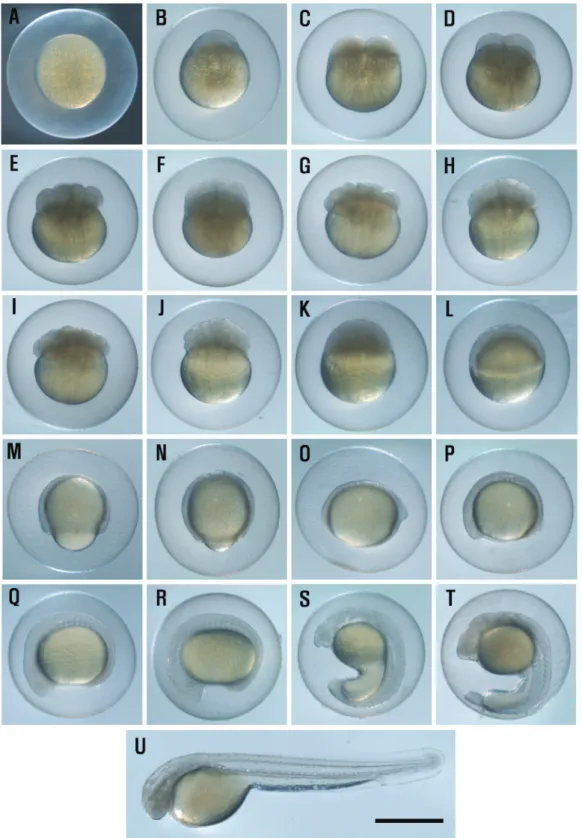
줄종개의 수정난은 약한 점착성을 가지는 분리 침성난이 었으며, 수정 후에 물을 흡수하여 20분 후에는 2.4±0.03mm (n=20)로 팽창하였다(Fig. 2A). 수정 후 45분 후에 세포질 이 동물극(animal pole)쪽으로 끌려 배반(blastodisc, 1세포기) 이 형성되었으며(Fig. 2B), 2세포기는 58분 후에 배반에 난할 이 일어나 형성되었고(Fig. 2C), 4세포기는 1시간 15분 후에 경할을 통하여 형성되었으며(Fig. 2D), 8세포기는 1시간 30 분 후에(Fig. 2E), 16세포기는 1시간 44분 후에(Fig. 2F), 32 세포기는 2시간 후에(Fig. 1G), 64세포기는 2시간 15분 후에 (Fig. 2H) 형성되었다. 128세포기는 2시간 30분 후에 형성되 었고(Fig. 2I), 상실기(morula, 256 세포기)는 2시간 45분 후 에 형성되었으며(Fig. 2J), 이후 난할을 계속하여 4시간 25분 후에 포배기(blastula)가 형성되었다(Fig. 2K). 7시간 후에는 낭배기(gastrula)가 형성되어 식물극(vegetal pole) 쪽으로 덮 기 시작하였으며(Fig. 2L), 이후 9시간 30분 후에 낭배 중기에 (Fig. 2M), 10시간 30분 후에는 90% 이상을 덮어 낭배 말기에 도달하였다(Fig. 2N). 12시간 후에는 원구(blastopore)가 폐쇄 되고 배체(embryo)의 윤곽이 뚜렷해졌으며(Fig. 2O), 13시간 20분 후에는 근절(myotomes)이 3~4개가 생기고 안포(optic vesicle)가 형성되었다(Fig. 2P). 15시간 30분 후에는 9~10개 의 근절이 형성되었으며(Fig. 2Q), 17시간 30분 후에는 근절 이 17~18개이고 이포(auditory vesicle)와 Kupper’s vesicle이 형성되었다(Fig. 2R). 이후 꼬리가 난황에서 분리되면서 움직 이기 시작하였고, 21시간 후에는 28~30 근절이 생기고 눈의 렌즈가 형성되며 뇌가 분화하기 시작하였으며 Kupper’s vesi- Fig. 1. Number of spawned eggs of Cobitis tetralineata in Churyeo- ng Stream, Jeongsan-ri, Bokheong-myeon, Sunchang-gun, Jeollan- buk-do, Korea, June, 2013.
y=73.48x-5755.3 R2=0.617 5000
4000 3000 2000 1000 0
Number of spawned eggs
Total length(mm)
90 100 110 120 130 140
cle이 사라졌으며(Fig. 2S), 26시간 후에는 심장이 형성되어 뛰기 시작하였다(Fig. 2T). 45시간 후부터 꼬리를 이용하여 난
막(chorion)을 뚫고 부화하는 개체가 관찰되었고, 56시간 후에 50%가 부화하였으며, 65시간 이내에 모두 부화하였다(Fig. 2U).
Fig. 2. Egg development and hatching of Cobitis tetralineata at 25℃ of water temperature. Time required for each developmental stage is shown in Table 1. The bar indicates 1mm.
98 고명훈·원용진
3. 자어와 치어의 발달
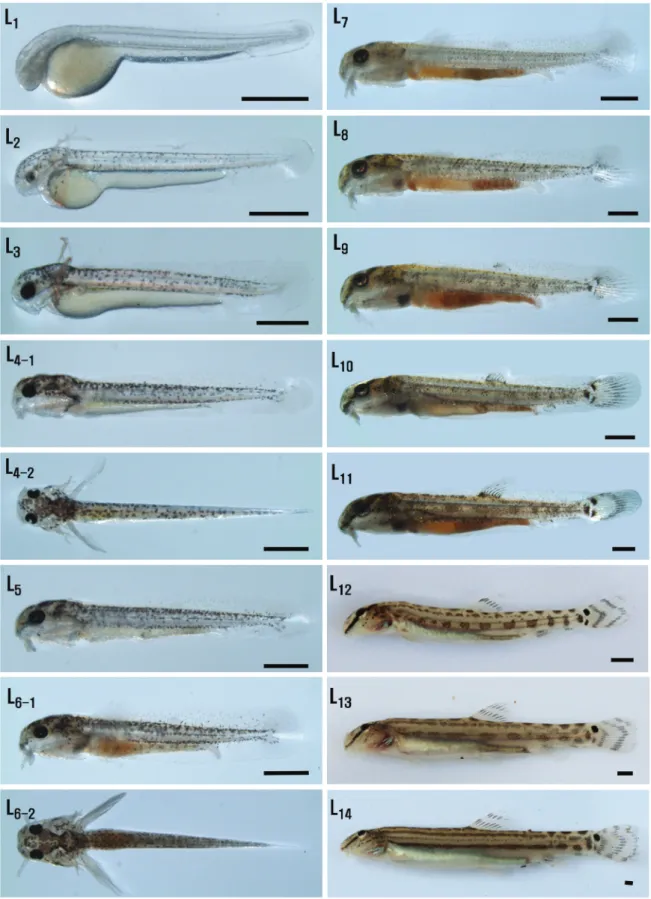
부화 이후의 발달단계는 Fig. 3과 같이 전기자어기와 후기 자어기, 치어기로 구분하였으며, 성장 경향은 Fig. 4와 같았다.
1) 전기자어기
부화 직후의 자어는 전장 4.6±0.11(4.5~4.8)mm(n=10) 로 몸이 약간 휘어져 있었고 몸은 무색으로 입과 항문은 열리 지 않았다. 앞쪽에 구형의 난황이 있었으며 몸의 중앙과 뒤쪽 에 막지느러미가 형성되었다(Fig. 3L1). 부화 후 1일째의 자어 는 전장 4.9±0.27mm(n=10)로 몸이 곧게 펴지고 외새가 5 쌍이 나타나며 난황이 많이 흡수되어 축소되었다. 눈은 검게 착색되었고 온몸에 흑색포가 침적되었으며 가슴지느러미가 형성되기 시작하였다(Fig. 3L2). 부화 후 2일째는 전장 5.4±
0.13mm(n=10)로 난황이 1/2이상 흡수되었고 뒤쪽의 막지
느러미가 넓어졌으며 수염이 나타나기 시작하였다(Fig. 3L3).
부화 후 3일째에는 전장 5.9±0.20mm(n=10)로 온몸에 보다 많은 흑색포가 침적되었고 수염이 보다 길어졌다(Fig. 3L4).
부화 후 4일째에는 전장 6.4±0.36mm(n=10)로 난황이 대부 분 흡수되었고 꼬리지느러미 원기가 나타나기 시작하였으며 입과 항문이 열리면서 처음으로 먹이(알테미아 부화 유생)를 섭식하였다(Fig. 3L5).
2) 후기자어기
부화 후 5일째에는 전장 6.7±0.28mm(n=10)로 난황을 모 두 흡수하였고 외새가 짧아져 아가미 뚜껑속으로 들어갔으 며 왕성하게 먹이를 섭식하였다(Fig. 3L6). 부화 후 8일째에 는 전장 7.3±0.17mm(n=10)로 수염 3쌍과 꼬리지느러미 기 조 3~4개가 관찰되었고 등지느러미와 뒷지느러미 원기가 관 찰되었다(Fig. 3L7). 부화 후 14일째에는 전장 8.2±0.34mm Table 1. Egg development of Cobitis tetralineata at 25℃ of water temperature
Stage Elapsed time Characters Fig. 1
Zygote period
Insemination 00 h 00 min Sperm and egg are inseminated -
Swelling 00 h 20 min Swelling A
Blastodisc 00 h 45 min Blastodisc B
Cell cleave period
2 cells 00 h 58 min 2 blastodisc is cleavage C
4 cells 01 h 15 min 2-2 array of blastomeres D
8 cells 01 h 30 min 2-4 array of blastomeres E
16 cells 01 h 44 min 4-4 array of blastomeres F
32 cells 02 h 00 min 4-8 array of blastomeres G
64 cells 02 h 15 min 8-8 array of blastomeres H
Blastula period
128 cells 02 h 30 min 8-16 array of blastomeres I
Morula(256 cells) 02 h 45 min 16 regular tiers of blastomeres J
Blastula 04 h 25 min Flattening produces an elliptical shape K
Gastrula period
Early gastrulation 07 h 00 min Early gastrulation(50% epiboly) L
Middle gastrulation 09 h 30 min Middle gastrulation(75% epiboly) M
Late gastrulation 10 h 30 min Late gastrulation(90% epiboly) N
Embryoric period
Formation of the embryo 12 h 00 min Formation of the embryo O
3-4 myotomes 13 h 20 min 3-4 myotomes, formation of optic vesicles P
9-10 myotomes 15 h 30 min 9-10 myotomes Q
17-18 myotomes 17 h 30 min 17-18 myotomes, formation of auditory vesicles and Kupffer’s vesicles R 28-30 myotomes 21 h 00 min 28-30 myotomes, disappear Kupffer’s vesicles, formation of eye lens,
specialization of brain S
Formation of heart 26 h 00 min Formation of heart T
Hatching period 45 h 00 min Hatching start
U 56 h 00 min Hatching(50%)
65 h 00 min Hatching complete
Fig. 3. Larva and juvenile development of Cobitis tetralineata at 25°C of water temperature. The bar indicates 1mm. L1: 0 day, 4.6±0.11mm(TL), prelarva; L2: 1 day, 4.9±0.27mm; L3: 2 days, 5.4±0.13mm; L4: 3 days, 5.9±0.20mm; L5: 4 days, 6.4±0.36mm; L6: 5 days, 6.8±0.28mm, postlarva; L7: 8 days, 7.3±0.17mm; L8: 14 days, 8.2±0.34mm; L9: 17 days, 8.9±0.34mm; L10: 25 days, 9.8±0.50mm, juvenile; L11: 40 days, 13.0±0.62mm; L12: 60 days, 18.7±2.24mm. L13: 80 days, 24.7±3.89mm. L14: 100 days, 34.7±5.77mm.
100 고명훈·원용진
(n=10)로 꼬리지느러미 기조는 6~7개가 관찰되었고(Fig.
3L8), 부화 후 17일째에는 전장 8.9±0.34mm(n=10)로 등지 느러미 원기 2~3개가 나타나고 체측 중앙에 흑색 반점들이 모여 반문(Gambetta’s zone 4)이 형성되기 시작하였으며 비병 부에 2개의 반점이 나타났다(Fig. 3L9).
3) 치어기
부화 후 25일째에는 전장 9.8±0.50mm(n=10)로 등지느 러미 기조(8개)와 뒷지느러미 기조가 정수(5개)로 나타나 치 어기로 이행하였고 미병부에 반점 3개가 나타났다. 체측 상부 (등쪽)에 반문이 나타나고(Gambetta’s zone 1) 체측 증앙부의 반문이 8~10개가 나타나며 진해졌다(Fig. 3L10). 부화 후 40 일 후에는 전장 13.0±0.62mm(n=10)로 꼬리지느러미에 1개 의 반문이 나타나고 미병부의 검은점이 진해졌다(Fig. 3L11).
부화 후 60일 후에는 전장 18.7±2.24mm(n=10)로 체측 상 부(Gambetta’s zone 1) 아래에 점선의 반문(Gambetta’s zone 2)이 작은 점으로 이어져 있었으며 등지느러미에 1줄, 꼬리지 느러미에 2~3줄의 반문이 나타났다(Fig. 3L12). 부화 후 80일 후에는 24.7±3.89mm(n=10)로 Gambetta’s zone 2와 4의 점 들이 커지고 길어졌으며 등지느러미에 2줄의 반문이 나타났 다(Fig. 3L13). 부화 후 90일 이후에는 Gambetta’s zone 2와 4 가 줄로 이어지기 시작하였고 그 사이 Gambetta’s zone 3이 작은 점으로 이어졌으며, 100일 뒤에는 전장 34.7±5.77mm (n=10)로 뚜렷한 4줄의 Gambetta’s zone이 완성되어 체측반 문 및 외형이 성어와 비교적 유사하였다(Fig. 3L14).
고 찰
성숙한 줄종개 Cobitis tetralineata에 Ovaprim을 주사한 후 12시간 이후에 성숙란이 잘 배란되고 난질도 좋아 기존에 Ovaprim을 사용한 초기생활사 연구인 참종개 Iksookimia kore- ensis(Ko et al., 2012)와 부안종개 I. pumia(Ko et al., 2013), 좀수수치 Kichulchoia brevifasciata(Ko and Bang, 2014)와 유 사하였다.
인공 산란된 줄종개의 성숙란 크기는 1.04±0.03mm로 성 숙시기에 채집된 난경 0.98±0.05mm보다 약간 컸으며(Kim et al., 2006) 유연종과 비교하여 볼 때 1.1~1.2mm인 C. biwae (Saitoh and Hosoya, 1988)와 미호종개 C. choii(Song et al., 2008), 미꾸리 Misgurnus anguilicaudatus(Uchida, 1939), 미 꾸라지 M. mizolepis(Kim et al., 1987), 얼룩새코미꾸리 Kore- ocobitis naktongensis(Song et al., 2009), 북방종개 I. pacifica (Lee et al., 2011) 등과 비슷하였으나 기름종개 C. hankugensis (1.29mm)(Ko and Park, 2012)와 부안종개(1.27mm)(Ko et
al., 2013), 참종개(1.37mm)(Ko et al., 2012), 왕종개 I. longi- corpa(1.5mm)(Ko et al., 2009), 좀수수치(1.5mm)(Ko and Bang, 2014), C. takatsuensis(1.5mm)(Shimizu et al., 1998), 수수미꾸리 K. multifasciata(1.8mm)(Kim and Lee, 1995), Niwaella delicata(2.7mm)(Suzuki, 1966) 보다는 작은 편이었 다.
산란수는 2,646±916개(전장 102~133mm)로 나타나 Kim et al.(2006)의 포란수 1,288±583개 보다 많은 것으로 나타 났는데, Kim et al.(2006)은 2년생 926±270개(전장 84~95 mm), 3년생 1,240±444개(95~110mm), 4년생 이상 2,236±
573개(전장 111~126mm)로 보고한 바 있어 본 조사에서 난 수가 적은 2년생 개체가 포함되지 않은 반면 난수가 많은 4년 생 이상의 개체가 많이 포함되었기 때문에 차이가 난 것으로 판단된다. 이러한 포란수는 2,000~3,000개인 기름종개(Ko and Park, 2012)와 참종개(Ko et al., 2012), 왕종개(Ko et al., 2009), 북방종개(Lee et al., 2011) 등과 비교적 유사하였다.
부화시간은 수온 25°C에서 56(45~65)시간이 걸려 비슷한 수온대에서 50~60시간 걸린 기름종개(Ko and Park, 2012) 와 C. biwae(Saitoh and Hosoya, 1988), 부안종개(Ko et al., 2013), 참종개(Ko et al., 2012), 북방종개(Lee et al., 2011) 와 유사하였으나 미호종개(24시간)(Song et al., 2008)와 얼 룩새코미꾸리(38시간)(Song et al., 2009)보다는 빠르고 왕 종개(52 ~72시간)(Ko et al., 2009), 좀수수치(66시간)(Ko and Bang, 2014) 보다는 느린 편이었다. 부화 직후 자어크기 는 4.6±0.11mm로 기름종개(Ko and Park, 2012)와 C. biwae (Saitoh and Hosoya, 1988), 참종개(Ko et al., 2012), 부안종개 (Ko et al., 2013)와 비교적 유사하였다.
Fig. 4. Early growth of Cobitis tetralineata after hatching at water temperature 25°C. Vertical lines show SD.
y=0.0015x2+0.1219x+5.8147
R2=0.9932 40
30
20
10
0
Total length(mm)
Age(day)
0 10 20 30 40 50 60 70 80 90 100 110
난황흡수가 완료되어 후기자어로의 이행시기는 5일로 나 타나 참종개(Ko et al., 2012)와 부안종개(Ko et al., 2013), C.
biwae(Saitoh and Hosoya, 1988)와 동일하였으나 4일의 미 호종개(Song et al., 2008)와 왕종개(Ko et al., 2009), 미꾸 리(Uchida, 1939), 미꾸라지(Kim et al., 1987) 보다는 빠르 고 6일의 좀수수치(Ko and Bang, 2014), 7일의 기름종개(Ko and Park, 2012)와 북방종개(Lee et al., 2011), 얼룩새코미꾸 리(Song et al., 2009), 16일의 C. takatsuensis(Shimizu et al., 1998) 등 보다는 느렸다.
치어기로의 이행시기는 25일로 기름종개(Ko and Park, 2012)와 왕종개(Ko et al., 2009), 북방종개(Lee et al., 2011), 미꾸라지(Kim et al., 1987)와 유사하였으나 17일의 참종개 (Ko et al., 2012)와 부안종개(Ko et al., 2013), 좀수수치(Ko and Bang, 2014) 보다는 느리고 미호종개(35일, Song et al., 2008)와 얼룩새코미꾸리(50일, Song et al., 2009), 수수미꾸리 (85일, kim and Lee, 1995) 보다는 빠른 편이었다.
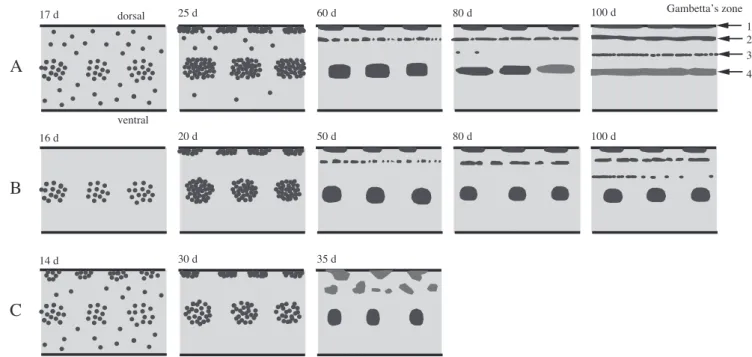
Cobitis속 어류는 체측에 4줄의 Gambetta’s zone이 나타나 는 특징을 보이는 것으로 알려져 있다(Linnaeus, 1758; Kawa- nabe, et al., 1989; Kim, 2009). 줄종개의 초기생활사를 통한 Gambetta’s zone의 형성은 부화 후 17일에 Gambetta’s zone 4가 처음으로 체측 중앙에 형성되며 25일 후에 Gambetta’s zone 1이 등쪽에, 60일 후에 Gambetta’s zone 2가 Gambetta’s zone 1 아래에 생성되며 90일 후에 Gambetta’s zone 3은 Gam- betta’s zone 2와 4 사이에 형성되었다(Fig. 5A). 또한 Gam- betta’s zone 2와 4는 처음에 점으로 형성되었으나 90일 이후
부터는 점이 길어지면서 줄로 연결되었다. 같은 속에 속하는 기름종개는 줄종개와 유사한 순서로 Gambetta’s zone이 형 성되었으나 Gambetta’s zone 2와 4가 점에서 줄로 바뀌지 않 았으며 생성시기에서도 약간의 차이를 보였다(Ko and Park, 2012)(Fig. 5B). 미호종개는 부화 후 14일에 체측 중앙에 Gam- betta’s zone 4가 등쪽에 Gambetta’s zone 1이 생성되기 시작 하며, 35일 후 Gambetta’s zone 1과 4 사이에 점으로 이루어진 Gambetta’s zone 2가 나타났다(Song et al., 2008). 35일 이후 는 보고되지 않았으나 Kim and Park(2007)의 성어 반문을 볼 때 Gambetta’s zone 3은 생성되지 않아 본 종과 차이를 보였다 (Fig. 5C). 최근 Kwan(2015)의 우리나라 미꾸리과 어류의 분 자계통학적 연구에 의하면 Cobitis속 어류에 있어서 체측에 4 줄의 반문(Gambetta’s zone)이 나타나는 기름종개와 줄종개, 점줄종개가 하나의 계통으로 묶이나 3줄의 반문이 나타나는 미호종개는 별도의 계통으로 떨어진다고 보고한 바 있어 본 결과와 유사하였다.
전체적인 줄종개의 초기생활사 특징은 성숙란과 부화직 후의 자어 크기, 부화시간, 후기자어로의 이행시기, 치어기로 의 이행시기 등에서 같은 Cobitis속에 속하는 기름종개 및 C.
biwae와 유사하였는데, 특히 기름종개는 Gambetta’s zone의 형성 순서 및 시기 등에서 매우 유사하였다. 하지만 80일 이후 줄종개는 점이 점점 길어지고 이어져 줄을 형성하여 기름종 개와 차이를 보였다. 이러한 반문 발달과정으로 볼 때 줄무늬 Gambetta’s zone은 점줄무늬 Gambetta’s zone이 생성된 이후 변형되어 나타나기 때문에 줄무늬 Gambetta’s zone이 한 단계 더 진화한 반문형태로 판단된다.
17 d 25 d 60 d 80 d 100 d
16 d 20 d 50 d 80 d 100 d
14 d 30 d 35 d
A
B
C
dorsal
ventral
Gambetta’s zone 12 3 4
Fig. 5. Lateral line development of Cobitis tetralineata(A), C. hankugensis(B)(Ko and park, 2012) and C. choii(C)(Song et al., 2008) by days.
102 고명훈·원용진
요 약
우리나라 고유 담수어류 줄종개 Cobitis tetralineata의 난발 생 및 초기생활사를 연구하기 위하여 2013년 6월 섬진강 상 류인 전북 순창군 복흥면 정산리에서 족대를 이용하여 친어를 채집하여 실험하였다. 채집된 성숙한 친어는 복강에 Ovaprim 을 주사하여 12시간 경과 후 복부압박법으로 채란하고 건식 법으로 인공수정 시켰다. 산란된 성숙란은 약한 점착성을 띤 회색의 분리침성난으로 난경은 1.04±0.03mm이고 산란수는 2,646±916개였다. 수온 25°C에서 수정 후 56시간 만에 부화 하였으며, 크기는 전장 4.6±0.11mm이었다. 부화 5일 후에 전 장 6.8±0.28mm로 난황이 모두 흡수되어 후기자어로 이행하 였으며, 25일 후에는 전장 9.8±0.50mm로 지느러미 기조가 모두 정수로 되어 치어기로 이행하였다. 부화 후 100일 후에 는 전장 34.7±5.77mm로 4줄의 Gambetta’s zone이 완성되고 외형은 성어와 비교적 유사하였다.
사 사
야외 채집과 사육에 도움을 준 이화여대 분자생태학연구실 대학원생 권예슬, 장숙진에 감사를 전한다. 본 논문은 2013년 한국연구재단의 이공분야기초연구사업 지원(과제번호: NRF- 2013R1A1A2062008)을 받아 수행되었다.
인 용 문 헌
Balon, E.K. 1985. Early life histories of fishes: New developmental, ecological and evolutionary perspectives. dr. W. Junk Pub- lisher, Dordrecht, 280pp.
Blexter, J.H.S. 1974. The early life history of fish. Spring-Verlag.
Berlin, 765pp.
Charles, B.K., W.B. William, R.K. Seth, U. Bonnie and F.S. Tho- mas. 1995. Stages of embryonic development of the Zebraf- ish. Dev. Dyn., 203: 253-310.
Kawanabe, H., N. Mizuno and K. Hosoya. 1989. Freshwater Fishes of Japan. YAMA-KEI Publishers Co., Ltd., Tokyo, 720pp.
Kim, I.S. 1997. Illustrated Encyclopedia of Fauna & Flora of Korea, Vol. 37, Freshwater Fishes. Ministry of Education, Yeongi, 629pp.(in Korean)
Kim, I.S. 2009. A review of the spined loaches, family Cobitidae (Cypriniformes) in Korea. Korean J. Ichthyol., 21(supple- ment): 7-28.
Kim, I.S. and E.H. Lee. 1995. Studies on early embryonic develop-
ment of Niwaella multifasciata(Pisces: Cobitidae). Korean J. Limnol., 28: 455-462.(in Korean)
Kim, I.S. and J.H. Lee. 1986. A chromosomal study on the genus Cobitis(Pisces: Cobitidae) in the southern part of Korea.
Bull. Korean Fish. Soc., 19: 257-564.(in Korean)
Kim, I.S. and J.Y. Park. 2007. Freshwater Fishes of Korea. Kyohak Publishing, Seoul, 465pp.(in Korean)
Kim, I.S. and W.O. Lee. 1984. Effects of stream modification in the Seomjin River on the fish communities of the Dongjin River in Korea. Bull. Korean Fish. Soc., 17: 549-556.(in Korean)
Kim, I.S., J.Y. Park and T.T. Nalbant. 1999. The far east of the ge- nus Cobitis with the description of three new taxa(Pisces:
Ostariophysi: Cobitidae). Trav. Mus. Nus. Natl. Hist. Nat (Grigore Antipa), 39: 373-391.
Kim, I.S., M.H. Ko and J.Y. Park. 2006. Poulation ecology of Kor- ean sand loach Cobitis tetralineata(Pisces: Cobitidae) in the Seomjin River, Korea. J. Ecol. Field Biol., 29: 277-286.
(in Korean)
Kim, I.S., Y. Choi, C.L. Lee, Y.J. Lee, B.J. Kim and J.H. Kim. 2005.
Illustrated Book of Korean Fishes. Kyohak Publishing Co.
Ltd., Seoul, 615pp.(in Korean)
Kim, J.H. and S.Y. Yang. 1993. Systematic studies of the genus Co- bitis(Pisces: Cobitidae) in Korea IV. Introgressive hybrid- ization between two spined loach subspecies of the genus Cobitis. Korean J. Zool., 36: 535-544.
Kim, Y.U., Y.S. Park and D.S. Kim. 1987. Development of eggs, larvae and juveniles of loach, Misgurnus mizolepis Günther.
Bull. Korean Fish. Soc., 20: 16-23.(in Koran)
Ko, M.H. and I.C. Bang. 2014. Spawning Character and Early Life History of the Endangered Korean Dwarf Loach, Kichul- choia brevifasciata(Teleostei: Cobitidae). Korean J. Ichthy- ol., 26: 89-98.(in Korean)
Ko, M.H. and J.Y. Park. 2012. Eggs development and early life his- tory of spine loach, Cobitis hankugensis(Pisces: Cobitidae), endemic to Korea. Korean J. Ichthyol., 24: 94-100.(in Kor- ean)
Ko, M.H., J.Y. Park and I.S. Kim. 2009. Development of eggs and early life history of Iksookimia longicorpa(Pisces: Cobiti- dae) from Nakdong River of Korea. Korean J. Ichthyol., 21:
15-22.(in Korean)
Ko, M.H., S.Y. Park and I.C. Bang. 2012. Eggs development and early life history of spine loach, Iksookimia koreensis(Pis- ces: Cobitidae). Korean J. Limnol., 45: 93-101.(in Korean) Ko, M.H., S.Y. Park and I.C. Bang. 2013. Eggs development and
early life history of endangered spine loach, Iksookimia pumila(Pisces: Cobitidae). Korean J. Ichthyol., 25: 65-73.
(in Korean)
Kwan, Y.S., M.H. Ko and Y.J. Won. 2014. Genomic replacement of native Cobitis lutheri with introduced C. tetralineata through a hybrid swarm following the artificial connection of river systems. Ecol. Evol., doi: 10.1002/ece3.1027.
Kwan, Y.S. 2015. Molecular phylogenetic and population genetic studies of the freshwater fish family Cobitidae(Teleostei:
Cypriniformes) in Korea. Ewha Womans University Doc- toral Thesis, 143pp.
Lee, W.O., K.H. Kim, J.M. Baek, Y.J. Kang, H.Z. Jeon and C.H.
Kim. 2011. Embryonic development and early life history of the northern loach, Cobitis pacifica(Pisces: Cobitidae.
Korean J. Limnol., 44: 1-8.(in Korean)
Linnaeus, C. 1758. Systema Naturae per Regna Tria Naturae, Tomus I. Edito Decima, Reformata. Laurentius Salvius, Holmiae (Stockholm). 824pp.
ME(Ministry of Environment). 2006. Technology for Utilization and Control of Ecosystem. Kunsan University, Kunsan, 537pp.
ME(Ministry of Environment). 2009. Development of Genetic Div- ersity Analysis, Culture and Ecosystem Restoration Tech- niques for Endangered Fish, Iksookimia choii. Soonchunhy- ang University, Asan. 537pp.(in Korean)
MLTM(Ministry of Land & Transport and Maritime Affairs). 2010.
Culture and Restoration of Endangered Species in the Major Four River Drainages. Soonchunhyang University, Asan, 489pp.(in Korean)
MLTM(Ministry of Land & Transport and Maritime Affairs). 2011 Culture and Restoration of Endangered Species in the Ma- jor Four River Drainages(Ⅱ) Soonchunhyang University, Asan, 364pp.(in Korean)
Nelson, J.S. 2006. Fishes of the world. John Wiley & Sons, Inc., pp.
139-143.
NIBR(National Institute of Biological Resources). 2013. Breeding
Manual of Endangered Freshwater Fish. Incheon, 239pp.(in Korean)
Park, J.Y. and I.S. Kim. 1997. Egg membrane in five cobitid species of Cobitis(Pisces: Cobitidae). Korean J. Ichthyol., 9: 121- 129.
Saitoh, K. and K. Hosoya. 1988. Cobitis biwae Jordan et Synder.
Page 159 in M. Okiyama, ed. An atlas of the early stage fishes in Japan. Tokai Univ. Press, Tokyo, xii+1154 pp.(in Japanese)
Shimizu, T., H. Sakai and N. Mizuno. 1998. Embryonic and larval development of a Japanese spinous loach, Cobitis takat- suensis. Ichthyol. Res., 45: 377-384.
Song, H.Y., W.J. Kim, W.O. Lee and I.C. Bang. 2008. Morphologi- cal development of egg and larvae of Iksookimia choii(Co- bitidae). Korean J. Limnol., 41: 104-110.(in Korean) Song, H.Y., H. Yang, E.M. Cho, H.C. Shin and I.C. Bang. 2009.
Morphological development of egg and larvae of Koreoco- bitis naktongensis(Cobitidae). Korean J. Ichthyol., 21: 247- 252.(in Korean)
Suzuki, R. 1966. Artficial spawning and early development of the loach, Cobitis delicata Niwa. Bull. Freshwater Fish. Res.
Lab., 15: 175-188.(in Japanese)
Tanaka, S. 1973. Significationce of egg and larval surveys in the studies of population dynamics of fish. In The early life history of fish(Blaxter J.H.S. ed), Springer-Verlag, pp. 151- 157.
Uchida, K. 1939. The fishes of Tyosen. Part I. Numatognathi, Even- tognathi. Bull. Fish Exp. Sta. Gov. Gener. Tyosen, 428-458.
(in Japanese)